In the early ’80s I was the managing editor of The Film Journal, and as such was occasionally invited to long-lead screenings. The Warner guys let me see an early cut of The Shining, for example…a cut that included the famous hospital visitation scene between Barry Nelson and Shelley Duvall.
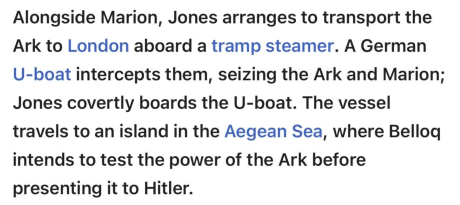
I was also invited by Team Paramount to see an early cut of Raiders of the Lost Ark, and it contained footage of Harrison Ford‘s Indiana Jones hanging on to the side of a Nazi submarine as it travels to the Aegean Sea island where the big finale occurs.
In this version Indy didn’t slip inside the sub by pretending to be a German, mind. He hung on to it like Gregory Peck‘s Captain Ahab hangs on to the scarred, harpooned white whale in Moby Dick. When the sub reaches the island the implication is that Indy rode it like a human barnacle for hundreds of miles.
Yeah, I didn’t believe it either but I saw this footage with my own two eyes.
Here’s a paragraph from a Wiki synopsis that dodges an explanation of how Jones manages to get to the island without the bad guys getting wise. Key line: “Jones covertly boards the U-boat.”
Initially posted on 3.28.21: There’s nothing glorious and soul-cleansing about being executed by Roman arrows. Plus it would hurt like hell, and death probably wouldn’t come quickly. Plus one of the archers might aim poorly and shoot me or my fiance in the eye. Or I might get an arrow in the groin.
If I’d been in the sandals of Marcellus (Richard Burton), a confirmed Christian and deeply in love with the gentle Diana (Jean Simmons), and if Caligula (Jay Robinson) had demanded that I renounce the teachings of the executed carpenter known as Yeshua of Nazareth and the nascent religion he’d recently come to stand for, I would say “damn straight, your excellence.”
What difference would a few words make one way or the other? It’s deeds and convictions that count. The court of Caligula is pure political theatre, and therefore meaningless. Moral relativism is the only way to travel.
HE solution in a nutshell: (a) Renounce Christ out of one side of my mouth, (b) Diana and I are then free to move to Capri and live a life of Christian leisure (mountain hikes, sailing, swimming + eating dates, grapes and fresh fish), and (c) Caligula would soon be killed anyway by the Praetorian Guard.
What glorious purpose would Diana and I serve by going to our deaths? You know the answer. The answer is “nothing.”
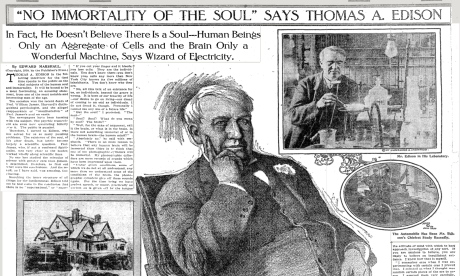
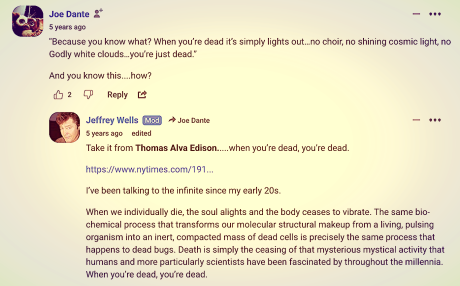
The secondary answer is “martyrdom might look like an act of transcendence at the end of a 1953 20th Century Fox release, but in real life it isn’t worth it.” Because you know what? When you’re dead it’s simply lights out…no choir, no shining cosmic light, no Godly white clouds…you’re just dead.”
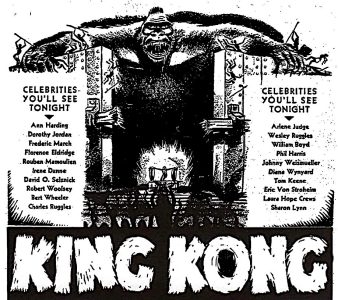
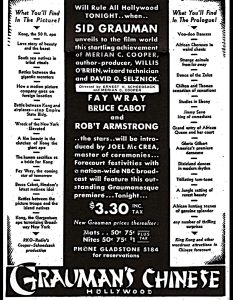
King Kong’s Los Angeles premiere at Grauman’s Chinese happened on 3.24.33, or 93 years ago. That night $3.50 was roughlyequivalent to $86 in today’s currency.
“While Chris Sarandon carries immense pride for this breakthrough role, he also acknowledged he would never land the Leon part today. ‘And rightfully so,’ he adds. ‘It should be somebody who’s more authenticallyaligned with the character, but I’m very proud of it.’” — from interview posted by People‘s Angela Andaloro on 10.4.25.
Bullshit, Chris! Sarandon is great in this scene. Acting is acting, and a gifted actor’s default orientation or sexual preference has very little to do with the ability to channel a character fully and profoundly. If they’re goodenough, I mean.
I’m very sad and sorry about the debilitating disease (Alzheimer’s) that began to enfold poor Mary Beth Hurt back in the teens. And about her death, which was announced on Facebook earlier today.
I’m also sorry that I never caught any of Hurt’s Manhattan stage performances (Trelawny of the Wells, Crimes of the Heart, Benefactors), which were earnestly praised.
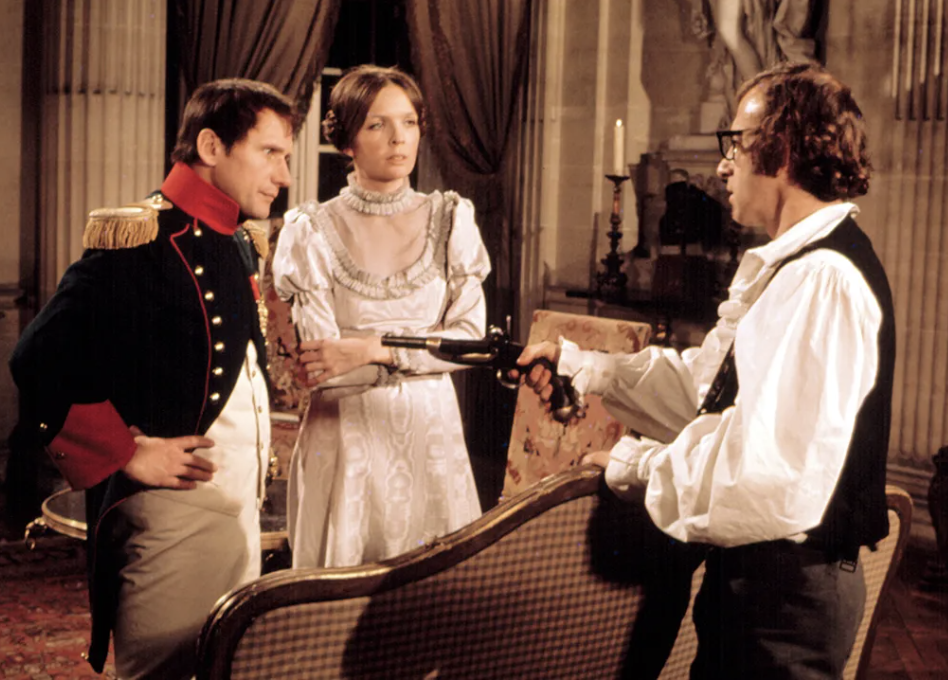
I was re-watching Woody Allen‘s Interiors (’78) only three or four days ago. It’s not one of my favorite Woody’s (feels too “written”, too on-the-nose), but Hurt’s portrayal of Joey, a creatively frustrated 30something who wants to be a top-tier writer but hasn’t quite the talent for it, got to me back then.
Because I was feeling some of the same things in ’78. I wanted very much to break into the Manhattan film-critic fraternity, but I was beset by doubts about my ability to write well enough, which was basically rooted in a lack of confidence, which came from my low self-esteem, which came from being the pissed-off son of an alcoholic.
Like Joey and God knows how many others I would type and type and re-type, over and over and over, the 8 1/2 x 11 paper in my typewriter caked with smudges of white-out. It would take me forever (two or three days!) to bang out a simple 750-word review.
Hurt’s performance was moving but disturbing because Joey’s story, I had decided during my initial viewing, was sorta kinda my own. I felt a certain morose affinity.
Yes, I managed to climb out of that awful fraught place (took me a couple of years) but…well, I’ve said it.
Hurt was downishly believable (and therefore memorable as hell) in Joan Micklin Silver‘s Chilly Scenes of Winter (’79); ditto George Roy Hill‘s The World According to Garp (’82).
I’ll never forget that scene in Garp in which Hurt’s Helen, a college professor married to Robin Williams, accidentally decapitates her younger boyfriend’s schlong while she’s blowing him in the front seat of his car, an accident caused by an agitated Williams slamming his vehicle into the rear of the boyfriend’s auto.
When I finally pass, I don’t want it to happen in godforsaken Jersey City. I want it to happen on a cobblestoned street in Montmartre, preferably in the mid-summer. Or somewhere in northern Italy or in the Czech Republic even. Or somewhere in the California desert.
In a 3.28 N.Y. Times Op-Ed titled “Project Hail Mary Is Fun — Maybe That’s All It Takes“, former Amazon exec Roy Price cheers on the relatively recent, non-woke, non-ideological drift of five commercially successful Hollywood films.
Price not only praises the super-bountiful Project Hail Mary, which I didn’t exactly hate but which left me feeling semi-exhausted, excluded and vaguely bummed out, but also Avatar: Fire and Ash (refused to see it…totally uninterested in sitting through a third installment…the once-phenomenal James Cameron has damn near thrown his career away on this shite), The Housemaid (thoroughly despised it due to the obvious fact that it’s basically ludicrous airport chick fiction…pure garbage), Scream 7 (even fouler garbage), Wuthering Heights (over-heated and, for me, truly agonizing to sit through).
These and other films, Price says, are largely responsible for a 20% surge in the domestic box office over 2025.
It’s obviously a great relief that mainstream Hollywood has, to a significant extent, blown off wokeism, but dear God in heaven, the five “fun” films that have revitalized the box-office are nothing to shout and cheer about in a spiritual sense. (I understand why impressionable people like PHM, but it’s such a calculating emotional suck-up thing,)
Price on the woke quake that kicked in six years ago: “The Dionysian elements of popular entertainment — irreverence, sexual frankness and broad, even scatological humor — were cast aside as the industry sought to correct historic wrongs and resist current ones.
“An unmistakable censoriousness and fear of saying or doing the wrong thing seemed to settle over the creative process. Cultural and political considerations played an outsize role — not only in what movies got made, but in how success for these movies was defined.
“What didn’t seem to matter as much? Making sure that audiences were filling seats.”
Likely to make big money, I’m guessing, but I can already feel the pain I’ll be experiencing when I watch it. No, I don’t know what it’s about, but if it’s anything like EEAAO….
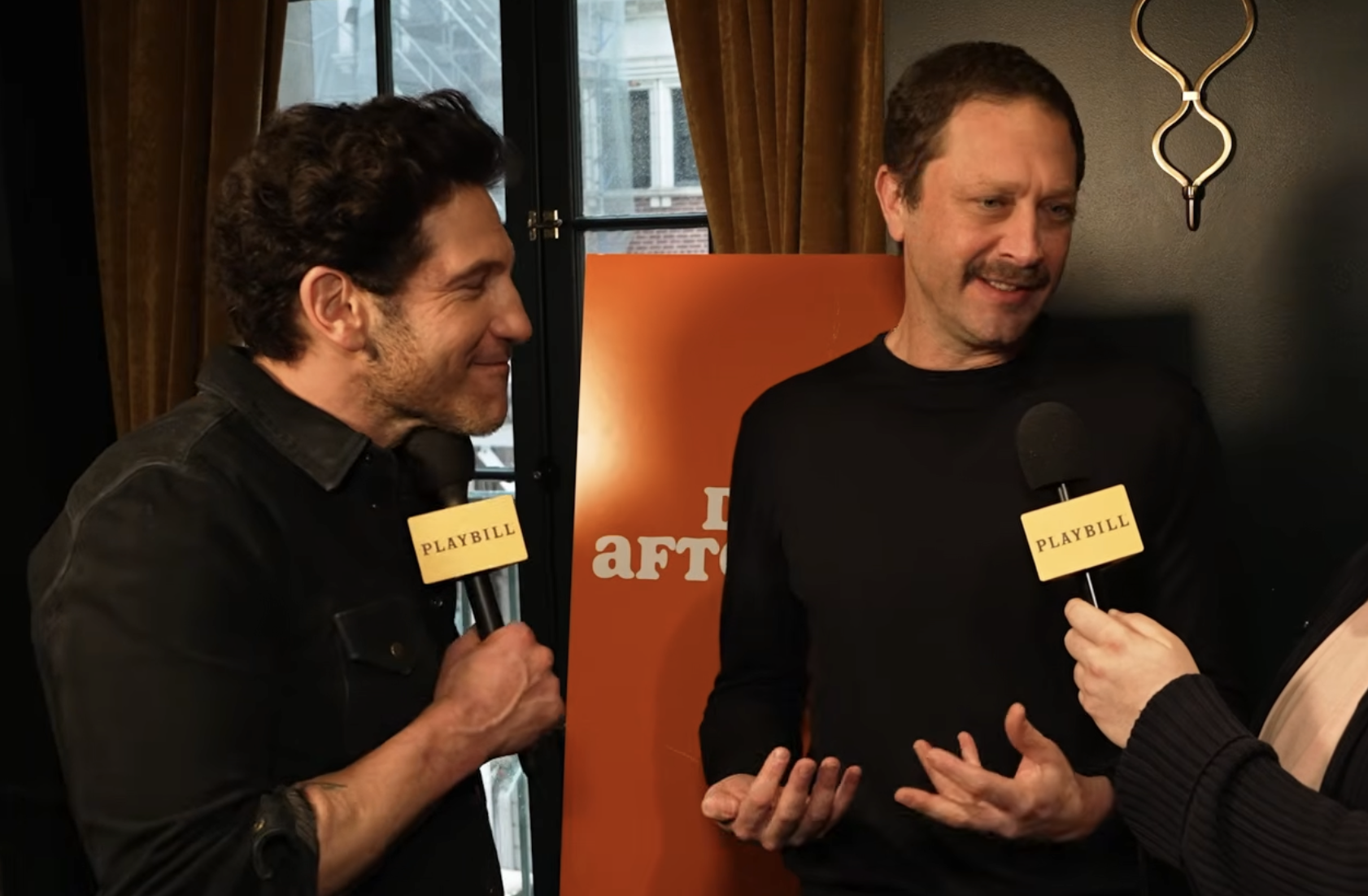
Cruz at 1:31 mark: “The whole queerness of the story was shied away from a lot in the film. It’s on record that [Al] Pacino had several moments of pushback with the film being too queer.”
The limited-engagement play, which has been in previews since 3.10.26, opens tomorrow night (3.30) at the August Wilson Theatre. It runs until 6.28.26.
Bernthal has never been on the New York stage before. Ebon Moss-Bachrach plays John Cazale‘s Sal character, who takes a bullet in the forehead at the very end.
Lumet’s film was based on an actual 1972 Brooklyn bank robbery that went wrong. Frank Pierson‘s screenplay arose from a LIFE magazine article, “The Boys in the Bank“.
By HE standards there were three stand-out James Tolkan performances. All supporting, of course. Tolkan wasn’t a charismatic lead-actor type. He always played clenched hardasses.
The first that really connected was a rigid, button-down Boston mob guy hiring Peter Boyle to clip Robert Mitchum in The Friends of Eddie Coyle (’72).
The second was George Polito, the vindictive, hard-nosed district attorney who went after Treat Williams‘ Danny Ciello (and some of the others on the original narco team, including Jerry Orbach‘s Gus Levy) in Sidney Lumet‘s Prince of the City (’81).
Tolkan’s third big score was playing Chicago real-estate salesman Dave Moss in the original 1984 B’way stage production of David Mamet‘s Glengarry Glen Ross. I caught that show on opening night (42 years ago) with all the big-gun critics in the room.
Have any of the Tolkan obits so far mentioned these three performances? Of course not. They only acknowledge his roles in TopGun and the Back to the Future franchise and yaddah-yaddah.
Snapped earlier this evening (3.27) at JFK airport, roughly around 7:30 pm.
Oneproblem: The burning red-orange on my iPhone truly pops —- it’s like watching a Super Technirama 70 capture on mescaline, projected at 30 foot lamberts. But the reconstitution through the HE server makes it look weaker, a bit muddier, certainly less vivid. And the actual, naked-eye-filling vista that prompted me to pull over in the first place was the best of all.
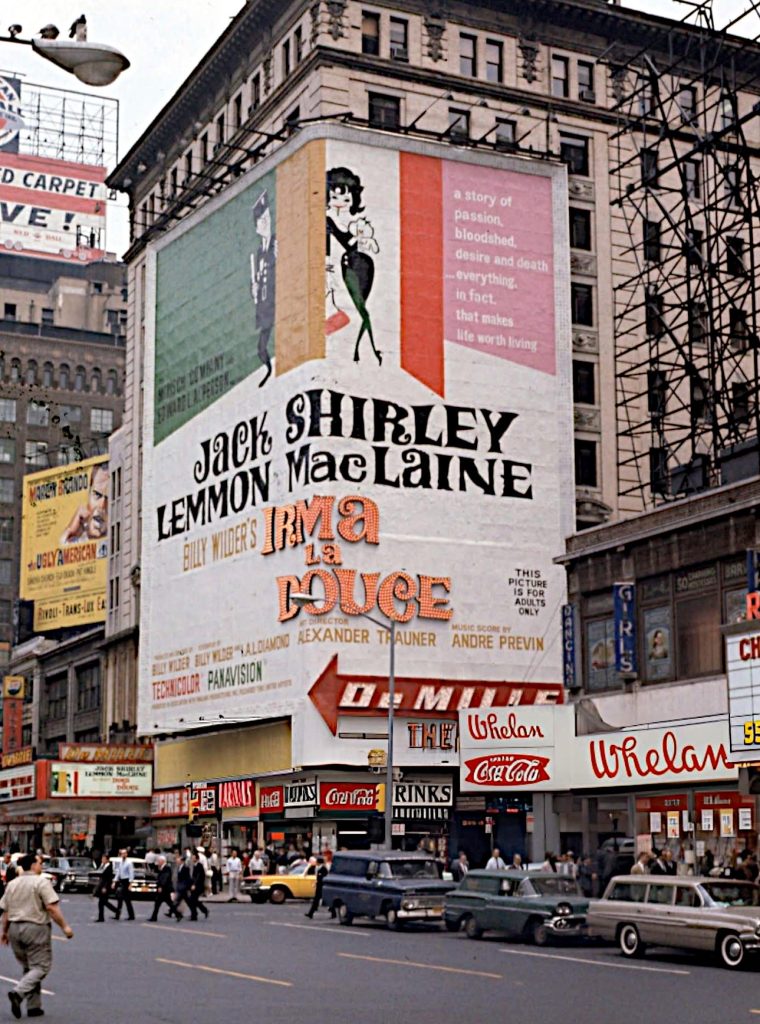
BillyWilder‘s IrmaLaDouce (opened on 6.5.63) was hugely successful…cost $5 million to make, earned $25million. But many Wilder fans will tell you it was a silly, sentimental slog and a general disappointment. FACT: At 147 minutes, it was certainly too long.
A year later the Wilder train was temporarily derailed by Kiss Me Stupid. Things rebounded somewhat with The Fortune Cookie (‘66) but Wilder’s peak era (1944’s Double Indemnity to 1961’s One Two Three) had come and gone, and “there wasn’t nothin’ you could do about it”.
“The Hill”, reported by Julia Manchester, 2:57 pm: “President Trump on Friday directed the Department of Homeland Security (DHS) to pay Transportation Security Administration (TSA) employees during the government shutdown, marking a key development as funding the agency stalls in Congress.
“’As President of the United States, I have determined that these circumstances constitute an emergency situation compromising the Nation’s security,’ Trump said in a presidential memo released Friday.
“A person familiar told The Hill the administration was working to make sure TSA employees receive pay as quickly as possible.
“’Now that this has been signed, admin is working to effectuate as fast as possible. We have directed payroll providers to process paychecks as expeditiously as possible,’ the person said.
“A DHS spokesperson told The Hill that TSA officers will begin seeing paychecks as soon as Monday.”