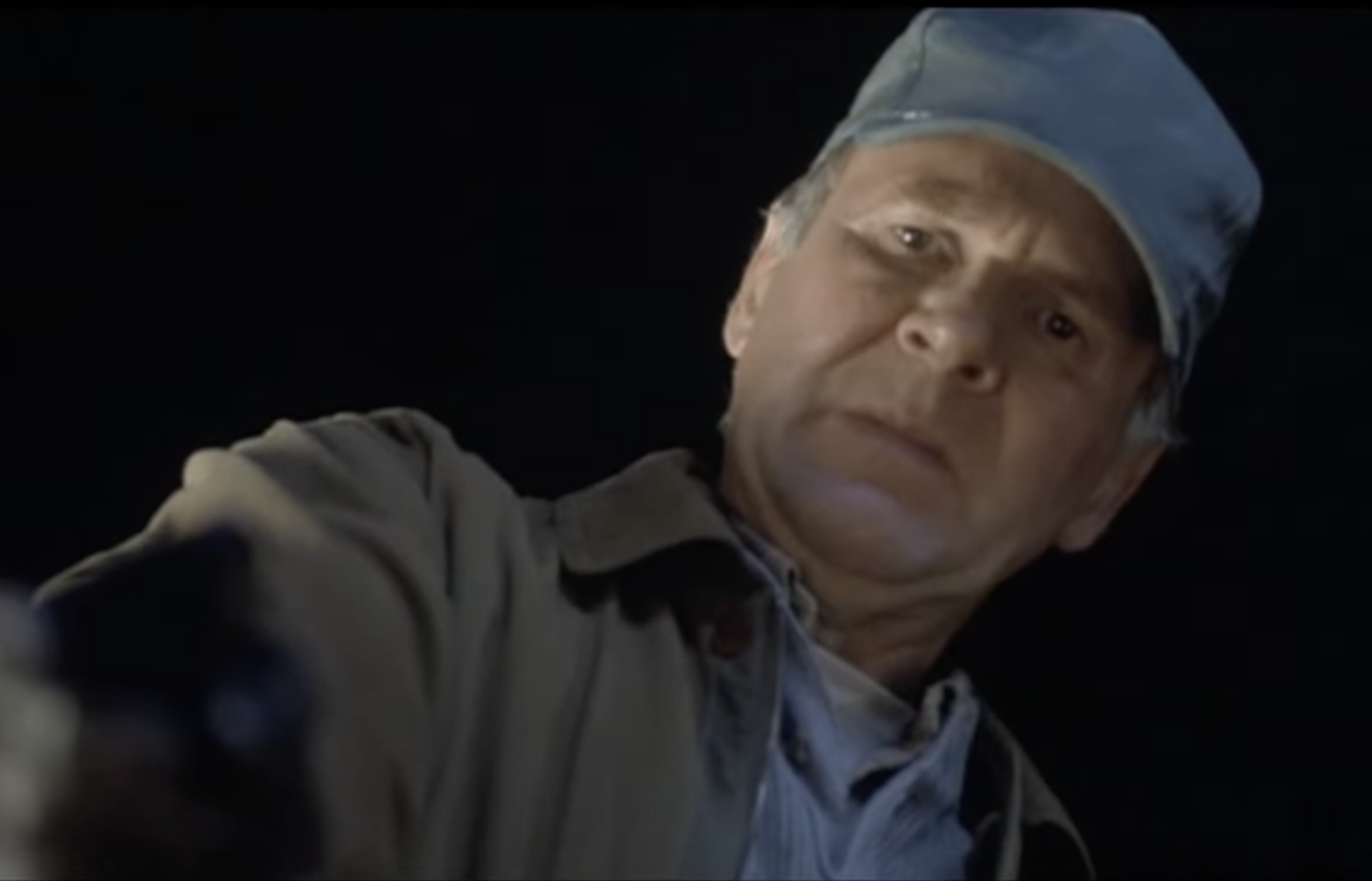
Has Walter Brennan been posthumously cancelled? Hollywood’s progressive vanguard needs to do so toutdesuite. Perhaps install a special Brennan exhibit in the Academy museum called “Hollywood’s Shameful Shielding of a Rightwing Fanatic”? Seriously, Brennan’s social-political views made John Wayne look like Norman Thomas.
Two or three days ago Cameraimage festival director Marek Żydowicz made a huge political error by writing, boiled down, that enforcing DEI gender quotas (i.e., more women directors and dps) could lead to “mediocre film productions” in place of the proverbial good stuff.
Industry progressives have freakedout over this. Directors Steve McQueen (Blitz) and CoralieFargeat (TheSubstance) have bailed on attending the forthcomingPolishfestival as a protest against Zydowicz’s statement.
Politically ill-advised as Zydowicz’s11.8.24article obviously was, saying that DEI quotas allow for potential mediocrity in the ranks is not a lie or a misstatement. It’s true in theory, and anyone who states that artistic quality is more important or more valuable than equity and representation is not standing on shaky ground.
BadDayatBlack Rock (‘55) is a good, strong John Sturges film except for one thing. Nobody in that tiny little desert backwater is doing Anne Francis.
It makes no sense that Francis would even BE there, as a woman this fetching would never settle for a grim existence in a dinky little ghost town like this. Life is short — you have to go for the gusto and the goodies.
But even if you accept that Francis’s “Liz Wirth” would be content to live in this dusty hell hole, human nature dictates that someone in that miserable hamlet would’ve stepped up to the plate and said to her, “I’m your man and we can make beautiful music together and have all kinds of nice plants on the patio.”
Someone always steps up and seals the deal in these situations. It happened in each and every cave settlement in prehistoric times, in every village in ancient Judea, in every clay-hut, grass-roof settlement in medieval Europe. Not that a knockout like Francis would’ve rubbed shoulders with everyday European villagers or Judeans or cave-dwellers.
If I was Spencer Tracy, I would’ve sized things up and sauntered over to Robert Ryan or Lee Marvin or Walter Brennan or Wirth’s brother Pete, who works at the hotel, and said, “Are you telling me that noone’s giving Anne the high, hard one, or at least trying to? Because that really goes against basic human nature.“
John Krasinski is a nice-looking, well-tended guy as far as it goes, but he’s always seemed a littlebitnerdy with those brown, marble-sized eyes and the slightly swollenPolish-prolenose and grubby beard stubble.
And his tepid response to HE and Richard Brody’s QuietPlacesocialtheory (i.e., the brown spider monsters are metaphors for wokesters pouncing on anyone who says the wrong thing) indicated that he might be intellectually lazy or, you know, stunted.
So he really can’t qualify as People’s Sexiest Man Alive. He seems pleasant enough but he just doesn’t have that supreme alpha-dude thing going on. He’s far from “Warren Beatty in the 70s” pretty, and is just this side of schlumpie…due respect. Agreeable, nice-guy vibes but nocigar.
Okay, if he’d paid lip service to the QuietPlacetheory I might feel differently…
After innumerable savorings and re-savorings of Rod Serling‘s The Twilight Zone over the last several decades (no one ever seems to speak all that fondly of Night Gallery) and almost 50 years after Serling’s untimely passing at age 50, where is the acute hunger for a family-approved Serling documentary?
I’ve read all about Serling’s pre-Twilight Zone life and have seen Patterns and Requiem for a Heavyweight a couple of times and have watched all the noteworthy Twilight Zone episodes (which I own on Bluray) over and over…so what’s the idea exactly? To reach Millennials and Zoomers who’ve never heard of him?
Leonardo DiCaprio’s Appian Way will produce the Serling doc; Jonah Tulis will direct. Serling’s daughters, Jodi and Anne, are in for a hefty slice of the action as executive producers.
I’m probably beyond the reach of psychotherapy, but thanks to all for the birthday greetings.
Here’s a link for an L.A. Times Calendar piece that I wrote 31 years ago about Dan Richter, the ’60-era mime who played the bone-tossing Moonwatcher in Stanley Kubrick‘s 2001: A Space Odyssey. Here are three scans of the original article — #1, #2 and #3.
My father met Dan at a Connecticut AA meeting in ’91 or thereabouts, and at my dad’s suggestion I called a while later and visited Dan at this home in Sierra Madre for an interview.
I remember he was dealing with chemotherapy at the time and not walking all that well, but he’s still here and doing fine.
In 2022 Richter published a 2012 memoir — “The Dream Is Over” — that’s mainly about a four-year period that he spent off-and-on with John Lennon and Yoko One (’69 to ’73).
Nancy Porter, an old childhood friend who was also living in Sierra Madre in ’93, came with me to visit Dan at this mountainside home. She later complained that he talked too much about himself. “But he’s the guy who picked up the bone to the strains of ‘Thus Spoke Zarathrusta’,” I replied. “And…you know, he hung with Lennon all those years and his stories are fascinating.”
If you’re hanging with someone who has lived large and touched serious history and has several first-hand recollections to share, you sit and absorb and give thanks. Either you get that or you don’t.
At age 86, is GladiatorII director Ridley Scott a reliablenarrator of his own personal experience? And if so, could the 1977 Cannes Film Festival jury have been as whorish as the Golden Globes were reputed to be in the bad old days?
In an 11.7N.Y. Timesinterview with Kyle Buchanan, Scott claims that his 1977 debut film, TheDuellists, a competition entry, was on track to possibly win the Palme d’Or, or at least that jury chairman Roberto Rossellini told Scott that he wanted this to happen.
Alas, Scott recalls, Rossellini confided that the jury had rejected TheDuellists “because somebody in there [had] bribed the committee” (which included NewYorker critic Pauline Kael) to give the big prize to Paolo and Vittorio Taviani’sPadrePadrone…”money had been chucked in at the top.”
Scott doesn’t mention that the jury handed TheDuellists, which Scott had directed at age 39, a special “Best First Work” award.
And as you might expect, the top five picks were mostly dreary or cerebral or vaguely punishing in a film-dweeb way. Mainly because the critics are status-quo sheep.
Christopher Nolan‘s Oppenheimer, which I respected but didn’t especally enjoy (my legs and my soul groaned in anguish) tallied the most votes. The first runner-up was Todd Field‘s TAR, which I saw four times without ever really tumbling for…it kept pissing me off.
In third, fourth and fifth place were The Daniels’ utterly infuriating Everything Everywhere All at Once (hated it with every fiber of my being), Ryusuke Hamaguchi‘s Drive My Car (too many Parliament cigarettes) and Jonathan Glazer‘s The Zone of Interest (an austere one-trick-pony).
The second five (#6 through #10) were Justine Triet‘s Anatomy of A Fall (a good film but kind of a slog to sit through, and I really hated that little cloying kid), Jane Campion‘s The Power of the Dog (effing despised it), Yorgos Lanthimos‘ Poor Things (yes! — the only film among the top ten that I really liked), Celine Song‘s Past Lives (fuck you) and Paul Thomas Anderson‘s Licorice Pizza (HE-approved with sight reservations) came in ninth and tenth.
I wasn’t a huge fan of the films that placed 11th and 12th either — Martin McDonagh‘s The Banshees of Inisherin and Emerald Fennell‘s Promising Young Woman.
HE’s top five films of the 2020-2024 period are Roman Polanski‘s J’Accuse (which premiered in Europe in late ’19 but wasn’t pirated for U.S. consumption until early ’20), Sean Baker‘s Anora, Steve McQueen‘s Mangrove, David Fincher‘s The Killer and Pedro Almodovar‘s Parallel Mothers.
My #6 thru #10 are Steven Zalllian‘s Ripley, Reinaldo Marcus Green‘s King Richard, Edward Berger‘s Conclave, Tran Anh Hung‘s The Taste of Things (The Pot au Feu) and Guy Ritchie‘s The Covenant.
Other HE faves: Maestro, The Holdovers, Happening, Quo Vadis, Aida?, The Pigeon Tunnel, The Apprentice, La Chimera, Riders of Justice, Spider-Man: No Way Home, The Worst Person in the World, The Beatles: Get Back, R.M.N., Bardo, The Trial of the Chicago 7, The King of Staten Island, The Trip to Greece, The Wild Goose Lake, Nomadland, In The Heights, West Side Story, Blackberry. (21)
In Robert Wise’s 1961 West Side Story as well as innumerable stage versions performed over the decades, the dance scenes are never acknowledged by passersby, much less performed for them. In fact, passersby barely exist.
With the exception of “I Feel Pretty”, the basic rule is that each dance number happens in the hearts and minds of the Jets or Sharks.
And one other thing: Except for the opening sequence (i.e., ballet-like daytime street fighting), the dancing happens in a restricted space of some kind (dance hall, tenement rooftop, back alley, dress shop, drug store, rumble under a highway), and always among Jets or Sharks and their immediatekin or sympathizers.
The dancing, in short, is restricted to the immediate “family.” Neighborhood civilians never notice or acknowledge that any carefully choreographed activity is going on. The dancing is rigorously intimate — members only.
Which is why that “America” scene with Ariana DeBose (Anita) and David Alvarez (Bernardo) in Steven Spielberg’s West Side Story…dancing down and around San Juan Hill in the daylight — has been bothering me from the get-go. Because sidewalk neighborhood residents are clearly watching Anita and Bernardo and their friends “cut a Latin rug”, so to speak. And, one presumes, are enjoying the “show.”
That’s a violation of a basic West Side Story rule, and is where the the Spielberg film loses the mojo. Because the singing and dancing are absolutely not for onlookers.