Respect But No Turn-On Factor…Made My Legs Ache…Wept When I Realized I Had Another Two Hours To Go

“‘Maestro’ vs. ‘Oppenheimer — Mano e Mano,” posted on 11.4.23:

J. Robert Oppenheimer (1902 — 1967) and Leonard Bernstein (1918 – 1990) were well-born, well-educated Jewish geniuses of the 20th Century and internationally famous giants in their respective fields (physics and music)..men who rocked their realms and left indelible cultural impressions while unmistakably shaping and changing the 20th Century in historic terms…in short household names, known to every school kid who ever cracked open a book.

Gifted, mercurial and selfish (as many if not most creative-genius types tend to be), both men led dramatic and to some extent conflicted personal lives (and certainly a professionally turbulent one in Oppie’s case). They both smoked like chimneys, causing Oppenheimer to die of throat cancer and Lenny to die of lung failure and a heart attack. And now, as fate would have it, both men are the subjects of major, highly praised motion pictures in 2023, and both directed by gifted and intense and highly exacting auteurs (Chris Nolan and Bradley Cooper) — Universal’s Oppenheimer and Netflix’s Maestro (11.22).

Both films are intense and rich and brilliant, but in my heart and mind there is no comparison in terms of the viewing pleasure and emotional upheaval factor — no contest at all.

Read more

Fiddling With Potential Oscar Remedies

Richard Rushhfield‘s best suggestion about fixing the Oscars (he’s published three or so over the last few days) is to move up the date to “early” January, and let all the various pre-Oscar award shows scramble and adjust.

Basically get it over with sooner, Richard urged. Except we all know that early January is unworkable. Late January should be the target.

Yesterday Sasha Stone and I kicked this all around, except we didn’t stick to the subject and indulged in the usual Jeff-and-Sasha digressions.

All Hail Jeff Sneider’s Oscar Telecast Suggestion

For decades we’ve all been talking about (or denying the likelihood of) The Big One — the massive earthquake that might, God forbid, destroy much of Los Angeles a la Mark Robson and deliver a bruising blow to the entertainment industry.

It hasn’t happened yet, of course, but the various firestorm ravagings of the last six days (especially the Pacific Palisades Hiroshima blaze) have come damn close in terms of the numbing devastation…physical, historical, emotional, spiritual.

Last weekend it occured to damn near everyone that in the midst of all this shock and trauma, focusing on award season is suddenly, obviously a bad look.

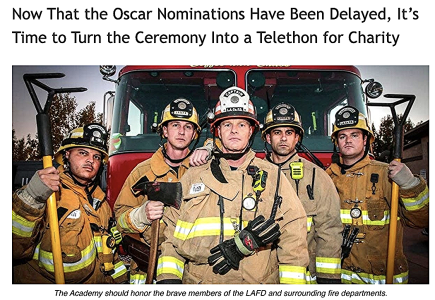
Which is why Jeff Sneider’s suggestion to make the Oscars into a charity-and-compassion event sounds inspired.

Sneider: “It the Academy really wants to put its money where its mouth is, it should turn the Oscars into a telethon hosted by Conan O’Brien, backed by an army of A-listers. And I’m talking everyone — all hands on deck.

“If you’ve been reading Richard Rushfield’s thoughtful Ankler series on ‘How to Fix the Oscars’, one thing he’s absolutely right about is correcting the piss-poor attendance from A-listers. It shouldn’t matter if they’re nominated or not. Certain celebs need to make more of an effort to show their support, if only to signal that they care about the larger community.

THR‘s Steven Zeitchik has echoed Sneider in a post that appeared at 4:43 pm eastern:

“I think the show should be a giant all-in arts-based awareness-raiser of the kind done best in the 1980s,” he writes, “while also attempting to restore the spectacle of every Oscar decade but the last. A telecast that will at once provide the must-see qualities we all lament awards shows now lack while giving fundraisers the kind of shine they haven’t had in decades. Think Farm Aid meets the Titanic year.

“Here’s one way that could look:

“Every nominee comes with a plus-one — but it has to be someone who was affected by the wildfires. Could be a third-generation Altadena homeowner, could be a film person from the Palisades. As long as they lost something. Because it would be pointless to have this show and ignore loss.”

Back to Sneider: “This hypothetical Oscar telethon should, obviously, benefit every family and individual who was directly impacted by these wildfires, starting with those who experienced some loss of life, which should always be valued over property. As of now, the death toll stands at 25.

“Buildings, businesses and even communities can be rebuilt, but those 25 innocent people are never coming back. And that’s just awful to think about. The families of those victims need our help, as do so many others, and a global audience could be incredibly helpful in that regard.

“Meanwhile, if the Academy truly wants a viral moment, it will have first responders from the Los Angeles Fire Department on stage giving out the award for Best Picture.”

HE comment: I’m not so sure about this. I can see and heartily support various first-responders coming onstage and a spokesperson delivering the right kind of speech while urging charitable support, but announcing the Best Picture winner? Something about that feels a tiny bit off.

The 97th Academy Awards will be held on Sunday, March 2nd — seven weeks hence minus a day.
“Babygirl” Has Topped “Anora”?

Note: As the following article partly focuses on the financial earnings of Anora, any and all comments by HE commenter “This Is Heavy, Doc“, a relentless Anora buzzkiller and piss-sprayer, will be instantly deleted.

A friend reminded me yesterday that despite its overwhelming popularity with both critics and ticket-buyers, Sean Baker‘s Anora (Neon), which opened semi-wide in early November after a couple of weeks in select urban venues, managed to tally only $14,554,317 domestically and $15,699,037 internationally.

A $30 million haul is far from disastrous for a modestly-budgeted indie, of course, and Anora will continue to thrive on streaming platforms, especially if it snags several Oscar nominations (i.e., all but guaranteed).

But it struck me as odd or at least curious that Halina Reijn‘s Babygirl (A24), which opened on 12.25 but has sparked much less enthusiasm among critics as well as Joe and Jane Popcorn, has managed to bring in $21,738,200 in two and a half weeks of domestic theatrical play.

Don’t get me wrong — it’s great that Babygirl (of which I’m an ardent fan) has connected (it needs to make $50 million to break even) but given the fact that ticket-buyers are far less taken with it than Anora, what accounts for it having made more money?

That’s a simplistic, dumb-guy question, I realize. My first thought is that ticket-buyers were too lazy and stupid to have vigorously embraced Anora in November and early December because of Neon’s less-than-overwhelming promotion plus the no-star cast. Plus Babygirl‘s Christmas opening along with the name-brand attraction of Nicole Kidman obviously counted for something.

It’s just odd that despite a mixed or disappointed reception Babygirl has earned $21M in less than three weeks while Anora managed to earn only two-thirds of that amount over a five or six-week period. Younger urban audiences have flocked to it, but your suburban and rural slowboats…not so much.

Myth of Evil Lions

Directed by Stephen Hopkins and written by William Goldman, The Ghost and the Darkness (’96) was one of those mediocre, big-studio, high-concept films that had a B-movie vibe. You could smell it before it opened, and once you saw it there was virtually no residue.

Goldman sold the idea as “Lawrence of Arabia meets Jaws“, but despite being fact-based (John Henry Patterson‘s “The Man-Eaters of Tsavo“, published in 1907) it passed along a cruel mythology — a notion that bad-ass lions were somehow analogous to the great white shark in Jaws, which is to say bringers of primal evil.

Val Kilmer played the heroic Patterson; producer Michael Douglas played an invented lion-killer character, Charles Remington — a grizzled, brawny, larger-than-life figure who seemed modelled on Robert Shaw‘s Quint. Like Quint, Remington is eaten at the end, but Hopkins missed an opportunity by not including a shot of Douglas’s bearded head — the camera doesn’t even glance at this final carnage.

Shot within the Songimvelo game reserve and with great difficulty, Hopkins called the Paramount release “a mess…I haven’t been able to watch it.”

It’s significant that a 1.12.25 Forbes article about the real-like Tsavo lions that inspired Patterson’s book doesn’t even mention the Paramount film.

Lions are today an endangered species, and one of the reason for their population decrease is sport-hunting. I’m convinced that The Ghost and the Darkness inspired Donald Trump Jr. and Eric Trump (respectively 19 and 12 years old when The Ghost and the Darkness opened) planted the ideas that bagging a lion enhanced the masculinity of the hunter.

Equity on Fire

Lionelnation.com is about the love of Lionel trains…really. But the site’s founder, obviously a cranky conservative, digresses here for an examination of a 2019 clip by LAFD deputy chief Kristine Larson, a 33-year, LGBTQ-identifying veteran (Equity on Fire) who is subordinate to LAFD chief Kristin Crowley (also LGBTQ). The offending clip is six years old, mind. I’m sorry but the Lionel guy is kinda funny in an irked, tempestuous, exasperated way.

12 Years Ago, Six Months Sober

Thanks to the gracious, good-humored Stephen Holt for conducting this Toronto Film Festival interview in 2012. It’s oddly comforting to consider a 12-years-younger version of one’s self. I had darker sideburns — otherwise I haven’t aged at all. Well, I have but…

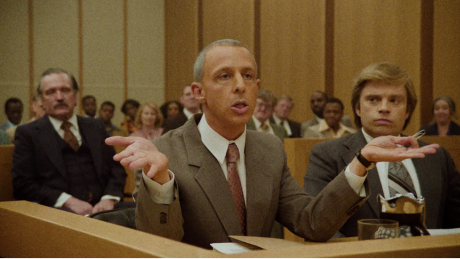
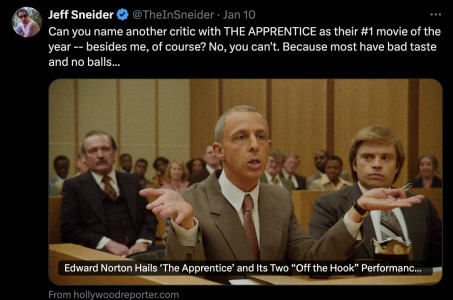
Ed Norton to “Apprentice” Avoiders: “You Have Sinned A Great Sin Against The Movie Godz”

All hail Edward Norton for praising Ali Abassi‘s under-seen and under-heralded The Apprentice in an interview with THR‘s Scott Feinberg:

Posted by yours truly one week ago (1/4/25): “Industry-ites are afraid to praise The Apprentice because they’re cowards…plain and simple. I’ve been saying for nearly eight months that it’s a truly excellent film with superb performances by Sebastian Stan and Jeremy Strong, but they’re afraid to acknowledge the quality because they don’t want to be seen as supportive of anything bearing any kind of Trump stamp, even though the film’s second half is quite condemning of the former and future president.”

HE’s Cannes review, posted eight months ago:

Richard Brody Is HE’s New Best Friend…For Now

I knew less than 15 minutes in that I would loathe sitting through The Brutalist, for right off the top it struck me as a melancholy slog, a swamp thing…a movie populated with draggy characters and a draggier-than-fuck storyline. Lemme outta here.

Silly as this sounds, I came to believe that The Brutalist hated me as much as I was learning to hate it.

I looked at my watch and moaned…dear God, over three hours to go. I was nonetheless determined to at least make it to the halfway mark. I almost managed that.

From Richard Brody‘s “The Empty Ambition of The Brutalist”:

The Brutalist is [fundamentally] a screenplay movie, in which stick figures held by marionette strings go through the motions of the situations and spout the lines that Corbet assigns to them—and are given a moment-to-moment simulacrum of human substance by a formidable cast of actors.

“The themes [of The Brutalist] don’t emerge in step with the action; rather, they seem to be set up backward.

“[For] The Brutalist is also a domino movie in which the last tile is placed first and everything that precedes it is arranged in order to make sure that it comes out right.”

Brody subhead: “Brady Corbet’s epic takes on weighty themes, but fails to infuse its characters with the stuff of life.”

Not Bad “Havana”

Friendo: “Regarding your recent list of the best movies released in 1990, where the hell is Havana? Havana, Jeff! Robert Redford, Sydney Pollack, David Rayfiel!”

HE to friendo: “In my eyes, Havana is a solid, respectable, midrange redemption tale — a flawed character (Redford’s Jack Weil) puts aside selfish tendencies and winds up doing a selfless, noble thing for a woman he loves (Lena Olin‘s Bobby Durán) but can’t have. It left an agreeable taste in my mouth. I loved Rayfiel’s dialogue, shared with Judith Rascoe.

“But over the last 35 years I’ve never rented or streamed Havana, and that means something. My criteria was ‘which 1990 films are still really living in my head 35 years later?’ I remember it with earnest, moderate affection, but not a lot of fervor. It’s a romantic film, obviously, but afflicted with a tone of resignation.”