Rosen is the host — he panelists are Bill McCuddy, smiley-faced Perri Nemiroff and the candid Roger Friedman. A good bunch, good talk.
The Maestro section (starting at 5:08, ending around 9:40) is the best portion.
Bill McCuddy: “What we gotten from Maestro is a very, very good movie…it’s not a miniseriers. It’s a biopic about a guy I didn’t think I cared about until I saw this. And yet it’s very devoted to Carey Mulligan, who has the last shot in the film.”
Once upon a time The Spirit Awards were known as the “indie Oscars”. This handle was generally accepted between the early ’90s to mid 20teens. But that ship began to leave port when the woke Covid virus infected everything and especially after a Branch Davidian cult within the leadership overturned the apple cart by destroying gender acting categories.
I’m not kidding or exaggerating — talent + markeing & publicity are still playing along because “where’s the harm?”, but the Spirits have gone totally wacko, and nobody cares what they think (not really) because they’re encamped on planet Pluto.
That said, here are HE’s preferences. comments and predictions among the 2024 Film Independent Spirit Award nominations, which popped this morning — Tuesday, 12.5.
Best Feature
ALL OF US STRANGERS / (forget it — Andrew Scott is fine, but Paul Mescal‘s Van Dyke whiskers are a complete stopper)
AMERICAN FICTION / HE, should win, probably will win.
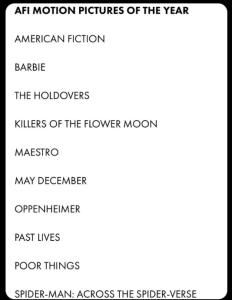
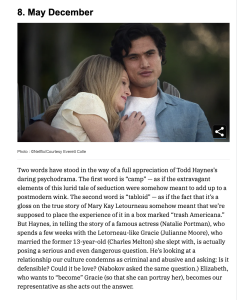
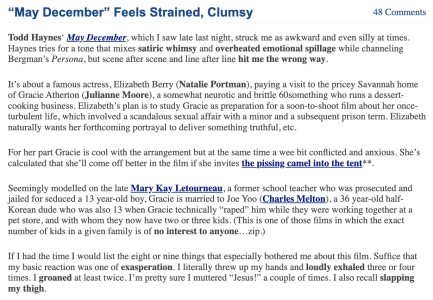
MAY DECEMBER / (even with the power of the Frirnds of Todd Haynes + the Branch Davidians can’t push this through to a win)
PASSAGES / (generally detestable)
PAST LIVES / (gentle, passive, under-energized….peaked last January)
WE GROWN NOW / (who?)
Best Director — i.e., where’s American Fiction‘s Cord Jefferson?
Andrew Haigh, ALL OF US STRANGERS / no way Todd Haynes, MAY DECEMBER / slight chance but doubtful William Oldroyd, EILEEN / haven’t seen it Celine Song, PAST LIVES / winner by deafult? The fix has been “in” for months but is diminishing. Ira Sachs, PASSAGES / Nope
Best Lead Performance (gender neutral — all sexual persuasions and species are welcome on a “whatever you can hustle up” basis)
Jessica Chastain, Memory” / If it weren’t for American Fiction‘s Jeffrey Wright, I would vote for Chastain — her best peformance since Zero Dark Thirty. Greta Lee, “Past Lives” Trace Lysette, “Monica” Natalie Portman, “May December” Judy Reyes, “Birth/Rebirth” Franz Rogowski, “Passages” (hateful) Andrew Scott, “All of Us Strangers”
Teyana Taylor, “A Thousand and One” Jeffrey Wright, “American Fiction” / should win but you never know with the Branch Davidians. Teo Yoo, “Past Lives” (forget it)
Best Supporting Performance
Erika Alexander, “American Fiction” (not a big enoughh role) Sterling K. Brown, “American Fiction” (playing a no-bullshit gay guy….could win!) Noah Galvin, “Theater Camp” Anne Hathaway, “Eileen” (haven’t seen it) Glenn Howerton, “BlackBerry” / HE is split on preference between Howerton and The Holdovers‘ Da’Vine Joy Randolph — if there were gender categories both would win in their respective categories — Glenn is great in this. Marin Ireland, “Eileen” Charles Melton, “May December” / HE will never get the Melton thing — he;s caugth on in a way that defies any known standard or system of industry lkogic other than the fact that he;’s half-Korean on his mother-s side — fairly bizarre Da’vine Joy Randolph, “The Holdovers” Catalina Saavedra, “Rotting in the Sun” Ben Whishaw, “Passages” (ixnay)
Best Screenplay
“American Fiction” or “The Holdovers” ought to win…equakl perference.
The rest: “Birth Rebirth”, “bottoms”, “Past Lives”, “The Holdovers”
Best International Film<./p> — where is The Taste of Things?
“Anatomy of a Fall” (way overpraised)
“Godland”
“Mami Wata”
“Totem”
“The Zone of Interest” (maybe)
Friendo to HE: “Saturday Night Fever isn’t even that good, but the opening makes me think movies will never be this good again.”
HE to friendo: “My initial thought when I first saw it was ‘nothing good can come from a film in which the star (John Travolta) dresses this horribly’…those high-heeled boots, grotesque bell bottoms…that awful bridge-and-tunnel haircut.
“There’s glory in the Brooklyn disco dance numbers, of course, and the tearful ending works, but I despised guys like this back in the day.”
Plus Nik Cohn‘s original New York story was piped.”
Friendo to HE: “I know but that opening scene. Pure genius.”
There’s a brief sequence toward the end of Maestro that’s fun and a bit sad. Leonard Bernstein (Bradley Cooper) and his aliing wife Felicia Montealegre are enjoying their three kids — Jamie (Maya Hawke), Nina (Alexa Swinton) and Alexander (Sam Nivola) — as they dance along to Shirley Ellis‘s “The Clapping Song.” The scene works, feels right.
It reminded me, of course, of Ellis’s other big mid ’60s hit, “The Name Game“, and how I never understood who the fuck “Ahno” is.
“Laying aside the giveaway verb — no eruptive dysfunction here — one can but marvel at the blush of puritan shockability in such a response. It’s a charming idea that the audience was stirred not by any dramatic skills on the part of the leading lady but exclusively by her valor as she dared to feign the gymnastic arts of love.
“There is indeed a fair dollop of carnality in Lanthimos’s movie, but it’s hardly a torrent. ‘Furious jumping,’ Bella calls it, in a fine example of her poetic plain speaking, and, having sampled it, she wants more. Sprawled in postcoital languor next to [Mark Ruffalo‘s] Duncan, she asks, ‘Why do people not do this all the time?’ — an excellent question to which I, like Duncan, have no satisfactory reply.
“What matters most is that the sex, pace Variety, is not some isolated bout of friskiness; it takes its place in a larger comedy of appetites, as Bella hungers to steep herself in experience. If she dislikes a mouthful of food, she spits it out. When she dances, she jerks like a doll gone mad.”
JurorNo. 2 director ClintEastwood in full-codger, GabbyHayes mode:
Hollywood Elsewhere would also like to submit to Ozempic, but it’s too costly.
This note is spot-on. You can’t logically think yourself into the realm of satori. You have to just let it in in a way that sidesteps your giant intellect.
I’ve seen TakashiYamazaki‘s GodzillaMinusOne, and I mostly agree with the praise from director JoeDante and all the critics who’ve been swooning over this recently-released, Toho-produced, English-subtitled, Japanese import that Yamazaki made for only $15 million…amazing!
It is indeed the most emotionally resonant, well-grounded, human-scale kaiju flick I’ve seen in decades, except I mostly hate Japanese monster movies and avoid them like the plague so my perspective doesn’t count for much. But others (genre fans) feel this way.
I “liked” (i.e. enjoyed goofing-on or hate-watching) the two Warner Bros. fatzilla films — GarethEdwards’ 2014 Godzilla reboot and AdamWingard’s 2021 Godzilla vs. Kong. Both were about totally obese monsters destroying cities and whatnot.
I haven’t seen the KurtRussell Godzilla TV series, (Apple’s Legacy of Monsters) but that monster also appears to be a treadmill-avoider, judging by trailers.
But those were huge wallop monster spectacles while Yamazaki’s film is primarily an intimate, mid-1940s period piece that invests in a human saga about post-WWII struggle and reconstruction, family love and community, honor and devotion to country, etc.
Godzilla is a major “character”, of course — a metaphor for the mass murder of tens of thousands in Hiroshima and Nagasaki in August ‘45 and therefore a reptilian manifestation of J. RobertOppenheimer and Gen. LeslieGroves. But the humans are just as important and actually a bit more so. It’s an ensemble piece.
The lead is a Japanese kamikaze (i.e., suicide) pilot named Kōichi Shikishima (Ryunosuke Kamiki). Despairing over Japan having lost the war, we meet Koichi as he is abandoning his kamikaze mission. Two years later in a bombed-out Tokyo, Koichi has sexlessly teamed with a young substitute mother named Noriko Ōishi (Minami Hamabe) while coping with intense survivor’s guilt (i.e., why didn’t I pointlessly sacrifice my life at the tail end of the war?).
Then the Godzilla threat manifests big-time (the monster, trust me, is not the star but a huge-big-noise supporting character). Before you know it almost total Tokyo destruction is happening all over again, and then Noriko is apparently killed by Godzilla’s wrath.
Down the road it’s eventually up to Koichi and a team of spirited pals who’ve been tasked with destroying war mines off the coast of Japan…one of these fine fellows (forget who) eventually brainstorms a special atyical bomb device that will kill Godzilla.
And you know that the climax will focus on Koichi being the guy who needs to fly a plane right into Godzilla, kamikaze-style, and thereby erase his survivor’s guilt.
I’m not going to spoil the last 20 minutes but boy oh boy, does this movie cop out! Not just regarding Koichi but another significant character. Total happy endings-ville. No balls, no hardball commitment, no accepting the occasionally brutal terms when the chips are down…we just want everyone to live and be happy!
I should report that Yamazaki’s monster is a somewhat leaner fellow than the WBfatzillas — he’s not as lean and “in shape” as Ishirō Honda‘s original monster in 1954’s Godzilla, but at the same time Yamazaki’s newbie looks like a sumo wrester who’s gone on a crash diet and consequently still has rolls of lingering belly and boob fat clinging to his upper body.
Most weirdly the newbie has breasts — I know the designer intended the chest mounds to look like male pectorals but they look like breasts for nursing, I swear.
Like Dante I too felt moved when we hear passages from Akira Ifukube‘s original 1954 Godzilla score.
Godzilla Minus One is probably the best written and most humanistic Godzilla film since the original. It’s about characters you actually come to know and care about, and about Godzilla secondarily.
It has no balls in terms of who dies and whatnot, but genre filmmakers like Yamazaki (he’s 59 as we speak) don’t respect death’s honesty — none of them do.
I received this email from the great Joe Dante a few hours ago:
“I’ve just seen Godzilla Minus One, a 2023 Japanese kaiju film directed, written and visual effects by TakashiYamazaki.
“Produced by Toho Studios and Robot Communications and distributed by Toho, this is the 37th film in the Godzilla franchise.
“See it in IMAX!” Note: HE will see it tomorrow afernoon.
“Set in immediate postwar Japan, this is arguably the best Godzilla movie since the 1954 original. Seriously, it’s pretty great! And a fitting run-up to the Big G’s 70th birthday!
“Dramatic and spectacular, with memorably rounded characters and pitched on a more emotional adult level than almost any kaiju movie.
“Even so, the verdict of the preteen kids in the Grauman’s Chinese restroom afterward was wild enthusiasm, and for a subtitled Japanese movie with grownup themes of guilt, loss and redemption.
“When the classic Godzilla theme music (composed by the late Akira Ifukube) kicked in during the exciting climax I was nearly moved to tears.
“Technically it’s amazing…the director was also in charge of the visual effects.
“If you’re a Monster Kid you won’t see a more satisfying movie this season.”
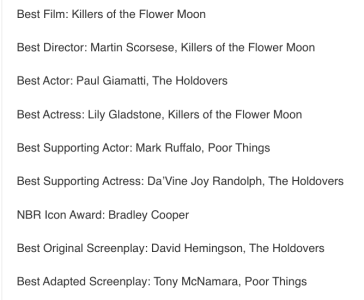
Killers of the Flower Moon‘s Lily Gladstone, whose performance as Mollie Burkhart is basically a supporting role (i.e., a victim who does nothing to defend or save herself from predatory Oklahoma beasties), recently won Best Actress trophies from the Gotham Awards and the New York Film Critics Circle.
Her performance is admired in some corners, yes, but Mollie Burkhart was written by Eric Roth and Martin Scorsese in a very minimalist fashion, and there is very little risked or revealed on Lily’s part as an actress. There isn’t a single scene in which she goes hard or raises the room temperature or pours out her soul.
People seethe when I say this, but somebody has to cut through the crap: Gladstone won this week because of her ethnic identity (having been raised within Montana’s Blackfeet community and playing an Osage native) and because the woke mob has decided that it would be a fitting paleface apology gesture for a Native American actor to win a major Oscar. No amount of denial and tap-dancing will change what everyone knows and relatively few will admit.
If Lily was running a Best Supporting Actress campaign, she’d have it totally in the bag and I wouldn’t say boo. Because that’s the category that suits her performance, and the scope of her role.
The year’s finest Best Actress-level performances have been given by Maestro’s Carey Mulligan and Poor Things’ Emma Stone. These are serious knock-out performances…obviously…c’mon.
Non-white identity has been a pervasive award-season motivator (i.e., the support for this is commonly known as virtue signalling) since the woke mentality began to spread and take hold on a checklist basis in the mid teens. Non-white directors and actors have enjoyed elevated status for six or seven years.
This is the wave that Gladstone’s campaign is surfing upon, and why many under-45 SAG-AFTRA members and New Academy Kidz are planning on voting for her, despite her low-key, “good enough but no great shakes” performance as a wealthy Osage native whose family members are murdered by greedy white guys (oil money), and who is herself nearly killed.
The key element is that a Native American winning a Best Actress Oscar would be a first-time-ever thing and a kind of holy milestone in many voters’ eyes.
“Vulture‘s Kyle Buchanan, Stacey Wilson Hunt and Chris Lee have posted a piece about the views and attitudes of the Academy’s new voters, all of whom were invited to join the Academy over the last two years and who constitute roughly 17% or 18% of the present membership. Of the 14 members interviewed, more than half were women and more than a third were people of color.
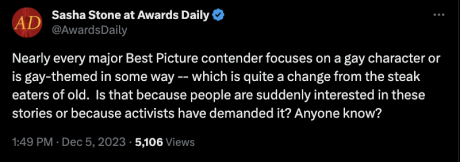
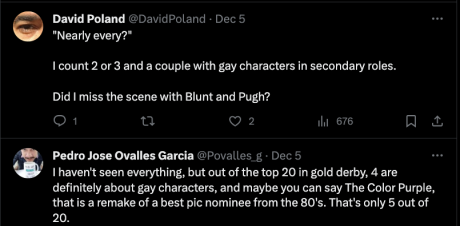
“I for one found it surprising if not shocking that the biggest concerns of the New Academy Kidz appear to be representation, representation and….uhhm, oh, yes…representation.
“Consider a quote from HE reader “filmklassik:
“’In this particular cultural moment it is all about Tribal Identity. And what’s disturbing is, we have a whole generation now for whom Tribal representation is, to use one critic’s word, numinous. The under-40 crowd has invested Race, Gender and Sexuality with a kind of cosmic significance.
“It doesn’t mean a lot to them — it means everything to them. Indeed, much of their conversation and writing seems to always come back to it.”
James Carville at 5:27 mark: “Republican Speaker of the House] Mike Johnson and what he believes is one of the greatest threats you have today to the United States. [Christian nationalism] is a bigger threat than Al-Queda. They’re funded, and they’re relentless, and they probably won’t win for a while, but they might. They don’t believe in the Constitution. They’ll tell you that. Mike Johnson himself says, what is democracy but two wolves and a lamb deciding what to have for dinner That’s what they really, really believe.”