“People I trust are saying it’s somewhat underwhelming” — Toronto Film Festival friendo, passed along earlier today.

 Jeff Wells
 “People I trust are saying it’s somewhat underwhelming” — Toronto Film Festival friendo, passed along earlier today.
Something in me doesn’t trust Shawn Levy‘s All The Light We Cannot See (Netflix, 11.2), a limited series based on a 2014 novel by Anthony Doerr. I don’t trust the concept of using a young blind girl as the main protagonist — it feels a bit cloying and manipulative. Especially with an actual limited-sight girl playing the role.
The stain of Naziism can never be erased, of course, but at the same time a voice is telling me that relatively few in this day and age are willing to see it for what it was. I don’t get the feeling that Levy and his creative collaborators have really grappled with the roots of what happened in Germany in the 1920s and ’30s.
The teaser for Levy’s film feels too 21st Century…too morally smug and self-righteous. As if to say “if we had been living in Germany back then we would have known better…we would have stood up and refused.”
“Shameful Heritage“, posted on 10.26.20: Almost every day I get scolded and shat upon. An opinion or confession that would barely raise an eyebrow in private conversation a week or a decade ago will often as not get you lynched today. Such is the fate of semi-honest fellows in this wonderful wokester age we’re living through.
A couple of days ago I mentioned that I was grateful for my health (i.e., my body’s ability to rebuff infections), which I’d been told all my life by my mom was due to “strong German genes.” I should have said strong family genes but mom always said they principally came from her German-descended dad and German-immigrant granddad. This, of course, led to some branding me as an Aryan supremacist. So I posted the following to address this:
There’s no ignoring the horrid legacy and cultural associations between early to mid 20th Century Germany and horrific Nazi genocide. The stain was embedded 80-odd years ago, and will never be forgotten. Nor should it be.
My mother was filled with such revulsion by what happened between 1920 and ‘45 that she never once visited Germany her entire life.
That said, Germany is a rich and stirring culture (the beers, the cuisine, the desserts, the singing in the pubs, the historic operas, the architecture, the medieval remnants in Rothenburg) and the people I’ve met and dealt with there are as recognizably human as anyone or anywhere else.
The horror of Naziism and the Holocaust is a lasting national disgrace, and yet in a certain progressive sense it’s been scrubbed clean and built upon. It’s also been acknowledged all over in Germany — officially atoned for from the top down. There are memorials, moral messages and reminders all over Berlin, for example. There’s a huge Holocaust memorial right smack dab in the center.
In 2012 the boys and I visited Dachau, which is northwest of Munich and only a 20-minute train ride away. Talk about a lingering after-vibe.
Does anyone expect that any kind of similar atonements will happen here in the wake of the Trump administration? That some kind of institutional recognition of our ghastly racist history will be built? Don’t hold your breath.
All to say there’s nothing inherently evil or odious about being partly descended from Germans. Just as no one is saying there’s something inherently evil or odious about J.D. Vance having grown up in a small MAGA community in southern Ohio.
I was extremely disappointed when I saw Four Rooms, a ’90s hipster anthology comedy that opened 28 and 1/3 years ago (12.25.95). It consisted of four episodes directed by four directors — Allison Anders, Alexandre Rockwell, Robert Rodriguez and Quentin Tarantino. Tim Roth‘s performance as Ted the bellboy provided the narrative follow-through and connective tissue.
Tarantino’s episode was titled “The Man From Hollywood” — very twisted and perverse but not especially funny. It was based upon Roald Dahl‘s “Man From The South” and more particularly a 1960 Alfred Hitchcock Presents episode costarring Steve McQueen, Neilie Adams (who had married McQueen in ’56) and Peter Lorre.
L.M. Kit Carson passed me the Four Rooms script before it began shooting, and I was floored by some of it. I was convinced that it would almost certainly work as a hip black comedy. Carson and I visited the Raleigh Studios set during filming (in either late ’94 or early ’95). Slender Quentin was there, quietly strolling around. I saw it once in late November or early December of ’95, and whoo boy…that was the last time.
Four and 2/3 years ago (2.3.19) I posted a piece about Bradley Cooper‘s then-forthcoming Leonard Bernstein biopic. The title of the piece (“Bernstein’s Melodies Are Everything“) accompanied the news that Cooper’s film had secured music rights from the Bernstein estate.
Excerpt: “I respect Cooper’s intention to both direct and star. A comprehensive Benstein biopic would naturally focus upon Bernstein’s creative saga with West Side Story, and also upon his closeted life and conflicted marriage to Felicia Montealegre. A heavy smoker and emphysema sufferer, Bernstein died at age 72 in 1990.
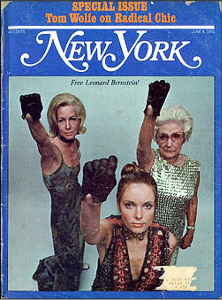
“Presumably Cooper’s pic will include the Black Panthers episode that Tom Wolfe wrote about in “Radical Chic: That Party at Lenny’s” (6.8.70). A Black Panther fundraiser was held at Bernstein’s Park Avenue apartment, and was attended by Donald Cox, a Panther “field marshal” from Oakland. Wolfe‘s famous New York article was more or less about the guilty-liberal syndrome among Bernstein’s social crowd.
“A friend writes: ‘Don’t count on Cooper’s Bernstein biopic to include Wolfe’s ‘Radical Chic’ tale. It’s an anecdotal incident, and would cast too negative a light on Lenny. The tone of Wolfe’s piece is one of utter mockery of the Bernsteins and their wealthy liberal ilk.'”
Well, guess what? Vanity Fair‘s Richard Lawson reports that “the famous Black Panther Party event that Felicia Montealegre held at the family’s apartment in 1970, which led to the writer Tom Wolfe sneeringly coining the term ‘radical chic, is not mentioned at all in the film.”
WHAT??? The Wolfe piece is the first thing I’ve thought about for decades whenever I’ve thought of Lenny and Felicia. ‘Radical chic’ is VIRTUALLY SYNONYMOUS with their legend.
A friend informs that Maestro “leaves out a great many things. It’s an audacious and highly idiosyncratic movie, but you’ll never see Lenny up on the podium conducting in his ’50s and ’60s heyday.
“There’s a great, very extended scene of him conducting Mahler’s Second Symphony in a London cathedral — the film’s big conducting set piece, and truly magnificent. But the film is mostly set in the ‘70s, and Bernstein launched his celebrity as America’s first iconic world-class conductor in 1943. You never quite see him becoming Leonard Bernstein on the podium.
“So yes, it’s an intimate Leonard Bernstein biopic that leaves out many things. Hell, it leaves out West Side Story, for God’s sake! Because the focus is on Lenny and Felicia’s marriage from the inside out. [It is my opinion that] the movie does fine without it. It all works.”
Differing opinion from friendo #2: “Maestro is pretty weak tea at the end of the day.”
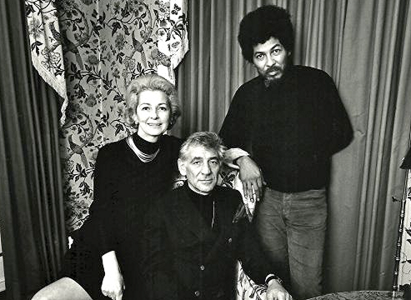
Felicia and Leonard Bernstein and their guest of honor, Black Panther “field marshal” Donald Cox, during a 1970 fundraiser held at Bernstein’s Park Ave. apartment. The event was famously written about in Tom Wolfe’s “Radical Chic: That Party at Lenny’s“:
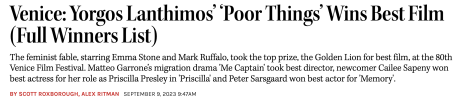
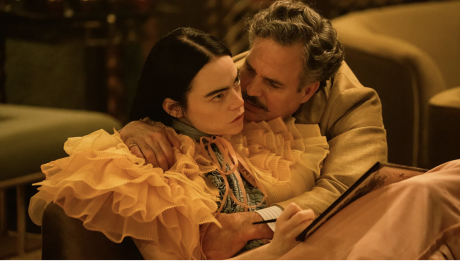
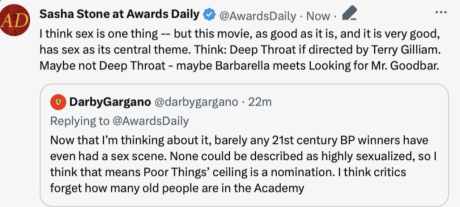
Emma Stone‘s Poor Things performance is an all-but-certain lock for a Best Actress nom, and the big Venice win for Yorgos Lanthimos‘ emphatically carnal, Terry Gilliam-like fantasy makes a Best Picture Oscar nom all the more likely.
But don’t kid yourself. The New Academy Kidz will adore Poor Things, but the Searchlight release (opening on 12.8) flirts too closely with hard-R exploitation to win. The over-45s will cultivate reservations. The flagrant bizarre-itude is exciting in a festival environment, but Venice and Telluride elitists need to calm down.
Posted from Telluride: “Poor Things was the biggest conversation flick, but the gymnastic ‘furious jumping’ scenes and the generally bawdy Bride of Frankenstein sexuality will probably diminish enthusiasm among older industry audiences.”
Dissenting viewpoint: Remember a Telluride friendo’s recent opinion that Poor Things is “like Barbie directed by the Marquis de Sade“? He thinks it’s stilted and didactic, and feels profoundly depressed by Poor Things‘ ascension, starting that it affects him “the way the triumph of EEAAO affected you last year.”
HE to Barbie and Poor Things lovers: Are your heads exploding yet, or do you need more time? Don’t look now but both are problematic.
The Rolling Stones kicked into serious gear in this country in ’65 and early ’66 The explosive “Satisfaction” was released on 6.5.65, “Out of Our Heads” (album of blues covers) was released the following month, followed by “Get Off of My Cloud” on 9.25.65, and then “December’s Children” (blues covers) in December ’65.
And then came “Aftermath” on 4.15.66 — the first definitive Stones album, all original compositions, still one of their greatest.
Beneath the “Angry” video is some silent Sunset Strip footage that was shot in ’64. The Stones had been performing for two years at that point — 61 years ago.
“Hackney Diamonds” is obviously a good thing as far as it goes. Better to release an album of original material (the last all-original album, “A Bigger Bang“, came out in ’05) rather than be a greatest hits band.
Tatiana and I caught their show in mid October of ’21 (Inglewood’s SoFi Stadium)
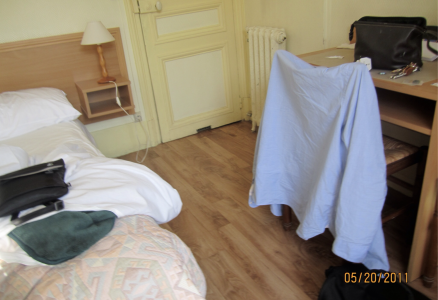
While roaming around Munich 10 or 11 years ago, I succumbed to an impulse buy — a Tom Rusborg of Copenhagen shirt — linen, light blue, banded collar. I’m wearing it now. Here’s a snap of the same shirt in a small room inside Hotel Bonsejour, maybe a year later. I love the idea of shirts enduring for decades.
>
.
>
I returned last night to the Wilton homestead, and am only now catching up on stuff.
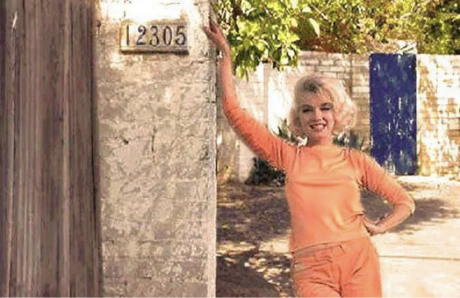
Item #1, for me, is the appalling decision by some slithering, thoughtless animal to try and destroy the classic hacienda-style bungalow bought by Marilyn Monroe in February 1962, or roughly six months before her (possibly accidental) barbituate death in August of that year.
A presumably thoughtless, soul-less life form recently bought the place for $8.5 million a while back, and wants it demolished.
A formal demolition permit is yet to be granted, but we know how this shit almost always plays out. It would be disgusting to destroy a place with this kind of haunted history, not to mention a place that exudes a vibe of understated class and simplicity.
The one-story bungalow is located at 12305 Fifth Helena Drive.
Built in 1929, it sits at the end of an inauspicious cul-de-sac not far from Brentwood’s San Vicente Boulevard.
The architectural heritage of the Monroe home was and is classic Mexican adobe (overhead beams, classic brick patio, backyard pool). She had bought a few pieces of Mexican-made furniture earlier that year when she visited Mexico City.
On or about 3.1.62 she dropped by the set of Luis Bunuel‘s The Exterminating Angel, which was finishing shooting at Churubusco Studios. It played in Cannes less than three months later.
I’ve never been inside the Monroe home, but I’ve visited two or three times and peeked through the fence, etc.

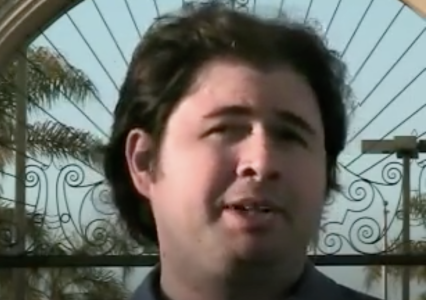
…which means that in a manner of speaking or superficial speculation that the lead character in Quentin Tarantino‘s upcoming film will resemble a late ’70s version of former stand-up comedian, former HE comment-thread enfant terrible (“I want a hooker!”) and podcaster LexG (aka Mike Gilbert).
HE to Tarantino: If the Hauser casting happens, please consider giving LexG a cameo part. It would be, at the very least, poetically and historically fitting.
Think of it! All these decades of the obstinate, hugely conflicted LexG huffing and puffing and podcasting from his modest Burbank realm, and now his persona may (I say “may“) be on the final climb toward the summit of film geek mythology.
In the same sense that Jeff Dowd is widely presumed to be the real-life inspiration for Jeff “The Dude” Lebowski in Joel and Ethan Coen‘s The Big Lebowski, it could be argued that LexG is at least a partial real-life inspiration for “Jim Sheldon,” the lead protagonist in Tarantino’s The Movie Critic, at least by way of his vague physical resemblance to Paul Walter Hauser, who has reportedly been “offered” the Sheldon role.

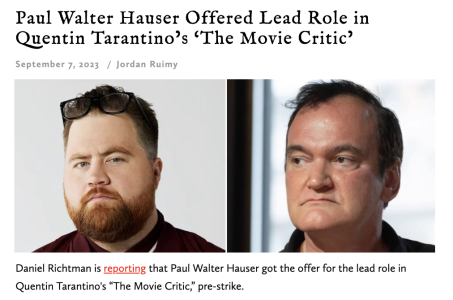
Jordan Ruimy: “Tarantino has described the character as ‘Travis Bickle if he were a film critic”'” — an obsessive loner and a bit of an oddball who happens to review movies for an underground porn rag called The Popstar Pages or Hollywood Press. The film is set in 1977.
Tarantino to Deadline‘s Baz Bamigboye: “The Movie Critic is based on a guy who really lived, but was never really famous, and he used to write movie reviews for a porno rag…a porno rag that had a really interesting movie page. He wrote about mainstream movies and he was the second-string critic. I think he was a very good critic. He was cynical as hell. His reviews were a cross between early Howard Stern and what Travis Bickle might be if he were a film critic.
“[And this] porno rag critic was very, very funny. He was very rude, you know. He cursed. He used racial slurs. But his shit was really funny. He was as rude as hell. He wrote like he was 55 but he was only in his early to mid 30s. He died in his late 30s. It wasn’t clear for a while but now I’ve done some more research and I think it was it was complications due to alcoholism.”
I don’t know about now but a decade ago alcoholism was seemingly one of the anvils (if not the anvil) tied around LexG’s ankle.
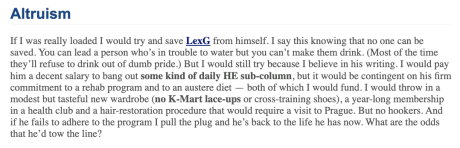
On 9.24.13 I wrote the following about trying to save LexG if I had the money:
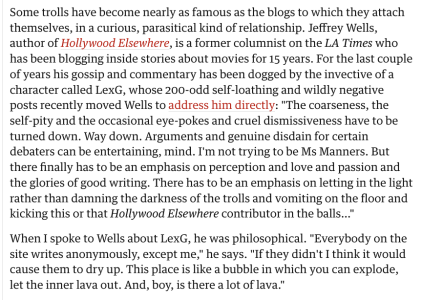
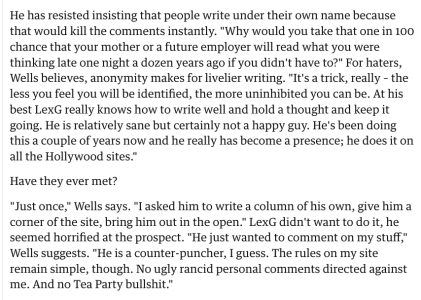
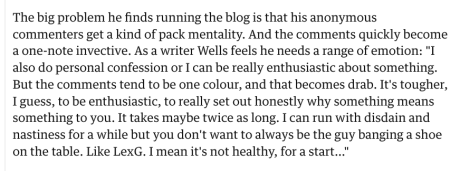
From “How the Internet Created An Age of Rage,” a 7.23.11 article by The Guardian‘s Tim Adams:
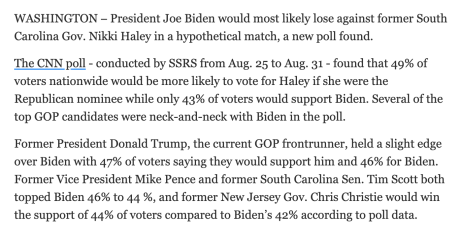
…they would recognize that despite Joe Biden‘s diminished capacity due to advanced age (not to mention his capacity between now and early ’29), the criminally inclined, four-times-indicted Donald Trump can’t possibly be elected president again. A lot of crazies will vote for him, sure, but he can’t win. The sensibles will not vote to put a modern political equivalent of Al Capone or Vincent “Mad Dog” Coll — a proven crime boss and foam-at-the-mouth sociopath — back into the White House.
But a healthy majority might vote for Nikki Haley. According to a new CNN poll, Haley is polling best against Biden in a theoretical match-up, above and beyond the margin of error.
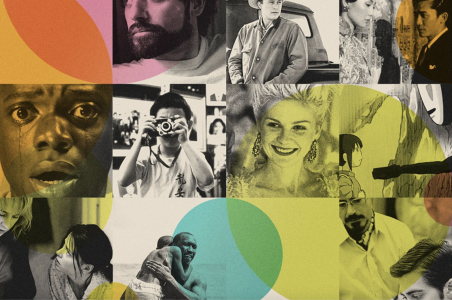
Forgive the lateness but five months ago (4.6.23) six Hollywood Reporter critics — Jon Frosch, David Rooney, Sheri Linden, Livia Guyarkye, Leslie Felperin and Jordan Mintzer — posted their choices for the 50 Best Films of the 21st Century.
Nobody is an absolute authority and we all have our special passions and allegiances, but boy, do these guys live on Planet Uranus or what? Travelling within their own solar system, residing in ivory tower suites, however you want to put it. Wow.
Friendo: “Absurd, elitist, off in their own realm…shows how out of touch they and so many other critics are these days.”
The THR gang didn’t include 2022 or 2023 films, but their top ten (#1 to #10) are are Yi Yi, Inside Llewyn Davis (HE agrees that it’s among the top 50), The Gleaners and I, Zodiac (stiff HE salute), Mulholland Drive, Spirited Away, Brokeback Mountain (ditto), In The Mood For Love, 4 Months, 3 Weeks and 2 Days (definitely among HE’s top 20) and Get Out (WHAT??).
I’m still in New Jersey and facing a drive back to Wilton and therefore in too much of a rush to include the films of the last four years, but here’s one of HE’s 21st Century rundowns, moving backwards from 2018 — roughly 114 titles:
Best of 2018: Roma, Green Book, First Reformed, Hereditary, Capernaum, Vice, Happy As Lazzaro, Filmworker, First Man, Widows, Sicario — Day of the Soldado. (11).
Best of 2017: Call Me My Your Name, Dunkirk, Lady Bird, The Square, War For The Planet of the Apes, mother!, The Florida Project. (7)
Best of 2016 Manchester By The Sea, A Bigger Splash, The Witch, Eye in the Sky, The Confirmation, The Invitation. (6)
Best of 2015: Spotlight, The Revenant; Mad Max: Fury Road; Beasts of No Nation; Love & Mercy, Son of Saul; Brooklyn; Carol, Everest, Ant-Man; The Big Short. (10)
Best of 2014: Birdman, Citizen Four, Leviathan, Gone Girl, Boyhood, Locke, Wild Tales. (7)
Best of 2013: The Wolf of Wall Street, 12 Years A Slave, Inside Llewyn Davis, Her, Dallas Buyers Club, Before Midnight, The Past, Frances Ha (8).
Best of 2012: Zero Dark Thirty, Silver Linings Playbook, Amour, Beasts of the Southern Wild, Barbara, The Grey, Moonrise Kingdom (7).
Best of 2011 (ditto): A Separation, Moneyball, Drive, Contagion, X-Men: First Class, Attack the Block (6).
Best of 2010: The Social Network, The Fighter, Black Swan, Inside Job, Let Me In, A Prophet, Animal Kingdom, Rabbit Hole, The Tillman Story, Winter’s Bone (10).
Best of the First Decade (’00 to ’09): Zodiac, Memento, Traffic, Amores perros, United 93, Children of Men, Adaptation, City of God, The Pianist, The Lives of Others, Sexy Beast, Avatar, There Will Be Blood, Michael Clayton, Almost Famous (the “Untitled” DVD director’s cut), 4 Months, 3 Weeks and 2 Days, Collateral, Dancer in the Dark, A Serious Man, Girlfight, The Departed, Babel, Ghost World, In the Bedroom, Talk to Her, Bloody Sunday, No Country For Old Men, The Quiet American, Whale Rider, Road to Perdition, Open Range, Touching the Void, Maria Full of Grace, Up In The Air, The Hurt Locker, Million Dollar Baby, The Motorcycle Diaries, An Education, Man on Wire, Revolutionary Road, Che and Volver. (42)
HE’s Best of 2020: 1. Chloe Zhao‘s Nomadland; 2. Roman Polanski‘s J’Accuse (An Officer and a Spy); Aaron Sorkin‘s The Trial of the Chicago 7; Florian Zeller‘s The Father, 8. Chris Nolan‘s Tenet, Judd Apatow and Pete Davidson‘s The King of Staten Island, Michael Winterbottom‘s The Trip to Greece, Rod Lurie‘s The Outpost, Diao Yinan‘s The Wild Goose Lake. 10. Cory Finley and Mike Makowski‘s Bad Education.
HE’s best of 2021: 1. King Richard, 2. Parallel Mothers, 3. West Side Story, 4. Spider-Man: No Way Home, 5. The Worst Person in the World, 6. A Hero (Amazon), 7. Riders of Justice, 8. No Time To Die, 9. The Beatles: Get Back, 10. Zola.
…that out of darkness leads up to light.
I avoided Elizabeth Chai Vasarhelyi and Jimmy Chin‘s Nyad (Netflix, 10.20 theatrically, 11.3 streaming) during Telluride because I was told over and over that Annette Bening‘s titular performance amounted to a tough sit. Now, having seen the trailer, I’m seeing a possible parallel between Nyad and Raging Bull. It seems clear that both Bening and costar Jodie Foster go for it hard, and that Foster…let’s wait and see but she may deliver like Joe Pesci.