Polanski’s “Palace” Seems Like “Triangle of Sadness” Rehash

No subtitles on the new Italian-language trailer for Roman Polanski‘s The Palace, but the satirical thrust is obvious.

As was the case with the guests aboard a super-yacht in Ruben Ostlund‘s Triangle of Sadness, the super-wealthy guests staying at a deluxe Gstaad hotel on New Year’s Eve in 1999 are arrogant, self-obsessed, super-rich fools, and some have been disfigured by extreme plastic surgery.

The Palace opens in Italy on 9.28. I for one would love an opportunity to see it in NYC prior to the Venice Film Festival.

“Napoleon” Is “Phantom Thread”-ish, A Bit “Weird’

However Ridley Scott‘s Napoleon turns out, an early consensus began emerging months ago that Joaquin Phoenix‘s titular performance is highly eccentric. Ditto Vanessa Kirby‘s as Josephine.

In an recent interview with Empire‘s Ben Travis, it’s mentioned that during an argument scene Phoenix’s Napoleon slaps Josephine — an unscripted improv, the actors have told Empire magazine.

“We were using the real words from their divorce in the church,” Kirby says. “When that happens, you can faithfully go through an archival re-enactment of it and read out the lines and then go home. But we always wanted to surprise each other.”

Phoenix: Kirby said “whatever you feel, you can do…you can slap me, you can grab me, you can pull me, you can kiss me, whatever it is.”

Kirby: “It’s the greatest thing when you have a creative partner and you say, ‘Right, everything’s safe. I’m with you. And we’re gonna go to the dark places together.’”

Consider a research screening reaction posted on 1.23.23 by World of Reel‘s Jordan Ruimy:

“In the first half hour Phoenix’s performance is mostly subdued and he speaks in either exposition or military orders, so we don’t have a great sense of the character either. After the Egypt part though the movie really takes off and becomes fantastic, I would say Scott’s best historical movie.

“Weirdly the movie I was reminded of most was Phantom Thread, because Napoleon and Josephine have this perverse but also funny and sad and abusive relationship. Kirby is great.

“The battle scenes are all huge in scope and unique and probably the best of Scott’s career.

“I wouldn’t say Phoenix’s Napoleon is whiny, but he’s an egomaniac and Phoenix does a great job of portraying that. The humor hit for me and it felt like it did for the rest of the audience, with the scene where Napoleon stages a coup being one the funnier scenes I’ve seen in a movie in a while.

“Overall it’s much weirder than I would’ve expected from Scott or the subject.”

No Remake Allowed

Joel Schumacher and Ebbe Roe Smith‘s Falling Down opened on 2.26.93 — 30 years and six months ago. No one would dare remake it today, but if someone did it would certainly be portrayed by the wokester congregation (all those who praised Women Talking and hated Empire of Llght) as a rightwing movie in the vein of Sound of Freedom.

Which means that apart from what the few truly independent-minded reviewers out there might say, no mainstream critics (i.e., the go-along-to-get-along types who represent the vast majority) wouldn’t be allowed to write anything praise-worthy. On top of which Clayton Davis would strongly disapprove.

Even if Son of Falling Down turned out to be good or half-decent or at least popcorn-worthy, it would nonetheless have trouble finding a distributor because the focus is too Joe Rogan or Daily Wire-ish…doesn’t follow the woke party lne. But if it found a distributor and managed to open theatrically, it would most likely become a word-of-mouth flick among MAGA types.

From Roger Ebert’s 2.26.93 review: “Some will even find it racist because the targets of the film’s hero are African American, Latino, and Korean…with a few Whites thrown in for balance. Both of these approaches represent a facile reading of the film, which is actually about a great sadness, which turns into madness, and which can afflict anyone who is told, after many years of hard work, that he is unnecessary and irrelevant.

“What is fascinating about the Michael Douglas character, as written and played, is the core of sadness in his soul. Yes, by the time we meet him, he has gone over the edge. But there is no exhilaration in his rampage, no release. He seems weary and confused, and in his actions he unconsciously follows scripts that he may have learned from the movies, or on the news, where other frustrated misfits vent their rage on innocent bystanders.”

I posted a shorter version of an HE Falling Down piece on 6.20.19.

Another crazy white guy movie that couldn’t be remade…forget it.

Fashion Felony

Since seeing Oppenheimer I’ve been feeling very supportive of Josh Hartnett, who gives a mature and highly convincing performance as nuclear physicist Ernest Lawrence. It’s a major career bump for a guy I’ve admired and have followed for over 20 years — The Virgin Suicides, Black Hawk Down, Pearl Harbor, Hollywood Homicide and Mozart and the Whale in the early days.

And then I saw this appalling sweater-and-shirt combo — one of the most seriously frightful mine eyes have ever beheld. The sweater alone! How can a reputable actor wear stuff like this? Obviously a small matter but still.

Trump Filet

I’m still perusing Jack Smith’s new Trump indictment, but right now (i.e., as far as I’ve read) it seems to boil down to three conspiracies: (a) an attempt to defraud the United States, (b) an attempt to obstruct an official government proceeding and (c) a third to deprive people of civil rights provided by federal law or the Constitution.

Basically it’s a fork shoved into his flabby bloated gut for trying to overthrow the 2020 election.

Does this mean Smith (I’m slow with legal jargon so please bear with me) is charging Trump with having blatantly incited the Jan. 6th assault upon the Capitol building for the purposes of obstructing the electoral vote count? Or with having aided and abetted the assault by waiting 187 minutes to attempt to call upon his followers to cease and desist. Apparently so but I’m still sifting through the particulars.

Oscar Poker on “Barbie” Noms, Festival Snags, Ludicrous Best Pic Predictions

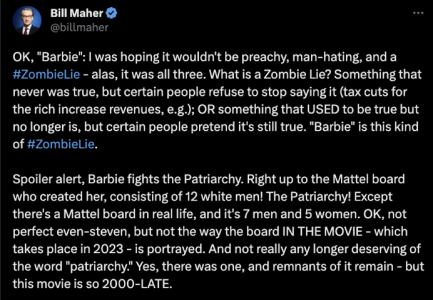
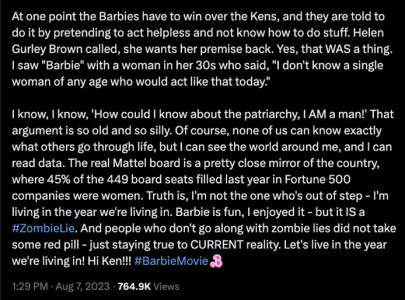
Description #1: A two-track Jeff and Sasha chat — first about the evolution of women’s #MyTurn complaint-and-identity culture of the last 30 or 40 years (mostly Sasha’s story), and a second about Barbie, box-office, various projected Best Picture contenders, etc. Again, the link.

Description #2: Jeff calls Sasha from Grand Bend, Ontario, and one of the big subjects is Barbie, of course — will the blowout box-office launch Greta Gerwig‘s film into the Best Picture race? And if so, how many Oscar nominations are we talking about?

Plus a rumination on happiness for women and how Isabella Rossellini has found it by running a farm in the Hamptons. We also discuss film festivals and the landscape of the awards race.

Dumb As A Pile of Rocks

Brilliant Burn,” posted on 9.5.08: Either you get, agree with and derive enormous delight from dry misanthropic humor…or you don’t.

Either way, you certainly can’t argue with the fact that while Joel and Ethan Coen have a lot more up their sleeves than just this, for when they’re in the mood to dispense their extremely low opinion of human behavior, they are masters of the form. Nobody knows from dry, diseased and delectably deadpan like these guys. It’s in their bones and their blood.

And it’s the genius of Burn After Reading, their latest, to offer another serving in a way that may seem slight or irksome to some, but it is in fact — I mean this — a major satirical meditation about everything that is empty, wanting, sad and hilariously absurd in these united and delusional states of America.

I didn’t laugh all that much, but I loved every minute of this thing. Relished it. I sat there with a slight smark on my face, chortling every now and then but with all kinds of “yeah, right, exactly, perfect, hah!” stuff happening in my head.

The plot shenanigans are for the popcorn eaters to chew on and the disgruntled critics to bitch about; the meat and marrow of Burn After Reading is contained in the ample and delicious margins. The atmosphere, the asshole-ish line deliveries, the mocking tone, the wacked particulars, and those looks of fear, loneliness, concrete stupidity and desperation.

If you look at it this way, the movie is a feast.

If you’re on the misanthrope boat, this half-espionaged, half-comedic take on modern fools and manners is about as good as this sort of thing gets. But you have to forget about “laughing.” (Which is overrated anyway, despite what Joel McCrea‘s John L. Sullivan might have thought.)

You can sit there and eat your popcorn and take it as a sardonic goofball spy movie crossed with a comedy of errors that doesn’t add up to much, and that’s fine. But the meanest and cruelest jokes aren’t just the funniest, as Mort Sahl once said — they’re also the most thoughtful.

Burn After Reading is not a movie for the ages, but a modest and dead-perfect geiger-counter reading of what ails those desperate, constantly itchy and perturbed Americans in the comfortable urban areas who can’t help but shoot themselves, attack others, make mad lunges at quick money and temporal erotic satisfaction. Prisoners of their swollen egos and limited intelligence.

Strivers who must (they feel) have more, who can’t be satisfied or serene, who eat the right foods, belong to health clubs, drink too much, scheme and claw too much and are natural-born comedians in the eyes of God.

Which is how Burn After Reading starts and ends, by the way — from the point of view of a sad, bemused and occasionally chuckling cosmic super-being.

I haven’t even mentioned the cast — George Clooney, John Malkovich, Brad Pitt, Frances McDomand, Richard Jenkins, J.K. Simmons, David Rasche — or the beautiful note-perfect ending. But them’s the breaks when you’re doing four movies a day plus filing and parties and random chit-chats on the street.

My Favorite Mutiny

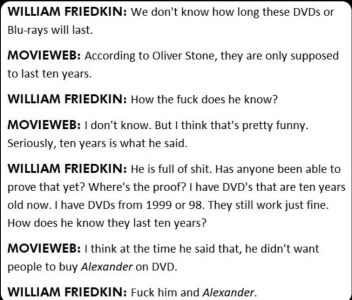
With the Venice Film Festival debut of William Friedkin‘s The Caine Mutiny Court-Martial only a month away, it’s necessary to state here and now that the absolute best shipboard mutiny scene ever filmed can be found in Carol Reed and Lewis Milestone‘s Mutiny on the Bounty (’62).

Yes, better than the mutinies in Roger Donaldson‘s The Bounty (’84), Lewis Gilbert‘s Damn The Defiant! (‘62), Tony Scott‘s Crimson Tide (‘95) and Edward Dmytryk‘s typhoon takeover in The Caine Mutiny (’54).

In its entirety the ’62 Bounty is problematic but the 10-minute mutiny scene, especially between the 1:40 and 3:30 mark, is absolute aces. I especially adore Marlon Brando‘s dashing and authoritative saber-brandishing during the brief, side-to-side tracking shot between 1:55 and 2:05 — the first and only such shot in the entire film.

My second favorite mutiny scene occurs in Howard HawksRed River (’48).

Friedkin’s film is apparently set during the Gulf War of the early ’90s. The costars include Kiefer Sutherland as Humphrey Bogart, Jason Clarke as Jose Ferrer, Jake Lacy as Van Johnson and Lewis Pullman as Fred MacMurray.

When I was 10 or thereabouts my father played a psychiatrist in a small-town stage production of The Caine Mutiny Court Martial so don’t tell me.

Read more

Helen Mirren vs. Ingrid Bergman

From Fionnuala Halligan‘s Screen Daily review of Golda (2.20.23):

“When an iconic actor portrays an iconic figure, the success or failure of the project tends to depend on the power of the performance blasting away the wigs and prosthetics. Helen Mirren achieves all that while playing Israeli politician Golda Meir. But, in Golda, director Guy Nattiv and writer Nicholas Martin haven’t quite kept up their end of the bargain.

“Dropping the audience into the start of the 1973 Yom Kippur war with the chain-smoking caretaker premier, the film is a tense story of a woman and her generals around a cabinet table over the course of the conflict. Endless cigarette smoke, overflowing ashtrays, maps, a fat suit, a wiry wig, hairy eyebrows, orthopaedic shoes — but who was Golda Meir? The film prefers to avoid her as a human being, swerving into her politics and replaying the war from the perspective of her military cabinet over 10 charged days.”

Back Door Passion of Oliver Barret, Jr.

Posted on 2.29.16: “In a few days Quentin Tarantino‘s New Beverly Cinema will be screening a beware-of-Ryan O’Neal double bill — Love Story (’70) and Oliver’s Story (’78).

“A little more than 37 years ago I laughed at a defaced version of an Oliver’s Story one-sheet on a New York subway station wall. It won’t be very funny if I use the original graffiti so I’m going to use polite terminology. The dialogue balloons had O’Neal saying to costar Candice Bergen, “I’m sorry but may I have sex with you in a way that can’t get you pregnant?” Bergen answered, “If missionary is really and truly out I’d prefer oral.”

“I was poor and struggling and mostly miserable, but the graffiti made me laugh. It still makes me laugh today. I guess you had to be there.”

Read more

Old Times’ Sake

It was apparent earlier today that some are still clinging to the idea that Alan Parker and Bo Goldman‘s Shoot The Moon (’82) is a formidable, first-rate family melodrama. I thought it was a gloomy drag when I first saw it 41 years ago, and I feel the same today. Here’s how I put it on 10.2.21, in the wake of Albert Finney‘s passing:

A few weeks after Finney’s death I re-watched Alan Parker and Bo Goldman‘s’s Shoot The Moon (’82). Not on Amazon, but on the big screen at Hollywood’s American Cinematheque.

It didn’t work out. The film drove me nuts from the get-go, mainly because of the use of solitary weeping scenes (three or four within the first half-hour) and the relentless chaotic energy from the four impish daughters of Finney and Diane Keaton. It was getting late and I just couldn’t take it. I bailed at the 45-minute mark.

The “obnoxious argument in a nice restaurant” scene indicates what’s wrong with the film. It has a striking, abrasive vibe, but it doesn’t work because there’s no sense of social or directorial restraint. If only Parker had told Finney and Keaton to try and keep their voices down in the early stages, and then gradually lose control. Nobody is this gauche, this oblivious to fellow diners.

The balding, red-haired guy with his back to the camera (James Cranna) played “Gerald” in the Beverly Hills heroin-dealing scene in Karel Reisz‘s Who’ll Stop The Rain?.

Which other films aspire to be as relentlessly gloomy as Shoot The Moon? I’m talking about films that give you no mirth, no oxygen. A steady drip-drip-drip of depression, foul moods, anger, downishness.