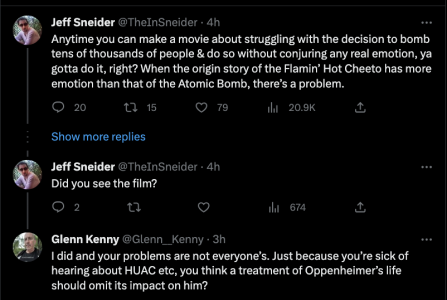
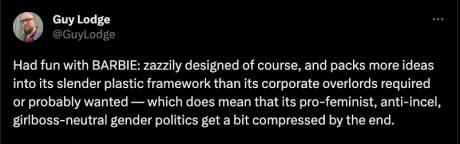
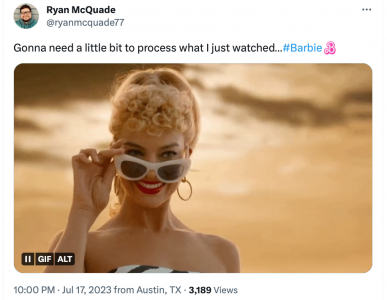
…I would seek out a brilliant acting-and-vocal coach, part Evanna Lynch and part Henry Higgins, and beg him or her to please help me get rid of my white-trash, Deliverance hillbilly shitkicker accent. Because if I could sound more like Sigourney Weaver, I could become more acceptable as a national political figure.
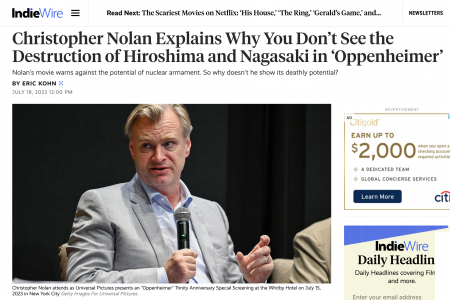
Following a special screening of Salk at Manhattan’s Whitby Hotel last weekend, director Christopher Nolan explained why he chose not to show the human-scale benefits of the Salk polio vaccine, which began to be distributed in 1955 and eventually eliminated polio in the United States.
In the recent documentary To Eliminate Polio: Jonas Salk and his Miracle Vaccine, the impact of the innoculations is shown in abundant, upbeat detail. Although the documentary was released in part to drum up hype for Nolan’s three-hour biopic about Jonas Salk‘s heroic achievement, no such footage appears in Nolan’s Salk.
Nolan’s film doesn’t show thousands of children running around and enjoying their lives unhindered by polio, he explained, for a good reason. Salk is strictly a POV film that is centered around Salk’s immediate perspective, and since Dr. Salk didn’t innoculate any kids personally (except for his own three children) and didn’t go on a national goodwill tour to personally observe the vaccine’s beneficial effect upon families with children, it felt like “a reach”, Nolan said, to dramatize the effects of the Salk vaccine.
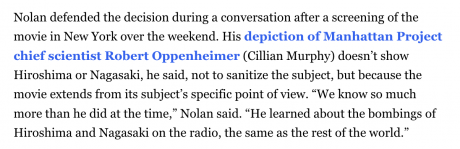
“We know so much more than Salk did at the time,” Nolan said. “He didn’t personally observe the mass innoculations and only saw them on TV, as he wasn’t exactly a ‘people person.’ He didn’t meet with any children or parents on a random basis, and he certainly didn’t administer the vaccine personally to children outside his own family, and so I decided to focus the film strictly on Salk’s research along with his dealings with scientific colleagues and a couple of government representatives.”
It’s funny how these Oscar Poker chats go. Sometimes the discussion will feel relaxed and confident, and sound that way. At other times a relaxed chat (like this one) will bore your pants off. Still other times a discussion that feels awkward and inarticulate during recording will result in a good listen.
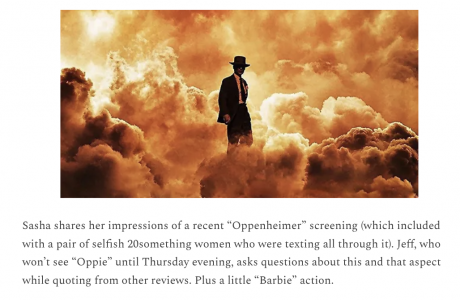
Having seen Oppenheimer in Burbank on Tuesday evening (7.18), Sasha shared her euphoric impressions, calling it a 10. She also described a grotesque encounter with a pair of selfish 20something women who were texting all through it. Jeff won’t see Oppie until this evening (Thursday, 7.20, 7:30 pm), and so he asked questions about this and that aspect while quoting from other reviewers. Plus a little Barbie action.
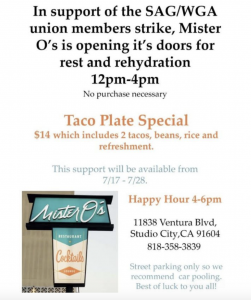
Director-screenwriter friendo to HE: ‘I know you appreciate old-school class, etc. Mister O’s is a retro-designed supper club a la Mad Men and ’60s Rat Pack style in the Valley. Since Universal and other neighboring studios are making it additionally difficult for picketing writers and actors by doing things like cutting down shade trees and blocking sidewalks, this upscale restaurant is offering itself as a cooling station…and it’s a very cool place to hang and cool down.”
Many three-hours-or-longer films reside on my all-time greatest roster — The Godfather Part II, Apocalypse Now, Lawrence of Arabia, The Wolf of Wall Street, Scarface, The Irishman, Barry Lyndon, Ben-Hur, Titanic, The Seven Samurai, Gone With The Wind, Spartacus, etc.
Length, of course, has always been immaterial or irrelevant when it comes to quality — no bad film can be too short, no good film can be too long, etc. There’s nonetheless something a bit more transporting or inviting or impactful when it comes to films that are just a bit shorter — 165 minutes to 180 minutes, I mean.
If you’re talking “long but good movie,” 165 to 180 is HE’s sweet spot. Long but a little lighter, tighter and trimmer…slightly less indulged.
HE’s favorite 165 to 180s: The Godfather (175), Heat (170), Patton (172), The Best Years of Our Lives (170), Saving Private Ryan (169), The Thin Red Line (170), Long Day’s Journey Into Night (174), The Young Lions (167), The Longest Day (178), Beau Is Afraid (179), Dogville (’03), The Great Escape (172), The Unbearable Lightness of Being (171), Braveheart (178).
I even have a certain elveated regard for flawed films in this realm…King of Kings (168), In Harm’s Way (165), The Towering Inferno (165), The Good Shepherd (167), Alexander (175), etc.
All this said, we’ve all become sick of the relatively recent avalanche of needlessly long movies, otherwise known as the Peter Jackson King Kong syndrome….films running between 130 and 150 minutes or longer for no apparent reason other than a lack of basic narrative discipline.
Three months ago I posted a Fred Astaire + Rita Hayworth dance sequence from You’ll Never Get Rich. Yesterday I happened upon a colorized version, and I’m sorry but my eyes liked it better.
“Jeff — I totally agree with Paul Schrader on Oppenheimer — it’s the best film I’ve seen come out of a major Hollywood studio in eons. Really fantastic for the entire three hours. Tremendous.” — gmail message, arrived at 11:21 am eastern.
“Barbie and Ken are a version of Eve and Adam, if Eve were God’s favorite and Adam acknowledged as the liability he was.
“After an unplanned detour separates her from Ken, Barbie makes her way back home [from the real world]. ready to restore perfection to her routine. But her homecoming is a dour one; Barbie returns to see that Ken, armed with his newfound knowledge of the patriarchy, has transformed Barbieland.”
Wait…a JOE POPCORN-ISH REACTION from a 30something guy who saw Barbie earlier this afternoon:
“You have absolutely no idea how anti-male Barbie is. Wait until you see it — it’s a landmine of outrage waiting to happen. There will be heated debate…some people are going to HATE it. I mean, there’s a trans Barbie…”
HE to 30something Guy: “Is Ryan Gosling’s Ken a kind of villain figure or…?”
30something Guy: “He turns into a villain, yes. An alpha male who realizes he doesn’t need Barbie in his life and that he can control women.”
HE to 30something guy: “Are you telling me he’s not gay in the film?”
30something Guy: “He loves Barbie.”
HE to 30something Guy: “WHAT? All the guys in the film obviously look and dress gay, but they’re straight? Every single trailer and photo of Ken says ‘this guy obviously isn’t straight.’ The Ken doll with the cock ring….obviously not straight….c’mon!”
From Peter Debruge‘s Variety review: “In the year 2023, it would be a shock (and box-office suicide) if Barbie arrived without some kind of female-empowerment message baked in.
“This one checks all the right boxes, while making Ryan Gosling’s dumb-dumb Ken the butt of most of its gender-equity jokes. Boasting fresh tracks from Billie Eilish and Lizzo, the result is a very funny kids’ movie with a freshman liberal arts student’s vocabulary that tosses around terms like ‘patriarchy’ and ‘appropriation’ — pretty much everything but ‘problematic,’ which the movie implies without actually calling Barbie’s legacy.”
Letterbox’d, A.A. Dowd: “Barbie is practically the textbook definition of corporate feminism, but it knows that too, of course, and is earnest in using the platform of a big-budget toy commercial to speak to the audience about the patriarchy; there’s a big speech that recalls the one Laura Dern delivers in Marriage Story, which makes me wonder if Baumbach counterintuitively wrote this one or if Gerwig helped him write that one.
“Even its lionization of the woman behind Barbie comes with an asterisk. The whole thing is animated by neurosis more than joy, which is what I found most interesting about it: Is there a little of Gerwig’s offscreen wrestling with the assignment in Barbie’s onscreen existential crisis? Wish it was a little funnier.”
On 12.2.15 I postedMatthew Morretini‘s version of the montage, which is more metronomically correct than the original 1952 version, which was assembled by editor Elmo Williams.
“The famous High Noon tick-tock sequence has always bothered me slightly,” I wrote. “It was edited to match Dimitri Tiomkin‘s music, and so every cut was supposed to happen at the precise instant of the final beat…except it doesn’t quite do that. Today editor Matthew Morettini wrote to say the reason for my slight irritation is that the picture is four frames ahead of the music.
“But now Morettini has fixed it.
“‘I’m a professional editor and had a few minutes on my hands today and re-synced the clip the way I always felt it should be,’ Morettini wrote. “And guess what? It’s better. Each and every picture edit was exactly four frames early.”
Compare the Morettini version (top) to the Elmo Williams version (below) — the proof is in the pudding.
Matthew Morettini 2015 version:
Elmo Williams 1952 version:
Boilerplate commentary: Rio Bravo (’59) and High Noon (’52) don’t share a “general genre” as much as they share a fairly specific plot/situation, which is an honest lawman (or lawmen) preparing to do battle with a gang of bad guys who will soon arrive in town and are out for blood revenge.
The films, in fact, are pretty much peas in a pod. Rio Bravo was in fact dreamt up as a response to what director Howard Hawks and star John Wayne saw as the pessimism and wimpishness of Will Kane, the resolute small-town sheriff played by Gary Cooper.
Both films are about a community’s response to the threat of lawnessness and violence, and about the lawman’s (or lawmen’s) code of honor and self-respect.
In Rio Bravo‘s case, the chief villain is Nathan Burdette. In the matter of High Noon, it’s a recently sprung prison convict named Frank Miller.
Rio Bravo is more optimistic or positive-minded in that the community (Wayne, Dean Martin, Ricky Nelson, Walter Brennan, Angie Dickinson) bands together to fight the baddies; in High Noon the community hides or equivocates or otherwise declines to help Kane form a posse so they can meet Miller and his three gunnies head on. They all say no for their own reasons, and Kane is forced to stand up to the gang all alone.
Before clicking on this link, please understand that HE is profusely apologizing for posting it. I have no excuse except for this: I’m fascinated by AI’s ability to own and manipulate the voice of Barry Lyndon‘s narrator, Michael Hordern.
The below scene, of course, is the one that has killed most viewers’ interest in Barry Lyndon over the decades. Specifically Ryan O’Neal blowing smoke into Marisa Berenson‘s face. The instant this act of sociopathic callousness happened, I checked out. The scene completely nullifies all emotional engagement in the tale until the death of Barry and Lady Lyndon’s son Brian (David Morley), which is followed by the climactic duel between Barry and Lord Bullington (Leon Vitali).