Supply and demand.

 Jeff Wells
 Supply and demand.
In a just-posted comment in the “People’s Revolt” thread, Filmklassik responded to an observation by Lauren Bertrand about the wokey wackos.
“For all their faults and lack of vision, conservatives don’t seem too keen on boldly reinventing society with the hopes of a utopia on the horizon,” she wrote. “They understand how deeply flawed and corrupt human nature really is, in part because they’re much more likely to be religious (also explains their lack of vision), but this fosters an a priori cynicism that never expects humans to transcend their pettiness, greed, and envy.”
Filmklassik: “I understand why people of the 1990s preferred their own time to, for example, the Eisenhower era, when the McCarthy witch hunts were still going on, Jim Crow was still in effect, homosexuality was still a criminal offense, and women in many ways were still second-class citizens.
“Bottom line: I understand why, for many people, the formulation was that Clinton’s America was vastly preferable to Eisenhower’s America. I get it.
“But for the life of me, I do NOT understand why anyone would prefer city life in 2023 compared to the mid-1990s. Or, God forbid, academic life in 2023 compared to the mid-‘90s. Or hiring practices in 2023 compared to the mid-‘90s. Or cultural restrictions on expression and storytelling in 2023 compared to the mid-‘90s.
“I mean, are you fucking kidding me??
“Who can view the trend-line in those areas as anything resembling progress? Answer: Progressives.”
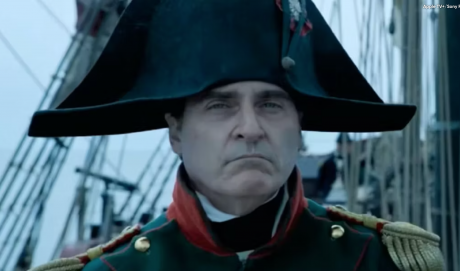
Reportedly Ridley Scott‘s Napoleon (Apple, 11.22) isn’t a chapter-and-verse history of the rise and fall of the mercurial French emperor (Joaquin Phoenix), but a story of “Napoleon’s rise to power through the lens of his addictive and volatile relationship with Empress Josephine (Vanessa Kirby).”
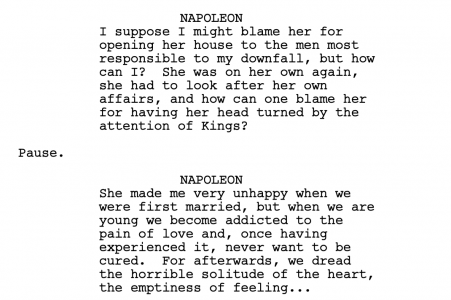
With this in mind, I was struck yesterday by a passage from Stanley Kubrick‘s Napoleon script, which of course was never filmed. It appears near the end of the story, and is basically Napoleon’s conveyance of the heart of his relationship with Josephine when they were both young.
The idea is that the pain and torment of a love affair is preferable to its absence — that nothing is worse than the void.
“This Page Six article is so misleading,” an attorney friend wrote yesterday. “He, Elliott Page, did not have the affair with Olivia Thirlby. Ellen Page did. The article’s use of pronouns to me is totally misleading.”
The article is drawn from an excerpt from “Pageboy,” the trans actor’s recently published memoir.
I was recalling last night how things were 15-plus years ago, back when Page, 36, was Ellen, 20 or 21, and the blogaroos (myself included) were having a field day with her/his/whatever’s performance in Jason Reitman‘s Juno.
Page’s performance was peppy and upfront and fully relatable, but I always had trouble with her (am I guilty of dead-naming Page by recalling the old days?) as a sexual being, which is to say a person who generates stirrings along said lines.
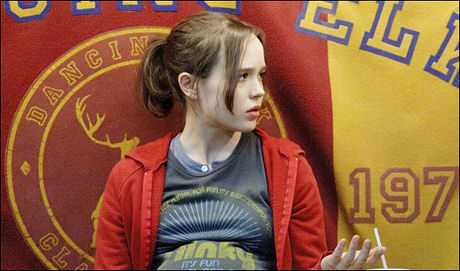
Posted on 12.16.07: Ellen Page‘s Juno performance is highly likable and sympathetic. You’re with her from the get-go because of her indefatigable spunk and pizazz. But the first time I saw Juno (at the Toronto Film Festival), I had a thought that wouldn’t leave me alone. It’s going to sound a little oddball but here it is. My first thought was ‘how and why did Page’s character get pregnant?’
More to the point, why did director Jason Reitman cast an actress based on her sass and spirit, but with no regard for the fact that in the real world a young woman who looks like Page — midget-sized, on the scrawny side, looking like a feisty 11 year-old with absolutely nothing about her that says ‘alluring breeding-age female’ — most likely wouldn’t exactly be fighting off the attentions of hormonally-crazed teenage boys, including nice-guy dweebs like Michael Cera‘s character?
Unfortunate pregnancies happen to young girls of all shapes and sizes — obviously, sadly — but I kept saying to myself (and I’m writing this having once been 16 and 17 years old) that Page is the super-bright girl you want for a good friend — someone you can talk to at 12:30 ayem on a school night when you’re depressed or in trouble or enthusing over a band you just heard. But she’s not what any teenaged boy would call a hot package. She’s got the soul and the wit and the attitude of a Dorothy Parker (and the value that comes with such a person is priceless), but Juno is about an accidental breeder, and certain qualities need to be evident for this to happen in most circumstances.
Every time I’ve seen a too-young pregnant girl in real life I’ve quietly remarked to myself for this or that reason, “Too bad, but I can sorta see how that happened.” I’m just saying it didn’t quite calculate when I first laid eyes on Page. I’ve been sitting on this impression for three months now, and didn’t express it because I knew people would call me a dog. But it’s a fair thing to say, I think. Page is great on her own, but she doesn’t seem right for the role. Or rather, she’s right in every way except physically.
Paul Stanley and Harry Kleiner‘s Cry Tough (United Artists) opened in August 1959, when steamy, semi-nude sex scenes were all but absent from mainstream American films.
Cry Tough was mainly a crime film about Puerto Rican gang activity in Spanish Harlem, but between 39:00 and 43:53 there’s a fairly provocative bedroom scene between John Saxon, 23, and the Argentinian actress Linda Cristal, 28.
Saxon and Cristal died almost exactly a month apart in 2020 — 7.25.20 and 6.27.20 respectively.
Kleiner’s screenplay is based on Irving Shulman’s 1949 novel of the same name, which was about a Jewish Brooklyn gang.
This morning “Nonbinary Woke Jihadi“, whose comments about the French Connection censorship thing have indicated an attitude of spineless woke accommodation, was slapped around good and proper by “HumanaHumana“, and it was music to my ears:
HH to NWJ: “Corporations and individuals are well within their rights to cut films apart to their delight, you say Corporations are well within their rights to do many terrible things — so? Again, look at all the ink you’re spilling over insisting on the editorial rights of Disney whilst spilling essentially none about what’s happened to The French Connection (let alone why it’s happened).
“You would’ve made a fine useful idiot for the studios when they took Greed, The Magnificent Ambersons, Brazil, Dune, Margaret et. al. away from the filmmakers.
“I never again want to hear you bitch about this site needing to get back to talk of cinema, because you’ve revealed here how little you actually care about the artists who create that cinema and how quick you’re willing to make the sanctity of a filmmaker’s vision secondary to a semantic nitpicking that would help maintain your ideological entrenchment and not have to confront why this has happened/keeps happening.
“Why DO you think this happened, by the way? Why DO you think the studio chose to exercise its ‘rights’ in this case?
“Don’t ever again tell us Jeff has abandoned cinema when this is a far more egregious and repugnant abandonment by you.”
Finessed synopsis: “Fanny (Lou de Laage) and Jean (Melvil Poupaud) are an ideal couple: financially flush and professionally fulfilled, they live in a magnificent apartment in [one of] the high-end districts of Paris and seem to be as in love as [they were on] the first day they met.
”But when Fanny crosses, by chance, Alain (Niels Schneider), a former high school friend, she is immediately hooked. They see each other again, and, very quickly, get closer and closer…”
I’ve just watched the riveting, highly charged French-language trailer for Woody Allen‘s Coup de Chance, but of course it has no English subtitles. Any bilinguals who could possibly help with an English-language transcript of the dialogue?
The trailer announces that Coup de Chance is opening in French-language territories on 9.27.23. It will probably be previewed in Venice or San Sebastian or perhaps both. As we speak no U.S. distributor has found the balls to release the film stateside. I will be attending the Telluride Film Festival a little less than three months hence. It goes without saying I would love to see Coup de Chance play there.
A couple of months ago I reported about an early April screening of Coup de Chance in Manhattan. Resturateur Keith McNally and columnist Roger Friedman raved. If another advance NYC screening is slated for sometime this summer, I’d sure like to attend!
…but chose the meat-cleaver approach instead.
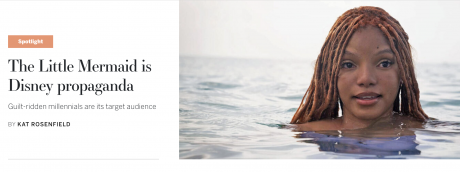
According to “The Little Mermaid is Disney Propaganda,” a 6.5 Unherd article by Kat Rosenfeld, old-fashioned, shamefully un-woke Disney cartoons and animated features on Disney + “come affixed with a hectoring title card that you cannot fast forward through.”
“This program includes negative depictions and/or mistreatment of people or cultures,” it reads. “These stereotypes were wrong then and are wrong now. Rather than remove this content, we want to acknowledge its harmful impact, learn from it and spark conversation to create a more inclusive future together.”
Instead of lopping off the racially offensive nine-seconds from its current streaming of The French Connection, Disney censors could have posted the following at the beginning of the film — another hectoring that couldn’t be fast-fowarded:
“This Oscar-winning film, initially released in 1971, includes negative depictions and/or mistreatments of African Americans. These depictions were wrong then and are wrong now. Rather than remove this content, we want to acknowledge its harmful impact, learn from it and spark conversation to create a more inclusive future together.”
Why didn’t Disney simply choose this option? Nobody would’ve squawked if they had.
From yesterday’s update about the recently discovered removal of a brief, first-act passage in William Friedkin‘s The French Connection (’71), or more precisely in the Criterion Channel’s streaming of same:
“It is nonetheless astonishing that the Criterion Channel is running this version of Friedkin’s Oscar-winning film (Best Picture, Hackman for Best Actor, Friedkin for Best Director, Best Film Editing, Best Adapted Screenplay) without an explanation of some sort.
“This deletion seriously harms the Criterion brand, which has always been about honoring and representing the original artistic intentions of filmmakers. The deletion was apparently Disney’s doing, but Criterion can’t just sit idly by.
“Criterion’s streaming version of The French Connection needs to include a three-point statement, to wit: (a) the following film has been altered from its original state; and (b) is therefore not altogether the same film that opened in 1971 and subsequently won five Oscars, although (c) the alteration was not implemented by the Criterion Channel but by the Walt Disney Company, which owns the distribution rights to the film.”
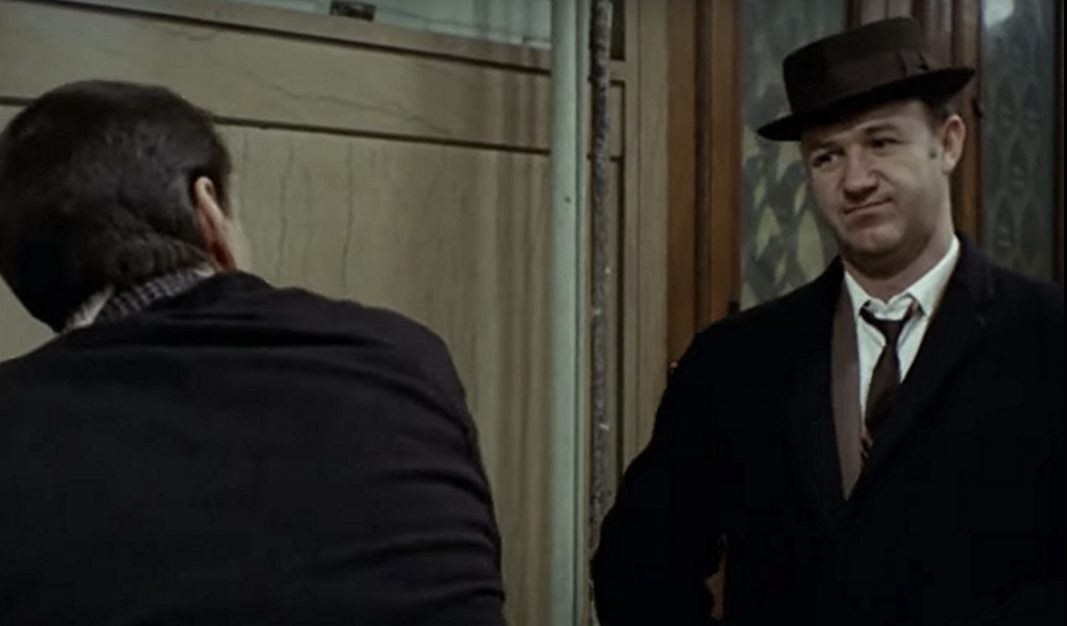
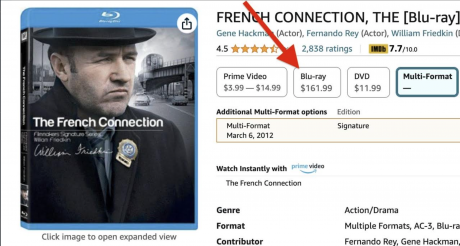
Here are 12 bullet points about the recently discovered removal of a brief, first-act passage in William Friedkin‘s The French Connection (’71), or more precisely in the Criterion Channel’s streaming of same.
1. The absence of this sequence can be confirmed by anyone who streams the Criterion Channel’s version of the Oscar-winning feature. The messed-with sequence begins at the 9:42 mark, during the film’s first act. Gene Hackman‘s Popeye Doyle enters the brightly-lighted main lobby of the police station. He drops off paperwork, puts on his overcoat, walks over to the main door and flexes his hand. Roy Scheider‘s Cloudy follows but at exactly 10:05 a passage that used to be part of the film is no longer there.
2. It’s a bit between Doyle and Cloudy, who’s nursing a wounded arm after being stabbed by a drug dealer. Doyle: “You dumb guinea.” Cloudy: “How the hell did I know he had a knife?” Doyle: “Never trust a [ethnic slur].” Cloudy: “He coulda been white.” Doyle: “Never trust anyone.”
3a. The nine-second sequence (:52 to :59 in the below video) was obviously censored over Doyle’s racially offensive dialogue, specifically the N-word.
3b. It is presumed that the sequence was removed by Disney, which bought the film’s original owner, 20th Century Fox, on 3.20.19, and not The Criterion Channel.
4. The absence of said passage was also reportedly evident when The French Connection was screened at the American Cinematheque’s Aero theatre on Friday, 5.12.23. HE commenter identified as “The Connection”: “I don’t know if anyone else complained. I should have said something to the manager as I was leaving, but I sent them an email the next day asking who changed it (themselves? the studio? the filmmaker?) and [that] in the future they [should] at least advertise that they’re showing an altered version. Since Criterion is now showing the same version, I’m assuming it was the studio, and I wonder if the Aero was even aware of the change.”
5. HE commenter “Gus Petch” (posted Sunday night): “I have multiple recordings of the movie on my DVR. The versions recorded off TCM 4 and 2 months ago are both the censored versions, but the versions recorded off FXM (Fox Movies) 8 months ago are uncensored. Also FWIW, the TCM versions did not have the title screen in front that you often see that the film has been modified for presentation on TV.”
6. HE commenter “Ken Koc” (posted Sunday night): “That [nine-second sequence] is also gone from my purchased copy of The French Connection on iTunes.”
7. It is nonetheless astonishing that the Criterion Channel is running this version of Friedkin’s Oscar-winning film (Best Picture, Hackman for Best Actor, Friedkin for Best Director, Best Film Editing, Best Adapted Screenplay) without an explanation of some sort. This deletion seriously harms the Criterion brand, which has always been about honoring and representing the original artistic intentions of filmmakers. They need to address this issue ASAP.
8. If in fact Disney is responsible for deleting the nine seconds of footage, they owe an explanation to the film’s fans as well as the industry at large why this was done, and whether or not they consulted Friedkin before doing so, and if they intend to delete other portions of other films that feature the N-word.
9. Over the last couple of days I’ve sent emails to various directors and producers, asking them to please forward yesterday’s HE story about the French Connection censorship to Friedkin. I’m presuming that Friedkin would hit the ceiling when he learns of this, and will post some kind of protest statement or perhaps even a video.
 />
/>