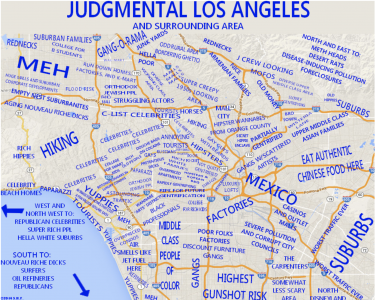
The key to the humor, obviously, is willy-nilly crude labelling…fuck sensitivity…no tippy-toeing. It follows that wokesters (i.e., Jeremy Fassler types) are generally turned off by the implied racism, or at least in their little nickle-and-dime, pearl-clutching minds.
Mort Sahl: “The cruelest jokes are always the funniest.”
Hannah Gadsby, needless to say, disagrees…the best jokes embroider or advance the generic moral-ethical progressive narrative, and they certainly don’t channel what Gadsby regards as Dave Chappelle’s toxicity…either you’re on Hannah’s wavelength or you’re not, and she feels sorry for you if you’re in the latter category.
HE’s favorite Williamsburg neighborhoods: (a) “PROBABLY JEWS”, (b) “assholes,” (c) “ADIOS AMIGOS,” (d) “STUPID HAIRCUTS”, (e) “FRIENDS YOU DON’T TRUST,” (f) “shady” and (g) “Ended up at a party here once.”
HE’s favorite Los Angeles neighborhoods: (a) “MEH”, (b) “BOTOXED COUGARS IN LUXURY CONODS,” (c) “NOUVEAU RICHE DICKS,” (d) “SOMEWHAT LESS SCARY AREA,” and (e) “GANG-O-RAMA.”
For 30 years my West Hollywood pad was smack dab in the middle of “DOUCHEBAGS ON COCAINE” AND “GAYS.”
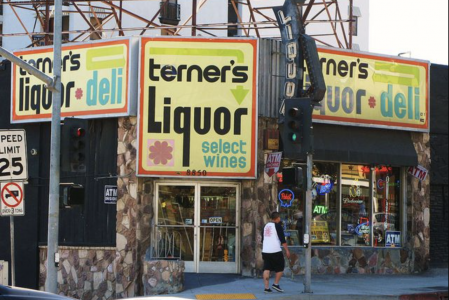
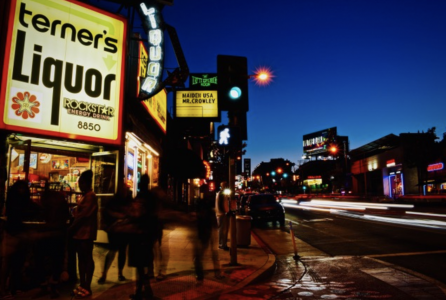
For decades I never felt the slightest affection for Terner’s Liquor (SW corner of Sunset and Larrabee). It was always just a common, overlighted liquor store with clerks who’d absolutely never been to college. I visited from time to time, but I always wanted to bolt as soon as possible. (I’ve been in liquor stores that had nice settled vibes…places that I felt vaguely soothed by.) Terner’s was a soiled establishment.
Aaahh, but the skanky history of the place! The rock-industry druggies and clubbers (the Viper Room is right next door) who stopped in each and every night at Terner’s for smokes and 16-oz. cans of beer and whatnot. I would occasionally visit while waiting for a pizza from Panini across the street. I would buy cheap pocket combs when they were available, but never wine or champagne or cigars — Terner’s was always fundamentally sleazy and unworthy of anything more than incidental purchases.
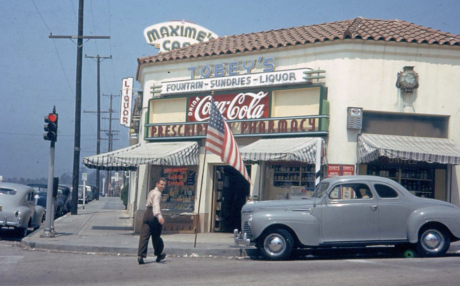
Let’s not forget, by the way, that the people behind “Terner’s” were crassly imitating the name of the more reputable and storied Gil Turner’s Liquors (NW corner of Sunset and Doheny), which opened in 1953. Before that there was a liquor store on the same corner called Tobey’s. Check out the color photo below — notice how Tobey’s had a tidy and well-tended look, and didn’t seem the least bit cheap or tawdry?
Anyway Terner’s is permanently closed now. It’ll soon be torn down to make way for a large glass-box monstrosity called 8850 Sunset Blvd. Strange as it may sound, I’m half-sorry about this. Because as low-rent as it was, Terner’s had personality.
A couple of nights ago I was sitting through (i.e., not exactly watching) The Towering Inferno, and the truth of it hit me. When you break that film down there are three basic elements that make it work — the lead performances by Steve McQueen and Paul Newman and the score by John Williams. Every other element is weak or annoying in some way. Too many explosions, unlikely complications, You could even call the film tawdry, but Williams score gives it a veneer of class. Williams had to know that The Towering Inferno was pricey pablum, but he pulled himself together, manned up and did the job. He sold it.
I know he’s presumed to be Next Big Thing, mostly because of (a) his wimpy, weepy dad performance in Aftersun, (b) his Stanley Kowalski on the British stage earlier this year, (c) his having been tapped to step into Richard Linklater‘s adaptation of Merrily We Roll Along, and (d) his forthcoming starring role as Lucius, the son of Connie Nielsen‘s Lucilla, in Ridley Scott‘s Gladiator sequel.
But for me, the 27 year-old Paul Mescal is a problem. There’s something overly soft and sweet and smiley about the guy. He just doesn’t radiate that solemn, low-key, less-is-more studly male aura. It would be one thing if he had some SteveMcQueen behavior going on, but he doesn’t. He’s just not my kinda guy.
World of Reel‘s Jordan Ruimy is conducting a critics poll of the preferred greatest films of the 1960s.
It not only broke my heart but caused great physical pain to not include The Hustler, Blow-Up, Rosemary’s Baby, Easy Rider, Breathless, Shoot The Piano Player, L’Eclisse, Cool Hand Luke, To Kill A Mockingbird, The Apartment, Repulsion, Psycho, A Hard Day’s Night, The Train, Butch Cassidy And The Sundance Kid, The Magnificent Seven, Bullitt, The Man Who Shot Liberty Valance, Dead Heat on a Merry-Go-Round, Point Blank, etc.
It’s completely infuriating, but when you have to choose ten you have to be brutal, and ithurtssobadly.
HE’s top ten of the ’60s: 1. Dr. Strangelove, 2. Midnight Cowboy, 3. The Manchurian Candidate, 4. L’Avventura, 5. Bonnie and Clyde, 6. 2001: A Space Odyssey, 7. This Sporting Life, 8. The Wild Bunch, 9. The Graduate, 10. Lawrence of Arabia.
What am I really, actually looking forward to at the 2023 Cannes Film Festival, which kicks off a week from tomorrow (5.16)? I’ve put asterisks next to 14 films (below), but when you get right down to it and get past the films you believe that you should see but probably aren’t actually hot to see, the list is shorter.
HE’s serious Cannes hotties (in order of preference): Martin Scorsese‘s Killers of the Flower Moon, Steve McQueen‘s Occupied City, Jonathan Glazer‘s The Zone of Interest, Todd Haynes‘ May December, James Mangold‘ Indiana Jones and the Dial of Destiny, Kore-eda Hirokazu‘s Monster, Jessica Hausner‘s Club Zero, Wes Anderson‘s Asteroid City, Alice Rohrwacher‘s La Chimera. (9)
COMPETITION (9):
* Club Zero, Jessica Hausner
* Asteroid City, Wes Anderson
* The Zone of Interest, Jonathan Glazer Fallen Leaves, Aki Kaurismaki Les Filles D’Olfa (Four Daughters), Kaouther Ben Hania Anatomie D’une Chute, Justine Triet
* Monster, Kore-eda Hirokazu Il Sol Dell’Avvenire, Nanni Moretti
* La Chimera, Alice Rohrwacher About Dry Grasses, Nuri Bilge Ceylan
* L’Ete Dernier, Catherine Breillat The Passion of Dodin Bouffant, Tran Anh Hung Rapito, Marco Bellocchio
* May December, Todd Haynes Firebrand, Karim Ainouz
* The Old Oak, Ken Loach
* Perfect Days, Wim Wenders Banel Et Adama, Ramata-Toulaye Sy Jeunesse, Wang Bing
OUT OF COMPETITION (3):
* Killers of the Flower Moon, Martin Scorsese The Idol, Sam Levinson Cobweb, Kim Jee-woon
* Indiana Jones and the Dial of Destiny, James Mangold
* Jeanne du Barry, Maiwenn
MIDNIGHT SCREENINGS:
Omar la Fraise, Elias Belkeddar Kennedy, Anurag Kashyap Acide, Just Philippot
SPECIAL SCREENINGS (2):
Retratos Fantasmas (Pictures of Ghosts), Kleber Mendonca Filho
* Anselm, Wim Wenders
* Occupied City, Steve McQueen Man in Black, Wang Bing
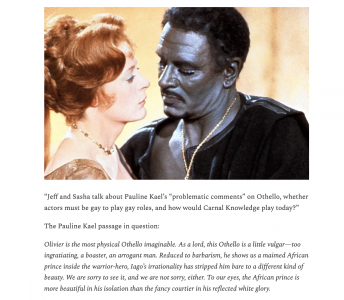
Laurence Olivier‘s Othello (1965) is a capturing of the National Theatre Company’s 1964-65 staging of Shakespeare’s classic tragedy. Directed by Stuart Burge. It stars Olivier, Maggie Smith, Joyce Redman and Frank Finlay; Derek Jacobi and Michael Gambon made their film debuts in it.
“Olivier’s Othello is history already; it’s something to remember. And Othello isn’t even much of a ‘movie’. Just a reasonably faithful (one assumes) record of a stage interpretation. After thirty-five years in movies and masterpiece upon masterpiece acclaimed in the theatre, Olivier still could not raise the money to do a real movie version of his Othello. And of his Macbeth, acclaimed as the greatest since [something], we have not even a record.
“Olivier’s greatness is in his acting; as a movie director, he is merely excellent and intelligent.
“Yet his Shakespearean performances deserve — at the minimum — the kind of movie he or other talented directors might do, what he brought to Henry V, Hamlet, Richard III. It is a scandal, an indictment of Anglo-American civilization and values, that eight million dollars can go into a spy spoof, twelve into a comic chase, twenty-seven into a spectacle, and for Olivier in Othello, we and history must content ourselves with a quickie recording process.
“And yet the joke is on the spoofs, chases and spectacles. For Othello lives.
“Olivier is the most physical Othello imaginable. As a lord, this Othello is a little vulgar — too ingratiating, a boaster, an arrogant man. Reduced to barbarism, he shows us a maimed African prince inside the warrior-hero, Iago’s irrationality has stripped him bare to a different kind of beauty. We are sorry to see it, and we are not sorry either. To our eyes, the African prince is more beautiful in his isolation than the fancy courtier in his reflected white glory.
“I saw Paul Robeson‘s Othello [for the Royal Shakespeare Company in Stratford in April 1959], and he was not black as Olivier is; Frank Finlay can hate Olivier in a way Jose Ferrer did not dare — indeed did not have the provocation — to hate Robeson. Possibly Negro actors need to sharpen themselves on white roles before they can play a Negro. It is not enough to be: for great drama, it is the awareness that is everything.
“Every time we single out the feature that makes Olivier a marvel — his lion eyes or the voice and the way it seizes on a phrase — he alters it or casts it off in some new role, and is greater than ever. It is no special asset, [but] the devilish audacity and courage of this man.
“Olivier, who, for Othello, changed his walk and talk, is a man close to sixty who, in an ordinary suit in an ordinary role, looks an ordinary man, and can look even smaller in a role like Archie Rice in The Entertainer. What is extraordinary in Olivier is what’s inside, and what is even more extraordinary is his determination to give it outer form.” — from a Pauline Kael essay that appeared in McCall’s in March 1966.
By the way: I found it odd that Meriem Perez Riera‘s Rita Moreno: Just A Girl Who Decided To Go For It (Roadside, 6.18.21) didn’t even mention Moreno’s cameo in Carnal Knowledge, presumably because Riera didn’t approve of Moreno playing a prostitute… But of course, Moreno’s character, ‘Louise,” has the power in this scene. She’s indulging Jack Nicholson’s need for pathetic fantasy in order to have a decent erection — she’s going along with the act, of course, but obviously finds it ridiculous and a little bit sad.
…would the Zoomers and Millennials be appalled, or would they say “yes!…this is what we’ve been talking about!…the mid-30ish white guys in this film are truly diseased, and this proves why we need more angelic men of color and gay guys and trans-persons in positions of responsibility…this is exactly what we’ve been talking about!”
“You were talking earlier about why woke ideology is so dangerous to the west…it’s because people in other parts of the world are not teaching their young children to hate their own country. And if [the American wokester mafia] continue to do this, how is the west going to do in the battle of civilizations? Because that’s what we’re in, right? The Asians want to thrive, the Russians want to thrive…and they’re teaching their children to be strong, to be confident, to go out there and learn science instead of, you know, equity and diversity.” — Konstantin Kisin on the most recent Real Time with Bill Maher.