I don’t know about seeing Paul Weitz‘s Moving On (Roadside, 3.17). A white-haired Jane Fonda telling white-haired wife abuser Malcolm McDowell that she intends to kill him is a silly contrivance. Where’s the upside or the intelligence in offering a warning? Unless, of course, Fonda is only looking to frighten.
I’ll tell you what’s frightening — the difference between present-tense McDowell and the way he looked in Lindsay Anderson‘s If… (’68).
At least I’m now thinking of re-watching Martin Brest‘s Going in Style (’79), which wasn’t half bad. (Or was it?) At the very end of the trailer George Burns says about a chubby kid, “If he eats any more jelly donuts they’re going to have to take him to kindergarten in a moving van.” One, that’s fat-shaming. Two, maybe the kid grows up to be Vincent D’Onofrio‘s Private Pyle from Full Metal Jacket (’87)?
Last night the London Film Critics Circle, whose choices have often reflected where things are generally heading, didn’t tumble for Everything Everywhere All At Once…sometimes there’s God so quickly!
Todd Field‘s Tar won their Best Film and Best Director award. The Best Actor and Best Actress awards went to The Banshees of Inisherin‘s Colin Farrell and Tar‘s Cate Blanchett, and the Best Supporting and Actress trophies went to Banshees‘ Barry Keoghan and Kerry Condon.
I’m not saying this means a whole lot but obviously it means something, given the London Critics Circle track record and the fact their choices have always been smart. Over the last ten years their Best Film awards have gone to Amour, 12 Years a Slave, Boyhood, Mad Max: Fury Road, La La Land, Three Billboards Outside Ebbing, Missouri, Roma, Parasite, Nomadland and The Power of the Dog. They vote smarter than the Academy, but not too far afield.
They built and labored and created alongside dozens of tribes and cultures, and they certainly weren’t the only ones who suffered grievously as this country gradually developed and bloomed and grew into itself…a nation of primarily European-descended immigrants (even today) and a conflicted multicultural stew.
Two and a half years ago (7.30.20) I posted a loose-shoe retort to the 1619 Project, which attempted to (a) define the U.S. of A. as an empire built upon slavery and (b) to define 1619 (when the first slaves arrived in Virginia) as this country’s primal defining event rather than the signing of the Declaration of Independence in 1776.
In the wake of Disney’s The Proud Family: Louder and Prouder, which at least partly seeks to indoctrinate 5 to 7 year-olds into the theology of anti-white racism and the basically racist idea that whites are inherently evil, and with the understanding that anti-racism essentially advocates for the furtherance of more racism (i.e., defining ourselves primarily by race and the huddling of separate tribes, pride within those tribes, white against black, etc.) and with the Proud Family chant of “slaves built this country,” I’m reposting “What’s Your 1619 Beef?”
“Slavery has always been an ignominious chapter in the first 245 years of US history (1619 to 1865) and racism has stained aspects of the culture ever since, but to assert that slavery and racism (which other cultures have shamefully allowed over the centuries) are THE central and fundamental definers of the immense American experience strikes many of us as a bridge too far.
“Many factors drove the expansion and gradual strengthening and shaping of this country, and particularly the spirit and character of it…here are 40 for starters, posted in groups of 10:
1. Immigration. 2. The industrial revolution and the cruel exploitations of sweat-shop workers by wealthy elites; 3. The delusion of religion; 4. Anti-Native American racism and genocide; 5. the American Revolutionary War against the British; 6. The mid 19th Century influence of Abraham Lincoln, Frederick C. Douglas, John Brown and Harriet Beecher Stowe; 6. The vast networks of railroads; 7. Selfishness & self-interest; 8. Factories and construction; 9. The two world wars of the 20th Century; 10. Scientific innovation.
11. Native musical forms including jazz, blues (obviously African-American art forms) folk and rock; 12. American literature; 13. The influence of New York theatre and Hollywood movies; 14. 20th and 19th Century urban architecture; 15. The influence of Frank Lloyd Wright and Frank Gehry; 16. Major-league baseball (Babe Ruth, Lou Gehrig, Hank Aaron, Stan Musial, Mickey Mantle, Yogi Berra, Roger Maris); 17. Family-based communities and the Protestant work ethic; 18. Fashion and the garment industry; 19. Midwestern farming and individual gardening; 20. Native cuisine and the influences of European, Mexican, Asian and African cultures, not to mention hot dogs with mustard.
21. The shipping industry; 22. Hard work and innovation in all industries great and small; 23. John Steinbeck, George Gershwin, Paul Robeson, Louis Armstrong, JFK, MLK, Stanley Kubrick, Chet Baker, John Coltrane, Marilyn Monroe, Amelia Earhart, Malcom X, Taylor Swift, Charlie Parker, Elizabeth Warren, Woody Guthrie, Katharine Hepburn, Aretha Franklin, Jean Arthur, Eleanor Roosevelt, Carol Lombard, Shirley Chisholm, Marlon Brando, Woody Allen; 24. Barber shops; 25. Manual lawnmowers; 26. The auto industry; 27. Prohibition & gangsters; 28. The Great Depression and the anti-Communism and anti-Socialism that eventually sprang from that; 29. Status-quo-challenging comedians like Richard Pryor, Lenny Bruce and Steve Allen (“schmock schmock!”), 30. Popular music of the ’50s, ’60s and ‘70s (Chuck Berry, Little Richard, Elvis Presley, Frank Sinatra, Beatles and Rolling Stones, Queen).
31. Television, cable and streaming; 32. Great American universities; 33. Great historians; 34. Great journalism (including the National Lampoon and Spy magazine); 35. Great poetry; 36. Beats, hippies and post-Stonewall gay culture; 37. The anti-Vietnam War movement; 38. Pot and psychedelia, cocaine, quaaludes; 39. The late ’70s splendor of Studio 54; 40. 20th & 21st Century tech innovations (Steve Jobs).
[Starting at 4:20] “And if you think for one second that Indiana Jones 5 (Disney, 6.30) is gonna put Lucasfilm back on top, all I can say is ‘well, bless your heart, you sweet summer child!’ Nobody, and I mean nobody in the entire universe, wants to see a geriatric Indiana Jones get humiliated and replaced by a goofy British comedy actress whose claim to fame [within the realm of popcorn franchises] is voicing an insufferable droid in a failed Star Wars movie.
In my book Phoebe Waller-Bridge‘s claim to fame was (a) creating Fleabag and (b) having helped punch up the screenplay of No Time To Die.
In Indy 5 Waller-Bridge plays Helena Shaw, Indiana Jones’ goddaughter and the reported catalyst of the film, dragging Grandaddy Indy / Uncle Festus into situational difficulties that she ignited or is otherwise responsible for.
Basic CD thesis: Over the last few years the once family-friendly, entertainment-for-entertainment’s-sake Disney has been fucking up franchises and swallowing wokester pills (i.e., vigorous injections of gay and trans-friendly content, attempting to feed young children with white-people-bad content. The resulting lack of popularity among Average Joes has led to Disney share prices dropping almost 50% over the last two years — “from an all-time high of $200 a share in early ’21 to just $110 per share now.” Go woke = go broke.
Inner Affleck to himself: “I hate this but I have to do it…Jesus, man up! Pretend that you’re having a half-decent time. Do you want to become the latest misery meme? Remember that Simon & Garfunkel thing?”
Everyone else: “That‘s pretending? You’re telling the whole world what you’re going through, bruh. You look miserable.”
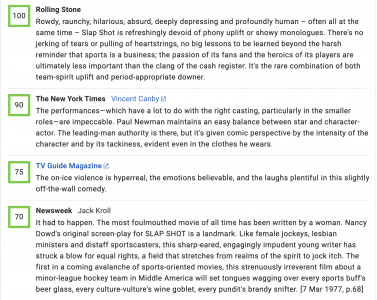
George Roy Hill‘s Slap Shot (’77) has gotten better with each successive re-viewing. Nancy Dowd‘s screenplay is based on her brother Ned’s rough-and-tumble experience with the Johnstown Jets, a minor-league Pennsylvania hockey team. And yes, in the early to mid ’70s violence was a serious selling point with the low-rent fans.
But the film doesn’t feel “realistic”…not really or fully. It may take a while during your first viewing, but it gradually hits you that Slap Shot is a brilliantly sustained farce — partly a satire of crude, working-class lifestyles and sensibilities, and partly a kind of valentine to same.
Assembled and finessed to a fare-thee-well (dp Victor Kemper and editor Dede Allen are a dynamic duo), it’s a blend of grim blue-collar realism and coarse slapstick. The characters are all trapped in a kind of blue-collar, no-exit hellscape, but only a couple of them (the married malcontents played by Michael Ontkean and Lindsay Crouse) succumb to anything close to lethargy. Everyone else is indefatigable.
And the violence is hilarious. Damn near every line is about making fun of these yokels, and yet Hill and Dowd clearly love them. It’s almost spooky how intoxicating it all is. Except, that is, for the climactic striptease-on-the-ice scene, which I’ve never believed.
Above The Line‘s Jeff Sneider and Perri Nemiroff clash over Women Talking starting around the 53:00 mark. Sneider: “It’s number 10! It will win if every woman in the Academy votes for it. It won’t win because no men in the Academy will be voting for it. This is a bad movie…simple as that.” It gets even better at 56:30: Sneider: “It belongs nowhere near this [Best Picture] race…what a fucking boring waste of time!”
HE to Sneider, Nemiroff: Steven Spielberg‘s The Fabelmans has no chance to win…nobody hates it but nobody really thinks it’s all that great…it’s a semi-agreeable, very broadly acted family film (especially on Michelle Williams‘ part) which contains very little compelling material except for that concluding scene with John Ford / David Lynch. If it weren’t for the kneejerk Spielberg kowtow factor, it wouldn’t even be in the conversation.
HE to readership, Movie Godz, everyone within the sound of my voice: “Watch the skies…no. For the love of God and the betterment of civilization, stop Everything Everywhere All At Once…a grueling, agonizing, interminable piece of medieval torture …a harbinger of cultural ruin and a cinematic apocalypse if I ever saw one…all hail the GenXers and boomers who despise it with every fibre of their being, and there are many who feel this way.”
SNL had a chance to gently satirize The Last Of Us, or more particularly episode #3 (i.e., bearded middle-aged bear couple finds true love and domestic bliss). But of course, they would’ve have gotten in trouble for making even gentle fun of it so they candy-assed out. SNLalways often avoids pointed satiric barbs. If I’d been the writer-producer of such a segment, I would have had the two actors pretending to be Nick “drop that towel” Offerman and Murray Bartlett…I don’t know, I would have made them look twice as bearish.
Guy Ritchie’s The Covenant (UA Releasing, 421) was shot a year ago near Alicante, Spain. It’s basically a “do the right thing” rescue mission flick. Recovering from a war wound, Sergeant John (Jake Gyllenhaal) is determined to save a local interpreter (Dar Salim) who once saved John. Somewhat reminiscent of Sam Waterston‘s Sydney Schanberg determined to save Haing Nor‘s Dith Pran in The Killing Fields.
I don’t trust Ritchie but let’s see what develops.
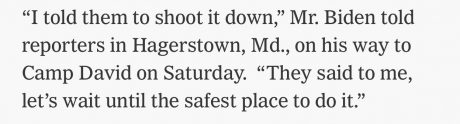
Team Biden apparently waited until the Chinese spy balloon was over the sea (off the coast of South Carolina) to shoot it down.
What I want to know is this — where’s the cathartic Tom Cruise-Jerry Bruckheimer kill shot explosion? I wanted to see the balloon taken down dramatically, and now I feel shortchanged.
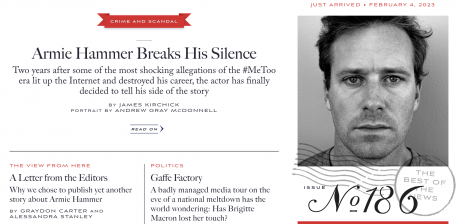
I’m not going to summarize the main points of James Kirchick’s 2.4 Air Mail article as anyone can read it (it’s not paywalled), but there’s no question that anyone with an open mind will emerge with their previous impressions strongly challenged.
I read the article this morning, and many of the accusations against Hammer look kinda flimsy now, I can tell you that.
At the very least readers will conclude that Kirchik’s piece has downgraded Armie’s status from that of an alleged monster and ruthless rapist-carnivore to the much less odious label of admitted former asshole (an asshole in recovery, I mean) who knows where the BDSM attraction came from (i.e., sexual abuse as a powerless youth).
The article claims that Hammer’s primary sin was using his power as a rich, famous actor in his 30s (“power imbalance” being a major #MeToo felony these days) to sexually overwhelm various younger women and then (this is what really got him in trouble) ghosting them when he decided to abruptly or whimsically end the affairs like that.
Message to everyone: “Ghosting” a lover really hurts and often leads to revenge moves. If you want to move on, save yourself a lot of trouble by conveying this in some kind of half-considerate way.
We all agree that ignoring a safe word is an awful thing to do, and this charge hasn’t been specifically addressed in the article (or maybe I read it too fast) but the sexual behavior of Armie and the various women who participated, so to speak, is addressed and explained. Hammer raped no one, he says — it was all a consensual game with rules and a particular script laid out in advance.
Hammer seems to be mainly guilty of behaving like a sexual obsessive. He certainly didn’t chew on anyone’s rib or cut off a woman’s toe and put it in his pocket….none of that crazy stuff.
Excerpt #1: “The Hammer case raises questions about the media. Virtually without exception, the press has treated the accusations from Hammer’s professed victims, no matter how fantastical, with utter credulity. As recently as last October, for instance, a story in New York magazine claimed that Hammer stands accused of ‘possible cannibalism.'”
Excerpt #2: “One prominent Hollywood figure has decided to speak out unreservedly in Hammer’s defense. ‘I found him to be so polite and so well mannered and so nice and so funny and so real,” says Howard Rosenman, the veteran producer of Call Me by Your Name. ‘And don’t forget, I spent time with him a lot, both in Crema and on the road, when we were on the Oscar trail. So all of [the allegations are] just pure bullshit, and yes, he deserves a second chance.’
“Rosenman, who is gay and has been involved in some of Hollywood’s most important gay-themed films (The Celluloid Closet, Common Threads: Stories from the Quilt, Milk), sympathizes with Hammer as someone whose sexuality was once considered taboo. ‘It’s been puritanical,” Rosenman says of the media’s prurient coverage. ‘The kink-shaming is just awful. I, as a gay man who had sex for many, many years with many different kinds of people, understand this better than anyone.”
“In a recent podcast interview, Luca Guadagnino said that he ‘cannot wait to work with Armie as soon as I have a great role for [him].'”
Excerpt #3: “When I ask [Hammer] if he takes inspiration from his mentor Robert Downey Jr., who was arrested multiple times in the late 1990s on drug charges and spent several spells in jail, his answer turns toward the mythological: ‘What I would say is this: There’s examples of people who went through really difficult times and experienced what [the author] Joseph Campbell would call ‘the hero’s death.’ And the hero must die so the hero can be reborn again.’