Son of Young Walken Moments

[Initially posted on 8.16.21, or 15 months ago]: It was late in the afternoon in the fall of ’78 when I ran into Chris Walken upon the New York-bound platform of the Westport train station.

Tall and slender and good-looking in a curious, off-center sort of way, Walken looked that day like he does in the below interview, which was taped in late ’80. He was 35 but could’ve been 29 or 31. Same hair, same calmness of manner, same “waiting for something to happen” watchfulness.

I’m pretty sure it was a Sunday. I’d been visiting my parents (Jim and Nancy) in Wilton. Walken had been in Westport to visit his manager, Bill Treusch.

Our encounter happened two or three months before The Deer Hunter opened. I hadn’t seen that pretentious, wildly overpraised Michael Cimino film at the time, and it was probably for the better. I was simultaneously taken aback (“Whoa, this movie is up to something!”) and at the same time irritated. Those ridiculous Russian roulette scenes, that interminable Russian wedding celebration and those absurd mountain peaks in rural Pennsylvania drove me insane. I was surprised and moved by the “God Bless America” finale.

At that precise moment in time I knew Walken from only two roles — that “who’s this guy?” performance in Paul Mazurskys Next Stop, Greenwich Village (’76) and his bit part as Diane Keaton‘s weird, soft-spoken brother, Dwayne, in Annie Hall (’78).

Anyway I stepped up to the platform, ticket in hand, and there he stood, reading a newspaper. I felt a certain natural kinship with Walken as I resembled him somewhat, and I wasn’t shy back then anyway so I introduced myself. Walken was cool and casual (“I’m Chris”), and we wound up talking all the way into Grand Central Station.

I visited Walken’s Upper West Side apartment twice in ’79, although he wasn’t there. I had an excellent thing going with a lady named Sandra, you see, who was working for Walken and his wife as a kind of au pair girl or house-sitter. I remember the oriental rug on the living room floor, you bet, and the wood-burning fireplace in front of it. I don’t know why Sandra and I didn’t last for more than four or five weeks but it wasn’t for lack of interest on my part. She was quirky and moody, but that was part of the allure.

I spoke to Walken one or two years later (’80 or ’81) when I went backstage at the Public Theatre after a performance of The Seagull. (He played Trigorin, and rather well at that.). He had no recollection of our train-ride discussion. Zip. I could have mentioned Sandra as an ice-breaker but I thought better of it.

The chicken-and-pears video was shot, I’m presuming, at Walken’s home in Wilton, Connecticut, which is where I lived for a few years and where I did my last two high school years. Paul Dano went to high school there also. And Keith Richards has a big home there.

I love, love, love, love the way Chris Walken pronounces “chicken” and “pears.” Certain people says certain words perfectly, and I mean better than anyone else in the world. Walken saying “pears” (“peahrs“) is like Peter O’Toole pronouncing “ecclesiastical.”

When Driving At Night

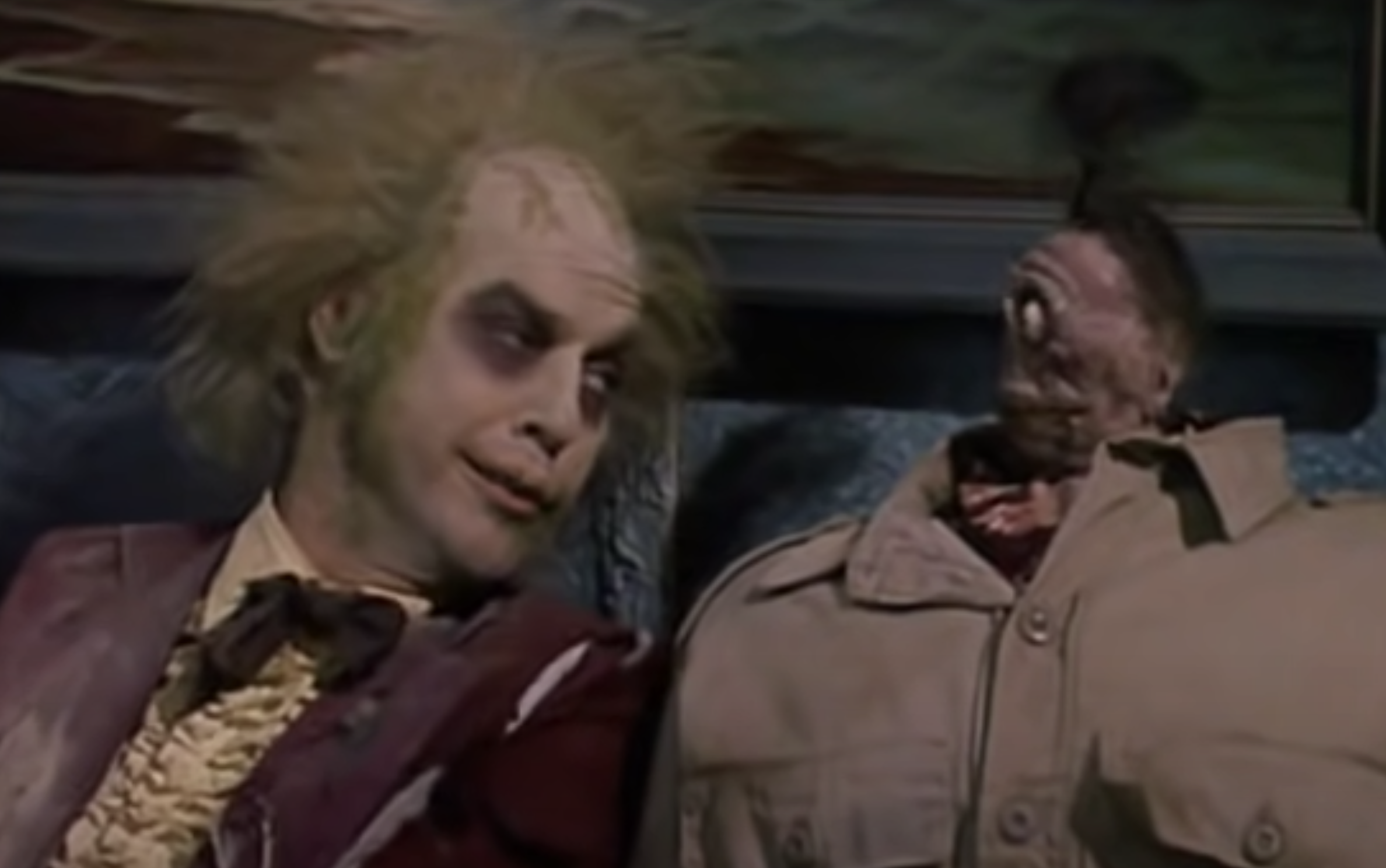
…on a four-lane blacktop I tend to stay to the right, largely because driving in the left lane (or the one closest to the yellow dividing line) makes me more vulnerable to the Dwaynes of the world who might want to suddenly veer across the line and smash head-on into an oncoming vehicle. If you’re in the right lane it’s much easier to avoid a potential Dwayne. I’m serious about this. I believe there are definitely some Dwaynes out there, thinking about suicide and self-destruction. Why not play it safe or at least safer?

George Harrison’s “All Those Years Ago”

A 64 year-old Louisiana woman who claims to have been sexually fiddle-faddled by Warren Beatty 49 years ago, when she was 14 and 15 and therefore a minor, has filed a lawsuit against the 85-year-old actor-director.

The alleged relationship between Beatty and the plaintiff, Kristina Charlotte Hirsch, happened, she claims, throughout most of 1973, when Beatty was 35 and 36. Hirsch claims to have met Beatty in January 1973, and was involved in some kind of sexual relationship with him until the end of that year. She claims she and Beatty first met on a movie set — presumably The Parallax View, a paranoid thriller that was shot in ’73 and released in June ’74. Beatty starred; Alan Pakula directed.

Yeah, I know — why wait 49 years to attempt a shakedown? Because of the protection afforded by #MeToo community, for one thing. There’s also the California Child Victims Act, which allows survivors of any age to pursue justice, no matter how old they are, when the abuse occurred, or if their abuser is alive or dead.

The CCV Act has to be acted upon within a three-year window, starting in 1.1.20 and ending on 1.1.23. Hirsch could have filed the Beatty lawsuit as early as 1.1.20, but didn’t then and didn’t for the rest of that year.. She also sat silent throughout 2021 and throughout the first three-quarters of 2022. Her lawsuit was filed last Monday by Jeff Anderson & Associates.

Read more

Three “Fabelman” Keepers

[Steven Spielberg‘s latest film has already been heavily reviewed, discussed, spoiled and Twitter-poked. Nonetheless spoiler whiners are hereby warned.]

I caught Steven Spielberg‘s The Fabelmans (Universal, 11.11) last night, and like everyone else I was prepared to be mildly disappointed. Because the word on the street is that this 151-minute family film isn’t nearly as great as those suck-uppy Toronto critics said it was. A decent film in many respects, some have said, and highlighted by a few…make that three stand-out scenes, but calm down. So I was ready for a mixed-bag experience, and that’s exactly what I realized it was as I left the theatre around 9 pm.

It’s all right in some respects and very good in terms of those three scenes (Judd Hirsch soliloquy, Gabriel LaBelle‘s teenaged “Sammy” shooting WWII battle scenes in the Arizona desert with verve and ingenuity, Sammy meeting the cantankerous John Ford at the very end) but it’s no Oscar frontrunner, I can tell you that. At best it’s a soft frontrunner because there’s no big consensus film that appears ready to elbow The Fabelmans aside.

It’s basically an overlong, broadly-played family movie about a kid learning the basic filmmaking ropes while his parents edge toward divorce, and it really doesn’t feel natural — for my money it feels too “performed”. Especially in the matter of Michelle Williams‘ Mitzi Fabelman, Samy’s colorful, excitable, piano-playing mom.

Judd Hirsch’s big scene aside, the family saga is…I’m not saying it’s boring but I wouldn’t call it especially rousing either, and Spielberg doesn’t seem to realize this. And he definitely lets it go on too long.

You have to ask “what if The Fabelmans wasn’t a largely autobiographical tale about Spielberg’s childhood…what if it was just a story about some boomer kid who loved movies and wanted to make his own?”

The fact is that without the Spielberg factor, without us knowing that this is the kid who went on to make Jaws, Raiders of the Lost Ark, Jurassic Park and Schindler’s List…if this was just the story of a filmstruck kid, it wouldn’t have been made because it doesn’t have that much in the way of basic magnetism…it’s just the slow story of a marriage that slowly falls apart and about how the oldest son deals with it all.

The Fabelman saga (cowritten by Spielberg and Tony Kushner) is simply not that riveting, and yet it means so much to Spielberg that he doesn’t seem to realize it’s only intermittently engaging to Average Joes. If he had realized this, he would have made it shorter. It should have run two hours max, not two and a half.

I’m not calling it a wholly unsatisfying or a poorly made film, but it’s mostly a so-so experience.

The only parts that I really liked were those that focused on Spielberg shooting and showing stuff. The marital infidelity stuff (Williams cheating on Paul Dano with Seth Rogen‘s “Uncle Benny”) was frankly trying my patience. The anti-Semitic high-school bully scene in the hallway doesn’t really work. And in the 1952 section, Sammy’s parents can’t understand why Sammy crashed his toy train set? They’ve just recently taken him to see The Greatest Show on Earth and they can’t figure it out?

The only scene I really adored was Sammy meeting grumpy old John Ford (David Lynch). The moment when the Searchers music begins playing as Sammy is looking around at the posters on the wall…this is the greatest moment in the film. Ford endlessly lighting the cigar was too much but barking at Sammy about the horizon lines was great.

The fact is that during most of the film I was losing patience. I just didn’t care all that much. I kept asking myself “when is this film going to leave the ground and get airborne”? It finally does at the very end with Ford/Lynch,

Julia Butters, who plays Sammny’s younger sister, isn’t as good here as she was in Quentin Tarantino‘s Once Upon A Time in Hollywood because she’s obliged to perform in a Spielberg vehicle in a Spielbergy fashion.

And that weird Jesus-freak girlfriend Sammy falls in with in Northern California! She was like a farcical sitcom character, like somebody out of Happy Days.

Read more

“Causeway” — Slow-Paced, Well-Acted Slog

Lila Neugebauer and Jennifer Lawrence‘s Causeway (Apple, theatrical + streaming), is an extremely solemn, snail-paced, drip-drip recovery drama.

Lawrence is Lynsey, a gay U.S. soldier who suffered brain damage during a recent tour in Afghanistan. I saw it last night, and although the running time is 92 minutes it felt like two hours, minimum.

Lawrence is believably plain, but the performance by costar Brian Tyree Henry struck me as actorish and inauthentic.

Supporting players Linda Emond, Jayne Houdyshell, Stephen McKinley Henderson and Fred Weller are good enough.

Serious Best Picture Judgment Calls

Indiewire‘s Anne Thompson and Marcus Jones have posted several Best Picture Oscar predictions. Some of their calls have merit; others are a joke. Their choices are pasted below.

Among the Thompson-Jones picks, HE has boldfaced the titles of films that are either actually good or are thought to be genuinely good, and which may seriously deserve Best Picture consideration.

In fact, before picking apart the Thompson-Jones calls, here are ten of HE’s Best Picture projections, mostly based upon the fact that the films are (or in some cases are presumed to be) actually good and/or held in high esteem, and therefore deserving of a BP nomination. These are not political predictions as much as judgment calls:

1. The Fabelmans
2. TÁR
3. Top Gun: Maverick
4. Avatar: The Way of Water
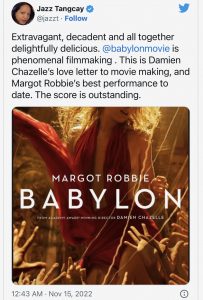
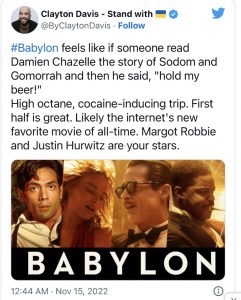
5. Babylon
6. Empire of Light
7. She Said
8. Armageddon Time
9.
Bardo
10. Close

Thompson-Jones reactions: The letters UL (as in “unfortunately likely”) appear next to films that aren’t good enough but will probably be be nominated anyway. The letters NH (as in “not happening”) appear next to films that haven’t much of an emotional or political prayer. The words FORGET IT are placed next to titles which HE regards as absurd and/or ridiculous in this context.

Frontrunners:

The Banshees of Inisherin / UL
Black Panther: Wakanda Forever / FORGET IT
Elvis / UL
Everything Everywhere All at Once / / UL
The Fabelmans
Guillermo del Toro’s Pinocchio / ANIMATION
TÁR
Top Gun: Maverick
The Woman King / FORGET IT
Women Talking / NH

Read more

“People Are Amazing” — aka “Meerhit”

We all understand that Brendan Fraser‘s performance as the 600-pound “Charlie” in Darren Aronofsky‘s The Whale (A24, 12.9) is going to result in a Best Actor Oscar nomination, and perhaps even a win.

What many of us don’t understand is what the tearful Fraser is saying at the 45-second mark. I realize, of course, that he’s not saying “people are meerhit” but I’ve listened seven or eight times with headphones. and that’s what it sounds like — “people are meerhit.”

Update: A director friend informs that Fraser is saying “people are amazing.”

“According to the CDC, obesity impacts 49.6% of African Americans and 44.8% of non-white Hispanic Americans, compared to only 42.2% of white Americans.

“Black and Brown children are also disproportionately affected by childhood obesity. 2017 CDC data indicates that among racial groups, obesity impacts 25.6% of non-white Hispanic children and 24.2% of African American children, compared to only 16.1% of white children. These obesity disparities result from a complex confluence of socioeconomic, environmental, cultural, and psychological factors.” — Center for Healthcare Innovation, 6.8.22.

Only 42.2% of white Americans” are obese? ONLY??

Six years ago: “The prevalence of obesity in the U.S. population has increased steadily since the 1960s — from 3.4 percent of adults in 1962 to 39.8 percent in 2016, the year of the most recent Centers for Disease Control and Prevention data. In all, 180.5 million people or 60.7 percent of the population, ages 2 and over — were either obese or overweight.”

Should Chris Rock Have Been Chosen?

…to host the 95th Oscar telecast, I mean? Did the producers even reach out in this regard? Maybe not, but Jimmy Kimmel is fine.

I’ll always associate Kimmel with what many of us feel was The Greatest Oscar Finale in Hollywood History — the ballot screw-up between Moonlight and La La land. I love watching the unedited footage of that snafu, and in my book Kimmel handled the chaos fairly well.

Is Kimmel’s brand of humor too woke? The right thinks so because he’s brutally lambasted Trump for so many years, but I’ve never felt that he was especially guilty on that score.

I also think the Oscar producers tapped Kimmel because they wanted to close the books on the Oscar slap. I also think they wanted to signal that the Oscars don’t necessarily have to be the Anglo Apology BIPOC awards.

Kimmel hosting again is a gesture that says to viewers “okay, we’re pulling back a bit…we’re reaching back to the vibe and attitudes of early ’17, or before the woke virus took over. Quality is quality and may the most gifted or politically popular contenders win, but we’re easing up on the white guilt or white apology factor.”

Read more

No Sale

Last Thursday (11.3) an official trailer for Laure de Clermont-Tonnerre‘s Lady Chatterly’s Lover (Netflix, 12.2) appeared. The trailer is decently cut but it obscures a basic problem that I had with the film, which I caught a couple of months ago in Telluride.

HE review, posted on 9.7.22: “Actors should be allowed to play whomever or whatever. In a perfect world none of us would or should have a problem with a straight actor playing gay or vice versa, or a non-Latino playing Fidel Castro or you-name-it.

“Acting is about submitting and becoming, and whenever a particular effort succeeds it’s glorious. I can still enjoy Alec Guinness‘s Prince Feisal in Lawrence of Arabia, his actual ethnicity be damned. I’ve always believed in his storied brilliance. All Guinness has to do is speak a line or two…sold.

“Then why, I was asking myself, did I have trouble submitting to Emma Corrin‘s lead performance in Lady Chatterly’s Lover?

“Corrin was a perfect Lady Diana in The Crown, and yet I had difficulty accepting her as a wealthy cis British woman succumbing to runting passion in the 1920s blah blah. Nor did I believe that her earthy gamekeeper lover (Jack O’Connell) had any special passion for her. I felt only the effort.

“This is probably at least partly because Corrin has been somewhat pronounced about being queer (she came out in July 2021) and adopting “they/them” pronouns and being nonbinary and wearing breast flatteners and whatnot.

“Plus there’s just something about her that seems coy and stand-offish about sensuality in any form.

“I said a somewhat similar thing about the late Olivia De Havilland when she passed in late July 2020. To me OdH always seemed to lack a sensual ignition switch. Too goody two-shoes or something. I was immediately disciplined for saying so. Variety‘s Steven Gaydos accused me of ‘pissing on her coffin.’ I replied that detecting an absence of a sensual undercurrent in De Havilland was not dismissive or derogatory.

“I’ll never not appreciate Corrin’s first-rate skills, but I just couldn’t believe that her Lady Chatterly was hungry for the proverbial thrusting loins. I kept telling myself ‘forget Corrin’s stated real-life identities’ — just sink into her soul and absorb the feelings and let the movie wash over you and carry you along. But I couldn’t.

“And I’m saying this as someone who truly loved Jonathan Groff‘s straight FBI guy in Mindhunter, Cate Blanchett‘s vampy lipstick lesbian in Carol, Kevin Spacey‘s miserable married suburbanite in American Beauty, Peter Finch‘s gay doctor in Sunday Bloody Sunday and so on. Great acting is great acting, but…well, I’ve said it.”

Read more

Buried Dialogue Is An Actual Thing

I’ve been complaining about all-but-unintelligible movie dialogue for several years now, and the almost uniform response from the HE commentariat has been that it’s mostly my fault — my hearing isn’t what it used to be so I need to get a hearing aid and blah-dee-blah.

That may be true to some extent but movie dialogue has nonetheless been increasingly hard to understand over the last decade or so, and it’s absolutely not entirely my fault.

According to Slashfilm’s Ben Pearson and an absolutely historic article that I was too distracted to read until today, a good amount of the blame is on actors, mixing boards, theatre sound systems, Chris Nolan, etc.

Please accept my humble, bended-knee apology for overlooking Pearson’s piece, titled “Here’s Why Movie Dialogue Has Gotten More Difficult To Understand.”

And please read it, and then watch the video.

Pearson says the chief culprits are (a) Chris Nolan, who has made a fetish out of mixing his films so you can barely hear the dialogue, (b) self-conscious actors who deliver “soft, mumbling, under-their-breath delivery of some lines,” (c) a lack of respect for sound recording during principal photography, (d) too many digital tracks resulting in de-prioritizing dialogue, (e) mixing for cinemas vs. mixing for streaming.

One thing Pearson doesn’t mention is vocal-fry murmur, which Millennial and Zoomer actresses began to project back in the early teens. I first wrote about the vocal-fry plague eight years ago.

All I know is that I’m really looking forward to watching Tar at home with subtitles — something tells me this will be transformative.

To Die in Paris Wearing a Bow Tie

Andrew Prine, a respected character actor who drew from the water of episodic television and B movies for many decades, died a few days ago at age 86.  

Prine was one of Quentin Tarantino’s favorite character actors.  Alas, he never enjoyed a late-career, Tarantino-sponsored rennaissance like the late Robert Forster did. Prine died on 10.31 while on vacation with his wife in Paris.  He liked wearing bow ties for some reason, but let’s not hold that against him.

Friendo to HE: “There are worse ways to go.” HE to friendo: “When my time comes I’d be honored to breathe my last in Paris. Preferably while strolling north on rue Veille-du-Temple, close to the intersection of rue de Bretagne.”