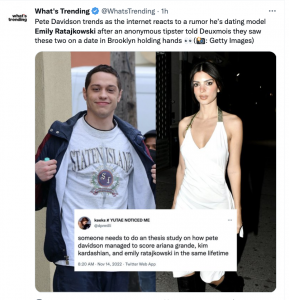
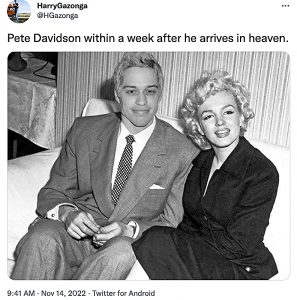
“If there is reincarnation, I’d like to come back as Pete Davidson‘s fingertips.” — Woody Allen.

 Jeff Wells
 Some critics have sought to dismiss Sam Mendes‘ Empire of Light (Searchlight, 12.9) because they’re unable to buy the curious but ultimately poignant bond between the two leads, played by Michael Ward and Olivia Colman. I myself was skeptical going in, but the fine writing, acting and overall period swoon effect (largely due to excellent production design plus Roger Deakins‘ handsome cinematography) won me over.
Filmmakers are generally required to depict POCs with a paintbrush of presentism these days (i.e., presenting them according to contemporary standards and mindsets), and many critics, knowing this, will get all riled when a Black character is presented “incorrectly” within a period film. Many elite critics see themselves as white-knight figures whose task is to bestow dignity or even majesty upon characters of color.
Ward’s performance will never be criticized, of course, but there’s no dodging the fact that he’s a handsome actor of considerable poise and charisma playing a decades-old period character in a film written and directed by an older white man. (Not unlike Mahershala Ali in Green Book.)
And there’s a fascinating violent moment in this film, by the way, that I haven’t mentioned. Racist skinhead goons are lurking on the fringes of this story, and early on a few of them are taunting Ward’s Stephen character on a sidewalk, and one strikes him with a head slap. And what does Stephen do? He does the smart thing by ignoring the attacker as he continues to walk away. He knows these animals are looking for an excuse to beat him senseless, and so he doesn’t give them that.
A violent moment such as this runs against the presentism aesthetic. A Black man of today would never ignore an attack of this nature if it was depicted in a present-tense film, but Mendes, adhering to the ugly reality of things in rural 1980 England as much as Paul Thomas Anderson’s Licorice Pizza was truthfully immersed in the Los Angeles culture of the ‘70s, does the stand-up thing.
Empire of Light is my idea of a sublime and deeply moving yesteryear film, and is exceptionally well acted. There was no question in my mind that it was an authentic, emotionally fine-tuned masterwork after I saw it at the Herzog. It seemed “just right” in so many ways.
As a study of a few characters living smallish lives in a somewhat isolated English coastal village in 1980 and ‘81, it recalls the complex textures of another tale of small-town characters, some of them grappling with sexual matters and with a certain movie theatre occupying an iconic space in their lives — Peter Bogdanovich’s The Last Picture Show (‘71).
“Critics are truiy their own species these days, living on their own politically-attuned planet. Eternally fickle and excitably hair-trigger, they often seem divorced from and in some cases contemptuous of Average Joe perceptions about this or that film, and particularly those, it seems, that have explored racial situations or narratives. (2018’s Green Book being another example.)
More than any other time in cinema history, today’s elite critics are, to a large extent, living for and within their own realm.
“There are noteworthy exceptions and honorable outliers, thank God, and I’m not saying the elite critic cabal is entirely untrustworthy, but in the matter of films that either touch upon or seriously explore the holy woke covenant (race, gender, sexuality and whitey-very-bad), they’re never been more unreliable than today.”
Friendo: “I dunno. I’ve spoken to folks who don’t like it, and they didn’t seem to be coming from a woke perspective.”
HE to friendo: “They’re not ‘wrong’ but they’ve allowed themselves to be triggered by the romantic inter-racial dynamic. If Michael Ward’s character (who is only slightly older than Mendes’ age was in ‘80) had been white, the same know-it-alls you’ve spoken to would be much more accommodating. Then again the film wouldn’t stand out as much, of course, if Ward’s character had been a pale-faced Mendes stand-in.”
Bottom line: If you’re dealing with a Black lead character, a director-writer has to play his/her cards in exactly the right way or the elite critics will scold to no end.
Mendes casting Ward as a generational stand-in for himself seemed, at first, like a fashionably woke gambit before I saw it. But the writing and the acting and the overall quality factor won me over. I melted. And Ward is so charming and good-looking.
HE to Friendo #1: “Are these Next Best Picture guys crazy? Women Talking is in third place among Best Picture contenders? On what planet?”
HE to Ruimy: “The truth is that almost every pundit has Women Talking in their predictions, but don’t be surprised if it misses out on a nomination. I’d say right now 60/40 it gets nominated.”
Friendo #2 to HE: “When it comes to Women Talking, the fix is in. A Best Picture nomination is going to happen whether people want it to or not. You could see that in Telluride.”:
HE to Ruimy: “Because of #MeToo tokenism and the fact that the one male character (Ben Whishaw‘s “August Epp”) is passive and tearful?”
Friendo #1 to HE: “The critics will have to drive this movie to Oscar nominations, and I don’t think they’re all on board.”
HE to friendos #1 and #2: “There are more than a few male voices, not just certain critics & columnists but filmmakers who are not on board. The bottom line, I realize, is that most male critics are afraid of #MeToo and are certainly not going to argue the point.”
Friendo #2: “Don’t you remember grown men weeping in Telluride after that?”
HE to friendo #2: “No, I don’t. A wealthy older guy told me he hated it, in fact — unsolicited. And a 40ish straight woman told me she hated it also. Both in Telluride.”
Friendo #2: “All three #MeToo movies — Women Talking, She Said and TAR — are a slog. She Said is the best one.”
HE to friendo #2: “TAR is a #MeToo movie? Since when? Lydia Tar is the architect of her own demise. She’s an X-factor Polanski figure. Nothing #MeToo about it.”
Friendo #2 to HE: “That’s the whole point of the #MeToo movement — exposing people who warrant their own demise by having been abusive.”
“Will Joe & Jane Resist Women Talking?,” posted on 10.11.22:
The new Women Talking trailer tells you it’s a quality-level thing for smart women…grim, somber, articulate, muted palette, lotsa dialogue. I can only tell you that as much as I recognized the pedigree and respected the aims of Sarah Polley’s film (UA Releasing, 12.2), I looked at my watch at least seven or eight times.
Posted on 9.9.22: Step outside the woke-critic realm and there’s a sizable body of opinion (or so I determined after speaking with Telluride viewers) that Sarah Polley‘s Women Talking is a static, dialogue-driven #MeToo chamber piece that could be fairly described as a “tough sit.”
Based on Miriam Toews’ 2018 novel, which is “loosely based on real-life events that occurred in 2011 at the Manitoba Colony in Bolivia,” Women Talking is about several women dealing with corrosive sexual trauma.
Set within an isolated American Mennonite community, Women Talking focuses on a nocturnal, seemingly dusk-to-dawn discussion inside a barn, and focuses on eight or so women debating whether to leave their community to escape the brutality of several men who have repeatedly drugged and raped them.
Fortified by several first-rate performances (most notably from Jessie Buckley, Rooney Mara and Claire Foy) and currently enjoying a 92% and 90% approval ratings on Rotten Tomatoes and Metacritic, respectively, the post-Telluride narrative is that Women Talking will probably be Best Picture-nominated and will certainly be in the running for a SAG Best Ensemble prize.
Speaking as a longtime honorary (i.e,. self-proclaimed) member of “the tribe”, I’m semi-astonished that within the community of decent, well-brought-up Americans (i.e., outside the realm of MAGA lunatics) that even a shred of anti-Semitism still circulates in the bloodstream of this nation.
Ken Burns‘ The U.S. and the Holocaust reminded that anti-Semitism was an unmistakable horror in the 1930s and ’40s, but haven’t we jettisoned all that, especially over the last 50 or 60 years? Among decent folk, I mean**?
Perhaps not. Or at least, apparently or allegedly, among a certain subset of Black Americans. Kanye West spit out some of the ugly not long ago, and was severely pounded and punished for it. Dave Chapelle spoke of the Kanye slapdown on SNL two nights ago, and David Poland spoke of tribal animus yesterday in his Substack Hot Button column (#255):
“I have never really understood how this thing between Blacks and Jews took such hold,” he wrote, [but] I am also aware, from living a long time, that many of my Black friends believe in a lot of false tropes about Jewish people, which is also true in reverse.
“My best friend in the world still makes a comment anytime I order pork of any kind. Jews are ‘them,’ meaning not only are we in the category of entitled white oppressors, but we are also hyper-entitled by perceptions of wealth, political prowess, and higher levels of education.”
I for one have never ordered a pork dish in my life — not once — although I’ve written more than once about one of the greatest compliments I’ve ever received in my life. In the late ’70s a smart and wise Jewish friend and fellow cineaste told me I had more Jewish guilt than he did. That was the beginning of my honorary Jewhood, which thrives to this day. I also regard myself an honorary gay guy, in a vaguely metrosexual sort of way.
I am grateful that my alleged or supposed honorary status among Jews and gays, however legit or illegit it may be, is at least a discussion point because it gives my life a certain dimension that would not otherwise exist.
Poland #1: “[Jews and Blacks] have been held down, exiled, slaughtered, and suffered attempts to remove what is uniquely [theirs] in the world. It is somewhat insane to compare atrocities, but personally, I believe the Black Holocaust of slavery is a step worse than the Jewish Holocaust that killed 6 million Jews because slavery not only killed and demeaned and tortured Blacks, it sought to homogenize away any cultural history away from them.”
Poland #2: “I guess it’s a little like having a friend you love who is abusive to women (short of violence) or who is a little bit racist. We all have them or have had them. And most of us know people of some small group that looks down on another small group without breaking the bar on what we believe makes them a racist. Once you become an adult, the world gets complicated. Dave Chappelle is complicated.”
I’ll make it simple — no one who aspires to even a semblance of honesty will claim that race consciousness doesn’t exist in every human. Race acknowledgement is what we all feel in our gut while racism is a judgment call — a suspicion that there may be something a little bit preferable about our tribe vs. the others. Everyone has muttered this to him or herself at one time or another, usually when young and ignorant due to the influence of under-developed people in our families or communities — “our thing seems a little better and perhaps is a little better, at least according to standards that we’re familiar with.”
I’m speaking of under-our-breath acknowledgments, of course. Nobody will say this stuff out loud. We all know how to adhere to what’s expected of us, and we all say the right things in order to get along, etc. The best of us understand the cosmic universality of everything, and act accordingly.
What I can’t stand about finger-pointing, holier-than-thou types like Poland (i.e,” Rabbi Dave”) is that they’re constantly sniffing the air for whiffs of people who may be “a little bit racist,” and who, once identified, need to be bitchsmacked and name-called and shoved around and so on. We’re all vaguely, subliminally conscious of racial separatism under the skin, but those us with even a smidgen of heart and soul dismiss those subliminals on a regular basis while summoning the better angels of our nature. That’s how things have always worked on my side of the court, at least.
** The Charlottesville primitives are not included in this category.
I’m as delighted as the next person that just about every 2020 election denier lost their respective election bids last Tuesday, and that the final House tally may give Republicans only a one or two vote advantage. Plus Senator Catherine Cortez Masto‘s re-election in Nevada last night means that Democrats have locked their majority control of the Senate. Plus the odds seem to favor Sen. Raphael Warnock defeating Herschel “wacko” Walker in the early December Georgia runoff. American voters have basically rejected the MAGA crazies, and thank God for that highly significant trend. I still hate the Stalinist ultra lefties, of course, but at least…
Revision on House projection pic.twitter.com/dv3eQfcnPr
— Acyn (@Acyn) November 12, 2022
The idea is that Trump is over in more ways than one. A seemingly lewd and salacious thrust at first (“alpha dogs never die”), and then you start thinking about it…
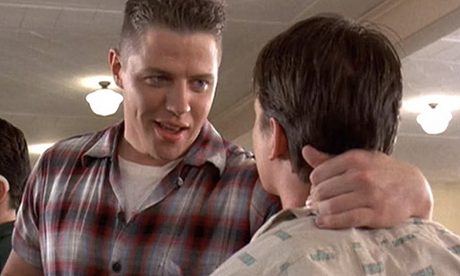
This morning Jordan Ruimy sent me a screen capture of a half-interesting movie idea [after the jump]. I’ve re-worded it and used a shot of Back to the Future‘s “Biff” for an illustration, to wit: “A late 1950s or early 1960s high-school bully (like Sam Rechner or Oakes Fegley in The Fabelmans) is somehow transported into a 2022 high school or college — an institution teeming with diversity, Tik-Tokers and trans kids.”
Okay, cool premise…then what? The idea is basically a spin on those Rip Van Hippie scripts that were making the rounds in the ’80s.
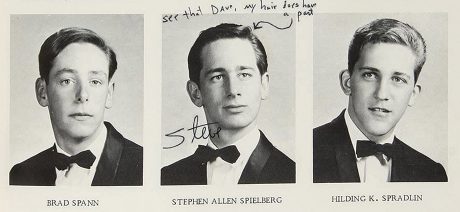
Like Steven Spielberg, I also tried my hand at filmmaking in my early youth. A sequence in The Fabelmans triggered the memory. Teenaged Sammy Fabelman (Gabriel LaBelle) is shown directing a WWII action movie with his teenaged high-school pallies. Well, when I was 11 I also rounded up my friends and attempted to shoot a short western in a local park.
I was shooting with my parents’ manual wind-up 8mm camera. I had roughed out some kind of synopsis (the usual good guys vs. bad guys routine). The big climax would’ve shown the bad guy getting shot and falling off a cliff. What happened, to my profound embarassment, is that I over-wound the camera, which caused it to freeze or jam or something. The bottom line is that despite making noises as if it was operating normally, I only got about five minutes worth of footage. I discovered this when the film came back from the Kodak lab.
I was mortified — all that planning and organizing and braggadocious ambition, and it was all for naught. If I’d been braver and more tenacious I would have confessed my technical failure to my friends and asked them to perform the western on another weekend, but I was so embarassed and deflated that I abandoned the idea. A fire-in-the-belly filmmaker would’ve tried again, but I didn’t. I wasn’t encouraged by my parents to give it another go (maybe they felt they’d indulged me sufficiently with the first filming attempt) but it was my fault. If I’d simply manned up and said “Okay, mistakes happen, let’s do it again,” I might have ended up with enough half-assed footage to assemble a half-decent attempt at a short film…who knows? And then I might’ve felt sufficiently encouraged to shoot another one and so on.
But I didn’t. Not trying again was the first significant failure or lack of nerve in my life. But I gradually rebounded on some level, and by my mid teens I was writing my own satiric high-school newsletter. But then I got into trouble with the high school assistant principal for using raw, ribald language, and my furious father was called in for a meeting with this blustery dickhead, and again I felt angry and mortified so my first journalistic enterprise was half-suffocated in the crib. I could have ignored the scolding and kept going, but I didn’t.
I hated my life back then — I hated damn near everything about it. The only spiritual escape valve was watching TV and movies and sneakily drinking beer on weekends. I was so angry and suffering from such a bad case of low self-esteem that I didn’t feel moved to try journalism again until my mid 20s.
Kids really do need support and encouragement from their parents and extended families, especially in their teens. Spielberg was lucky in that sense. The Fabelmans pretty much tells it all.
This is a very nickle-and-dime matter but…
In an 11.9 interview with N.Y. Times critic A.O. Scott, Steven Spielberg recalls his brief meeting with legendary director John Ford — an encounter depicted at the end of his latest film, the largely autobiographical The Fabelmans (Universal, 11.11).
“I was only about 16 when I met him,” Spielberg says, “and I didn’t know anything about his reputation, how surly and ornery he was and how he ate young studio executives for breakfast. That only came later when people began writing more about him. I felt I really escaped that office with my life.”
The slight problem is that Spielberg was born on 12.18.46 and therefore lived his sixteenth year of life between 12.18.62 and 12.18.63. Spielberg’s meeting with Ford, which happened at Radford Studios in Studio City, was arranged by a “second cousin” who was working on the then-upcoming Hogan’s Heroes, which began pre-production in ’64 before debuting on CBS in September ’65.
Let’s presume Spielberg met Ford sometime in the summer of ’64, while he was working as an unpaid assistant at Universal Studios’ editorial department. (He graduated from Saratoga High School in June 1965, at age 18.) He was therefore 17 and 1/2 when Ford instructed him about horizon lines — 17, not “about 16.” Just saying.
“Three Fabelmans Keepers,” posted on 11.9.22.
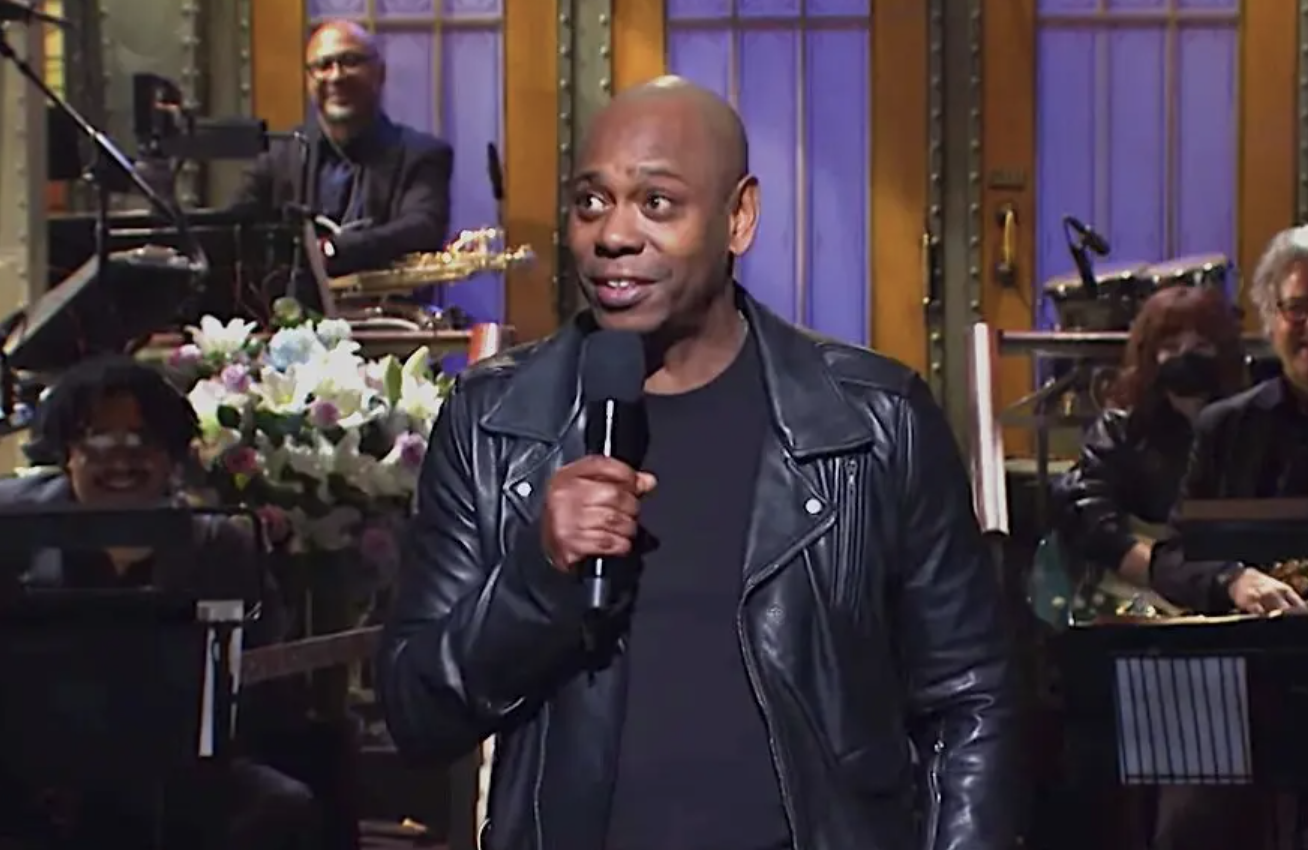
Closing remark: “It shouldn’t be this scary to talk about anything. It’s made my job incredibly difficult and to be honest with you, I’m getting sick of talking to a crowd like this. I love you to death and I thank you for your support, and I hope they don’t take anything away from me. Whoever ‘they’ are.”
Daniel Craig cutting loose in Paris is wonderful…wait, wait, why is he slinking around in some swanky hotel? Get back on the streets, bruh! Feel the joy and rapture. You don’t need Belvedere Vodka…you really don’t.