
 Jeff Wells
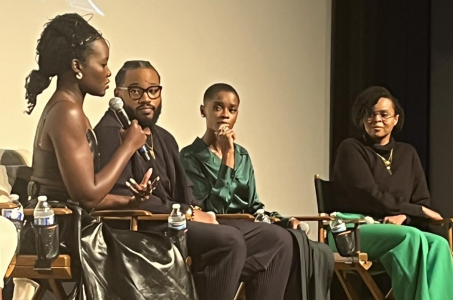
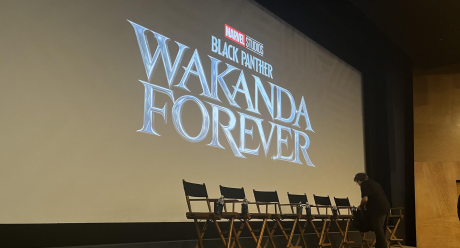
“Wakanda” at WGA
And an industry friendo agrees with Scott Mantz: “First half lame. Second half launches.”
Oh, God…This Must Be Garbage
The title alone, Savage Salvation**, tells you everything. The fact that problematic producer Randall Emmett directed is a problem upon a problem.
Previously titled Wash Me In The River.
Camel In The Tent Pissing Out
…is better than outside the tent pissing in.
Posted on 4.25.15: An assortment of Los Angeles-based film bloggers and print journalists are presently enjoying a gratis, all-expenses-paid visit to the 2015 Riviera Maya Film Festival. The seven-day event is based in Playa del Carmen, the Yucatan beach town 30 miles south of Cancun and 200 miles north of Belize City.
I tried to offer my…uhm, “promotional” services to Sunshine Sachs publicist Brooke Blumberg, who did the inviting, but she decided to invite every name-brand columnist in town (Sasha Stone, David Poland, Scott Feinberg, et. al.) except me…thanks!
Brooke apparently doesn’t like me or suspects I’d be more trouble than I’m worth or something along these lines. Not true! I am perfectly willing to shill for any film festival that will fly me there and put me up, etc. I write really well and can give the same kind of handjobs that other journalists give when they visit places for free.
This morning I got a message from Stone, who’s down there now and staying at the Hotel Platinum Yucatan Princess, which offers the exact same kind of luxurious decor and feelings of well-tended splendor offered by every other luxury hotel in the world. (I stayed in a place almost precisely like this in Hoi An, Vietnam in 2013.)
May I ask something? What is the point of travelling to an exotic location if you’re going to stay in a place that’s a carbon-copy duplicate of every other luxury habitat around the world? It’s the Club Med approach to travel…the Kardashian way. Has anyone read Conde Nast Traveller lately? With slight variations every luxury hotel in the world looks exactly the same.
The body snatchers have branched out — they’re now designing hotels.
Jerry Lee Lewis in Heaven
Now that he’s gone, I don’t know what to say about Jerry Lee Lewis (aka “the Killer”) that hasn’t been said. He was a great, thundering rock ‘n’ roll legend if there ever was one…a madman in his youth, and a truly magnificent performer every time he sat down to play piano. It’s remarkable that a guy who drank and caroused and burned the candle at both ends in the ’50s and ’60s lasted as long as he did…87 years.
I saw Lewis perform a set at a smallish venue in Cannes in ’92 (he was 57 at the time) and man, those fast hands and fingers were so beautiful to watch. In my book Lewis was a better, more flamboyant ’50s rocker than Elvis. Boundless energy, awesome boogie chords, a great singing voice, madness and excess, “Great Balls of Fire”…kick it all night long.
To speak admiringly of Jerry Lee Lewis today, of course, is to risk career damage because was he was said to be a notorious brute in his alcohol cups and hardly a feminist, and because he had a thing for jailbait girls back in the ’50s (as did Elvis and a few others). On the other hand there was “Whole lotta Shakin’ Goin’ On”, “Great Balls of Fire”, “Breathless” and that long blond curly hair hanging from his head and bouncing along as he pounded those keys.
I don’t know if A24 will ever release Jerry Lee Lewis: Trouble in Mind, the T. Bone Burnett-Ethan Coen documentary, but they should get the lead out and release it this year. My impression (which I forgot to post for some reason) was that it’s loads of fun to watch and listen to, but it’s almost too friendly. It barely gets into the crazy stuff, but it does include a spit-take clip in which Lewis is interviewed about his third wife, Myra Gale Brown, his first cousin who was 13 years old when they married. Lewis confesses that she was actually 12 when they first hooked up but he and Brown waited until she was 13 to tie the knot. (Or something close to that.)
Are you going to tell me that Jean Luc Godard‘s Breathless (’60) wasn’t inspired by Lewis’s hit 1958 single? Of course it was. It had to have been.
Elvis Presley and Frank Sinatra are in heaven and watching this colorized clip on a 77-inch Sony 4K HDR OLED.
Elvis: I obviously didn’t know when we sang this in ’60, but I only had another 17 years left.
Frank: Yeah, I know…sorry, chief.
Elvis: How long did you last?
Frank: I died in ’98, age 82.
Elvis: Shit, I was only 42.
Frank: Quality, not quantity.
Elvis: I had the quality until I went to see Nixon in the White House. That’s when it all turned sour.
Frank: You liked Nixon?
Elvis: He was against drug use, and I had to support him for that.
Frank: Isn’t that how you died?
Elvis: Yeah. (beat) If I’d played my cards differently I could’ve lasted as long as Jerry Lee Lewis.
Frank: When did he die?
Elvis: He’s still alive! 84 years old, and he was a crazy man in the ’50s.
Frank: Genes.
When Real Life Sadness Bleeds Into Cinema
I’ve been through the heartbreak of losing cats to disease and cruel fates (a beloved Siamese named Mouse died from pancreatic cancer in ’01, and two others, Ricci and Mouse 2, were run over by careless drivers) and I’m truly, deeply sorry for what recently happened with Sasha Stone‘s poor unfortunate cat.
But while my reaction to The Banshees of Inisherin may have bled into the sad passing of Sasha’s pet (and I’ve felt these sadnesses in my own life, trust me), it actually had nothing to do with it. Martin McDonagh‘s film is its own realm, its own turf…nay, its own blend of folksy melancholy Irish rage and despondency + McDonagh-ass weirdness and perversity. My heart aches for Sasha’s furry friend and lover but not for Brendan Gleeson’s bloody stumps.
I for one have never once shut anyone out because they disliked a film that I’ve loved. I’ve been hurt, disappointed or saddened that a friend didn’t share my love for a film, but I’ve always shaken that shit off. Sometimes people love and hate films for odd reasons. There’s no figuring it.
If you’ve just seen Raoul Walsh’s They Died With Their Boots On, which opened on 12.21.41, you’re allowed to love or hate it for reasons that have only to do with the merits or demerits of the film. Your feelings about your father or kid brother having been killed during the bombing of Pearl Harbor two weeks earlier…well, you can conflate or separate these disparate events as you see fit, but they’re really not related.
Carl Foreman’s The Victors opened in the vicinity of 11.22.63. Some might have seen it that day or during the weekend (11.23 and 11.24) and they might have said “Dear God, the blood and horror and absolute cruelty of war as imagined by Foreman is forever merged with the blood and horror of what happened in Dealey Plaza during lunch hour!” And they wouldn’t be wrong to have this reaction, but if a person wanted to express a reaction to the film and ONLY the film, they would be within their rights. And I certainly wouldn’t fault them for this, even if I was Robert F. Kennedy.
Yes, sad or traumatic events have a way of bleeding into each other or into films that we’ve just seen or music that we’ve recently been touched by…I know all about that bleeding-through process. But you have to show a little discipline in these matters, and sometimes you have to be hard.
Quentin, Leo and Adriana
Last night Quentin Tarantino, who divides his time between Tel Aviv and the U.S. of A about “60-40,” talked about his 30-month-old son Leo with Jimmy Kimmel, and called him “the audience member I’ve waited for my entire life.” Great stuff. Tarantino was plugging his next book, “Cinema Speculation,” which pops on 11.1

Pelosi Attack Almost Feels Pre-Fort Sumter-ish
It’s possible that the person who broke into the Pacific Heights home of House Speaker Nancy Pelosi this morning and assaulted her husband Paul…it’s possible that the attacker wasn’t a rightwing nutter, but what are the odds that he/she was just a boilerplate felon?
Obviously the facts need to emerge, but this feels analogous to the matter of Nicholas John Roske, the 26 year-old California man who threatened the life of Supreme Court Justice Brett Kavanaugh with a gun early last June. Citing an affadavit, The Washington Post reported that Roske “decided to kill the justice and then himself, thinking it would give his life purpose.”
Throw in the attempted kidnapping of Michigan governor Gretchen Whitmer in late 2020 and you’re left with a suspicion that acts of anti-left or anti-right violence have almost become par for the course, certainly since 1.6.21. From a certain perspective these are the isolated provocations that may lead to an actual woke wackos vs. militant righties Civil War. Some believe this is right around the corner.
Four days before the Donald Trump-incited assault on the U.S. Capitol, Pelosi’s San Francisco home was vandalized (on or about January 2, 2021).
Austrian Lethargy

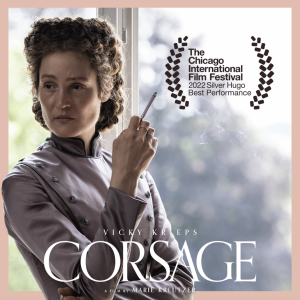
After debuting last May in Cannes and hitting several film festivals and opening worldwide over the last three or four months, Marie Kreutzer‘s Corsage (IFC Films) will open stateside on 12.23 — one of the last significant commercial bookings.
Third to last actually. The historical drama opens in England on 12.30.22, and in France on 1.25.23.
“Royally Uninterested,” posted on 5.20.l22: “I regret reporting that Corsage, which screened at 11 am this morning, didn’t sit well. I found it flat, boring, listless.
“The Austrian empress Elizabeth (Vicky Krieps) is bored with her royal life, and the director spares no effort in persuading the audience to feel the same way.
“Krieps plays up the indifference, irreverence and existential who-gives-a-shit?.
“Somewhere during Act Two a royal physician recommends heroin as a remedy for her spiritual troubles, and of course she develops a habit. I was immediately thinking what a pleasure it would be to snort horse along with her, or at least during the screening.
“Corsage is unfortunately akin to Pablo Larrain‘s Spencer and Sofia Coppola’s Marie Antoinette — stories of women of title and privilege who feel alienated and unhappy and at a general loss. I’m sorry but this movie suffocates the soul.
“In actuality Empress Elizabeth was assassinated in 1898, at age 51. For some reason Kreutzer has chosen to end the life of Krieps’ Elizabeth at a younger point in her life, and due to a different misfortune.
“This is one of the most deflating and depressing films I’ve ever seen.”
Movies That Have Ended Friendships

Everything’s cool now (I think), but for three or four days a close friend was giving me the cold-shoulder treatment because I’m not a fan of Martin McDonagh‘s The Banshees of Inisherin.
The truth is that I am a fan of some of it but I couldn’t abide the idea of a significant fiddle-playing character mutilating himself in order to emphasize to a former friend (a non-musician) that he really, really doesn’t want to chit-chat anymore.
I’m sorry but I found this behavior to be incomprehensible, not to mention repugnant.
HE to friendo: “Banshees obviously has its virtues and charms and its pictorial beauty and whatnot, but the [afore-mentioned nihilism] is ridiculous. THR‘s Scott Feinberg isn’t demonic for sharing my reaction or vice versa. There are many sane people out there who’ve found this film mystifying. I really don’t think I deserve to be shunned or banished for feeling this way. I respect many things about it. It’s not ‘bad’ as much as infuriating.”
Observational friendo #2: “[Sometimes movie lovers] will invest the year-end movie contest with an unreasonable ideological fervor. And thus Banshees, like Belfast, is somehow praised as a great film with traditional, classic, old-fashioned and in some ways masculine virtues…a film that that all good people must rally behind. In disliking Banshees you were pissing on The Cause.
“We’re all looking for an Oscar movie to keep The Dream alive. But once a special film is discovered and praised in certain quarters, people who don’t like it are somehow annihilating the dream.”
HE regulars are asked to recount stories about friendships and relationships that went through a bad patch or were even torn asunder due to a major disagreement over a film.
Still Tiptoe-ing Through Wakanda Tulips
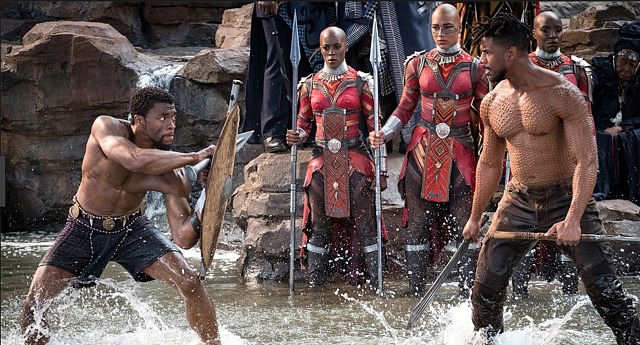
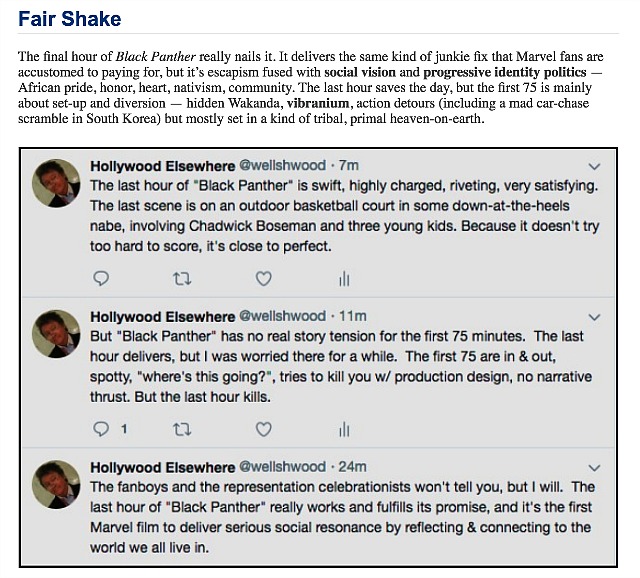
On 2.6.18, I stated a bedrock emotional truth that few others would cop to, which was that white critics were afraid to not praise Black Panther. Ryan Coogler’s 2018 Marvel blockbuster is being celebrated right now as a better film than Wakanda Forever, but don’t forget that the first 75 minutes of Black Panther weren’t all that great, and the final hour was the only part worth writing home about.
My article was titled “Critics Are Tip Toe-ing Around Black Panther Truth“:
On 1.31 I posted a qualified capsule rave of Ryan Coogler‘s Black Panther (Disney, 2.16). More precisely I raved about the final hour while lamenting that the first 75 minutes are largely lacking in narrative tension and are mostly about set-up, diversion, pageantry and obligatory battle and car-chase action sequences for their own sakes. All through the first hour-plus I was worried. I was asking myself “when is this film going to get it together and start moving purposefully in a direction that we all want it to go in?”
And then it finally does that, and it’s all exuberant, pedal-to-the-metal, forward-motion engagement. But you’ll need to scrutinize the recently-posted Black Panther reviews with a fine tooth comb to find even a hint of acknowledgment that it waits and waits and waits to really rev up the T-bird and put the rubber to the road.
Big Curtis Night

Early next year, Roger Durling‘s Santa Barbara Film Festival will present the 2023 Maltin Modern Master award to Jamie Lee Curtis. Not because of her legendary scream queen rep (recently underlined by her starring role in Halloween Kills) but because of her broad performance as a wackjobby IRS agent in A24’s Everything Everywhere All At Once**.
We all respect the endurance (persistence?) of Curtis’s career, but the truth is that Everything Everywhere aside she hasn’t been in any reasonably good films in over 20 years. I’m not being mean — that’s just factual.
Curtis’s peak years were from the late ’70s to mid ’90s, and principally in the ’80s. Her three finest films, in this order, are Charles Crichton and John Cleese‘s A Fish Called Wanda (’88), John Landis‘s Trading Places (’83) and James Cameron‘s True Lies (’94).
Other noteworthy JLC vehicles, listed sequentially, are Halloween (’78), The Fog (’80), Love Letters (’83), James Bridges‘ Perfect (’85), Diane Kurys‘ A Man in Love (’85), Kathryn Bigelow‘s Blue Steel (’90), John Boorman‘s The Tailor of Panama (’01) and Rian Johnson‘s Knives Out (’19).
HE to Durling: The perfect presenter of the actual award would be John Carpenter, to whom Curtis owes her entire breadwinning career.
** The perfect ending aside, I mostly loathed this curiously successful film. but that’s water under the bridge.