Broken Champagne Glass

Please pay particular attention to the last two paragraphs of this piece, which was originally posted on 3.5.18, or three and a half years ago:

Yesterday I watched Fox Home Video’s Bluray of Joseph L. Mankiewicz‘s A Letter To Three Wives (’49), which I first saw…oh, sometime in my teens. Even in that early stage of aesthetic development I remember admiring the brilliant writing and especially the way it pays off.

Nominally it’s what used to be called a “woman’s drama“. A three-character piece, it’s about whose husband (Jeanne Crain‘s, Linda Darnell‘s or Ann Sothern‘s) has run away with sophisticated socialite Addie Ross, who narrates the film from time to time (the voice belongs to Celeste Holm) but is never seen. But that’s just the story or the clothesline upon which Wives hangs its real agenda. For this is primarily an examination of social mores, values and ethics among middle-class marrieds of late 1940s America.

Over and over the film reminds you how long ago this was. Southern is fairly liberated in the sense that she’s the main breadwinner in her household; her husband, played by Kirk Douglas, is a more-or-less penniless schoolteacher. One of the film’s quaint highlights is Douglas’s cocktail party rant against the dishonest and vulgar hucksterism of commercial radio. This was a valid point, I’m sure, from Mankiewicz’s perspective 60-plus years ago, but if Joe could see the world now…

But I’d really forgotten how effective the ending is. It’s partly the surprise admission from Paul Douglas (as Darnell’s wealthy, somewhat crude businessman husband) that it was he and not Craine’s husband Brad (written by Mankiewicz as a bland and patronizing type, and certainly played that way by Jeffrey Lynn) who ran off with Addie. But what really got me is the final bit when Douglas and Darnell hit the dance floor and the camera drops down to the table and suddenly Addie is a spirit of some kind — a spectral force.

All through the film Addie has been the absent “other” and suddenly she’s a spook who tips over a champagne glass and breaks it. A metaphor for disappointment and defeat, sure, but I find it fascinating that Mankiewicz would shoot Wives as a thoroughly dialogue-driven, medium-interior, right-down-the-middle relationship drama and then, at the very last second, change the rules and turn it into Topper or The Ghost and Mrs. Muir. That’s a surprise ending in spades.

He Walks Alone

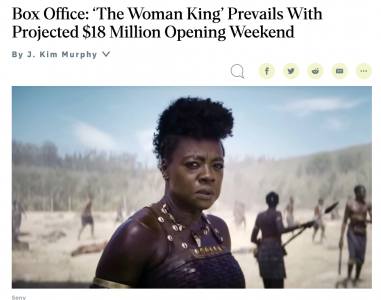
I won’t be seeing Gina Prince-Bythewood‘s The Woman King (Sony 9.16) until Tuesday evening. The Toronto Film Festival response has been overwhelmingly positive — a very well contructed, highly engaging action drama, they’re all saying. 100% and 75% scores from Rotten Tomatoes and Metacritic, respectively.

Given the overwhelming tide of positivity, HE salutes World of Reel‘s Jordan Ruimy for having the temerity to swim against the tide. I’ve no opinion if Ruimy’s view is correct or incorrect (ask me late Tuesday night), but his review also points out the historical record about the Kingdom of Dahomey.

The Woman King “tells the story of the Agojie, an all-female troop of warriors who fought for the west African Dahomey kingdom for centuries, violently and effectively taking on men who threatened and underestimated them.” — Benjamin Lee’s Guardian review.

Dahomey Wikipage excerpt: “The Kingdom of Dahomey was an important regional power that had an organized domestic economy built on conquest and slave labor, significant international trade and diplomatic relations with Europeans, a centralized administration, taxation systems, and an organized military. Notable in the kingdom were significant artwork, an all-female military unit called the Dahomey Amazons by European observers, and the elaborate religious practices of Vodun.

The growth of Dahomey coincided with the growth of the Atlantic slave trade, and it became known to Europeans as a major supplier of slaves. As a highly militaristic kingdom constantly organised for warfare, it captured children, women, and men during wars and raids against neighboring societies, and sold them into the Atlantic slave trade in exchange for European goods such as rifles, gunpowder, fabrics, cowrie shells, tobacco, pipes, and alcohol.”

From Peter Debruge‘s Variety review: “Dana Stevens’ stirring script strategically downplays the Dahomey’s own practice of capturing and enslaving others, which surely would have complicated the more admirable dimensions of this historical — and history-making — drama.”

Whoever Heard of Werewolves By Day?

Werewolves don’t do lunch and certainly not breakfast. They’ve always been nocturnal. Influenced by the gentle light of the slivery moon. Lon Chaney, Jr. didn’t enjoy an afternoon stroll with the Queen of England — they were walking down a damp narrow street in Soho after dark. All to say that the title Werewolf By Night is redundant, to put it mildly.

Hirsch, Williams Locked For Acting Noms (As Predicted)

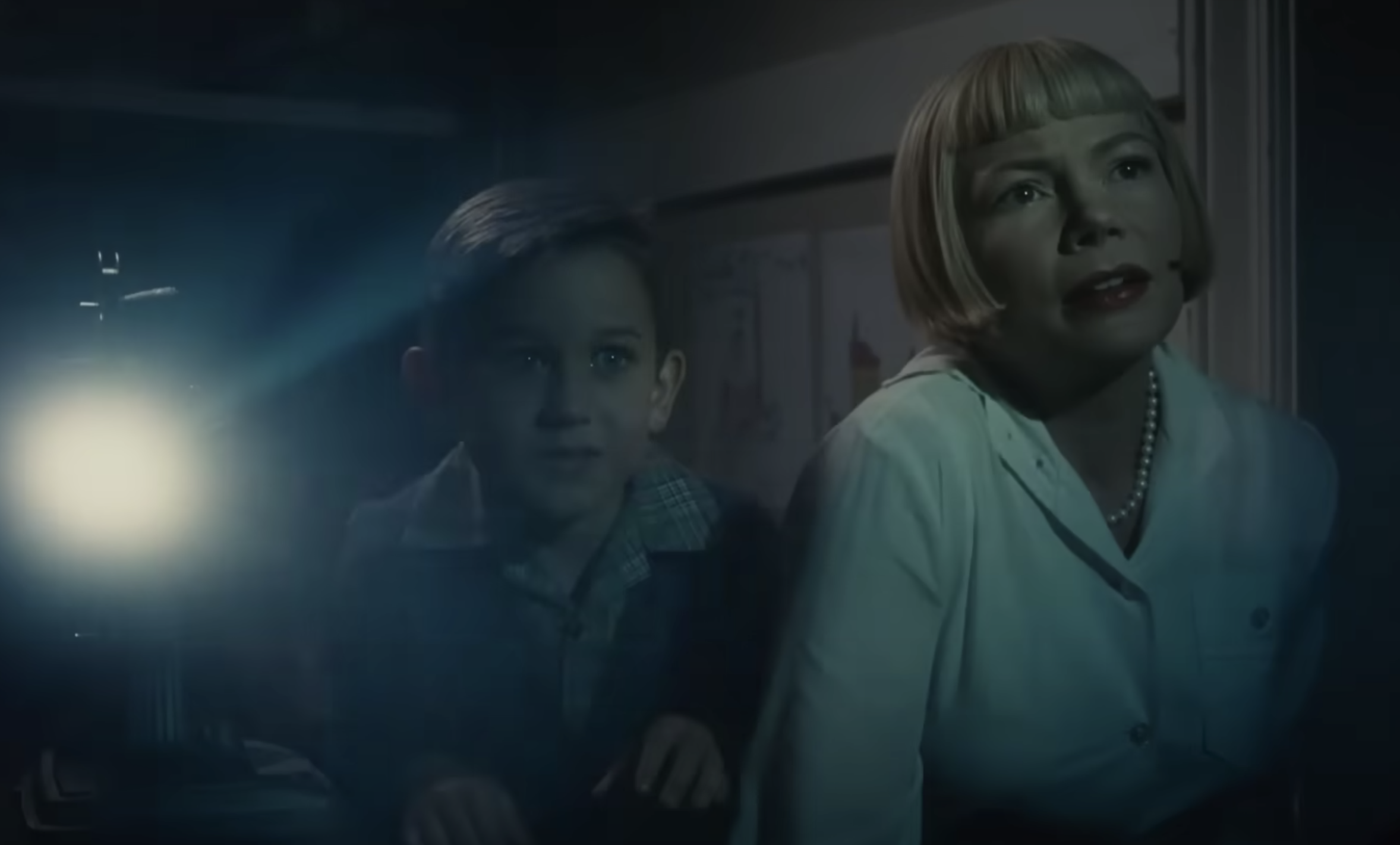
Just shy of six weeks ago HE passed along predictions about likely Oscars noms for The Fabelman‘s Judd Hirsch and Michelle Williams. Late last night several Toronto tweeters emphasized the same. When Spielberg is able to get it just right by restraining himself without diluting the emotional essence, his touch is golden. Here’s hoping that last night’s praise is genuine and verfifiable.

Read more

Lonely Forlorn Males As Ticking Time Bombs

If you say that young white males — the lonely, undervalued, borderline incel, spending-too-much-time-at-home types — are having a rough time these days, fine. I’ve seen it with my own eyes, and it’s a known thing among many of us. But if you say that young white males are having a particularly difficult time because they’re regarded by liberal elites as bad eggs and would-be oppressors because they’re white and therefore a potential Kyle Rittenhouse, you’ve got a problem. Because in progressive circles “white male” has become an epithet. Not without cause, I realize, but if you express the slightest sympathy for young, depressed white dudes (under-educated, working at home, limited prospects), elites automatically presume that you’re aligning yourself with some kind of toxic male syndrome.

Three Musketeers (& Perhaps More)

Letter to friend, sent this morning: Jeff Sneider, Brian Truitt and Ed Douglas have supported your skepticism about Sarah Polley’s Women Talking. And thank God for you four and others who haven’t been intimidated by the #MeToo rank-and-file & have summoned the courage to calmly and sensibly call a spade a spade.

Your reservations have been respectful and all you were doing in re-tweeting Sneider, Truitt & Douglas was showing there are other dissenting voices out there.

You know what things were like in Telluride with the Justin Chang, Eric Anderson & Greg Ellwood kowtow crowd praising it to the heavens. And then finally the clouds parted in Toronto…breaths of fresh air!

Aside from my own less-than-delighted reaction I was told twice in Telluride, unprompted, by an elderly rich guy & a 40ish married woman that they “hated” Polley’s film. When the rank-and-file Academy & guild members get a look at this thing you KNOW what many of them will think.

Neither you nor I hated it, but you know in your heart that it’s basically a dimly-lighted #MeToo “Waiting for Godot” in a barn, and that aside from the morally urgent narrative (of COURSE they should leave but (a) where are they going and (b) with what funds and (c) do they have tents and blankets and toilet paper?) & high-quality performances (principally from Jessie Buckley, Rooney Mara and Claire Foy) that it’s WELL below the compelling, confined-set standards of Lumet’s 12 Angry Men or Rope or Rear Window, and that it’s fairly agonizing to sit through and that the Women Talking experience is basically about waiting for it to end.

The basic idea, of course, isn’t that a few sex-starved, cold-blooded Mennonite men are brute beasts, but that the overall patriarchy (straight white men) is to be regarded with extreme suspicion as too many white males seem amoral, heartless and exploitive & probably need to be fought tooth & nail and perhaps even overthrown.

A friend feels Polley’s film is “almost comically male-hating.” When the wimpy and wimpering Ben Whishaw is the only male they can trust, you know what Polley is saying……”tearful, guilt-stricken-on-behalf-of-their-gender gay men are cool but forget straight guys!!”

Really? There isn’t one decent straight guy in the community who can be trusted? Not one regular dude who’s disgusted by the rapes and pledges to support the women? Imagine how the film could be spiritually and emotionally opened up, so to speak, if there was such a character. Or if a second straight male were to intrude only to speak skeptically about the assaults & argue against leaving.

Women Talking is oppressive because (a) it’s oxygen-starved and visually claustrophobic, (b) there’s no dramatic tension to speak of because from the perspective of the horribly brutalized victims it’s ludicrous to argue for staying, (c) the characters don’t sound like isolated Mennonites but smart, educated, worldly women playing their idea of isolated Mennonites.

In short, your skepticism about Women Talking is sensible and mature and certainly not extreme.