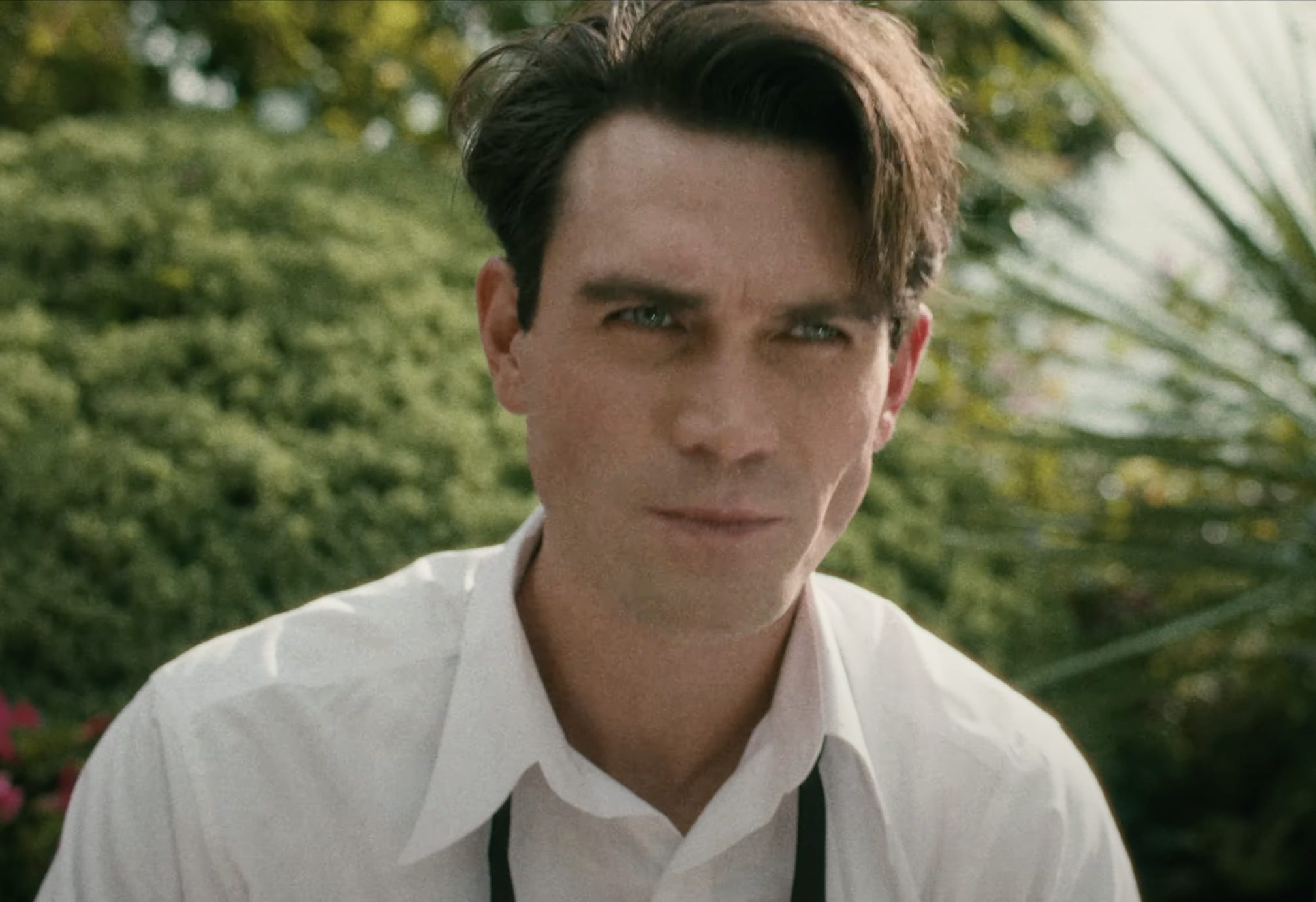
Right after Olivia Wilde‘s The Invite premiered at Sundance last January, Rotten Tomatoes gave it a 91% positive rating while Metacritic only gave it a 76% score. Fuck does that mean? Critics can be such niggly-piggly pissheads.
I will be sorely disappointed if I can’t wheedle my way into a market screening of The Invite next month in Cannes. It’s a hot title. There will have to be a market screening or two.
Kat Coiro and Ryan Engle’s You, Me & Tuscany (Universal, 4.10) is obviously a synthetic romcom…fake backdrops, a fizzy Nancy Meyers vibe, big-studio lighting, a slick American sensibility…aimed at younger women of color who’ve never been to Europe, much less to Tuscany.
No self-respecting straight dude of any tribe or persuasion would see this effing thing on his own volition. Obviously a featherweight bauble.
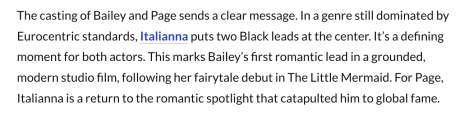
The vaguely chubby Halle Bailey (The Little Mermaid, The Color Purple) and the hunky Rege-Jean Page (Bridgerton, Black Bag) are the fated-to-fall-head-over-heels twosome. Something tells me there won’t be any sex scenes….no Todd Haynes-level rim jobs.
Over the last 25 years I’ve roamed all over Tuscany, having visited…I don’t know, eight or nine times. I’m always attracted to Tuscany-set films because I know the general area and am always hoping to spot some village or piazza I’ve been to. I love the warm evening aromas over there. I love scootering from town to town. I love walking through the vineyards just before sunset.
There’s a section of a 4.7.26 IndieWire interview with Coiro that gave me pause. The scary part isn’t that she loves classic romcoms directed by Nancy Meyers and Richard Curtis, although that’s bad enough. The scary part is that she lumps Meyers and Curtis in with Preston Sturges.
Until this morning I’d never thought of Sturges as a romcom guy. I’ve always thought of him as a social satirist who used fast-paced love-story plots as structures to hang his witty razmatazz material from. His films were always about social themes that were “bigger” than, say, the mere diversion of Joel McCrea and Veronica Lake falling in love.
“Bailey began a relationship with DDG, an American YouTuber and rapper, in December 2021. On December 22, 2023, Bailey gave birth to their son. On October 3, 2024, DDG announced that he and Bailey had split after almost three years of dating but would continue to be “best friends” and raise their son together. In May 2025, Bailey was granted a restraining order against DDG, following allegations of abuse. She was also granted temporary physical and legal custody of their son. DDG, who was granted his own temporary restraining order against Bailey, filed a motion to prevent her from leaving the U.S. with their son, claiming Bailey was a ‘risk’ to herself and their child, but was denied until a further hearing.”
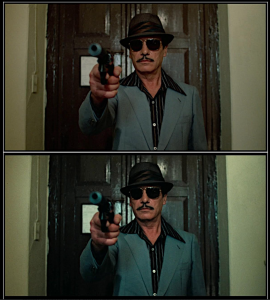
Posted on 6.24.25: William Friedkin would turn in his grave if news of Criterion’s defacement of their Sorcerer 4K Bluray could somehow be communicated to his afterlife realm.
Freidkin to Criterion: “How dare you….how fucking dare you saturate my 1977 masterpiece with grotesque teal-green tones…you don’t flood your Carnal Knowledge 4K with teal so why did you do it to Sorcerer?…do you understand that what you’ve done represents a form of evil? Do you even get that, fuckers, or are you oblivious?”
Friedkin-to-Criterion followup: “Do you guys know that Birds scene in the Bodega Bay diner when that hysterical mother says to Tippi Hedren, ‘Who are you?…what are you? I think you’re evil….EVIL!!’ You know that scene? Well, that mother is the Bluray-buying public, and you’re Tippi Hedren!”
Late last night I finally saw Craig Brewer‘s Song Sung Blue, ånd like everyone else I felt generally pleased and often turned on during the musical performance segments. Who wouldn’t be? Catchy NeilDiamond tunes, re-energized by spirited, sufficiently talented middle-class tribute folk…alive, they cried!
I’ve never been the biggest Neil Diamond fan but on a certain level I felt a genuine kinship with the real-life, Milwaukee-based tribute performers Mike and Claire Sardina, who are fetchingly played by Hugh Jackman and Kate Hudson.
Mike and Claire’s heyday was in the ’80s and early ’90s, and it was quite a ride. Serious Milwaukee favorites.
Plus I loved Michael Imperioli‘s supporting turn as Mark Shurilla, a Buddy Holly impersonator who joins Mike and Claire’s band. Ditto Ella Anderson, Fisher Stevens, Jim Belushi, Mustafa Shakir…everyone generates full conviction and good vibes.
There’s a fountain of musical joy that flows from the voices and hearts of Hackman and Hudson, and it’s a serious pleasure during the film’s first half…maybe the first 60% or so. Heart-lifting stuff that really floods the system.
But then they both get walloped with out-of-the-blue waffle irons that struck me, frankly, as too much. These tragedies really happened, yes, but it stills feels like bad plotting.
OBVIOUSLY NOT A SPOILER IF YOU’VE SEEN THE MIKE-AND-CLAIRE DOCUMENTARY, BUT I CAN IMAGINE WHINERS COMPLAINING IF I DON’T WARN: Claire getting hit by an out-of-control car while gardening in her front yard…the fuck? What kind of ridiculously demented asshole-behind-the-wheel would do such a thing? (Another crazy driver slams into the same home 20 to 25 minutes later, and it’s like….again? It’s just too nuts.) And then Mike dying from putting super-glue on a gash in his forehead after suffering a heart attack? It doesn’t feel real. Hell, it feels surreal.
Hudson delivers the spunkiest performance, and I wouldn’t be surprised if she winds up getting BestActress–nommed. Plus she seems to have gained a little bit of weight for the part, which is kinda commendable in a Robert DeNiro-in-Raging Bull sort of way. (Okay, maybe Hudson didn’t gain weight for the film, but she sure as hell didn’t lose any. She looks filled out in a 40ish sort of way.)
This is going to sound shallow, but I had problems with Jackman’s Neil Diamond wig, which has a kind of three-pointed shape and looks seriously dorky or bulldogish or whatever. It’s too Prince Valiant bouncy on the sides. The real Mike’s hair was far more becoming.
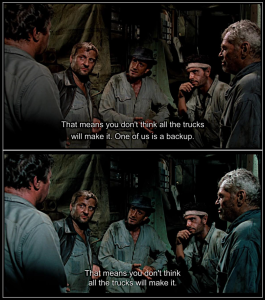
I’m sorry but last night I gave Henri-Georges Clouzot‘s The Wages of Fear (’53) another viewing, and I came away fully convinced that it’s a slightly lesser achievement than William Friedkin‘s financially calamitous remake, titled Sorcerer (’77). And here’s why:
(1) The first hour of Fear has no urgency or narrative drive. It’s just about the four main characters — Mario (Yves Montand), Jo (Charles Vanel), Luigi (Folco Lulli) and Bimba (Peter van Eyck) — bellyaching about being stuck in the South American town of Las Piedras, which doesn’t look South American at all (pic was shot in the flatlands of southern France), and is certainly not mountainous or jungle-y. The first hour is basically a lighthearted hangout film.
(2) The first hour of the Freidkin version has much more punch and texture, largely due to the riveting backstories of the four main characters — Roy Scheider‘s Jackie Scanlon, Bruno Cremer‘s Victor Manzon, Francisco Rabal‘s Nilo, and Amidou‘s Kassem.
(3) Sorcerer‘s South American shanty town, called Porvenir, also delivers a much more engrossing atmosphere of grit, grime and hand-to-mouth poverty than Fear‘s Piedras, which is all interiors and without much atmosphere (i.e., surrounded by arid flatlands).
(4) In The Wages of Fear, Véra Clouzot‘s Linda, a barefoot cantina worker and Mario’s devoted admirer (lover?), serves no narrative purpose. All she does, really, is smile nonsensically and bat her eyelashes at the camera. (She was the director’s wife, of course — he obviously indulged her and let her do whatever.)
(5) Fear kicks in, of course, once the men begin their journey in the two trucks. This portion of the film is superbly paced, shot, framed, edited. And yet it doesn’t have Sorcerer‘s rickety bridge-crossing scene in the rain and over the raging rapids. Clouzot didn’t have much of a budget — Friedkin spent around $22 million in 1977 dollars, or roughly $125 million in today’s economy.
(6) Both teams have to use nitroglycerine to eliminate a dirt-road blockage (a massive stone in Fear, a fallen tree in Sorcerer), and yet the circumstance that leads to Van Eyck and Lulli’s truck detonating and blowing them to smithereens isn’t shown — an interesting decision on Clouzot’s part, but was it primarily a financial one? It feels like a bit of a cheat. The viewer naturally wants to know what happened.
(7) Montand’s truck-crash death at the end of Fear is caused by his character being in a great, jaunty mood, and is therefore a bit careless. This, I feel, is a bit of a careless ending. It reminded me of a story my dad told me about a guy he met in an AA meeting…a guy whose bumpy life took a joyful turn for the better, which put him into such a happy frame of mind that he started drinking again.
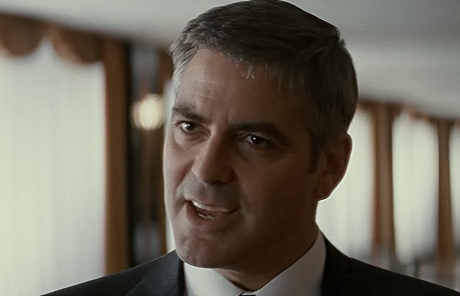
Compare George Clooney’s 2007 Clayton look with the ultra-slender, not-an-ounce-of-fat, rich-movie-star appearance he’s sporting today…he’s probably a good 15 pounds lighter now than he was 18 years ago.
And yet the Clayton thing — slightly puffy-faced, perhaps a bit of a boozer, not-bordering-on-overweight-but-getting-there — undoubtedly enhanced his Clayton character…a “bagman” attorney for a large NYC law firm…a fixer who cleans up messes (a “niche”) and who suffers from a sense of frustration and bitterness, not to mention a touch of low self-esteem.
If Clooney had been as thin back then as he is today, his Clayton performance — his career best — wouldn’t have worked as well.
Is his Jay Kelly performance nearly as good? Yes, nearly. Nominatable, I would say.
I’m not saying Volodymyr Zelensky wishing for the literal death of Vladimir Putin is unwarranted, but literally saying this in so many words is highly unusual.
“Brick” is a popular New York City slang term, particularly in the Bronx, Queens and Long Island, used to describe extremely cold weather. Originating in the 1980s-90s, it suggests the cold hits as hard as a brick, or refers to cold city buildings.
Meaning: Extremely cold outside. Example: “It’s brick out there”.
Origin: Likely originated from urban slang in New York City (Harlem/Bronx) during the 1980s or 1990s.
Context: Used when temperatures are freezing; sometimes related to the feeling of brick buildings in winter, which are described as being ten times colder than the air.
Regional Usage: Primarily associated with New York City, but also used in neighboring areas like Long Island.
By the time this reasonably decent confrontation scene came along (Rose Byrne vs. Conan O’Brien), I was exhausted from the sheer effort of sitting through this damned thing. Depleted, emptied out, spent.
Conan O’Brien is Rose Byrne’s therapist in IF I HAD LEGS I’D KICK YOU, coming to theatres on October 17. #IfIHadLegsIdKickYou #MaryBronstein #RoseByrne #ConanOBrien #A24 #VVSFilms #therapy #therapist #moviescene #movieclip #cinema #film
Jimmy (Burns & Co., 11.6.26) is obviously a sentimental, low-budget, family-friendly attempt at ennobling and glorifying James Stewart‘s World War II experience as a bombardier in the European theatre. Pic was directed by Aaron Burns, whose company Burns & Co. also produced.
Burns & Co. mission statement: “In the truest sense of the word, Burns & Co. is a company of creatives crafting timeless adventure films and stories for the enjoyment of families around the world.”