When this happens inside Hollywood’s Dolby Theatre on Sunday, 3.15.26, it will be the second time that a political/cultural sympathy vote has bestowed a major honor upon Jafar Panahi’s latest film, the first time occuring at the close of last May’s Cannes Film Festival when it won the Palme d’Or.
Joachim Trier‘s Sentimental Value, obviously the best film of the 2025 festival, therefore lost to It Was Just An Accident and had to settle for a Grand Prix award (i.e., second prize). If I know anything about the Academy, Value will once again get elbowed aside because of Panahi’s just-announced one-year jail sentence.
It is my considered opinion that emotionally performative people of an insincere bent — i.e., phonies who instinctively laugh their ass off or otherwise show monkey-like obeisance before power whenever there’s an opportunity to back-pat or express any sort of emotional mood support — are among the worst people in the world.
All “performative” people are, by nature, insincere. They’re basically jacking you off.
I understand the basic pleasing impulse as I’ve expressed insincere approval thousands of times throughout my life, but I’ve always tried to avoid bending over or slapping my thighs when laughing uproariously at some shitty joke.
Posted 11 months ago: Nothing uncorks my rage more than people laughing too hard, too demonstratively, giggling like idiots, rocking back and forth, slapping their thighs, covering their mouths with their right hand, going “hoo-hoo-hoo” and “yee-hee-hee”…all of this is truly horrible.
Have you ever seen any serious, heavy-cat comedians laugh like this? Woody Allen will crack an occasional grin or smirk, but never, ever has he yee-hawed in some over-the-top way. People who know what goes never laugh like this. Only shallow gladhanders do. Only the worst people.
12.30.22: “I wear my gracious alpha face all the time in social situations. It’s the only way to be. 99% of people who work in social congregation situations turn on the placid vibes. So much so that it’s fairly freaky, in fact, when certain people (submentals, addicts, sociopaths) don’t turn it on. There’s no earthly reason not to be warm and kind and gracious with people, and I mean especially in Hollywood realms.
“I’m saying this because I wish below-the-liners and set visitors and others who work with above-the-liners would stop saying ‘wow…he/she is so nice!’? How else are they gonna behave? They’re probably nice people anyway, yes, but first and foremost they’re top-level professionals and talented smoothies, and this is how the movie business operates.
“Do you ever hear polar bears saying, “Wow, the snow is so white and powdery, and the seals bark so vigorously when I catch and eat them!” I’m just sick of hearing how nice this and that famous person turned out to be. Turn that shit down a bit.”
By the way: Of all the millions upon millions of faces out there, there’s one that immediately makes me flinch and recoil:
The greatest “holy shit, this marriage is so totally fucked” finale is delivered by Francis Coppola‘s The Godfather (’72), but what are some of the strongest runner-ups?
In the same vein, what are some of the most dishonest upbeat finales in the history of movies about marriages and families? Upbeat endings that you’d like to believe and invest in, but you can’t possibly do so because of all the emotional corn syrup and forced fakery?
It’s A Wonderful Life is surely the fakest of them all, although I’ve always melted (and will continue to melt) when James Stewart cries out “Clarence!…I want to live again!” That’s always moved me, but the happy-schmappy stuff at the Bailey home with all the community joy and donated money…that has always felt to me like happy crap.
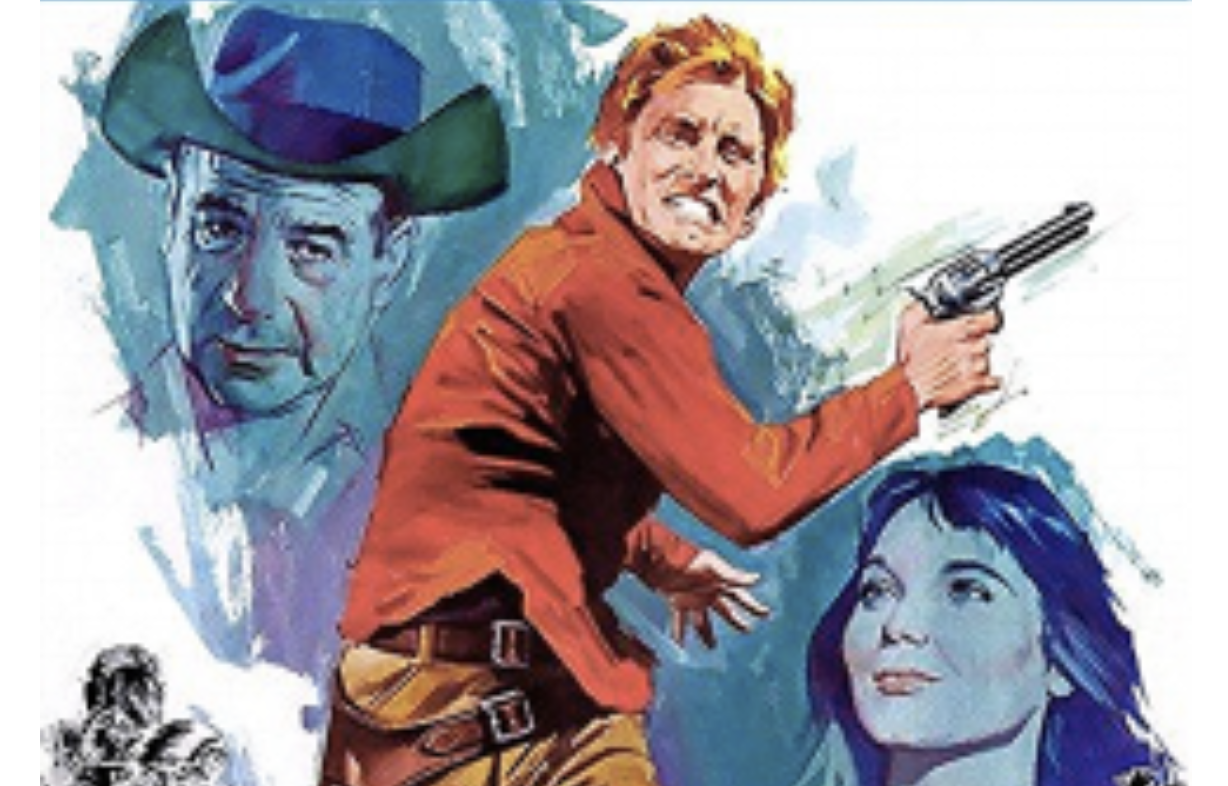
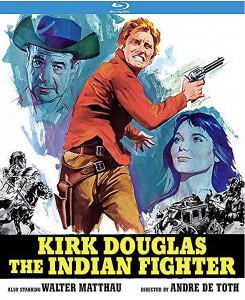
The Indian Fighter (United Artists, 12.21.55) was a passable-but-no-great-shakes western, starring Kirk Douglas and directed by Andre de Toth. It served the usual brawny action stuff in eye-filling CinemaScope, but the main hook was the sexual rapport between the 39-year-old Douglas and the 20 year-old Elsa Martinelli, a native of Tuscany and a fashion model, playing a willing Sioux squaw.
Douglas was a legendary hound, of course, and given the fact that (a) he hired Martinelli after seeing her photo on a European magazine cover, and (b) his company, Bryna Productions, produced The Indian Fighter, you can guess what happened off-screen.
12.22.55 N.Y. Times review excerpt: “Douglas’s Johnny Hawks, a free soul, thinks nothing of detouring a wagon train he is leading towards Oregon in order to keep a nocturnal tryst with the chief’s comely daughter; and only one reel before he nearly had succumbed to the blandishments of an equally beauteous widow.
“It must be noted of course, that the script by Ben Hecht and Frank Davis has a fair sense of humor, and that the forests and mountains of Oregon, where this fiction was filmed, are sweeping and picturesque in color and CinemaScope.
“In the brunette Elsa Martinelli, who plays the Indian lass with a minimum of words and a maximum of feline grace, Mr. Douglas has come up with a pretty photogenic newcomer.
“Eduard Franz as Chief Red Cloud, Walter Matthau and Lon Chaney as the bad men of this escapade, Diana Douglas as the marriage-minded widow and cavalry officer Walter Abel do not contribute spectacular performances.
“But Mr. Douglas’ characterization is properly muscular. As a hard though not faultless gent, he sits a horse well, looks great in buckskins and sometimes gives the impression that he could take over a pioneer’s chores. Mr. Douglas has not blazed a cinema trail with The Indian Fighter, but he has come up with a sturdy entertainment that should please the action fans.”
I was watching Ken Burns The American Revolution, his epic-length PBS series about the Revolutionary War, and I don’t know if it was me or the series but something felt vaguely off. After a half-hour or so I began saying to myself, “This feels staid…Burns’ Civil War series (35 years ago) felt more alive and engaging on some level…this doesn’t seem to have much in the way of primal forward thrust.”
That said, I don’t see what’s so woke or twisted or threatening about Burns suggesting that the Iroquois Confederacy, a union of six Indian tribes or nations in New York state, influenced the structural thinking behind the U.S. Constitution.
Narrator Peter Coyote: “Long before 13 British colonies made themselves into the United States,” the Iroquois had “a union of their own that they called the Haudenosaunee — a democracy that had flourished for centuries.”
The legend is that Benjamin Franklin was so taken with the Iroquois Confederacy that in 1754, he suggested that the 13 colonies should form a similar union, which became known as The Albany Plan. The plan was rejected but was a forerunner for the Articles of Confederation and the United States Constitution.
Canassatego, a leader and spokesman of the Iroquois Confederacy in the 1740s. In 1744 he urged that the British colonies emulate the Iroquois by forming a confederacy.
What’s so terrible about passing this verified history along?
Iroquois Wiki excerpthttps://en.wikipedia.org/wiki/Iroquois#Confederacy: “When Europeans first arrived in North America, the Haudenosaunee (Iroquois League to the French, Five Nations to the British) were based in what is now central and west New York State including the Finger Lakes region, occupying large areas north to the St. Lawrence River, east to Montreal and the Hudson River, and south into what is today northwestern Pennsylvania.
“At its peak around 1700, Iroquois power extended from what is today New York State, north into present-day Ontario and Quebec along the lower Great Lakes–upper St. Lawrence, and south on both sides of the Allegheny Mountains into present-day Virginia and Kentucky and into the Ohio Valley. From east to west, the League was composed of the Mohawk, Oneida, Onondaga, Cayuga and Seneca nations.
“In 1722, the Iroquoian-speaking Tuscarora joined the League, and thereafter the Iroquois League become known as the Six Nations.”
K-pop is bad for my soul, and vapid synth-pop of of any origin makes me collapse into a fetal position, but four-year-old Sutton likes this song (she sings along!) so I have to shut up about it. I will never ever sit through KPop Demon Hunters, but “Golden:” is apparently fated to be Oscar-nominated.
Exquisite vocals elevating HE’s Thanksgiving Day mood. Thanks, bruhs! Perfect harmonic accompaniment for the crooning, commanding Jeff Goldblum from National Anthem guy Anthony Gargiula and pop singer Jonathan Tilkin.
But I hate, hate, HATE Gargiula’s black cutoffs, white socks and black hat. Plus he’s a ginger…Jesus! If only Anthony had a decent dress sense, but of course he doesn’t.
Oh, and it’s pronounced “poppa-you-lur” (four syllables),
I’ll be catching my second viewing of Hamnet fairly soon, but based upon my first viewing I don’t recall many specifics about the demanding, burdensome life of William Shakespeare. Until the film’s final third, I mean, which is when your under-educated Joe and Jane Popcorn viewers begin to understand that he’s doing well as a combination playwright, director and actor.
Maggie O’Farrell and Chloe Zhao‘s script mainly focuses on how things were in Stratford-upon-Avon for Shakespeare’s eight-years-older wife, Agnes Shakespeare (aka Anne Hathaway), and particularly the arduous responsibilities and domestic family strife that Agnes/Anne had to cope with.
But not much is offered about Will, who, for half or two-thirds of the film, is off galavanting in London doing God-knows-what but was actually working on the writing and performing of his plays. This is what an under-educated viewer might gather or infer.
The film offers damn few specifics about Mr. Shakespeare, particularly (a) his living situations in London, (b) his work habits (i.e., did he write most of his plays in Stratford-upon-Avon or in London?…apparently the former but the film is vague), (c) his all-around success as a playwright beginning in the early 1590s (he wrote and produced most of his plays between 1589 and 1613), and (d) Shakespeare becoming wealthy enough to purchase, at age 33, a sizable, bordering-on-grandiose family home in Stratford, known as New Place, which he bought for about 120 pounds in 1597.
Shakespeare purchased New Place roughly a year after the death of his 11-year-old son, Hamnet Shakespeare, who had succumbed to the plague.
If Hamnet acknowledges the purchase of New Place, I missed it due to muttered speech or murky dialogue, or a combination of the two.
London and Stratford-upon-Avon are roughly 100 miles apart. In the 1590s, travel between these cities would take about 2 to 3 days by horse, or 4 to 5 days on foot. For some reason horse-drawn carriages were much slower, taking around 10 days.
A general lack of sanitation caused the bubonic plague and Black Death, which “swept through Asia, Europe, and Africa in the 14th century and killed an estimated 50 million people, including about 25% to 60% of the European population,” the Wikipage says.
London had no working sewer system. Waste was often dumped in streets or rivers, contributing to a general foulness and stench.
Shakespeare’s most notable London residences were in the St. Helen’s parish (near the modern-day Lloyd’s Building) and later on Silver Street, near St. Paul’s Cathedral. He also lived briefly in Southwark near the Globe Theatre. Will purchased his first London home in the Blackfriars area in 1613. He moved back to Stratford-upon-Avon that same year. He died three years later at age 52.
Critical Drinker: “We have peaked in terms of a common pop culture movie current…a shared cultural experience that we can all get invested in. It feels like we just don’t have that any more. As compared to the days when a movie like The Matrix, say, would come out and everyone would talk about it. Because it was [a] cultural event.
“But over the past ten years it’s difficult to think of anything that’s come out that we are all invested in**.. We’ve lost that spontaneity…that occasional occurence when something new and really interesting would come along.
“The general consensus is that woke messaging in films is dying down, but you’re always gonna get a few hold-outs. Something like One Battle After Another is a good example of that. Just a straight-up [left] propaganda movie…extolling the virtues of domestic terrorism, and just all the usual nonsense. It’s hard to believe that a movie like that was greenlit in this day and age.
“But it probably speaks volumes to the fact that it was a massive flop at the box-office, [and a film] that contributed to the worst October at the box-office in 30 years, and that’s not even adjusting for inflation.
“OBAA is the kind of movie that people do not want now. There’s an actual political fatigue that has kicked in….people don’t want political propaganda [coming from] one direction or the other.
** HE’s top ten films of the 2020-2025 period thus far: (1) Roman Polanski‘s J’Accuse (which premiered in Europe in late ’19 but wasn’t pirated for U.S. consumption until early ’20), (2) Sean Baker‘s Anora, (3) Joachim Trier‘s Sentimental Value, (4) Steven Zallian‘s Ripley, (5) Edward Berger‘s Conclave, (6) Steve McQueen‘s Mangrove, (7) David Fincher‘s The Killer, (8) Pedro Almodovar‘s Parallel Mothers, (9) Reinaldo Marcus Green‘s King Richard, (10) Tran Anh Hung‘s The Taste of Things (The Pot au Feu).
Second Grouping of Ten: (11) Guy Ritchie‘s The Covenant, (12) Joseph Kosinski‘s Top Gun: Maverick, (13) Hasan Hadi‘s The President’s Cake, (14) Janicza Bravo’s Zola, (15) Joachim Trier’s The Worst Person in the World, (16) Mike Leigh’s Hard Truths, (17) Eva Victor’s Sorry Baby, (18) Yorgos Lanthimos’ Poor Things, (19) Bradley Cooper‘s Maestro, (20) Alexander Payne‘s The Holdovers.
Best of 2019: The Irishman, Joker, Les Miserables, The Lighthouse, Once Upon a Time in Hollywood, 1917, Marriage Story, Bombshell, Parasite, The Farewell (10).
Best of 2018: Roma, Green Book, First Reformed, Cold War, Hereditary, Capernaum, Vice, Happy As Lazzaro, Filmworker, First Man, Widows, Sicario — Day of the Soldado. (12).
Best of 2017: Call Me By Your Name, Dunkirk, Lady Bird, The Square, War For The Planet of the Apes, mother!, The Florida Project. (7)
Best of 2016: Manchester By The Sea, A Bigger Splash, La La Land, The Witch, Eye in the Sky, The Confirmation, The Invitation. (6)
Best of 2015: Spotlight, The Revenant; Mad Max: Fury Road; Beasts of No Nation; Love & Mercy, Son of Saul; Brooklyn; Carol, Everest, Ant-Man; The Big Short. (10)
I’ve listened to Max Richter‘s “On The Nature of Daylight” so many times in so many films. The note progression is so slow and meditative you almost forget where it’s begun before it ends. Hard to get a handle grip, but you certainly know it when you hear it. It’s more of a vibe than a “melody.”
Hamnet, Stranger than Fiction, Shutter Island, Disconnect, Arrival, The Last of Us, Call Me By Your Name, etc.