
— from Patrick McGilligan‘s “Woody Allen: A Travesty of a Mockery of a Sham” (Doubleday, 2.5.25)

 Jeff Wells
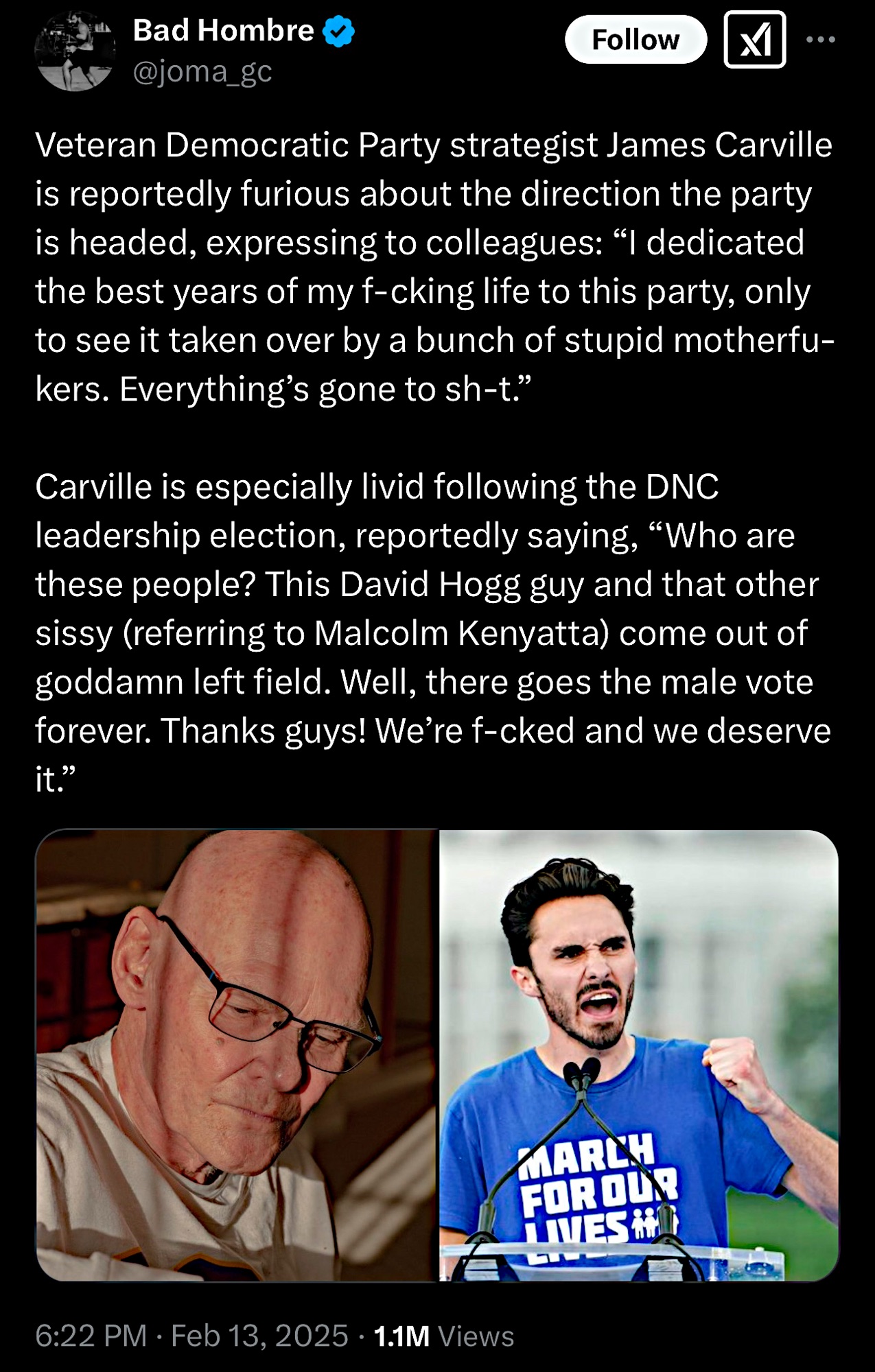
 For what it’s worth, I’m no fan of David Hogg either. The Dems need real dudes in charge, not Harvard-educated woke wussies. Okay, Hogg isn’t necessarily a wussie but he’s certainly a skilled opportunist.
What Hogg endured during the Parkland nightmare was obviously traumatic and devastating. In no way have I dismissed or minimized the terror of almost being shot to death by a deranged teenaged maniac.
Nonetheless Hogg DID seize upon and then master and then ride this experience to fame and influence and political glory in much the same way that Audie Murphy rode his WWII combat trauma like a racehorse to become a famous movie actor & a man of property and symbolic power.
Murphy would have been foolish to turn that opportunity down at the end of WWII; the same applies to Hogg in the wake of Parkland.
Hogg may well have had political careerist ambitions all along (I’m presuming that he did), but surviving the Parkland trauma and then railing against the pro-gun lobby served as quite the dynamic springboard.
And here he is now…a political player, a guy with skin in the game, a young establishment Democrat who has risen in the ranks. He’s in a position now to run for a seat in Congress before long or for the U.S. Senate when he’s a bit older, and perhaps even the Presidency some day. He rode that traumatic horse, all right.
If you could somehow magically migrate yourself into The Brutalist…if you could somehow penetrate that membrane and suddenly find yourself actually hanging with Adrien Brody‘s Laszlo Toth and all the rest of those miserable characters…if you could push a button that would allow you to actually gain entry to and live in their world…would you?
Answer: Of course you wouldn’t because (a) theirs is a grim, grief-stricken world…a morose “lemme outta here” underland if there ever was one, and (b) the characters aren’t “real” (by which I mean relatable in a recognizable, everyday, human being sense) but Brady Corbet constructs.
Living inside The Brutalist would be, in fact, hellish. That’s precisely how I felt as I watched it…trapped in a cold hell cave.
An HE commenter claimed a week or two ago that I had ranked Emilia Perez among my top five films of ’24. Not true — in my final 12.21.24 wrap-up I ranked it in 15th place.
1. Sean Baker‘s Anora / HE review (5.22.24)
2. Edward Berger‘s Conclave / HE review (8.31.24)
3. Payal Kapadia‘s All We Imagine as Light / HE review (5.24.24)
4. Alice Rohrwacher‘s La Chimera / HE review (4.24.24)
5. James Mangold‘s A Complete Unknown / HE review (12.10.24)
6. Luca Guadagnino‘s Queer / HE review (9.18.24)
7. Halina Reijn‘s Babygirl / HE review (12.10.24)
8. Steven Zallian‘s Ripley / HE review (4.27.24)
9. Robert Lorenz‘s In the Land of Saints and Sinners / HE review (4.5.24)
10. Ali Abassi’s The Apprentice / HE review (5.20.24)
11. Tim Fehlbaum‘s September 5 / HE mini-review (10.24.24)
12. Jesse Eisenberg‘s A Real Pain.
13. Alex Garland‘s Civil War / HE review (4.9.24)
14. Halfdan Ullmann Tondel‘s Armand / abbreviated HE non-review (11.18.24)
15. Jacques Audiard‘s Emilia Perez (audacious but calm down) / HE review (6.18.24)
16. Steve McQueen‘s Blitz / HE review (11.5.24)
17. Magnus von Horn’s’s The Girl With the Needle
18. Denis Villeneuve‘s Dune: Part Two.
19. Coralie Fergeat‘s The Substance
20. Christy Hall‘e Daddio (Sony Pictures Classics, 6.28)
21. Rose Glass‘s Love Lies Bleeding
22. Brady Corbet‘s The Brutalist.
23. Jean-Stéphane Sauvaire‘s Asphalt City (formerly Black Flies)
24. Clint Eastwood‘s Juror No. 2
25. Luca Guadagnino‘s Challengers
26. Ridley Scott‘s Gladiator II.
27. Yorgos Lanthimos‘s Kinds of Kindness
28. Wes Ball‘s Kingdom of the Planet of the Apes
29. RaMell Ross‘s Nickel Boys
30. Greg Kwedar‘s Sing Sing
31. Zellner Bros.’ Sasquatch Sunset.

“…and you used me to get Jack Reed to marry you.”
HE is preparing for a forthcoming podcast withh Sasha Stone about Warren Beatty‘s Reds. Immersing myself.
Arguably the best Hitler video in years…best editing, best dialogue…made me very happy, restored my soul.
Sean Baker (1:04 mark): “Writing is the hardest [part of the process] for me. I think it’s…when you’re alone and you’re just breaking [into] a story and you don’t know if it’s something that’ll work…it’s torture, absolute torture.”
And I, the beast of Hollywood Elsewhere burden, endure a form of this torture (obviously not the same as Baker’s but somewhat similar) every damn day. If you don’t think that takes a spiritual toll, think again.
This Scott Feinberg-moderated discussion happened last night in Santa Barbara’s Arlington theatre. The event was called the Outstanding Directors Award Group Discussion & Awards Presentation. Baker, Jacques Audiard, James Mangold, Brady Corbet, Coraline Fergeat.

This SBIFF Virtuosos montage (it unfurled last Friday night) is first-rate, mesmerizing…as good as this kind of thing gets.
On the other hand, Jennifer Lawrence (aka J-Law) was on a fairly hot roll for three years, starting with Winter’s Bone (’10) and cresting with her Oscar-winning performance in the phenomenally on-target and commercially successful Silver Linings Playbook (’12), written and directed by David O. Russell.
But that was it — a charmed career path that lasted three years.
From 2013 onward or over the last 12 years, Lawrence has been more or less plotzing…treading water, in-and-out, hit-and-miss. She’s been in two or three good films, but the lucky-streak period ended with Playbook, her last big critical and commercial hit. She’s been doing “okay” but the career has kinda been poking and lurching along.
The three Hunger Games films were commercially successful but critically loathed. Russell’s American Hustle enjoyed critical and commercial approval but lacked that special euphoric spark. Lawrence’s X-Men films…give me a break. Susanne Bier‘s Serena (’14) was a bust. Russell’s Joy (’15) felt like a miss or even a semi-fizzle. And then along came Morten Tyldum‘s Passengers (’16), which succeeded commercially but was hated by people with taste…a critical Hindenburg.
Darren Aronofsky‘s mother! (’17) was a powerful art-horror film (heartily approved by HE) but almost everyone hated it. Red Sparrow (’18) was a modest hit and a critical flop. Dark Phoenix…later. Adam McKay‘s Don’t Look Up (Netflix) was critically applauded but failed to really catch on culturally or awards-wise. Lila Neugebauer‘s Causeway (’18 — Lawrence’s wokey, low-rent New Orleans film) was critically upvoted but otherwise felt like a whiff.
In my book Gene Stupnitsky‘s No Hard Feelings (’23) was Lawrence’s best comedy since Silver Linings Playbook. Her next film is Lynne Ramsay‘s Die, My Love, a dark comedy.
It’s been 13 years since Silver Linings Playbook connected across-the-board. If she wants to maintain her Lawrence-ness, J-Law needs to hit another homer or at least a triple. She can’t just star in movies that are semi-liked or which perform fairly well. She needs to really tag one.
I’ve noted before that most name-brand directors, producers and actors enjoy 12-year streaks when everything is cooking and breaking their way. Some directors and actors are lucky enough to last 15 or 20 years or even longer.
Dustin Hoffman is an exception to this general rule in that (a) he enjoyed a serious 15-year hot streak from The Graduate (’67) to Tootsie (’82), and then (b) he kept things going on an in-and-out-basis for another 10 years if you ignore Ishtar (’87) and start with Rain Man (’88) and finish with Wag the Dog (’97).
So if you want to be liberal or forgiving by erasing Ishtar, Hoffman actually revelled in a 25-year hot streak, which puts him alongside Meryl Streep (40 years), Martin Scorsese (half-century), Alfred Hitchcock (23 years), Steven Soderbergh (23 years), John Ford (27 years) and John Wayne(37 years).
You also have to give Hoffman credit for delivering a pair of ace performances in 2004’s I Heart Huckabees and Meet the Fockers.
Hoffman’s initial golden streak contained 11 or 12 really good films: The Graduate (’67), Midnight Cowboy (’69), Little Big Man (’70), Straw Dogs (’71), Papillon (’73), Lenny (’74), All the President’s Men (’76), Marathon Man (’76), Straight Time (’78), Agatha (’79…decent, not great), Kramer vs. Kramer (’79), Tootsie (’82).
The mixed second streak (10 years) contained nine films: Rain Man (’88), Dick Tracy (’90), Billy Bathgate (’91), Hook (’91…REALLY BAD), Hero (’92…problematic), Outbreak (’96), Sleepers (’96), American Buffalo (’96), Mad City (’96) and Wag the Dog (’97)
I saw Kevin Costner‘s Horizon: An American Saga — Chapter 2 last Friday night (2.7) at the Santa Barbara Film Festival.
For what it’s worth this 190-minute western feels a tad more engaging than Horizon: Chapter 1, which I caught in Cannes last May. But it’s more or less the same bowl of scenic, big-swing lethargy soup, and that ain’t cause for joyful celebration. I’m sorry but it’s just not.
Seven months ago (i.e., early last July) I wrote that unless Horizon 2 significantly improves upon the sprawling and sluggish initial installment and delivers something that feels whole and alluring and thematically fulfilling, he should probably forget about Parts 3 and 4.
Alas, Chapter 2 makes the same kind of mistakes that Chapter 1 did — it kinda moseys around and half-assedly hopscotches and fritters away story tension. Too damn slow, too clop-cloppy, almost zero urgency in terms making it all come together.
Chapter 2 is mostly about the women — it’s a rough-and-tumble film about open-range feminism. Sienna Miller‘s Frances Kittredge, Ella Hunt‘s Juliette Chesney, Isabelle Fuhrman‘s Diamond Kittredge, Abbey Lee‘s Marigold, Kathleen Quinlan‘s Annie Pine…but for God’s sake don’t ask me to recount their disparate storylines. I don’t want to think about them, talk about them, write about them…leave me alone. It’s taken too damn long to sit through these two films, and I’m damn sure not going to invest even more hours trying to neatly summarize them on the Macbook.
It really and truly breaks my heart to say all this. I love Costner as a man of character, consequence and sincerity, and I truly worship some of the films he’s directed and starred in. Open Range especially.
In my original Cannes review, I wrote that I was so bummed after seeing the first installment that “if a friend had offered a couple of snorts of Vietnamese heroin, I would have followed him right into the bathroom.”
Serious cinema in the classic western mode, especially when you’re talking about two movies running three hours each, is about delivering a solid, well-strategized, self-contained story with emotional currents. It needs to deliver a beginning, a middle and hopefully a bull’s-eye ending. Horizon Chapter 1 didn’t do that, and neither has Chapter 2. They both mainly plant seeds by introducing characters along with the beginnings or continuings of six or seven story lines. In so doing they refuse to deliver a serious, nutritional, stand-alone meal…the kind of thing most of us want to see.
Think of the huge, sprawling, emotional story that Red River told, and it did so in 133 minutes
Costner said last May that Horizon “is a journey…it’s not a plot movie.”