Just for openers, the combination of Lupita Nyong’o as Helen of Troy plus Elliot Page…yeesh.
,/p>
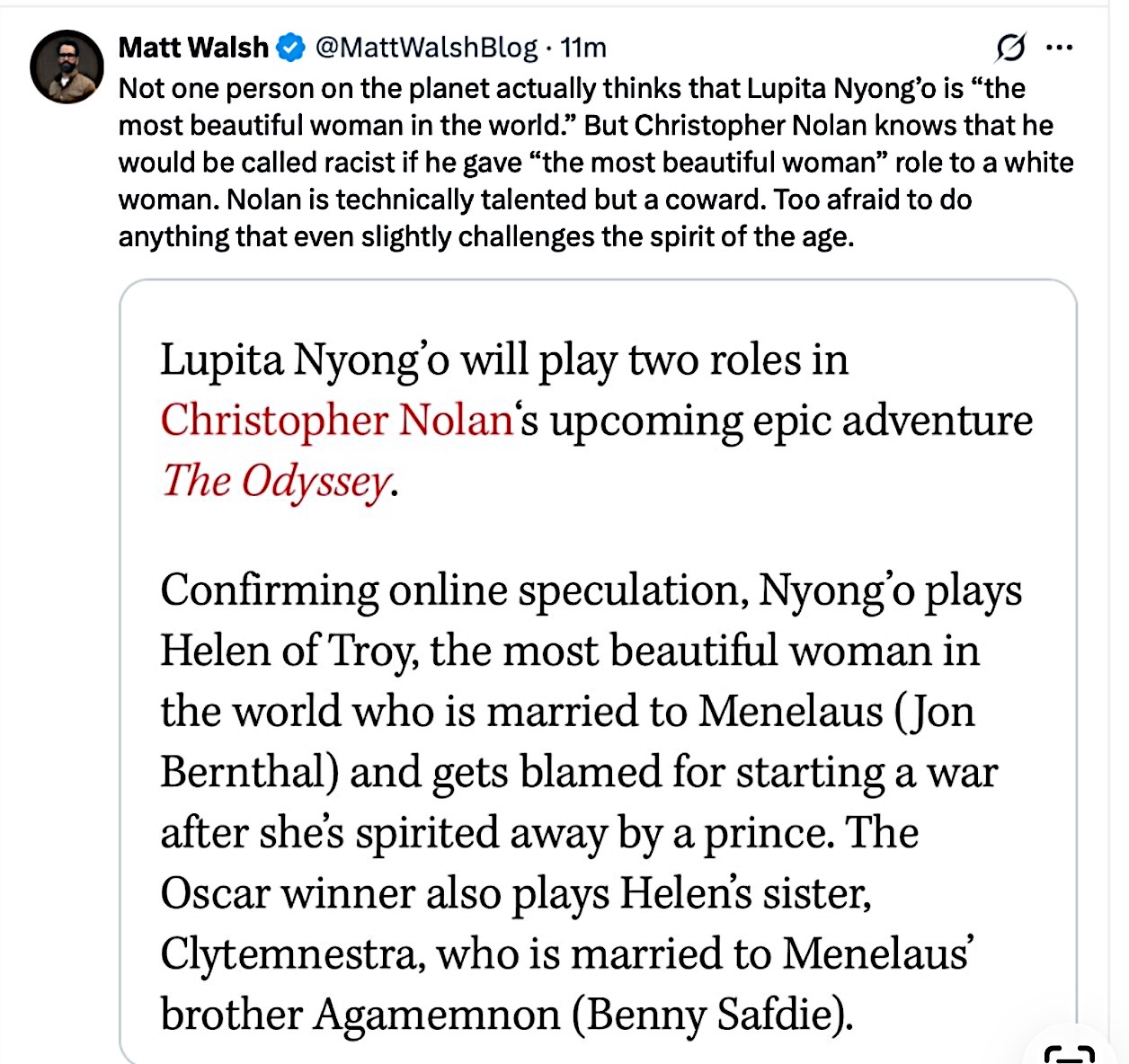

Just for openers, the combination of Lupita Nyong’o as Helen of Troy plus Elliot Page…yeesh.
,/p>
Zoe Kazan‘s longform Netflix version of John Steinbeck‘s East of Eden will be strikingly different from her grandfather’s 1955 version, which was basically about James Dean‘s anguished Cal Trask.
Zoe’s version adopts the point of view of Jo Van Fleet‘s Cathy Ames/Kate Trask, the bitter, hard-edged madam character who shot Raymond Massey in the shoulder and then, many years later, lent Dean $5K so he could partner with Albert Dekker“s Will Hamilton in the bean business.
I’m simply too attached to Elia Kazan’s 1955 version to give his granddaughter’s angry-feminist version a fair shake.
I respect the fact that Florence Pugh has apparently slimmed down and is no longer chubby-cheeked.
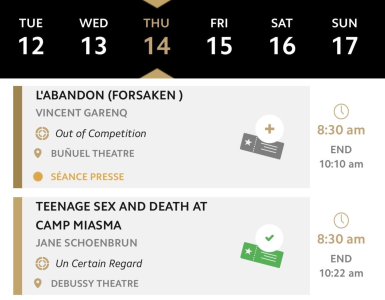
I don’t know about Jane Schoenbrun‘s Teenage Sex and Death at Camp Miasma (Thursday at 8:30 am) or the 1 pm follow-up, Diego Luna‘s Ashes (Niza en la Boca), although reviews of the Luna have been pretty good so far.
But I’m fairly certain that Pawel Pawlikowsky‘s Fatherland (4:45 pm) will be some kind of monochrome smarthouse knockout**, and that Asghar Farhadi‘s Parallel Tales (6:45 pm) will, at the very least, register as moderately impressive.
 ,/p>
,/p>
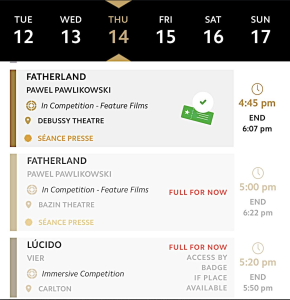

** Sandra Huller‘s performance as Erika Mann, daughter of novelist Thomas Mann (Hanns Zischler), is already being touted as a Best Actress contender. How do I know this? Because Huller will soon be interviewed by THR‘s Scott Feinberg at the Campari Lounge, which is located in “the bunker.”
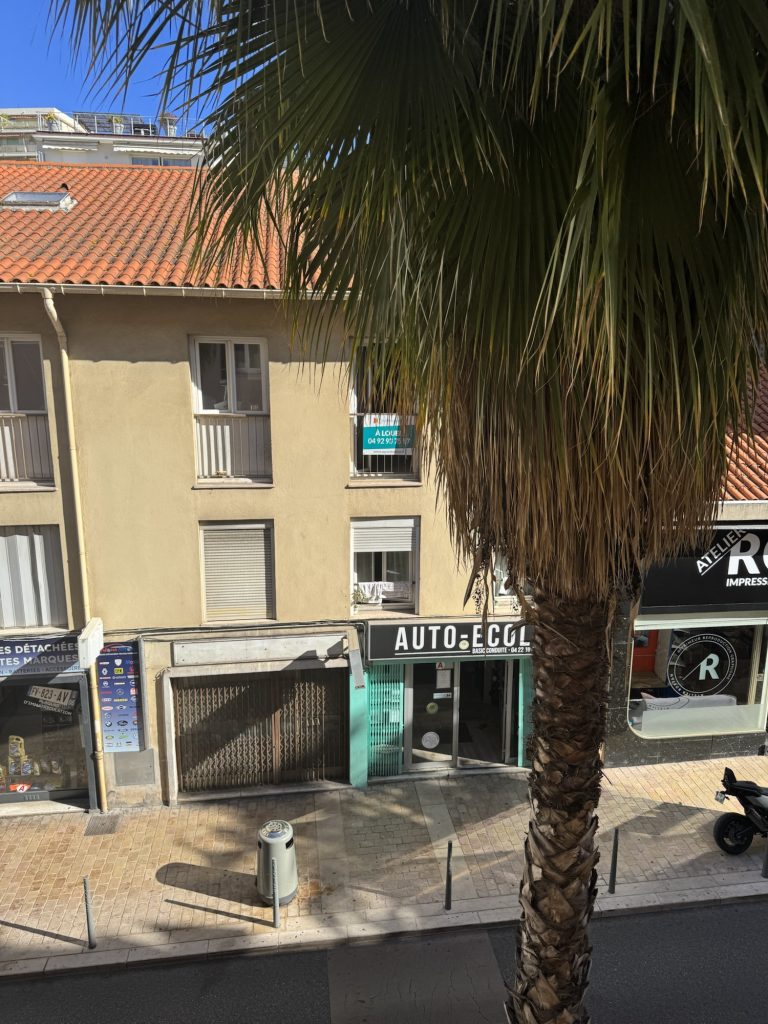
…of opening your kitchen window, pushing back the wooden French shutters and looking out at all this effing “waaaahhh“. The apartment is sound-insulated, of course, but just knowing this crap is out there…it’s a bit like living next door to Jurassic Park.
Against all odds, the Cannes Film Festival’s press ticketing system gave me a break this morning, abandoning its curious posture of blocking me from reserving a ticket to Kantemir Balagov‘s Butterfly Jam. I was suddenly allowed to attend this morning’s 10 am screening inside the Theatre Croisette (i.e., the basement forum beneath the JW Marriott)…great. Appreciate the largesse!
But no sooner did this happen when the system changed its mind and screwed HE over in a different way, denying me access to Sunday evening’s screening of Maverick, the David Lean documentary. And this was between 7:02 and 7:03 am this morning…thanks so much! I really hate this festival for pulling this shit.
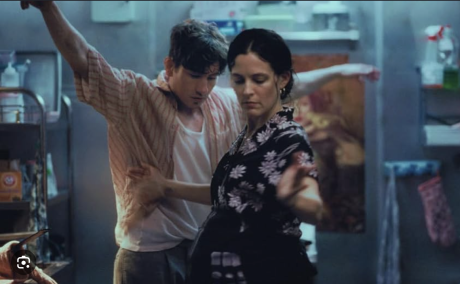
I was surprised that I liked Butterly Jam as much as I did. That’s because it’s a kind of surreal ethnic fable…an oddly poetic, magical-realism thing about Circassian culture and cuisine…the general Circassian diaspora of northern New Jersey. (The 34 year-old Balagov is himself Circassian.) The film is set in and around Newark, New Jersey and Bergen County…God, what a miserable, environment…coarse, gunky, lower-depth vibes.
The central protagonist is Temir (Talha Akdogan), a 16 year-old wrestler with a heavy-set, bordering-on-fat physique, and who bears not the slightest resemblance to his father, Azik (the 33 year-old, warlock-eyed Barry Keohgan). They certainly don’t have the same kind of nose, and Akdogan’s eyes are dark and totally lacking that warlock quality.
Azik’s culinary specialty is “delens,” a traditional meat-and-cheese pie from Russia’s Kabardino-Balkaria region.
Azik’s pet name for his teenaged son is Pyteh, which means “little one.” Azik is a chef working in a struggling Circassian diner in Newark. 36 year-old Riley Keough plays his sister Zalya, the pregnant owner (co-owner?) of the diner.
The inciting incident is Azik being offered a job as top chef at a swanky new restaurant. Better pay, onward and upward, etc. But Azik, being an impulsive ethnic who’s unable to think and act in sensible, practical terms, manages to complicate this situation.
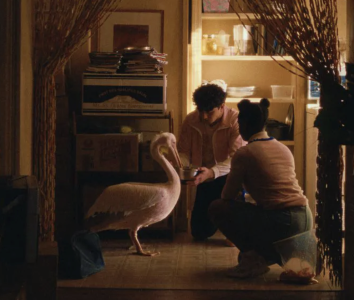
But smart career strategy isn’t the focus here — Jam is a film about all sorts of magical oddball elements by way of Circassian this and that…acne, wrestling, a pink pelican, the lore of Monica Bellucci, etc. Presuming that Butterfly Jam will play commercially in the U.S., I doubt if Joe and Jane Popcorn know who Bellucci is, much less know her face, especially since she now looks 60ish.
I loved the pink pelican metaphor**, as well as the real bird itself. I didn’t get the acne-healing thing between Temir and real-life wrestler Jaliyah Richards. Keogh, for the first time, looks older than she years — she could easily be 40 or older. Koehgan is playing Temir’s father, as noted, and he looks several years older than 33 with those deeply etched eyebags upon his cheekbones, and yet in Sam Mendes‘ currently filming Beatle quartet he’s playing Ringo Starr in his early to mid 20s. Go figure.
** I’m actually not sure what the metaphor actually amounts to.
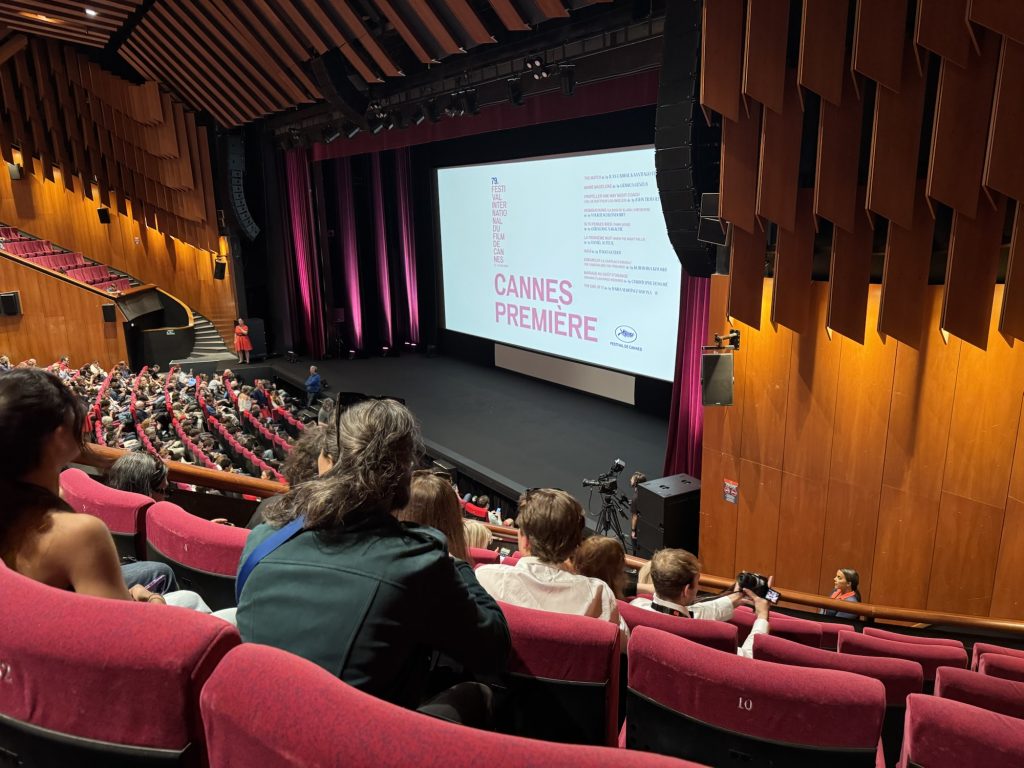
Last night I suffered through agonizing leg-muscle torture during the Cannes Film Festival’s opening night screening, Pierre Salvadori‘s The Electric Kiss (La Vénus electrique).
This isn’t an allusion to the quality of Salvadori’s lightweight dramedy (which isn’t “bad”, just forced and insubstantial). It’s a statement of simple fact. I arrived a bit late to the screening due to working on my Rex Reed obit, and was therefore obliged to sit in the half-filled balcony. I was scrunched between two women, and the leg pain began about 45 minutes into the show. I was nonetheless determined to man up and suffer my way through the whole thing, and I made it! 122 minutes!
Set in 1928 Paris, The Electric Kiss is basically an emotionally earnest, low-key farce — an unrequited, “oh what a tangled web we weave when we practice to deceive” hetero romance in the usual farcical ways.
What got me, a high-octane hetero in decline, is the fact that Kiss doesn’t offer even the briefest anatomical glimpses or depictions — no sweat-glistened boobs, no fleeting ass shots, no simulations of this or that sex act. It’s kind of striking that while there are no bare breasts to contemplate, Salvadori is careful during one moment to offer a clean silhouette of a female nipple…a case of alluring, old-school, almost Lubitsch-like discretion.
It is universally required that in any hetero dramedy dealing with the pain and ecstasy of romantic longing, the female lead must stir erotic desire among (or more precisely within) dudes like myself. The unfortunate fact is that Anaïs Demoustier, who plays a hustling, opportunistic carnival performer named Suzanne, simply doesn’t cut it in this respect. I’m sorry but that’s the truth of it.
Over the closing credits we’re treated to a re-listen of Shocking Blue’s “Venus“…this should tell you a lot.
What is The Electric Kiss about? The three Ds — desire, deception, discovery.
In a spring of 1997 edition of The Paris Review (issue #142), David Mamet explains “the trick of dramaturgy” as follows: “The main question in drama…is always ‘what does the protagonist want?’ That’s what drama is. It comes down to that. It’s not about theme, it’s not about ideas, it’s not about setting, but what the protagonist wants. What gives rise to the drama, what is the precipitating event, and how, at the end of the play, do we see that event culminated? Do we see the protagonist’s wishes fulfilled or absolutely frustrated? That’s the structure of drama. You break it down into three acts.”
And that’s fine, but I’ve long believed that the most affecting kind of drama (or comedy even) is one in which the main protagonist wants something and then somewhere during Act Two discovers that he/she actually wants something else. Something that is less a thing of mood or sexuality or a longing for wealth or advancement and more of a tender, deeper, more emotional longing. A personal growth thang, falling in love, doing the right moral thing, etc.
A character who stays with the same desire all the way through a play or a film is not, in my view, an interesting one. We don’t want to see the protagonist’s wishes “fulfilled or absolutely frustrated,” as Mamet says. We want to see those wishes evolve and thereby reveal something unexpected.
Which is why I’ve frequently noted my preference for stories that are built and structured upon the three Ds.
Here‘s an excerpt from Howard Suber‘s brilliant Some Like It Hot commentary track . It partly explains how this basic scheme of all great comedies applies during the finale.
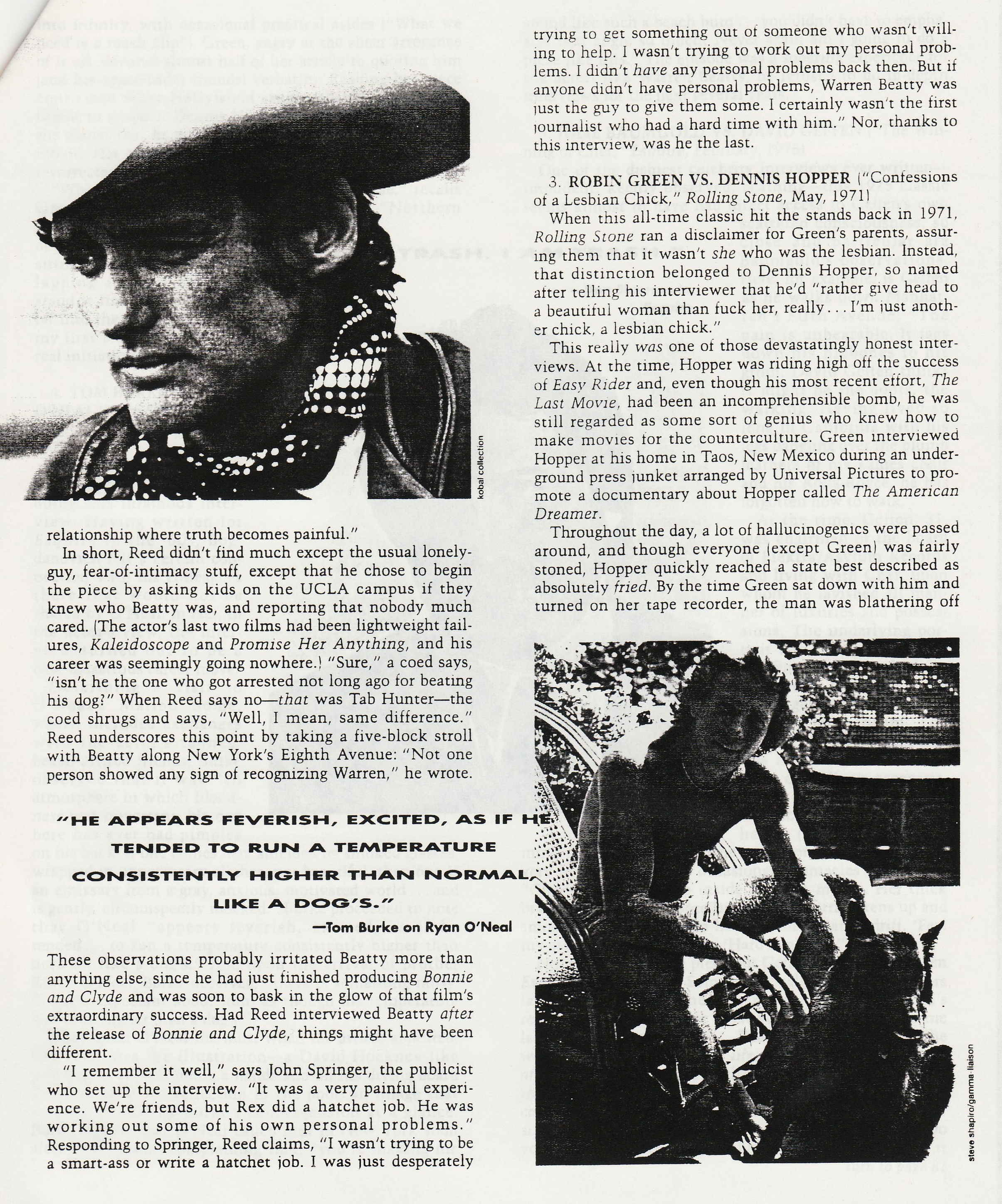
The once-great film critic and flamboyantly blunt-spoken personality Rex Reed has left the earth at age 87.
In his prime (mid ’60s through early ’90s) the openly gay Reed was a swaggering, colorful, unintimidated writer. When he was younger he seemed to really know his stuff and truly care about the value of great cinema. Reed really and truly understood the Hollywood universe, and was a major fan of same. He worshipped legendary filmmakers and their best work, and said so repeatedly with commendable eloquence.
Reed wasn’t really a proverbial “critic of the cloth” who walked around in monk’s robes, and in this sense wasn’t on Roger Ebert‘s level (i.e., at times he seemed to value snooty judgments more than insight for insight’s sake) but during his peak years Reed was an absolute king of the bitchy-critic realm as well as a famous brand and an occasional movie actor, and I for one quite liked reading his stuff, or most of it. I adored his bluntness. Plus I knew him personally and enjoyed his company as far as it went. He was always friendly.
I’ll admit that the older, going-downhill, white-haired Reed got a little sloppy with his reviews from time to time (factual errors, misspellings, etc.), but I loved that he despised woke critics, and they him. I admired his courage in deriding Jordan Peele‘s Get Out (are you hearing this, Bob Strauss?), knowing full well that the identity fanatics would viciously trash him for this.
Here’s my Movieline assessment of Reed’s legendary Warren Beatty hit piece in Esquire, titled “Will The Real Warren Beatty Please Shut Up?“:
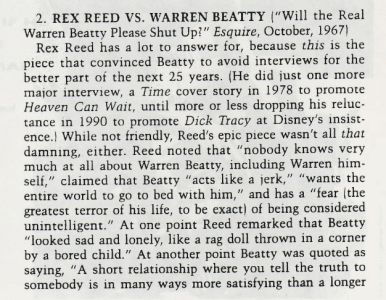
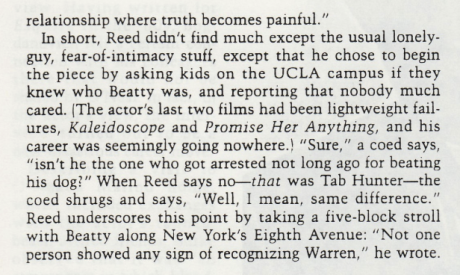
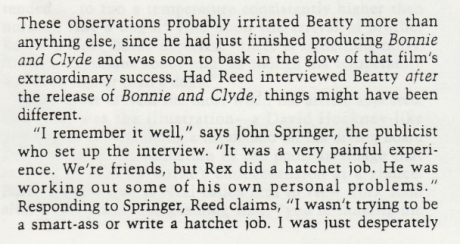
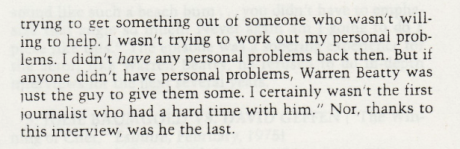
I’ve decided to blow off John Travolta‘s Propeller One-Way Night Coach, which will screen in Cannes later this week. Pic was directed, written and narrated by Travolta, and features a kid protagonist named Jeff, and is seemingly bland in a brightly colored way. Pic only runs 61 minutes, which isn’t quite feature-length (a commercial film has to run at least 70 minutes) but too long for a short.
Based on Travolta’s same-titled children’s book and based on his own eye-opening experience in the late ’50s or early ’60s. (Travolta was born in ’54.) I’ll catch it down the road…no offense.
“Revolucian” created this mix 17 years ago…Terminator Salvation opened on 5.29.09…Barbra Streisand delivers the coup de grace.
I slept last night on a couch inside my one-night Airbnb (20 rue de Mimont, just behind the Cannes gare). I’m moving into a semi-permanent abode around 3 pm today. The hilltop Le Suquet pad (12 days, 3000 euros, rue des Freres) is right next to a high-speed highway (Voie Rapide) with cars going “waahhh!” 24/7. A short downhill walk from the hellishly noisy apartment exterior is a quiet 19th Century area with charming, old-world restaurants (a Vietnamese place looks especially inviting) with outdoor seating areas.
And yes, Senator John Fetterman of Pennsylvania speaks like a sane, reasonable regular guy, and listening to a U.S Senator who tries to avoid default political cliche phraseology is very refreshing.
Fetterman is not a reflexive Trump hater, but — this is where I stand adamantly alone, if need be — his failure to condemn the proposed White House ballroom as a vulgar, Mussolini-like monstrosity isn’t just uncool — it’s blind. The ballroom reeks of philistine sensibilities…a coarse, tasteless, disproportionate projection of Mar a Lago
boorishness…zero class, culturally coarse.
I love a line from Catherine Slessor’s 10.23.25 Guardian essay, to wit: “Trump’s engoldening of the Oval Office, described by White House press secretary Karoline Leavitt as a ‘golden office for the golden age’, has been unflatteringly compared to a professional wrestler’s dressing room.”