Guillermo del Toro Is Closer To God Than Most Of Us, But Average Joes Don’t Want Peace Candles — They Want These Fiends Gutted and Fed To Wolves

Before attending this evening’s TCL Chinese second-look screening of The Big Short, I’ll be attending a 5 pm Paris massacre peace vigil at the Consulate General De France (10390 Santa Monica Blvd, adjacent to Beverly Glen Blvd.). The Move On message asks participants to “show your opposition to all violence and hatred…share our hope that together France and her allies seek justice, not vengeance.” Justice? I will stand among this crowd and hang my head and maybe even hold a candle, but I will not sing “Amazing Grace.” Not this time, pal.

There can be no “justice” in a situation created by animals, and you can’t make deals with them either. (Just ask Ray Hicks.) I don’t think it’s right or wise, but you know that most people are thinking along the lines of Dirty Harry right now. They definitely don’t want to know from peace candles. When Bonasera the undertaker asked Don Corleone for justice, he said “let them suffer then, as [my daughter] has suffered.” ISIS wants a super-vicious response, of course. Their biggest wet dream is the U.S. of Satan coming after them and bringing on the Ultimate Armageddon. I don’t know what to do, but if any one group or army in world history deserves extermination, it’s the “Allahu akbar” guys.

I was genuinely touched by Guillermo del Toro‘s tweet last night about his response to his father’s kidnapping and how he didn’t want to contribute to the cycle of violence, and how this is a lesson right now. But this is not what Average Joes are thinking, trust me. You can feel the current out there. God help us if Ann Coulter is right and Donald Trump surges ahead of Hillary Clinton because of this. This almost feels Biblical, what’s happening now.

If you could bury the entire ISIS army and all their admirers under a thousand feet of sand by snapping your fingers three times, would you do so? Be honest. Yes, I know Guillermo’s tweet reflects a wiser, more Solomon-like response, but I wonder what Alejandro G. Inarritu is thinking right now.

Read more

Too Dumb To Fully Grasp All The Big Short Particulars — Need To Read Lewis Book, Study Up, Burn Midnight Oil

I didn’t post anything about Adam McKay‘s The Big Short because…well, because I feel I should give it another chance. So I’ll be buying and reading Michael Lewis’s book and re-seeing it again on Saturday. I got most of it, generally speaking. But I don’t have a place in my head for high-stakes betting, and I didn’t understand some of the fast-flying terminology. Some of it felt too dense and arcane and wonky, and I was (and still am) too dumb to fully process it. So I’ll be re-immersing tomorrow and maybe writing something on Sunday.

Adam McKay‘s Big Short bid to leap from Anchorman director to Oscar contender is a bold one, but his let-me-spell-it-out-for-you comic take on the financial crisis still flew over the heads of many befuddled media members I spoke to.” — from 11.13 Oscar Futures post by Vulture‘s Kyle Buchanan, posted late this afternoon.

Me to 3 Guys Who Saw Big Short A While Back & Told Me How Game-Changing It Was: “You didn’t tell me it was really wonky…that a viewer has to contend with loads of impenetrable jargon, and that sometimes it’s hard to keep up with what is actually going on. Don’t get me wrong — I understood the basic shot and some of the specifics, but not all of it, and sometimes I was muttering to myself ‘…the fuck?’ Some of that terminology is hard to wrap around your head, bro.

“And you guys didn’t even mention this when I asked you for reactions? You didn’t bury the lede — you ignored it altogether. You mostly just said ‘very good’ and ‘Carell, Carell, Carell.’ What do you have to say for yourselves now that the truth is known far and wide?

“You glad-handed it. You sold me a bill of goods. You led me down the garden path. You pulled the wool over my eyes. You tied a tin can to my tail.”

Response from Tipster #1: “Jeff, you’re on some madness. There’s nothing in that movie that’s particularly hard to understand. It’s not a traditional film in the sense that it has a multi-plot structure and it isn’t necessarily narratively traditional, but the key scam seems clear: the banks forced the rating agencies to give bogus ratings to the loans that allowed them to sell them and pretend they were secure loans when in fact they were garbage likely to default.

“This is really all you need to understand, and it came through for me.

“A secondary point is that federal oversight at the SEC and other agencies was pathetic, and the government failed its citizens, in part because of the revolving door between government and the finance industry. Some smart guys figured out the game was soon to be up, bet heavy, and won. Carrell’s moral dilemma is somewhat contrived for dramatic effect, but I’d bet none of these guys felt exactly right about building their fortunes off other people’s misery – – unlike Goldman Sachs.”

Response from Tipster #2: “What can I tell you, Jeff? It made me feel a bit smarter. If I were you I wouldn’t proclaim how this movie left you in a dizzy haze. People at least have the perception that you’re on top of things, that you’re a smart guy. Don’t burst their bubble, Bubba.”

My Response to Tipster #2: “I’m not the only one crying ‘too dumb!'”

Another “Allahu akbar” Paris Slaughter, Only Worse

Roughly 120 people dead in my blessed City of Light, a place I’ll always call my second home. I know next to nothing but this was all starting to happen when I came back from a Sicario lunch at Craig’s in West Hollywood. Between your unstable, garden-variety, NRA-empowered nutters and your ISIS-supporting, foam-at-the-mouth terrorists…it’s enough to make you think medieval thoughts.

Read more

Deakins-San

The legendary Roger Deakins has delivered distinctive, mouth-watering, world-class cinematography on so many great films it’s almost tiring to review them all. All of those Coen brothers films alone…Barton Fink, The Hudsucker Proxy, Fargo, The Big Lebowski, O Brother, Where Art Thou?, The Man Who Wasn’t There, Intolerable Cruelty, No Country for Old Men, A Serious Man, True Grit and the forthcoming Hail, Caesar!. Not to mention The Shawshank Redemption, Kundun, A Beautiful Mind, In the Valley of Elah, The Assassination of Jesse James by the Coward Robert Fordthe list goes on and on.


Sicario dp Roger Deakins in West Hollywood’s London hotel — Friday, 11.13, 10:22 am.

Deakins is in the pantheon with Emmanuel Lubezki, Robert Richardson, Wally Pfister, Jeff Cronenweth, Matty Libatique, Dante Spinotti and…I don’t know, you tell me.

Currently on the plate is Denis Villeneuve‘s Sicario, which Deakins shot the hell out of in his usual striking way. Hot blasts of Texan-Mexican sun, noirish atmosphere, serious malevolence. Good hands, good eye, enormous assurance.

I spoke to Deakins around 10 am this morning inside West Hollywood’s London hotel. The primary idea was to discuss Sicario but also to afford myself and others a chance to remind everyone that this brilliant resident of Santa Monica — British, lanky, white-haired, laid back — has been nominated for the Academy Award for Best Cinematography twelve fucking times, and that it’s time to finally give him the trophy already.

Read more

Sullied Guys Wearing Turned-Around Collars

Lewis Beale has written an L.A. Times piece (dated 11.12) about how Spotlight has once again cast the Catholic Church in a sordid light. This has been an increasingly common occurence in Hollywood movies for some time now, Beale writes. Tom McCarthy‘s fact-based saga of the Boston Globe‘s “Spotlight” team uncovering a pattern of coverups of degenerate clergy is but the latest manifestation.

We all carry around notions of the Catholic church being steeped in shady dealings, political corruption and perversity. This wasn’t always so, of course. For decades Hollywood portrayed priests as heavenly emissaries. The mid to late ’40s were the high point of Hollywood’s glorification crusade with films such as Going My Way, The Bells of St. Mary’s and The Miracle of the Bells. But these films popped over 65 years ago.

The tide began to turn in the late ’80s, Beale believes, “when the Catholic Church sex abuse scandal began to become known.” One of the first eruptions along these lines, he contends, was Judgment, a 1990 TV flick starring David Strathairn as a Louisiana priest accused of molesting his young parishioners. That was followed by The Boys of St. Vincent, a 1992 Canadian TV film (shown theatrically in the U.S.) about boys being diddled in a Catholic orphanage in Newfoundland.

But by my sights the Catholic church’s Hollywood rep has been going downhill big-time since 1982, when Frank Perry‘s Monsignor (Christopher Reeve as a priest with mafia dealings) and Sidney Lumet‘s The Verdict (the Boston archdiocese trying to pay off Paul Newman‘s sunken attorney to cover up the truth in a medical malpractice tragedy) were released.

Read more

Laugh Riot

All along 20th Century Fox has wanted The Martian to compete in the Golden Globes’ comedy/musical category, and today, by a reported single-vote margin, the Hollywood Foreign Press Association’s eligibility committee voted to classify Ridley Scott‘s film as a comedy. How is this not a pothole on the road to potentially winning a Best Picture Oscar? How can this scientific space-rescue flick compete for an Oscar with its own studio willing to call it a comedy in order to win a GG award, when in fact it’s pretty much a straight drama with a few laugh lines? Author and former Grantland columnist Mark Harris has called this “an embarrassment for the Globes [and] a stumble for the movie.” From Glenn Whipp’s L.A. Times story: “Finding The Martian in the comedy category is…raising a few eyebrows around town [as] ‘comedy’ isn’t the first genre that springs to mind when discussing the film. And, apparently, some HFPA members agree. The Martian made it into the comedy category by just one vote.”

More Christmassy Than Starbucks’ Red Cup

Call me crazy but this new Carol one-sheet seems to be aimed at potential viewers with conservative hinterland values. The suggestion is that Cate Blanchett has a thing for Rooney Mara but that slightly out-of-focus Rooney isn’t noticing or isn’t that interested or something along those lines. The big red car between them seems to symbolize a barrier of some kind, but it also seems to say “hey, folks, it’s holiday time!” There are happy snowflakes falling all around them, of course, which is more than you can say for Starbucks’ Red Cup. Snowflakes = holiday mirth = Santa Claus = Jesus. The poster seems to basically be saying “if Starbucks isn’t Christian enough for you, Carol will step in and fill that void because we believe in holiday values.” Except for the girl-on-girl aspect, of course, but who’s to say love-struck lesbians don’t value Christianity and Christmas?

O’Neil, Hammond Chew Oscar (i.e., Gold Derby) Fat

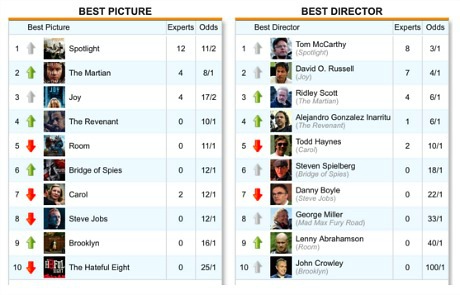
Listen to Deadline‘s Pete Hammond openly doubt Spotlight‘s Best Picture chances (“Let’s not get overboard here!”), claiming that it’s mainly a favorite of journalists and that rank-and-file types have yet to render a verdict so let’s wait and see, etc. And listen to Hammond and Gold Derby‘s Tom O’Neil go all kissy-face on The Martian, calling it “this year’s Gravity.” Hammond reasonably says “not so fast” about Joy, but says he’s spoken to people who’ve seen The Revenant and that it’s “phenomenal,” “Leonardo DiCaprio is in it for the Best Actor Oscar,” “very dark,” “two and a half hours,” etc. O’Neil, a Steve Jobs sentimentalist and lamenter, doesn’t like the idea of a guy (Leo) trudging across the snow and trying to survive. They both agree that Brooklyn and Room have the heat, certainly among women.

Read more

Big McKay Turnabout

Adam McKay‘s The Big Short (Paramount, 12.11) screens tonight at AFI Fest — a big moment for Paramount and potentially an even bigger moment for presumed Best Actor contender Steve Carell…maybe. But this featurette is a little too generic, and I’m not sure what I feel about a director who always wears a scarf, which to me is like a director in the ’50s or ’60s wearing a beret and an ascot. If you ask me Paramount should have put out a featurette that answers The Big Adam McKay Question, to wit: how did a comedy director whose whole career since the turn of the century has been more or less about directing or producing low-rent Will Ferrell movies (Anchorman, Talladega Nights, Step Brothers, Land of the Lost, The Campaign, Casa De Mi Padre, Get Hard) suddenly spins around and directs an allegedly smart, fully-grounded drama (dramedy?) about the collapse of the American economy? Due credit and huzzahs if The Big Short turns out to be as good as some are claiming, but how did McKay’s transition suddenly come about? McKay to Paramount: “Hey, I know I’ve been making comedies for popcorn-munchers for the last 12 or 13 years but I’d like to upgrade my stock by directing something a little sharper and darker and more real-world adult…okay?”

Great Expectations

A ton of movie sites have posted stories about their all-time favorite opening sequences over the last several years, and a lot of their choices are bullshit. The “authors” of these pieces don’t seem very thoughtful or perceptive — they mainly want you to click on 10 or 25 or 50 pages. There are two kinds of opening sequences that can be called great or highly memorable — one, the kind that put the primal hook in by whatever means and prompt you to say “Wow, I want to see the rest of this!” but don’t necessarily tell you much about the story to come, and two, the kind that do deliver key information about the story to come and/or the character who will be at the center of things.

A fine example of the first kind (“No clue what this is about but the footage and the vibe feel cool!”) is the George Gershwin-scored opening of Woody Allen‘s Manhattan (’79). It tells you two things about Allen’s lead character, Isaac Davis, which is (a) he’s head-over-heels in love with Manhattan (i.e., the film was shot before way, way before Brooklyn existed as a hipster habitat), and (b) that he’s a writer working on a book. That’s all it tells you, but it so wins you over that it’s like “forget it, I’m watching this movie to the end.”

A great example of the second kind is the music-free opening credit sequence in Sidney Lumet‘s The Verdict (’82). (Which I can’t find a clip for.) It’s basically a long, slow dolly-in of a gray-haired Paul Newman playing pinball in a low-lit bar somewhere, sipping whiskey from a shot glass, daylight outside. Right away you know he’s a guy with a problem or two and that difficult trials await. Another sterling example is the opening scene in The Godfather — tells you everything about who Don Corleone is, what the Corleone family is about, how it works, what the terms are plus the old-time gangster milieu. You’re fully informed by the time the scene ends, and totally hooked.

Read more