In tonight’s one-on-one interview between President Biden and ABC’s George Stephanopoulus, Biden is asked if he’s watched his own debate performance.
Biden’s reply: “I don’t think I did, no.”
Wait…he’s doesn’t THINK he watched a replay? He doesn’t think so but isn’t 100% SURE? He CAN’T RELIABLY RECALL something that may have happened a week ago or less?
He’s either lying or his mind has no snap, crackle, pop.
The best films about revolutions are those that wind the viewer up to such an extent that by the midpoint he/she wants to join the revolution being depicted. Films, in other words, that literally inject revolutionary serum into the viewer’s veins…the real kind, I mean, and not the bullshit Star Wars kind.
The second best are those that pass along the hard, cold, bitter and dispassionate truth about most revolutions, which is that they’re not all that romantic and are much more complex and complicated and even dispiriting than most of us would like to think.
The very best manage to convey both perspectives.
HE’s list of the finest, tip-top films about the (sometimes disappointing or delusional) drug of revolution are as follows:
13. Sergei Eisenstein‘s Battleship Potemkin (’25).
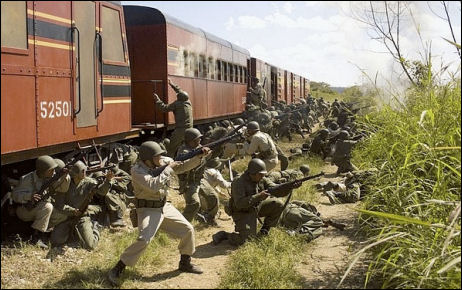
Posted on 12.1.08: Che isn’t a pamphlet or a short story or tight three-act “movie” to be savored with a tub of popcorn and a “do it to me” attitude. It’s about luxurious feasting as long as you understand the kind of feast that it is. A big and filling one, certainly, in terms of realism and theme and transportation, but served without conventional “story”, patented emotionalism, movie moments, dessert, coffee, appetizers, waiters, napkins, brandy or any of your standard four-star restaurant perks.
Obviously I’m not mentioning Che‘s subject matter, cinematography, real-life history, performances, etc. I just can’t do it again. Not now anyway. I’ve written about it so many times it’s coming out of my ears.
The people who nip-nip-nipped into this film in Cannes will, I believe, someday eat their words. If, that is, the prevailing opinion trend, which I’m told is starting to move for Che after six months of Cannes after-effect, actually manifests. Among the guilds and the branches, I mean. In which case the nip-nippers will begin to pretend that they liked it all along.
Perhaps there is, in fact, some kind of positive counter-surge brewing among those who are not critics. In the same way that 2001: A Space Odyssey, dumped on by big-city critics when it opened in April 1968, was saved by doobie-tokers. By this I mean people with the apparent capacity to enjoy a film that doesn’t do “drama” and just roll with what it is and what it does.
For me this boils down to the savoring of naturalistic experience, behavior, aroma — a kind of high-end movie versimilitude trip that isn’t trying to arouse and soothe in a campfire-tale sort of way but is strangely immersive all the same.
“Che is a direct challenge to audiences,” declared L.A. Times guy Mark Olsen in a 10.31 article. “Depending on who you ask, Che is either Soderbergh’s greatest masterwork or his grandest folly.”
Che is so fully realized and so completely off on its own humid jungle trail that many don’t get what it’s doing. It is in no way a folly.
Not to slight Chrissie Hynde‘s vocals in any way, but I absolutely adore the guitar tracks on “Back On the Chain Gang.” Hynde playing jangly rhythm, James Honeyman-Scott playing lead. This song is 42 years old…Jesus.
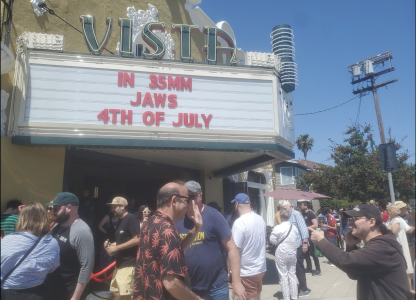
…if I’d somehow found myself in Los Angeles yesterday, even given the fact that I can’t watch Jaws anymore. I own the 4K Bluray and I just can’t sit through it. But I adore Laurent Bozereau‘s Making of ‘Jaws’ documentary, which I wrote about a year and a half ago.
I first saw Laurent Bouzereau‘s The Making of ‘Jaws’, an extra feature on the Jaws laserdisc, in ’95. 27 and 1/2 years ago. It’s since been included on the DVD, Bluray and 4K Bluray editions. It runs two hours and six minutes or something close to that. I was instantly gobsmacked by how honest and thorough and meticulous it was. Every significant chapter, every step of the journey. And a lot of it is funny. And everyone looks so young!
Almost everyone took part except for poor RobertShaw, who passed in ’78, and the late Murray Hamilton, who departed in ’86. Spielberg, Zanuck and Brown, Sid Sheinberg, Richard Dreyfuss, Lorraine Gary, book author Peter Benchley, screenwriter Carl Gottlieb, Roy Scheider, dp Bill Butler, edtitor Verna Fields, John Williams, shark specialists Ron and Valerie Taylor, etc.
It’s absolutely the definitive account of how Steven Spielberg, Richard Zanuck and David Brown‘s 1975 thriller came to be. The doc is significantly better, it goes without saying, than Eric Hollander‘s The Shark Is Still Working (’12), which I caught a few years ago. Decent, approvable.
I re-watched Bouzereau’s doc last night, and it’s still transporting. I know the saga backwards and forwards and I loved every minute. The only thing it needs is someone acknowledging at the very end that the enormous success of Jaws yielded a mixed legacy. For Jaws and Star Wars basically brought about the end of the Hollywood’s greatest chapter (the late ’60s to late ’70s) by ushering in the era of the blockbuster. Nobody so much as mentions this in Bouzereau’s film….astonishing.
Is this from the old In Living Color days? I’m presuming the fall of ’91. (Carrey’s reference to Oliver Stone and JFK indicates this.) Never saw this before this morning.
First and foremost, those who aren’t hiding their heads in the sand about the Joe Biden catastrophe (which lets out most of the lost-in-denial HE commentariat) need to listen to this All In podcast discussion between Chamath, Jason, Sacks & Friedberg. This is it, this is it, this is it.
Gurgling Joe Biden‘s taped, make-or-break interview with ABC’s George Stephanopoulosairs tonight at 8 pm, and I mean make-or-break for Stephanopoulos. He’s generally regarded as a “safe”, sensible-minded liberal Democrat, but if he goes too easy on Biden his reputation as a hotshot TV journalist will be instant toast.
Conversely if George’s questions for the Rotting Pumpkin are tough and unsparing and Biden stutters and chokes, Stephanopoulos will have earned a golden place in U.S. history.
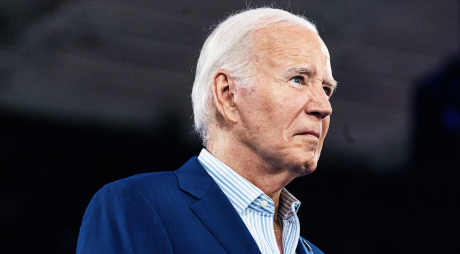
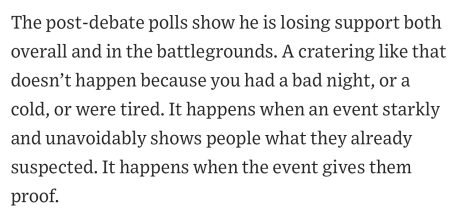
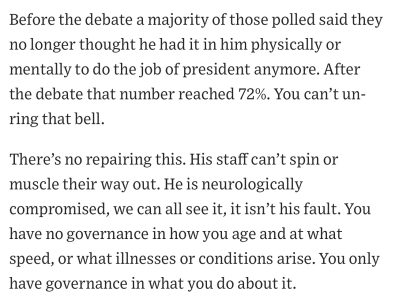
Issue #1, obviously, is not Joe’s “one bad debate” bullshit (“That’s 90 minutes onstage…look at what I’ve done over the last three and half years”), but observations by many that Biden has been in a state of cognitive decline for at least a couple of years and that the administration and mainstream media types have been covering this up like obedient mafia goons.
So the “Joe is sharp as a tack” narrative has been a Big Whopping Lie — a major coordinated effort at gaslighting — and the current term for this is “agewashing.” The inevitability of neurological decline is obviously not a crime or anything to be ashamed of, but lying about the obvious is vile and infuriating and self-destructive.
Earlier today (7.5) The Ankler‘s Matthew Frankreported there’s a full-scale, anti-Biden revolt among the donor class.
Barry Diller told Frank he’s no longer a Biden supporter. Netflix cofounder Reed Hastings has called on Biden to step aside. Producer and showrunner Damon Lindelof “also published an op-ed urging Democratic contributors to seal their wallets until Biden is replaced.” At the Aspen Ideas Festival, speaking just after the 6.28 debate, Endeavor CEO Ari Emanuel said “we are in Fuck City,” adding that Biden “is not the candidate anymore” and suggested his campaign will hit a dead end as a result of big money ‘drying up.'”
Frank: “Abigail Disney, granddaughter of Roy O. Disney, who cofounded The Walt Disney Co., told CNBC yesterday that she plans to withhold donations until Biden drops out.
“I intend to stop any contributions to the party unless and until they replace Biden at the top of the ticket,” she said. “This is realism, not disrespect. Biden is a good man and has served his country admirably, but the stakes are far too high. If Biden does not step down the Democrats will lose. Of that I am absolutely certain. The consequences for the loss will be genuinely dire.”
“In the weeks and months before President Biden’s politically devastating performance on the debate stage in Atlanta, several current and former officials and others who encountered him behind closed doors noticed that he increasingly appeared confused or listless, or would lose the thread of conversations.
“Like many people his age, Mr. Biden, 81, has long experienced instances in which he mangled a sentence, forgot a name or mixed up a few facts, even though he could be sharp and engaged most of the time. But in interviews, people in the room with him more recently said that the lapses seemed to be growing more frequent, more pronounced and more worrisome.”
The same day Carl BersteintoldAnderson Cooper that sources have told him Biden’s cognitive issues have definitely become worse over the last six months and were evident within the last year.
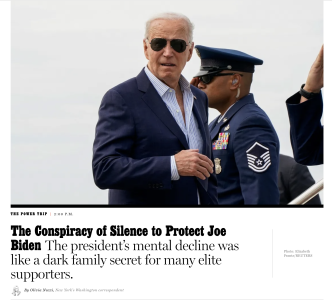
Yesterday afternoon (7.4) Intelligencer‘s Olivia Nuzzi posted a piece titled “The Conspiracy of Silence to Protect Joe Biden,” with a subhead that read “the president’s mental decline was like a dark family secret for many elite supporters.”
The gaslighting thing, in short, has become the burning issue behind the “Joe is falling apart and should probably resign” swamp fire, and it’s now time for all the really bad people who’ve been saying the same thing on Hollywood Elsewhere threads to come forward, drop to their knees, admit they’ve been part of the lying throng and beg for forgiveness. Because they have no honor now — zero — and they need to atone before it’s too late.
Jill Biden’s Wikipage reports that she and then-Senator Joe Biden met in March 1975. “They [allegedly] met on a blind date set up by his brother Frank, who had known her in college,” it says. “Although Joe was nearly nine years her senior, Jill was impressed by his more formal appearance and manners compared to the college men she had known, and after their first date, she told her mother, ‘Mom, I finally met a gentleman.’”
“Meanwhile she was going through turbulent divorce proceedings with husband Bill Stevenson. A civil divorce was granted in May 1975. Jill and Joe were married in New York City on 6.17.77.”
Three and a half years ago Stevenson, a Trump supporter, challenged this official narrative in an interview with London’s rightwing Daily Mail.
Stevenson said that he introduced Joe and Jill in ’72, only a few months before Joe’s then-wife Neilia Hunter Biden and their daughter were killed in a car accident. (Beau and Hunter were riding in the back seat of the crash car, and were pretty banged up.)
Stevenson told the Daily Mail‘s Harriet Anderson that he first suspected Biden and Jill were having an affair in August 1974, right around President Nixon’s resignation. Jill was 23; Joe was 31. Stevenson said that “one of [Jill’s] best friends told me she thought Joe and Jill were getting a little too close. I was surprised that she came to me.”
This is not a big deal to me personally as changing partners is always a messy process. Extra-marital affairs happen all the time, and those who succumb to this kind of passion are not necessarily evil or morally deplorable or even necessarily conniving. I was involved in an extra-marital affair with a married journalist colleague between early ’98 and late ’00, and I know how this stuff works backward and forward.
But let no one doubt that Jill wasn’t power-hungry back then, and that she isn’t the same kind of person right now.
"She wants to promote herself… she's not the damn President! Get out of the chair."
Megyn Kelly tears into First Lady Jill Biden. Watch more
“Bill Stevenson also had issues with a divorce case between he and his first wife, Jill Jacobs, who today is married to Senator Joseph R. Biden Jr. (D-Del.). They had married in February 1970, when Stevenson was only 23 and Jacobs was a student at the university, but drifted apart and were divorced in 1976.
‘He avoids details in his book, but after a turbulent court case, Stevenson walked away only paying Jacobs less than half what we she had wanted, not including the half-ownership she sought of the Stone Balloon bar. Within months she was married to Biden.”
JoeBiden seemed to mutter or mush up his administration’s black landmarks and identities today in Philadelphia…”first Vice-President, first black woman, served with black president…first black woman on the Supreme Court”…drooling into his soup in the cafeteria.
Kamala isn’t really “black”…she’s primarily of Indian descent (her mother, Shyamala Gopalan, was a Tamil Indian biologist0 with an Afro-Jamaican dad, Donald J. Harris, of Irish-Jamaican ancestry.
HE favorite: This is “ninetuss states Americuh,” Joe said.
Biden tells a Philadelphia radio station that he's "proud" to be "the first black woman to serve with a black president" pic.twitter.com/kP5J7Q9lYy
Friendo: “That Stephanopoulos interview is going to be must-see TV.” HE: “It’s not going to air live — it’s taped. Segmented. Not the real, raw thing.” Friendo: “You think they’ll edit the interview to make Biden look coherent or will they show Americans the true state of his cognitive decline?” HE: “It’s up to question. The fact that Stephanopoulos agreed to a taped version says something, I think.”
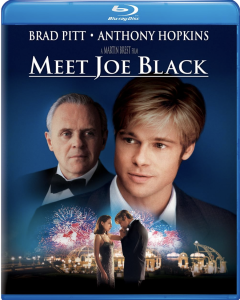
I’ve only seen the original 181-minute cut of Meet Joe Black. Caught it on the Universal lot. Rough sit. I never saw the 129-minute Alan Smithee version. Has anyone?
Needless to say this Manhattan coffee shop scene between Brad Pitt and Claire Forlani would’ve worked better without the double-hit ragdoll body bounce-flop…really bad CG. Imagine if just after Forlani walks off she hears the screech of tires and vague sounds of commotion, but doesn’t realize Pitt is dead until she reads about it the next day. Maybe a small item-plus-photo in the N.Y. Daily News.
It’s always better if you can nudge the audience into imagining a scene of violence rather than hitting them over the head with it.
BTW: Pitt was no spring chicken when Meet Joe Black was shot in mid to late ’97 (he was 33, had made Se7en three years earlier) but he looks 24 or 25.
Posted on 3.16.21: This is easily the most emotionally affecting scene from Martin Brest‘s Midnight Run (’88), and generally speaking action road comedies don’t do this kind of thing at all. But Midnight Run, written by George Gallo, was different.
A violent chase-caper flick with a quippy attitude, fine. But a film of this calibre delivering this kind of emotion would be all but inconceivable today…be honest.
Robert DeNiro (as bounty hunter Jack Walsh) and Danielle DuClos (as DeNiro’s 12 year-old daughter Denise) handle the heavy lifting, making the most of non-verbal currents. But the silent-witness vibes from Charles Grodin (as white-collar criminal Jonathan Mardukas) and Wendy Phillips (as Walsh’s ex-wife) are poignant in themselves.
When Midnight Run opened 32 and 2/3 years ago somebody wrote that it was a hamburger movie that occasionally tasted like steak, but if you re-watch it (as I did a year or two ago) you’ll recall that it wasn’t that great, not really — that it was formulaic and goofy and rarely subtle.
But it was good enough to temporarily “lift all boats,” as the expression goes. Brest peaked four years later with Scent of a Woman (’92), and then he hit the rocks with Meet Joe Black (’98) and then Gigli (pronounced “Jeelie”).
Imagine how this scene might’ve played if Brest hadn’t cast DuClos or someone else on her level. Born in ’74, she was 13 when this scene was filmed.”
DuClos will turn 50 on 9.29.24 — a crisp salute for excellent work.