Reunion Poker

Awards Daily‘s Sasha Stone, my longtime Oscar Poker partner until we split up two or three months ago, accepted my invitation to do another one for old time’s sake. We covered everything, except I thought Sasha was recording and she thought I was recording. We talked for a good 90 minutes or so, and it was all for naught. Then I started recording and we did about 49 minutes’ worth. Happy New Year.

Matchmaker

The following story about Steven Spielberg‘s initial connection with Lincoln star Daniel Day Lewis was apparently included an 11.30 Oprah Now interview. I may have heard it and brushed it aside, but I don’t think so.

“For a time I was going do [Lincoln] with Liam Neeson,” Spielberg explained. “But then, you know, we just decided to move in two different directions. I was sitting around at home one day realizing I’m never going to make Lincoln. It’s just never going to happen.

“And Leo DiCaprio came over for dinner that night. It was just my wife and Leo and myself. We were sitting around and Leo said, ‘What’s happening with Lincoln? You’ve been, what, five years on this thing?’ And I said, ‘Longer.’ I told Leo the whole story, and I told him I had tried to approach Daniel on another screenplay and I wasn’t able to re-approach Daniel.

“And the next day, my assistant said ‘Leo’s on the phone.’ He said, ‘You got a pencil? Write this down. This is Daniel Day-Lewis’s cell phone. He’s expecting your call.’ Leo had gone to bat for me and had called Daniel on the telephone and got Daniel and I together. Everything at that point started really moving quickly.”

Whoa, wait: Spielberg “wasn’t able to re-approach” Daniel Day Lewis because he “tried to approach Daniel on another screenplay”? In response to which DDL was (let’s imagine) so turned off by the initial project that he decided to refuse Spielberg’s subsequent calls? And the all-powerful Spielberg wanted to offer the Lincoln role to DDL but was unable to get his cell phone number? DDL thought he might fail in trying to portray Abraham Lincoln, etc. I’ve read that. But I don’t believe DDL would tell his assistant, “If Spielberg calls, I’m not in.” Bullshit.

Update: “The Spielberg/Day-Lewis story has been everywhere,” a friend days. “They both it in detail at a q & a at the Bruin, and Day-Lewis completely concurred. In fact, they really told much more about it including how when DDL finally accepted the Lincoln role Spielberg couldn’t even speak, so he put the phone down for a few until he could compose himself.” Wells response: I still don’t believe DDL wouldn’t take Spielberg’s calls and/or that Spielberg couldn’t get his cell phone #.

For Those Who Are Susceptible

Mom isn’t just weeping after seeing Les Miserables; she’s fairly devastated and having trouble explaining why. Everyone else in the car either has a case of the giggles or is going “okay, I respect your reaction but not so much on my end.” (Tip of the hat to Awards Daily‘s Sasha Stone.)

Free, Innocent, Plugging Away

After 18 bad years behind bars, exonerated West Memphis Three defendant Damien Echols was freed on 8.19.11 through an Alford plea. And then Amy Berg‘s excellent, unavoidably compelling West of Memphis was released, and Echols has been on the promotion circuit (for his book Life After Death as well as the film) ever since.

Echols on Devil’s Knot, the upcoming Atom Egoyan film that was inspired by and mostly based on the West Memphis Three case: “We’re completely against it…I’ve read previous drafts…it’s not even remotely accurate…[it’s been called] a ficitional account based on the mythology of the West Memphis Three…they’ve taken a fringe character who had little or nothing to do with me getting out, and made like the big star and hero and everything…no, we don’t have anything to do with it and want to stay as far away from it as possible.”

If there’s a God West of Memphis will at the very least be nominated for Best Feature Documentary Oscar. A win would obviously be better.

I ran into Echols at two Sundance 2012 events — a West of Memphis after-party and a morning press conference — and again at the 2012 Santa Barbara Film Festival. The possibly guilty party Echols is speaking about in the early part of the DP30 interview is Terry Hobbs.

Living High In The Dirty Business of Dreams

I like to think of my own life in this way. I am living a kind of Steve Winwood “high” life without the big money, or life as defined by a series of highs rather than one of “stability” in the old-fashioned, white-picket-sense of that term (which my parents invested in). I live in order to feel high and spread highs of a certain kind.

Another way to put it is that I live in order to celebrate dream states that have obviously been made, at root, to fuel the fires of commerce, which is where the vaguely dirty aspect comes in. Except I love revenue. Who doesn’t?

There’s also the “constant fighting with people who disagree and are looking to spread poison by tearing you down any which way” aspect, but that will never go away.

All I know is that writing this column sure beats working. Which is what Robert Mitchum often said about acting. And yet I’m a 15-hour-per-day slave to it.

Many of us are in love with the idea of living the life of a literary Dean Martin but without the drinking and the cigarettes and the endless cynicism. Okay, some of us are. What do I actually mean by “literary Dean Martin”? I don’t know but give me a minute or two and I’ll figure something out. Don’t be afraid to start a sentence just because you’re not sure how to finish it. It’ll come to you. I learned that a long time ago from Patti Smith.

Thus Spoke O’Hehir

“Art is an inherently amoral and ruthless enterprise, however much we may want to believe otherwise.”

This is a quote from Andrew O’Hehir‘s 12.29 Salon analysis of the Zero Dark Thirty shitstorm. Many of us go to films hoping to be blown away or mesmerized or emotionally melted down, period. We just want the movie to work. We’re not uninterested in its political leanings, or oblivious to same, but most of us, I think, are willing to process this as connected-but-separate dish.

Others want their movies above all to stand on the right side. They want their art to be moral and compassionate. In exactly the same way, I feel, that the Soviet bureaucrats of the 1930s wanted their art to celebrate the glorious wheat farmers of the Ukraine. The Stalinists who’ve ripped Zero Dark Thirty for allegedly being pro-torture are cut from the exact same cloth.

I will bow down to any film that kicks ass. Okay, I won’t bow down to a brilliantly made film that advances an evil agenda, but if the film is as obviously well made as, say, Leni Reifenstahl‘s Triumph of the Will, I will at least have mixed feelings about condemning it. But a film that is morally ambiguous or indistinct will never anger or alienate me. And I don’t care what kind of politics it espouses. I am just as much a fool for Tony Scott‘s Man on Fire, one of the most rousing rightwing thrillers ever made, as I am for Oliver Stone‘s W. or Nixon.

Not Over Lunch?

In a 12.27 N.Y. Times interview with Zero Dark Thirty director Kathryn Bigelow, Brooks Barnes writes that Bigelow and ZD30 screenwriter-producer Mark Boal “have succeeded — perhaps a bit too well — in renewing a conversation about America’s use of torture to fight terrorism.”

But Bigelow “was not particularly keen to discuss torture over lunch, she said, partly because she wants her work to speak for itself and partly because she is aware that any public comments could just add fuel to the fire.”

I love and admire Bigelow, but c’mon. The anti-ZD30 rhetoric has obviously been raging over the Christmas holidays, and it’s become clear that the Hollywood Stalinists have probably succeeded in tarring and feathering ZD30 by persuading those who refuse to venture beyond party-chat points that the film is pro-torture (which it’s NOT) and is therefore pushing a politically incorrect narrative. So at this point a little lighter fluid by way of a quote given to Brooks Barnes would hardly fucking matter.

If I were Bigelow I would at least acknowledge that the Stalinists have probably wounded ZD30 badly enough to deny it the Best Picture Oscar, and that I hope they’re happy about that. I would also thank the Stalinists for giving us all an education about the hidden side of their nature.

On top of which if there’s one thing that the Stalinist attack pieces have made clear, it’s that ZD30 isn’t speaking for itself in terms of this topic. As Barnes observes, ZD30‘s torture scenes “are presented with no obvious political tilt, creating a cinematic Rorschach test in which different viewers see what they want to see.”

Dan Latimer

The only time Harry Carey, Jr. half-got me was when he played young Dan Latimer in Howard HawksRed River (’48). He’s on his horse, gently calming the herd…”whoa, dogies, whoa”…when Tom Dunson (John Wayne) and Matthew Garth (Montgomery Clift) come up to chat. Latimer tells Dunson that when they reach Missouri and everyone gets paid he plans to buy his wife a pair of red shoes.

An hour later the cattle go on a stampede and Latimer is trampled to death. They find what might be his body but can only presume it’s him because he was wearing a checkered shirt. Dunson tells Garth to give full pay to Latimer’s wife, “just like he finished the drive…and, uh, … anything else you can think of.” Garth replies, “Like a pair of red shoes?”

And that was it. Carey never had a better part or brought it home in as an actor quite as fully. He wasn’t a great performer, just a good-enough one. But getting stomped into mulch by hundreds and hundreds of cattle hooves, godawful as that experience had to be, gave him dignity, or gave it, rather, to poor Dan Latimer.

Carey’a becoming a regular in the John Ford hambone stock company from the late ’40s through the mid ’60s sealed his fate. All he could do was play amiable or spirited second bananas on horseback.

Harey Carey, Jr. was a very well-liked fellow. On this point agreement was wide and far. Much of his likability (among boomers, at least) came from his playing the kindly ranch counselor Bill Burnett in the Walt Disney Mickey Mouse Club serial The Adventures of Spin and Marty. He made three other films with Hawks — Monkey Business, Gentlemen Prefer Blondes and Rio Bravo. He lived a long and fruitful life, and died today at age 91. God rest his soul.

It Happened In The ’50s


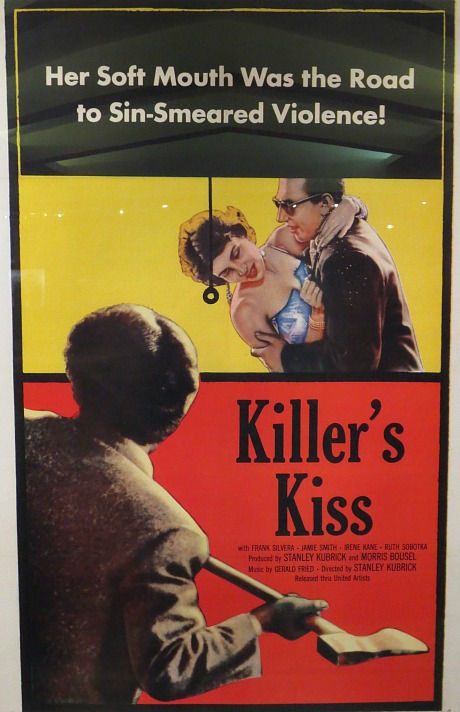
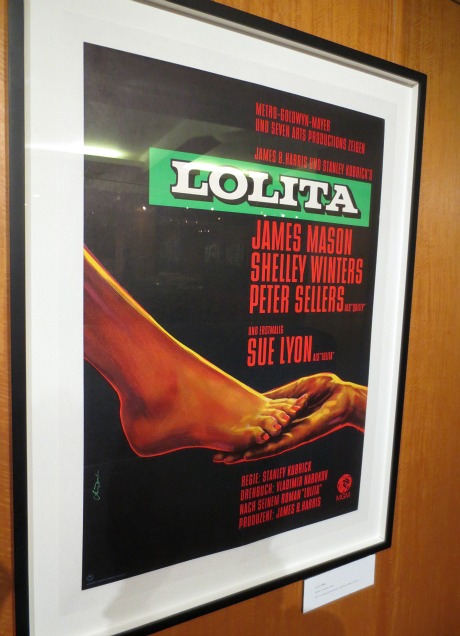
I know the 1950s are generally regarded as a moderately prudish or at least somewhat restrictive era in terms of sexual content in movies, TV and advertising. But I doubt if any copy for a 2012 one-sheet would allude to a woman’s “soft mouth” for fear of sounding soft-porny. This poster is currently hanging in the Academy’s main lobby as part of a general Stanley Kubrick exhibit.

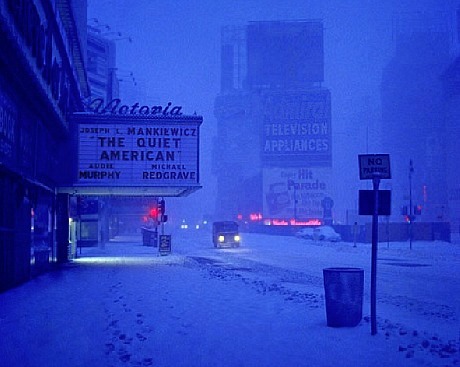
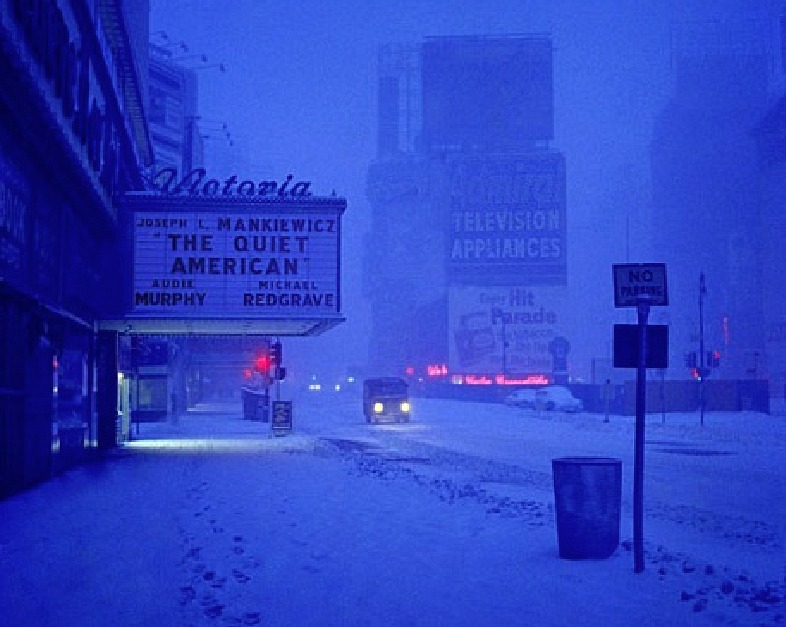
I’ve run this photo once before. It may be my all-time favorite Times Square capture. I love the blizzard-covered atmosphere, or the blizzard-at-6-am atmosphere or whatever it is. Joseph L. Mankiewicz’s The Quiet American opened in early February of 1958.

Get ‘Em While They Last

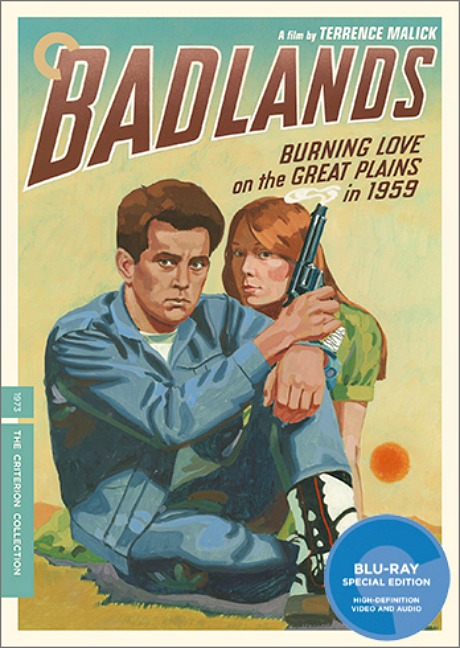
The good news is that Criterion has a Badlands Bluray coming out on 3.19.13. The bad news is that they’ve cleavered the aspect ratio down to 1.78 to 1. The good news is that I still have my copy of a 1999 Warner Home Video Badlands DVD, and it’s presented at 1.37 to 1. [See jump page.]

I don’t know for a fact that this WHV DVD presents the definitive full-frame, open-matte version of Terrence Malick‘s 1973 classic, but it sure looks good. I’ve watched it three or four times and can tell you it has acres and acres of spacious headroom.

Read more