The passionately praised Beasts of the Southern Wild, which I finally saw last night at Park City’s MARC, is everything its admirers have said it is. It’s a poetic, organic, at times ecstatic capturing of a hallucinatory Louisiana neverland called the Bathtub, down in the delta lowlands and swarming with all manner of life and aromas, and a community of scrappy, hand-to-mouth fringe-dwellers, hunters, jungle-tribe survivors, animal-eaters and relentless alcohol-guzzlers who live there.
It’s something to sink into and take a bath in on any number of dream-like, atmospheric levels, and a film you can smell and taste and feel like few others I can think of.
Directed and co-written by Benh Zeitlin, Beasts is much more of a naturalistic object d’art than a narrative-driven drama, at least as most of us define that term. The emphasis is on sensual naturalism-wallowing — lush, grassy, muddy, oozy, leafy, stinky, primeval, non-hygenic, slithery, watery, ants up your ass — with a few story shards linked together like paper clips.
The narrative, as such, focuses on six-year-old Hushpuppy (Quvenzhane Wallis) and her father Wink (Dwight Henry) and a third-act search for Hushpuppy’s mother.
Wallis is a hugely appealing young actress — beautiful, spirited, wide-eyed — and she pretty much carries the human-soul portions of the film. But Henry’s dad, who cares for Hushpuppy in his own callous and bullying way, is a brute and a drunk and mostly a drag to be around, and after the fifth or sixth scene in which he’s raging and yelling and guzzling booze, there’s a voice inside that starts saying “I don’t know how much more of this asshole I can take.”
Here comes the part of the review that the keepers of the precious Sundance flame are going to dislike. If you apply the classic Jim Hoberman “brief vacations” concept of a great film not only being a kind of “sacred text” but constituting a realm that a viewer would be happy to literally take up residence within, Beasts of the Southern Wild does not, for me, pass the test.
I’m sorry but after a while it began to feel too oozy and filthy and slimey and boozy. I don’t like hanging with people who drink all the time — alcoholism is boredom incarnate — and I don’t like walking around in oil-like, knee-deep mud and feeling bugs and snakes on my body as I sleep and running across the occasional alligator who’s looking to bite my leg off. I come from the suburbs of New Jersey, and I like taking hot showers and sipping wine in streetside cafes and sleeping on clean sheets and watching Blurays with my cats. And I hate snakes.
I not only didn’t want to live in the world of Beasts of the Southern Wild — a part of me wanted to escape after an hour or so. I wanted to walk or hitchhike to New Orleans, and catch a plane to Orlando and stay for a few days with Steve and Jackie Siegel, the stars of The Queen of Versailles. All right, scratch that…too extreme. But it made me think about clean roadside motels and rental cars and hot baths and power toothbrushes and all the comforts of home.
In short, I aesthetically respect and admire Beasts of the Southern Wild, but watching it almost turned me into a Republican. Until I left the theatre and went down to John Sloss‘s Cinetic Media party at Bing and I talked to some friends and started to feel like myself again.
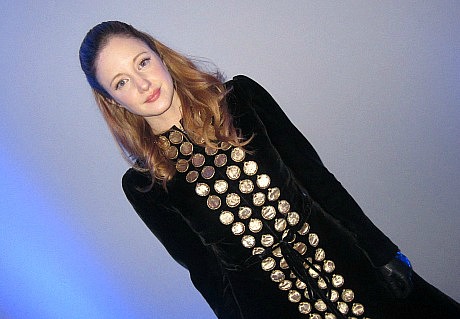
Andrea Riseborough (W.E., Brighton Rock) delivers an unforgettable traumatized-Irish-lassie performance in James Marsh‘s Shadow Dancer, which screened tonight at the Eccles. The after-party happened at the Grey Goose lounge on Main Street. Thanks to Susan Norget for the invite, etc.
A brief portion of Josh Radnor‘s q & a after Sunday’s 3:15 pm screening of Liberal Arts, which many (myself included) are calling a mature and significant uptick from Radnor’s last film, happythankyoumoreplease.
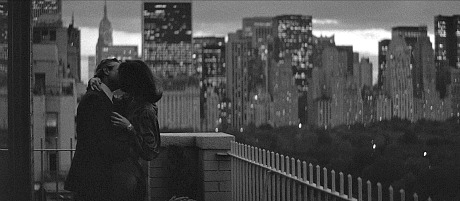
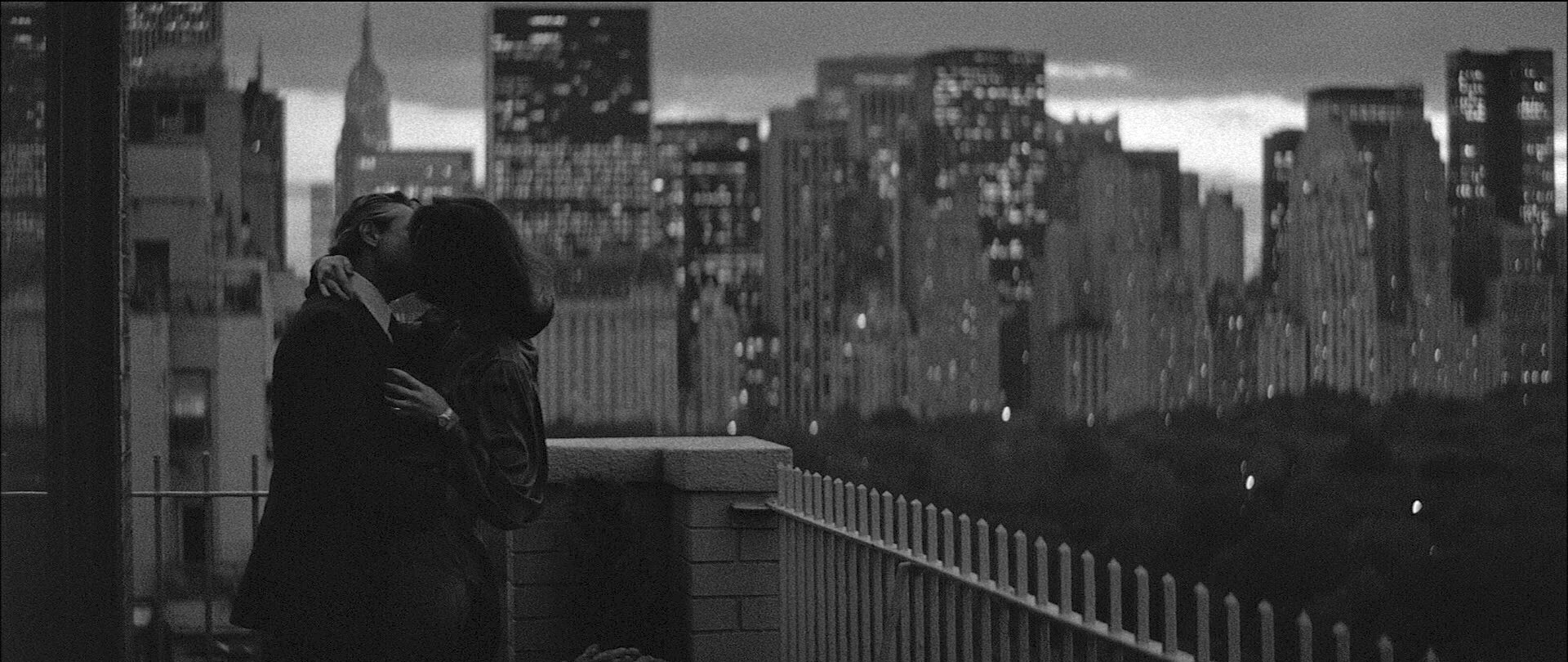
In 1981 I was that guy in this shot. Almost. It didn’t happen on a Fifth Avenue apartment balcony overlooking Central Park, but on an apartment building rooftop during a fairly wild party on a hot July night. I was wearing a suit and she was dishy and a little bit bombed, and she smelled like soap and flowers and had cigarette breath. We came close to forgetting ourselves. It all came back when I happened upon this DVD Beaver frame capture from the just-out Bluray of Woody Allen‘s Manhattan.
As much as I tell myself I’m Lee Marvin, the truth is that sometimes I’ll cave in to peer pressure and follow the crowd. And when I do that I’m usually a bit sorry. Which is to say not always. But today I am.
After seeing Ben Lewin‘s The Surrogate at 8:30 am, recording a special Oscar Nomination Announcement Oscar Poker with Sasha Stone and then tapping out a three-paragraph Surrogate review, I caught a 1 pm screening of Craig Zobel‘s Compliance. The plan after that was to go to Joe Berlinger‘s Under African Skies at 3 pm and then bail at the 75 minute mark so I could see Colin Trevorrow‘s Safety Not Guaranteed, which James Rocchi told me I should see.
But when I went into the press tent at 2:50 pm to show my pass I noticed that a huge crowd was waiting to see Bart Layton‘s The Imposter, and that almost no one was lined up to “the Berlinger,” as David Denby would put it. Did I shrug my shoulders and say “whatever, my path is set”? No — I figured the big crowd must know something I don’t so I bailed and went to The Imposter instead. And within 30 minutes I began to feel bored. (Angelina Jolie knew the returned kid wasn’t her kid in The Changeling, so why didn’t the San Antonio, Texas, family that lost their son recognize the same kind of fraud? I would have.)
And so I quit and went to a Mexican restaurant and did a little work, and then I tried too late to get into Safety Not Guaranteed — “Sorry, sir, but the theatre is full.” So the whole plan went down the tubes. At least I’ve used the spare time to do some filing.
The plan tonight is to see James Marsh‘s Shadow Dancer at the Eccles at 6:30 pm, and then Beasts of the Southern Wild at the MARC (formerly the Raquet Club) at 8:30 pm.
I saw Ben Lewin‘s The Surrogate this morning, and yes, it’s a touching, thoughtful and comforting film about touching, needing, being open and the finding of fulfillment. It’s an emotionally erotic variation on the themes in My Left Foot, The Sea Inside and The Diving Bell and the Butterfly with a little dash of Who’s Life Is It Anyway? thrown in. And John Hawkes will almost certainly get some awards action eight to ten months hence; ditto Helen Hunt.
The only thing the film (i.e., Lewin) lacks is a strong visual imagination. Any film about a paralyzed protagonist needs to somehow free itself from that immobility. It can’t just be a series of static interiors or the viewer will start to be hemmed in to some degree. I haven’t time to flesh this out as I need to be at screening…later.
“This is cheerful news for me and for the family of cinema in Iran, specially the nomination for the best original screenplay. It seems that although people speak different languages around the world but there is one common universal language which everyone understands — the language of cinema.” — Asghar Farhadi, director-writer-producer of A Separation, reacting to nominations for Best Foreign-Language Film and Best Original Screenplay.
Says a critic friend: “The fact that the Academy gave a Best Picture nomination to Extremely Loud & Incredibly Close but blew off Shame and Drive and [forgetting his last example but fill in the blank]….says it all.’
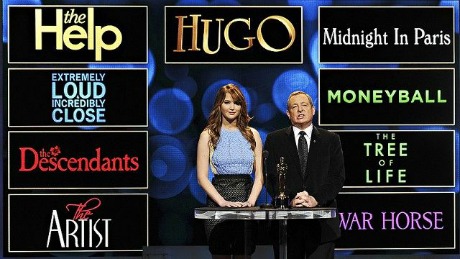
If only five Best Picture nominees were allowed, which of this morning’s nine nominees would be included? Not The Help — be honest. Not Extremely Loud & Incredibly Close — due respect. Probably not War Horse or The Tree of Life. It’s delightful, of course, that The Tree of Life has been nominated but I’m stunned that 5% of the membership gave #1 votes to the other three. These moves are worthy and commendable in their own way, but they’re #3 or #4 picks.
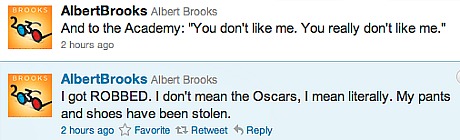
This morning’s biggest “holy moley” is the Academy’s blowoff of the great Albert Brooks for Best Supporting Actor in Drive and the somewhat surprising inclusion of Max Von Sydow for Extremely Loud & Incredibly Close in the same category. I’ve detected respectful appreciation among Oscar seers for Von Sydow’s performance but little in the way of serious passion.
Cheers to A Better Life‘s Demian Bichir for landing a Best Actor nomination. He did it all by himself. It was almost entirely the performance, I mean, and not the promotion, which was minimal.
Tom Sherak pronounced Michel Hazanavicius as “Michel Azzanavasheetos.” Theory: He’s been taking prounciation lessons from Deadline‘s Pete Hammond.
Cheers to the Moneyball team for landing nominations for Best Picture, Best Actor (Brad Pitt), Best Supporting Actor (Jonah Hill) and Best Adapted Screenplay (Steve Zallian, Aaron Sorkin). But it’s bordering on criminal that the Academy failed to nominate Mychael Danna‘s delicate, tingly and profoundly spiritual Moneyball score while nominating John Williams‘ overbearing, “this is how you’re supposed to feel” War Horse music.
Why didn’t they give a Best Sound Editing or Best Sound Mixing to The Artist? Seriously…why not? It has nice music on the soundtrack and the film is so likable and the dog is so cute.
What is the biggest lie in terms of reactions of the nominees? “I was sleeping…my agent/manager woke me up with the good news.”
I have to catch an 8:30 am screening of The Surrogate so I’m outta here. Sasha Stone and I will do an Oscar Poker podcast later this morning.
I didn’t have time to re-code everything so here are the nominations taken directly from Awards Daily:
Best Picture
“The Artist” Thomas Langmann, Producer
“The Descendants” Jim Burke, Alexander Payne and Jim Taylor, Producers
“Extremely Loud & Incredibly Close” Scott Rudin, Producer
“The Help” Brunson Green, Chris Columbus and Michael Barnathan, Producers
“Hugo” Graham King and Martin Scorsese, Producers
“Midnight in Paris” Letty Aronson and Stephen Tenenbaum, Producers
“Moneyball” Michael De Luca, Rachael Horovitz and Brad Pitt, Producers
“The Tree of Life” Nominees to be determined
“War Horse” Steven Spielberg and Kathleen Kennedy, Producers
Best Directing
“The Artist” Michel Hazanavicius
“The Descendants” Alexander Payne
“Hugo” Martin Scorsese
“Midnight in Paris” Woody Allen
“The Tree of Life” Terrence Malick
Best Actor
Demian Bichir in “A Better Life”
George Clooney in “The Descendants”
Jean Dujardin in “The Artist”
Gary Oldman in “Tinker Tailor Soldier Spy”
Brad Pitt in “Moneyball”
Best Actress
Glenn Close in “Albert Nobbs”
Viola Davis in “The Help”
Rooney Mara in “The Girl with the Dragon Tattoo”
Meryl Streep in “The Iron Lady”
Michelle Williams in “My Week with Marilyn”
Best Supporting Actor
Kenneth Branagh in “My Week with Marilyn”
Jonah Hill in “Moneyball”
Nick Nolte in “Warrior”
Christopher Plummer in “Beginners”
Max von Sydow in “Extremely Loud & Incredibly Close”
Best Supporting Actress
Berenice Bejo in “The Artist”
Jessica Chastain in “The Help”
Melissa McCarthy in “Bridesmaids”
Janet McTeer in “Albert Nobbs”
Octavia Spencer in “The Help”
Best Animated Feature
“A Cat in Paris” Alain Gagnol and Jean-Loup Felicioli
“Chico & Rita” Fernando Trueba and Javier Mariscal
“Kung Fu Panda 2? Jennifer Yuh Nelson
“Puss in Boots” Chris Miller
“Rango” Gore Verbinski
Best Art Direction
“The Artist”
Production Design: Laurence Bennett; Set Decoration: Robert Gould
“Harry Potter and the Deathly Hallows Part 2”
Production Design: Stuart Craig; Set Decoration: Stephenie McMillan
“Hugo”
Production Design: Dante Ferretti; Set Decoration: Francesca Lo Schiavo
I got caught up in a couple of Bingham Ray posts late this morning and consequently missed the 12:30 Eccles screening of Ben Lewin‘s The Surrogate, which played like gangbusters, I’m told. (The crowd gave it two standing ovations.)
I made the 3:30 showing of Sheldon Candis‘s LUV, and I’m sorry to say that I found it dispiriting and repetitive (too many characters with malevolent minds and motives) and generally Dante-esque.
Then came Julie Delpy‘s comedic 2 Days in New York, which follows the rules of farce, French or otherwise, by keeping the dialogue peppy, the action frenetic and the personalities anxious-eccentric-obsessive. It was fine. The audience had a good time. I was feeling a little winded or fatigued and couldn’t quite find my way into it as much as others sitting near me…but that happens.
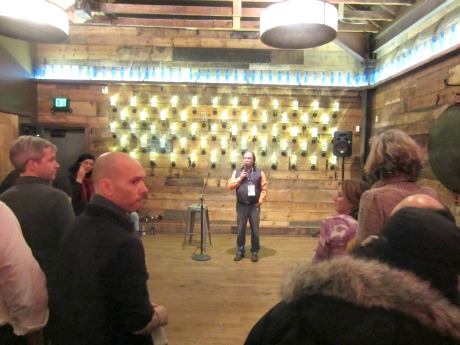
Late this afternoon the San Francisco Film Society held a memorial gathering at a brewery bar on Park Avenue for the late, legendary Bingham Ray, who died earlier today following a stroke. I arrived only during the last half-hour, but the sad faces were all familiar– Ray’s former October Films partner Jeff Lipsky, various Indiewire staffers; IFC Films’ Jonathan Sehring and Ryan Werner; producer Christine Vachon; former MGM honcho Chris McGurk, Sony Pictures Classics co-chief Tom Bernard, and several journalists, ex-pals and acquaintances.
The memorial was reportedly “originally planned by Ray as a party for the San Francisco Film Society, which he had just joined as executive director in the fall,” according to a Wrap report by Joshua Weinstein. Ray had recently become the exec director of the San Francisco Film Festival, and had in fact planned this afternoon’s gathering as a celebration of the festival.
Indiewire critic Eric Kohn told me a couple of hours ago that sometime during a panel discussion last summer that Kohn attended Ray declared that “I’m going to do this” — film distribution and generally being a film devotee — “until I drop, whether it’s 60 minutes from now or whenever.” In this sense Ray went out like a champ. He died with his proverbial boots on, in the middle of the hurly-burly at a Sundance Film Festival.
The following is from the opening pages of a draft of “Down & Dirty Pictures,” a screenplay adaptation of Peter Biskind‘s book by Joshua James Craig and Dean Craig. The story is by Ken Bowser & Joshua James. I’m posting this excerpt because the late Bingham Ray appears as a character with some (for me) amusing dialogue. Here it is:
TITLE CARD ON BLACK:
“To fight the empire is to be infected by its derangement. This is a paradox: Whoever defeats a segment of the Empire becomes the Empire; it proliferates like a virus, imposing its form on its enemies. Thereby it becomes its enemies.” — Philip K. Dick, “Exegesis.”
FADE IN: EXT. MOVIE THEATER – DAY
The marquee reads: “DOWN & DIRTY PICTURES”. A truck pulls up. HANDS deposit two 35mm FILM CANS outside the door. The theater door opens. Two NEW HANDS pick up the cans.
INT. MOVIE THEATER – CONTINUOUS CLOSE:
Hands carry the FILM CANS into a projection room. Hands extract a reel of film and thread it through the gates of the projector. A hand flips switch and LIGHT splashes an image across a darkened theater onto the screen.
EXT. HOLLYWOOD HILLS – NIGHT
A CAR speeds through the winding roads.
INT. CAR (MOVING) – CONTINUOUS
BINGHAM RAY, forties, drives fast around the curves.
Caption: March 24, 1999.
BINGHAM
Fuck the Academy Awards…FUCK ‘EM!
Bingham takes a swig and, his eyes off the road, LOSES CONTROL of the car. Enormous CRUNCH of metal as car meets tree.
INT. AMBULANCE (MOVING) – LATER
Bingham opens his eyes, covered in cuts and bruises, and flat on his back on a gurney in an ambulance.
PARAMEDIC
Didn’t see that tree jump out in front of ya, I take it?
The PARAMEDIC, thirties, checks Bingham’s vital signs.
BINGHAM
(in a whisper)
Who won?
PARAMEDIC
I’m pretty sure the tree won this one. Here, lean your head back.
BINGHAM
No, not that. Who won Best Picture?
The AMBULANCE DRIVER chimes in.
AMBULANCE DRIVER
(over his shoulder)
Shakespeare In Love.
PARAMEDIC
You have to forgive my partner. He’s crazy about movies.
BINGHAM
So was mine. Fuck! FUCKING HARVEY! That’s it, I’m fucking done!
Paramedic adjusts the gurney and neck brace on Bingham.
PARAMEDIC
Easy. What’d you do before you were done?
BINGHAM
October Films.
AMBULANCE DRIVER
(over his shoulder)
October? Never heard of ’em.
BINGHAM
(to Driver)
You’ve heard of Miramax?
AMBULANCE DRIVER
(over his shoulder)
Pulp Fiction! And Good Will Hunting! And Sling Blade and The English Patient…
BINGHAM
They also produced and directed Playing For Keeps, but no one remembers that.
AMBULANCE DRIVER
Clerks! Fucking Clerks kicks ass!
PARAMEDIC
Okay Jimmy, we got it. Yeah, Miramax. October was like Miramax?
Bingham notices an OBJECT hanging from the rear view mirror.
BINGHAM
Kinda like Miramax. Just not as successful.
The OBJECT is a miniature version of the SCREAM mask.
INT. SCREENING ROOM – DAY
The film on the screen freezes on the scene in the ambulance. Bingham, now older, sits in theatre seat, shaking his head.
BINGHAM
You should be ashamed of yourself, that’s so fucking Hollywood.
Caption: BINGHAM RAY, cofounder, October Films.
UNSEEN DIRECTOR
So what we just saw didn’t happen?
We never see the DIRECTOR, safely behind the camera.
BINGHAM
It did, but not like THAT. It was in the morning, not at night, I was drinking but within legal limits, and it happened over a year after that. I mean, I was fucked up, I did hit a tree, but there were much more tragic things …
INT. DOROTHY PAVILION – NIGHT
HARRISON FORD stands at a podium.
FORD
And the Academy Award for Best Picture goes to . . .
JEFF LIPSKY
(V.O.)
Oh, no. No, you can’t.
INT. SCREENING ROOM – DAY
JEFF LIPSKY, dressed in purple and without a hair on his body, shifts in his seat.
LIPSKY
You can’t begin the movie there, that’s the end, not the beginning.
Caption: Jeff Lipsky, cofounder, October Films.
UNSEEN DIRECTOR
Some people would argue that Shakespeare was the end and the beginning.
BINGHAM
Very funny. You don’t fuckin’ get it, do you? This was a battle, this was a fucking war to the death.
UNSEEN DIRECTOR
A war between . . .
BINGHAM
Film and movies.
LIPSKY
Art and populism.
BINGHAM
Cinema and…
LIPSKY
Multiplexes.
BINGHAM
Our battlefields were film festivals. Like Toronto.
LIPSKY
Cannes.
BINGHAM
Sundance.
LIPSKY
You really want to show what happened, you’ve got to go back to the beginning. Up that damn hill to Sundance.