
Missing Manohla

Manohla Dargis has been absent from her N.Y. Times film critic duties since…what, mid-June? I had assumed she’d taken time off for the writing of a book, or maybe some simple chill time in Paris, a favorite city of hers. Contemplation, battery-recharging, whatever. But nobody would say anything when I asked around this morning. Dargis didn’t reply. Nothing from mutual journalist pallies or Times colleagues. Silencio.

So I wrote her N.Y. Times editor, Lorne Manly, and said I didn’t recall any announcement in the Times about her taking time off. “We don’t tend to do announcements about leaves around here,” he replied, “but everything is fine and she’ll be back in action after Labor Day when her leave comes to an end. You’ll see her in Toronto, and you can catch up with her then.”

“So this wasn’t a book-writing sabbatical?,” I wrote back. “Just a plain and simple leave for the purpose of smelling the grass and the flowers and the coffee and…like that?” Manly’s response: “I’m sure Manohla will be happy to fill you in when you see her.”

So I asked some other folks if they’d heard anything. A Manhattan publicist said she was told Dargis “has been doing some graduate school work and perhaps writing a thesis,” but this is “very, very unconfirmed.”
Five Phone Messages

Remember the “too soon!” crowd that refused to watch United 93? The Movie Godz were aghast that anyone would take such a position against one of the finest films of the aughts, but what can you do? I wonder, in any case, if the too-sooners will return in force for the forthcoming film version of Extremely Loud and Incredibly Close, which was announced over the weekend.

Scott Rudin is producing, Stephen Daldry is directing, and Eric Roth has written the screenplay that is based on the Jonathan Safran Foer novel. No word on who will play Oskar Schell, the precocious nine year-old kid, but Tom Hanks, I gather, will play his dead dad (killed on 9.11.01) and Sandra Bullock will play the mom. Warner Bros. is the “lead studio” with Paramount handling the overseas distribution, or something like that.

The idea, I would think, would be to get the film released at least somewhat concurrent with the tenth anniversary of the World Trade Center attacks. I mean, doesn’t that make basic sense? Maybe not. Maybe it’s best to ignore all that and just release it when it’s good and ready to be seen.

“Message one. Tuesday, 8:52 a.m. Is anybody there? Hello? It’s Dad. If you’re there, pick up. I just tried the office, but no one was picking up. Listen, something’s happened. I’m okay. They’re telling us to stay where we are and wait for the firemen. I’m sure it’s fine. I’ll give you another call when I have a better idea of what’s going on. Just wanted to let you know that I’m okay, and not to worry. I’ll call again soon.”

Again

At best, Ben Mankiewicz became known as the less objectionable half of that miserable misbegotten At The Movies show he co-hosted with Ben Lyons. But check him out on The Young Turks. He’s reasonable, intelligent, relaxed…himself. It’s another example of how mainstream TV producers always demand the exact same speaking style — fast-talking, sound-bitey, uptempo — from anyone doing any kind of analysis show. But take it down a notch and the guy who pissed you off on ABC is suddenly okay.

Mankiewicz’s reviewing partner is Associated Press critic Christy Lemire.

Ishtar Deliverance

That Digital Bits announcement about Columbia Tristar Home Video deciding to release an Ishtar DVD on 10.19 is incorrect, I was told this morning. It’s actually coming out sometime in the first quarter of 2011. Whatever the facts, I’m happy to assume that various HE articles pushing for this may have had a minor impact. (The first, posted on 1.8.10, was called “Free Ishtar!“). I’ll allow that New Yorker‘s Richard Brody may have also influenced, although he didn’t speak up until early this month.

Teeth and Awfulness?

Now I have to go out and pay money to see Piranha 3D? I know I’ll hate it but it’s apparently the new Human Centipede so there’s no ducking out. “An imitation of B-movie beach schlock and John Waters” with “visual humor that lacks wit or nerve,” in the words of Wesley Morris? Or “hands down and body parts floating, the most irresistibly sick movie in years,” in the view of Tampa Bay’s Steve Persall?

It’s managed an 81/60 hoi-polloi vs. elite divide on Rotten Tomatoes. Any film with Eloi Roth in a supporting role has to be at least a bit repellent.

Barry and Lo

Last Friday The Digital Bits announced that Warner Home Video is currently preparing Bluray editions of Stanley Kubrick‘s Lolita and Barry Lyndon, for release in 2011. Their WHV source also “hinted” that the films are going to be available both as singles and as part of a new Stanley Kubrick Blu-ray Collection.

Essential buys, of course, but I wonder how much of a big Bluray bonanza Barry Lyndon is likely to be. It’ll look better than the DVD, of course, but to what extent? There’s no overpraising John Alcott‘s cinematography, but how much better can a slightly grainy 35mm film that mainly relied on natural light and is distinguished mainly for its framings (i.e., simulating the look of 18th Century landscapes) look on Bluray? I’m asking. I think the better Bluray high will come from Lolita, a monochrome jewel with lush silvery tones and velvety blacks and…I don’t know how to put it but there’s always been something vaguely sensual and Bijou-ish about the textures.

Corporatized

Cenk Uygur‘s rant about Fox News’ constant servings of non-journalistic propaganda is fairly boilerplate. Uygur delivered this last Friday, the final day of his guest-hosting stint on MSNBC’s Ed Show. And it’s obvious how MSNBC producers have made him into a slightly different guy. He’s been told, like all mainstream TV journos, to talk faster, keep it peppy and wear slick powerball suits with vivid ties. I prefer Cenk’s slightly slower, more natural-sounding patter on The Young Turks, and with the collar unbuttoned.

The pronunciation of his name, I finally figured out, is “Jenk Yoo-gerr.”

Simmons, At Least

I failed yesterday to acknowledge the box-office triumph of The Expendables, particularly its overtaking the initial lead of Vampires Suck on Saturday to claim the weekend crown with an estimated $16.5 million at 3,270 locations for a $5045 per-screen average. And to note that Eat Pray Love only dropped 48% for the weekend (as opposed to the Friday-to-Friday drop of 57%) for $12 million and a third-place showing.

Nobody seems to care very much about Lottery Ticket, The Other Guys, Nanny McPhee, etc. Who am I to argue?

I could argue that the failure of The Switch to make more than $8.3 million at 2010 locations ($4125 per screen average) betokens or foretells the gradual collapsing of the Jennifer Aniston brand…or I could just let it go. I’m glad that Bill Simmons didn’t. His 8.20 piece on Aniston (“Why she can’t find a man” and “Why her film career is what it is”) is the best piece of analysis I’ve read about any actor’s’ career in a long time. L.A. Times columnist Patrick Goldstein more or less agreed the same day.

Aniston “hasn’t faded into B- and C-list obscurity because of the Angelina/Brad/Jennifer love triangle,” Simmons wrote. “[It is] like Brett Favre‘s comeback/retirement/comeback routine multiplied by 10, but has been cruising along for twice as long. She lost her scummy husband to a seductive co-worker. Maybe it was the worst thing that ever happened to her personally, but professionally? Godsend. She became America’s adorable little victim for seven years until Sandra Bullock finally pushed her aside.”

Feinberg’s List

Scott Feinberg‘s pre-festival Oscar nominee projection slate is pretty good stuff. I have my disputes, of course. The Social Network is my idea of muscular (again, based on a reading of the script) and, going by Scott Foundas and Peter Travers raves, right up there with Inception, The Kids Are All Right and Toy Story 3. (Even if the latter’s nomination will be meaningless.) But what makes Danny Boyle‘s 127 Hours, a movie about a spiritual arm-carving, a frontrunner? Because of the Boyle brand?

A friend who knows the game insists that Mike Leigh‘s Another Year is not a Best Picture frontrunner — he says it’s going to open, be well reviewed and then “go away.” Feinberg thinks Ed Zwick‘s Love and Other Drugs is a Best Picture frontrunner. But we all know that Zwick’s track record argues against this. (The only clear signal I’m getting is that LAOD‘s Anne Hathaway is a Best Actress nominee.) If The Tree of Life in fact opens and is half as good as it’s rumored to be, it’ll be a frontrunner, not a possibility. In a right world Get Low would be at least a major threat. And how does Feinberg rate Julian Schnabel’s Miral and Alejandro Gonzalez Inarritu‘s Biutiful as mere possibilities?

Fatigue

I couldn’t react to Anne Thompson‘s 8.19 report about Terrence Malick‘s The Tree of Life opening later this year after all. Which posted a day or so after Todd McCarthy predicted it wouldn’t be seen until next May’s Cannes Film Festival. After reading McCarthy’s piece I asked a super-connected guy and he said “no decision” had been made. A day or so later Thompson reported her version. Is anyone else sick of this?

Most Happy Fella

I had lunch with the great Ray Bradbury on the Disney lot in ’84, a week or two before the debut of Something Wicked This Way Comes. (The chat was facilitated by veteran Disney publicist Howard Green.) I especially recall Bradbury talking about how writing was pure joy to him, and how banging out three or four pages was always the high point of his day.

“Pure joy?,” I remember saying to myself. “In what parallel universe?” Doing HE is actually fun most of the time, and when it isn’t it’s not too difficult. But in the bad old typewriter days I equated writing with digging ditches. “I don’t care how successful Bradbury is,” I muttered. “Is he taking…what, happiness pills? Writing is pain. He’s just spewing.”

Instant Weight Gain

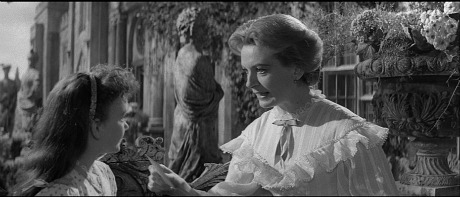
In his review of a new British Bluray of Jack Clayton‘s The Innocents, DVD Beaver’s Gary W. Tooze ignores a significant visual element. The 1961 film was clearly shot with older Fox CinemaScope lenses, and therefore suffered from the “CinemaScope mumps,” a syndrome that mostly manifested in CinemaScope films of the ’50s in which actor’s faces (and everything else) looked a tad wider than in actual life.


Deborah Kerr, Pamela Franklin (who’s now 60 years old) in Jack Clayton’s The Innocents.

The “mumps” began to gradually disappear around ’59 or ’60 when then-new widescreen Panavision lenses, which didn’t produce wider-than-normal images, were put into use. But Fox’s British unit was apparently using older-style CinemaScope lenses.

I hate the “mumps” syndrome. It makes me grind my teeth. DVD Talk’s Glenn Erickson noticed it in his 2005 review of an Innocents, to wit: “The only hindrance is that the lenses used appear to be older models that give faces the CinemaScope ‘mumps’ in close-ups. These earlier lenses with distorted fields show up frequently in Fox films made in Europe.”

Millions of moviegoers watched widescreen “mumps” films in the ’50s and early ’60s and didn’t notice or say anything, of course. It’s my cross to bear that I do notice this stuff (like the 1.85 masking of On The Waterfront the other night, which the entire audience was apparently cool with) and being the only guy who goes up to complain, or who writes about it.

Toooze also says, by the way, that “this dual-layered 1080P transfer from the BFI does indeed improve especially in the visibility of grain…[it] is far easier to see, providing some earthy texture to the visuals.” I understand how detail and grain sometimes go hand in hand with older films, but how does a film improve by “the visibility of grain”? Forget it. I don’t want to know.