Not Funny

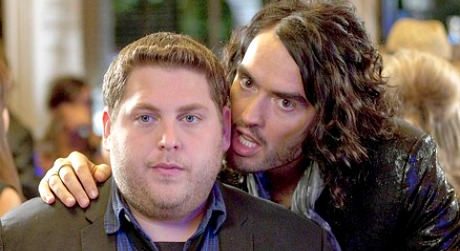
I’ve tried watching this trailer a couple of times now, and I can only focus on one thing, which is that Jonah Hill has become such a wildly out-of-control beach ball that his appearance is getting in the way of his shtick. It’s obviously okay or even de rigeur for a comedic actor to be “the fat guy,” but Hill has become the “working-on-a-heart-attack guy” or “the guy who’s shooting for John Candy status when he hits his 40s.”

Hill’s Superbad physique was relatively svelte compared to how he looks now. You think one or two of his Judd Apatow pallies would stage an intervention, but I guess they’d rather be cool and low-key about it, just like Harry Nillson‘s “friends” never forced the issue about his alcoholism.

The film is called Get Him To The Greek (Universal, 6,.4,). Nicholas Stoller directs from a script he co-wrote with Rodney Rothman. Russell Brand, Rose Byrne, Sean Combs and Elisabeth Moss costar with Hill.

As The Nose On Your Face

Why have so few critics tuned into the political/war metaphor in How To Train Your Dragon? It seems obvious as hell to me, and yet the ones I’ve read have steered clear, perhaps feeling that it’s somehow inappropriate to mention our Middle East conflict when discussing a family film. And yet the filmmakers had no problem weaving in a pronounced lefty-peacenik message about understanding your enemy and getting past the knee-jerk instinct to draw swords etc.

Not mentioning this is like reviewing Gone With The Wind and not saying it’s basically a Great Depression metaphor that praises tenacity and gumption.

The only critic who seems to have spotted the liberal Dragon metaphor (besides myself) is the New York Post‘s Kyle Smith. He’s riled by it, being of an apparent conservative bent, but at last he’s discussed it.

“One interesting aspect of the movie, apart from the design, is that it puts so much effort into projecting a moral,” Smith writes. “Hiccup begins to think about a different approach to dragon-human relations. Shouldn’t the dragon wars stop? Shouldn’t we all live together in a warm, friendly human-dragon commune? Hiccup tells the dragons, ‘Everything we know about you guys is wrong‘ and believes the beasts are not killers — ‘They defend themselves, that’s all.'”

“Of his own folk, he says, ‘The food that grows here is tough and tasteless — the people, even more so.’

“Hurrah for all this. Really, it’s never too soon to get your kids to accept that their own culture is pathetic — and that the alien one their society is at perpetual war with is really friendly, peace-loving and misunderstood. Hiccup may not be much of a dragon-slayer but in the sequel maybe he’ll go on to a brilliant career in the State Department.”

Here’s how I put it:

How To Train Your Dragon is quite pronounced in its liberal metaphorical messaging. The core theme is the saga of the young finding their own way — about the young minds of a Viking tribe standing up for their own beliefs and defying traditional ways. But it’s also Avatar-like in that it’s about (a) befriending the supposed ‘enemy’ and (b) thereby breaking the bonds of an age-old warfare tradition — i.e., in order to be ‘proud Vikings’ (i.e., good Americans) we must defeat and destroy those who threaten us.

“The proverbial baddies were alluded to in Richard Lester‘s How I Won The War as the ‘wily pathan,’ and if you let your mind go you could view the dragons as a metaphor for ‘them’ — i.e., terrorists, Islamic fundamentalists, those who would attack and kill us.

“In line with this, the big super-dragon which all the smaller dragons serve could be seen as Islamic jihad, the theology of martyrdom, radical fundamentalism, etc. The super-beast, the film is saying, is the real enemy because left to their own devices the regular dragons are actually fairly cool pets (i.e., just like the big screeching lizard birds the Na’vi flew around on in Avatar) who respond to petting and training and whatnot.”

Necessary Awe

Every review of How To Train Your Dragon has writ rhapsodic about the dragon-riding flying scenes. I’m not persuaded that they’re all that terrific (possibly because I saw a 2D version) but whatever. As N.Y. Times critic A.O. Scott puts it, they recall “the basic, ecstatic reasons you go to the movies in the first place.”

I was thinking “yeah, pretty good” as I watched these scenes, but also that the lizard-bird flying scenes in Avatar were somewhat cooler because they felt a bit more realistic. But the point is made — big-screen movie-watching becomes extra-special when something really “wowser” happens and you’re suddenly six years old again — eyes wide, pulse racing, mouth agape.

If you ask me the greatest theatrically-viewable awe moments this weekend are the two blast-off capturings in Hubble 3D — the fierce orange-white glow of the fuel discharge, the magnificent mega-rumble of the engines, the exploding cloud formations surrounding the gantry. You can’t “get” this from a DVD playing on a 40-inch flat screen, even with amplified sound. You have to see and hear it right through super-bad 3D on a 100-foot tall IMAX screen with super-powerful sound. I’ve heard or read people say “I don’t know” because the doc only lasts 43 minutes, but the launches are worth the price.

The first time I heard someone say that a film was “about awe” was when I came out of my second viewing of Close Encounters of the Third Kind — a film that I can’t stand to watch any more, incidentally, except for the opening 20 or 25 minutes. But I was viscerally sold on the damn thing (which has one of the highest tallies of deeply irritating ingredients among any of the major event films of the 20th Century) when that first crash of sound and Sonoran desert light hit the screen — precisely at the 1:33 mark in the video below.

This moment didn’t mean or amount to anything except that it excited and delighted. And because it happened quite early in the film — an important thing. A CG-heavy flick like Transformers 2 can wear you down pretty quickly. Awe isn’t awe unless it’s break-out amazing — unless it stops you in your tracks in some way. It has to knock or melt you down. The cancer of CG-driven cinema, of course, is that it goads producers into trying to make films that are about nothing but awe, which results in sensory assaults that are nothing but punishment.

Which have been the great awe moments in films over the last 50 or 60 years? And I don’t just mean “big” technical awe, come to think of it. That plastic bag video I posted yesterday made the grade.

Pages, Print, Pulp

Yesterday L.A. Times columnist Patrick Goldstein reported that Variety editor Tim Gray and various entertainment reporters at the trade have been telling publicity execs that if they give casting scoops to any of Variety‘s online competition, the paper won’t run their big announcement stories in print, relegating them to online posts only.”

Gray confirms this to Goldstein: “We’ll put the [already-posted] story on the web — for the record — but we won’t put it in the print edition.”

The “print edition”? As Goldstein notes, “Many of the younger studio executives, managers and agents in town probably haven’t seen a print copy of Variety in years, preferring to get their news from web alerts sent to their BlackBerries.”

I had a wake-up moment yesterday morning. I’d just come back from a diner with copies of the N.Y. Daily News and New York Post, and I threw them on top of a small pile of newspapers in the kitchen that I’ll eventually recycle. And I suddenly stopped and looked at all that newsprint, that weight, that adder of clutter, that metaphor for the past, that waste of lumber and household space, that unsightly annoyance. And I said to myself, “What a waste newspapers have become.”

I may have said this to myself once or twice before over the last ten years, but I said it with real conviction this time. There’s only one specific circumstance in my life in which newspapers are really and truly welcome, and that’s when I’m sitting down alone in some European cafe. Then I regard newspapers as dear friends. And I guess you could add the solace of reading newspapers on trains (i.e., until trains start providing wifi-on-the-go). But in every other instance you can have ’em.

Flaming Arrows, Blue Sea

Ridley Scott‘s Robin Hood (Universal, 5.14) will open the 63rd Cannes Film Festival with screenings on Wednesday, May 12th. Non-competitive, strictly hoopla. The period actioner costars Russell Crowe, Cate Blanchett, Max Von Sydow, Lea Seydoux and William Hurt. Robin Hood will open commercially in France on the same day, and in the US two days hence.

Passing of Torch

Like I said in my 3.16 Hot Tub Time Machine review, “the real breakout is Rob Corddry, who plays the wild-card wildass in the group of four (John Cusack, Corddry, Craig Robinson, Clark Duke) who visit a broken down ski resort and travel back to their youth in the mid ’80s ,” etc. So Philadelphia Inquirer critic Carrie Rickey has it right — Corddry is “the new Zach Galafianakis.”

Multiple Choice

Quickly and without thinking — which Eclipse movie seems slightly cooler, grabbier, more substantial, more erotically intriguing? If you’ve chosen the middle poster you’re obviously a knee-jerk Eloi ready to plunge once again over the lemming cliff on 6.30. If you went with the left you’re probably afflicted with the indie-preferring, adult-subject disease that afflicts audiences over 30. And if you chose the right-side poster you may have a Masters in Film Studies from NYU or Columbia.


The poster on the left is for Conor McPherson’s The Eclipse, a nicely shaded adult ghost story that opens on 3.26.

My Dead Wife

Conor McPherson‘s The Eclipse (Magnolia, 3.26) doesn’t broadly signal that it’s a creepy ghost story, but when the scary moments happen they pay off on a level that conventional thrillers miss because they’re playing a more obvious game. It’s certainly worth seeing for this unusualness, and for the sturdy lead performance by the great Cieran Hinds, who always brings all kinds of inner currents to the table.

At times the spook-outs feel like similar moments in Jack Clayton‘s The Innocents, which are my favorite kind.

It’s got a couple of issues (one being a boozing, boorish writer played by Aidan Quinn, whose presence wears very thin by the end) but it’s far from a bust and in no way a burn. So I’m not quite understanding the 63% positive Rotten Tomatoes rating, which is a failing grade by high-school quiz standards. The Eclipse is more 80% or even 85%. It’s a better-than-decent Irish ghost story so whaddaya whaddaya?

I did a little phoner with McPherson and Hinds a couple of weeks ago, and have been putting off writing up their quotes because I hate writing up interviews because it takes too much time and effort. It gives me a headache on top of everything else. I’ll post a video or audio recordings with a four- or five-graph intro but that’s as far as I go these days. Especially when it’s the late afternoon (as it is now). But I’ve posted this and the Eclipse tryptich thing (above) so I’ve covered things for now.

The Fire Next Time

It was announced today that the 2010 Oscar telecast will air roughly a week earlier than the ’09 awards did — on Sunday, 2.27.11. More or less the same deal all around.

And nobody is foolish enough to venture a guess which contender might win the Best Picture Oscar? I’m going to stick my neck out and say it’ll be either Chris Nolan‘s Inception (payback for Dark Knight snub), Doug Liman‘s Fair Game (a 21st Century All The Presdient’s Men?) , David Fincher‘s The Social Network (the GenX/GenY Treasure of Sierra Madre), or Alexander Payne‘s The Descendants (if he finishes it in time).