Having just seen Variety‘s latest Avatar figures ($48.5 million domestically, $143 million overseas), a friend believes “this juggernaught has a real shot at taking $2 billion worldwide, which would be extraordinary.
“Titanic‘s $1.8 billion worldwide total is starting to look like chicken feed. A domestic weekend tally of $48.5 million is impressive enough but its foreign weekend take of $143 million is jawdropping — an actual increase over last weekend. Also factor in the appalling weather over most of Europe and we really are talking about a once-in-a-generation phenomenon.”
I’ve watched almost all of the N.Y. Timesvideo pieces by Melena Ryzik, who took over David Carr‘s Oscar-beat “Carpetbagger” column late last year, and they’re quite good — personality, pizazz, smoothly produced. And her Oscar-race analyses are snappy and perceptive.
So why do I have this back-of-the-neck feeling that she’s not quite getting the attention that Carr got in years past? The buzz ain’t the same. Is it fair to say she doesn’t have that mix of wise-guy personality and flip humor that Carr had — that eye-rolling routine that suggested in a hundred different ways that the Oscar beat was beneath him, and that he felt deeply humiliated by doing red-carpet interviews and yet enjoyed the chance to peel back the layers and toss off the occasional bon mot? Of course it’s not. But it’s true.
Ryzik has no alternative but to be herself, obviously. She projects an agreeable mixture of brains, sophistication and straightforward perk. Ryzik’s stuff works for me. I loved the Nine video piece when she danced. But at the same time a little voice is wishing she could be…oh, Kathy Griffin maybe? Or Camille Paglia? Maybe call people on their bullshit a little more?
I started to think this through after a veteran reporter friend wrote the following this morning: “It’s nearly the middle of January, about a month away from the Oscars, and nobody is talking about Melena Ryzik‘s Carpetbagger stuff. Carr himself is still drawing attention with his artlcles about Mo’Nique and his other N.Y. Times pieces on Roger Ailes and the Apple tablet. But Ryzik not so much.”
The generic definition of a “gaffe” is a remark or observation that most people would probably regard as true but will embarass nonetheless if you say it in mixed company. Sen. Harry Reid‘s racially-tinged comment about Barack Obama in Mark Halperin and John Heilemann‘s “Game Change” certainly qualifies.
Reid reportedly said that Obama was an attractive and electable candidate in part because he was notably “light-skinned” and had “no Negro dialect unless he wanted to have one.” A horrendous thing to say, but not wrong. This is exactly why many older white rural voters supported Obama in part — i.e., because he isn’t that “black.” Does anyone believe Obama would have beaten John McCain if he looked and spoke like Tracy Morgan? Remember that SNL bit in which Morgan said he’s “way blacker” than Obama?
In any event that quote attributed to Bill Clinton in the same book is much more inflammatory.
An L.A. Times story summarizes as follows: “In lobbying the late Sen. Edward Kennedy to endorse his wife, former President Clinton angered the liberal icon by belittling Obama. Telling a friend about the conversation, Kennedy recalled Clinton had said ‘a few years ago, this guy would have been getting us coffee,’ the authors paraphrase. A spokesman for the former president declined to comment on the claim.”
I’ve just finished reading 24 pages about the making of the embarassing Love Affair (1994) in Peter Biskind‘s “Star: How Warren Beatty Seduced America” (Simon & Schuster). Biskind offers quote after quote about how Beatty, the film’s star, producer and co-writer (with Robert Towne), marginalized and pretty much ignored and deballed Love Affair‘s director Glenn Gordon Caron.
Using quotes from several sources including Caron himself, Biskind also reports that director of photography Conrad Hall ignored Caron for the most part, treating him with little if any respect.
Towards the end of filming in late 1993 I was told similar stories by two excellent sources (the late production designer Richard Sylbert, a longtime Beatty collaborator and friend, and another insider I’d rather not name). And I included it in a file submitted to Entertainment Weekly‘s “News & Notes” section, edited at the time by Maggie Murphy, for a story about the making of Love Affair. The file made it clear that Beatty was really running the show and that Caron (hired off his rep as the creative light behind TV’s Moonlighting and Remington Steele) was the director in name only.
I talked to Beatty about these stories, not naming the sources but telling him I’d heard this and that, and he (a) denied that they were true and (b) calmly expressed outrage that EW was working on a story along these lines, which he naturally felt would tarnish the film as a troubled production and perhaps dent its box-office appeal. He mentioned at one point that he might sic his attorney, Bert Fields, on the magazine.
I don’t know who said what to whom, but I do know that EW decided to ignore the Caron-having-his-balls-cut-off angle when they ran their story a week or two later in mid-December 1993. Anne Thompson, who also did some Love Affair reporting, was assigned to write a cottonball piece called “Love and Warren” that said Beatty was a perfectionist and blah blah. It was basically a valentine.
The Caron angle was removed, I was told, because managing editor Jim Seymore didn’t like the fact that we couldn’t name the sources. I heard second hand that he told Murphy there was “no story here.” I always suspected this was code for “I’m feeling too much corporate heat on this thing so let’s kill it or water it down.”
I later told Beatty that by all appearances he’d played his cards well and had clearly won the round. If you have any sporting blood you have to respectfully acknowledge when you’ve been out-maneuvered.
I got pretty good at imitating Beatty’s voice. I remember calling Thompson during the end of the Love Affair episode. She picked up and said hello. “Anne Thompson?,” I said. Yes? “Warren Beatty.” She fell for it. “Hey-hey….howz it goin’?'” and so on. “Anne, Anne…I’m sorry. It’s Jeff. Foolin’ around…sorry. I wanted to see if I was good enough.”
Love Affair opened in October 1994 and was panned by just about everyone. I saw it once and found it flat and mundane. Roger Ebert was one of the few critics who gave it a break. It cost about $30 million and made $18 million, give or take. But Beatty would rebound four years later with Bulworth, one of the sharpest and most unflinching political comedies ever made in this country.
HE reader “btwnproductions” said “the fat people will be relieved” that I was going through a writing slump earlier this afternoon. Just for that I’m going to post a 100% true fat-people anecdote — actually a comment that I heard during the 1999 Sundance Film Festival.
I’d just finished interviewing the great Ken Kesey at Burgie’s on Main Street. (Remember Burgie’s?) He was talking to journalists about The Source, a Chuck Workman documentary about the hip movement of the ’50s and ’60s in which he appeared. I got a rise out of Kesey when I told him I’d played Dr. Spivey in a small theatrical production of One Flew Over The Cuckoo’s Nest . He grinned faintly. “So you played Spivey, eh?” Our chat lasted 20 minutes and then the next guy took over.
I walked outdoors to a second-floor balcony area that looked down upon Main Street. Kesey’s son Zane — heavyish, late 20s or early 30s — joined me. Down below were hordes of festivalgoers, all looking and behaving like typical industry types from NY or LA. Zane, who lived on or near his dad’s farm in Pleasant Hill, Oregon, looked down and said, “Where are all the fat people?” He was joking but critiquing. “This isn’t real America,” he was more or less saying. “These people are too hip looking, too well-dressed.”
I can’t get going today. It’s not that I feel depressed or under-energized. I’m just especially sick today of being indoors and tapping out stories with the TV on and yaddah-yaddah. I feel like Ashley Judd in that motel scene with Robert De Niro in Heat: “I’m sick of it…sick of it!”
With James Cameron‘s Avatar now the #1 film four weekends in a row ($46 million projected earnings by Sunday night) and the second-highest worldwide grosser of all time at the worldwide box office, can it overtake Cameron’s Titanic tally of $1.8 billion, and thereby become the all-time #1 earner?
It can do this if it gathers another $600 million worldwide starting Monday morning. By Sunday night Avatar will have earned $1.2 billion and change in only four weekends of play, or three and a half 7-day weeks (Friday, 12.18 to Sunday, 1.10). At this rate another $600 million doesn’t seem too hard.
It’ll take a little longer, of course, due to diminished post-holiday revenues and the fact that the first and second wavers have already seen it. But there’s a repeat-viewing factor at work plus an understanding that Avatar is not something to wait for on DVD.
I’m figuring Avatar will take Titanic by…what, February 1st? Mid-Feburary?
Avatar‘s domestic cume through last Wednesday was $374.4 million with a foreign tally of $760.9 million. It’s expected to pull in $100 million globally this weekend ($46 million here plus another $55-something over there) for a Sunday-night worldwide total of $1.235 billion, give or take. So to pass $1.8 billion it needs another $600 million.
The three-way Best Picture race will shift this way and that over the next two months, but it’ll be the same thing in late February and early March that it is right now — a choice between the visionary and game-changing Avatar vs. the social resonance of Up In The Air vs. the visceral charge and universal critical acclaim of The Hurt Locker. My heart is with all three, but the most personally enjoyable scenario, I feel, would be if Kathryn Bigelow‘s film took the prize.
A Hurt Locker win would amount to the biggest eff-you to the Oscar awards box-office component ever expressed by the Academy, and I would find that not only delightful but stirring. Because the message would effectively be, “Most of the public didn’t see this film, but at the end of the day we, the Academy, aren’t finally moved by box-office acclaim — we vote for what we care about and believe in, aesthetically and historically. And if the ticket-buyers couldn’t move themselves to see The Hurt Locker during its brief theatrical life, or if it didn’t play in their area last summer, then they know how to find the DVD. And if they don’t like our decision, too bad.”
A Hurt Locker win would also constitute a major expression of belief and support for the independent film community at a time when that community is on the financial ropes.
It would also be a little reminder to the Rob Friedman-styled bottom-liners that a significant component in the distribution business is sometimes about faith and spirit…if you have the right kind of film. Don’t hedge and go “gee, I don’t know” when the cutting-edge critics are cheering your movie. Stand up and stick your neck out the way the Harvey Weinstein-led Miramax Films did in the ’90s.
Given the general…well, at least marginal view that Elaine May‘s Ishtar (1987) is better than its rep and is actually hilarious in portions, it seems odd that today, 22 years after its catastrophic release, there’s no domestic DVD available. (A tape was released in 1994, but no DVD was ever pressed.)
Think about that for five or ten seconds. A major event movie that cost $55 million in 1985, ’86 and ’87 dollars (which would be what by today’s dollar? $120 million or so?) with Warren Beatty and Dustin Hoffman and miles of sand and a rich supply of dry underplayed humor (including some of the stupidest song lyrics ever written), and you can’t buy or rent it. And yet it’s available on home video in Europe.
Obviously Columbia TriStar Home Video execs still regard this legendary flop (which made only $14 million and change) as some kind of mongoloid child that needs to be kept chained in the basement, even though they had nothing to do with its production. This is residual corporate cowardice in action. Over 15 years since it came out on VHS and not one home video executive has had the courage to say, “Hey, let’s put out an Ishtar DVD! Infamy makes for a kind of fame, and maybe it’ll sell if we put some effort into the marketing. Times have changed, tastes have evolved.”
Ishtar was one of the first “no-laugh funny” films ever released. That was a completely new concept back then, and people didn’t know what to make of it. Beatty and Hoffman played a pair of profoundly untalented New York-based songwriters — I remember that much clearly. I also recall that the first half hour or so played pretty well, and that the film’s troubles didn’t start until they travelled to Morocco…Ishtar, I mean. I remember that the best no-laugh humor happened when Beatty and Hoffman were compulsively composing awful songs.
Ishtar costarred Isabelle Adjani, Charles Grodin, Jack Weston, Tess Harper and Carol Kane. It was shot by the great Vittorio Storaro. The intentionally awful songs were written by Paul Williams.
“Come look, there’s a wardrobe of love in my eyes / Look around and see if there’s somethin’ in your size.”
Ishtar is a Sony asset, a decent (some would say inspired) piece of entertainment, a legendary Hollywood debacle that, like Heaven’s Gate, gradually found a measure of respect. Okay, among people with a slightly corroded and perverse sense of humor but still, no one today thinks of Ishtar as a film to be shunned. I haven’t conducted a poll, but I’ll bet very few critics would put it down, and that most would probably say “not half bad.”
So why not put out a no-frills DVD? In fact, why not a DVD/Bluray with a documentary about how one of the biggest bombs in history came to be made (I’ve been reading the tragicomic story in Peter Biskind‘s Warren Beatty biography), and how, after time, it came to be seen as a half-decent, curiously off-funny thing, and in some circles as a kind of misunderstood gem. Certainly nothing to be ashamed of.
“Life is the way / we audition for God / let us pray that / we all get the job.”
Here‘s Janet Maslin ‘s moderately positive N.Y. Times review. And Roger Ebert‘s pan.
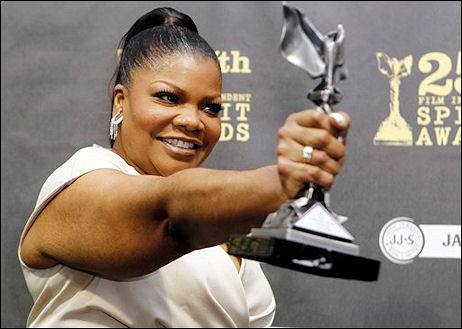
David Carr‘s N.Y. Times profile of Mo’Nique (up today but dated 1.10) oozes admiration for her stand-offish attitude about making the rounds and doing the Oscar dance. “I got my talk show to take care of,” “My performance is my campaign,” etc. She stands her ground, he down wit dat.
If Carr was a tad more squinty-eyed he might ask Mo’Nique about (a) those stories that she’s demanded to be paid for showing up at Precious promotional events, or (b) that “what does it mean financially?” question she asked Terrence Howard and Taraji P. Henson on her BET talk show, or (c) why she’s blowing off the N.Y. Film Critics Circle awards event next Monday. (Nobody believes that she can’t make it due to her taping schedule or a family vacation.)
At the very least you’d think he’d raise an eyebrow about why, during his interview with her, she was “accessorized by a bathrobe, a headband and the Precious director Lee Daniels.” Trust me — Daniels sat in because this was an important interview, and he and the Lionsgate publicists don’t trust what Mo’Nique might say on her own. He was there to positively augment and steer her comments in the right direction. You’d think that Carr would at least take note of this, but no.
“Mo’Nique and Mr. Daniels are a pair,” he notes, “cracking each other up into near helpless laughter at the smallest provocation, and are particularly amused by the keening of the Oscar press because she hasn’t paid proper tribute to the needs of the Oscar-industrial complex. ‘Deny her a nomination and teach her a lesson,’ harrumphed Jeffrey Wells of Hollywood Elsewhere.” I wasn’t harrumphing. Not in my head, at least. I was saying “Yo, why not? Smack her down for the fun of it. Give like you get.”