HE to Rob Reiner: Never Wear Merrells In Public

Rob Reiner was holding his own with Bill Maher and sounding reasonably sane and sensible, and then a wide shot revealed that Reiner was wearing a pair of men’s black Merrell slip-ons and suddenly I lost interest. Because I just can’t with the Merrells.

“Oscar Wilde’s The Importance of Wearing Italian Shoes,” posted on 11.5.16: It was nearly three years ago (1.9.14) when I tried to explain one of the most important rules for famous guys attending public events, which is to never wear orthopedic old-man shoes.

I was derided for saying this, of course, but you can’t explain this aesthetic to deplorable-shoe types. Either you get the importance of wearing elegant shoes in public or you don’t. Wear your grandpa shoes all you want when you’re at home or shuffling around the mall, but never in front of the paying public.

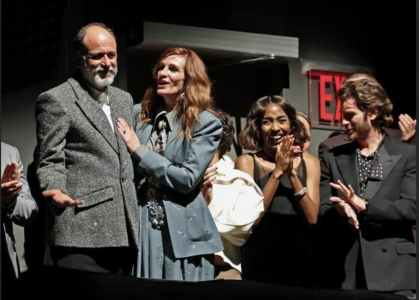
I’m mentioning this again because a certain famous guy was recently photographed in a pair of black senior-citizen sneakers during a post-screening q & a. People in the audience listened to him discuss this and that, I’m sure, but they also had a good 30 to 40 minutes to just sit there and contemplate those ugly-ass shoes. Those people will never forget this.

My original point was that all self-respecting actors, celebrities and X-factor types need to tough it out and wear cool Italian shoes for lah-lah events, no matter what.

I’ve walked around the streets of Rome, Milan, Venice, Sienna and Florence on warm evenings, and white-haired Italian guys never, ever wear comfort shoes. They would rather be stricken with a heart attack and collapse on the street than wear those clunky things. When you’re hanging with the swells you have to look classy and elegant, even if it hurts. Even if it shortens your life.

You can laugh but a man’s choice of footwear usually says a lot about him, particularly about how he sees himself. Once the public realizes that you’re more into comfort clunkers than looking good, it’s the beginning of the end.

Read more

Tetiaroa’s Brando Resort Is Confined To One Small Island — Onetahi

All my life I’ve been describing Marlon Brando‘s Tetiaroa as a sprawling horseshoe-shaped atoll, but the the Brando resort is confined to just one of the smaller islands — Onetahi. The hotel, the bungalows, the airstrip…all of it. The bungalows rent for $3500 a night, or so I’ve read.

Read more

Tyranny Wins!

“Tyranny requires the citizenry to show fear, maintain silence and offer compliance.

“Democracy requires balls, backbone, courage. Too hard!”

From Owen Gleiberman’s 9.27.25 weekly essay:

“As the United States gets pushed, day by day, closer and closer to autocracy, that’s a situation that ought to be setting everyone in the country on edge. Yet it’s part of the nature of autocracy to narcotize people into numbness, delusion, fear, and a kind of self-perpetuating apathy. And that’s what seems to be happening in America right now. Gavin Newsom shouldn’t be the only one saying that we’re in danger of not having real elections in 2028; tons of people (leaders, citizens, journalists) should be saying it. But too many of us are caught in a zone halfway between resistance and despair, and that’s the mood that One Battle After Another taps into.”

HE Regular on “One Battle After Another”

Paul Thomas Anderson did himself no favors when he shot a scene in which Leonardo DiCaprio‘s character is shown watching The Battle of Algiers, possibly the greatest political film ever made.

“The contrast between Gillo Pontecorvo‘s brilliantly realistic and nuanced masterpiece and PTA’s slick but essentially meaningless satire could not be more extreme. One has something meaningful to say about revolutionary violence, colonialism and their effects. The other is basically a caper film with aspirations to say something about our present-day political crisis, but fails to do so.

Benicio del Toro‘s ‘Sensei’ character is the only character who’s actually doing something of benefit, given his work with the undocumented. Just about everyone else is portrayed as a foul-mouthed, charged-rhetoric revolutionary or, in the case of Sean Penn, a rigidly violent and racist nut job. Well, that’s not true — Chase Infiniti‘s Willa Ferguson is untainted by insurrectionist fervor, and is fairly compelling on her otwn terms.

“I didn’t hate One Battle After Another — it’s too well made for that. But it’s been wildly over-rated.”

“I Won’t Stream It…Don’t Ask Me!”

In his 9.28 Anemone review, Variety‘s Owen Gleiberman reveals that Daniel Day Lewis‘s Ray, a morose, white-haired hermit and a victim of priestly molestation when young, recalls an act of gross revenge — i.e., shitting on the face of the priest who diddled him.

Gleiberman: “Ray describes an encounter with the priest in which he pretended to come on to him, then had the priest lay down, face up, on the floor. Earlier that day, Ray had imbibed a special regimen of food and Guinness that would leave his bowels in a very active state; by the time he saw the priest, they were rumbling with need. And that’s when he took down his trousers, crouched over the priest’s face, and…let loose.”

“Trust me, I’m describing this far more abstractly than Ray does, and Day-Lewis, his face rippled with a grin of malice, digs with hideous relish into the scatological description of what went down.”

In Hal Ashby‘s The Last Detail, Otis Young‘s “Mulhall”, after hearing a seemingly incredulous statement of fact, says to Clifton James, “You’re shittin’ me.”

James to Young (deadpan): “I wouldn’t shit you. You’re my favorite turd.”

Read more

I’m Down With “After The Hunt” Because….

…it’s the first Hollywood-financed, Oscar-tasty, mainstream upscale drama that implies…no, states very plainly that #MeToo has created a predatory mindset that is out to “get” cis white males. It doesn’t scream this premise or conclusively demonstrate that this is absolutely the case, but it certainly says “okay but wait a minute…hold on.”

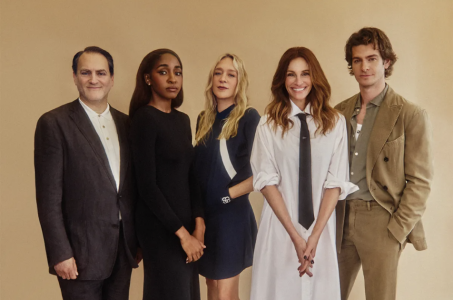
It’s certainly possible that Hunt features two “bad guys”, played by Ayo Edibiri and Andrew Garfield. There may be only one, if you think about it. In my mind it’s both, but Garfield may be slightly less blame-worthy.

I saw it for the second time two nights ago (i.e., Friday), and since then it’s been simmering in warm butter and sauteed garlic.

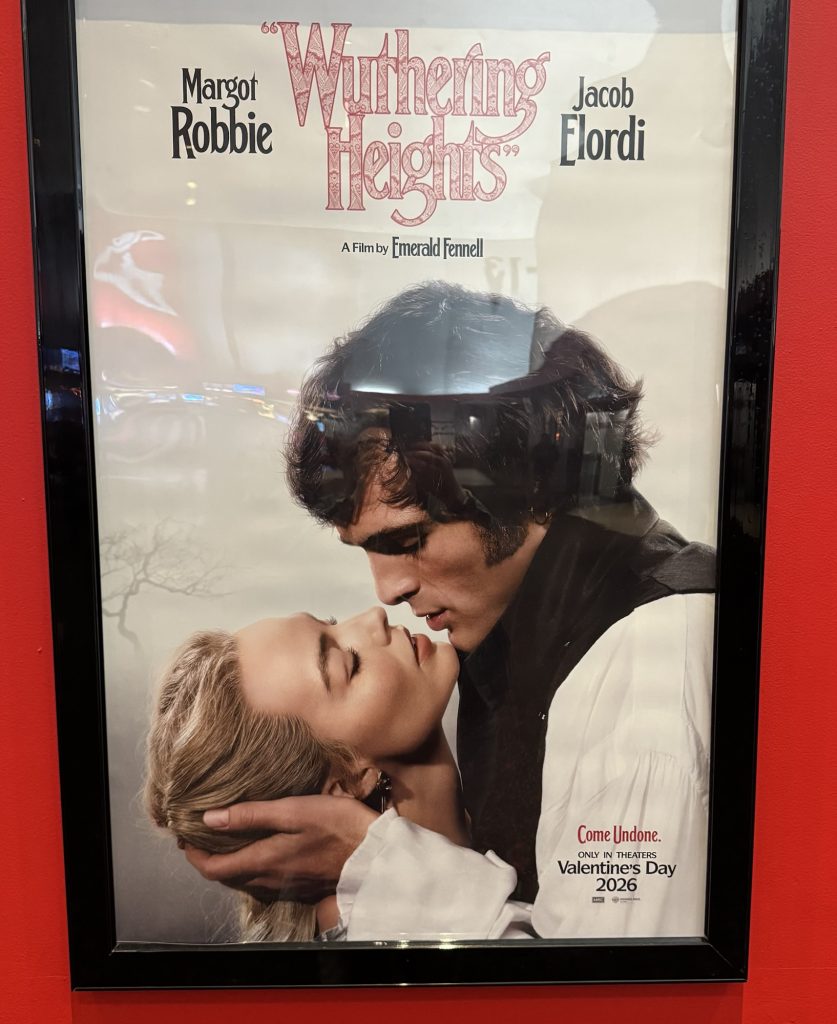
More Sex With Heathcliff

Fuck me hard and long, not to mention all squishy and sweaty, and I mean Emerald Fennell-style…shrieking like pigs and salivating like hungry dogs. But no accidental farting.

Spotty, Undisciplined and Half-Assed, “Waltzing with Brando” Is Nonetheless A Sporadic Charmer

I finally saw Waltzing With Brando the other night. Before opening it had been obvious to everyone that Waltzing was an insubstantial bauble, a cinematic piffle…interesting only for Billy Zane‘s performance as an early ’70s incarnation of the great Marlon Brando.

The fact that the 59-year-old Zane is almost a dead ringer for the Godfather/Last Tango-era Brando…that’s the selling point. He’s certainly striking and actually rather disarming to hang with, which is all the film is basically about…chilling with a whimsical, easygoing, laid-back legend…bask in it!

There are portions of Waltzing With Brando, trust me, in which Zane’s Brando schtick is enough, which is to say pleasantly transporting or at least alpha-vibey. His unpretentious, laid-back, low-key confidence is actually pretty great. I totally bought into it.

And the mid 40ish Jon Heder, whose last big score was the titular role in Napoleon Dynamite, which enjoyed a glorious reception at the 2004 Sundance Film Festival..Heder isn’t half bad as architect and ecological planner Bernard Judge, whom Brando hired to convert Tetiaroa, the Tahiti-adjacent, horseshoe-shaped atoll that Brando bought in 1966, into an ecologically wholesome, self-sustaining haven.

This is what Waltzing With Brando, directed and written by Bill Fishman, is basically about — a South Seas design-and-engineering project with interludes in which Brando hangs out, sips from drinks, charms the womenfolk, talks about what he wants to see happen on Tetiaroa, drops trou without going full frontal, etc.

Judge works for years on end (initially in Tahiti but mostly on Tetiaroa). ’70 to ’75 or thereabouts. No story tension, no dramatic arc, no third-act twist….nothing. Just a lot of engineering details about potable water, building a small airstrip, this and that logistical challenge. Plus Fishman breaks the fourth wall by having Heder talk to the camera when the mood strikes. (The Brando resort wasn’t built until well after Brando’s death in 2004 — it opened in 2014.)

The only thing that “happens” of a dramatic nature is when Judge impulsively decides to cheat (or at least start to cheat) on his 40ish wife Dana, portrayed by Alaina Huffman. The object of temptation is the blonde, 15-years-younger Michelle, played by Camille Razat. But he does so foolishly. Most of the time Dana is back in Los Angeles (they have a school-age daughter); she only visits Tetiaroa from time to time. So when does Judge express a brief interest in ravaging Michelle? During one of Dana’s visits, of course. Idiot.

If You’ve Lost Chris Gore…

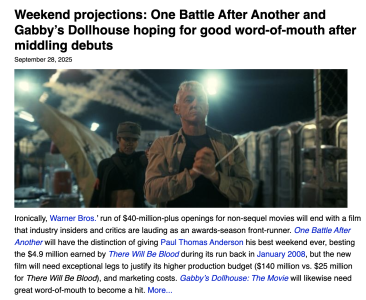
The only sensible way to discuss One Battle After Another is in a form-vs.-content fashion.

Form-wise it’s obviously quite good — driven, vigorous, excellent at times. The longish length doesn’t feel all that burdensome…really. But the insurrectionist, death-to-the-racist-whitey-bad-guys, eat-hot-lead, anti-ICE, lefty-Antifa-women-of-color content (is there even one female speaking role played by a European-descended paleface?) will prove to be a box-office problem over the next week or two. A problem for Average Joes and Janes, I mean.

The radical political stuff is presumably playing well in the costal blue cities. That plus the “okay, Paul Thomas Anderson, a brand, has earned my ticket-buying allegiance” crowd.

From Owen Gleiberman’s 9.27 Variety essay, “One Battle After Another, With Its Thriller Vision of Authoritarianism, Is the Rare Movie That Could Rule the Cultural Conversation”:

Arguably The Best “New Rules” Segment in Months

The heart of this rant begins at the 1:00 mark…”looney woke shit“, etc.

One of the main reasons Kamala Harris lost is that she never even began to acknowledge that Average Joes and Janes despise the left for this. She never even alluded to the possibility of this feeling being out there.

Harris: “Looney woke shit what? You’re talking about us? Since when? Whudda-whudda whah?

Haven’t Re-Watched This For Decades

Stuart Rosenberg and W.D. Richter‘s Brubaker (’80) was a ’70s hangover film. Not a trace of the influence of Star Wars or Jaws. It could have been released in ’74 or ’75 and no one would have blinked an eye.

Robert Redford was 43 during filming in ’79, and he didn’t look a day older than he did in The Candidate, The Sting or Three Days of the Condor.

Morgan Freeman‘s brief performance as a crazed psycho inmate put him on the map, and this was seven years before Street Smart (’87), mind.

Richter’s adaptation of “Accomplices to the Crime: The Arkansas Prison Scandal” was nominated for Best Original Screenplay at the ’81 Academy Awards.

Brubaker opened on 6.20.80, three months before the 9.19.80 release of Redford’s Oscar-winning Ordinary People.