Without Drums or Trumpets


Approaching Newscorp. building for a 3 pm press screening of The Day The Earth Stood Still, which followed (naturally, inevitably) the noontime screening of Seven Pounds over at the Sony building on Madison and 55th.

Wild One one-sheet in the big lobby outside the Sony screening-room on…what is it, the seventh or eighth floor? I forget. But sitting on that rear couch in the dark with your feet up on one of those green leather ottomans is fantastic.

Yours truly is filing from this very spot as we speak, inside a Starbucks on Eighth and 48th.

WALL*E’s Big Day

I got out of a 3 pm showing of The Day The Earth Stood Still only about 30 minutes ago so forgive my being slow to respond to the news about Andrew Stanton‘s WALL*E winning the Best Picture prize from the L.A.Film Critics earlier today. Waahhhlleeeee! Big development, you bet.

It’s a good decision born of bold and original thinking. Hooray for LAFCA not putting its paws up and yelping for Slumdog Millionaire. They stood up and shot their own wad.

Right now, today, as of this precise minute, the Slumdog juggernaut is idling in traffic, stopped at a red light, and just a tiny bit worried. I wouldn’t be. Things will pick right up again tomorrow for Slumdog once the unusual WALL*E win — the first-ever animated pic to win LAFCA’s Best Picture award — is processed and kicked around. But at least today’s surprise win has given the Best Picture race a little contour, a little shading, a little “oh, yeah?” attitude.

The Dark Knight was the Best Picture runner-up. Honestly? It would been a little bit cooler if Chris Nolan‘s film had won instead of Stanton’s. WALL*E, trust me, isn’t going to bust into the Academy’s Best Picture race, but The Dark Knight might, and it could’ve used LAFCA’s support to pursue this. But what does LAFCA care about the stupid Academy? Nothing. They’re playing their own game.

LAFCA’s Best Director trophy went to Slumdog‘s Danny Boyle . It’s a sop, of course — a make-up for the disappointed Slumdog contingent. But as long as LAFCA was going off the script they should have at least given the Best Director prize to Nolan, who was first runner-up after Boyle.

Milk‘s Sean Penn won the Best Actor award (fine), and The Wrestler‘s Mickey Rourke came in second (tough break).

This columnist recognizes that Sally Hawkins‘ performance in Happy-Go-Lucky was crackling and throbbing and gifted-crazy, but the kind of person she played — a happy fascist who insists on happy-vibing everyone she runs into until they’re down on their knees and begging for mercy– is the sort of positive soul I find personally detestable, so I say “no” to this in order to discourage all of the other happy fascists, both in other forthcoming movies and in real life.

But yay for Best Actress runner-up Melissa Leo, the desperate people smuggler of Frozen River .

The Best Supporting Actor prize went to The Dark Knight‘s Heath Ledger, and Happy Go Lucky‘s Eddie Marsan, whose performance I enjoyed much more than the one given by Hawkins, was named runner-up.

Vicky Cristina Barcelona and Elegy‘s Penelope Cruz was named Best Supporting Actress, and Doubt‘s electrifying power-hitter Viola Davis came in second.

Here are the rest of the awards.

Time Has Come

“I respectfully request a moratorium on Holocaust films,” writes Stewart Klawans on the Jewish culture site, Nextbook. “By continually replaying and reframing and reinventing the past, these movies are starting to cloud the very history they claim to commemorate. Call it the law of diminishing returns — or call it a paradox that mirrors the Torah’s famously self-contradictory commandment at the end of Parshat Ki Tetze, concerning the people who were the prototype of Nazi Germany: ‘Thou shalt blot out the remembrance of Amalek from under heaven; thou shalt not forget.’ Very soon, with Holocaust movies, we’ll need to forget if we want to remember.”

Scoot

Running into town for afternoon screenings of Seven Pounds and The Day The Earth Stood Still. Back around 5 pm eastern. Probably.

The Whacking

Speaking to L.A. Times/”Big Picture” columnist Patrick Goldstein about the firing of piece-of-work Twilight helmer Catherine Hardwicke from shooting the upcoming sequels. Summit honcho Rob Friedman yesterday insisted that the first follow-up, titled New Moon , was not being rushed into production.

“We love the draft [that Melissa Rosenberg] turned in,” he says. “Melissa has worked very hard on the material and was an integral part of what made the original film such a success. This is not a rush job. The movie only gets released when it’s finished. I’d like it to be next year, but we’re not going to put out a bad movie to hit a release date.”

“On the other hand, Summit can’t dawdle,” Goldstein writes. “Unlike with Harry Potter, whose characters aged with each book, the characters in the “Twilight” series remain young forever, so if the studio is going to rely on its newly-minted stars, Kristen Stewart and Rob Pattinson, to carry the entire series, it has to move full speed ahead. Summit has options on its lead actors, but since they are now in demand for other films, if Summit doesn’t press ahead quickly, it could lose them for months on end to other productions.

“Hardwicke’s abrupt departure has also fueled rumors that she clashed with the all-male hierarchy at Summit. It’s a charge often leveled at Hollywood’s largely all-male executive ranks, which has a woeful track record of hiring female filmmakers on mainstream studio projects. Friedman insists there were no gender issues .

“‘It’s an insult to me personally as well as to our company. I’m the father of four daughters. When I was at Paramount, we did Kathryn Bigelow ‘s K-19: The Widowmaker. I was the person who marketed Mimi Leder‘s Deep Impact [often cited as one of the most commercially successful films directed by a woman]. Here at Summit, one of the first films we’ve bought was The Hurt Locker, which is also directed by Kathryn Bigelow. We would definitely make another film with Catherine Hardwicke, just not the sequel to Twilight

Goldstein’s best passage in the piece, to wit: “Summit’s handling of Hardwicke’s departure is more reminiscent of what Universal did with its Bourne series, which was also in the hands of a prickly indie filmmaker.

Doug Liman launched the franchise with his dazzling The Bourne Identity, but he went way over schedule and drove the studio crazy with his improvisational perfectionism. Even though the movie was a big hit and seemed to carry Liman’s personal stamp, the studio ditched him, bringing in Paul Greengrass, a filmmaker with equally indie-minded credentials who could better deal with the deadlines and demands of a studio environment.”

BFCA Noms Blank Road, Thomas

The great Revolutionary Road was blanked entirely in this morning’s nominations for the 14th Annual BFCA Critics Choice Awards, including a denial of Kate Winslet‘s fully deserved Best Actress nomination. BFCA, your middle name is shame. This is a manifestation of the “it’s too gloomy” sentiment that deep-and-heavy-soul types have been muttering all along.

Milk and The Curious Case of Benjamin Button did best with eight nominations apiece. But where’s Kristin Scott Thomas‘s Best Actress nomination for I’ve Loved You So Long? This is ridiculous. Who are these Shallow Sallys and Quarter-Inch-Deep Williams doing the voting?

The positive-surprise standouts were Best Actress and Best Supporting Actress noms, respectively, for Nothing But The Truth‘s Kate Beckinsale and Vera Farmiga; the negative-shocker standout is the omission of Revolutionary Road‘s Michael Shannon for Best Supporting Actor — a performance that is universally acknowledged as totally killer. Shannon is the baby who got thrown out with the anti-Road bathwater.

The too-abundant-and-therefore-close-to-meaningless Best Picture nominations contain no surprises.

The 10 Best Picture noms went to Changeling (a worthy film but not interesting or masterful enough to truly be called one of the year’s best), The Dark Knight (fine), The Curious Case of Benjamin Button (okay), Frost/Nixon (default over-50 fave for reasons of efficiency, brevity, quality of performances), Milk (fine), The Reader (a too-generous call — tasteful, well-rendered pic doesn’t deliver emotionally); Slumdog Millionaire (naturally), WALL*E (of course) and The Wrestler (boldly cast downbeat grit, but I have doubts about those metal-staple and delicatessen sliced-hand scenes, which are clearly intended to make viewers flinch and recoil and moan).

The awards will be handed out in Los Angeles on Thursday, 1.8.09, at 9 pm. The show will air on VH1.

The Best Actor nominees are Gran Torino‘s Clint Eastwood (yes!), The Visitor‘s Richard Jenkins (certainly), Frost/Nixon‘s Frank Langella (of course), Milk‘s Sean Penn (yup) and The Curious Case of Benjamin Button‘s Brad Pitt (I loved Pitt in Burn After Reading, but his Button thing is at best passively stirring — the sponge-man thing doesn’t deliver much in the way of arcs or turns), and The Wrestler‘s Mickey Rourke (a given).

The Best Actress nominees are Nothing But The Truth‘s Beckinsale (hooray, Kate! — I’ve been pushing her all along), Benjamin Button‘s Cate Blanchett (take away the de-aging CG and Jack Crabbe old-woman makeup and you’re left with a fine but less-than-breathtaking performance), Rachel Getting Married‘s Anne Hathaway (natch), Changeling‘s Angelina Jolie (very good work but a bit of a perplexing character — why did she accept the replacement kid in the first place?), Frozen River‘s Melissa Leo (naturally) and Doubt‘s Meryl Streep.

The Best Supporting Actor noms went to Milk‘s Josh Brolin (good work!), Tropic Thunder‘s Robert Downey, Jr.(inspired), Doubt‘s Phillip Seymour Hoffman (first-rate), The Dark Knight‘s Heath Ledger (the best) and Milk‘s James Franco (a good man delivering a fine perf).

The Best Supporting Actress noms went to Vicky Cristina Barcelona‘s Penelope Cruz, Doubt‘s Viola Davis, Nothing But The Truth‘s Farmiga, Benjamin Button‘s Taraji P. Henson (who’s fine, but she had a much better role in Hustle & Flow), The Wrestler‘s Marisa Tomei and The Reader‘s Kate Winslet.

Friends of Torino #1

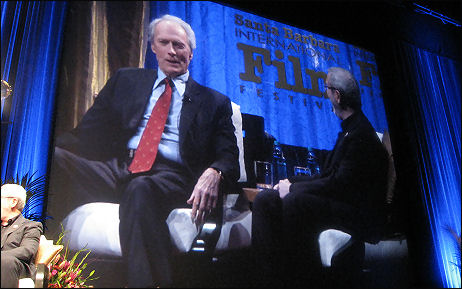
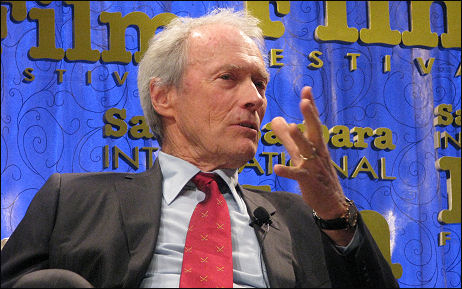
Clint Eastwood is America’s great humanist director at present, making eloquent calls for compassion in films like Million Dollar Baby, Letters From Iwo Jima and this year’s Changeling, but never at the expense of spinning a good yarn.

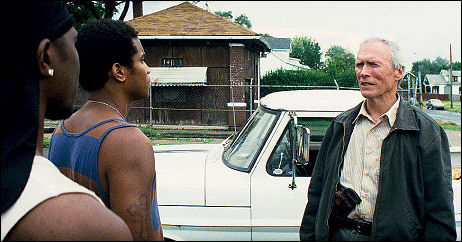
Gran Torino is a plea for racial tolerance but also a compelling story of friendship which lingers in the mind when the extravagances of Benjamin Button and Australia have faded from memory.

“As with Eastwood’s other recent films, the film is ultimately a tearjerker with a momentously moving finale. As Clint’s own gravelly voice starts up over the end credits singing the mournful title song, it’s genuinely sad to think we might not see him act again, but somehow fitting that he should bow out with Walt Kowalski.” — Screen International‘s Mike Goodridge, writing from London.

Queen of the Flops

Earlier today the Guardian‘s David Thomson, a longtime admirer and recent biographer of Nicole Kidman, asked if Ms. Frozen Forehead is “becoming box-office poison.” Becoming?

Sliced Hand

“The best sequence in The Wrestler, even more likely to lodge in your mind than the soaring sadness of the climax, takes place not on the wrestlers’ canvas, with its carpet of blood and broken glass, but at the deli counter of the supermarket,” writes New Yorker critic Anthony Lane in the current issue.


Mickey Rourke in The Wrestler

“Here Randy (Mickey Rourke), needing the money, dons a protective hairnet and doles out pasta salad. He even pins on a name tag that says ‘Robin,’ randiness being too rich for this clientele. The dent to his pride is profound, more wounding than any professional blow to the head, and the scene closes in agony, as he takes out his frustration on a meat slicer.

“But here’s the thing: while the job lasts, he’s pretty good at it, bringing a brief shaft of pleasure to the customers, and suffering any taunts that come his way. What Rourke offers us, in short, is not just a comeback performance but something much rarer: a rounded, raddled portrait of a good man. Suddenly, there it is again — the charm, the anxious modesty, the never-distant hint of wrath, the teen-age smiles, and all the other virtues of a winner.

“No wonder people warmed to Randy Robinson twenty years ago. I felt the same about Mickey Rourke, and I still do.”

Slumdog Push-Back?

“Though Slumdog Millionaire has a hoary plot device, the kind of narrative armature that could have come out of the vaults of Warner Brothers five decades ago, the ability of Danny Boyle to find both the movie and the humanity in that story make it a tough Oscar competitor,” says N.Y. Times Oscar guy David Carr, a.k.a., “the Bagger.”

“[Still], the more Slumdog Millionaire rolls, the harder the push-back will get. Nothing is writ. And it won’t be long before we start hearing, ‘Sure, it was a darling movie, a surprise really, but that third act? Please.'”

That’s exactly the opposite view I have of Slumdog Millionaire. It’s a buzz-kick movie but also a rough one to get through because of all the cruelty and violence visited upon the lead character (played in his adult years by Dev Patel) in the first and second acts. It’s hard, it’s a chore, but then along comes that third act and the film starts to sing. The third act saves it, and the train-station finale knocks it out of the park .

No-Shows

Boston Herald critic Jim Verniere informs that the Boston Film Critics will vote this coming Sunday, and yet he can’t get get his hands on a screener for Steven Soderbergh‘s Che, or one for Rod Lurie‘s Nothing But The Truth. If I were IFC I would have rented a room and have a big Che screening for the whole Boston gang.

Update: IFC, I’m told, “did send the Boston Film Critics screeners by priority mail,” and that its mailing house “did send a copy to Verniere a while ago.” They are nonetheless “overnighting him a new screener today,” I’m told. “These things happen but it is not on purpose.”