Gong Show

If you go to a movie this weekend chances are you’ll run into the poster for Oliver Stone‘s World Trade Center (Paramount, due in late summer or early fall) hanging in the lobby. And if you’re at all like me, you may experience a slight involuntary twitching when you stand there and take it in. Not out of disdain for the visual concept (which is okay), but that godforsaken title. The wretched sound of it, I mean.

World Trade Center just keeps needling me. I’ve tried to get used to it, but that generically odious Jack-and-Jill quality (every time I hear it a J. Arthur Rank gong goes off in my head) makes it one of the worst big-studio movie titles of all time.

It seems to me that a movie set in lower Manhattan on 9.11.01 would have to be direct, honest and dignified…and yet try for a touch of the poetic. If you believe that titles should somehow correspond to content, the name of Stone’s movie should be about an echo of some kind…not about a redundant fact, but soul particles lingering in the air.

The title World Trade Center is about duhh-level marketing…about snagging the lowest common denominator, and the hell with poetic import.

You can hear somebody on Gerry Rich’s advertising team saying to a colleague, “Nobody will look at this one-sheet and not know right away what it’s more or less about…nobody. And no one will be able to point their finger at any of us after the opening weekend and say we made it seem too oblique.”

Try offensive. World Trade Center isn’t “overkill” as much as idiotkill. All good titles work on at least two levels, and World Trade Center doesn’t even work in terms of pure one-note simplicity. It sounds like a compromise produced by a committee of scared people.
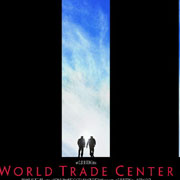

A portion of Paramount World Trade Center one-sheet, as it appears in USA Today story out today (Friday, 2.10)

The image of two guys standing side by side between the Twin Towers is a little dumb-assed (the 9.11 disaster wasn’t a personal/intimate experience for anyone, including the two Port Authority guys who were covered and trapped in rubble), but it’s tolerable.

USA Today‘s Anthony Breznican has written that Paramount “hopes the image reflects that filmmakers are trying to approach America’s greatest modern tragedy with respect.”

Breznican says the studio “decided to emphasize mood, while the stars’ and director’s names are downplayed. There’s an abstract reminder of the twin towers instead of an actual photograph of the buildings intact, or in ruins. The red, white and blue colors imply it’s an American story — not a tale of terrorists or politics.”

The true story of Port Authority police officers John McLoughlin and Will Jimeno (i.e., the guys who were bured and eventually rescued), World Trade Center costars Nicolas Cage and Michael Pena along with Maggie Gyllenhaal, Maria Bello, Frank Whalley, Nicholas Turturro and Thomas Mapother.

Gooney Bird

Several weeks ago I wrote a little thing about how Mel Gibson looked like a totally wacked John Brown with that flannel shirt and wild-ass beard in that flash-and-he’s- gone appearance in his Apocalypto trailer.
And now following the posting this morning of Gabriel Neeb‘s letter that called Bravheart‘s Best Picture Oscar win an embarassment(i.e., “a post-Passion of the Christ reassessment”), some guy has written in to set me straight:
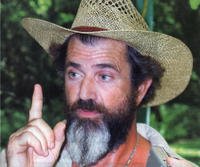

Mel Gibson

“Did you know you’re being laughed and mocked in movie websites all over the internet because you didn’t realize that it was a joke when Mel Gibson appeared in his trailer? Of course it was a joke, you silly hypocritical prick! Anyone who knows anything about show business, knows that Mel Gibson is the biggest prankster in the business.
“And you should have also known that his beard was being grown in for a part in Under and Alone, but you just wanted to make judgments because you don’t like his politics and because you don’t understand his religion. And now you want to take away the honor of his Oscar win for Braveheart, because you don’t care for The Passion. Again, you’re a stinking PRICK!!” — Jeremy Cohen .

Measure of Ledger

Heath Ledger submitted to a friendly dog-and-pony show at the Santa Barbara Film Festival last night (i.e., interviewed by Pete Hammond on the stage of the Lobero theatre, watched several film clips, accepted the festival’s Breakthrough Award), and I’m a tiny bit stumped.

It was a nice evening…pleasant, heartening…and Heath seems like a right guy, but I don’t know what to say about him that doesn’t sound cliched or repetitive or flat.
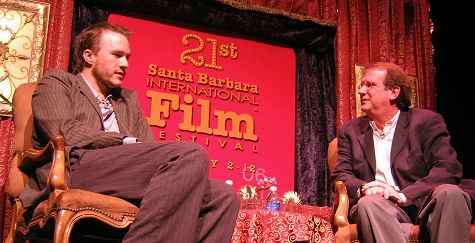

Heath Ledger, Pete Hammond on stage of Santa Barbara’s Lobero Theatre — Wednesday, 2.8.06, 8:25 pm.

He’ll be around for a long time, I think. That seems like a fairly safe bet. He’s 27 now — he’ll probably still be acting 40 or even 50 years from now, and in quality vehicles, given his standards and talent. I’ll be dead (probably) and he’ll still be acting. Nice thought.

I’ve never written a damn word about Ledger’s performance as “Skip” in The Lords of Dogtown because I never gave a shit about watching it (due to laziness…I had nothing against the film), but after watching him in a clip or two last night I now want to see it whole.

I think Ledger may be a bit like Laurence Olivier and Alec Guiness, which is that without a role to play (or a fake nose or an exotic accent to hide behind) he congeals and stammers on a bit and isn’t quite up to the charm levels of Jay Leno or Conan O’Brien or Jimmy Kimmel in front of a crowd.

Ledger is a gently spoken sort with what feels like a fairly strict sense of integrity. It’s no secret that he has one of those serious light-up-the-room smiles. Being Australian and somewhat expressive and non-taciturn, his voice isn’t the least bit Ennis del Mar-ish, but it does have a deepish timbre and a kind of rolling tonality.
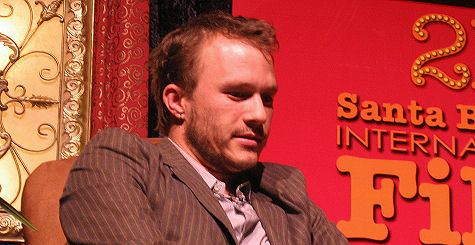

Heath Ledger — Wednesday, 2.8.06, 8:32 pm.

He’s a gifted, probably genius-level actor who right now seems to be about sixteen times more into spending time with his infant daughter than making new movies and pocketing huge paychecks, and is actually planning on not working at all for roughly a year. (He said something about living in Amsterdam when we spoke at the Focus Features after-party following the Golden Globes.)

I liked it that there was a loose tab or some kind of mini-tongue sticking out of the heel of his lace-up shoes, and I was staring at this thing for a while and thinking, “Yeah, funky-ass shoes…but I guess that’s Ledger and his I’m-not-your-father’s- idea-of-an-uptown-actor attitude.

He was pretty good at fidgeting around in his seat last night as he spoke to Hammond about this and that. He sat on his hands for a bit. His legs were kind of tucked under the chair, a bit like a British school kid doing detention. He said that auditions have always been awkward because he doesn’t like the feeling of being examined and judged.
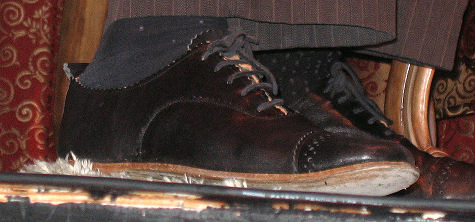

Heath Ledger’s shoe — 2.8.06, 8:40 pm. See that little doo-dad thing sticking out of the heel? That’s intentional, right?

Here’s that Manohla Dargis riff about Ledger’s Brokeback Mountain performance that I ran in WIRED last week: “I’ve almost always liked Ledger, but I didn’t think he had anything going on as an actor until Monster’s Ball. But while he was amazing for the ten seconds he was in that film, I wasn’t prepared for Brokeback, where he creates a world of pain with a tight mouth and a body so terribly self-contained it’s a wonder he can wrap his arms around another person.

“But here’s the thing,” she concluded, “and this is the part that’s hard to explain — I don’t just admire the performance on the level of craft, I am also deeply moved by it, just as I am by the film.”

SBFF director Roger Durling said the following at the end of the evening: “Movies reflect who we are, and in going to the movies we identify with the heroes and protagonists. When I saw Brokeback Mountain and Heath Ledger’s performance, I felt as if somebody had punched the wind out of me.
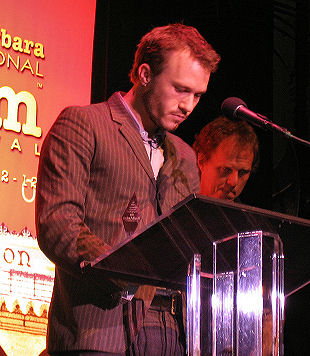

Wednesday, 2.8.06, 9:55 pm.

“It took me a while to understand that never before I had seen a character in a major Hollywood film that portrayed all the loneliness, self-loathing, the need to be loved and give love back that a gay man like me goes through, and I felt a personal form of catharsis watching Heath’s performance. He was kicking a door open that had been long shut, and for that I’m very grateful.”

I’m still stuck about the Best Actor contest because I feel exactly the same degree of admiraton for Philip Seymour Hofman’s performance in Capote as I do for Heath Ledger’s in Brokeback. I’ve called for this before and it makes no sense and it’s highly unlikely from a mathematical perspective, but there should be a tie and they should both win. This really, really should happen.
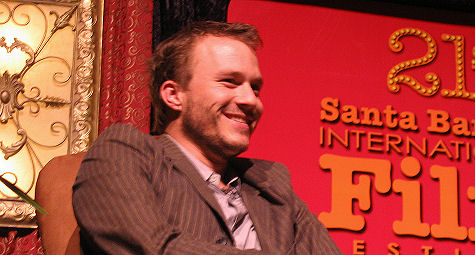

Wednesday, 2.8.06, 8:25 pm.

Grabs
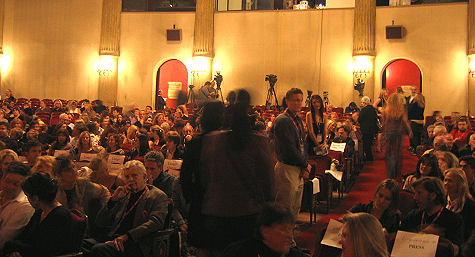

Crowd at Lobero theatre prior to Heath Ledger appearance — Wednesday, 2.8.06, 7:40 pm.
Tuesday, 2.7.05, 11:10 pm.
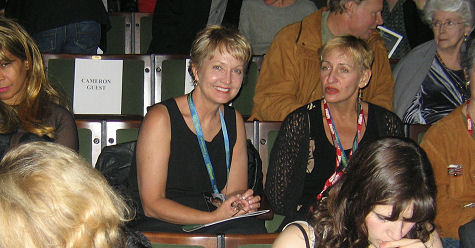
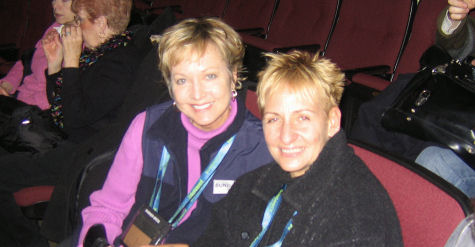
Texas ladies at Monday’s Jim Cameron sit-down — Monday, 2.6.06, 7:40 pm.
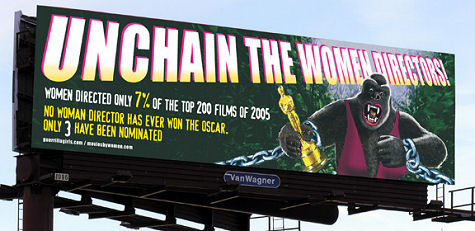
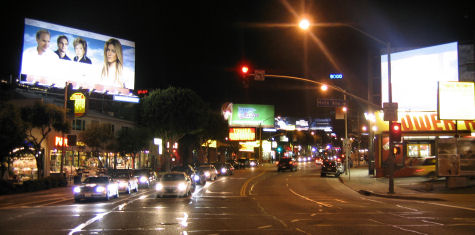
Billboard currently viewable in downtown Hollywood

Unto Himself

Not so many years ago, James Cameron was a formidable Hollywood heavyweight — a hard-driving director of audacious, emotionally gripping audience-friendly films like Titanic, T2: Judgment Day, True Lies, etc. He was one of the Big Guys…in the Spielberg realm with a legend, a following and a potent aura all his own.
But after Titanic he started backing away from features and concentrating more and more on underwater exploration (particularly the haunted remains of the Titanic, which he’s visited 33 times) and making undersea documentaries and generally turning into a deep-dive tech head.

Eight years and two months have passed since the release of the multi-Oscar-winning Titanic, Cameron’s biggest hit and the largest-grossing film in history, but he seems more invested than ever these days in his really-rich-guy, super-expensive, tinker-toy delvings into underwater exploration and making documentaries about same.
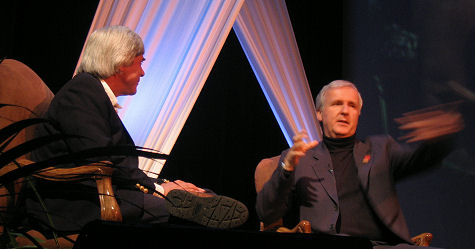

Some nice-guy diving buddy with an engaging personality (forgot his name…sorry!) interviewing James Cameron at Santa Barbara’s Marjorie Luke theatre — Monday, 2.6.06, 8:25 pm.

I’m basing this view on comments Cameron made at last night’s tribute to him at Santa Barbara’s Marjorie Luke theatre, as well as the focus of the evening, which was all about underwater this and that (which explained the sponsorhip by the Santa Barbara Aquarium) and nothing at all to do with Hollywood movies or escapism in general.

Cameron’s sit-down interview session lasted almost two hours, and there wasn’t a single word spoken, even in passing, about Battle Angel, a fururistic, super-sized 3-D feature that Cameron has stated will begin production early in 2006, according to a q & a interview he did last September with the Hollywood Reporter‘s Paula Parisi.

In his remarks at the podium after accepting the festival’s Attenborough Award, Cameron said he places a higher value on the “process” of working with his team of 15 people in their underwater explorings and the technological refining of deep-dive hardware, etc., than working with a production crew of 100 or 110 people on a film.

He said that this process was more important to him than the documentaries that have resulted (or will result) from these excursions.
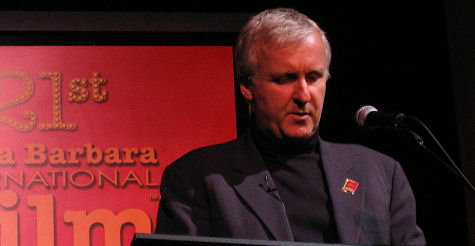

James Cameron at the podium after receiving the Santa Barbara Film Festival’s Richard Attenborough Award, given in loving memory of Sir Dickie’s direction of A Chorus Line and his performance as the wacky geneticist in Jurassic Park. Yes, I’m kidding. It’s just called the Attenborough Award.

Cameron also said that he also values the act of “exploration” in and of itself more highly than on any documentary record of same.

In other words, the nuts-and-bolts aspects are providing much more personal satisfaction than creating a mesmerizing entertaining film (or films) about what he and his team are doing down there.

Except for my friend Cherry Kutac, a Houston-based publicist who feels that Cameron’s deep-dive activities are just as moving and awesome as his Hollywood films, pretty much everyone I spoke to at the after-party said they respect Cameron’s undersea activities, but that they also feel kind of underwhelmed at the same time.

They said that Cameron seems to be doing what he’s doing because he’s rich enough to do whatever he wants, and that as worthy and valuable as his undersea exploration and documentary work is, he seems to be farther off the Hollywood boat than ever before, and that he seems to be more of a eccentric rich-guy explorer than any kind of mover and shaker in the narrative filmmaking realm, like he used to be.

The way I see it is this: I’m glad Cameron is enthused and satisfied and doing what he wants to do, but docs about underwater exploration aren’t as moving or sexy as creating stories and legends about human strivings upon dry land.
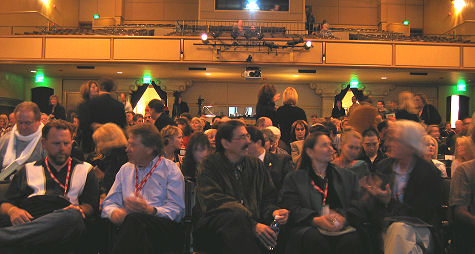

Truth be told, the audience at the Marjorie Luke theatre wasn’t as large as it could have been. (The house was about 70% full — less if you count the balcony.) I think this was because Cameron hasn’t made a real audience-pleasing movie since the middle of the Clinton administration.

Cameron used to be a Vanity Fair/Time/American Cinematographer-type guy — now he seems to belong more to the realm of IMAX films, the Discovery Channel and the National Geographic.

I’m not saying Cameron won’t be making Battle Angel sometime soon, but if he were going to do this wouldn’t the film at least have been mentioned during the tribute? It seems weird that a film of such size (it’s been projected to cost about $200 million) and new-styled visual design didn’t even merit a mention.

Cameron told Parisi last September that Battle Angel, an adpatation of the Japan- ese graphic novel by Yukito Kishiro, will be shot with a mix of “real sets and CG characters,” and that “we’re planning to be in theaters in 2007, releasing it in 2-D and 3-D.”

Cameron described Battle Angel as “the story of the journey of a teenage girl who has a human brain in a synthetic body,” or a variation on Robocop.

“It takes place in the 26th century, [and] it’s a quest for identity, mainly, with a lot of samurai- and kung-fu-type action [that] becomes s story about making a stand, deciding to do something to change the world for the better.”


Bend-over panel from “Battle Angel” graphic novel

Parisi asked Cameron at one point if he would be manning the cameras himself on Battle Angel and he said he would be. “Everybody keeps asking when we start shooting,” he said, “and I don’t know because with all the other stuff we’ve had to work out, shooting will probably be the least challenging part of it.

“But it’ll probably be in January or February [of ’06],” he said.

Touched God, Mostly Died

I was moved by John Scheinfeld’s Who is Harry Nilsson (and Why Is Everybody Talkin’ About Him?), which had its debut screening at the Santa Barbara Film Festival last Saturday evening…and also, to be honest, a bit bummed and a tad bored. Sorry, but that’s what happens when your story‘s about a guy who had everything to live for but decided to drink himself to death.

One of rock music’s most gifted songwriters and melody-makers, Harry Nilsson lived for 53 years. But the heart of his life was a period of eight years — roughly from ’66 to ’74 — when he wrote or sang “Without You,” “Everybody’s Talkin’ At Me” (the famous Midnight Cowboy tune), “One,” “Daybreak”, “Coconut,” “Jump Into the Fire” and the world-famous hurtin’ lyric, “You’re breaking my heart, you’re tearing it apart, so fuck you.”
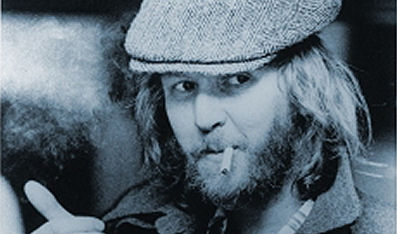

Harry Nilsson, sometime around 1973

Nilsson’s first 25 years were formative (he was born in 1941) and the last 20 were about self destruction — booze, drugs and who knows how many tens of thousands of cigarettes. His parents both died in their 50s so maybe he believed it was in the cards, but Nilsson’s heart finally quit for good in February 1994, just before the big L.A. earthquake.
Obviously those eight years were blessed, shining, God-imbued. The parts of his character that would eventually lead to his death were present and pulsing, but the creative instincts ruled and he was truly king of a kingdom then. The Beatles, Randy Newman and Brian Wilson worshipped Nilsson, and so did everyone else in the music industry along with the millions of fans.

I loved hearing the story of how Nilsson’s listening to the cadence of a busy tone when he was calling a woman led to the same cadence in the opening piano chord of “One (is the Loneliest Number),” the Three Dog Night song that he wrote in ’66 or thereabouts.

This sounds contradictory, but I also loved hearing about the bad-ass behavior before Nilsson’s life turned bloated and pathetic…like the time when he and John Lennon, drunk as skunks, were thrown out of the Troubadour in 1974 after heckling the Smothers Brothers and acting, in the words of club owner Doug Weston, “very Irish pubbish.”
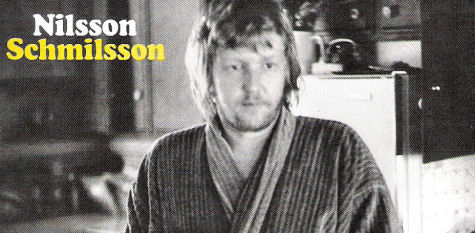
The problem with Scheinfeld’s doc is that the last 40% is about the suicide years, and the fact that they weren’t bittersweet or tragic in the least. And the fact that Scheinfeld, to his credit, doesn’t try to portray them in any other light. It’s not how he made the film that doesn’t feel quite right — it’s the woozy, boozy story he honestly tells.

They were just about waste and rich-guy arrogance and Nilsson’s low self-esteem (sired by his dad leaving the family and disappearing when he was three years old) and a downward spiral that went on and on. Frankly? From a dramatic standpoint Nilsson’s life would have been more stirring if he’d died younger and thinnner and less ruined in a drunken car crash in 1975.

The swirling-toilet-water years, I’m guessing, were also about the “friends” who shook their heads a bit sadly but who mainly chuckled at Nilsson’s carousing.

Somewhere among the many talking heads in Scheinfeld’s film, I feel, are at least one or two enablers….the sort of people who laugh and backslap when a guy has a problem that’s taking him down. I have a notion that the love and affection they say they had for Nilsson when he was alive wasn’t quite as sincere as it seems to be in front of Scheinfeld’s camera.
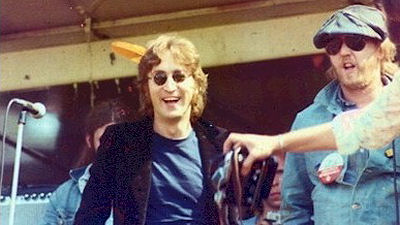

John Lennon, Harry Nilsson around ’73 or ’74

“I loved Harry when he was alive but only as far as I could because of who he was …and there just wasn’t much you could do,” they all seem to say. This attitude is the elephant in the middle of the room of this film, and after a while you can smell it.

The talking heads include music producer Richard Perry (who produced Nilsson’s best album, “Nilsson Schmilsson”), Brian Wilson, Robin Williams, Paul Williams, Rndy Newman, Van Dyke Parks, Yoko Ono, May Pang, Dick and Tom Smothers, Terry Gilliam, Mark Hudson, Micky Dolenz and Ray Cooper.

The mid ’60s to the late ’70s were about uncorking the constipation and repression that younger adults of the time went through when they were kids and being raised by their World War II-generation parents. And artists have always felt that kicking out with drugs, drink and bacchanalian behavior of any variety is their basic due for creating their creations.
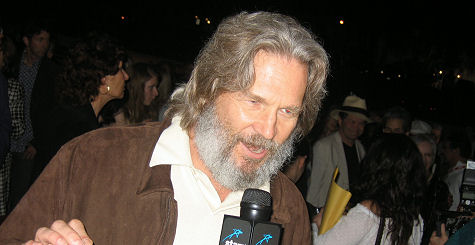

Jeff Bridges in “old man River” mode prior to Saturday’s Who is Harry Nilsson? screening at Santa Barbara’s Lobero theatre, around 6:30 pm.

It all goes with the territory, I guess, but throw these two together and you had one of the most widespread and longest-lasting periods of debauchery in the history of Western Civilization.

But even with all this going on, could there have been anything more despicable for Nilsson to have done (short of hurting others in some way) than to ruin himself with animal indulgence (he even managed to destroy his singing voice) and kill the golden goose within?

As Eric Idle says near the beginning, Nilsson “loved to party and he got that…and the end it got him.” Nilsson’s songs were great but the sad aesthetic of his life — the dramatic arc of Scheinfeld’s film — is what a complete wastrel he eventually became.
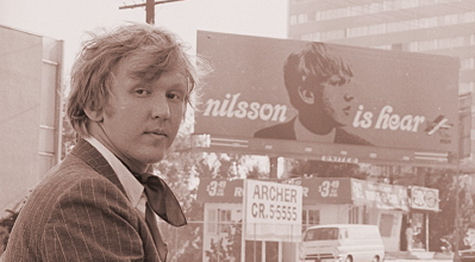
This said, Scheinfeld does an excellent job of telling Nilsson’s life story — I can’t imagine a more comprehensive job — but so many rock ‘n’ rollers have bought the farm early on due to drugs and booze that there’s no tragic dimension to it.

I don’t know when the movie will hit theatres or DVD or cable TV, but sooner rather than later, I’d expect. It’ll sell to the geezer-rock crowd and anyone who respects Nilsson’s music, which would be anyone who respects music, period.

You broke my heart, Harry…you tore it apart, but fuck you for all your brandy chugging and spending way too many years shitting on your gift.

Nilsson Syndrome

“Interesting piece about the Harry Nilsson doc. It reminds me of so many life stories of artists — the last act always sucks.

“I just read two biographies of the much underrated poet Edna St. Vincent Millay, who, in an interestingly modern turn, got herself addicted to pain-killers after a horrendous car crash. She lost the only copy of a major work in a hotel fire (that’s what they had in those days instead of computer crashes), got deserted by most of the people she cared about — including her public and the critics, whose vitriolic backlash continues to this day (She was a performer not a poet, supposedly — the first rock star of poetry, but a second rate writer).

“Best advice when reading (or watching) an artist’s bio — skip the last fifteen years. It’s certainly true of my Dad. No happy endings for artists.” — Steve Axelrod

Grabs


Five or six miles north of Los Olivos, California (which is northwest of Santa Barbara) and just off the road. Los Olivos is the little town with that wine-bar restaurant where Paul Giamatti and Thomas Haden Church had that drink-and-dial dinner with Virginia Madsen and Sandra Oh in Sideways
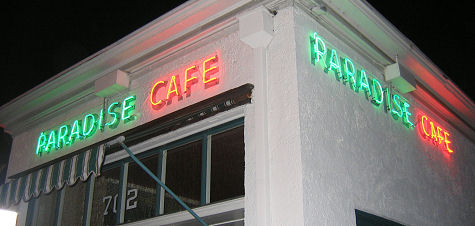
Santa Barbara’s Paradise Cafe — Sunday, 2.5.06, 9:45 pm

Sunday, 2.5.06, 4:40 pm
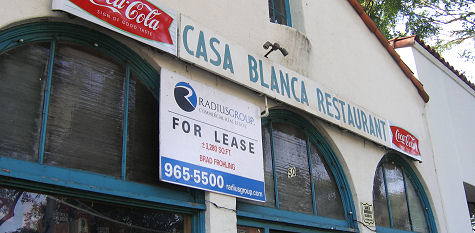
I’ve been eating Mexican food in this place for years. It never attracted the upscale crowd (and good riddance) and always felt like a place ou might find in Vera Cruz, for locals and backpackers on a budget. It was big and roomy with high ceilings, and there was always annoying salsa music playing too loud on the jukebox. And now it’s gone, soon to be replaced by some dink-yuppie bar.
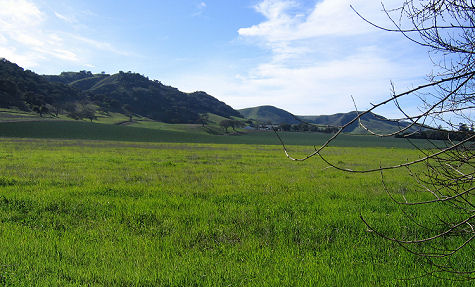
Near the small town of Los Alamos, California — Sunday, 2.5, 4:45 pm.

Love Is Strange

Mozart and the Whale, which screened yesterday afternoon at the Santa Barbara Film Festival, is a Rain Man-type love story with a jumpy heart. Jumpy as in child- like, energetic, anxious.

A romanticized, tidied-up version of a complicated real-life love story, it’s about a youngish couple (Josh Hartnett, Radha Mitchell) with autism, or more particularly Asperger’s Syndrome. And this, viewing-wise, is nervy and provocative in more ways than one.
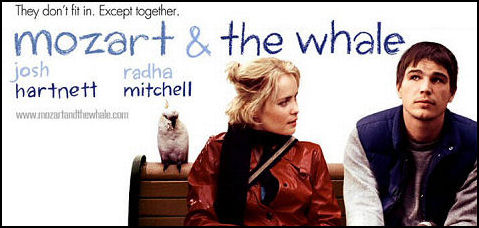
It’s not calming or swoony like other love stories because the lovers are always in a fairly hyper and unsettled state, which feels a bit challenging, but it seems real and fairly honest and is obviously on a wavelength all its own.

At first you’re thinking it needs a regular-guy character (like Tom Cruise‘s selfish prick in Rainman) to provide stability and perspective, but then you get used to the manic energy of it.

And then you start enjoying more and more the vigorous cutting and the funky European-style tone (Norway’s Petter Naess directed), and particularly Hartnett and Mitchell’s performances, which feel wired and fresh and unlike anything I’ve ever gotten, tonally, from a love story before.

I guess this pogo-stick element isn’t striking a chord with very many others since Mozart and the Whale has been having difficulty finding a distributor.

Shot in early ’04, Mozart and the Whale has been released overseas and has even hit the DVD market in places like Greece and Brazil, but a U.S. theatrical release hasn’t happened and looks at this moment a bit dicey.
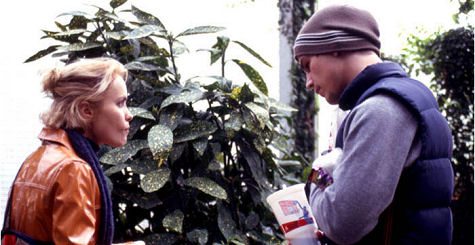

Rhada Mitchell, Josh Hartnett in Mozart and the Whale

Even Hartnett, who went to Sundance to do interviews for the mostly shitty Lucky Number Slevin, isn’t standing behind Mozart . His portrayal of Donald, a child-like mathematical genius, is easily the bravest, most emotionally wide-open thing he’s ever done, and the guy’s not here in Santa Barbara to help plug it. This seems to me like a real jerk move.

I was talking about Hartnett yesterday with a TV producer as we stood on State Street just before noon, and the TV guy told me Hartnett has “the biggest ego in the industry” and that he’s making curious calls about the films he’s starring in (Lucky Number Slevin being one glaring example) and he’s “turning stuff down left and right” and nothing he’s acted in so far has quite caught on in the right way and that his career is cooling off.

But he’s done something brash and unusual in Mozart, and he should be standing by the people who took the journey with him. Even if you happen to prefer Dustin Hoffman’s quieter, more internalized autistic behavior in Rainman (which wasn’t my reaction, not by a long shot), Hartnett’s willingness to take a flying leap and go for it is admirable and exciting.
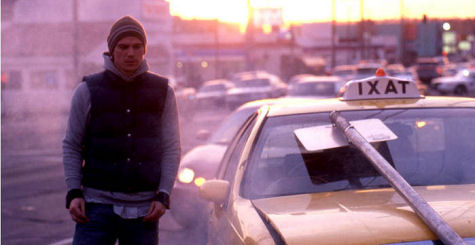

Josh Hartnett in Mozart and the Whale

For what it’s worth, a woman who said she has an autistic child stood up after yesterday’s screening and said Hartnett’s performance is authentic and spot-on. And people from Europe who are claiming to be autistic (or are close to autistic people) who’ve seen the DVD are saying the same thing in online chat rooms.

Lawrence said during the post-screening q & a that “we’re very disappointed that Josh couldn’t be here.” The IMDB says Hartnett is currently filming Texas Lullaby, a present-day retelling of “Hamlet”, but if he could attend Sundance in Park City for a weekend why couldn’t be come to Santa Barbara?

Written by Rain Man screenwriter Ron Bass, Mozart and the Whale is nothing if not alive to the moment. It’s a little twee at times and vigorously paced, but it’s not a comedy, despite what you might have read elsewhere. Call it amped or cranked up but it feels more original than not.

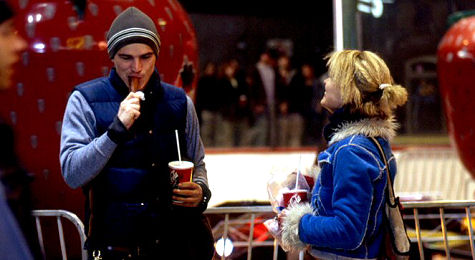
It’s a spirited tale about two childlike souls, Donald and Isabelle, dealing with the peaks and valleys of a turbulent love affair, but also trying to seriously build a life together.
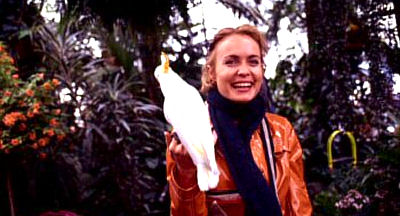
Donald (Hartnett) is a kindly eager-beaver who keeps birds in his stinky cluttered apartment and, like Dustin Hoffman’s Raymond, has a genius-like ability with numbers. He works as a taxi driver but is also an organizer of an autistic support group. He copes well but doesn’t adapt well to change.

Isabelle (Mitchell) is also austistic but bohemian. Her life-coping skills are more refined than Donald’s and she’s more goal-oriented, but in a way she’s more manic and volatile, and she has a way of setting Donald off…and vice versa.

Austistic boy meets autistic girl, they fall in love, they break up, they get together again, they break up again and get back together again and finally get married. A familiar-sounding plot, perhaps, but with odd angles and tender weirdnesses.

Whale was filmed in Spokane, Washington. The costars are Gary Cole, Allen Evangelista, Sheila Kelley, Erica Leerhsen, John Carroll Lynch, Nate Mooney and Robert Wisdom.
The only reps at yesterday’s screening were producer Robert Lawrence and Jerry Newport, the real-life model for Hartnett’s Donald (i.e., the original “whale”).

Newport’s real-life story will soon appear in a book he co-wrote with wife Mary and former People writer Johnny Dodd (who was also at the screening) which is called “Mozart and the Whale: An Asperger’s Love Story.”

I searched around and found a poster for the film with an alternate title — Crazy in Love — which is vaguely offensive, if you ask me. Autistics are different but hardly nutso. They get life as fully and completely as anyone else, and seem to process it, in some ways, with above-average passion and even ecstasy.
Face It Down

Love Is Strange

Mozart and the Whale, which screened yesterday afternoon at the Santa Barbara Film Festival, is a Rain Man-type love story with a jumpy heart. Jumpy as in child- like, energetic, anxious.
A romanticized, tidied-up version of a complicated real-life love story, it’s about a youngish couple (Josh Hartnett, Radha Mitchell) with autism, or more particularly Asperger’s Syndrome. And this, viewing-wise, is nervy and provocative in more ways than one.

It’s not calming or swoony like other love stories because the lovers are always in a fairly hyper and unsettled state, which feels a bit challenging, but it seems real and fairly honest and is obviously on a wavelength all its own.
At first you’re thinking it needs a regular-guy character (like Tom Cruise’s selfish prick in Rainman) to provide stability and perspective, but then you get used to the manic energy of it.
< ?php include ('/home/hollyw9/public_html/wired'); ?>
And then you start enjoying more and more the vigorous cutting and the funky European-style tone (Norway’s Petter Naess directed), and particularly Hartnett and Mitchell’s performances, which feel wired and fresh and unlike anything I’ve ever gotten, tonally, from a love story before.
I guess this pogo-stick element isn’t striking a chord with very many others since Mozart and the Whale has been having difficulty finding a distributor.
Shot in early ’04, Mozart and the Whale has been released overseas and has even hit the DVD market in places like Greece and Brazil, but a U.S. theatrical release hasn’t happened and looks at this moment a bit dicey.


Rhada Mitchell, Josh Hartnett in Mozart and the Whale

Even Hartnett, who went to Sundance to do interviews for the mostly shitty Lucky Number Slevin, isn’t standing behind Mozart . His portrayal of Donald, a child-like mathematical genius, is easily the bravest, most emotionally wide-open thing he’s ever done, and the guy’s not here in Santa Barbara to help plug it. This seems to me like a real jerk move.
I was talking about Hartnett yesterday with a TV producer as we stood on State Street just before noon, and the TV guy told me Hartnett has “the biggest ego in the industry” and that he’s making curious calls about the films he’s starring in (Lucky Number Slevin being one glaring example) and he’s “turning stuff down left and right” and nothing he’s acted in so far has quite caught on in the right way and that his career is cooling off.
But he’s done something brash and unusual in Mozart, and he should be standing by the people who took the journey with him. Even if you happen to prefer Dustin Hoffman’s quieter, more internalized autistic behavior in Rainman (which wasn’t my reaction, not by a long shot), Hartnett’s willingness to take a flying leap and go for it is admirable and exciting.


Josh Hartnett in Mozart and the Whale

For what it’s worth, a woman who said she has an autistic child stood up after yesterday’s screening and said Hartnett’s performance is authentic and spot-on. And people from Europe who are claiming to be autistic (or are close to autistic people) who’ve seen the DVD are saying the same thing in online chat rooms.
Lawrence said during the post-screening q & a that “we’re very disappointed that Josh couldn’t be here.” The IMDB says Hartnett is currently filming Texas Lullaby, a present-day retelling of “Hamlet”, but if he could attend Sundance in Park City for a weekend why couldn’t be come to Santa Barbara?
Written by Rain Man screenwriter Ron Bass, Mozart and the Whale is nothing if not alive to the moment. It’s a little twee at times and vigorously paced, but it’s not a comedy, despite what you might have read elsewhere. Call it amped or cranked up but it feels more original than not.
It’s a spirited tale about two childlike souls, Donald and Isabelle, dealing with the peaks and valleys of a turbulent love affair, but also trying to seriously build a life together.

Donald (Hartnett) is a kindly eager-beaver who keeps birds in his stinky cluttered apartment and, like Dustin Hoffman’s Raymond, has a genius-like ability with numbers. He works as a taxi driver but is also an organizer of an autistic support group. He copes well but doesn’t adapt well to change.
Isabelle (Mitchell) is also austistic but bohemian. Her life-coping skills are more refined than Donald’s and she’s more goal-oriented, but in a way she’s more manic and volatile, and she has a way of setting Donald off…and vice versa.
Austistic boy meets autistic girl, they fall in love, they break up, they get together again, they break up again and get back together again and finally get married. A familiar-sounding plot, perhaps, but with odd angles and tender weirdnesses.
Whale was filmed in Spokane, Washington. The costars are Gary Cole, Allen Evangelista, Sheila Kelley, Erica Leerhsen, John Carroll Lynch, Nate Mooney, and Robert Wisdom.

The only reps at yesterday’s screening were producer Robert Lawrence and Jerry Newport, the real-life model for Hartnett’s Donald (i.e., the original “whale”).
Newport’s real-life story will soon appear in a book he co-wrote with wife Mary and former People writer Johnny Dodd (who was also at the screening) which is called “Mozart and the Whale: An Asperger’s Love Story.”
I searched around and found a poster for the film with an alternate title — Crazy in Love — which is vaguely offensive, if you ask me. Autistics are different but hardly nutso. They get life as fully and completely as anyone else, and seem to process it, in some ways, with above-average passion and even ecstasy.
Talk It Out

Triple Oscar nominee George Clooney (two for Good Night and Good Luck, one for Syriana) and the legendary Robert Towne (director-writer of Ask the Dust) stirred some talk soup in Santa Barbara last night (2.3) — Clooney at the Arlington, Towne at the Victoria.

This shouldn’t come as a surprise (and I’m wondering if it’s even interesting), but they both confirmed they’re a pair of sharp and likable operators. Clooney is a better “entertainer” than Towne — he’s as fast and funny as any comedian I’ve ever seen on Leno or Letterman — but both have the kind of seasoning and assurance that you can’t help but settle into.


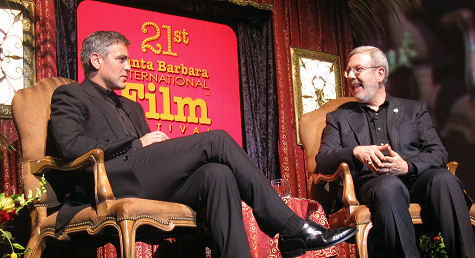
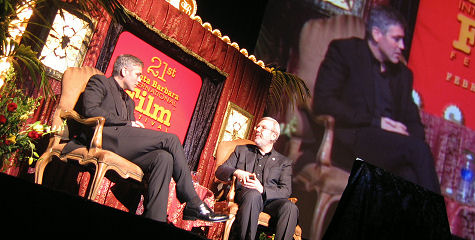
George Clooney, Leonard Maltin at Santa Barbara’s Arlington theatre — Friday, 2.3, 8:50 pm.

I’ve seen Clooney sit down two or three times over the last several weeks, and each time he’s had the same black leather lace-up shoes — nicely old-fashioned, probably Italian-made. Towne is more of a cross-training shoe or mountain-boot type of guy. Sorry, but I happen to feel that footwear matters. It betokens attitude and character and self-image.

You want me to continue or should I just post the photos? Because I have shit to get to this morning. Actual screenings, I mean, along with the usual parties and seminars and long easy strolls down State Street. It’s a tough beat, the Santa Barbara Film Festival, and not for the faint of heart.

The problem with attending glamorous film festivals (for journalists, I mean) are the constant temptations leading to a general undermining of journalistic discipline. There sirens singing songs in this town that are no less threatening than those who tried to lure Ulysses and his men to their doom.

I asked Towne towards the end of his Victoria theatre session which film he admires the most among the five Best Picture nominees, and he said without hesitation that Capote tops his list — for the discipline of it, the lean visual style, and the fascinating portrait of a “monster”…not Clifton Collins’ Perry Smith but Philip Seymour Hoffman’s Truman Capote.


Ask the Dust director-writer Robert Towne and a journalist/interviewer who didn’t identify himself at Santa Barbara’s Victoria theatre — Friday, 2.3., 6:10 pm.

The Clooney show — a chat with Leonard Maltin and a shitload of film clips — didn’t get started until 8:30 pm, and ended around 10:40 pm. Clooney and Maltin had to be whipped after 130 minutes of tap-dancing and brisk banter. I’ve done this kind of thing and it’s like acting in a play. It feels great when you’re up there and kicking, but when it’s over you feel like you’ve boxed for 15 rounds.

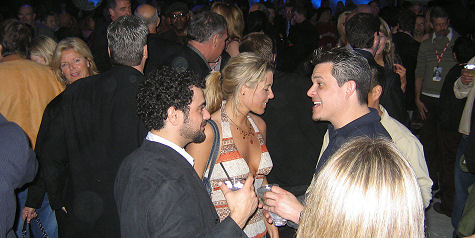
Clooney was so beat after the show he barely stuck his head into the after-party before turning around and scramming. I can’t say I blame him given the fact that the soiree was held in an underground parking garage and was basically a sprawling “pig fuck” — sorry, but that’s the standard term for an overcrowded film festival gathering.


Clooney, Maltin — Friday, 2.3, 8:55 pm.

There’s something about standing around on hard concrete with three or four hun- dred others that just…I don’t know…makes me feel all swoony. Everyone milling around in an atmosphere of bluish light and aimless wandering, and with so little in the way of edibles that people were swarming over waiters, covering them like locusts, when they appeared with hors d’oeuvre trays.

It took me and my two Texas girlfriends a long time to get into the VIP lounge, and then came the word that Clooney wouldn’t be showing so we finished our glasses of wine, ate a few more cheese squares, said our goodbyes and called it a night.


At the parking garage Clooney-no-show after-party — Friday, 2.3, 11:25 pm

Face It Down

It took me a few hours to come to this, but Robert Towne’s Ask the Dust (Para- mount Classics, 3.10), which I saw last night at Santa Barbara’s Arlington theatre, is about how self-acceptance — who you really are, where you come from, what you’re feeling deep down — brings clarity and with that the noblest kind of strength, which is the ability to love.
It took me most of last night and a couple of hours this morning to come to terms with this movie and what it actually is and how I feel about it, but I guess anything of value takes a while to attain.


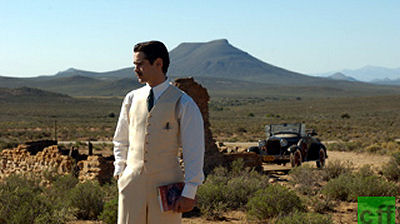
Colin Farrell in finale of Robert Towne’s Ask The Dust (Paramount Classics, 3.10)

This is the core of Ask the Dust, the payoff…but as with any film or play or novel, it’s the journey that counts. And the path of Ask the Dust is a bit old-fashioned because it feels and often looks like a play. But I admire the ballsiness of a film that stands its ground and says take it or leave it because it’s about a great writer who knew what he was doing and knew from integrity, and either you get that or you don’t.
There are inch-deep movies that are all about external visual stuff and cut like heebie-jeebie music videos that leave you with nothing, and there are delicate haunted-soul movies that are about internal stuff and fully-absorbed human experience, and which pay off at the end because they’re about something.
Some who see Ask the Dust may shift around in their seats a bit, but this is a film that knows what it’s doing and gets to where it’s going. It is what it damn well is.
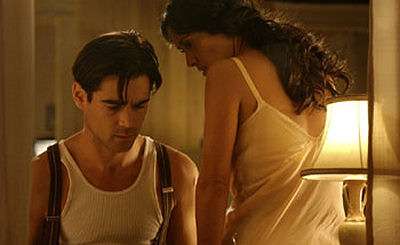
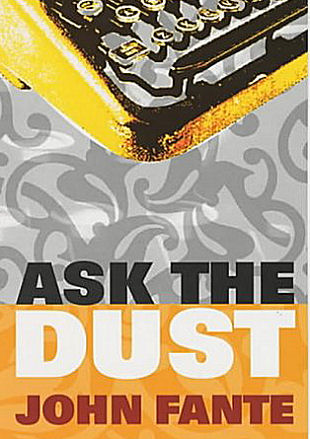
Based on John Fante’s simple but fine little novel of the same name (which was written in 1939), it’s about a cocky young Italian writer named Arturo Bandini (Colin Farrell) and a young Mexican woman named Camilla (Salma Hayek) with whom he has a feisty relationship with, and I got it and respect it all the more today. I found parts of it serene and nourishing, and I can still feel them inside me as I sit inside my extra-large suite at the Fess Parker Doubletree on Friday at 10:35 am.
Dust is meditative and sometimes talky as shit, and it feels visually claustrophobic in the middle section, but this is the kind of life a poor writer leads (sitting, thinking, typing, dreaming and feeling all manner of hunger) so you can’t say it’s not honest.


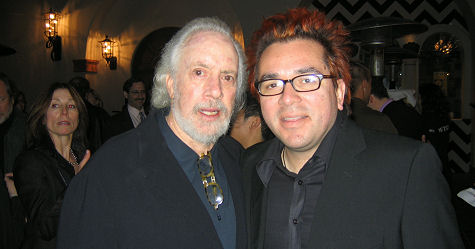
Ask the Dust director-writer Robert Towne, Santa Barbara Film Festival director Roger Durling at Thursday night’s after-party in a large outdoor mall off State Street

And it pays off at the end, and you can’t say it’s not wonderfully written, and there’s a spiritual element in the water table if you settle down and let it soak in.
I was in and out as I watched it, but this is the kind of film that comes together the next morning. You can say “not for me…I want the movie to pay off completely as I’m watching it” and I hear you, but movies that take a few hours to percolate are always the ones that we remember and value more because they hold up over time.
The recently-out-of-rehab Farrell (this is probably why he didn’t attend last night’s screening) gives the most open, intimate and charming performance of his career here.
I loved the nonverbal instinctual places Farrell went to in Terrence Malick’s The New World, and there’s no overlap here — his Bandini (Fante’s alter ego) is an alert and focused “performance” of the older school. But he looks trim and young (I was expecting him to look a tiny bit bloated, given his off-screen reputation), and he manages the feat of making Bandini, who lets go with what seems at first like inexplicable cruelty in the first half, half-likable or at least tolerable.
And Hayek’s Camilla is deeply touching…a sad, sickly woman with a relentless spirit and a big heart…a woman who takes a lot of racial abuse and at the same time stands up and calls her abuser’s bluff, and in the end gathers a kind of dignity that is hard to forget. People of Hispanic heritiage were telling me last night that her performance carries a special poignancy.

The Paramount Classics marketing guys will probably try to sell this as a steamy love story between Farrell and Hayek (there’s a skinny-dip-in-the-surf scene that fully supports this notion), but thematically this is basically the same movie as Curtis Hanson’s 8 Mile.
That 2002 film was about Eminem being unable to rap with confidence or clarity until he stands up and admits he’s just this grungy white kid from a trailer park with a loser alcoholic mom. Dust is about Bandini coming to terms with his roots and how his own rage about suffering ethnic prejudice as a boy leads to treating Camilla disrespectfully and even cruelly in the same vein, and how accepting this helps him get past the crap and find his voice.
Give up the pose and the attitude, admit who and what you really are, and you’ll be able to move on and be a man.
Fante is a superb naturalistic writer whose stuff feels poetic and yet hard and pretense-free in the Hemingway mode. It’s easy to see why the great Charles Bukowski was such a big fan, and of “Ask the Dust” in particular.
The aura and aroma of Los Angeles in the late 1930s is on every page of Fante’s book, and to be frank I wish Towne and his producers had gotten more dough together so he could have provided more pre-war L.A. atmosphere. I wanted to see and smell the way the entire town was back then, but all you get in Ask the Dust is a nice outdoor set of the downtown Bunker Hill area and a few shots of a forest and a beach.


Thursday night’s party for the opening of the Santa Barbara Film Festival

It’s odd how this film feels as right as it does this morning, but felt like a half-and- halfer last night. Maybe I’m not deep or smart enough to get complex works in one sitting.
A lady who was with me didn’t like it — she called it Bite the Dust — but there’s no right or wrong way to process any half-serious film unless it’s an out-and-out piece of shit.
Ask the Dust is a gentle bittersweet thing about the hard and sometimes cruel things that people do to each other (because they suffered the same blows when they were younger, etc.) before the fog lifts and the cycle ends…if they’re lucky. There’s a kind of daring ugliness to this portion of the film. Farrell and Hayek goad and prod each other with racial epithets and scrappy put-downs that hurt… much more provocative than the usual romantic b.s. about a couple fighting because they’re attracted to each other, etc.
Dust is a movie with dignity and a tender heart and not a whole lot of action, but to have punched it up just to punch it up would have been a dishonorable way to shoot Fante’s book.

Impatient moviegoers can reject the whole package if they want…Hayek, Fante, old-time L.A. atmopshere, Towne, Bukowski, Farrell…and it’s a free country, but things may feel a tiny bit flatter and poorer if they do.
Side note: Ask the Dust opens in about five and a half weeks and the website still says “official site coming soon.” This is bush-league behavior…an indication that the distributor doesn’t care. Get the site up and running this weekend, guys, and stop jerking off.

Once Upon a Time

I’m thinking of a film about two men in love with each other, but one of them loving a bit less. They have sexual hunger for women and children are sired, but nothing approaches their feelings for each other. They’re pried apart by social-political con- cerns and they never quite mesh, but the man who loves a bit more can never quit his feelings. He doesn’t know how, and he hurts badly as a result.
And then one of them is killed by a group of violent men who despise what their victim stands for, and finally the longish movie (lasting over two hours) ends with the survivor lamenting his dear friend’s passing and talking quietly to his ghost.


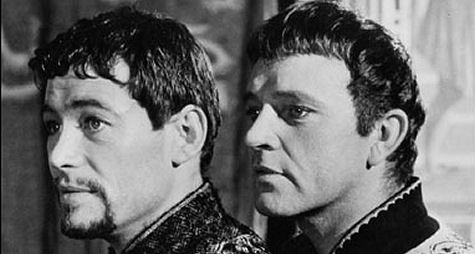
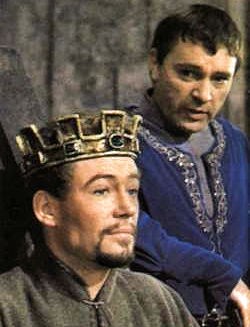
Peter O’Toole, Richard Burton in publicity still for Peter Glenville’s Becket

The men with unquenchable feelings for each other are played by movie stars in their prime, the movie is funded by a major studio, and come January it is honored with a slew of high-prestige Oscar nominations — Best Picture, Best Actor, Best Supporting Actor, Best Director, Best Adapted Screenplay, and so on. Everybody admires or at least respects it, and the reviews are almost 100% ecstatic.
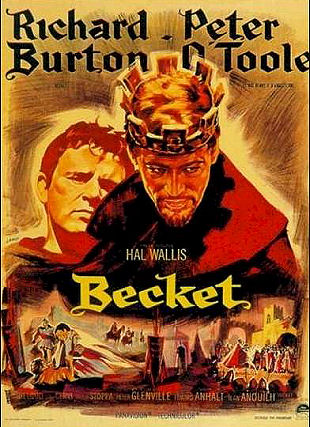
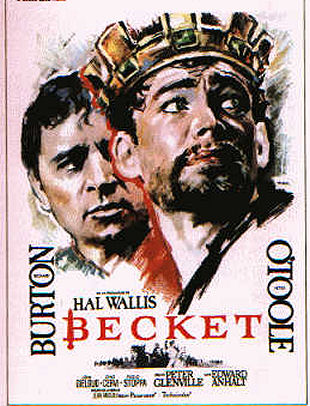
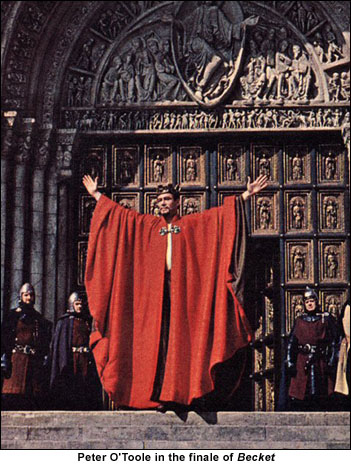
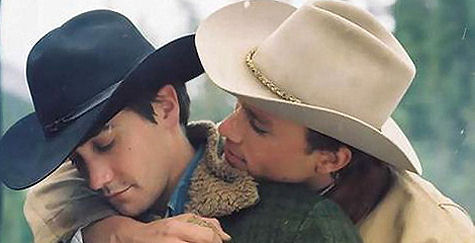
The movie, of course, is Peter Glenville’s Becket, which came out just shy of 42 years ago. But the element of men in love with each other (in a not-quite-sexual way) was no less pronounced or emotionally intense than the love affair in Broke- back Mountain, except for Becket‘s lack of depicted physical intimacy.
And yet it’s a film in which the lead actors share a bed in the first act, with one of them confiding to the other a few pages earlier that “I can’t bear to think of you in pain.” They argue fiercely during a third-act scene about rejected feelings of love between them, and a disapproving female accuses one of having “an obsession” for the other that is “unhealthy and unnatural.”
In fact, it’s more than a little bit astounding that a movie as “gay” as Becket was released five years before the Stonewall riot and the beginning of the gay rights movement, and that it was made by the stodgy-at-the-time Paramount Pictures, and was performed by two of the era’s most respected actors (Peter O’Toole and Richard Burton), and was patronized by straightlaced audiences who had probably never considered the idea of emotional dignity between homosexual men.

In short, there are a lot of striking similarities between Becket and Brokeback Mountain. So many, in fact, that the stage has been pretty much set by James Schamus and Ang Lee’s western for Becket to enjoy a whole new level of interest on DVD.
But years after plans were first made by MPI Home Video to bring out a loaded Becket disc, complete with a making-of documentary and a commentary track by Peter O’Toole, the chances of it coming out any time soon seem…well, a bit up in the air.
MPI Home Video marketing executive Greg Newman says the DVD will be out “this year,” but his reluctance to speculate about whether he’s speaking of the spring, summer, fall or winter indicates that MPI’s plans are perhaps less than rock-solid. Newman’s vagueness suggests that the Becket DVD, whenever it finally peeks through, may strike when the iron is cold.
Unless, of course, it happens to be released at the same time that Brokeback Mountain comes out on DVD, which will probably be in the late spring or early summer.
I know that no video company would be forecasting an ’06 release of a major title in late January without having formulated some kind of ballpark or target release-date in their heads.
And I can’t imagine Peter O’Toole not having questions about the Becket DVD also, some two years and four months after taping his supplemental interview footage and voice-over commentary for MPI in London, in the fall of ’03.

Becket has been out of circulation for several years due to a rights-and-revenue issue and the family of Jean Anouilh, the French author of the original stage play of “Becket” that Glenville’s film was based upon. Plus the 40 year-old film elements had deteriorated. But a 35mm version was restored about three years ago by the Academy Film Archive, with support from the Film Foundation.
Around the same time (i.e., the summer/fall of ’03), MPI, which has owned the video rights for a long while, began making plans for a DVD release of the film. The revenue issue with the Anouilh family has finally been resolved, I was told by an MPI spokesperson on Monday, but there’s still a measure of uncertainty about anyone seeing a DVD of Becket with a firm date in mind.
I think it’s fair to say that the Illinois-based MPI Home Video is known for being a small-time, not-quite-in-the-hip-groove-of-things outfit, and it seems a shame that a film as good and valuable as Becket should be land-locked with a company of this calibre. Becket is clearly the kind of highly-valued classic that should be released by a toney video company like Criterion or Acorn Media.
I saw Becket on a big screen in the summer of ’04 and again at a UCLA class that I moderated last spring, and it holds up very nicely. Burton is masterful as Thomas Becket, but O’Toole’s performance as King Henry II is one of the most exciting ever seen in a mainstream movie. O’Toole takes your breath away half the time, and the other half he makes you grin with delight.

Nominated for 12 Oscars (but winning only one for Best Adapted Screenplay), Becket isn’t just a touching story about unrequited love but one that manages to dramatize in a recognizable way what it is to experience profound spiritual growth.
It’s a conventional costume drama in some respects, yes, but it’s one of the smartest and most engrossing features ever made in this vein. Directed by Glenville from a screenplay by Edward Anhalt (who adapted Jean Anouilh’s play), photographed by the great Geoffrey Unsworth and edited by Anne V. Coates, Becket feels slightly hemmed in by the conventions of prestige-level filmmaking as they existed in the mid ’60s, but the delivery and the talent levels are tip-top.
MPI has owned the film for several years but contributed nothing to the Academy’s restoration costs (about $125,000, give or take), which were covered by the Film Foundation. The restoration work was handled by Mike Pogorzelski, who provided the print of Becket that was shown at UCLA last March.
Newman told me almost two years ago that MPI got O’Toole to record a commentary track in London in the fall of ’03. The 71 year-old actor talked all through the 2 hour and 29 minute film, Newman said.
“We’re still doing quite a lot of the technical work for the DVD and everything else,” Newman told me in the summer of ’04, “and we’re going to have a hell of an extras package, and these releases take time. I hope that it will come out next year.”

Newman was referring to a 2005 release, which never happened.
“Remember, we’re coming right on the heels of this restoration thing,” Newman said. “It was only finished recently.” When he said this, the restored Becket had been screened in London seven months earlier.
The crux of the restoration was about the original stereo mix of Becket being digi- tally reconstituted. “That’s what the restoration was mainly about,” I was told in the summer of ’04.
“MPI never invested in the film,” says restoration specialist Robert Harris, who wanted to restore Becket a decade ago. “If the Academy hadn’t done it, those audio tracks would have been trashed. The Academy is an angel here.”
Harris told me that MPI “should pay the Academy back out of their first earnings, because without the Academy’s efforts they wouldn’t have a film to release.”

Nommie Nommie

I’m thinking of a film about two men in love with each other, but one of them loving a bit less. Their lusts and longings are entirely about women and children are sired, but nothing approaches their feelings for each other. They’re constantly pried apart by social-political concerns and they never quite mesh, but the man who loves a bit more can never quit his feelings. He doesn’t know how, and he hurts badly as a result.

And then one of them is killed by a group of violent men who despise what their victim stands for, and finally the longish movie (lasting over two hours) ends with the survivor lamenting his dear friend’s passing and talking quietly to his ghost.


Peter O’Toole, Richard Burton in publicity still for Peter Glenville’s Becket

The men with unquenchable feelings for each other are played by movie stars in their prime, the movie is funded by a major studio, and come January it is honored with a slew of high-prestige Oscar nominations — Best Picture, Best Actor, Best Supporting Actor, Best Director, Best Adapted Screenplay, and so on. Everybody admires or at least respects it, and the reviews are almost 100% ecstatic.

The movie, of course, is Peter Glenville’s Becket, which came out just shy of 42 years ago. But the element of men in love with each other (in a not-quite-sexual way) was no less pronounced or emotionally intense than the love affair in Brokeback Mountain, except for Becket‘s lack of depicted physical intimacy.

And yet it’s a film in which the lead actors share a bed in the first act, with one of them confiding to the other a few pages earlier that “I can’t bear to think of you in pain.” They argue fiercely during a third-act scene about rejected feelings of love between them, and a disapproving female accuses one of having “an obsession” for the other that is “unhealthy and unnatural.”

In fact, it’s more than a little bit astounding that a movie as “gay” as Becket was released five years before the Stonewall riot and the beginning of the gay rights movement, and that it was made by the stodgy-at-the-time Paramount Pictures, and was performed by two of the era’s most respected actors (Peter O’Toole and Richard Burton), and was patronized by straightlaced audiences who had probably never considered the idea of emotional dignity between homosexual men.

In short, there are a lot of striking similarities between Becket and Brokeback Mountain. So many, in fact, that the stage has been pretty much set by James Schamus and Ang Lee’s western for Becket to enjoy a whole new level of interest on DVD.

But years after plans were first made by MPI Home Video to bring out a loaded Becket disc, complete with a making-of documentary and a commentary track by Peter O’Toole, the chances of it coming out any time soon seem…well, a bit up in the air.

MPI Home Video marketing executive Greg Newman says the DVD will be out “this year,” but his reluctance to speculate about whether he’s speaking of the spring, summer, fall or winter indicates that MPI’s plans are perhaps less than rock-solid. Newman’s vagueness suggests that the Becket DVD, whenever it finally peeks through, may strike when the iron is cold.

Unless, of course, it happens to be released at the same time that Brokeback Mountain comes out on DVD, which will probably be in the late spring or early summer.

I know that no video company would be forecasting an ’06 release of a major title in late January without having formulated some kind of ballpark or target release-date in their heads.
And I can’t imagine Peter O’Toole not having questions about the Becket DVD also, some two years and four months after taping his supplemental interview footage and voice-over commentary for MPI in London, in the fall of ’03.

Becket has been out of circulation for several years due to a rights-and-revenue issue and the family of Jean Anouilh, the French author of the original stage play of “Becket” that Glenville’s film was based upon. Plus the 40 year-old film elements had deteriorated. But a 35mm version was restored about three years ago by the Academy Film Archive, with support from the Film Foundation.

Around the same time (i.e., the summer/fall of ’03), MPI, which has owned the video rights for a long while, began making plans for a DVD release of the film. The revenue issue with the Anouilh family has finally been resolved, I was told by an MPI spokesperson on Monday, but there’s still a measure of uncertainty about anyone seeing a DVD of Becket with a firm date in mind.
I think it’s fair to say that the Illinois-based MPI Home Video is known for being a small-time, not-quite-in-the-hip-groove-of-things outfit, and it seems a shame that a film as good and valuable as Becket should be land-locked with a company of this calibre. Becket is clearly the kind of highly-valued classic that should be released by a toney video company like Criterion or Acorn Media.

I saw Becket on a big screen in the summer of ’04 and again at a UCLA class that I moderated last spring, and it holds up very nicely. Burton is masterful as Thomas Becket, but O’Toole’s performance as King Henry II is one of the most exciting ever seen in a mainstream movie. O’Toole takes your breath away half the time, and the other half he makes you grin with delight.

Nominated for 12 Oscars (but winning only one for Best Adapted Screenplay), Becket isn’t just a touching story about unrequited love but one that manages to dramatize in a recognizable way what it is to experience profound spiritual growth.

It’s a conventional costume drama in some respects, yes, but it’s one of the smartest and most engrossing features ever made in this vein. Directed by Glenville from a screenplay by Edward Anhalt (who adapted Jean Anouilh’s play), photographed by the great Geoffrey Unsworth and edited by Anne V. Coates, Becket feels slightly hemmed in by the conventions of prestige-level filmmaking as they existed in the mid ’60s, but the delivery and the talent levels are tip-top.
MPI has owned the film for several years but contributed nothing to the Academy’s restoration costs (about $125,000, give or take), which were covered by the Film Foundation. The restoration work was handled by Mike Pogorzelski, who provided the print of Becket that was shown at UCLA last March.

Newman told me almost two years ago that MPI got O’Toole to record a commentary track in London in the fall of ’03. The 71 year-old actor talked all through the 2 hour and 29 minute film, Newman said.

“We’re still doing quite a lot of the technical work for the DVD and everything else,” Newman told me in the summer of ’04, “and we’re going to have a hell of an extras package, and these releases take time. I hope that it will come out next year.”

Newman was referring to a 2005 release, which never happened.

“Remember, we’re coming right on the heels of this restoration thing,” Newman said. “It was only finished recently.” When he said this, the restored Becket had been screened in London seven months earlier.

The crux of the restoration was about the original stereo mix of Becket being digitally reconstituted. “That’s what the restoration was mainly about,” I was told in the summer of ’04.
“MPI never invested in the film,” says restoration specialist Robert Harris, who wanted to restore Becket a decade ago. “If the Academy hadn’t done it, those audio tracks would have been trashed. The Academy is an angel here.”

Harris told me that MPI “should pay the Academy back out of their first earnings, because without the Academy’s efforts they wouldn’t have a film to release.”

Nommie Nommie

A hearty yee-haw for the eight nominations that went to Brokeback Mountain this morning. This pretty much certifies that Ang Lee’s film has the Best Picture Oscar in the bag. Someone tell me how this won’t happen.

And a big college yell for Best Picture nominees Capote (as well as Best Actor contender Philip Seymour Hoffman, Best Director hopeful Bennett Miller and Best Adapted Screenplay nominee Dan Futterman), Paul Haggis and Bobby Moresco’s Crash, and George Clooney’s Good Night, and Good Luck.


The Best Picture nominees: Brokeback Mountain, Capote, Crash, Munich and Good Night, and Good Luck

And a confused head-shake over Munich taking the fifth Best Picture nomination.
I understand the reasoning, I think. Why shouldn’t a movie that appalled a significant portion of film cognoscenti the world over with that ludicrous cross-cutting between Eric Bana schtupping his on-screen wife and a reenactment of the 1972 shoot-out between Black September kidnappers and German police at Munich’s Furstenfeldbruck air base…a film such as this is surely a finer and more worthy achievement than The Constant Gardener, Walk the Line or Match Point.

Three and a half hours ago (around 7 am) I received an e-mail that said “Steven Spielberg says fuck you,” and I guess I deserved that.

But let’s be clear: my comment to Newsday‘s Jon Anderson in late December was that Munich was “dead, dead…deader than dead” as a Best Picture winner. (And that’s still the case today, as everyone well knows.) I asked Anderson to please get this right because I knew that the Academy psychology might give up a Best Picture nomination, despite all the minuses.

Munich helmer Steven Spielberg wouldn’t have been nominated for Best Director without the ingrained Spielberg kowtow sensibility out there. No friggin’ way would Roger Donaldson have been nominated if he’d directed the same Munich now playing in theatres.


Avner (Eric Bana) and Munich-massacre-montage fuck partner watch initial tube coverage of 1972 Munich Olympic Games hostage standoff

But let’s ease up and acknowedge that NBC/Univeral publicists and, yes, Munich water-carrier David Poland managed to sell it for all it was worth…they and other Munich team members pulled it off against great odds. They helped to save Munich from total humiliation. Now go away and don’t come back until the DVD comes out.

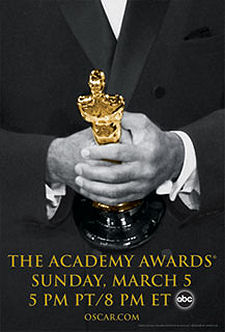
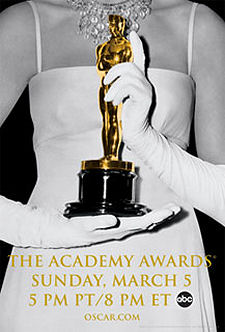
The Oscar show ratings on March 5th will be fairly low because the viewing audience for the five Best Picture nominees isn’t that high (so far), but what could the academy have done? Nominate King Kong or Fun With Dick and Jane for Best Picture? It’s going to be a gnarly three or four weeks for ABC’s ad sales team.

A big hand to the Academy for giving George Lucas what-for by not nominating Revenge of the Sith for a special-effects award. It took them a while to stand up and grow a pair, but they finally delivered a referendum on the soullessness of the Star Wars prequels.

And another cheer for their refusal to nominate the thoroughly rancid Sin City in this category, although it should be once again acknowledged that the black-and- white photography in this otherwise pukey film was to-die-for.

Congratulations to the great Terrence Howard for nabbing a Best Actor nomination for his superb performance in Craig Brewer’s Hustle & Flow. It wasn’t that long ago when handicappers were saying he might not have the juice to go all the way (especially after he got re-categorized by the Golden Globes). A proud moment for a good man.

Mixed congratulations, at best, to North Country‘s Frances McDormand….the truly great Frances McDormand…for her Best Supporting Actress nomination. No self- respecting actor wants accolades for playing a blue-collar laborer dying from Lou Gehrig’s disease and saying “fuck you” out of a voice box.

McDormand was nominated because some not-very-hip Academy people decided to think sappy. It’s wrong, wrong, wrong that In Her Shoes costar Shirley MacLaine and The Family Stone‘s Diane Keaton were blown off in this category.

Down the list and firing at will…

It doesn’t seem right that both Walk the Line honcho James Mangold and The Constant Gardener helmer Fernando Meirelles weren’t included among the five Best Director nominees. I understand why History of Violence helmer David Cronenberg didn’t have the votes, but he’s still a world-class artist whose films will play to film lovers 100 years from now.


Best Supporting Actor nominee Jake Gyllenhaal, Best Actor nominee Heath Ledger

Walk the Line‘s Reese Witherspoon will win for Best Actress, but I wish her competition was stronger, and I’m lamenting again that Toni Collette didn’t get her due by receiving a Best Actress nom for In Her Shoes…a performance that was absolutely in the same league as Witherspoon’s, if not above and beyond.

Keira Knightley’s Best Actress nomination for her work in Pride & Prejudice is bizarre, I think. Weird. I saw that film again on an Academy screener earlier this month, and if she weren’t young and beautiful…aaahh, forget it.

Paul Giamatti will probably win the Best Supporting Actor Oscar for his Cinderella Man trainer, but hooray for Crash costar Matt Dillon nabbing a nomination in this category. Couldn’t have happened to a nicer, harder-working guy…and for playing a cop with pretty ugly stuff inside.

And cheers to the great William Hurt for winning a nomination for his hilarious, jaw-dropping History of Violence performance.

Cheers to Junebug‘s Amy Adams for taking a Best Supporting Actress nom, even though The Constant Gardener‘s Rachel Weisz is the almost-certain winner.


Best Actor nominee Philip Seymour Hoffman, Best Supporting Actress nominee Catherine Keener

Congrats to Match Point director-writer Woody Allen for his Best Original Screen- play nomination. I thought this might not happen after the Writers Guild blew him off.

The Best Foreign Language Film showdown is between Hany Abu-Assad’s Paradise Now and Gavin Hood’s Tsotsi, but I’m half- presuming that concerns about the recent election of Hamas to run the Palestinian state will adversely affect support for Abu-Assad’s film. Everything cross-pollinates.

March Of The Penguins has long been the presumed favorite in the Best Documentary Feature race, but maybe the start of the Enron trial in Houston will assist its closest competitor, Enron: The Smartest Guys In The Room.

And shame once again upon Freida Mock and her documentary nomination committee for failing to even short-list Werner Herzog’s Grizzly Man, by far the most critically honored and awarded doc of the year.

Nothing else has me revved right now. I’ll put more stuff in as the day progresses, and I’ll put the final nominations into a final Oscar box later this morning.

Oh, and Hollywood Elsewhere didn’t arise at 5 ayem this morning to tap this piece out because waking at 6 ayem was rigorous enough.

Expanded Balloon

Oscar Balloon ’06 is finally up and running, and the more input and attention the better. Movies that look like they might rate because they’re been (or are being) directed and written by proven top-tier talents…that’s all this is now.

Best Picture: Flags of Our Fathers (DreamWorks); The Departed (Warner Brothers); Babel (Paramount); The Good Shepherd (Universal Pictures); The Good German (Steven Soderbergh); Che (Focus Features); Southland Tales (Universal); Marie Antoinette (Columbia Pictures); The Pursuit of Happyness (Columbia Pictures); Breaking and Entering (The Weinstein Co.); Infamous (Warner Independent); All The King’s Men (Columbia Pictures); A Good Year (20th Century Fox); Stranger Than Fiction (Columbia); I’m Not There: Suppositions on a Film Concerning Dylan (Cinetic Media); Dreamgirls (DreamWorks/Paramount); Running With Scissors (Columbia); World Trade Center (Universal); The Prestige (Touchstone); The Children of Men (Universal); Zodiac (Paramount).


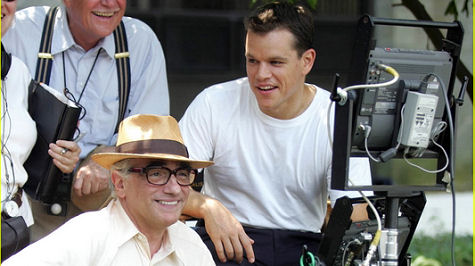
Matt Damon, Martin Scorsese during filming of The Departed

Best Director: Clint Eastwood (Flags of Our Fathers); Anthony Minghella (Breaking and Entering); Martin Scorsese (The Departed); Steven Soderbergh (The Good German, Che); Ridley Scott (A Good Year); Alejandro Gonzalez Inarritu (Babel); Marc Forster (Stranger Than Fiction); Richard Kelly (Southland Tales); Steve Zaillan (All The King’s Men); Bill Condon (Dreamgirls); Doug McGrath (Infamous); Ryan Murphy (Running With Scissors); Oliver Stone (World Trade Center); Chris Nolan (The Prestige); Alfono Cuaron (The Children of Men).; Todd Haynes (I’m Not There: Suppositions on a Film Concerning Dylan); David Fincher (Zodiac).

Best Actor: Will Smith (The Pursuit of Happyness); Matt Damon (The Good Shepherd); Jude Law (Breaking and Entering); Sean Penn (All The King’s Men); Brad Pitt (Babel).

Best Actress: Anette Bening (Running with Scissors); Nicole Kidman (Fur); Cate Blanchett (The Good German or Babel); Maggie Gyllenhaal (Stranger Than Fiction).

Best Supporting Actor: Jack Nicholson (The Departed); Hugh Grant (American Dreamz); Gael Garcia Bernal (Babel); Albert Finney (A Good Year ); Jamie Foxx (Dreamgirls), Javier Bardem (Che).


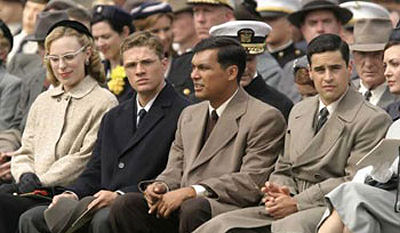
Ryan Phillipe (l.) and costars in Clint Eastwood’s Flags of Our Fathers

Best Supporting Actress: Kate Winslet (All The King’s Men), Sandra Bullock (Infamous)

Best Original Screenplay: Richard Kelly (Southland Tales); Paul Weitz (American Dreamz); Eric Roth (The Good Shepherd); Anthony Minghella (Breaking and Entering).

Best Adapted Screenplay: Sofia Coppola (Marie Antoinette).

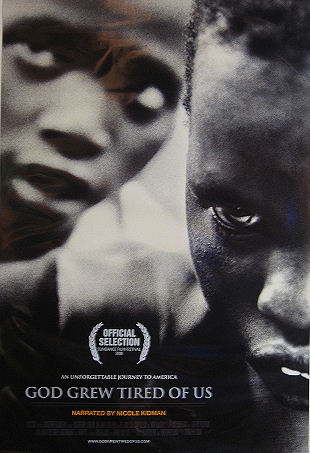
Best Feature Documentary: God Grew Tired of Us ((Christopher Dillon Quinn, Tom Walker); Sicko (Michael Moore).

Sure To Be Remembered: Snakes on a Plane (New Line Cinema — director: David Ellis — CAST: Samuel L. Jackson, Nathan Phillips, Benjamin McKenzie).

Grabs


In motion on the Santa Monica Pier merry-go-round — Sunday, 1.29.06, 4:10 pm.

Billboard over Book Soup on Sunset Strip — Saturday, 1.28.06, 9:55 pm.

Posted at pizza joint on Abbot Kinney Blvd. in Venice — Sunday, 1.29.06, 5:15 pm.

Sunday, 1.29.06, 4:12 pm.

Sunday, 1.29.06, 6:45 pm.

Quince…what?

Day after day and hour after hour during the Sundance Film Festival I asked every journalist, distributor and agent I ran into what they’d seen and liked (or half-liked). I must have asked this question 60 or 70 times over the eight days I was up there…
And nobody mentioned Quinceanera, a small-scale drama about sexual tensions vs. Hispanic community values in L.A.’s Echo Park. It was like it didn’t exist…one of those strugglers that sometimes get lost in the shuffle.


I can guess but I don’t precisely know who these guys are, but they’re Quinceanera costars. Possibly Jesse Garcia and Emily Rios.

And yet Wash Westmoreland and Richard Glatzer’s film not only won the Dramatic Grand Jury Prize last night but the Dramatic Audience Award, which hasn’t occured at a Sundance Film Festival since Tony Bui’s Three Seasons took the same two prizes in 1999.
I guess I should spend more time talking to non-pro types and not just my know- it-all friends. It’s probably also fair to say that the other dramatic competition entries — Stay, Sherrybaby, Somebodies, Wristcutters, Stephanie Daley, The Hawk is Dying, Right at Your Door, etc. — all had some kind of drawback or dislike element. (I had no beef with Daley at all — it’s a very respectable and well-made trauma drama.)
That rumor about Bob Berney’s Picturehouse having bought Quinceanera for distribution isn’t true, by the way. Berney told me this morning it’s “a good rumor” but an inaccurate one. He agreed that the buzz about Quinceanera wasn’t very strong during the festival, but said it was apparently a “local” favorite (i.e., among people in the ticket lines).
Since almost no one in journo circles saw it, I suggested an idea this morning to Quinceanera producer Anne Clements, whom I reached via cell phone: offer it for a showing at the Santa Barbara Film Festival (which kicks off on Thursday, 2.2). Festival director Roger Durling told me he might be able to find a loose slot in his schedule if the film were to be made available.


Wash Westmoreland, Richard Glatzer, who co-directed and co-wrote Qinceanera, during the ’06 Sundance Film Festival. (Pic stolen from Indiewire site.)

There was another double winner last night when Christopher Quinn’s God Grew Tired of Us won both the Grand Jury Documentary Prize as well as the Audience Doc Award — another festival first.
The World Cinema Jury Prize for Best Documentary went to Juan Carlos Rulfo’s In The Pit, which Variety‘s Robert Koehler went on about and told me to see. It explores the day-to-day lives of guys building an upper deck to Mexico City’s Periferico freeway.
The World Cinema Dramatic Jury Prize went to Gela Babluani’s 13 Tzameti. The World Cinema Audience Documentary Award was given to Tim Dirdamal’s De Nadie, about a female Central American immigrant making her way from souterhn Mexico into the U.S. And the World Cinema Audience Dramatic Award was given to Toa Fraser’s No. 2.
Here’s the official announcement.

Alarm Sounder

Quince…what?

Day after day and hour after hour during the Sundance Film Festival I asked every journalist, distributor and agent I ran into what they’d seen and liked (or half-liked). I must have asked this question 60 or 70 times over the eight days I was up there…
And nobody mentioned Quinceanera, a small-scale drama about sexual tensions vs. Hispanic community values in L.A.’s Echo Park. It was like it didn’t exist…one of those strugglers that sometimes get lost in the shuffle.


I can guess but I don’t precisely know who these guys are, but they’re Quinceanera costars. Possibly Jesse Garcia and Emily Rios.

And yet Wash Westmoreland and Richard Glatzer’s film not only won the Dramatic Grand Jury Prize last night but the Dramatic Audience Award, which hasn’t occured at a Sundance Film Festival since Tony Bui’s Three Seasons took the same two prizes in 1999.
I guess I should spend more time talking to non-pro types and not just my know- it-all friends. It’s probably also fair to say that the other dramatic competition entries — Stay, Sherrybaby, Somebodies, Wristcutters, Stephanie Daley, The Hawk is Dying, Right at Your Door, etc. — all had some kind of drawback or dislike element. (I had no beef with Daley at all — it’s a very respectable and well-made trauma drama.)
< ?php include ('/home/hollyw9/public_html/wired'); ?>
That rumor about Bob Berney’s Picturehouse having bought Quinceanera for distribution isn’t true, by the way. Berney told me this morning it’s “a good rumor” but an inaccurate one. He agreed that the buzz about Quinceanera wasn’t very strong during the festival, but said it was apparently a “local” favorite (i.e., among people in the ticket lines).
Since almost no one in journo circles saw it, I suggested an idea this morning to Quinceanera producer Anne Clements, whom I reached via cell phone: offer it for a showing at the Santa Barbara Film Festival (which kicks off on Thursday, 2.2). Festival director Roger Durling told me he might be able to find a loose slot in his schedule if the film were to be made available.


Wash Westmoreland, Richard Glatzer, who co-directed and co-wrote Qinceanera, during the ’06 Sundance Film Festival. (Pic stolen from Indiewire site.)

There was another double winner last night when Christopher Quinn’s God Grew Tired of Us won both the Grand Jury Documentary Prize as well as the Audience Doc Award — another festival first.
The World Cinema Jury Prize for Best Documentary went to Juan Carlos Rulfo’s In The Pit, which Variety‘s Robert Koehler went on about and told me to see. It explores the day-to-day lives of guys building an upper deck to Mexico City’s Periferico freeway.
The World Cinema Dramatic Jury Prize went to Gela Babluani’s 13 Tzameti. The World Cinema Audience Documentary Award was given to Tim Dirdamal’s De Nadie, about a female Central American immigrant making her way from souterhn Mexico into the U.S. And the World Cinema Audience Dramatic Award was given to Toa Fraser’s No. 2.
Here’s the official announcement.

Over and Done

The Sundance ’06 awards ceremony happens tomorrow night, and I think we all know what to expect. The jury prizes will most likely reflect elitist attitudes and determinations and be promptly ignored, and the audience awards will mean a lot more to most of those who’ve trudged through this festival over the last seven or eight days.
I’m gone tomorrow so today (Friday, 12.7) is all about last licks — catching not- yet-seen films like Wristcutters: A Love Story, which I’ll probably end up half-liking, Raymond De Felitta’s ‘Tis Autumn: The Search for Jackie Paris, The Ground Truth, In The Pit, and Half Nelson.


Just north of the Treasure Mountain Inn on Park City’s Main Street — Thursday, 1.26, 11:10 pm.

Several good films were shown here, but only about six or seven are are likely to make much of a dent in the real world. If a Sundance film generates a 9.5 Richter reading among festival audiences, you can usually count on half that level of juice coming from sea-level engagements…unless it’s something seriously breakout in the Napoleon Dynamite or Little Miss Sunshine mode.
Most of the industry contingent had fled Park City by late Wednesday, which was kind of welcome. It’s been easier to get into films since then and the traffic congestion around town hasn’t been nearly as bad as it was last weekend. With these and other downshiftings the fest suddenly felt like it used to in the early to mid ’90s, when it seemed more a pure-movie thing and the Paris Hilton virus had yet to manifest.
If you want a smart, no-nonsense rectitation of some of the lessons of Sundance ’06, check out this piece by Hollywood Reporter columnist Anne Thompson. I’m feeling way too whipped to assemble one of these.
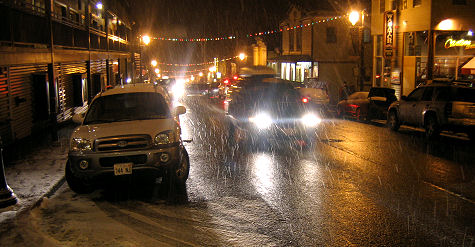
A beautiful dense mountain snowfall came down last night. Watching hundreds of thousands of moisture particles floating down from the black Utah sky and the sensation of faintly sprinkled dampness upon my face made it all seem worth it. It’s just hitting me that I may have experienced as many atmospheric epiphanies during this festival as cinematic ones.
Anyway, it’s back to Los Angeles tomorrow and a five or six days of calm (I’m kidding…the Oscar nominations will be announced Tuesday) before starting in with the Santa Barbara Film Festival, which kicks off on Thursday, February 2nd.

Grabs


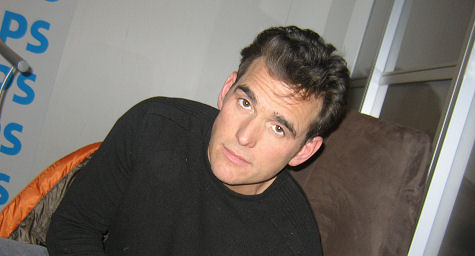
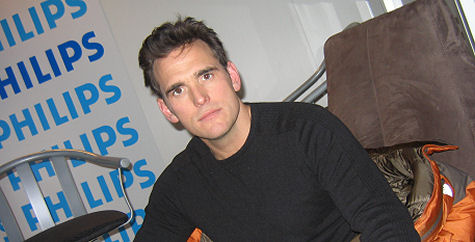
Factotum star Matt Dillon — Tuesday, 1.24, 3:40 pm. Here’s an interview I did with Dillon and Factotum director-writer Brent Hamer a couple of days ago. I didn’t like it at first because of excessive ambient noise, but I listened again this morning and some of the sentences are discernible. I couldn’t find an official Factotum site but here’s a French one

Houston-based film fan who comes here every year (and also attends the Telluride Film Festival in September) — Thursday, 1.26, 11:45 am.

It’s snowing very heavily right now, but the flakes are so small that somehow the camera can’t “see” them, even though they’re plain as day to the naked eye — Friday, 1.27, 12:50 pm.

Volunteers working the door of Holiday Village cinemas prior to screening of God Grew Tired of Us — Tuesday, 1.24, 4:10 pm.

Whassup Rockers director Larry Clark in Santa Monica a few days before the start of the Sundance Film Festival. For those who didn’t hear the interview I ran with Clark a while back, here it is again.

Alarm-Sounder

Americans are so stoned and spoiled by their Treo 650s and SUV’s and McMan- sions and all the other junkie trappings of Bush-era affluence that they make the aesthetic of Marie Antoinette look like that of St. Francis of Assisi.
They’re so drunk on their lifestyles that they’re willing to kill the planet in order to keep groovin’ on. I wish it were otherwise but I really believe this, and so does George Carlin. That’s why the planet is probably doomed. That’s why…


Al Gore delivering his informative global-warming lecture, which is orchestrated by director Davis Guggenhiem into a gripping, opened-up form in An Inconvenient Truth

I’m sorry. I’m stopping this now. Leftie despair can be as much of a drag as obesity and mental insulation and believing in the Church of Bush, Cheney and Big Oil.
This is a weird way of starting a piece that basically says Al Gore and his new film, An Inconvenient Truth, have given me hope and that everyone should see it. It’s strike-a-match time, and this film is a ray of light. It’s just good straight infor- mation, but if a sizable number of the “drunks” in this country see it…
I’m starting to think that Gore’s entire political career, which culiminated with his run for the White House in 2000, has been about getting people to see and fully consider this slide-show lecture movie about global warming.
An Inconvenient Truth is Gore’s crowning achievement…the summation of his life…the reason he was put on this earth to become a politican and a stirrer-upper and influencer of public opinion.
Because if people see Truth in sufficient numbers, Gore will have done more to save this planet from ruination than anyone in his realm has ever managed.


Al Gore, Robert Redford at some Sundance-type gathering that may have occured before the ’06 festival began

That’s if enough people see it and really take it in…
I saw Davis Guggenheim’s film at a press showing Wednesday afternoon and I can’t get it out of my head. It may not be the most exciting or artful or sensually swoony film of Sundance ’06, but it’s easily the most important.
It hasn’t been acquired but in a perfect synergistic world it ought to be released in April to coincide with the release of Gore’s book of “An Incovenient Truth” (Rodale), which will come out in print and audio form.
An Inconvenient Truth is as enlightening and eye-opening as a “spinach documen- tary” — i.e., very good for you and nutritious — can possibly be.
It’s just a visual opening-up of Gore’s slide show, which the former Presidential candidate and vice-president has been presenting to audiences around the globe for the last I-don’t-know-how-many years. (Gore says in the film that he’s done it about 1,000 times.)


Davis Guggenheim and Al Gore

Gore’s teaching style is folksy, straight and very personable. (It’s too bad he wasn’t half this charming or persuasive during the 2000 Presidential election.) Go to this Gore-sponsored website to research the facts, but set aside the time to go see it when it hits a nearby theatre or DVD store.
Seriously — no other film I’ve seen has spelled out the problem quite so clearly. Everyone on the planet needs to see it…even if they think they know everything there is to know about the harm being done to this planet. And it’s bad…really bad.
But there’s a road beyond the despair that I started this piece with, and Gore’s film is an attempt to show the way.
One more thought, and I’m not just saying this to be a smart-ass: this film is very persuasive, but it would be a tad more so if Gore were a little bit thinner. He’s not Oliver Hardy but he looks very well fed, and the metaphor is obvious. The under- message of An Inconvenient Truth suggests that a new kind of austerity is vital for the earth’s survival, and I feel it would play better if Gore looked like someone who practices more denial.

Dick’s MPAA Flap

Kirby Dick is complaining that the MPAA illegally copied, apparently for internal purposes, a “digital version” of his new film This Film Is Not Yet Rated, which a several journos saw at a press screening yesterday morning and which screens at 9:30 pm tonight at the Sundance Film Festival.
More to the point, Dick got L.A. Times reporter John Horn to do the squawking for him in a piece that ran Wednesday (1.25) called “Avast, Ye Pirates!” It struck me as a thin beef, but it made for good press.


This Film Is Not Yet Rated director Kirby Dick on Park City’s Main Street — Tuesday, 1.24, 4:20 pm.

The dust-up was partly about an issue of secrecy, but what it really boiled down to was one of anger and frustration on the part of Dick and many, many film directors who have long despised what they see as an unfair and highly arbitrary ratings system.
And so Dick has struck back at the MPAA in a nyah-nyah way that he knows will hurt and enrage the ratings and appeals board members — he’s “outed” them.
The MPAA has a policy of keeping the identities of the its Ratings and Classification Board secret. Dick’s position is that filmmakers have the right to know the names of those people on the MPAA ratings board who occasionally slap their films with absurd and restrictive ratings that end up hurting the economic prospects of their films.
Therefore, This Film Is Not Yet Rated is partly about Dick hiring a lesbian private investigator to unmask the identities of the MPAA’s ratings board members, as well the big wheels on the appeals board.
The film tracks the progess of Dick and his investigator (along with the woman’s junior assistant) as they park outside MPAA headquarters in the L.A. suburb of Woodland Hills, write down their license plate numbers, follow them on their way to restaurants and on errands, and in one case sifting through garbage.

By the end of the film the raters are pretty much totally exposed — names, backgrounds, in some cases photos, the ages of their children, and in some instances the kind of cars they drive.
Horn’s story says that Michael Donaldson, a lawyer representing Dick, has written the MPAA and demanded that it “immediately return all copies” of the film in its possession and explain who approved the making of the copy and who within the MPAA has looked at the reproduction.”
Dick recently discovered during a recent conversation with an MPAA lawyer that the MPAA had copied the film from a digital version he submitted on 11.29 for a rating. The MPAA’s copy of Dick’s film was viewed by Dan Glickman, the MPAA’s new president, the MPAA said.
“Dick said that when he asked MPAA lawyer Greg Goeckner what right his organization had to make the copy, Goeckner told him that Dick and his crew had potentially invaded the privacy of the MPAA’s movie raters,” Horn’s story says.
“We made a copy of Kirby’s movie because it had implications for our employees,” said Kori Bernards, the MPAA’s corporate communications vp. She told Horn that Dick’s spying on the MPAA raters led the organization to feel “concerned about the raters and their families,” Bernards said.


MPAA chief Dan Glickman

She said the MPAA’s copy of This Film Is Not Yet Rated is “locked away” and is not being copied or distributed.” She added that the organization was operating lawfully when it copied Dick’s movie, saying that “the courts recognize that parties are entitled to make a copy of a work for use as evidence in possible future proceedings.”
MPAA chief Dan Glickman told AP reporter Dave Germain that normally he doesn’t watch films submitted for ratings but that he viewed most of This Film Is Not Yet Rated — the MPAA’s copied version, apparently — because he “heard they used unusual surveillance techniques to follow our raters around.”
“I decided the privacy of our employees was in jeopardy. I didn’t know if there was some violation of law, maybe, but I thought that was going way too far,” Glickman said.
Dick’s film is a hugely entertaining, sharp-tongued trashing of the MPAA’s absurd and politically lopsided rating calls.
These include the board’s well-known tendency to attach R and NC-17 ratings to films showing scenes of sexual pleasure but allow scenes showing horrific and/or grotesque violence to prretty much skate. The ratrings board is also known for being harder on depictions of gay over hetero sex, and for giving indies a harder time than the majors.
The sage and sometimes very funny talking heads include directors John Waters, Kevin Smith, Todd Solondz, Wayne Kramer, and indie distributors Mark Urman and Bingham Ray.

Grabs


Haskell Wexler, director of Who Needs Sleep?, at the VW Lounge on upper Main Street — Tuesday, 1.24, 3:45 pm.

Anne Heche and a friend/colleague at the after-party for Wim Wenders’ Don’t Come Knocking — Tuesday, 1.14, 11:50 pm. I searched through Heche’s IMDB profile and don’t see a Sundance ’06 film among her credits, so I guess…well, it was nice to say hello.

Non-celebrity on bus heading into town from Kimball Junction

Flannel Pajamas costars Jamie Harrold (I think) and Julianne Nicholson, the film’s director-screenwriter Jeff Lipsky, and costar Justin Kirk — Tuesday, 1.24, 2:19 pm. Roger Ebert has praised this unusual romantic drama, and a woman I spoke to an hour ago has said, ‘Naaah…not for me.” That makes it an absolute must-see.

Picturehouse chief Bob Berney (lower left) during latter stages of party thrown by his company at Zoom on lower Main Street — Tuesday, 1.24, 5:15 pm .

Ashley Judd, star of Joey Lauren Adams’ Come Early Morning, presenting a Women in Film award to Adams — Monday, 1.24, 8:10 pm.

Exterior of Riverhorse Cafe — Tuesday, 1.24, 4:10 pm.

Dining room of Park City’s Riverhorse Cafe during Women in Film party — Monday, 1.23, 7:25 pm.

Documentarian and Entourage costar Adrian Grenier on Main Street outside VW lounge — Tuesday, 1.24, 3:55 pm.

Matt Dillon during our interview about Brent Hamer’s Factotum, the latest and finest Charles Buklowski-inspired film ever made. Dillon’s performance as Bukowski’s alter-ego Henry Chinaski isn’t just more nuanced and naturalistic than Mickey Rourke’s riff on the boozy writer-poet in Barfly and Ben Gazarra’s in Tales of Ordinary Madness — it also exudes an exceptional dignity.

Hanging in one of Park City’s two townie bars.

Lonely Deliverance

Dick’s MPAA Flap

Kirby Dick is complaining that the MPAA illegally copied, apparently for internal purposes, a “digital version” of his new film This Film Is Not Yet Rated, which a several journos saw at a press screening yesterday morning and which screens at 9:30 pm tonight at the Sundance Film Festival.
More to the point, Dick got L.A. Times reporter John Horn to do the squawking for him in a piece that ran Wednesday (1.25) called “Avast, Ye Pirates!” It struck me as a thin beef, but it made for good press.


This Film Is Not Yet Rated director Kirby Dick on Park City’s Main Street — Tuesday, 1.24, 4:20 pm.

The dust-up was partly about an issue of secrecy, but what it really boiled down to was one of anger and frustration on the part of Dick and many, many film directors who have long despised what they see as an unfair and highly arbitrary ratings system.
And so Dick has struck back at the MPAA in a nyah-nyah way that he knows will hurt and enrage the ratings and appeals board members — he’s “outed” them.
< ?php include ('/home/hollyw9/public_html/wired'); ?>
The MPAA has a policy of keeping the identities of the its Ratings and Classification Board secret. Dick’s position is that filmmakers have the right to know the names of those people on the MPAA ratings board who occasionally slap their films with absurd and restrictive ratings that end up hurting the economic prospects of their films.
Therefore, This Film Is Not Yet Rated is partly about Dick hiring a lesbian private investigator to unmask the identities of the MPAA’s ratings board members, as well the big wheels on the appeals board.
The film tracks the progess of Dick and his investigator (along with the woman’s junior assistant) as they park outside MPAA headquarters in the L.A. suburb of Woodland Hills, write down their license plate numbers, follow them on their way to restaurants and on errands, and in one case sifting through garbage.

By the end of the film the raters are pretty much totally exposed — names, backgrounds, in some cases photos, the ages of their children, and in some instances the kind of cars they drive.
Horn’s story says that Michael Donaldson, a lawyer representing Dick, has written the MPAA and demanded that it “immediately return all copies” of the film in its possession and explain who approved the making of the copy and who within the MPAA has looked at the reproduction.”
Dick recently discovered during a recent conversation with an MPAA lawyer that the MPAA had copied the film from a digital version he submitted on 11.29 for a rating. The MPAA’s copy of Dick’s film was viewed by Dan Glickman, the MPAA’s new president, the MPAA said.
“Dick said that when he asked MPAA lawyer Greg Goeckner what right his organization had to make the copy, Goeckner told him that Dick and his crew had potentially invaded the privacy of the MPAA’s movie raters< ' Horn's story says. "We made a copy of Kirby's movie because it had implications for our employees," said Kori Bernards, the MPAA's corporate communications vp. She told Horn that Dick's spying on the MPAA raters led the organization to feel "concerned about the raters and their families," Bernards said.


MPAA chief Dan Glickman
She said the MPAA’s copy of This Film Is Not Yet Rated is “locked away” and is not being copied or distributed.” She added that the organization was operating lawfully when it copied Dick’s movie, saygin that “the courts recognize that parties are entitled to make a copy of a work for use as evidence in possible future proceedings.”
MPAA chief Dan Glickman told AP reporter Dave Germain that normally he doesn’t watch films submitted for ratings but that he viewed most of This Film Is Not Yet Rated — the MPAA’s copied version, apparently — because he “heard they used unusual surveillance techniques to follow our raters around.”
“I decided the privacy of our employees was in jeopardy. I didn’t know if there was some violation of law, maybe, but I thought that was going way too far,” Glickman said.
Dick’s film is a hugely entertaining, sharp-tongued trashing of the MPAA’s absurd and politically lopsided rating calls.
These include the board’s well-known tendency to attach R and NC-17 ratings to films showing scenes of sexual pleasure but allow scenes showing horrific and/or grotesque violence to prretty much skate. The ratrings board is also known for being harder on depictions of gay over hetero sex, and for giving indies a harder time than the majors.
The sage and sometimes very funny talking heads include directors John Waters, Kevin Smith, Todd Solondz, Wayne Kramer, and indie distributors Mark Urman and Bingham Ray.

Grabs


Haskell Wexler, director of Who Needs Sleep?, at the VW Lounge on upper Main Street — Tuesday, 1.24, 3:45 pm.

Anne Heche and a friend/colleague at the after-party for Wim Wenders’ Don’t Come Knocking — Tuesday, 1.14, 11:50 pm. I searched through Heche’s IMDB profile and don’t see a Sundance ’06 film among her credits, so I guess…well, it was nice to say hello.

Non-celebrity on bus heading into town from Kimball Junction

Flannel Pajamas costars Jamie Harrold (I think) and Julianne Nicholson, the film’s director-screenwriter Jeff Lipsky, and costar Justin Kirk — Tuesday, 1.24, 2:19 pm. Roger Ebert has praised this unusual romantic drama, and a woman I spoke to an hour ago has said, ‘Naaah…not for me.” That makes it an absolute must-see.

Picturehouse chief Bob Berney (lower left) during latter stages of party thrown by his company at Zoom on lower Main Street — Tuesday, 1.24, 5:15 pm .

Ashley Judd, star of Joey Lauren Adams’ Come Early Morning, presenting a Women in Film award to Adams — Monday, 1.24, 8:10 pm.

Exterior of Riverhorse Cafe — Tuesday, 1.24, 4:10 pm.

Dining room of Park City’s Riverhorse Cafe during Women in Film party — Monday, 1.23, 7:25 pm.

Documentarian and Entourage costar Adrian Grenier on Main Street outside VW lounge — Tuesday, 1.24, 3:55 pm.

Matt Dillon during our interview about Brent Hamer’s Factotum, the latest and finest Charles Buklowski-inspired film ever made. Dillon’s performance as Bukowski’s alter-ego Henry Chinaski isn’t just more nuanced and naturalistic than Mickey Rourke’s riff on the boozy writer-poet in Barfly and Ben Gazarra’s in Tales of Ordinary Madness — it also exudes an exceptional dignity.

Hanging in one of Park City’s two townie bars.

Lonely Deliverance

The hype was reliable, the accomplishment is major and it seriously touches the soul. And thus it seems, now, that Christopher Quinn’s God Grew Tired of Us is the reigning “heart” movie of the Sundance Film Festival.
It’s a lusciously photographed, exquisitely edited piece about John, Daniel, and Panther — three young Sudanese men, all refugees from their country’s ongoing, utterly devastating civil war — who escape to America to start new lives only to encounter profound longings for home and family, and no small measure of guilt.


(. to r.) God Grew Tired of Us director Chistopher Quinn and the film’s three hero-stars — Panther, John Bul Do and Daniel Abul Pach — during post-screening q & a.

I don’t care if this sounds intemperate, but feelings of humanitarian compassion and admiration for these three Sudanese men…indeed, for the indominability of the human spirit…flooded the Holiday Cinemas theatre where God played late yesterday afternoon.
There’s no distributor on board yet, but it can be safely assumed if and when it opens later this year that God Grew Tired of Us will nab a Best Feature Docu- mentary nomination.
You could feel the moist emotion in the room after Monday’s 5:30 pm screening came to an end. The packed house gave a standing ovation to the film’s three “stars” — John Bul Dou, Daniel Abul Pach and Panther (whose full formal name isn’t clear to me as I write this) — as they stood in front of the screen alongside Quinn.
Another measure of the riveting emotionalism of God Grew Tired of Us is that a middle-aged woman from Texas came up to Duo right after the q & a and, knowing of his ongoing effort to raise funds to pay for a medical clinic in Duk county in South Sudan, wrote his organization (called the American Care for Sudan Foun- dation) a check for $25,000.

To escape the ravages of the Sudanese civil war (northern Muslims vs. southern Christians) in the late ’80s, roughly 27,000 Sudanese “lost boys” braved the danger and starvation of a months-long trek across desert terrain into Kenya. The U.S. government eventually invited some of the boys to settle in this country, and the tightly woven God (it runs only about 86 minutes) is the step-by-step saga of three.
God is thus a fresh look at American culture through immigrant eyes, and yet it finds us wanting in several respects.
At first it’s fascinating to watch these guys learn the ins and outs of American materialism, technological abundancy and creature comforts. Then the film turns melancholy when it gauges the downside — the feelings of isolation and loneliness common to immigrant life, and the lack of family support that nourished the trio in Africa.


Sudanese women performing at last night’s God Grew Tired of Us party — Monday, 1.23, 8:10 pm.

And yet John, Daniel, and Panther somehow plod through and make the best of it and then some. It’s clear from the get-go they are men of serious character and personal honor, and it’s very gratifying to see them overcome obstacles and not let the coldness of American life get them down.
There was a party after last night’s screening at an art gallery in downtown Park City. Spicy Sudanese food was served and several Sudanese women (there’s a community of some 800 Sudanese living in Salt Lake City) sang and danced.
Brad Pitt and Dermot Mulroney invested in the film and are listed as producers (i.e., executive and associate). The closing credits show that a lot of other Hollywood types were persuaded to pitch in with this and that form of assistance.


John Bul Dou, one of the three subjects of God Grew Tired of Us and head of the American Care for Sudan Foundation, at last night’s after-party — 1.23, 8:15 pm.

The basic elements of God Grew Tired Of Us have, of course, already been seen in a 2004 doc called Lost Boys of Sudan, directed by Megan Mylan and John Shenk. Their film followed seven Sudanese teenagers who went through the same immigrant experience as John, Daniel and Panther…with variations.
I didn’t see Lost Boys so I’m obviously lacking perspective, but I know an emotional grabber when I experience one, and there’s no question that God Grew Tired of Us does the trick.
One thing that sets it apart from its predecessor, I’m told, is that God has been exceptionally well filmed and cut — i.e., a cut or two above Lost Boys. Content aside, it’s simply a pleasure to watch for its pictorial beauty and expert composition.

Docs Own It

So far the most affecting highs of Sundance 2006 are not coming from the features but the documentaries. No narrative except Little Miss Sunshine has generated any kind of noticable wattage, but everywhere you turn people are talking up the docs.
Yesterday afternoon I saw Freida Mock’s conventional but nonetheless moving and impassioned Wrestling with Angels, a study of the great playwright Tony Kushner. Here, at last, was a film of serious substance and palpable emotion…something that woke me up…a movie about caring and striving and laying it on the line.

An acquisitions guy who’s been vigorously making the rounds told me last night that Christopher Quinn’s God Grew Tired of Us, a study of young Sudanese refugees, is an Oscar-level achievement. (I’ll be seeing it this morning, and — not that this matters — there’s a reception for Quinn from 8 to 10 pm tonight.)
I detected heartfelt enthusiasm last night in response to yesterday’s 3 pm Eccles screening of Stewart Copeland’s Everyone Stares, which is said to provide epic coverage of the career of the Police in the late ’70s and ’80s. I won’t see it until 11:30 pm tonight at Prospector Square but I’m sensing the alignment of coming pleasure.
Ditto Jonathan Demme’s Neil Young: Heart of Gold, which screens tonight at the Eccles at 9:30 and tomorrow (Tuesday) at the Library. How can this not be a fine deep-drill meditation about an indusputably great songwriter and performer, no matter how Demme decides to play it? The elements seems unquenchable.
Haskell Wexler’s Who Needs Sleep, which is showing right now at the Holiday Cinemas (and which I’m obviously not seeing because I’m writing this) did well at the Library on Saturday evening. Okay, I didn’t poll the audience but I’ve spoken to two journos who saw it, and they were well satisfied.
Thin, Lauren Greenfield’s doc about eating disorders, is reputedly exceptional… although I still have yet to see it.


Neil Young

There was ample respect and satisfaction shown for Lian Lunson’s Leonard Cohen I’m Your Man when it played the Toronto Film Festival last September, and the response has been the same in Park City. (And there’s no colon after “Cohen”… this is how the title reads.) The IMDB says Lionsgate will be releasing it in May.
The selling point of Nathaniel Hornblower’s Awesome: I Fuckin’ Shot That!, which ThinkFilm will release in late March, is in the concept. It’s a Beastie Boys concert doc shot by 50 fans who were handed video cameras and urged to shoot away. The word on it has been strong since before the festival began.
Not to mention Patricia Foulkrod’s Ground Truth: After the Killing Ends, Steve Bognar and Julia Reichert’s A Lion in the House, Malcolm Ingram’s Small-Town Gay Bar…obviously I’m just laundry listing and you can call it hot air, but docs are where the current is.

To Live By

I can’t provide a clip from Freida Lee Mock’s Tony Kushner doc, Wrestling with Angels, but I’ve found a sampling of the exceptional joie de vivre that this gifted writer seems to exude every time he steps in front of a mike.
It’s a portion of a Class Day address that Kushner delivered a delivered to grad- uating Columbia University students in June 2004. Read it, or watch the video.
Think not of the content as words meant to inspire students, but all of us. Each morning of each day begins the remainder of our lives.


Tony Kushner

“This is the Columbia dialectic, the New York City dialectic, all this spectacular symmetry, all this Euclidean geometry…all this rational griddage is a lattice entwined with floribund, uncontrolled and uncontrollable vines, shoots, roots, fruits, leaves, bees, busily cross-pollinating.
“This box, this machine, this is a crystal incubatory whence comes the fluid, the protean, the revolutionary, the non-mechanical, the non-commodified, the non-fetishized, the human. The air this morning is electric. You have fed, you have sated, you’re ready…and every step you take from this point on counts.
“This is your Code Orange: Life and its terrors, terrible and splendid, awaits. I know I speak for Jon, Warren and Justice Ruth — seek the truth; when you find it, speak the truth; interrogate mercilessly the truth you’ve found; and act, act, act.
“The world is hungry for you, the world has waited for you, the world has a place for you. Take it. Mazel tov. Change the world.”

Holding Pattern

Saturday’s snowfalls (there were at least two) in Park City seemed far more nour- ishing and stimulating than any of the four films I saw: Laurie Collyer’s Sherrybaby, Julian Goldberger’s The Hawk is Dying, Patrick Stettner’s The Night Listener and Mia Goldman’s Open Window.
If there’s a general impression so far, it’s that festivalgoers are underwhelmed so far (apart from Little Miss Sunshine). It’s fun going from screening to screening and trucking around and running into friends, but none of the films have struck anyone as genuinely powerful or heavy-duty.
Apart from the four I sat through, nothing happened yesterday except for people talking about the $10 million Fox Searchlight purchase of Little Miss Sunshine, a couple of pleasant-vibe parties, a lot of time spent in impossibly congested traffic jams, especially on the main road in downtown Park City, which is a ridiculous alcoholic zoo.


Little Miss Sunshine costar Alan Arkin grilled by a blonde at party thrown for Sunshine and Sherrybaby by Big Beach at VW Lounge — Saturday, 4:45 pm

I’ve heard good things about Lauren Greenfield’s Thin, which shows tonight (1.22) at the Holiday Village cinemas. (My only concern is an enthusiastic review that David Poland wrote about this film last night. Beware: underneath every Poland rave is a potential for another Devil and Daniel Johnston meltdown.)
I’ve also heard stuff about the Tony Kushner doc Wrestling with Angels, which I’m going to try to see today at 5:30 pm.
As I was leaving the Eccles just after Saturday’s 6 pm Night Listener screening I mentioned to a journo pal that watching it felt like being in a kind of prison…a windowless isolation cell in Iraq during the Hussein regime. It’s a movie for dead people — the whole thing is entombed. Almost every shot is enveloped in shadows and blackness, and your kindly torturer is a bearded and extremely old and withered-looking Robin Williams.
Written by Amistead Maupin, Terry Anderson and Stettner, The Night Listener is based on a mostly true story (or so I heard). It’s about a radio talk-show host who becomes intrigued by a young sickly kid (Rory Culkin) he’s spoken to on the phone but has never seen, and about his search for the boy and some very curious encounters with a blind woman who seems to be his mom (Tonni Collette).


During yesterday afternoon’s snowfall — Saturday, 3:15 pm

What happens is so dreary and stifling I don’t want to recount it, but this is one of those films that makes you repeat that Victoria Wisdom line about “Sundance spelled backwards spells depression.”
It’s startling to consider that the producers of this film thought that filmgoers might actually be persuaded to pay money to see this thing. You program Sundance for “diversity,” and you get stuff like this. This is a real John Cooper film.
Sherrybaby — a melancholy, downward-spiral drama about an ex-drug addict (Mag- gie Gyllenhaal) just out of prison who’s too weak, selfish and lacking in resolve to make any serious changes in her life — felt like the most straightforward and heartfelt of the four.
But as pics about suburban mothers with drug problems go, Down to the Bone (which I wrote about two weeks ago) isn’t as much of a downer because its main character, played by Vera Farmiga, is smarter and more self-aware than Gyllen- haal’s, and she seems more guilty and self-critical about her problem so you’re able to half-root for her recovery.


During q & a following yesterday morning’s screening of Sherrybaby at Racquet Club, costars Maggie Gyllenhaal, 8 year-old Ryan Simpkins, Bridget Barkan

Gyllenhaal’s Sherry, based upon a troubled woman from Collyer’s past, is some- what sympathetic. She has a good heart and loves her toddler daughter (who’s been raised by her brother and his wife when she went into prison for theft) and has been deeply hurt by sexual abuse she suffered at the hands of her father (Sam Bottoms). But some people are just born to screw up and fall down, and Sherry is one of these sad sacks and that’s that.
Recovering addicts need discipline, maturity and hard introspection to stay out of trouble, and a lot of them just don’t have the stuff to pull through, and so they wind up wasting their lives and subjecting their friends and families to all their crap for decades. Thank fortune some of them break out of the cycle and climb out of the pit, but most of them don’t.
That said, Gyllenhaal is quite invested and believable (her not being very likable is a choice that Collyer made), and the young girl who plays her daughter — 8 year- old Ryan Simpkins — is flat-out superb.


Snapped on the way to screening of The Night Listener — Saturday, 1.21, 5:25 pm.

I haven’t seen his mermaid-in-the-swimming-pool movie, but The Hawk is Dying won’t hurt Paul Giamatti’s career. We all have to work and pay the bills, and some- times we work with friends for the wrong reasons, and moviegoers understand this, I think.
I started thinking about catching a snooze very soon after this film began. I’ve become disciplined enough at sleeping during films that I can make myself wake up every ten minutes just to keep up with the plot. So I can honestly saw that I saw maybe half of it, and that the portions I saw left me totally cold.
Set in the south, The Hawk is Dying is about an owner of an auto upholstery shop named George who lives with his grotesquely fat sister and her mentaly challenged son Fred (Michael Pitt). George is into training falcons, and the footage of him capturing and training a red-tailed falcon is…well, interesting. But I was glad for the nap time.


Open Window star Robin Tunney, Kinky Boots star Chiwetel Ejiofor (his close friends call him “Chewy”) prior to midnight showing of Open Window at the Egyptian.

When I was watching I didn’t give care at all about paying sufficient attention in order to understand or give a shit about the hawk-capturing metaphor. Movies with overt metaphors get be very old very quickly.
Any movie that makes a Paul Giamatti performance seem dull or running on empty is definitely doing something wrong, and Michael Pitt really needs to play an aver- age guy soon. Someone who smiles and wears clean clothes and brushes his teeth and talks in complete sentences. Pitt always plays barely articulate zone cases, and I’m starting to wonder if he can do anything else.
Open Window is a dull, decently made drama about a youngish Los Angeles couple coping with the trauma of the wife (Robin Tunney) having been raped in their home while the husband, a UCLA professor (Joel Edgerton), is away.


Sherrybaby director Laurie Collyer at Saturday’s Big Beach party at VW Lounge — 4:40 pm.

It’s a problem movie because it’s only about dealing with a problem and nothing much else. A bad thing happens, good people struggle with after-effects of the bad thing, recovery is slow and difficult, and so on. There’s a startling Repulsion-like moment about halfway through, but nothing else got me.
The problem with midnight screenings is that they always start at 12:30 am after the talent introductions and the short and the initial start-up delays, so you wind up gettign to sleep at 3 ayem and then the next day is late-starting and a whole late- rising, late-to-bed cycle begins.
It’s now 1:25 pm. I’m just finishing and haven’t showered so I’ll be missing the 3 pm Eccles screening of Stewart Copeland’s Everyone Stares, his doc about touring with the Police. That settles it — no more midnight screenings.

Saturday Grabs


Cinetic Media’s John Sloss, Little Miss Sunshine director Valerie Fairs at Big Beach party — Saturday, 4:45 pm.

Ulrich Thomsen, star of Christopher Boe’s Allegro and Anders Thomas Jensen’s Adam’s Apples.

The traffic gets worse every year. From the Library up to Main Street is a total parking lot. I jumped off the bus and got into town much faster by walking.

Sunshine Sublime

Docs Own It

So far the most affecting highs of Sundance 2006 are not coming from the features but the documentaries. No narrative except Little Miss Sunshine has generated any kind of noticable wattage, but everywhere you turn people are talking up the docs.
Yesterday afternoon I saw Freida Mock’s conventional but nonetheless moving and impassioned Wrestling with Angels, a study of the great playwright Tony Kushner. Here, at last, was a film of serious substance and palpable emotion…something that woke me up…a movie about caring and striving and laying it on the line.

An acquisitions guy who’s been vigorously making the rounds told me last night that Christopher Quinn’s God Grew Tired of Us, a study of young Sudanese refugees, is an Oscar-level achievement. (I’ll be seeing it this morning, and — not that this matters — there’s a reception for Quinn from 8 to 10 pm tonight.)
I detected heartfelt enthusiasm last night in response to yesterday’s 3 pm Eccles screening of Stewart Copeland’s Everyone Stares, which is said to provide epic coverage of the career of the Police in the late ’70s and ’80s. I won’t see it until 11:30 pm tonight at Prospector Square but I’m sensing the alignment of coming pleasure.
< ?php include ('/home/hollyw9/public_html/wired'); ?>
Ditto Jonathan Demme’s Neil Young: Heart of Gold, which screens tonight at the Eccles at 9:30 and tomorrow (Tuesday) at the Library. How can this not be a fine deep-drill meditation about an indusputably great songwriter and performer, no matter how Demme decides to play it? The elements seems unquenchable.
Haskell Wexler’s Who Needs Sleep, which is showing right now at the Holiday Cinemas (and which I’m obviously not seeing because I’m writing this) did well at the Library on Saturday evening. Okay, I didn’t poll the audience but I’ve spoken to two journos who saw it, and they were well satisfied.
Thin, Lauren Greenfield’s doc about eating disorders, is reputedly exceptional… although I still have yet to see it.


Neil Young

There was ample respect and satisfaction shown for Lian Lunson’s Leonard Cohen I’m Your Man when it played the Toronto Film Festival last September, and the response has been the same in Park City. (And there’s no colon after “Cohen”… this is how the title reads.) The IMDB says Lionsgate will be releasing it in May.
The selling point of Nathaniel Hornblower’s Awesome: I Fuckin’ Shot That!, which ThinkFilm will release in late March, is in the concept. It’s a Beastie Boys concert doc shot by 50 fans who were handed video cameras and urged to shoot away. The word on it has been strong since before the festival began.
Not to mention Patricia Foulkrod’s Ground Truth: After the Killing Ends, Steve Bognar and Julia Reichert’s A Lion in the House, Malcolm Ingram’s Small-Town Gay Bar…obviously I’m just laundry listing and you can call it hot air, but docs are where the current is.

To Live By

I can’t provide a clip from Freida Lee Mock’s Tony Kushner doc, Wrestling with Angels, but I’ve found a sampling of the exceptional joie de vivre that this gifted writer seems to exude every time he steps in front of a mike.
It’s a portion of a Class Day address that Kushner delivered a delivered to grad- uating Columbia University students in June 2004. Read it, or watch the video.
Think not of the content as words meant to inspire students, but all of us. Each morning of each day begins the remainder of our lives.


Tony Kushner

“This is the Columbia dialectic, the New York City dialectic, all this spectacular symmetry, all this Euclidean geometry…all this rational griddage is a lattice entwined with floribund, uncontrolled and uncontrollable vines, shoots, roots, fruits, leaves, bees, busily cross-pollinating.
“This box, this machine, this is a crystal incubatory whence comes the fluid, the protean, the revolutionary, the non-mechanical, the non-commodified, the non-fetishized, the human. The air this morning is electric. You have fed, you have sated, you’re ready…and every step you take from this point on counts.
“This is your Code Orange: Life and its terrors, terrible and splendid, awaits. I know I speak for Jon, Warren and Justice Ruth — seek the truth; when you find it, speak the truth; interrogate mercilessly the truth you’ve found; and act, act, act.
“The world is hungry for you, the world has waited for you, the world has a place for you. Take it. Mazel tov. Change the world.”

Holding Pattern

Saturday’s snowfalls (there were at least two) in Park City seemed far more nourishing and stimulating than any of the four films I saw: Laurie Collyer’s Sherrybaby, Julian Goldberger’s The Hawk is Dying, Patrick Stettner’s The Night Listener and Mia Goldman’s Open Window.
If there’s a general impression so far, it’s that festivalgoers are underwhelmed so far (apart from Little Miss Sunshine). It’s fun going from screening to screening and trucking around and running into friends, but none of the films have struck anyone as genuinely powerful or heavy-duty.
Apart from the four I sat through, nothing happened yesterday except for people talking about the $10 million Fox Searchlight purchase of Little Miss Sunshine, a couple of pleasant-vibe parties, a lot of time spent in impossibly congested traffic jams, especially on the main road in downtown Park City, which is a ridiculous alcoholic zoo.


Little Miss Sunshine costar Alan Arkin grilled by a blonde at party thrown for Sunshine and Sherrybaby by Big Beach at VW Lounge — Saturday, 4:45 pm

I’ve heard good things about Lauren Greenfield’s Thin, which shows tonight (1.22) at the Holiday Village cinemas. (My only concern is an enthusiastic review that David Poland wrote about this film last night. Beware: underneath every Poland rave is a potential for another Devil and Daniel Johnston meltdown.)

I’ve also heard stuff about the Tony Kushner doc Wrestling with Angels, which I’m going to try to see today at 5:30 pm.
As I was leaving the Eccles just after Saturday’s 6 pm Night Listener screening I mentioned to a journo pal that watching it felt like being in a kind of prison…a windowless isolation cell in Iraq during the Hussein regime. It’s a movie for dead people — the whole thing is entombed. Almost every shot is enveloped in shadows and blackness, and your kindly torturer is a bearded and extremely old and withered-looking Robin Williams.

Written by Amistead Maupin, Terry Anderson and Stettner, The Night Listener is based on a mostly true story (or so I heard). It’s about a radio talk-show host who becomes intrigued by a young sickly kid (Rory Culkin) he’s spoken to on the phone but has never seen, and about his search for the boy and some very curious encounters with a blind woman who seems to be his mom (Tonni Collette).


During yesterday afternoon’s snowfall — Saturday, 3:15 pm

What happens is so dreary and stifling I don’t want to recount it, but this is one of those films that makes you repeat that Victoria Wisdom line about “Sundance spelled backwards spells depression.”

It’s startling to consider that the producers of this film thought that filmgoers might actually be persuaded to pay money to see this thing. You program Sundance for “diversity,” and you get stuff like this. This is a real John Cooper film.

Sherrybaby — a melancholy, downward-spiral drama about an ex-drug addict (Maggie Gyllenhaal) just out of prison who’s too weak, selfish and lacking in resolve to make any serious changes in her life — felt like the most straightforward and heartfelt of the four.

But as pics about suburban mothers with drug problems go, Down to the Bone (which I wrote about two weeks ago) isn’t as much of a downer because its main character, played by Vera Farmiga, is smarter and more self-aware than Gyllen- haal’s, and she seems more guilty and self-critical about her problem so you’re able to half-root for her recovery.


During q & a following yesterday morning’s screening of Sherrybaby at Racquet Club, costars Maggie Gyllenhaal, 8 year-old Ryan Simpkins, Bridget Barkan

Gyllenhaal’s Sherry, based upon a troubled woman from Collyer’s past, is somewhat sympathetic. She has a good heart and loves her toddler daughter (who’s been raised by her brother and his wife when she went into prison for theft) and has been deeply hurt by sexual abuse she suffered at the hands of her father (Sam Bottoms). But some people are just born to screw up and fall down, and Sherry is one of these sad sacks and that’s that.

Recovering addicts need discipline, maturity and hard introspection to stay out of trouble, and a lot of them just don’t have the stuff to pull through, and so they wind up wasting their lives and subjecting their friends and families to all their crap for decades. Thank fortune some of them break out of the cycle and climb out of the pit, but most of them don’t.

That said, Gyllenhaal is quite invested and believable (her not being very likable is a choice that Collyer made), and the young girl who plays her daughter — 8 year- old Ryan Simpkins — is flat-out superb.


Snapped on the way to screening of The Night Listener — Saturday, 1.21, 5:25 pm.

I haven’t seen his mermaid-in-the-swimming-pool movie, but The Hawk is Dying won’t hurt Paul Giamatti’s career. We all have to work and pay the bills, and some- times we work with friends for the wrong reasons, and moviegoers understand this, I think.

I started thinking about catching a snooze very soon after this film began. I’ve become disciplined enough at sleeping during films that I can make myself wake up every ten minutes just to keep up with the plot. So I can honestly saw that I saw maybe half of it, and that the portions I saw left me totally cold.

Set in the south, The Hawk is Dying is about an owner of an auto upholstery shop named George who lives with his grotesquely fat sister and her mentaly challenged son Fred (Michael Pitt). George is into training falcons, and the footage of him capturing and training a red-tailed falcon is…well, interesting. But I was glad for the nap time.


Open Window star Robin Tunney, Kinky Boots star Chiwetel Ejiofor (his close friends call him “Chewy”) prior to midnight showing of Open Window

When I was watching I didn’t give care at all about paying sufficient attention in order to understand or give a shit about the hawk-capturing metaphor. Movies with overt metaphors get be very old very quickly.

Any movie that makes a Paul Giamatti performance seem dull or running on empty is definitely doing something wrong, and Michael Pitt really needs to play an aver- age guy soon. Someone who smiles and wears clean clothes and brushes his teeth and talks in complete sentences. Pitt always plays barely articulate zone cases, and I’m starting to wonder if he can do anything else.

Open Window is a dull, decently made drama about a youngish Los Angeles couple coping with the trauma of the wife (Robin Tunney) having been raped in their home while the husband, a UCLA professor (Joel Edgerton), is away.


Sherrybaby director Laurie Collyer at Saturday’s Big Beach party at VW Lounge — 4:40 pm.

It’s a problem movie because it’s only about dealing with a problem and nothing much else. A bad thing happens, good people struggle with after-effects of the bad thing, recovery is slow and difficult, and so on. There’s a startling Repulsion-like moment about halfway through, but nothing else got me.

The problem with midnight screenings is that they always start at 12:30 am after the talent introductions and the short and the initial start-up delays, so you wind up gettign to sleep at 3 ayem and then the next day is late-starting and a whole late- rising, late-to-bed cycle begins.

It’s now 1:25 pm. I’m just finishing and haven’t showered so I’ll be missing the 3 pm Eccles screening of Stewart Copeland’s Everyone Stares, his doc about touring with the Police. That settles it — no more midnight screenings.

Saturday Grabs


Cinetic Media’s John Sloss, Little Miss Sunshine director Valerie Fairs at Big Beach party — Saturday, 4:45 pm.

Ulrich Thomsen, star of Christopher Boe’s Allegro and Anders Thomas Jensen’s Adam’s Apples.

The traffic gets worse every year. From the Library up to Main Street is a total parking lot. I jumped off the bus and got into town much faster by walking.

Sunshine Sublime

The first big of the ’06 Sundance Film Festival ignited last night in front of a huge, seriously delighted crowd at the Eccles theatre, and you can bet one of the big indie-level distribs will have cinched a deal to release it before the sun comes up Saturday morning.

I’m speaking of Jonathan Dayton and Valerie Faris’ Little Miss Sunshine …and all lovers of good, smart mainstream comedies with heart should have been there. For me, watching films like this with a live-wire crowd is what Sundance highs are all about.

This isn’t exactly a movie that re-invents the wheel. It’s just a smart family comedy-slash-road movie, but the last film that got so much good humor out of such dark subject matter was maybe David O. Russell’s Flirting with Disaster, although Sunshine is a bit more of a wholesome, straight-up thing.


Following the 6pm Friday night screening of Little Miss Sunshine (l. to r.): Toni Collette, screenwriter Michael Arndt (partially hidden), co-helmers Valerie Faris and Jonathan Dayton.

This is a film about hostility, feelings of futility, middle-aged career collapse, a troubled marriage, a fiercely alienated son, a dad who’s a bit of an asshole, a sudden family death, a failed suicide…and it’s often very funny and quite warm and so cleverly calculated and well-blended that it doesn’t feel like anyone calculated anything.

Sundance director Geoff Gilmore has written that Little Miss Sunshine possesses a kind of “Capra-esque lunacy.” For me the word Capra (as in Frank) means cornball emotion and cloying stabs at manipulation…and Sunshine feels, to me, more natural (and naturally effective) than any Capra film I’ve ever seen.

And damned if Steve Carell isn’t eight times sadder and gloomier in this thing than he was in the early portions of The 40 Year-Old Virgin, and if he isn’t much funnier and more winning here than he was in that hit film from last summer. It’s his best performance ever.

Virgin director-writer Judd Apatow has been writing comedy for 15 years or so, and when he sees Little Miss Sunshine he’s going to wish he could write something as good as what Michael Arndt has done, and direct a comedy of this type with the naturalistic panache shown by co-directors Jonathan Dayton and Valerie Faris.


The crowd on its feet after the lights came up.

Toni Collette, Steve Carell, Michael Arndt

Sunshine is basically about family ties holding strong under ghastly and horrific circumstances.
It’s two days or so in the life of the can’t-catch-a-break Hoover clan — the vaguely dipshitty motivational speaker Richard (Gregg Kinnear), his sorely frustrated wife Sheryl (Toni Collette), Sheryl’s crushed, post-suicidal brother (Carell), a curmud- geonly, drug-taking grandpa (Alan Arkin), the silent, sulking Dwayne (Paul Dano), and 7 year-old cutie-pie Olive (Abigail Breslin).

The action is about going on a car trip from hell to take Olive to a Little Miss Sunshine beauty pageant in Redondo Beach…and wouldn’t you just know the pageant itself would also be a nightmare? But this family has an improvised cure for that.

It’s not just that this all feels unexpectedly funny, but fresh and unforced. It’s not quite as refined or soulful as Alexander Payne’s Sideways, but dammit…Little Miss Sunshine has to be a hit…it can’t not be. Now watch paying audiences shrug their shoulders and go “eh” when it opens later this year.


The crowd waiting outside (in what felt like 20 degree weather) before the ushers finally let everyone into the 6 pm show..

Little Miss Sunshine got a standing ovation when it ended around 8 pm or there- abouts. And now it’s 3:55 ayem Utah time and I’m sitting in the lobby of the Park City Marriott because the QWest DSL that was supposed to be working in the condo wasn’t working, and fuck me.

Cinetic Media’s John Sloss is probably still finalizing the distrib deal for Little Miss Sunshine as I write this. Indiewire reported early this morning that “biz activity kicked into high gear with immediate offers rumored to be in the millions of dollars. Negotiations were continuing at 1:30 a.m. early Saturday morning. An overnight deal was possible, but an insider added, “I think it will be a long night.”

It took Faris and Dayton about five years to get this film made. Why I can’t imag- ine, but this anecdote in itself reminds me how blind and clueless mainstream Hollywood can often be. What if Faris and Dayton had given up? How many people with scripts as good as this one have grown weary and thrown in the towel after getting turned down for the 27th time?


Longtime Sundancer Cherry Kutac (left) and sister prior to start of 2nd Friday night show, Lucky Number Slevin.

Cold Mountain

For the first time since the ’93 Sundance Film Festival, I haven’t gotten a jump on things by arriving early in Park City — Wednesday night, say, or early Thursday afternoon — and filing the usual hot story about the food I’ve bought at Albertson’s and the people I’ve run into in the aisles.

I won’t even be picking up my press pass until late Friday afternoon, which means I’ll be missing the 1:30 pm press screening of The World According to Sesame Street, which I’m hearing is time very well spent. But the value of pre-festival Los Angeles phone-chat info is dropping sharply as we speak so forget it.


Park City’s Main Street during the waning hours of the ’05 festival, snapped from the roof of the Treasure Mountain Inn.

I can’t wait for the first left-field oddball movie to pop through. By “left field” I mean the sort of life-altering, visions-of-Johanna indie-cred film that very bright critics like Manohla Dargis or David Poland tend to have kittens over, and that not-quite-as- bright people like myself tend to have difficulty with. It’ll happen, trust me.

“There’s nothing like seeing a good film with a totally hip audience at Sundance,” people always say. And yes, the festival is worth it for those wondrous communal highs. But not every movie that slays in Park City does the same in Framingham or Paramus. And it’s not the film’s fault. I don’t want to sound like a snob, but some audiences just aren’t hip or perceptive enough to get it and that’s the truth.

If a movie is playing at the Eccles, the Raquet Club or the Library over the first three or four days, it’s probably pretty good or at least penetrating or half-clever on some level. And if it’s been scheduled from Tuesday, 1.24, through the end of the festival, be careful. (Except for Alpha Dog — see following story.)

I’m presuming that Stephanie Daley, Hilary Brougher’s drama about a young woman (Amber Tamblyn) who may have killed her child, will be one of the first announced pick-ups, but to judge from the film’s Equus-summoning quote that appears in the program notes — “This case is not about facts…it’s about what we believe” — the hoi polloi appeal may be limited.


At Thursday’s Sundance 2006 press conference (l. to r.): festival director Geoff Gilmore, founder & honcho Robert Redford, Friends with Money director-screenwriter Nicole Holofcener

I gather (i.e., have been told more than once) that Little Miss Sunshine, a Capra- esque dysfunctional-family heart movie from co-directors Jonathan Dayton and Valerie Faris, will also be one of the early pick-ups. (Smells to me like a Fox Searchlight thing.)

Written by Michael Arndt (who lived in my humble West Hollywood abode last summer while I crashed in his spartan Brooklyn apartment), it stars Toni Collette, Gregg Kinear, Steve Carell, Paul Dano, Alan Arkin, Abigail Breslin. (First screen- ing: Eccles at 6 pm Friday. 2nd screening: Library at 8:30 am, Saturday, 1.21.)

Other likely pick-ups appear to be Julia Goldberger’s The Hawk is Dying with Paul Giamatti and Michelle Williams; The Darwin Awards with Joseph Fiennes and Win- ona Ryder; The Night Listener, a drama with Robin Williams, Toni Collette and Sandra Oh; and The Illusionist with Edward Norton, Paul Giamatti and Jessica Biel.

Wait a minute…The Darwin Awards?

Other intrigues include Michael Gondry’s The Science of Sleep, about a guy (Gael Garcia Bernal) falling for his neighbor; Chris Gorak’s Right at Your Door, a post- 9/11 nightmare piece about a terrorist “dirty bomb” detonating in Los Angeles; and Jason Reitman’s Thank you for Smoking, a comedy about a jaded tobacco lobbyist (Aaron Eckkhardt) which everyone saw and liked in Toronto four months ago.

Some people are cranked about seeing Terry Zwigoff’s Art School Confidential, which I saw and didn’t think much of…sorry.

Prada Lala

The Devil Wears Prada (20th Century Fox, 6.30.06) is a Manhattan fast-lane chick flick about the soul-corrupting rigors of working for an Anna Wintour-like Boss from Hell.
Let’s face it — Meryl Streep is going to wail as Miranda Priestley, editor-in-chief of the Glamour-ish Runway magazine. We all love it when gifted actresses play successful hyper neurotics. Faye Dunaway was never so perfect as she was in Network.
Anne Hathaway (Jake Gyllenhaal’s wife in Brokeback Mountain) plays Andy, the college journalism major hired to be Streep’s junior assistant as the film begins. Stanley Tucci, Rent‘s Tracie Thoms, Simon Baker and Emily Blint costar.


Meryl Streep a Miranda Priestly in David Frankel’s The Devil Wears Prada

I’ve read the script and enjoyed it for what it is, but I’d like to see a Hollywood confection some day that doesn’t trot out the same old bromide that demanding, high-paying, high-pressure jobs are bad for your relationship with your sweet laid-back boyfriend (played here by Adrian Grenier) and bad for your soul, etc.
Peter Hedges (About a Boy) has top-of-the-page screenplay credit on my draft, which is dared March 14, 2005.
The revisions are by three smarty-pants writers supplying the uptown polish and bitchy banter (Howard Michael Gould, Paul Rudnick and Don Roos).
The most recent polish when this draft was copied was by Aline Brosh McKenna (Laws of Attraction), whom the producers brought in to punch up Hathaway’s part and soften up the emotional tone of the film (i.e., make it more appealing to under-30 women) by heightening the vulnerability stuff.

Dog Has Its Day

Of the dozens of definite-interest films playing at the 2006 Sundance Film Festival (which I haven’t even begun to try and summarize), Nick Cassevetes’ Alpha Dog has easily gotten the most press…and yet it’s showing at the very end of the fes- tival (Friday, 1.27 at the Eccles, and Saturday, 1.28, at Prospector Square) when most of the hot-and-happening crowd will be gone.
I have it on very good authority that it’s worth sticking around for. Alpha Dog isn’t a great film but it’s quite provocative and even agitating (in a good way). It’s certainly thought-provoking, and it boasts more than a few live-wire performances, including a serious stand-out one by Justin Timberlake.


Shawn Hatosy, Emile Hirsch, Harry Dean Stanton, Bruce Willis, Olivia Wilde and Justin Timberlake in Alpha Dog.

Directed and written by Cassevetes, Alpha Dog is more than a cautionary tale about amoral kids gone wild. It’s a condemnation of liberal anything-goes values, of absentee parents, of a society lacking in moral fibre. In short, it’s a film that social conservatives will point to and say, “See? This is what we’re trying to prevent.” And it’ll be hard to argue with them.
The impression is that Dog has fashioned its own particular vibe and attitude, but it will certainly be seen as following in the tradition of Tim Hunter’s River’s Edge, Jack Aaron Estes’ Mean Creek and Larry Clark’s Bully.
The film also stars Shawn Hatosy, Harry Dean Stanton, a bewigged Bruce Willis, Olivia Wilde, Sharon Stone, Dominique Swain and Ben Foster (another provider of an exceptional performance).
Based on a true story that happened about six years ago, Dog is about a 20 year-old known as Jesse James Hollywood (called Johnny Truelove in the movie, and portrayed by Lords of Dogtown‘s Emile Hirsch), a pot dealer from a well-to-do San Fernando Valley suburb who obviously saw himself as a minor-league Tony Montana.
This plus the general lower-end-of-the-gene-pool idiocy that is not unknown to suburban youth culture led to Jimmy making a fatal error: he and some pals kidnapped the 15 year-old younger brother of a guy who owed him $1200 as a way of applying pressure, and when he later realized he and his cronies would be looking at big-time jail terms he told a flunkie to kill the boy (Nicholas Markowitz in actuality– called Zack Mazursky in the film and played by Anton Yelchin) to keep him from testifying.


Justin Timberlake

When the boy’s body was found Jimmy eventually left the country and, with his father’s help, wound up living incognito in Brazil. But last March he was punched by Interpol agents and brought back to the U.S. to face murder charges.
The reason Alpha Dog has been getting a lot of press (in a David Halbfinger story that ran today in the New York Times and one that Lou Lumenick ran in the on 1.13) is because Cassavetes and the film’s distributor, New Line Cinema, are caught up in a legal tangle over a threatened injunction that could conceivably prevent Alpha Dog from being released on 2.24.06, as New Line is planning.
The beef is from Hollywood’s attorney James Blatt, who’s saying that prosecuting attorney Rod Zonen was guilty of misconduct by providing inside information about the murder case to Cassevetes during the film’s preparation phase. Blatt’s argu- ment is that the release of this information in a dramatic fashion in Alpha Dog will prejudice matters against his client.
Cassevetes was subpoenaed by Blatt last summer as part of an attempt to have Zonen removed from the case for giving Cassavetes access to nonpublic records. The ploy failed. Two months ago a judge ordered Cassavetes’s researcher, Michael Mehas, who is writing a book about the case, to turn over notes and tapes from his interviews to the defense. Blatt is now threatening to seek an injunction against the release of Alpha Dog.
I suspect Blatt is mainly grandstanding and that Alpha Dog will probably open as planned, but ahead-of-the-curve types will probably want to see it at Sundance just to play it safe.


Emile Hisch

Sundance honcho Geoff Gilmore declares in the program notes that Cassavetes’ film “captures the driving energy and sordid anomie of contemporary youth culture,” adding that it end “in a tragedy that would be shocking if we weren’t so aware of the kind of world we live in, a place with kids who live without mores, parents who don’t have a clue, and ongoing conflict between the lingering inno- cence of youth and moral disintegration and dissolution.”
Being a father of a 17 and a 16 year-old, this Cassevetes quote in the Times piece about absentee-parenting struck home:
“I’m guilty of it — of being too busy with your everyday life to properly spend enough time with your children to figure out what’s going on with them.
“You can check in, and you say, ‘Are you all right?’ But it’s not like being on a farm or spending a lot of time in the house. We all live really global, Internetty lives. Kids have more power than they did before. They have cars, they can get around, they have dough, and there’s always some person that’s got something going on that can get everybody killed.”

Vintage Art

Cold Mountain

For the first time since the ’93 Sundance Film Festival, I haven’t gotten a jump on things by arriving early in Park City — Wednesday night, say, or early Thursday afternoon — and filing the usual hot story about the food I’ve bought at Albertson’s and the people I’ve run into in the aisles.
I won’t even be picking up my press pass until late Friday afternoon, which means I’ll be missing the 1:30 pm press screening of The World According to Sesame Street, which I’m hearing is time very well spent. But the value of pre-festival Los Angeles phone-chat info is dropping sharply as we speak so forget it.


Park City’s Main Street during the waning hours of the ’05 festival, snapped from the roof of the Treasure Mountain Inn.

I can’t wait for the first left-field oddball movie to pop through. By “left field” I mean the sort of life-altering, visions-of-Johanna indie-cred film that very bright critics like Manohla Dargis or David Poland tend to have kittens over, and that not-quite-as- bright people like myself tend to have difficulty with. It’ll happen, trust me.
“There’s nothing like seeing a good film with a totally hip audience at Sundance,” people always say. And yes, the festival is worth it for those wondrous communal highs. But not every movie that slays in Park City does the same in Framingham or Paramus. And it’s not the film’s fault. I don’t want to sound like a snob, but some audiences just aren’t hip or perceptive enough to get it and that’s the truth.
< ?php include ('/home/hollyw9/public_html/wired'); ?>
If a movie is playing at the Eccles, the Raquet Club or the Library over the first three or four days, it’s probably pretty good or at least penetrating or half-clever on some level. And if it’s been scheduled from Tuesday, 1.24, through the end of the festival, be careful. (Except for Alpha Dog — see following story.)
I’m presuming that Stephanie Daley, Hilary Brougher’s drama about a young woman (Amber Tamblyn) who may have killed her child, will be one of the first announced pick-ups, but to judge from the film’s Equus-summoning quote that appears in the program notes — “This case is not about facts…it’s about what we believe” — the hoi polloi appeal may be limited.


At Thursday’s Sundance 2006 press conference (l. to r.): festival director Geoff Gilmore, founder & honcho Robert Redford, Friends with Money director-screenwriter Nicole Holofcener

I gather (i.e., have been told more than once) that Little Miss Sunshine, a Capra- esque dysfunctional-family heart movie from co-directors Jonathan Dayton and Valerie Faris, will also be one of the early pick-ups. (Smells to me like a Fox Searchlight thing.)
Written by Michael Arndt (who lived in my humble West Hollywood abode last summer while I crashed in his spartan Brooklyn apartment), it stars Toni Collette, Gregg Kinear, Steve Carell, Paul Dano, Alan Arkin, Abigail Breslin. (First screen- ing: Eccles at 6 pm Friday. 2nd screening: Library at 8:30 am, Saturday, 1.21.)
Other likely pick-ups appear to be Julia Goldberger’s The Hawk is Dying with Paul Giamatti and Michelle Williams; The Darwin Awards with Joseph Fiennes and Win- ona Ryder; The Night Listener, a drama with Robin Williams, Toni Collette and Sandra Oh; and The Illusionist with Edward Norton, Paul Giamatti and Jessica Biel.

Wait a minute…The Darwin Awards?
Other intrigues include Michael Gondry’s The Science of Sleep, about a guy (Gael Garcia Bernal) falling for his neighbor; Chris Gorak’s Right at Your Door, a post- 9/11 nightmare piece about a terrorist “dirty bomb” detonating in Los Angeles; and Jason Reitman’s Thank you for Smoking, a comedy about a jaded tobacco lobby- ist (Aaron Eckkhardt) which everyone saw and liked in Toronto four months ago.
Some people are cranked about seeing Terry Zwigoff’s Art School Confidential, which I saw and didn’t think much of…sorry.

Prada Lala

The Devil Wears Prada (20th Century Fox, 6.30.06) is a Manhattan fast-lane chick flick about the soul-corrupting rigors of working for an Anna Wintour-like Boss from Hell.
Let’s face it — Meryl Streep is going to wail as Miranda Priestley, editor-in-chief of the Glamour-ish Runway magazine. We all love it when gifted actresses play successful hyper neurotics. Faye Dunaway was never so perfect as she was in Network.
Anne Hathaway (Jake Gyllenhaal’s wife in Brokeback Mountain) plays Andy, the college journalism major hired to be Streep’s junior assistant as the film begins. Stanley Tucci, Rent‘s Tracie Thoms, Simon Baker and Emily Blint costar.


Meryl Streep a Miranda Priestly in David Frankel’s The Devil Wears Prada

I’ve read the script and enjoyed it for what it is, but I’d like to see a Hollywood confection some day that doesn’t trot out the same old bromide that demanding, high-paying, high-pressure jobs are bad for your relationship with your sweet laid-back boyfriend (played here by Adrian Grenier) and bad for your soul, etc.
Peter Hedges (About a Boy) has top-of-the-page screenplay credit on my draft, which is dared March 14, 2005.
The revisions are by three smarty-pants writers supplying the uptown polish and bitchy banter (Howard Michael Gould, Paul Rudnick and Don Roos).
The most recent polish when this draft was copied was by Aline Brosh McKenna (Laws of Attraction), whom the producers brought in to punch up Hathaway’s part and soften up the emotional tone of the film (i.e., make it more appealing to under-30 women) by heightening the vulnerability stuff.

Dog Has Its Day

Of the dozens of definite-interest films playing at the 2006 Sundance Film Festival (which I haven’t even begun to try and summarize), Nick Cassevetes’ Alpha Dog has easily gotten the most press…and yet it’s showing at the very end of the fes- tival (Friday, 1.27 at the Eccles, and Saturday, 1.28, at Prospector Square) when most of the hot-and-happening crowd will be gone.
I have it on very good authority that it’s worth sticking around for. Alpha Dog isn’t a great film but it’s quite provocative and even agitating (in a good way). It’s certainly thought-provoking, and it boasts more than a few live-wire performances, including a serious stand-out one by Justin Timberlake.


Shawn Hatosy, Emile Hirsch, Harry Dean Stanton, Bruce Willis, Olivia Wilde and Justin Timberlake in Alpha Dog.

Directed and written by Cassevetes, Alpha Dog is more than a cautionary tale about amoral kids gone wild. It’s a condemnation of liberal anything-goes values, of absentee parents, of a society lacking in moral fibre. In short, it’s a film that social conservatives will point to and say, “See? This is what we’re trying to prevent.” And it’ll be hard to argue with them.
The impression is that Dog has fashioned its own particular vibe and attitude, but it will certainly be seen as following in the tradition of Tim Hunter’s River’s Edge, Jack Aaron Estes’ Mean Creek and Larry Clark’s Bully.
The film also stars Shawn Hatosy, Harry Dean Stanton, a bewigged Bruce Willis, Olivia Wilde, Sharon Stone, Dominique Swain and Ben Foster (another provider of an exceptional performance).
Based on a true story that happened about six years ago, Dog is about a 20 year-old known as Jesse James Hollywood (called Johnny Truelove in the movie, and portrayed by Lords of Dogtown‘s Emile Hirsch), a pot dealer from a well-to-do San Fernando Valley suburb who obviously saw himself as a minor-league Tony Montana.
This plus the general lower-end-of-the-gene-pool idiocy that is not unknown to suburban youth culture led to Jimmy making a fatal error: he and some pals kidnapped the 15 year-old younger brother of a guy who owed him $1200 as a way of applying pressure, and when he later realized he and his cronies would be looking at big-time jail terms he told a flunkie to kill the boy (Nicholas Markowitz in actuality– called Zack Mazursky in the film and played by Anton Yelchin) to keep him from testifying.


Justin Timberlake

When the boy’s body was found Jimmy eventually left the country and, with his father’s help, wound up living incognito in Brazil. But last March he was punched by Interpol agents and brought back to the U.S. to face murder charges.
The reason Alpha Dog has been getting a lot of press (in a David Halbfinger story that ran today in the New York Times and one that Lou Lumenick ran in the on 1.13) is because Cassavetes and the film’s distributor, New Line Cinema, are caught up in a legal tangle over a threatened injunction that could conceivably prevent Alpha Dog from being released on 2.24.06, as New Line is planning.
The beef is from Hollywood’s attorney James Blatt, who’s saying that prosecuting attorney Rod Zonen was guilty of misconduct by providing inside information about the murder case to Cassevetes during the film’s preparation phase. Blatt’s argu- ment is that the release of this information in a dramatic fashion in Alpha Dog will prejudice matters against his client.
Cassevetes was subpoenaed by Blatt last summer as part of an attempt to have Zonen removed from the case for giving Cassavetes access to nonpublic records. The ploy failed. Two months ago a judge ordered Cassavetes’s researcher, Michael Mehas, who is writing a book about the case, to turn over notes and tapes from his interviews to the defense. Blatt is now threatening to seek an injunction against the release of Alpha Dog.
I suspect Blatt is mainly grandstanding and that Alpha Dog will probably open as planned, but ahead-of-the-curve types will probably want to see it at Sundance just to play it safe.


Emile Hisch

Sundance honcho Geoff Gilmore declares in the program notes that Cassavetes’ film “captures the driving energy and sordid anomie of contemporary youth culture,” adding that it end “in a tragedy that would be shocking if we weren’t so aware of the kind of world we live in, a place with kids who live without mores, parents who don’t have a clue, and ongoing conflict between the lingering inno- cence of youth and moral disintegration and dissolution.”
Being a father of a 17 and a 16 year-old, this Cassevetes quote in the Times piece about absentee-parenting struck home:
“I’m guilty of it — of being too busy with your everyday life to properly spend enough time with your children to figure out what’s going on with them.
“You can check in, and you say, ‘Are you all right?’ But it’s not like being on a farm or spending a lot of time in the house. We all live really global, Internetty lives. Kids have more power than they did before. They have cars, they can get around, they have dough, and there’s always some person that’s got something going on that can get everybody killed.”

Vintage Art

Globe Finals

Dog Has Its Day

Of the dozens of definite-interest films playing at the 2006 Sundance Film Festival (which I haven’t even begun to try and summarize), Nick Cassevetes’ Alpha Dog has easily gotten the most press…and yet it’s showing at the very end of the fes- tival (Friday, 1.27 at the Eccles, and Saturday, 1.28, at Prospector Square) when most of the hot-and-happening crowd will be gone.
I have it on very good authority that it’s worth sticking around for. Alpha Dog isn’t a great film but it’s quite provocative and even agitating (in a good way). It’s certainly thought-provoking, and it boasts more than a few live-wire performances, including a serious stand-out one by Justin Timberlake.


Shawn Hatosy, Emile Hirsch, Harry Dean Stanton, Bruce Willis, Olivia Wilde and Justin Timberlake in Alpha Dog.

Directed and written by Cassevetes, Alpha Dog is more than a cautionary tale about amoral kids gone wild. It’s a condemnation of liberal anything-goes values, of absentee parents, of a society lacking in moral fibre. In short, it’s a film that social conservatives will point to and say, “See? This is what we’re trying to prevent.” And it’ll be hard to argue with them.
The impression is that Dog has fashioned its own particular vibe and attitude, but it will certainly be seen as following in the tradition of Tim Hunter’s River’s Edge, Jack Aaron Estes’ Mean Creek and Larry Clark’s Bully.
< ?php include ('/home/hollyw9/public_html/wired'); ?>
The film also stars Shawn Hatosy, Harry Dean Stanton, a bewigged Bruce Willis, Olivia Wilde, Sharon Stone, Dominique Swain and Ben Foster (another provider of an exceptional performance).
Based on a true story that happened about six years ago, Dog is about a 20 year-old known as Jesse James Hollywood (called Johnny Truelove in the movie, and portrayed by Lords of Dogtown‘s Emile Hirsch), a pot dealer from a well-to-do San Fernando Valley suburb who obviously saw himself as a minor-league Tony Montana.
This plus the general lower-end-of-the-gene-pool idiocy that is not unknown to suburban youth culture led to Jimmy making a fatal error: he and some pals kidnapped the 15 year-old younger brother of a guy who owed him $1200 as a way of applying pressure, and when he later realized he and his cronies would be looking at big-time jail terms he told a flunkie to kill the boy (Nicholas Markowitz in actuality– called Zack Mazursky in the film and played by Anton Yelchin) to keep him from testifying.


Justin Timberlake

When the boy’s body was found Jimmy eventually left the country and, with his father’s help, wound up living incognito in Brazil. But last March he was punched by Interpol agents and brought back to the U.S. to face murder charges.
The reason Alpha Dog has been getting a lot of press (in a David Halbfinger story that ran today in the New York Times and one that Lou Lumenick ran in the on 1.13) is because Cassavetes and the film’s distributor, New Line Cinema, are caught up in a legal tangle over a threatened injunction that could conceivably prevent Alpha Dog from being released on 2.24.06, as New Line is planning.
The beef is from Hollywood’s attorney James Blatt, who’s saying that prosecuting attorney Rod Zonen was guilty of misconduct by providing inside information about the murder case to Cassevetes during the film’s preparation phase. Blatt’s argu- ment is that the release of this information in a dramatic fashion in Alpha Dog will prejudice matters against his client.
Cassevetes was subpoenaed by Blatt last summer as part of an attempt to have Zonen removed from the case for giving Cassavetes access to nonpublic records. The ploy failed. Two months ago a judge ordered Cassavetes’s researcher, Michael Mehas, who is writing a book about the case, to turn over notes and tapes from his interviews to the defense. Blatt is now threatening to seek an injunction against the release of Alpha Dog.
I suspect Blatt is mainly grandstanding and that Alpha Dog will probably open as planned, but ahead-of-the-curve types will probably want to see it at Sundance just to play it safe.


Emile Hisch

Sundance honcho Geoff Gilmore declares in the program notes that Cassavetes’ film “captures the driving energy and sordid anomie of contemporary youth culture,” adding that it end “in a tragedy that would be shocking if we weren’t so aware of the kind of world we live in, a place with kids who live without mores, parents who don’t have a clue, and ongoing conflict between the lingering inno- cence of youth and moral disintegration and dissolution.”
Being a father of a 17 and a 16 year-old, this Cassevetes quote in the Times piece about absentee-parenting struck home:
“I’m guilty of it — of being too busy with your everyday life to properly spend enough time with your children to figure out what’s going on with them.
“You can check in, and you say, ‘Are you all right?’ But it’s not like being on a farm or spending a lot of time in the house. We all live really global, Internetty lives. Kids have more power than they did before. They have cars, they can get around, they have dough, and there’s always some person that’s got something going on that can get everybody killed.”

Vintage Art

Globe Finals

There were no big surprises at the Golden Globes last night, and the big after-party on the roof of the Beverly Hilton…I’m not too sure I can do this right now. It’s 12:25 a.m. and I’m whipped, partly because I couldn’t muster the discipline to leave the after-party sooner but I had a good time so the hell with it.
I ran into and had brief chit-chats with Heath Ledger, Rachel Weisz, Walk the Line director-co-writer James Mangold and producer Cathy Konrad, Ang Lee, New York Times “Carpetbagger” blogger David Carr, Brokeback Mountain producer James Schamus and…


Heath Ledger, Michelle Williams at Focus Features/Universal/NBC post-Golden Globes party — Monday, 1.16.06, 8:15 pm.

I don’t know why I’m dropping names like this. I mean, it’s pathetic. I suppose there’s something a bit more vital about roaming around and chatting people up and taking snaps than sitting around and nibbling food and watching a TV screen, but…
Walk the Line is looking heavily fortified for the Oscars with three Globes in a knapsack — Best Picture (Musical/Comedy), Best Actor in a Musical/Comedy (Joaquin Phoenix) and Best Actress in a Musical/Comedy (Reese Witherspoon) …plus the domestic box-office is set to pass the $100 million mark this weekend.
And if Brokeback Mountain was looking like a hot Oscar contender before, it’s looking even stronger now with four Golden Globe wins — Best Picture, Best Director (Ang Lee), Best Adapted Screenplay (Larry McMurtry and Diana Ossana) and Best Song.
I never even knew there was a Brokeback Mountain song until last night. It’s called “A Love That Will Never Grow Old” (music by Gustavo Santaolalla, lyrics by B. Taupin, sung by Emmylou Harris), and is heard playing rather faintly on the radio when Jack (Jake Gyllenhaal) is driving in his pickup after after visiting Ennis in Wyoming just after the divorce. (Because it’s barely in the film, I’m told it’s ineligible for an Oscar nomination.)
Hooray for Capote‘s Philip Seymour Hoffman winning the Best Actor (Drama) award (although I’m still hoping for a tie between Hoffman and Heath Ledger on Oscar night), and George Clooney nabbing the Best Supporting Actor trophy for his work in Syriana.


Walk the Line director and cowriter James Mangold, producer Cathy Konrad — Monday, 1.16.06, 9:10 pm.

Brokeback Mountain director Ang Lee — Monday, 1.16.06, 9:20 pm.

V for Vendetta star Natalie Portman (foreground), Brokeback Mountain producer James Schamus (far left) — 1.16.06, 9:10 pm.

It was a pleasant evening all around. Maybe a little too pleasant? I have this memory of the Globes being a little looser and more raucous than the Oscars, but the only one indulging in oh-my-God behavior was E! red-carpet guy Isaac Mizrahi with his boob-cupping routines.
At the podium it was all small stuff…Sandra Oh, winner of the Best Supporting TV Actress award for Grey’s Anatomy, having trouble making it up to the stage, George Clooney telling that Jack Abramoff jack-off joke, and Dennis Quaid saying something about the import of Brokeback Mountain rhyming with “chick flick.” I think he meant “dick flick”…witty!
Drew Barrymore and Mariah Carey got the biggest “whoa” responses from the crowd at the Weinstein Co. viewing party at Trader Vic’s — Barrymore because of her green see-through dress and Carey because she’s moving closer and closer to Aretha Franklin dimensions.
And we have to wait until March 5th for the Oscars? Seven weeks minus two days?


Brokeback Mountain producer James Schamus, Universal Pictures honcho Ron Meyer — Monday, 1.16.06, 8:55 pm.

The Constant Gardener costar and Best Supporting Actress Golden Globe winner Rachel Weisz (who’s about five months pregnant) — 1.16.06, 8:20 pm.

There were plenty of GG nominations but no awards for Good Night, and Good Luck, Match Point, Crash and Mrs. Henderson Presents. Does this indicate anything? Naah. Well, maybe.
After making the rounds at the Focus Features party on the roof for maybe 40 or 50 minutes, I thought it might be time to head over to the 20th Century Fox/Walk the Line party, but as I made my way out the door I realized the Fox party guests — Line‘s director-co-writer Jim Mangold and producer Kathy Konrad, Fox Newscorp chief Rupert Murdoch, et. al. — had bailed and decided to join the Universal throng.
I’m just sorry I didn’t run into Capote‘s director Bennett Miller and screenwriter Dan Futterman, who were saluted by Hoffman during his Golden Globe acceptance speech and described as sitting “waay back in the corner.” Capote has brought in roughly $12.5 million domestically so far — I trust Hoffman’s win and the coming nominations will boost business considerably.
Winners — Best Picture (Drama): Brokeback Mountain. Best Director: Ang Lee, Brokeback Mountain. Best Actor, Drama: Philip Seymour Hoffman, Capote . Best Picture, Musical/Comedy: Walk the Line. Best Actor, Musical/Comedy: Joaquin Phoenix, Walk the Line. Best Actress, Musical/Comedy: Reese Witherspoon, Walk the Line.
More Winners — Best Actress, Drama: Felicity Huffman, Transamerica. Best Screenplay: Brokeback Mountain (Larry McMurty, Diana Ossana). Best Original Score: John Williams, Memoirs Of A Geisha. Best Foreign Language Film: Paradise Now.


Memoirs of a Geisha star Ziyi Zhang.

Amber Tamblyn, star of Stephanie Daley, a 2006 Sundance Film Festival Dramatic Competition selection that’s showing next weekend. Amber and I shared a table at the Weinstein Co. viewing party at Trader Vic’s, adjacent to the Beverly Hilton.

N.Y. Times “Carpetbagger” Oscar blogger David Carr

Steve Carell, winner of Best Actor (Musical/Comedy) in a TV series in The Office, and Geisha star Ziyi Zhang.

Bed of roses inside seating arangement at Focus Features after-party.

I think I get the meaning of this. I mean, I think it was meant to be received as (a) a friendly wink or (b) a form of social criticism of some kind in a Diane Arbus vein. Either way it’s cool.

London Daily Mail columnist Baz Bamigboye, Fox 411 columnist Roger Friedman.

Crash Bash

Lionsgate threw a big crowded pre-Golden Globes party at Morton’s last night (Saturday, 1.14). Some Crash stars (Matt Dillon, Terrence Howard, director-writer Paul Haggis, screenwriter Bobby Moresco) attended along with several journalists, Lions Gate brass (Jon Feltheimer, Tom Ortenberg) and staffers, and a lot of corporate promotional partners milling about with their wives and girlfriends.


Crash star and Golden Glove nominee Matt Dillon, manager-producer Victoria Wisdom at Lions Gate soiree at Morton’s — Saturday, 1.14.06, 9:25 pm.

Crash star Terrence Howard, Lion’s Gate CEO Jon Feltheimer

The party was about celebrating the work of Haggis and Moresco, whose Crash screenplay is GG-nominated, as well as Dillon, who’s been nominated for a Best Supporting Actor Golden Globe, plus the very hot Howard (distinguished in ’05 not just for his Crash performance but his superb rendering of a Memphis pimp going through a midlife crisis in Hustle & Flow).
But it was mainly about turning up the Crash flame in hopes of attracting a bit more Academy enthusiasm and maybe locking down a Best Picture Oscar nomination, plus (one would hope) noms for Haggis, Moresco, Dillon, et. al.
The vibe was friendly, amiable…an aura of flush satisfaction and anticipation and Pinot Grigio frivolity…dampened only slightly by a fire marshall blocking the door at one point and stranding a few latecomers on the sidewalk.


The Envelope “Styles & Scenes” correspondent Elizabeth Snead, Slate Kausfiles columnist Mickey Kaus, Arianna Huffington of the Huffington Post.

Crash director and co-screenwriter Paul Haggis, co-screenwriter Bobby Moresco — Saturday, 1.14.06, 9:10 pm.

I wanted to run over and catch a Writers Guild interview between Brokeback Moun- tain screenwriters Larry McMurtry and Diana Ossana and Oscar gadfly/film critic Pete Hammond, but I flaked.
And so concludes the least substantial Hollywood Elsewhere piece I’ve ever written…but I had fun and I don’t care. Working 15-hour days seven days a week requires an occasional kick-back or you’ll go catatonic.

Down To It

I finally saw Debra Granik’s Down to the Bone last night and got the wisdom of what almost every deep-focus movie journalist and critic has been saying since it (barely) opened in New York and Los Angeles nearly six weeks ago, which is that it’s grimly real but has something that doesn’t let up.
This is a profoundly honed and life-like low-budgeter about a mom with two kids coping with drug addiction, and Vera Farmiga, who plays this withered young woman like she’s not playing her at all, is the absolute shit.


Vera Farmiga, Hugh Dillon after last night’s screening of Down to the Bone at Laemmle’s Music Hall — 1.12.06, 9:50 pm.

Farmiga doesn’t perform — she becomes and burns through. She has the saddest eyes and the posture of a Siberian salt-mine worker, and she makes you feel the empty-soul fatigue of working a job at a supermarket check-out counter while nur- sing a serious cocaine habit and…Christ, stealing birthday money from her son in order to score, and then getting fired after she cleans up because the coke made her work faster.
This is Anna Magnani in Open City reborn and time-tripped into something worse than mere poverty.
I’ve been told Down to the Bone is the main reason Farmiga landed major roles in Anthony Minghella’s upcoming Breaking and Entering and Martin Scorsese’s The Departed…you can see why in a heartbeat.
Newsweek‘s David Ansen called Farmiga’s Down to the Bone performance a “reve- lation” and listed her performance among the best of the year, and of course the L.A. Film Critics voted her their ’05 Best Actress award. It was these responses that stirred me from slumber and led to last night’s wake-up.
I am so late-to-the-party on this one I don’t want to talk about it. But I am and I’m sorry, and I wish I’d been able to say this before: this is a moderately weak year for female performances, and there’s no question that Farmiga’s performance in this bleak but mesmerizing film is absolutely gold standard.


Farmiga with Jasper Daniels (playing her older son) in Debra Granik’s Down to the Bone

If we lived in a world that singled out the real jewels in the rough and paid less attention to industry hype and herd-mentality thinking, Vera Farmiga would right now be breathing down Reese Witherspoon’s neck.
But of course we don’t and she’s not, and Farmiga, giving it one last shot and laying it on the line, personally arranged for last night’s Down to the Bone screen- ing at Laemmle’s Music Hall (and for guys like me to be invited)…and good for her. And cheers to Adrien Brody, an old friend of Farmiga’s (they co-starred in an ’02 film called Dummy) who dropped by to lend support.
My apologies to publicist Steven Zeller, who tried to get me to see Down to the Bone early last fall. And a respectful tip of the hat to Farmiga’s ICM agent Chris Matthews, who also dropped by to show support and cheer things along.
And hold on…who’s this Hugh Dillon guy? He gives an assured, quietly sexy performance as Farmiga’s drug-counsellor boyfriend who holds her hand and caresses her cheek as they both spiral downward in the third act. Damned if he isn’t another reason for me to feel like a dilletante columnist.


Adrien Brody, Farmiga, Dillon — Thursday, 1.12.06, 9:52 pm.

Dillon is one of those steady souls who comes into a scene and looks the lead actress right in the eye in an easy, friendly way and says it plain and true (like he does in his first scene with Farmiga) and right away you’re saying to yourself, “This guy’s cool…I trust him.”
Dillon should be happening. He should be the star of a TV cop show… something. He’s got that pale-faced Irish hard-guy thing…he should have been cast as a cop or a wise guy in The Departed.
Don’t mention my having missed Down to the Bone at Sundance ’04 — I’m having enough trouble coping as it is. Just take my word and rent it when it comes out on DVD, which will probably happen over the next four to six months.
I told Dillon after the screening that the movie has a unique tension that comes from pulling you in opposite directions. You want his and Vera’s characters to straighten up and fly right and your heart sinks when they fall off the wagon, but at the same time the bleakness of their lives and surroundings seems so futile and spiritually draining that you can understand the appeal of an occasional snort.

Down To It

I finally saw Debra Granik‘s Down to the Bone last night and got the wisdom of what almost every deep-focus movie journalist and critic has been saying since it (barely) opened in New York and Los Angeles nearly six weeks ago, which is that it’s grimly real but has something that doesn’t let up. This is a profoundly honed and life-like low-budgeter about a mom with two kids coping with drug addiction, and Vera Farmiga, who plays this withered young woman like she’s not playing her at all, is the absolute shit.


Vera Farmiga, Hugh Dillon after last night’s screening of Down to the Bone at Laemmle’s Music Hall — 1.12.06, 9:50 pm.

Farmiga doesn’t perform — she becomes and burns through. She has the saddest eyes and the posture of a Siberian salt-mine worker, and she makes you feel the empty-soul fatigue of working a job at a supermarket check-out counter while nur- sing a serious cocaine habit and…Christ, stealing birthday money from her son in order to score, and then getting fired after she cleans up because the coke made her work faster.

This is Anna Magnani in Open City reborn and time-tripped into something worse than mere poverty.

I’ve been told Down to the Bone is the main reason Farmiga landed major roles in Anthony Minghella‘s upcoming Breaking and Entering and Martin Scorsese‘s The Departed…you can see why in a heartbeat.

Newsweek‘s David Ansen called Farmiga’s Down to the Bone performance a “revelation” and listed her performance among the best of the year, and of course the L.A. Film Critics voted her their ’05 Best Actress award. It was these responses that stirred me from slumber and led to last night’s wake-up.

I am so late-to-the-party on this one I don’t want to talk about it. But I am and I’m sorry, and I wish I’d been able to say this before: this is a moderately weak year for female performances, and there’s no question that Farmiga’s performance in this bleak but mesmerizing film is absolutely gold standard.


Farmiga with Jasper Daniels (playing her older son) in Debra Granik’s Down to the Bone

If we lived in a world that singled out the real jewels in the rough and paid less attention to industry hype and herd-mentality thinking, Vera Farmiga would right now be breathing down Reese Witherspoon‘s neck.

But of course we don’t and she’s not, and Farmiga, giving it one last shot and laying it on the line, personally arranged for last night’s Down to the Bone screening at Laemmle’s Music Hall (and for guys like me to be invited)…and good for her. And cheers to Adrien Brody, an old friend of Farmiga’s (they co-starred in an ’02 film called Dummy) who dropped by to lend support.

My apologies to publicist Steven Zeller, who tried to get me to see Down to the Bone early last fall. And a respectful tip of the hat to Farmiga’s ICM agent Chris Matthews, who also dropped by to show support and cheer things along.

And hold on…who’s this Hugh Dillon guy? He gives an assured, quietly sexy performance as Farmiga’s drug-counsellor boyfriend who holds her hand and caresses her cheek as they both spiral downward in the third act. Damned if he isn’t another reason for me to feel like a dilletante columnist.


Adrien Brody, Farmiga, Dillon — Thursday, 1.12.06, 9:52 pm.

Dillon is one of those steady souls who comes into a scene and looks the lead actress right in the eye in an easy, friendly way and says it plain and true (like he does in his first scene with Farmiga) and right away you’re saying to yourself, “This guy’s cool…I trust him.”

Dillon should be happening. He should be the star of a TV cop show… something. He’s got that pale-faced Irish hard-guy thing…he should have been cast as a cop or a wise guy in The Departed.
Don’t mention my having missed Down to the Bone at Sundance ’04 — I’m having enough trouble coping as it is. Just take my word and rent it when it comes out on DVD, which will probably happen over the next four to six months.

I told Dillon after the screening that the movie has a unique tension that comes from pulling you in opposite directions. You want his and Vera’s characters to straighten up and fly right and your heart sinks when they fall off the wagon, but at the same time the bleakness of their lives and surroundings seems so futile and spiritually draining that you can understand the appeal of an occasional snort.

Ve detta Days

If one man’s terrorist is another man’s freedom fighter (depending on one’s political perspective), the notion of a “good terrorist” should be an exploitable subject for a Hollywood film…no? In any case it’s now the basis of a very smart big-bolt action drama, and from the makers of The Matrix yet — the brilliant, very crafty, vaguely oddball Wachowski Brothers.

V for Vendetta (Warner Bros., 3.17), which I saw Wednesday afternoon, is a genuinely rousing and serious-minded thriller that’s fairly throbbing with political metaphor. Anyone over the age of 10 or 11 will be able to connect the dots. And it’s probably safe to assume that V will anger a few rightie jerkwads, but that’s fine — March can be a boring month and the arguments will be fun.

V for Vendetta is Fight Club-plus…it’s Fight Club strapped to a missile…or should I say a fertilizer bomb?

Based on Alan Moore’s early ’80s graphic novel and set in a fascist England in the near-future, it’s about revenge and revolution from the point of view of an anti-fascist rabble-rouser provocateur named “V” (voice-acted by Hugo Weaving, whom we never meet in the flesh). And about a growing relationship between V and Evey Hammond (Natalie Portman), whose parents were crushed for anti-fascist activi- ties and, like Neo at the beginning of The Matrix, is looking to add something vital to her life.
She certainly acccomplishes that before the film is over…along with thousands of others in London who join in overwhelming the police in front of Parliament…each one, like the hero all through the film, wearing a grotesque Guy Fawkes mask… bonding fast against tyranny.

Okay, so it has a pie-in-the-sky, fairy-tale ending. I think that’s allowable in some cases.
Most readers probably know that Fawkes was one of a group of Roman Catholic conspirators who attempted to blow up London’s Parliament building (or perhaps just the House of Lords) in 1605, but didn’t quite succeed. He and his co-conspi- rators were caught and was executed for treason. The anniversay of Fawkes’ failed attempt (which happened on November 5th) is celebrated as Guy Fawkes Day.

V for Vendetta is a futuristic myth, a fable…designed at every stage to entertain but quite obviously aimed at our world and time…portraying what happens when people get scared about potential enemies and give a pass to rightwing brown- shirts who run roughshod over basic freedoms. If you don’t see the parallels to the political tendencies and tensions of 2006 then I don’t know what.
What this is, curiously, is a heavily-budgeted, Joel Silver-produced actioner that works as a kind of companion piece to Eugene Jarecki’s Why We Fight. Jarecki’s film is pure exposition, of course, but it paints a riveting portrait of some crafty politicos who did what they could to exploit citizens’ fears after 9/11 in order to expand and strengthen their power base…and that’s exactly what the bad guys have been up to in Vendetta.

So the film is nervy as hell and will most likely enrage people like Ann Coulter, Bill O’Reilly and Sean Hannity, who will probably say it endorses terrorism or some such hooey. It doesn’t, of course…I mean, not actually…but watch the righties go to town.

Vendetta may not have the stylistic visual pizazz of the Matrix films, and in fact feels a tiny bit flat-footed during the first 15 minutes or so, but this concern quickly falls away because once the film gets rolling it becomes more and more pointed and complex by the minute.
In my book V is one of the most politically audacious mainstream Hollywood films ever made because it really lays it on the line — there are dark echoes of 9.11 and 21st Century neocon power dreams and hard-right fanatacism all through it, and yes…the good guy does blow up a building or two.


Natalie Portman, Hugo Weaving in V for Vendetta

And yet — trust me — this is a film that says and stands for all the right things. Which is why it’s going to get attacked.

Look at all the inflammables…a terrorist hero, a sub-plot about a deeply-in-love lesbian couple (this plus those hot lezzie scenes in Bound tells you the boys definitely have a thing for girl-on-girl action), plus a huge fertilizer bomb under Parliament and that ’03 sex-change operation…forget it, the right’s going to have a field day.

The bottom line is that V isn’t some simple-minded action flick trying to glorify the struggle of a lone terrorist against a repressive right-wing regime. It’s using a story that follows the contours of an action-thriller to push an allegory about some very real and threatening tendencies in our society today.

James McTeigue “directed” V, but it was basically a Wachowski show and there’s no point in getting picky about this. But it’s probably fair to credit McTiegue for the fact that the actors are excellent from to bottom — Weaving, Portman, Stephen Rea, John Hurt, Stephen Fry, Sinead Cusack, et. al.
I assume Warner Brothers marketing will be handing out Guy Fawkes masks at press and promotional screenings between now and March 17. How could they not be? Can I have mine early so I can be the first one on the block?

In any case, the Wachowskis are back after a two-year hiatus, and bully for that.

For most of us, the legend of Larry and Andy began nine years and three months ago with the release of Bound, a brilliantly designed indoor crime drama. Their rep was double-certified and cast in industrial steel with the release of The Matrix in March 1999, and it grew from there. For the next four years the Wachowskis were as mythical gods.

But the aura started to fade with the May 2003 release of The Matrix Reloaded, which disappointed just about everyone on the planet except for David Poland, and then came the Really Big Crash of The Matrix Revolutions in November of ’03, and everyone was saying “what happened?” The Wachowskis had let everyone down and all of that geek goodwill pretty much imploded.

The boys seemed to disappear for all of ’04 and early ’05. Then they began work on Vendetta last summer in London and here they are again with a film that some are going to call a work of genius, or at least a piece of revolutionary cinema.

Everybody loves a good comeback. Will V for Vendetta make big money or just good money? No telling…let’s see what happens.

Niagara Falls

Here’s an Abbott and Costello time-out. I’m figuring some of you need a break from terrorism, and I’m also presuming there are lots of under-30 readers who’ve never heard it. It’s an old burlesque classic that all the comics used to do. The Three Stooges did a version of it in a short called “Gents Without Cents.” Abbott and Costello did a “Pokomoko” version in a feature called Lost in a Harem , and then a “Niagara Falls” version with Sid Fields on their 1950s TV series.

Harsh Respect

As long as we’re looking ahead here, I saw David Ayer’s Harsh Times on Monday night, and it left me (or I left it) a little more than pleasantly surprised.

This is a totally respectable hardcase urban drama — perhaps not a date movie (unless you have an X-factor girlfriend or wife who thinks like Manohla Dargis), but it’s quality stuff all the way and rates as a very respectable calling-card film for Ayer, who’s best known for having written Training Day.

It’s not coming out for another three months (Bauer Martinez is planning a smallish mid-April release) but the word on Harsh Times out of the Toronto Film Festival was iffy, and it’s not that. I wouldn’t call it transcendent or drop-your-socks amaz- ing, but it’s pretty damn sturdy and rooted, and extremely well acted by leads Christian Bale and Freddy Rodriguez.

Christian Bale in David Ayer’s Harsh Times

Written about ten years ago and clearly cut from the same cloth as Training Day (which Ayer reportedly wrote two or three years after this), is a grimly believeable character piece about guys hangin’ and drivin’ around and flirting with danger.

It’s not what anyone would call a pleasant sit, but it has an honest street feeling and is certainly not the kind of film that uses lurid exaggeration for cheap effect.

It’s about a Gulf War veteran who’s obviously a hair-trigger nutjob (Bale), and how he gradually falls apart and detonates over the span of two or three (four or five?) days after failing to land a job as an L.A. policeman force hangin’ and cruising around East Los Angeles with his immature, irresponsible homie (Rodriguez).

The story’s about Bale’s character almost finding a career niche for himself with the Feds after losing out on a job with the L.A. police department, and almost nabbing a chance at happiness with his Mexican girlfriend…and about Rodriguez trying to shuck his drinking inclinations and get a job and fly right so he can hang on to his wife-girlfriend (Eva Langoria) and then…kablooey.

The way you’ve been prepped for a film always affects the way you see that film, especially if you’ve been told “watch out, rough going, my friend walked out,” etc. If the film turns out to be not be quite as gnarly or difficult to sit through as you heard it would be, you tend to come out with a favorable impression.


Rodriguez, Longoria and Harsh Times director David Ayer during last September’s Toronto Film Festival.

And if the film accomplishes some worthy things that you weren’t told about in the first place, then you’re really on the boat and flashing all kinds of positive things.

This is what happened to me three nights ago at Raleigh Studios. I went there to see Michael Winterbottom’s Tristram Shandy: A Cock and Bull Story, but when I arrived I learned that Harsh Times was playing next door. Before Shandy began I spoke to a big-name critic who said he’d seen Harsh Times in Toronto and found it overly harsh, and that New York Post critic Lou Lumenick had walked out after ten minutes.

That did it — I was sold. The lights went down and I was quickly bored by Shandy (sorry) so I got up, walked ten steps and slipped into Harsh Times room, and was soon glad I did.

Grabs


Sunset Boulevard near Horn — Tuesday, 1.10.06, 9:30 pm

On bike path in Santa Monica — Sunday, 1.8.06, 2:10 pm

Billboard on Laurel Canyon Blvd. just south of 134 on-ramp. Snapped on Tuesday, 1.10.06, 9:50 am.

Reasons to Believe

I spoke last Sunday to director Eugene Jarecki for “Elsewhere Live” about his superb documenary Why We Fight. The Sony Classics release is opening on 1.20 and spreading out from there.
A recording of our chat is uploadable in the Elsewhere Live archive, and here’s a stand-alone version.
If you want some prep before listening, here’s a re-print of a piece I wrote about Why We Fight during the Toronto Film Festival:
A thought hit me when I was writing my column from Toronto on the evening of 9.11.01, but I didn’t have the brass to write it down.


Former U.S. President Dwight D. Eisenhower delivering his farewell speech on 1.17.61.

It was my suspicion that no one in the news media in the coming weeks or months would ever be permitted to explore (or even discuss on a talk show like, say, Chris Matthews’ “Hardball”) what might have motivated the 9.11 attackers to do what they did.
It seemed fairly obvious that the news media were already locked into characterizing the Al Qeada plotters as nothing more or less than harbingers of pure evil, and that allowing for the possibility that United States foreign policy might have had something to do with their anger would simply never be acknowledged.
Eugene Jarecki’s Why We Fight isn’t the first doc to explore why so many people around the world hate our guts, but it’s one of the most precise and persuasive.
This is a cleanly composed, very perceptive explanation of how the American military-industrial complex basically runs everything and everyone, from the U.S. President to the U.S. Congress to the slant of our foreign policy.
The news-clip centerpiece, as you might imagine, is former president Dwight D. Eisenhower’s farewell address warning about the influence of the burgeoning military-industrial complex. Jarecki then goes on to show exactly how prophetic Ike was.


Why We Fight director Eugene Jarecki during q & a following TIFF screening at Toronto’s Cumberland plex — 9.15, 5:50 pm.

This will seem like boilerpate stuff to some, but Jarecki and his sources explain how and why the U.S. decided at the end of World War II to become a permanent roving super-power with the technological ability (if not necessarily the political will) to strike any adversary in any country at any time.
The film’s title is borrowed from a jingoistic Frank Capra doc made during World War II that explained the necessity of defeating Japan and Nazi Germany.
The movie says that for roughly the last 60 years, the U.S. has been led by a basic need for constant military adventurism for the sake of domestic corporate profits, which are then spread around to political supporters in government.
Fight shows how there are four branches of Eisenhower’s complex today — the military, the weapons-making industry, the U.S. Congress and conservative think tanks — and how they all feed into each other.
Gore Vidal is one of Fight‘s talking heads, supplying his view at one point that “we live in the United States of Amnesia.”
But Jarecki is smart enough to stay away from staunch liberals for the most part, speaking mostly to establishment or conservative types such as Sen. John McCain, high-level CIA veteran Chalmers Johnson, William Kristol, Richard Perle, former Lt. Gen. Karen Kwiatkowski and former president Eisenhower’s granddaughter Susan and son John.

Jarecki also talks to the wonderfully candid and articulate Charles Lewis of the Center for Public Integrity, who was more or less the star of Orwell Rolls in His Grave.
Why We Fight is also effective when it talks to average-Joe types. The standout in this realm is an ex-cop named Wilton Sekzer, whose son was killed on 9.11 and who came to embrace a very cynical attitude about the foreign policy aims of the Bush administration, not to mention its general lack of candor about same.
Jarecki also interviews a fresh Army recruit named William Solomon, and to a couple of military pilots who dropped the first bombs in the 2003 invasion of Iraq.
On top of everything else, Jarecki is an excellent cinematographer and editor. The movie is persuasive in part because it’s been shot and cut with eye-pleasing expertise.

Crash Man

Cheaters

There are three serious things wrong with Warner Home Video’s new double-disc “special edition” DVD of The Wild Bunch (on sale Tuesday, 1.10).

The wrongos may not seem like a big deal to some of you, but in my book they constitute a serious cheat on the part of Warner Home Video, enough for me to recommend that loyal Peckinpah fans should steer clear.


Straight-off-the-screen image from Warner Home Video’s “director’s cut” DVD of The Wild Bunch, released in 1997.

From WHV’s new double-disc Bunch that comes out Tuesday, 1.10 — notice the subdued sandy tones and Ben Johnson’s broader features

The things wrong are (a) the not-quite-right color, (b) the slightly distorted (i.e., anamorphically wider than it should be) image, and (c) Warner Bros.’ totally fraudulent promise on the jacket of “Never Before-Seen Additional Scenes.”

The color on the double-disc Bunch (on sale Tuesday, 1.10) feels like an arty-farty atmospheric touch compared to the color on the older single-disc “director’s cut” DVD that came out in May 1997.

< ?php include ('/home/hollyw9/public_html/wired'); ?>
Compare the unmanipulated snaps (above) of the same first-act image on both discs. The color on the double-disc version is clearly desaturated — it has a sandy, brownish, faintly monochromatic hue — compared to the more naturally buoyant color on the ’97 disc.

I didn’t notice the slight anamorphic distortion when I first watched the double-disc version, but compare these two shots again — taken from exactly the same angle and position in front of my TV. Ben Johnson’s face and neck are obviously bulkier in the double-disc “Bunch” image than on the ’97 version.

I don’t know why the WHV guy who did the mastering would produce a Bunch with slightly squatter, heavier characters, but why should anyone bother with it? The differences are obvious, and my Canon digital camera doesn’t shoot what isn’t there.

I shouldn’t have to point out the difference between “Never-Before-Seen Additional Scenes” and “Never-Before-Seen Outtakes“.” The former is promised on the back of the jacket of the double-disc version, and the latter is promised on the main menu of the second disc.

And it’s all outtakes. Some raggedy Wild Bunch footage is all…fragments and odd angles of scenes we’ve all seen before.

That said, there are some good things in the double-disc package.

There’s an excellent documentary about The Wild Bunch‘s legendary director- writer, called “Sam Peckinpah’s West: Legacy of a Hollywod Renegade.” There’s an emotional excerpt from a forthcoming Nick Redman documentary called “A SIMPLE ADVENTURE STORY: Sam Peckinpah, Mexico and The Wild Bunch. And there’s no harm in having the very fine “The Wild Bunch: An Album in Montage”, a 1996 Oscar nominee that first appeared on the ’97 disc, repeated.

But damn it…why did they mess with the integrity of the film? And what’s with the phony claim on the package? The main reason I bought this thing was because I wanted to see the “additional scenes.” This is flim-flammery, plain and simple.

Object d’Art


Billboard on Laurel Canyon Blvd. just south of 134 on-ramp. Snapped on Tuesday, 1.10.06, 9:50 am.

Crash Man

The biggest awards-surge story last week undoubtably belonged to Crash and its director-writer Paul Haggis. The film became one of the biggest all-time indie grossers earlier this year (topping out at $55 million) and now, four months after its DVD release, it’s catching new heat.

Oscar-level expectations for this indie-type ensemble drama about L.A. racism seemed to be very slightly down over the last month or two. But then Hollywood’s four big guilds announced nominations on Wednesday and Thursday and bam, bam, bam, bam…Haggis and Crash were back on the horse and clear contenders for a Best Picture Oscar.


Crash director and cowriter Paul Haggis

Haggis was nominated for the Directors’ Guild of America’s Best Director award, Haggis and co-writer Bobby Moresco were nominated for a Best Original Screen- play by the Writers Guild, the Producers Guild nominated Crash as one of five possible recipients of its Daryl F. Zanuck award and the Screen Actors Guild nominated the Crash cast for an ensemble acting award along with costar Don Cheadle for Best Supporting Actor. That’s a strong consensus.

So I called about speaking to Haggis on Thursday morning and we were chatting two or three hours later. The live broadcast was a bit of a cock-up because of two or three glitches in the sound quality (won’t happen again…I’ve figured out the problem) but I’ve cleaned up most of the choking sounds.

Here’s our 17-minute conversation, which went pretty well and covered Haggis’ script for Clint Eastwood’s Flags of Our Fathers and Haggis’ next film, a father- and-son film about the Iraqi War tentatively called Death and Dishonor, which Haggis is hoping to get Eastwood to star in.

Old Splendor

“My wife and I went to yesterday’s (Sunday, 1.8) 5 pm screening of Brokeback Mountain at the Tampa Theatre, and we were shocked to find lines around the block. In fact, there were two huge lines — one of ticketholders wrapped around the theater and another waiting to buy tickets.

“Many of us were worried it would sell out; however, we were all able to get in. There was also another huge line waiting to get into the 8 pm showing as we walked out.

Brokeback was only playing on only one screen in our county (Hillsborough) with even the Sunrise, the one so-called independent theater in our area, not showing it. (They wanted to show it, but the distributor refused.) Thank God for the Tampa Theatre!


A portion of a reportedly very long line to see the 5 pm showing of Brokeback Mountain at the historic Tampa theatre.

“The picture I sent you doesn’t convey how long the lines were, but I’ve never run into this in all the times I’ve gone to see a movie at the Tampa. I’ve always just walked up to the box office…no biggie. The lines reminded me of going to the opening of a Star Wars film and we went on a Sunday!” — Brian Bouton,

Wells footnote: I’ve never been to the Tampa theatre but it’s obviously an archi- tectural treasure. Check out the photos of the lobby and auditorium on the thea- tre’s website…awesome.

The Tampa originally opened nearly 80 years ago, on 10.15.26. The architectural style is called Florida Mediterranean. It cost $1.2 million to build, and was restored in the late ’80s at a cost of $2 million. The very first attraction was The Ace of Cads with Adolph Menjou.

Brokeback Lockouts

Brokeback Mountain did more good business last weekend, but it also ran into conflicts with the moral guardians in Rubeland.

Ang Lee’s film was abruptly pulled on Friday, 1.7, from the Megaplex 17 at Jordan Commons in Salt Lake City, Utah. The decision was reportedly made late Thurs- day, 1.5, although the word didn’t get out until Friday.

The reason appeared to be moral indignation, either on the part of the theatre’s Mormon owner, Larry Miller, or…let’s be imaginative …on the part of local rightie bigwigs who put political pressure on Miller.

Regal Cinemas also pulled it in Poulsbo, Washington, according to reports in the Kitsap Sun and on 365gay.com.


Larry Miller

Regal Cinemas reportedly took the film off the bill on Thursday after it had heavily marketed the movie in the local media. Regal has said that the decision was simply an error and isn’t about censorship, but there’s been some skepticism about this.

“The Regal multiplex movie theater ran ads for Brokeback Mountain in Thursday’s edition of the local Kitsap Sun newspaper and was promoting pre-sale tickets at the theater,” 365gay reports. “But posters at the theater disappeared on late Thursday, and further ads in the paper were cancelled.”

The Salt Lake City situation centers around Miller, known to be an auto dealer, entrepreneur and Utah Jazz owner. He has been described in a news story by Sean Means as “the Louis B. Mayer of Mormon Cinema.”

If Brokeback‘s opening-day business in Salt Lake City was in any way similar to how it was described by readers in St. Louis and Portland, it was probably pretty good. I’ve been told that shows were sold out in advance in SLC, but I don’t know.

Here’s an oddly written local report that ran Friday about Miller’s pulling the Ang Lee film from his theatre.

There’s an IMDB posting claiming that when Miller was asked for comment during a news segment on Fox News 13. He said he wasn’t up for comment or criticism, but added that “immorality is immorality, any way you look at it.”

Reader Mandy Bartels said that “what surprises and disappoints me is that the theater bought the film in good faith, promoted it and sold tickets to eager patrons. Then along comes the owner who pulls it when the queues were already forming to watch it. And then gives a totally lame reason as to why it was pulled.

“This sounds like the 1950s, not the 21st century. It underlines why Brokeback Mountain is so relevant today, despite people thinking we live in a more tolerant society. It seems we haven’t moved on from when the film was set in the 1960s.”

I’ll be nosing around for more reports about this. I suppose I’ll try to call Miller myself this weekend. If anyone was at Miller’s theatre on Friday and can fill in any details, please write in.

Brokeback Mountain added 215 theatres for this weekend and did $1.7 million Friday night. It’s expected to earn about $5.7 for the weekend, and by the end of this weekend the film will have made $22 million.

The cultural impact is obviously spreading, but the initial brushfire has cooled down a bit. It’s doing extremely well in some areas but only fair in others. The per-screen is still strong, but it’s more like $12,000 a print than $24,000 or thereabouts.

Smoke

Flashback

I wrote an item yesterday about the why the reign of New York Times film critic Bosley Crowther, the most powerful film critic in the country from the late 1940s to early ’60s, came to an end in the late ’60s.

It’s common knowledge why — more and more of his reviews showed he was get- ting older and more and more out of it, and that the culture was passing him by.

The fatal blow was Crowther’s April 1967 pan of Arthur Penn and Warren Beatty’s Bonnie and Clyde (1967), a certified 20th Century classic and still great today. Crowther called it “a cheap piece of bald-faced slapstick comedy that treats the hideous depredations of [the lead characters] as though they were as full of fun and frolic as the jazz-age cutups in Thoroughly Modern Millie.”


Faye Dunaway, Denver Pyle in Bonnie and Clyde

I like this passage even better: “Such ridiculous, camp-tinctured travesties of the kind of people these desperados were and of the way people lived in the dusty Southwest back in those barren years might be passed off as candidly commercial movie comedy, nothing more, if the film weren’t reddened with blotches of violence of the most grisly sort.”

I mentioned the Crowther review because I thought Today critic Gene Shalit demonstrated the same kind of disconnect with his recent review of Brokeback Mountain.

It’s fascinating, really fascinating, to read Crowther’s piece alongside Pauline Kael’s 7000-word defense of Bonnie and Clyde in the New Yorker, which appeared seven months after the film’s initial release, and to marvel at how one very smart and learned person can totally miss a good film and how another can absolutely get it and then some.

Seriously…read the Crowther and then the Kael. And try to remember the last time that a seriously prominent and brainy critic splattered egg over his face the way Crowther did.

Respect This Movie

It’s not a rumor and there’s absolutely no question about it: Ridley Scott’s 190- minute “extended cut” version of Kingdom of Heaven is a considerably better film than the 145-minute theatrical version that opened last May (and which came out on DVD on 10.11).

I saw it yesterday afternoon at the seedy-but-functioning Laemmle Fairfax in West Hollywood. The projection and sound were fine, but why is a must-see, calling-all- cars revival like this playing in a theatrical equivalent of a doghouse?


Outside the Laemmle Fairfax — Tuesday, 1.2.06, 7:05 pm.

Stand-up critics ought to review this version for history’s sake, for the sake of salu- ting top-grade filmmaking…whatever. An obviously improved version of what was a respected film to begin with, and from a major director…attention should be paid. When a film this admirable is deliberately gutted by a major studio, critics have an obligation to assess what was what.

Fox has booked this new Kingdom into the Laemmle Fairfax, I presume, as some kind of gesture of respect to Scott, who has made it clear this is the preferred ver- sion. But it shouldn’t just play to an audience of five or six people (like it did at yes- terday afternoon’s 3:45 pm show) in a sub-run theatre and be forgotten.

Every good movie has a prime “fighting weight.” 190 minutes is what Kingdom of Heaven should have been all along, and seeing it at this length proves it.

One presumes the 190-minute version will come out on DVD down the road, but who knows? It’s not that Fox publicists won’t answer any questions. They just don’t know anything (they say), and Kingdom of Heaven is obviously not a priority at this stage, etc.

Last May’s Kingdom was a painterly, politically nutritious meal that felt more than a touch truncated and a bit shy of playing like a true epic-type thing. The longer cut makes it into a fuller, tastier, more banquet-y type deal…sweepier and more sumptuous and better told.

The extra 35 minutes or so adds a good deal more in terms of story and character to an extremely moral (I would call it ethically enlightened), highly perceptive, anti- Christian-right epic.


Orlando Bloom as Balian in Ridley Scott’s Kingdom of Heaven

Pretty much every character (except for Ghassan Massoud’s Saladin character, who still generates as much panache and admiration as Orlando Bloom’s Balian) seems more interesting and filled out. And it reveals a significant new character (the blonde-haired son of Eva Green) and a sub-plot about his fate that the shorter version had completely eliminated.

As exacting and stirring as it is in many respects, the improved Kingdom is still, for me, more of a 90% rather than a 100% thing. There’s still something slightly opaque about it. But the longer version is certainly a finer and more substantial film. And this fact makes Fox’s decision to release its shorter, runtier kid brother seem more than a little distasteful.

Only an idiot could have watched both versions last spring (or late winter…when- ever it was that Fox and Scott sorted things through) and not realized that the 190-minute version was the distinctly better film.

Obviously the 145-minute version was released to make room for more shows per day, which theoretically allowed for more money to be made during the first two weeks of play. (The movie was a disappointment anyway. It would up making about $200 million worldwide, which, for a movie that cost $130 million to shoot, wasn’t enough.)

The decision to put out the shorter Kingdom of Heaven was a shameful dereliction of duty in terms of…okay, an admittedly sentimental responsibility that nonethe- less ought to be embraced by all distributors and filmmakers, which is to put the best films they can make before the public.


Tuesday, 1.2.06, 7:06 pm.

In deliberately releasing a not-as-good version in order to increase the chances of making more money during the first 14 days of release, Fox did the “right thing” from the point-of-view of the stockholders, but they betrayed the ticket-buying public…they really did.

Fox and Scott (who didn’t squawk at all about the shorter version being released, and who therefore bears some responsibility) were following a familiar pattern.

DreamWorks pulled the same crap when they released the not-as-good version of Almost Famous instead of the obviously better Unititled that came out on DVD later on. Warner Bros. and the Ladd Company did it also in the early ’80s with a truncated version of Once Upon a Time in America. It’s happened with some other worthy films.

What hasn’t changed about Kingdom of Heaven? All the stuff that was good to begin with.

It’s a big-canvas historical drama that dares to be different by being complex and unusual, and altogether a textural masterpiece.

Has there ever been a big expensive film about warring armies in which one side didn’t triumph absolutely? In which the loser wasn’t totally beaten down and slaughtered? I felt amazed and lifted up when this didn’t manifest…when life and sanity, in effect, is chosen over death and fanaticism.


Bloom, Eva Green

The 12th Century milieu feels entirely authentic, the big siege-of-Jerusalem battle scene totally aces Peter Jackson’s similar third-act sequence in Return of the King, there are fine supporting performances throughout (especially from Jeremy Irons and a masked Edward Norton), and William Monahan’s script, praise Allah, avoids a lot of black-and-white, good-and-evil stereotypes.

New York Times reporter Sharon Waxman wrote a piece last weekend about how the financial failure of Kingdom of Heaven and Elizabethtown (along with the under- whelming U.S. response to Troy) has cast a dark shadow on Orlando Bloom’s career.

All that went out the window when I watched him again yesterday. Bloom may have missed the boat in Cameron Crowe’s film, but he’s got heft and range and really knows how to play a stalwart hero.

The words I wrote last May still apply: “Bloom is bearded, grimy, quiet and steady throughout Kingdom of Heaven. He is manly, in short, and does that classic Jim- my Cagney thing — planting his feet, looking the other guy in the eye and telling the truth. Does he channel Laurence Olivier? No, but Bloom has definitely held his ground here.”

I suppose that the political attitude of this film — respectful and even admiring of the Muslims, contemptuous of the arrogant Christian attitudes that led to war — is partly what I love about Kingdom of Heaven.


The lobby of the Laemmle Fairfax — Tuesday, 1.2.06, 3:35 pm. Kingdom of Heaven is playing in theatre #2.

It’s obviously an impassioned f.u. to the Bush administration’s rationale for being in Iraq. It addresses the fundamental folly of being an occupier, and in fact offers an honorable solution for those who find themselves in this situation.

Fox has acted honorably by letting viewers see the extended version of this film, but it should also do the following:

(a) Don’t just keep Kingdom of Heaven at the Laemmle Fairfax so other critics can come see it (the film is apparently scheduled to play there only until the night of Thursday, January 5th), but schedule a critics’ screening on the lot;

(b) Arange for a similar critics screening in New York City as well as open it at a decent Gotham theatre, and…

(c) Release the “extended” version on DVD before too long.

That Darn Apatow

“Kudos for your stand against the Writers Guild giving a ridiculous nomination to the writers of The 40 Year-old Virgin, Judd Apatow and Steve Carell, for Best Original Screenplay

“As a huge fan of Apatow, I went into the film with high hopes to see something with the charm and freshness of Freaks and Geeks or Undeclared. Instead I sat in disbelief, covering my eyes in embarrassment and cringing when the first 45 minutes consisted of long stretches of badly timed and stilted gags and undercooked characters.

“Honestly, were we to buy that someone like Andy gave up on losing his virginity at some point? Who actually gives up and means it? There’s a difference between giving up on actively pursuing sex and giving up the possibility of sex altogether, and I don’t see someone like Andy, obviously caring and well-adjusted enough to function in a working relationship, doing the latter.


Not that funny, not clever…it hurts when you pull chest hair! Hah-hah!

“Carell seems to play the character this way, and he and Catherine Keener have a kind of touching, warm chemistry together, so what’s with the wafer-thin explana- tion for his virginity that reduces him to a punch-line…someone who had a montage of bad sex and therefore gave up on sex? What gives?

“How does a screenplay sell its characters short and draw them in only the broadest strokes — we are to believe, from the more overwhelmingly supportive critics, that because every character is sweet, the characterization is solid — and get these kinds of accolades for its sensitivity and insight?

“Seemingly tiny but significant character blips like that do not a great screenplay make. Unbelievable.” — Angelo Muredda

“I think I can help shed some light on your question concerning the WGA nom- ination for The 40 Year Old Virgin screenplay.

“It is not, as you put it, ‘bar none one of the most moronic, jaw-dropping calls the WGA has ever made,’ but a recognition of comedy as a genre worthy for awards consideration. Why does something have to be serious in order to be taken seriously? Isn’t the effort to make a film successful, entertaining and funny just as hard as creating one that is successful, entertaining and dramatic?

“I applaud the WGA for getting it right. Last year they nominated the equally worthy Mean Girls, which Tina Fey adapted from a non-fiction self-help book with enormous skill. In fact, if you look at the history of WGA nominations you’ll find that they usually choose more interesting and off-beat choices than the Academy does.


Also not funny or clever…ride shotgun and let the drunk girl drive! Huh?

“You want to talk about the year Steve Martin’s Roxanne actually WON against David Mamet’s The Untouchables and Gustav Hasford, Stanley Kubrick and Michael Herr’s Full Metal Jacket? The Academy didn’t even nominate Martin.

“Whether or not you personally thought 40 Year Old Virgin was funny or not is beside the point. There’s a high level of talent at work in a film that comes off as successfully as Virgin. Perhaps making everything look so easy is precisely why comedies are so often overlooked at awards time.

“Surely you’d agree that a nomination for a comedy like this is more appropriate than those side-splitters Pride and Prejudice and The Squid and the Whale which were chosen over Virgin for recent Golden Globe nominations as Best Motion Picture Comedy.

I, for one, am tired of comedy as being the bastard stepchild of the end of the year awards. And I don’t think I’m alone out there.” — Ron Fassler

Respect This Movie

It’s not a rumor and there’s absolutely no question about it: Ridley Scott‘s 190-minute “extended cut” version of Kingdom of Heaven is a considerably better film than the 145-minute theatrical version that opened last May (and which came out on DVD on 10.11). I saw it yesterday afternoon at the seedy-but-functioning Laemmle Fairfax in West Hollywood. The projection and sound were fine, but why is a must-see, calling-all-cars revival like this playing in a theatrical equivalent of a doghouse?


Outside the Laemmle Fairfax — Tuesday, 1.2.06, 7:05 pm.

Stand-up critics ought to review this version for history’s sake, for the sake of salu- ting top-grade filmmaking…whatever. An obviously improved version of what was a respected film to begin with, and from a major director…attention should be paid. When a film this admirable is deliberately gutted by a major studio, critics have an obligation to assess what was what.

Scott has made it clear this is the preferred version. But it shouldn’t just play to an audience of five or six people (like it did at yesterday afternoon’s 3:45 pm show) in a sub-run theatre and be forgotten.
Every good movie has a prime “fighting weight.” 190 minutes is what Kingdom of Heaven should have been all along, and seeing it at this length proves it.

One presumes the 190-minute version will come out on DVD down the road, but who knows? It’s not that Fox publicists won’t answer any questions. They just don’t know anything (they say), and Kingdom of Heaven is obviously not a priority at this stage, etc.

Last May’s Kingdom was a painterly, politically nutritious meal that felt more than a touch truncated and a bit shy of playing like a true epic-type thing. The longer cut makes it into a fuller, tastier, more banquet-y type deal…sweepier and more sumptuous and better told.

The extra 45 minutes or so adds a good deal more in terms of story and character to an extremely moral (I would call it ethically enlightened), highly perceptive, anti- Christian-right epic.


Orlando Bloom as Balian in Ridley Scott’s Kingdom of Heaven

Pretty much every character (except for Ghassan Massoud’s Saladin character, who still generates as much panache and admiration as Orlando Bloom’s Balian) seems more interesting and filled out. And it reveals a significant new character (the blonde-haired son of Eva Green) and a sub-plot about his fate that the shorter version had completely eliminated.

As exacting and stirring as it is in many respects, the improved Kingdom is still, for me, more of a 90% rather than a 100% thing. There’s still something slightly opaque about it. But the longer version is certainly a finer and more substantial film. And this fact makes Fox’s decision to release its shorter, runtier kid brother seem more than a little distasteful.

Only an idiot could have watched both versions last spring (or late winter…whenever it was that Fox and Scott sorted things through) and not realized that the 190-minute version was the distinctly better film.
Obviously the 145-minute version was released to make room for more shows per day, although the movie was a disappointment anyway. It would up making about $200 million worldwide, which, for a movie that cost $130 million to shoot, wasn’t enough.

The decision to put out the shorter Kingdom of Heaven was a shameful dereliction of duty in terms of…okay, an admittedly sentimental responsibility that nonethe- less ought to be embraced by all distributors and filmmakers, which is to put the best films they can make before the public.


Tuesday, 1.2.06, 7:06 pm.

In deliberately releasing a not-as-good version in order to increase the chances of making more money during the first 14 days of release, Fox did the “right thing” from the point-of-view of the stockholders, but they betrayed the ticket-buying public…they really did.

Fox and Scott (who didn’t squawk at all about the shorter version being released, and who therefore bears some responsibility) were following a familiar pattern.

DreamWorks pulled the same crap when they released the not-as-good version of Almost Famous instead of the obviously better Unititled that came out on DVD later on. Warner Bros. and the Ladd Company did it also in the early ’80s with a truncated version of Once Upon a Time in America. It’s happened with some other worthy films.

What hasn’t changed about Kingdom of Heaven? All the stuff that was good to begin with.
It’s a big-canvas historical drama that dares to be different by being complex and unusual, and altogether a textural masterpiece.

Has there ever been a big expensive film about warring armies in which one side didn’t triumph absolutely? In which the loser wasn’t totally beaten down and slaughtered? I felt amazed and lifted up when this didn’t manifest…when life and sanity, in effect, is chosen over death and fanaticism.


Bloom, Eva Green

The 12th Century milieu feels entirely authentic, the big siege-of-Jerusalem battle scene totally aces Peter Jackson‘s similar third-act sequence in Return of the King, there are fine supporting performances throughout (especially from Jeremy Irons and a masked Edward Norton), and William Monahan‘s script, praise Allah, avoids a lot of black-and-white, good-and-evil stereotypes.

New York Times reporter Sharon Waxman wrote a piece last weekend about how the financial failure of Kingdom of Heaven and Elizabethtown (along with the under- whelming U.S. response to Troy) has cast a dark shadow on Orlando Bloom’s career.

All that went out the window when I watched him again yesterday. Bloom may have missed the boat in Cameron Crowe’s film, but he’s got heft and range and really knows how to play a stalwart hero.

The words I wrote last May still apply: “Bloom is bearded, grimy, quiet and steady throughout Kingdom of Heaven. He is manly, in short, and does that classic Jimmy Cagney thing — planting his feet, looking the other guy in the eye and telling the truth. Does he channel Laurence Olivier? No, but Bloom has definitely held his ground here.”

I suppose that the political attitude of this film — respectful and even admiring of the Muslims, contemptuous of the arrogant Christian attitudes that led to war — is partly what I love about Kingdom of Heaven.


The lobby of the Laemmle Fairfax — Tuesday, 1.2.06, 3:35 pm. Kingdom of Heaven is playing in theatre #2.

It’s obviously an impassioned f.u. to the Bush administration’s rationale for being in Iraq. It addresses the fundamental folly of being an occupier, and in fact offers an honorable solution for those who find themselves in this situation.

Depth of Feeling

In real life Roberta Maxwell, the gifted New York actress who’s quietly riveting as Jake Gyllenhaal’s bereaved mom during a four- or five-minute scene near the finale of Brokeback Mountain, barely resembles her emotionally bruised, hardscrabble character.

Her face is pale and plain and vaguely trembling in Ang Lee’s film, and with short, sort-of-mousey red hair. Very much a cowering but compassionate farmer’s wife from Wyoming. But the woman who opened her apartment door at 6 pm on New Year’s Eve was a pert and sophisticated New Yorker in glasses, her blondish-gray hair cut even shorter and her eyes the opposite of morose.


Roberta Maxwell during the second-to-last scene in Ang Lee’s Brokeback Mountain

Imagine that! An actress who can not only manipulate her appearance but do a little internal tossing of the emotional salad.

Maxwell isn’t the only Brokeback Mountain actress who supplies a strong dose of hurt — there’s also the excellent Kate Mara and Linda Cardellini as Heath Ledger’s daughter and jilted girlfriend, respectively, on top of Michelle Williams and Anne Hathaway’s lead performances as unhappy wives — but Maxwell makes her mark in what is arguably the film’s penultimate scene.

It’s obvious that Maxwell’s mom and her scowling homophobic husband (played by the great Peter McRobbie) know what kind of relationship Ledger’s Ennis del Mar had with their son Jack, but her grief-ridden face is full of acceptance and compas- sion when del Mar pays a visit. And all of this hemmed in by fear of her husband’s rattlesnake temperament.
It’s the quiet but devastating interplay between Maxwell, McRobbie and Ledger that increases the film’s sadness to peak strength and sets up the film’s final hit, which comes when Mara tells Ledger she’s getting married to an oil-field worker named Kurt, and then leaves him alone in his trailer with Jack’s shirt hanging in the closet.

In fact, the more you watch Maxwell’s scene (I have a DVD screener of the film), the more clear it becomes that her underperforming of this exquisitely shot denouement is the emotional springboard of that last ten- or twelve-minute section. She’s got the whole film in her eyes.


Snapped about six hours before midnight in Maxwell’s Manhattan apartment — 12.31.05, 6:15 pm

And she had only a few hours to make it work.

Maxwell shot her footage in July 2004, not on a set but inside the rundown farm- house seen in the film, which is located about an hour outside Calgary, Alberta, which was a cheaper place to shoot than Wyoming, where most of the film’s story unfolds.

“When I arrived at the set, people were getting ready to leave,” she recalls. “It was the very end of the shoot.”

Jack’s mom is “a lifelong Pentecostal Christian,” says Maxwell. “And in this last scene we see this tension and fear about what she knows her husband feels about this relationship, and about great cruelty and suffering she has endured herself, but she shows compassion to Ennis because she can see Jack was obviously very much loved.”

Maxwell suspects that Brokeback Mountain‘s casting director Avy Kaufman arranged a meeting with director Ang Lee a few months earlier because she had played the mother of Sean Penn’s condemned prisoner in Dead Man Walking (’95) and “so I have a history of sad mothers.”

She sensed during her sit-down with Lee that “we had connected on a level that would make me a very strong competitor [for the part].”


Maxwell, Len Cariou and director Ethan McSweeny during a promotional stint on behalf of a relatively recent Pace University production of “The Persians.”

Brokeback Mountain had been showing to industry and festival audiences since early September, but Maxwell didn’t see it until it opened commercially on December 9th.

“I was really shocked by the scene, by our scene,” she recalls. “The starkness of it…the simplicity. And how [Lee] shot it, like when I put my hand on Heath’s shoul- der. I grabbed my friend sitting next to me. It was so strange, this old hand…I said to myself, is that mine?”

Maxwell began as a child actor in the ’50s, and has done lots of New York theatre, television, TV movies and features.
Her Dead Man Walking performance was, if you ask me, the big standout before Brokeback Mountain. She played the judge in Jonathan Demme’s Philadelphia (i.e., the one administering when Tom Hanks collapsed in court). And she had the lead female role in the 1975 debut stage production of Peter Shaffer’s Equus with costars Anthony Hopkins and Peter Firth. (That’s right…the naked-in-the-stables role.)

Maxwell was told in early October that her performance was special by none other than Annie Proulx, the author of the “Brokeback Mountain” short story that Larry McMurtry and Diana Ossana’s screenplay is so closely based upon. The advance review came in the form of a letter, and it brought Maxwell to tears.


Sometime around ’76 or ’77

It reads: “Dear Roberta Maxwell — Just the right touch…the almost-crushed wife of a martinette who under his very nose and in only a few lines about cake and coffee, gets across the message that she knew and understood what Jack meant to Ennis. I don’t know how you did it in so small a compass. With much apprecia- tion, Annie Proulx.”

Maxwell read this to me aloud near the end of our talk. Here’s a recording of about half of it.
She asked last night how I think Brokeback Mountain will do at the Oscars, and when I repeated the conventional wisdom that it’s the Best Picture front-runner, she feigned surprise. I would play it that way if I were her.

Maxwell told the Toronto Star‘s Martin Knelman that she’ll be visiting Los Angeles soon “so I can enjoy the fun of Brokeback being touted for the Oscars. It’s such a special time and such a special film. Why not enjoy it while it lasts?”

If it were my call (and I can’t imagine Focus Features not feeling the same way), Maxwell will wind up sitting next to her costars and Lee and the film’s producer James Schamus and all the others at the Oscar Awards. If there’s anyone apart from the core players who deserves such an honor, it’s Maxwell.

I mean, c’mon, she’s the ninth-inning pinch hitter…the windup, the pitch…thwack!

Depth of Feeling

Depth of Feeling

In real life Roberta Maxwell, the gifted New York actress who’s quietly riveting as Jake Gyllenhaal’s bereaved mom during a four- or five-minute scene near the finale of Brokeback Mountain, barely resembles her emotionally bruised, hardscrabble character.
Her face is pale and plain and vaguely trembling in Ang Lee’s film, and with short, sort-of-mousey red hair. Very much a cowering but compassionate farmer’s wife from Wyoming. But the woman who opened her apartment door at 6 pm on New Year’s Eve was a pert and sophisticated New Yorker in glasses, her blondish-gray hair cut even shorter and her eyes the opposite of morose.


Roberta Maxwell during the second-to-last scene in Ang Lee’s Brokeback Mountain

Imagine that! An actress who can not only manipulate her appearance but do a little internal tossing of the emotional salad.
Maxwell isn’t the only Brokeback Mountain actress who supplies a strong dose of hurt — there’s also the excellent Kate Mara and Linda Cardellini as Heath Ledger’s daughter and jilted girlfriend, respectively, on top of Michelle Williams and Anne Hathaway’s lead performances as unhappy wives — but Maxwell makes her mark in what is arguably the film’s penultimate scene.
< ?php include ('/home/hollyw9/public_html/wired'); ?>
It’s obvious that Maxwell’s mom and her scowling homophobic husband (played by the great Peter McRobbie) know what kind of relationship Ledger’s Ennis del Mar had with their son Jack, but her grief-ridden face is full of acceptance and compas- sion when del Mar pays a visit. And all of this hemmed in by fear of her husband’s rattlesnake temperament.
It’s the quiet but devastating interplay between Maxwell, McRobbie and Ledger that increases the film’s sadness to peak strength and sets up the film’s final hit, which comes when Mara tells Ledger she’s getting married to an oil-field worker named Kurt, and then leaves him alone in his trailer with Jack’s shirt hanging in the closet.
In fact, the more you watch Maxwell’s scene (I have a DVD screener of the film), the more clear it becomes that her underperforming of this exquisitely shot den- ouement is the emotional springboard of that last ten- or twelve-minute section. She’s got the whole film in her eyes.


Snapped about six hours before midnight in Maxwell’s Manhattan apartment — 12.31.05, 6:15 pm

And she had only a few hours to make it work.
Maxwell shot her footage in July 2004, not on a set but inside the rundown farm- house seen in the film, which is located about an hour outside Calgary, Alberta, which was a cheaper place to shoot than Wyoming, where most of the film’s story unfolds.
“When I arrived at the set, people were getting ready to leave,” she recalls. “It was the very end of the shoot.”
Jack’s mom is “a lifelong Pentecostal Christian,” says Maxwell. “And in this last scene we see this tension and fear about what she knows her husband feels about this relationship, and about great cruelty and suffering she has endured herself, but she shows compassion to Ennis because she can see Jack was obviously very much loved.”
Maxwell suspects that Brokeback Mountain‘s casting director Avy Kaufman arranged a meeting with director Ang Lee a few months earlier because she had played the mother of Sean Penn’s condemned prisoner in Dead Man Walking (’95) and “so I have a history of sad mothers.”
She sensed during her sit-down with Lee that “we had connected on a level that would make me a very strong competitor [for the part].”


Maxwell, Len Cariou and director Ethan McSweeny during a promotional stint on behalf of a relatively recent Pace University production of “The Persians.”

Brokeback Mountain had been showing to industry and festival audiences since early September, but Maxwell didn’t see it until it opened commercially on December 9th.
“I was really shocked by the scene, by our scene,” she recalls. “The starkness of it…the simplicity. And how [Lee] shot it, like when I put my hand on Heath’s shoul- der. I grabbed my friend sitting next to me. It was so strange, this old hand…I said to myself, is that mine?”
Maxwell began as a child actor in the ’50s, and has done lots of New York theatre, television, TV movies and features.
Her Dead Man Walking performance was, if you ask me, the big standout before Brokeback Mountain. She played the judge in Jonathan Demme’s Philadelphia (i.e., the one administering when Tom Hanks collapsed in court). And she had the lead female role in the 1975 debut stage production of Peter Shaffer’s Equus with costars Anthony Hopkins and Peter Firth. (That’s right…the naked-in-the-stables role.)
Maxwell was told in early October that her performance was special by none other than Annie Proulx, the author of the “Brokeback Mountain” short story that Larry McMurtry and Diana Ossana’s screenplay is so closely based upon. The advance review came in the form of a letter, and it brought Maxwell to tears.


Sometime around ’76 or ’77

It reads: “Dear Roberta Maxwell — Just the right touch…the almost-crushed wife of a martinette who under his very nose and in only a few lines about cake and coffee, gets across the message that she knew and understood what Jack meant to Ennis. I don’t know how you did it in so small a compass. With much apprecia- tion, Annie Proulx.”
Maxwell read this to me aloud near the end of our talk. Here’s a recording of about half of it.
She asked last night how I think Brokeback Mountain will do at the Oscars, and when I repeated the conventional wisdom that it’s the Best Picture front-runner, she feigned surprise. I would play it that way if I were her.
Maxwell told the Toronto Star‘s Martin Knelman that she’ll be visiting Los Angeles soon “so I can enjoy the fun of Brokeback being touted for the Oscars. It’s such a special time and such a special film. Why not enjoy it while it lasts?”
If it were my call (and I can’t imagine Focus Features not feeling the same way), Maxwell will wind up sitting next to her costars and Lee and the film’s producer James Schamus and all the others at the Oscar Awards. If there’s anyone apart from the core players who deserves such an honor, it’s Maxwell.
I mean, c’mon, she’s the ninth-inning pinch hitter…the windup, the pitch…thwack!

Snowstorm Grabs


(l. to r.) Subway tracks leading from Marcy Street into Manhattan during height of yesterday afternoon’s very slushy snow storm — 12.31.05, 3:05 pm

Budget-level Chinese restaurant in Chinatown, near corner of Mott and Bayard.

There’s a character in Woody Allen’s What’s Up, Tiger Lily called Wing Fat, played by Susumu Kurobe…and the name was meant as an ethnic goof

Oh-Six Starters

There are four January releases that definitely cut the mustard in my pantry, and two or three with one or two problems but are recommended regardless. So things are starting off reasonably well. For a month known for so-so product, I mean.
The absolute must-see’s are Lajos Koltai’s Fateless (Thinkfilm, 1.6), Eugene Jarecki’s Why We Fight (Sony Pictures Classics, 1.20), Steven Soderbergh’s Bubble (Magnolia, 1.27) and Michael Winterbottom’s Tristram Shandy: A Cock and Bull Story (Picturehouse, 1.27).


From Lajos Koltai’s Fateless (and not what it seems to be)

The not-bad-with-reservations in order of preference are Ol Parker’s Imagine Me and You (Fox Searchlight, 1.27), Albert Brooks’ Looking for Comedy in the Muslim World (Warner Bros., 1.20) and Lars von Trier’s Manderlay (IFC Films, 1.27).
I’ve seen some others and can riff a bit about them, but aside from these six or seven we all know what January is about. That is, if you aren’t priveleged or con- nected enough to go to Sundance and you pay to see new movies in your local plex. It’s about feeling vaguely burned.
Or it’s about catching up with Xmas films and watching more DVDs than usual or maybe picking up a book…but the mood that settles over a multiplex in January is rarely expectant, much less electric.
Here’s what I know, have heard or am deducing thus far…
January 6: Fateless is the first near-great film of 2006. The exquisite widescreen framing, desaturated color and exquisite editing make it, to my eyes, the most visually immaculate Holocaust death-camp drama ever made (does that sound right?) as well as one of the most realistic seeming and subtly-rendered in terms of story.
Based on Imre Kertesz’s mostly true-life account, it’s about a young Jewish boy from Budapest who ends up in a concentration camp during World War II and just barely survives. It lacks the story tension and rooting factor of Polanski’s The Pianist, but situations of hunger, despair and the ashy aura of near-death have never been rendered with such remarkable pictorial finesse.

Otherwise, I’ve been told by a young guy I completely trust that Grandma’s Boy is absolutely atrocious. I don’t know about BloodRayne except for the hot babe in the poster. I’ve seen the Hostel trailer and that’s as far as I go. Not a very brave or engaging attitude, I’ll admit. (I generally loathe horror films even though I rather liked Wolf Creek, which so many other critics were deeply offended by.)
January 13: The only one I’ve seen is Laurence Dunmore’s The Libertine (Weinstein Co.) and the less said about it, the better. Johnny Depp is utterly dislikable as a smart but self-destructive Old World asshole named John Wilmot, the second Earl of Rochester. Muddy, desaturated color…gobs of period detail without no discernible spark of life…an almost completely detestable film.
The trailer for Kevin Reynolds’ Tristan & Isolde (20th Century Fox)…oh, no….oh, no….Rufus Sewell is in it. I’m sorry but that tears it. And please…not another swords-and-horses romantic triangle King Arthur– slash-First Knight-type thing. How can studio executives greenlight this stuff and still look at themselves in the mirror?
James Franco (Tristan) is a very fine and charismatic actor who can’t seem to catch a wave, much less a break. (He’s also in Justin Lin’s Annapolis, opening on 1.27.) Sophia Myles, whom I liked in Art School Confidential, is a very intelligent, seemingly passionate actress with a very chubby moon face. Curvy, not-slim actresses are becoming more and more common these days, but there haven’t been any high-wattage moon-faced actresses since the days of Theda Bara.


Misty Wilkins, hot-stuff star of Steven Soderbergh’s Bubble

And zipposky on April’s Shower, Glory Road, Hoodwinked, Last Holiday, On The Outs.
January 20: Eugene Jarecki’s Why We Fight is not just the best film being released on this date but sure to be listed among the year’s (and probably the decade’s) finest also. A brilliantly told history of America’s military industrial complex and war machine. And very well made…well paced…totally blue-chip all the way. John McCain, Gore Vidal, William Kristol, Chalmers Johnson and Richard Perle are among the talking heads.
There are good things — more than a few good things — in Albert Brooks’ Looking for Comedy in the Muslim World (Warner Bros.). It’s dry and disciplined and somewhat amusing here and there, but it has an older guy’s energy levels and — frankly? — not that great a story.
You’d think a movie about what makes Muslims laugh would at least take a stab at answering this question. And it would have worked better if Brooks (playing himself) had somehow managed to visit the real Muslim world (Iraq, Saudi Arabia, Jordan, et. al.) instead of India, where most of this film takes place.
India is not where the terrorists are. Call for tech support and a very polite idiot who knows absolutely nothing about how to help you with your problem…that‘s India.


Albert Brooks (l.) in Looking for Comedy in the Muslim World

You know that Underworld: Evolution (Screen Gems), the Underword sequel, is solely about trying to grab a portion of the $100 million earned by the original. With Kate Beckinsdale and Scott Speedman reprising their roles, what are the odds of this being any more that the usual breathy-moldy-sexy CGI vampire-werewolf crap?
The trailer certainly gives every indication it’s a straight programmer and strictly a paycheck movie for the talent. If it rises even a tiny bit above the level of pure bilge I will buy a red rubber enema bag and do the appropriate thing.
Nothing about End of the Spear, Pizza, The Real Dirt on Farmer John.
January 27: Bubble is a minimalist murder tale from Steven Soderbergh, shot on video with non-pro actors. It’s a very clean, creepy and absorbing piece. It’s modest but damn fine within its perimeter. I consider Bubble Soderbergh’s return to form — the first high-grade wow thing he’s done since Traffic.
I wrote during the Toronto Film Festival that “as far as I’m concerned Bubble, a heart-of-proletariat-darkness drama, is reason to pop open the champagne and breathe easy. Soderbergh was falling off the horse repeatedly with Full Frontal, Solaris and the two Ocean‘s movies…but he hunkered down and stayed with the process and that constant-state-of-becoming trip that all artists need to be into, and now he’s back.”

Oh Parker’s Imagine Me and You, which I saw at Toronto, is one of those rotely British romantic confections, although nowhere near as sickening as Love Actually and for the most part a reasonably decent and even (at times) touching thing.
It’s about a woman (Piper Parabo) who falls in love with another woman (Lena Headley) on her wedding day…which leaves her husband Heck (Matthew Goode) confused and out in the cold. It’s formulaic and tidy, although at times I could feel the capability on Parker’s part (if not the willingness) to make a complex adult relationship drama along the lines of John Schlesinger’s Sunday Bloody Sunday.
I didn’t hear a single unkind word about Tristram Shandy: A Cock and Bull Story during the Toronto Film Festival, so even though I didn’t see it myself it seems like a reasonably safe call to put it on the recommend list.
It’s basically the bone-dry British funnyman Steve Coogan starring in some kind of smart-ass variation of Karel Reisz’s The French Lieutenant’s Woman (1982). It’s a film about the making of an historical film — an adaptation of Laurence Stern’s “The Life and Opinions of Tristram Sahndy, Gentlemen” — while at the same time a look at the historical characters as well as the actors portraying them.


Willem Dafoe, Bryce Dallas Howard in Lars von Trier’s Manderlay

After seeing Lars von Trier’s Manderlay in Cannes last May I wrote that “it didn’t do it for me, and I’m speaking as a totally ardent fan of von Trier’s Dogville, Dancer in the Dark and Breaking the Waves, as well as being a general fool for his bad-boy provocations.
“It’s a relentlessly talky, intelligent and provocative film that addresses…well, American racism, certainly, but more generally a do-gooder tendency by American governments to try and shape other societies so they more resemble our own (Iraq, Vietnam, etc.). And it indulges in the usual proddings and agitations that are par for this Danish filmmaker.
“The second installment in von Trier’s America trilogy, Manderlay is a continuation of the adventures of Grace, the gangster’s daughter played by Nicole Kidman in Dogville, the trilogy’s 2003 kickoff, and by Bryce Dallas Howard in the new film.


Sophia Miles, James Franco in Kevin Reynolds’ Tristan and Isolde

“Both films are stagey and pedantically inclined, and shot on what is probably the same massive sound stage with imaginary props and sets. (The third installment will presumably follow suit.)
Manderlay is too similar to Dogville and not similar enough. Despite its slow pace and too-gradual plot development, Dogville had a surprise revelation (Kidman is the daughter of gangster James Caan, and not his girlfriend, as the film allows us to assume at first) and a shockingly violent finale that expressed von Trier’s negative feelings about what he sees as American tendencies to exploit the less fortunate.
“Like Dogville it’s broken up by titled chapters, John Hurt again provides the dry and pungent narration, and the closing credit sequence is nearly identical with the same David Bowie song (‘Young Americans’) played over a series of stills that illuminate the uglier aspects of America’s history — in this instance the treatment of African-Americans over the last century or so.
“But there’s no big jolt or surprise at the finale — you can pretty much tell what’s coming from the get-go — and it so closely recalls Dogville‘s aching-butt aspects that watching it feels like a chore.


Eugene Jarecki discussing Why We Fight at the 2005 Sundance Film Festival

Otherwise…
Annapolis isn’t a precise revisiting of An Officer and a Gentleman but it’s obviously on similar turf with the element of boxing thrown in. Annapolis, boxing…Annapolis, boxing. Better Luck Tomorrow helmer Justin Lin is the director, and I should just keep my mouth shut until I see it.
Big Momma’s House 2 can have coitus with itself. Breaking News looks to me like a standard-issue Hong Kong cop thriller, and I’m not vigorous enough to try and figure the real truth of it. Mirage, Nanny McPhee and the IMAX film Roving Mars haven’t yet come into focus.
You don’t have confuse Tristram Shandy with Tristan and Isolde — “Tristram” has two r’s and the movie is fairly jaunty and flip, and the other one is bold-faced sincere.

Grabs


(l. to r.) Occasional Hollywood Elsewhere columnist Dylan Wells, Becca Payne and producer-screenwriter L.M. Kit Carson at Columbia student bar at Broadway and 113th Street — Tuesday, 12.27, 10:15 pm

On IRT Lexington uptown — Saturday, 12.24, 3:10 pm.

Troubador in waiting area for Union Square L line to Brooklyn — Monday, 12.26, 11:25 pm.

$30 jar of ginger orange foam scrub, purchased at Sabon on Spring Street on Sunday, 12.25, 8:40 pm.

Mott Street in Little Italy — Thursday, 12.29, 8:20 pm.

Canal Street near Manhattan Bridge — Thursday, 12.29, 7:15 pm.

Grand Central Station — Tuesday, 12.27, 4:25 pm.

On L train heading to Brooklyn — Tuesday, 1.27, 11:45 pm

What would Nic Cage (or a character played by him), Joan of Arc and Oliver Reed’s “Father Grandier” character in The Devils have in common? Something, I think…unless Neil Labute has decided to re-shuffle the story of The Wicker Man.

Thurday, 12.29, 8:15 pm.

Herzog vs. Huffman

“Thanks for celebrating Werner Herzog, the most amazing director working today. However…
“While I don’t disagree with you and Time‘s Richard Corliss for celebrating his little seen recent, wonderful documentary The White Diamond, I wonder if you were aware just how contrived the film is.
“Recently Herzog was in Seattle for a short festival of some of his recent films and in the q & a session afterwards he explained that pretty much everything said in the interview sessions in the film (particularly from the talkative local man who owned the rooster) was completely scripted.

“Herzog said it in way that made it seem like he would be stunned if anyone could possibly think it was done any other way. He described in detail how he wrote complete speeches for the folks and how they would struggle to deliver them (the speeches are basically based on his conversations with the interviewees and Herzog’s own thoughts).
“If anything, knowing that this is how Herzog constructs his documentaries makes me like them even more. All documentaries are a succession of lies that form a particular person’s greater truth. I am just surprised that Herzog seemed to assume that everyone else was in on the secret.” — Richard Huffman, Seattle, WA.
Werner Herzog replies: “Jeffrey — [Huffman’s] questions about The White Diamond are too simplified. Why would I who postulates a cinema where you can trust your eyes again (Fitzcarraldo) ‘concoct’ elements of his ‘documentaries’?

“My inventions and stylizations aim to penetrate into a deeper truth, whereas Reality TV only pretends to depict the ‘real’ but captures just facts, and not truth.

“I have to be more precise to distinguish between two major issues:

“1. Whenever it comes to visual material, I want audiences to trust their eyes again, like the ship over a mountain (Fitzcarraldo). When I use a digital effect, like at the end of Invincible where the strongman’s kid brother flies away across the ocean: it is so obvious, and so stylized, and embedded in the dialogue that it is no contradiction to what I like to achieve.

“I welcome the recreation of dinosaurs on the screen.

“Equally: everything which constitutes the hardcore identity of a protagonist in my “documentaries” I would not touch (Littlre Dieter Needs to Fly, Grizzlly Man, Wings of Hope, etc.). However, I do invent Dieter’s dreams, and I do stage elements of his character (otherwise not visible), like Dieter opening and closing the door of his home. This is the ecstatic truth of his existence.

“2. Whatever I can do to get beyond the mere facts…to get deeper into a story of a ‘documentary’…to grasp a truth in its ecstatic state, I will do. The story of Graham Dorrington remains untouched, the catastrophy which befell Dieter Plage, the cinematographer, during his maiden flight on board Dorrington’s airship, happened as narrated, yet: I liked a seemingly unimportant side figure, Mark Anthony Jhap so much that I manoeuvred him more and more into the center – or rather epicenter – of the film. The leading character shifts from Dorrington to Mark Anthony, and at the end to Mark Anthony’s splendid rooster.

“The scene where Mark Anthony leads the camera during his foraging trip to the waterfall, watching it through one single drop of water, is completely scripted, and staged, and rehearsed. From off camera I am asking the most insipid New Age question: ‘Mark Anthony, do you see a whole universe in one single drop of water’, and Mark Anthony turns around with a slight smirk on his face, and responds: ‘I cannot hear what you say for the thunder that you are.’ I believe I shot the scene 5 or 6 times until I got the right, almost imperceptible smirk.

“Mark Anthony’s sentence appears verbatim in a previous film, Cobra Verde, delivered by Kinski, and you will hear the same phrase in Rescue Dawn, spoken by Christian Bale.

“What you and your audience also should be aware of is the fact that the drop of water was not water, but glycerin which has better properties for filming. Klaus Scheurich, a very accomplished wildlife cinematographer, shot this drop of ‘water’ with the inverted waterfall caught in it, and this — at first sight — looked like kitsch, but I got hooked to the image, and I was convinced that this waterdrop embedded in an environment of sheer fantasy would assume a different, a higher, an ecstatic quality.
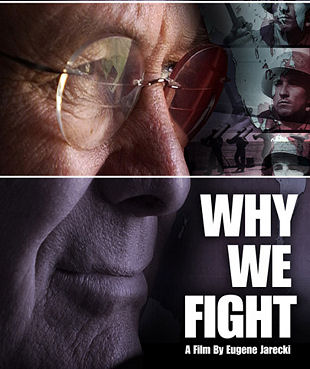
“I think that this delicate line between reality, and fact, and truth needs to be more clearly defined. My Minnesota Declaration (you’ll find it on my website) does this. But what has to be made more clear is: with the onslaught of virtual realities WE HAVE TO RE-DEFINE REALITY: beyond Cinema Verite, beyond the documen- taries we usually see on TV, beyond the terrain which is not solid any longer, as if we were treading on thin ice.” – Werner Herzog