Match Guilt

Match Guilt

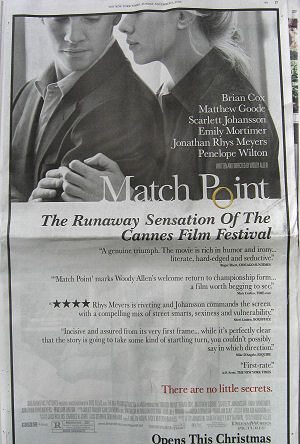
I’m feel I should be beating the drum more loudly for Woody Allen’s Match Point (DreamWorks, 12.28) because it’s not just his best in a long time, but one of the best of the year. And I need to stop being wimpy about this.
It really is Allen’s darkest and most precisely calibrated film since Crime and Misdemeanors…clean, cruel and ironic as hell.


Scarlett Johansson, Jonathan Rhys-Meyers in Woody Allen’s Match Point

Any film worth its salt has to have thematic clarity. Match Point‘s theme is clear as a friggin’ bell, and with echoes of George Stevens’ A Place in the Sun and Fyodor Dostoevsky’s “Crime and Punishment,” and it boils down to this:
Be smart and vigilant in life, and maybe you’ll get what you want, or what you think you need. But if you want things to really turn out, be lucky.
< ?php include ('/home/hollyw9/public_html/wired'); ?>
People hate this notion because it means our lives are little silver balls whirling around a roulette wheel. Maybe we’ll plop into a red or black slot at the right time, or into an odd or even number at the wrong time…and maybe something amazing or comical or devastating will come of it. Life is cold, man.
If there wasn’t such a herd mentality in this town, if people weren’t so political and equivocal, Match Point could actually be in the mix for Best Picture.
It’s a slightly better film than Good Night, and Good Luck. It’s not as much of a sad and broken-hearted thing as Brokeback Mountain, but it has as much confidence and self-awareness as Walk the Line. And it’s a good five or ten times better than Memoirs of a Geisha.
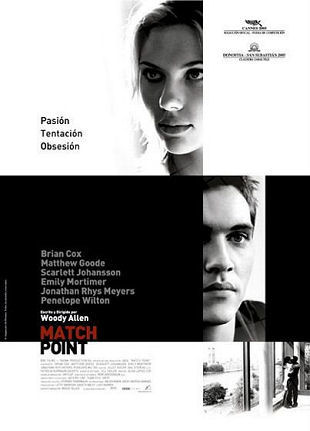

The Spanish one-sheet, which, if you ask me, has it all over the U.S. version

Let’s be really honest. I’m not ballsy enough to stand up for the Woody all alone, partly because deep down I’m only 90% supportive of Match Point (I have some problems with this and that aspect, but nothing humungous), but I feel bolder with Oscar prognosticators Pete Hammond, Sasha Stone and Eugene Hernandez listing it among their top five.
So I guess I’m like Bobby Kennedy after Eugene McCarthy got 42% of the vote in the 1968 New Hampshire primary against Lyndon Johnson. I’m going, “Uhh, okay …there’s something happening here and I’m joining the insurrectionists.”
Screw the herd mentality and the hell with political and equivocal. The more I think about Match Point, the better it seems. Woody’s easily a Best Original Screenplay contender, and…well, at least that.
I said last May at the Cannes Film Festival that Match Point isn’t quite as good as Woody’s Crimes and Misdemeanors, but it deals the same kind of cards and has its footing in more or less the same philosophical realm.
And I’ve said this three or four times, but the finale kills.
Set in present-day England (mostly London, Match Point is about a tennis instruc- tor namd Chris Wilton (Jonathan Rhys- Meyers) who relationships his way into an upper-crust English family by way of one of his male students, a cheerful smoothie named Tom Hewett (Matthew Goode).

Chris is soon romancing and then marrying Tom’s sister Chloe (Emily Mortimer), but almost-as-quickly getting involved with Tom’s fiance, a struggling American actress named Nola Rice (Scarlett Johansson).
The story essentially turns on the matter of Nola becoming pregnant and insisting that Chris leave his wife for her, and how Chris deals with the pressure of this.
Rhys-Meyers handles his part skillfully and with exactly the right balance between terrible, gut-wrenching guilt and the suggestion of a sociopathic undercurrent. But it’s Johansson, far and away, who gives the finest performance. She seems in possession of a fierce, almost Brando-esque naturalism here. She grabs Allen’s dialogue by the shirt collar and slaps it around.
Match Point feels a bit pat from time to time. The talk feels a little too polite here and there, and certain aspects of the plot feel a bit forced. But that’s Woody these days, and in this instance, in this realm, that’s pretty damn good.

Sense of Gravity

Do today’s African-American actors radiate a graver, weightier aura…a stronger sense of manly conviction than white actors these days? Do they seem more rooted, less whimsical…more dependably earnest?
Or has it always been this way and white-guy columnists like myself are only just waking up to this? Or is the whole idea bogus and agenda-driven?
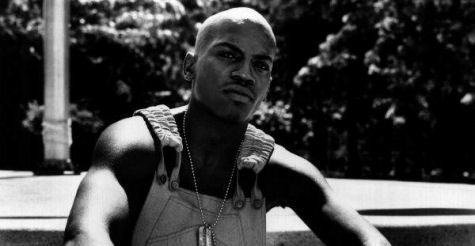

Would Mekhi Phifer have been better as Ennis del Mar or Jack Twist?

I got started on this theory when a New York-area guy named Richard Szathmary suggested this morning that if two black actors — Mekhi Phifer and Sharif Atkins, say — had played the kissin’ cowboys in Ang Lee’s Brokeback Mountain (Focus Features, 12.9) that reactions among younger-male heteros might be less squea- mish.
I’m referring to under-25s in both Flyover Country and in the big cities guffawing derisively at the film’s teaser-trailer. (I really hate bringing up this asinine reaction, but I’ve been told about it time and again.)
The feeling is that Atkins and Phifer falling for each other would somehow seem more solemn and steady and take-it-to-the-bank.
That’s how it seems to Szathmary, at least…a guy who hasn’t seen seen Brokeback Mountain but has his suspicions based on the trailer…a notion that there’s something vaguely flakey and untrustworthy about Jake Gyllenhaal and Heath Ledger. Something in their eyes, manner…something deep down.
I’ve seen Brokeback and I completely disagree. Ledger and Gyllenhaal totally inhabit their characters and then some, revving their emotional engines to a high pitch.
It wouldn’t have quite worked, in any case, to have a couple of black actors playing sheepherders-for-hire in a film that begins in the early ’60s, given the relatively few people of color known to have worked the open range forty or forty-five years agi, not to mention the conservative-racist mentality of big-time ranchers back then.
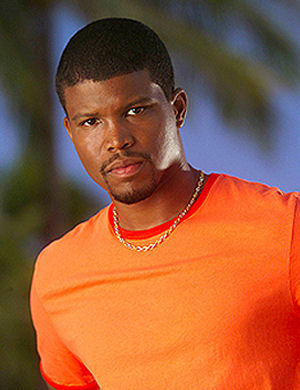

Sharif Atkins

And I can’t help wondering if Ang Lee and James Schamus would have been able to find a pair of marquee-worthy black actors if they’d said “Fine, let’s cast it this way.” The machismo factor among African-American actors is thought to be pretty high. Remember Will Smith’s reaction to briefly kissing a guy in Six Degrees of Separation?
But maybe Szathmary is onto something anyway.
The more I think about these guys and whatever that thing is they seem to possess, the more solid this idea seems.
I’m thinking of a list that includes (but certainly isn’t limited to) Terrence Howard, Don Cheadle, Denzel Washington, Mos Def, Jamie Foxx, Samuel L. Jackson, Phifer, Taye Diggs, Ludacris, Delroy Lindo, Bill Duke, Ving Rhames, Atkins, Ice Cube, Lawrence Fishburne, Sean Patrick Thomas, Henry Simmons, Keith Hamilton Cobb.
I could even include even Sean Combs, whom I believed as a death-row inmate in Monster’s Ball, despite his not being much of an actor.
“The American cinema is dominated by commanding black males,” wrote Szathmary. “Men whom one can picture as real men. Guys who don’t whine and have real voices and calmly and capably make their moves and get things done.”
As the risk of sounding like a cultural bubble-dweller or zombie of some kind, there’s something to this view. A feeling that there’s something more dependable and rock-solid about black guys…except when it comes to Martin Lawrence, the dandified Will Smith and that guy who played the sick-fuck Little Ze in City of God.
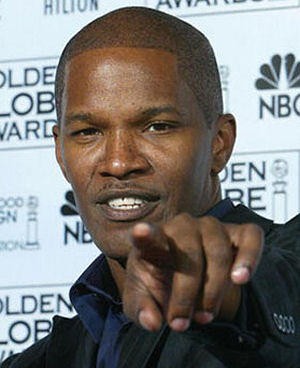

Jamie Foxx

At the same time the notion that guys with darker skin have it all over guys of European heritage sounds simplistic and dumb-assed.
On the other hand there was a voice inside me that said “cool” when that fast-flurry rumor popped up last year about Colin Salmon being one of the finalists being tapped to play 007.
I could riff some more about about this and call up ten or fifteen producers, agents and casting directors and chew it over with them, but let’s just throw this one out and get some reader reactions.

Joan and Toni

L.A. City Beat film critic Andy Klein came on “Elsewhere Live” last night (i.e., Thursday) to talk about the leading Best Actress contenders, and all the verbal sifting-through led me to realize something I hadn’t quite come to on my own:
The two finest waker-upper female performances of the year are both underdogs. One isn’t being spoken of very much, and the other isn’t even on the map.
I’m speaking of Joan Allen’s alcoholic, emotionally off-balance mother of four girls in Mike Binder’s The Upside of Anger and Toni Collette’s stressed, hurting, buoy- ant Philadelphia attorney in Curtis Hanson’s In Her Shoes.
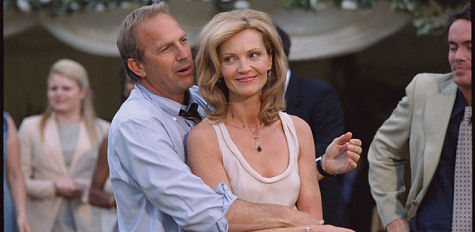

Kevin Costner, Joan Allen in The Upside of Anger

Allen is sitting on a few Oscar prognosticator “maybe” lists, but not so you’d notice. It’s high time to refresh the browser. There’s an emotional hair-trigger element that Allen gets hold of in Anger that feels almost giddy at times. She’s bracing and sexy, willful and vulnerable and quirky. (And let’s not forget how sublime she was in Sally Potter’s Yes.)
No one anywhere is talking about Collette at all. Obviously people disagree with my feelings about her. Maybe In Her Shoes getting only a 75% positive rating on Rotten Tomatoes had its effect, and maybe the underwhelming box office was a factor, or Fox not going to bat for Collette with trade ads…whatever.
I know what exceptional in-the-pocket acting is — I know what it feels like, sounds like — and I know plenty of others who feel this way, and those who’ve dismissed Collette’s performance out-of-hand are just being slackers.
Allen and Collette’s performances are funny, sad, joyful, exuberant. They raise the emotional thermometer and have all kinds of ins and outs, and the plain simple truth is that none of the other supposed contenders (i.e., the ones on everyone’s lists) are in their realm.
I believe this because…


Toni Collette in In Her Shoes

Reason #1: Reese Witherspoon, the presumed front-runner for her fine inhabiting of June Carter in Walk the Line, gives an assured movie-star performance…yes. Her acting is robust and and authentically down-home. She does more with less and is quite radiant and likable, and she sings like an angel. And she’s almost a supporting character (I said “almost”). And she doesn’t have one of those hair- pulling, “look ma, I’m acting” scenes to work with either.
But at the same time Witherspoon isn’t exactly pushing her boundaries or rewriting the book on acting. She’s great but c’mon…
Reason #2: Judi Dench, another presumed front-runner for her playing a spirited upper-class snob in Mrs. Henderson Presents, can do this sort of thing in her sleep. Academy people always kowtow to world-class British actresses when they get hold of a good part, and that’s happening here. Like I said a few weeks ago, Dench “has a pitch-perfect way of delivering zap lines with just the right tone of upper-class indifference, and yet the joke is always on her.” But it’s a performance that’s straight out of her kit bag.
Reason #3: Sarah Jessica Parker is the one who goes through the big character journey in The Family Stone, starting out all rigid and butt-plugged and then evol- ving into somone calmer and more centered. But she’s not in Witherspoon’s class, much less Allen’s or Collette’s (in part because of how her character is written).
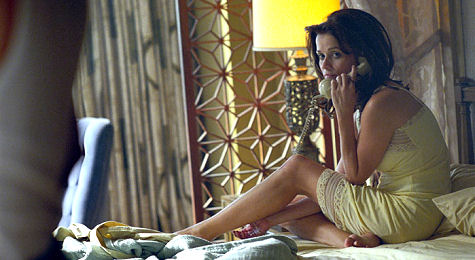

Reese Witehspoon in Walk the Line

Reason #4: Charlize Theron gives an impassioned, balls-out, tough-as-nails performance in North Country, but the movie, a fairly solid drama on its own terms, didn’t cause much of a stir when it came out, and people feel a little Charlize-d out from the Monster hoopla of…what was it, two years ago?
Reason #5: This is a non-reason, but I haven’t seen Felicity Huffman playing a man undergoing a gender-switch procedure in Transamerica, so she’s off the table for now.
Reason #6: Keira Knightley doesn’t have that element of a-churning-river-running- through-her…not at all…not in Pride & Prejudice, and not in any performance she’s given in any film so far. It’s vaguely silly that people have even put her on their lists. Just forget it.
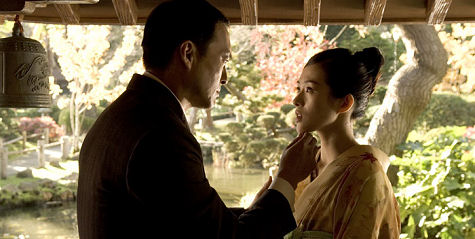
Reason #7: Ziyi Zhang is a barely emotive presence in Memoirs of a Geisha. She’s all makeup and porcelain and dropping her gaze to the ground. She’s young and vigorous and great on her feet with a sword, but quiet acting isn’t her game. She may get swept along in the current of all the below-the-line nominations that Geisha is expected to receive, but she doesn’t deliver on her own and that’s a fact.


Charlize Theron in North Country

Reason #8: Claire Danes doesn’t have nearly enough to work with in Shopgirl, and her character’s a bit opaque and the movie’s underwhelming, so forget it.
Reason #9: Gwyneth Paltrow’s daughter-of-Anthony-Hopkins character in Proof is too gloomy and self-involved. That was my reaction, at least — I felt she was too wrapped up in her woe-is-me blanket, and I found that off-putting after a while. The film has its moments and Paltrow’s performance has merit, but it’s a stretch to talk about Oscar contention.
Reason #10: The White Countess is said to have more than a few problems so however good Natasha Richardson may be, a nomination doesn’t seem to be in the cards.
Reason #11: It’s a little early to say anything, but the word around the campfire is that the same equation may apply to notions of Q’orianka Kilcher being singled out for her work in The New World.
I said no other female performance this year was quite in Allen and Collette’s realm. That isn’t entirely accurate if you allow Robin Wright Penn’s brief but startling turn in Rodrigo Garcia’s Nine Lives into the mix.
Wright Penn may not be on-screen long enough to qualify for contention in the Best Supporting Actress category (in people’s heads, I mean) but she’s absolutely mesmerizing in this film. I wrote about it in October (scroll to the bottom of the page).
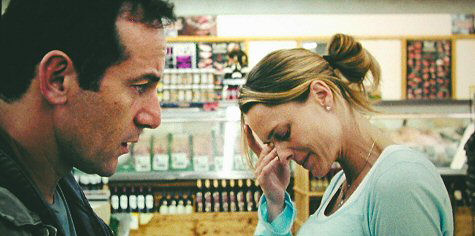

Jason Isaacs, Robin Wright Penn in Nine Lives

Forget It

Forget that whole Sundance Film Festival ’06 thing I posted in this section a few days ago, and in the main column last Saturday. Almost all of it was wrong and that’s that.
I’ve been reliably persuaded that a good portion of the titles I mentioned won’t be at the festival, and that some weren’t even submitted (!).
Five or six days ago a friend from the festival circuit sent me a document put together by Film Finders called “Tipped for Sundance,” and it had those 22 films listed.
I went for the information because (a) the Film Finders people are known to be fairly well connected on a business affairs level, (b) the document was passed along only a few days before the official announcements (the trades will be running the stories this week), (c) the document “looked” superficially reliable — it had production info history, sales contact info and phone numbers for each film — and (d) the combined reptutations of Film Finders and the guy who sent me the document convinced me the information was probably jake.
And for the most part, it wasn’t.

Fist in the Air

“I finally got a chance to catch Rent yesterday and wanted to let you that your review in your 11.9 column absolutely nailed it. Columbus did a helluva job transferring this thing to the screen and I agree it worked better in many ways than the play.
“Film allows the viewer to peer deep into its characters souls in a way that the stage (for all its vitality) cannot, and Columbus’s choices were excellent. He let the music speak for itself and didn√ɬ¢√¢‚Äö¬¨√¢‚Äû¬¢t let his ego or pretensions get in the way of telling the story.
“I can’t help but think that a more auteur-type (Martin Scorsese and Spike Lee were both attached at one time) would be more inclined to put a personal spin on the material, and thus dilute the essence of Larson’s music. The ego-less direction from Columbis lets the source material to shine through.
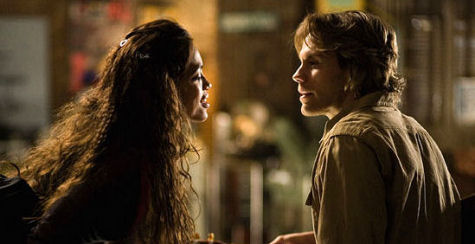

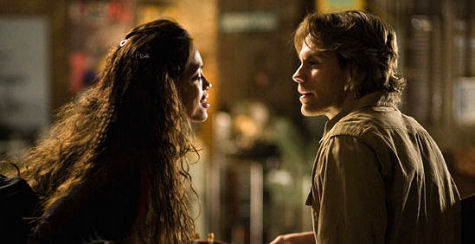
Rosario Dawson, Adam Pascal in Rent

“Like many others, I find myself caught in a daily grind of trying to move forth and survive in life’s scramble. Rent reminded me of how important prioritization is. When Rosario Dawson sings to Adam Pascal about how ‘life is yours to miss’ …damn, it hit hard.
Rent reminded me of why I love art and the way it can help affirm why we’re all here.
“I think many critics are down on this thing due to an anti-Columbus bias (which I previously shared), or they just didn’t enjoy the style, music, etc. They’re missing the boat. This film is much better than Chicago and has an emotional immediacy that is heartfelt and pure.
“So three cheers for Rent and your standing-by-what-you-saw review. It’s another reason why I will remain a loyal reader of your column.” — Kyle Fredette

Brokebackers

“In the Twin Cities where I live, the Brokeback Mountain trailer has been getting lots of snickers at cineplexes and Landmark chain theaters alike. I’m no homo- phobe, and I’m a big Ang Lee fan who will be seeing Brokeback the weekend it opens here. But the collective reaction in some of these theaters has been really something.
“People openly laugh at Heath Ledger’s line ‘Why can’t I quit you?’ A very liberal friend of mine has even taken to doing his own impression of Ledger saying that line, to the howls of all of our other friends.
“While Ledger is very talented and deserves more respect than he gets, I think the idea of the star of A Knight’s Tale uttering that line is hitting people as utterly ridiculous. The line is going to be the thing that most people think of when they think of this movie. Watch over the coming months as it becomes a catchphrase.

“I’m looking forward to this movie and I’m sure it will be deserving of/in contention for numerous awards. But I expect it’s going to get quite a beating from the mass culture, in the way The Crying Game did. I hope I can find a showing in a theater on opening weekend that isn’t ruined by laughter.” — Brian Roche
“I am a 20-something woman, and James Shamus is right, as he usually is about these things, that women like me are the target audience for Brokeback Mountain, and I will be there as soon as it opens here in DC.
“But whenever I bring up BBM to any heterosexual male under 30 I just get the ‘independent films are all about gay cowboys eating pudding’ thing from South Park. These men are well-educated and enjoy independent film. And I don’t think there is so much of a cringe factor as one might think for these young-ish men watching two dudes in love. I just do not think that is the problem.
“As much as I love South Park (and personally think that their characterization of independent film is quite funny), I have to blame Matt and Trey for the chortle and giggle factor that I have run into. However, I also think that if these men got their asses into the seats and watched the film I think most of them would enjoy it. But please, take me with a huge grain of salt as I really liked Ang Lee’s The Hulk.” — Haley Aurora
“Okay, message received: Jeffrey Wells is full-steam behind Brokeback Mountain as the film of the year. Groovy. And your worries about a bubba backlash against it, spurred by homophobia, are entirely realistic and well-founded.
“But with respect, is it possible you’re overlooking the other side of the coin here?
“What I mean is, if one is going to be upfront about the fact that there will be people who will skip this movie, dump on this movie, refuse to like or admit liking this movie because of what side they take in the moral debate over gay rights…is it not only fair but simply intellectually honest to also concede that there will be people who will reflexively praise and exalt it, without having seen it because they take the opposite side and want to see a gay-themed movie succeed?
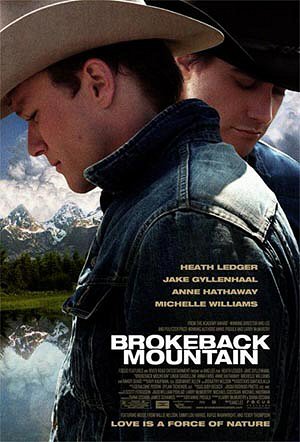
“I’m not accusing you of outright bias. You’ve seen the film, it’s obviously gotten to you in a profound way, and you’re convinced of it’s innate quality. But if it’s going to be fair-game (and I believe it ought to be) to read between the lines of negative reviews and question whether an element of homophobia is clouding the reviewer’s decision, would you not agree that it’s equally fair-game to do the same for the positive reviews?
“Not every critic is going to agree that this is a great or even good film. But how many of them will be, you’ll pardon the expression, bending over backwards to be positive about it for fear of appearing in cahoots with the religious right wackjobs who will probably be trashing it?
“I’m from Massachusetts and am regularly in the social company of various gay, bisexual or otherwise pals. I’ve supported just about every gay rights cause that’s come down the pike. I’m a full-bore enemy of religious fundamentalism in all it’s forms. I want to see a serious gay-themed movie make a mainstream impact to help society grow up a bit over the whole issue…
“And thus far, I think this movie looks like a chore. I’m sorry, but thats the impression I have right now. It’s possible my impressions are wrong, but for trailer-one this has looked to me like a drippy, soap-opera-ish, Titanic/Gone With The Wind/Cold Mountain chick-flick melodrama, and I’m regarding the prospect of seeing it with the same basic feeling you’ve expressed over sitting through the future Harry Potter sequels.
“But when I tell people this at least half of them look back at me in shock, as though I just implied that AIDS was a plague from God or that the Holocaust hadn’t occured. And I’m not seeing this discussed anywhere in the critical press, so far. Instead, the prevailing theme is Brokeback Mountain will be great, and anyone who doesn’t think so is a Christian right homophobe. And frankly, that’s just plain uncool.” — MST Mario
Wells to MST Mario: You contemptible closet-Christian bigot homophobe skeptical Ang Lee-dissing prick!
“Seriously, MST, I hear you and you’ve made some good points, but trust me on these two points: Brokeback Mountain in no way resembles Titanic or Gone With the Wind or anything along those lines. It’s austere, under-stated, and doesn’t try to massage you into feeling anything. Secondly and more importantly, it’s not a gay or gay-themed film. It really isn’t, despite what you may be presuming.
“I program a series of fine-film cinema locations here in Melbourne Australia, and last weekend I held the first public screening of Broekback Mountain in Australia as part of a promotional weekend launching a loyalty card. I attended the screening with my partner after having watched the film at an exhibitor’s screening the week prior.
“I enjoyed the film greatly at the exhib’s screening, perhaps only finding it a little longer than it could have been, but that’s probably my exhibitor’s hat talking. It actually wasn’t until I was driving home that evening that the weight of the film dawned on me and I was left profoundly moved by it. All night I wanted to talk about the film but forbid myself, not wanting to set expectations too high for my partner.
“I agree that the film is certainly worthy of a Best Pic nomination as well as a win, but from where I am standing the U.S. is a very conservative place at the moment and I wonder about the film’s box-office performance there and whether it will get the support it will need from the expanse between the east and west coasts.
“Perhaps the old adage that any publicity is good publicity” stands in this case. Who knows? Maybe if Oprah likes it, it’s in with a chance with the women of middle America.
“What I want to ltell you was that when I was at the screening, I found myself surprised by the reaction it received from the audience. Admittedly the cinema is in a very upscale location in the suburbs of Melbourne and the audience was partially made up of film buffs who jumped on the opportunity to see the film 2 months out from local release.
“But there was not a peep from anyone during the film’s more intimate scenes, 80% of the audience sat in their seats during the closing credits and when the film ended I overhead nothing other than quiet comments along the lines of ‘amazing,’ ‘brilliant,’ ‘incredible’ and other assorted superlatives. There were also plenty of tears and gasps during the film’s more shocking moments.
“It’s this reception that has me thinking that regardless of the U.S. reception, the film should find considerable success internationally.” — Kristian Connelly, Film Programmer, Cinema Europa, Traditional & Gold Class Village Cinemas, Australia
“I can understand why you’re on the Brokeback horse, but you better be paying real attention to those snickers in those heartland theaters.
“America is homphobic. To its core. And this is a film — no matter what you feel — about two guys in love. About two guys who have (rather explicit) sex with each other. And no matter how sensitive or how well-made, Brokeback mountain ain’t gonna fly in flyover country.
“And please dump your prejudices and realize that Pride and Prejudice is the kind of lush, middle-brow based-on-a-classic picture that Hollywood just loves to gift with Oscar noms.” — Lewis Beale
Joan and Toni

Match Guilt

I’m feel I should be beating the drum more loudly for Woody Allen’s Match Point (DreamWorks, 12.25) because it’s not just his best in a long time, but one of the best of the year. And I need to stop being wimpy about this.
It really is Allen’s darkest and most precisely calibrated film since Crime and Misdemeanors…clean, cruel and ironic as hell.


Scarlett Johansson, Jonathan Rhys-Meyers in Woody Allen’s Match Point

Any film worth its salt has to have thematic clarity. Match Point‘s theme is clear as a friggin’ bell, and with echoes of George Stevens’ A Place in the Sun and Fyodor Dostoevsky’s “Crime and Punishment,” and it boils down to this:
Be smart and vigilant in life, and maybe you’ll get what you want, or what you think you need. But if you want things to really turn out, be lucky.
< ?php include ('/home/hollyw9/public_html/wired'); ?>
People hate this notion because it means our lives are little silver balls whirling around a roulette wheel. Maybe we’ll plop into a red or black slot at the right time, or into an odd or even number at the wrong time…and maybe something amazing or comical or devastating will come of it. Life is cold, man.
If there wasn’t such a herd mentality in this town, if people weren’t so political and equivocal, Match Point could actually be in the mix for Best Picture.
It’s a slightly better film than Good Night, and Good Luck. It’s not as much of a sad and broken-hearted thing as Brokeback Mountain, but it has as much confidence and self-awareness as Walk the Line. It’s five or ten times better than Memoirs of a Giesha, and the Munich comparisons will soon be clear.


The Italian one-sheet…right?

Let’s be really honest. I’m not ballsy enough to stand up for the Woody all alone, partly because deep down I’m only 90% supportive of Match Point (I have some problems with this and that aspect, but nothing humungous), but I feel bolder with Oscar prognosticators Pete Hammond, Sasha Stone and Eugene Hernandez listing it among their top five.
So I guess I’m like Bobby Kennedy after Eugene McCarthy got 42% of the vote in the 1968 New Hampshire primary against Lyndon Johnson. I’m going, “Uhh, okay …there’s something happening here and I’m joining the insurrectionists.”
Screw the herd mentality and the hell with political and equivocal. The more I think about Match Point, the better it seems. Woody is easily a Best Original Screen- play contender, and…well, at least that.
I said last May at the Cannes Film Festival that Match Point isn’t quite as good as Woody’s Crimes and Misdemeanors, but it deals the same kind of cards and has its footing in more or less the same philosophical realm.
And I’ve said this three or four times, but the finale kills.
Set in present-day England (mostly London, Match Point is about a tennis instruc- tor namd Chris Wilton (Jonathan Rhys- Meyers) who relationships his way into an upper-crust English family by way of one of his male students, a cheerful smoothie named Tom Hewett (Matthew Goode).

Chris is soon romancing and then marrying Tom’s sister Chloe (Emily Mortimer), but almost-as-quickly getting involved with Tom’s fiance, a struggling American actress named Nola Rice (Scarlett Johansson).
The story essentially turns on the matter of Nola becoming pregnant and insisting that Chris leave his wife for her, and how Chris deals with the pressure of this.
Rhys-Meyers handles his part skillfully and with exactly the right balance between terrible, gut-wrenching guilt and the suggestion of a sociopathic undercurrent. But it’s Johansson, far and away, who gives the finest performance. She seems in possession of a fierce, almost Brando-esque naturalism here. She grabs Allen’s dialogue by the shirt collar and slaps it around.
Match Point feels a bit creaky from time to time. The talk feels a little pat here and there, and certain aspects of the plot feel a wee bit forced. But that’s Woody these days, and in this instance, that’s pretty damn good.

Sense of Gravity

Do today’s African-American actors radiate a graver, weightier aura…a stronger sense of manly conviction than white actors these days? Do they seem more rooted, less whimsical…more dependably earnest?
Or has it always been this way and white-guy columnists like myself are only just waking up to this? Or is the whole idea bogus and agenda-driven?


Would Mekhi Phifer have been better as Ennis del Mar or Jack Twist?

I got started on this theory when a New York-area guy named Richard Szathmary suggested this morning that if two black actors — Mekhi Phifer and Sharif Atkins, say — had played the kissin’ cowboys in Ang Lee’s Brokeback Mountain (Focus Features, 12.9) that reactions among younger-male heteros might be less squeamish.
I’m referring to under-25s in both Flyover Country and in the big cities guffawing derisively at the film’s teaser-trailer. (I really hate bringing up this asinine reaction, but I’ve been told about it time and again.)
The feeling is that Atkins and Phifer falling for each other would somehow seem solemn and steady and take-it-to-the-bank.
That’s how it seems to Szathmary, at least…a guy who hasn’t seen seen Brokeback Mountain but has his suspicions based on the trailer…a notion that there’s something vaguely flakey and untrustworthy about Jake Gyllenhaal and Heath Ledger. Something in their eyes, manner…something deep down.
I’ve seen Brokeback and I completely disagree. Ledger and Gyllenhaal totally inhabit their characters and then some, revving their emotional engines to a high pitch.
It wouldn’t have quite worked, in any case, to have a couple of black actors playing sheepherders-for-hire in a film that begins in the early ’60s, given the relatively few people of color known to have worked the open range forty or forty-five years agi, not to mention the conservative-racist mentality of big-time ranchers back then.


Sharif Atkins

And I can’t help wondering if Ang Lee and James Schamus would have been able to find a pair of marquee-worthy black actors if they’d said “Fine, let’s cast it this way.” The machismo factor among African-American actors is thought to be pretty high. Remember Will Smith’s reaction to briefly kissing a guy in Six Degrees of Separation?
But maybe Szathmary is onto something anyway.
The more I think about these guys and whatever that thing is they seem to possess, the more solid this idea seems.
I’m thinking of a list that includes (but certainly isn’t limited to) Terrence Howard, Don Cheadle, Denzel Washington, Mos Def, Jamie Foxx, Samuel L. Jackson, Phifer, Taye Diggs, Ludacris, Delroy Lindo, Bill Duke, Ving Rhames, Atkins, Ice Cube, Lawrence Fishburne, Sean Patrick Thomas, Henry Simmons, Keith Hamilton Cobb.
I could even include even Sean Combs, whom I believed as a death-row inmate in Monster’s Ball, despite his not being much of an actor.
“The American cinema is dominated by commanding black males,” wrote Szathmary. “Men whom one can picture as real men. Guys who don’t whine and have real voices and calmly and capably make their moves and get things done.”
As the risk of sounding like a cultural bubble-dweller or zombie of some kind, there’s something to this view. A feeling that there’s something more dependable and rock-solid about black guys…except when it comes to Martin Lawrence, the dandified Will Smith and that guy who played the sick-fuck Little Ze in City of God.


Jamie Foxx

At the same time the notion that guys with darker skin have it all over guys of European heritage sounds simplistic and dumb-assed.
On the other hand there was a voice inside me that said “cool” when that fast-flurry rumor popped up last year about Colin Salmon being one of the finalists being tapped to play 007.
I could riff some more about about this and call up ten or fifteen producers, agents and casting directors and chew it over with them, but let’s just throw this one out and get some reader reactions.

Joan and Toni

L.A. City Beat film critic Andy Klein came on “Elsewhere Live” last night (i.e., Thursday) to talk about the leading Best Actress contenders, and all the verbal sifting-through led me to realize something I hadn’t quite come to on my own:
The two finest waker-upper female performances of the year are both underdogs. One isn’t being spoken of very much, and the other isn’t even on the map.
I’m speaking of Joan Allen’s alcoholic, emotionally off-balance mother of four girls in Mike Binder’s The Upside of Anger and Toni Collette’s stressed, hurting, buoy- ant Philadelphia attorney in Curtis Hanson’s In Her Shoes.


Kevin Costner, Joan Allen in The Upside of Anger

Allen is sitting on a few Oscar prognosticator “maybe” lists, but not so you’d notice. It’s high time to refresh the browser. There’s an emotional hair-trigger element that Allen gets hold of in Anger that feels almost giddy at times. She’s bracing and sexy, willful and vulnerable and quirky. (And let’s not forget how sublime she was in Sally Potter’s Yes.)
No one anywhere is talking about Collette at all. Obviously people disagree with my feelings about her. Maybe In Her Shoes getting only a 75% positive rating on Rotten Tomatoes had its effect, and maybe the underwhelming box office was a factor, or Fox not going to bat for Collette with trade ads…whatever.
I know what exceptional in-the-pocket acting is — I know what it feels like, sounds like — and I know plenty of others who feel this way, and those who’ve dismissed Collette’s performance out-of-hand are just being slackers.
Allen and Collette’s performances are funny, sad, joyful, exuberant. They raise the emotional thermometer and have all kinds of ins and outs, and the plain simple truth is that none of the other supposed contenders (i.e., the ones on everyone’s lists) are in their realm.
I believe this because…


Toni Collette in In Her Shoes

Reason #1: Reese Witherspoon, the presumed front-runner for her fine inhabiting of June Carter in Walk the Line, gives an assured movie-star performance…yes. Her acting is robust and and authentically down-home. She does more with less and is quite radiant and likable, and she sings like an angel. And she’s almost a supporting character (I said “almost”). And she doesn’t have one of those hair- pulling, “look ma, I’m acting” scenes to work with either.
But at the same time Witherspoon isn’t exactly pushing her boundaries or rewriting the book on acting. She’s great but c’mon…
Reason #2: Judi Dench, another presumed front-runner for her playing a spirited upper-class snob in Mrs. Henderson Presents, can do this sort of thing in her sleep. Academy people always kowtow to world-class British actresses when they get hold of a good part, and that’s happening here. Like I said a few weeks ago, Dench “has a pitch-perfect way of delivering zap lines with just the right tone of upper-class indifference, and yet the joke is always on her.” But it’s a performance that’s straight out of her kit bag.
Reason #3: Sarah Jessica Parker is the one who goes through the big character journey in The Family Stone, starting out all rigid and butt-plugged and then evol- ving into somone calmer and more centered. But she’s not in Witherspoon’s class, much less Allen’s or Collette’s (in part because of how her character is written).


Reese Witehspoon in Walk the Line

Reason #4: Charlize Theron gives an impassioned, balls-out, tough-as-nails performance in North Country, but the movie, a fairly solid drama on its own terms, didn’t cause much of a stir when it came out, and people feel a little Charlize-d out from the Monster hoopla of…what was it, two years ago?
Reason #5: This is a non-reason, but I haven’t seen Felicity Huffman playing a man undergoing a gender-switch procedure in Transamerica, so she’s off the table for now.
Reason #6: Keira Knightley doesn’t have that element of a-churning-river-running- through-her…not at all…not in Pride & Prejudice, and not in any performance she’s given in any film so far. It’s vaguely silly that people have even put her on their lists. Just forget it.
Reason #7: Ziyi Zhang is a barely emotive presence in Memoirs of a Geisha. She’s all makeup and porcelain and dropping her gaze to the ground. She’s young and vigorous and great on her feet with a sword, but quiet acting isn’t her game. She may get swept along in the current of all the below-the-line nominations that Geisha is expected to receive, but she doesn’t deliver on her own and that’s a fact.


Charlize Theron in North Country

Reason #8: Claire Danes doesn’t have nearly enough to work with in Shopgirl, and her character’s a bit opaque and the movie’s underwhelming, so forget it.
Reason #9: Gwyneth Paltrow’s daughter-of-Anthony-Hopkins character in Proof is too gloomy and self-involved. That was my reaction, at least — I felt she was too wrapped up in her woe-is-me blanket, and I found that off-putting after a while. The film has its moments and Paltrow’s performance has merit, but it’s a stretch to talk about Oscar contention.
Reason #10: The White Countess is said to have more than a few problems so however good Natasha Richardson may be, a nomination doesn’t seem to be in the cards.
Reason #11: It’s a little early to say anything, but the word around the campfire is that the same equation may apply to notions of Q’orianka Kilcher being singled out for her work in The New World.
I said no other female performance this year was quite in Allen and Collette’s realm. That isn’t entirely accurate if you allow Robin Wright Penn’s brief but startling turn in Rodrigo Garcia’s Nine Lives into the mix.
Wright Penn may not be on-screen long enough to qualify for contention in the Best Supporting Actress category (in people’s heads, I mean) but she’s absolutely mesmerizing in this film. I wrote about it in October (scroll to the bottom of the page).


Jason Isaacs, Robin Wright Penn in Nine Lives

Forget It

Forget that whole Sundance Film Festival ’06 thing I posted in this section a few days ago, and in the main column last Saturday. Almost all of it was wrong and that’s that.
I’ve been reliably persuaded that a good portion of the titles I mentioned won’t be at the festival, and that some weren’t even submitted (!).
Five or six days ago a friend from the festival circuit sent me a document put together by Film Finders called “Tipped for Sundance,” and it had those 22 films listed.
I went for the information because (a) the Film Finders people are known to be fairly well connected on a business affairs level, (b) the document was passed along only a few days before the official announcements (the trades will be running the stories this week), (c) the document “looked” superficially reliable — it had production info history, sales contact info and phone numbers for each film — and (d) the combined reptutations of Film Finders and the guy who sent me the document convinced me the information was probably jake.
And for the most part, it wasn’t.

Fist in the Air

“I finally got a chance to catch Rent yesterday and wanted to let you that your review in your 11.9 column absolutely nailed it. Columbus did a helluva job transferring this thing to the screen and I agree it worked better in many ways than the play.
“Film allows the viewer to peer deep into its characters souls in a way that the stage (for all its vitality) cannot, and Columbus’s choices were excellent. He let the music speak for itself and didn√ɬ¢√¢‚Äö¬¨√¢‚Äû¬¢t let his ego or pretensions get in the way of telling the story.
“I can’t help but think that a more auteur-type (Martin Scorsese and Spike Lee were both attached at one time) would be more inclined to put a personal spin on the material, and thus dilute the essence of Larson’s music. The ego-less direction from Columbis lets the source material to shine through.


Rosario Dawson, Adam Pascal in Rent

“Like many others, I find myself caught in a daily grind of trying to move forth and survive in life’s scramble. Rent reminded me of how important prioritization is. When Rosario Dawson sings to Adam Pascal about how ‘life is yours to miss’ …damn, it hit hard.
Rent reminded me of why I love art and the way it can help affirm why we’re all here.
“I think many critics are down on this thing due to an anti-Columbus bias (which I previously shared), or they just didn’t enjoy the style, music, etc. They’re missing the boat. This film is much better than Chicago and has an emotional immediacy that is heartfelt and pure.
“So three cheers for Rent and your standing-by-what-you-saw review. It’s another reason why I will remain a loyal reader of your column.” — Kyle Fredette

Brokebackers

“In the Twin Cities where I live, the Brokeback Mountain trailer has been getting lots of snickers at cineplexes and Landmark chain theaters alike. I’m no homo- phobe, and I’m a big Ang Lee fan who will be seeing Brokeback the weekend it opens here. But the collective reaction in some of these theaters has been really something.
“People openly laugh at Heath Ledger’s line ‘Why can’t I quit you?’ A very liberal friend of mine has even taken to doing his own impression of Ledger saying that line, to the howls of all of our other friends.
“While Ledger is very talented and deserves more respect than he gets, I think the idea of the star of A Knight’s Tale uttering that line is hitting people as utterly ridiculous. The line is going to be the thing that most people think of when they think of this movie. Watch over the coming months as it becomes a catchphrase.

“I’m looking forward to this movie and I’m sure it will be deserving of/in contention for numerous awards. But I expect it’s going to get quite a beating from the mass culture, in the way The Crying Game did. I hope I can find a showing in a theater on opening weekend that isn’t ruined by laughter.” — Brian Roche
“I am a 20-something woman, and James Shamus is right, as he usually is about these things, that women like me are the target audience for Brokeback Mountain, and I will be there as soon as it opens here in DC.
“But whenever I bring up BBM to any heterosexual male under 30 I just get the ‘independent films are all about gay cowboys eating pudding’ thing from South Park. These men are well-educated and enjoy independent film. And I don’t think there is so much of a cringe factor as one might think for these young-ish men watching two dudes in love. I just do not think that is the problem.
“As much as I love South Park (and personally think that their characterization of independent film is quite funny), I have to blame Matt and Trey for the chortle and giggle factor that I have run into. However, I also think that if these men got their asses into the seats and watched the film I think most of them would enjoy it. But please, take me with a huge grain of salt as I really liked Ang Lee’s The Hulk.” — Haley Aurora
“Okay, message received: Jeffrey Wells is full-steam behind Brokeback Mountain as the film of the year. Groovy. And your worries about a bubba backlash against it, spurred by homophobia, are entirely realistic and well-founded.
“But with respect, is it possible you’re overlooking the other side of the coin here?
“What I mean is, if one is going to be upfront about the fact that there will be people who will skip this movie, dump on this movie, refuse to like or admit liking this movie because of what side they take in the moral debate over gay rights…is it not only fair but simply intellectually honest to also concede that there will be people who will reflexively praise and exalt it, without having seen it because they take the opposite side and want to see a gay-themed movie succeed?

“I’m not accusing you of outright bias. You’ve seen the film, it’s obviously gotten to you in a profound way, and you’re convinced of it’s innate quality. But if it’s going to be fair-game (and I believe it ought to be) to read between the lines of negative reviews and question whether an element of homophobia is clouding the reviewer’s decision, would you not agree that it’s equally fair-game to do the same for the positive reviews?
“Not every critic is going to agree that this is a great or even good film. But how many of them will be, you’ll pardon the expression, bending over backwards to be positive about it for fear of appearing in cahoots with the religious right wackjobs who will probably be trashing it?
“I’m from Massachusetts and am regularly in the social company of various gay, bisexual or otherwise pals. I’ve supported just about every gay rights cause that’s come down the pike. I’m a full-bore enemy of religious fundamentalism in all it’s forms. I want to see a serious gay-themed movie make a mainstream impact to help society grow up a bit over the whole issue…
“And thus far, I think this movie looks like a chore. I’m sorry, but thats the impression I have right now. It’s possible my impressions are wrong, but for trailer-one this has looked to me like a drippy, soap-opera-ish, Titanic/Gone With The Wind/Cold Mountain chick-flick melodrama, and I’m regarding the prospect of seeing it with the same basic feeling you’ve expressed over sitting through the future Harry Potter sequels.
“But when I tell people this at least half of them look back at me in shock, as though I just implied that AIDS was a plague from God or that the Holocaust hadn’t occured. And I’m not seeing this discussed anywhere in the critical press, so far. Instead, the prevailing theme is Brokeback Mountain will be great, and anyone who doesn’t think so is a Christian right homophobe. And frankly, that’s just plain uncool.” — MST Mario

Wells to MST Mario: You contemptible closet-Christian bigot homophobe skeptical Ang Lee-dissing prick!
“Seriously, MST, I hear you and you’ve made some good points, but trust me on these two points: Brokeback Mountain in no way resembles Titanic or Gone With the Wind or anything along those lines. It’s austere, under-stated, and doesn’t try to massage you into feeling anything. Secondly and more importantly, it’s not a gay or gay-themed film. It really isn’t, despite what you may be presuming.
“I program a series of fine-film cinema locations here in Melbourne Australia, and last weekend I held the first public screening of Broekback Mountain in Australia as part of a promotional weekend launching a loyalty card. I attended the screening with my partner after having watched the film at an exhibitor’s screening the week prior.
“I enjoyed the film greatly at the exhib’s screening, perhaps only finding it a little longer than it could have been, but that’s probably my exhibitor’s hat talking. It actually wasn’t until I was driving home that evening that the weight of the film dawned on me and I was left profoundly moved by it. All night I wanted to talk about the film but forbid myself, not wanting to set expectations too high for my partner.
“I agree that the film is certainly worthy of a Best Pic nomination as well as a win, but from where I am standing the U.S. is a very conservative place at the moment and I wonder about the film’s box-office performance there and whether it will get the support it will need from the expanse between the east and west coasts.
“Perhaps the old adage that any publicity is good publicity” stands in this case. Who knows? Maybe if Oprah likes it, it’s in with a chance with the women of middle America.
“What I want to ltell you was that when I was at the screening, I found myself surprised by the reaction it received from the audience. Admittedly the cinema is in a very upscale location in the suburbs of Melbourne and the audience was partially made up of film buffs who jumped on the opportunity to see the film 2 months out from local release.

“But there was not a peep from anyone during the film’s more intimate scenes, 80% of the audience sat in their seats during the closing credits and when the film ended I overhead nothing other than quiet comments along the lines of ‘amazing,’ ‘brilliant,’ ‘incredible’ and other assorted superlatives. There were also plenty of tears and gasps during the film’s more shocking moments.
“It’s this reception that has me thinking that regardless of the U.S. reception, the film should find considerable success internationally.” — Kristian Connelly, Film Programmer, Cinema Europa, Traditional & Gold Class Village Cinemas, Australia
“I can understand why you’re on the Brokeback horse, but you better be paying real attention to those snickers in those heartland theaters.
“America is homphobic. To its core. And this is a film — no matter what you feel — about two guys in love. About two guys who have (rather explicit) sex with each other. And no matter how sensitive or how well-made, Brokeback mountain ain’t gonna fly in flyover country.
“And please dump your prejudices and realize that Pride and Prejudice is the kind of lush, middle-brow based-on-a-classic picture that Hollywood just loves to gift with Oscar noms.” — Lewis Beale
Man From Decency

Man From Decency

Every now and then you need to take a break from all the Hollywood crap, and I got a really nice one last Saturday from an encounter with former U.S. Senator George McGovern. In so doing I felt an emotion that I haven’t had much contact with lately. I felt a kind of familial love.
The occasion was an early-Saturday-evening showing at Laemmle’s Music Hall of Stephen Vittoria’s One Bright Shining Moment: The Forgotten Summer of George McGovern, which I’ve been trying to catch since last July or so, when I happened to see a poster for it in the lobby of Manhattan’s Quad Cinema.


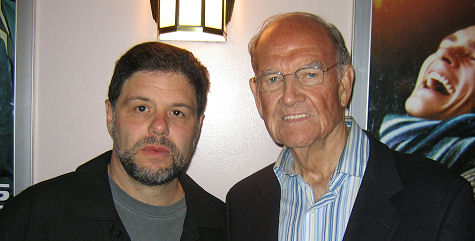
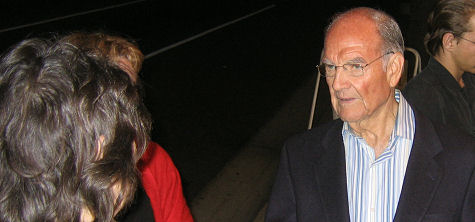
Stephen Vittoria, director of One Brief Shining Moment, and George McGovern in lobby of Laemmle’s Music Hall — Saturday, 11.19, 8:23 pm.

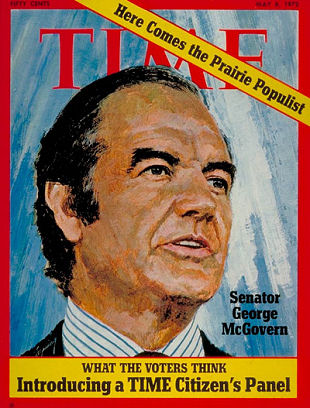
I’ve always admired McGovern, the longtime South Dakota liberal who’s mainly known for his catastrophic run as the Democratic President candidate in 1972 against President Richard Nixon. Hurt by a campaign that was chaotically mana- ged but also unlucky, McGovern got less than 40% of the vote and took only two states, Massachucetts and the District of Columbia.
I’ve long respected McGovern for having thetorically guided the last plain-spoken, genuinely liberal Democratic Presidential campaign. But my affection has mainly been about a long-held feeling that profound currents of decency and compassion run within him.
< ?php include ('/home/hollyw9/public_html/wired'); ?>
It sure felt that way as he spoke to a middle-aged crowd that had just seen Vittoria’s film around 7:30 pm, and later as he posed for photos and signed autographs and whatnot in front of the theatre on Wilshire Blvd.
He’s 83 now and seems to be in excellent health — tanned, trim — and he told the crowd he wants to live to be at least 100. He needs that much time, he said, to accomplish all his goals, which include doing what he can to eliminate hunger in third-world countries.
He’s been the World Food Program’s first global ambassador on hunger since ’01, and before that served as U.S. ambassador to the U.N. Food and Agriculture Agencies, based in Rome, Italy, from ’98 to ’01.
He said that his favorite line in Vittoria’s doc is when Gloria Steinem says that looking back on the ’72 campaign, the McGovern loyalists have a lot more to be proud of than do the supporters of Nixon’s campaign, who have all that Water- gate-related skullduggery to contend with.

Salon‘s Andrew O’Heir recently wrote than “when the long lens of history finally focuses on McGovern’s contentious era, he’ll appear in the main text, named as a prophet, while Nixon will be a twisted king consigned to the footnotes.”
But when asked last Saturday evening what he thinks about the present White House occupant, McGovern said he’d rather have Nixon there.
Nixon, he pointed out, was fairly practical and forward-thinking on domestic issues and the economy. He created the Environmental Protection Agency, advocated gun control, imposed wage and price controls, etc. And he wasn’t indebted to the neocons and their absolutist agendas.
The talking heads in One Bright Shining Moment include McGovern, Steinem, Gore Vidal, Warren Beatty, Howard Zinn, Dick Gregory, Gary Hart, Frank Mankiewicz, Jim Bouton, Rev. Malcolm Boyd and Ron Kovic.
Vittoria’s film is, for my money, a little too admiring, strident and one-sided. I wish he’d talked to some conservatives and maybe even a former enemy or two. It would have given the film some added intrigue without compromising McGovern’s image.
Some liberals still flinch at the memory of the ’72 campaign, but when a man has lasted as long as McGovern has and consistently stood for caring and compassion in public afairs, what’s not to admire? We’re speaking of one of the most steadily principled men to succeed in big-time politics in the 20th Century.


McGovern and admirers on sidewalk in front of Laemmle’s Music Hall on Wilshire near Doheny — Saturday, 11.19, 8:25 pm.

The Village Voice‘s Michael Atkinson has complained that Vittoria’s doc is filled with “exactly the sort of starry-eyed, bullet-spraying hyperbole that drains credibility from any brand of political discourse,” adding that it “may be useful as home-front history, if only it didn’t rant, yowl, and wet its pants so much.”
Still, it’s a good thing to have a film out there that doesn’t just train your attention on who George McGovern really is and was, and what his campaign was all about, but which pays the proper respect.
One Bright Shining Moment: The Forgotten Summer of George McGovern has been moving from city to city since its New York debut on 9.16. It doesn’t appear to have played a lot of the big liberal cities — San Francisco, Portland, Seattle, Chicago, etc.
The distributor, First Run features, is obviously operating on a shoe-string, but you’d think they’d at least manage to get it booked in the above-named cities and get it seem by as many devoted lefties as possible before the DVD debut in April ’06.

USC Interlude


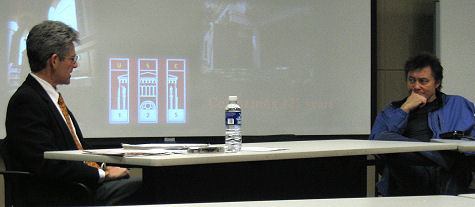
Ain’t It Cool’s Drew McWeeny and yours truly paid a visit Monday night to Charles Fleming’s “Entertainment, Business and Media in Today’s Society” class at the USC School of Journalism. We talked about internet journalism, industry politics, survival skills, the shortcomings of Tom Rothman and what the students think about the hot new movies. Defamer’s Mark Lisanti, profiled in the current issue of Los Angeles magazine, was supposed to show but bowed out at the last minute….something about his girlfriend having told him they already had “plans” (does that sound like a crock or what?). Thanks to Fleming (pictured at left with the suit and tie) for having us down.

White Eyeballs

As everyone presumably knows, I spend a lot of my spare time thinking up new ways to rip Peter Jackson. I’m kidding, but seriously…this is not one of those articles.
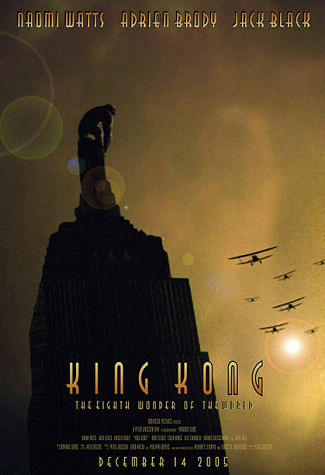
This is about a significant difference between Jackson’s King Kong — the big digital simian we’ll soon be seeing on the big screen — and Merian C. Cooper and Willis O’Brien’s classic stop-motion, herky-jerky version.

When this hit me the other day I was so excited I almost had to pull over and stop the car. The odd thing is that Jackson and a couple of his model-and-visual-effects guys talk about this very issue on the making-of-King Kong doc on the just-relea- sed Warner Home Video DVD of Cooper’s 1933 film.
I’m not saying Jackson has made the right or the wrong call in the fashioning of his own Kong, but stills from King Kong (Universal, 12.14) make it clear that his version is modelled pretty closely on the shape and musculature of real gorillas.
There may be some creative interpretation but compare Jackson’s ape with the shot [see below] of a Dianne Fossey gorilla…okay? Same deal. Grayish brown coat, big long Popeye arms, stubby hind legs, brown eyes.

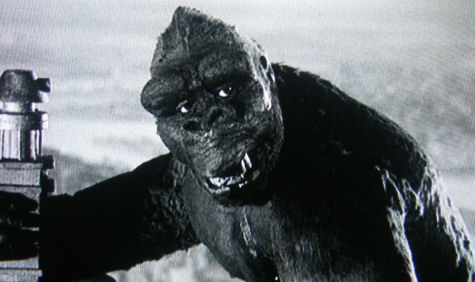
Cooper’s Kong didn’t look like any gorilla, chimp or orangutan that had ever walked the earth. He was something between a prehistoric hybrid and an imaginary mon- ster of the id…a raging nightmare beast designed to scare the bejeesus out of 1933 moviegoers.
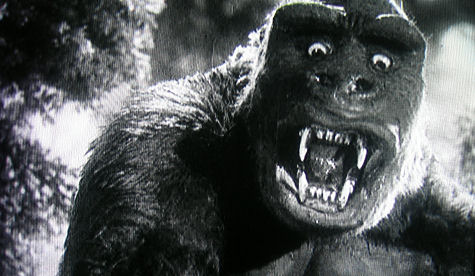
O’Brien, the legendary stop-motion phtography pioneer, used three slightly different-looking Kong models during filming, but for me the master stroke was deciding to give his Kong a set of gleaming white teeth and a pair of very bright white eyes.
In some of the darker shots of Kong in the 1933 film those teeth and those eyes just pop right out, and the effect is still primal as hell. Those white eyes and black pupils look so fierce and almost demonic…contrasting as they do with that black bear fur that Kong was covered in…that they almost give you the willies, even now.

Judging solely by the stills, there’s no such aura with Jackson’s National Geogra- phic Kong. The realism element is awesome but the guy doesn’t look all that spooky. I mean, not even a little bit. Ferocious and all, but he makes me think of Michael Apted and Sigourney Weaver.
There’s anothing wrong with this approach. It is what it is, and Jackson is going for his own thing. The stills and the trailer clearly suggest that his Kong is going to be one of the richest visual banquets in monster-movie history, if not movie history itself.
But in going for anthropological realism Jackson has thrown out that creepy, better-than-reality, only-in-the-movies element that gives the 1933 film a little- boy’s-nightmare quality.

Step On It

Rob Marshall’s Memoirs of a Geisha (Columbia, 12.9) is this year’s model of the big bland Best Picture contender that everyone who isn’t a sucker for this kind of thing — expensive, beautifully produced, Oscar-hungry, terminally boring — needs to throw tomatoes at.
Seriously…let’s start the ball rolling now. IM your friends and coworkers and tell them you’ve heard it’s a tedious costume-movie drag, but also that it’s caught a certain headwind and there’s a slight chance it could metastasize into this year’s Chicago.


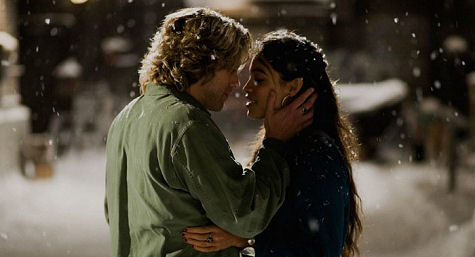
Ziyi Zhang during her big geisha-in-a-snowfall performance number that has zip to do with her character but a lot to do with Rob Marshall’s creative sensibility

The best thing about it is Gong Li’s performance as a jealous-bitch geisha in a Bette Davis mode. Otherwise the film is all costumes and pretty photography and a rags-to-riches story that creeps along at a petty pace.
It’s porcelain, nothing, stupefying…and every Godforsaken line of Chinese-accent English-language dialogue is like screeching chalk.
The first Academy-member Geisha screening happens tonight (11.21) so no pulse- readings until tomorrow, but there’s a poll of nine connected journos that just went up today on Movie City News called “Gurus of Gold,” and Geisha is being project- ed as one the top five Best Picture contenders.
Two of the respondents — Variety guy and Maxim critic Pete Hammond and USA Today‘s Scott Bowles — are actually projecting it as the most likely Best Picture winner…at this juncture.
The stars of Memoirs of A Geisha are Ziyi Zhang, Michelle Yeoh and Gong Li… three famed Chinese actresses played Japanese geishas and speaking English …and the feeling of Hollywood fakery and retrograde attitudes is fairly relentless.
The same Anglos-first mentality that led to the casting of Marlon Brando as Sakini in The Teahouse of the August Moon (’56) and Ricardo Montalban as Nakamura in Sayonara (’57) has prevailed once again.

And at no point does Memoirs of a Geisha feel like anything more than a colorful but perfunctory corporate tour of an exotic culture, tailor-made for Disney World Americans who won’t pay to see movies with subtitles.
I can tolerate the three Chinese actresses playing Japanese (although Ziyi doesn’t look Japanese for a second, and there’s a clear genetic difference in the faces of the two peoples), but the language and accent barriers are impossible.
Marshall should have shot a Japanese-language version concurrently, which Columbia could have concurrently released into select big-city theatres. Difficult but not impossible, and then people like me would have had an easier time of it.
There’s a scene early on in which a pair of young sisters are about to be forcibly separated. A very traumatic thing, but if this were to happen in real life the sisters would be in such shock they’d probably whimper a little bit and spend most of their last few seconds just staring at each other. Not in Rob Marshall’s world. When Geisha‘s sisters are torn apart the more spirited of the two goes, “Noooooo!!”
That’s a bullshit Hollywood reaction. People in bad Hollywood movies always go “noooo!!” when something bad happens. In a way, the whole movie is like this one scene. I didn’t believe a word of it.
And I wonder if the women for whom it’s been made will either. And I doubt if any real critical support will manifest. A publicist friend tells me all the journos he’s spoken are saying “pretty to look at, but cold.”
Robin Swicord and Doug Wright’s script is based on Arthur Golden’s 1997 novel, which is a huge international best-seller. I think it’s safe to say that the movie will dampen interest in anyone who hasn’t yet read it wanting to do so. My God, who would want to take this journey twice?


Ziyi Zhang, Ken Watanebe

Set in Japan in the 1930s and ’40s, Geisha is essentially a Cinderella story, and there’s not a hint of story tension or rooting interest in any part of it.
A little Japanese girl (Suzuka Ohgo) who will eventually be called Sayuri is sold to a geisha house (called an “okiya”), kicked around and treated like a slave. She’s quite pretty as an adolescent and is considered a special standout because of a pair of very weird-looking blue eyes (which throw you completely out of the film because they look like dopey contact lenses, pure and simple).
And then she grows up to be Ziyi Zhang, who doesn’t resemble Ohgo in the slightest.
This much-celebrated 26 year-old actress gives her first nothing performance here. She brought a fierce glaring passion and a taut physicality to her roles in Crouch- ing Tiger, Hidden Dragon and Hero and found a sense of emotional truth in Wong Kar Wai’s 2046, but here she’s a piece of wood.
Gong Li wields a much sharper blade as Sayuri’s wicked geisha nemesis Hatsu- momo. She’s stuck in the same mediocre Rob Marshall movie, but there’s fire in her veins and the heat burns through, and right away she has you thinking impure thoughts.
Sayuri, in any event, is trained to be a geisha and soon gets into an ongoing generational cat-fight with the older Hatsumomo. Her ally is Yeoh’s Mameha, a 40ish geisha playing a stock older-mentor character, dispensing sage advice with the usual kindly-patient smile.


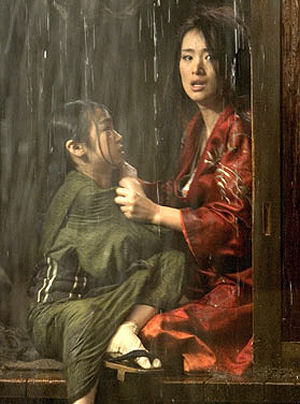
Suzuka Ohgo (l.), Gong Li

Eventually Sayuri meets Prince Charming in the form of a businessman called “The Chairman” (Ken Watanabe) and falls for him. The usual hurdles and compli- cations have to be overcome before Watanebe finally recognizes what a treasure she is and tells her he loves her.
I think I was a little happier than Sayuri was when this happened.
The most irritating performance is given by Kaori Memoi, who plays the crusty and conniving Mother, the head of Sayuri’s geisha house. Her English is so bad and so grating I literally twitched in my seat at one point.
The movie stays with the explanation in Golden’s novel about what being a geisha is all about, which is that geishas are in no way prostitutes and are more about being a very refined form of arm candy…a poised and disciplined ideal of Japanese femininity.
And yet somehow, despite all the talk about no sexual favors, Sayuri and Mameha end up doing some nocturnal skinny-dipping with a bunch of Japanese business- men and an American colonel (Ted Levine) in the third act.
A Japanese businessman admirer of Sayuri has asked her to cuddle up to the American Colonel so he get get a business deal out of him, and when Levine’s character makes a move a few minutes later Sayuri is shocked and offended.
This is ridiculous, and another reason I didn’t believe what the film was selling. Geishas are not hookers, okay, but all my life I’ve been told that carnal knowledge is sometimes part of the equation. You just have to be the right guy with the right attitude, the good manners of a gentleman and a lot of money.

No one will argue with Geisha getting the usual below-the-line nominations that are always handed to a film of this type. Dion Beebe’s cinematography, John Myhre’s production design, Colleen Atwood’s costumes and John Williams’ score are all topnotch. What the hell, throw in nominations for the editor and the sound editing guys.
Geisha was mostly shot in the Los Angeles area (an outdoor Japanese village was built north of the city), including the Sony soundstages in Culver City. That means a lot of local people were paid top dollar, which tends to produce in the minds of Academy people an urge to reciprocate in the form of handing out Oscar nomina- tions in the less-important categories.
But classy window-dressings aren’t enough to justify nominating a film for Best Pic- ture. The above-the-line nutrition in Memoirs of a Geisha simply isn’t there, and no amount of cheerleading by its supporters is going to change that fact.

Step On It

Step On It

Rob Marshall’s Memoirs of a Geisha (Columbia, 12.9) is this year’s model of the big bland Best Picture contender that everyone who isn’t a sucker for this kind of thing — expensive, beautifully produced, Oscar-hungry, terminally boring — needs to throw tomatoes at.
Seriously…let’s start the ball rolling now. IM your friends and coworkers and tell them you’ve heard it’s a tedious costume-movie drag, but also that it’s caught a certain headwind and there’s a slight chance it could metastasize into this year’s Chicago.


Ziyi Zhang during her big geisha-in-a-snowfall performance number that has zip to do with her character but a lot to do with Rob Marshall’s creative sensibility

The best thing about it is Gong Li’s performance as a jealous-bitch geisha in a Bette Davis mode. Otherwise the film is all costumes and pretty photography and a rags-to-riches story that creeps along at a petty pace.
It’s porcelain, nothing, stupefying…and every Godforsaken line of Chinese-accent English-language dialogue is like screeching chalk.
The first Academy-member Geisha screening happens tonight (11.21) so no pulse- readings until tomorrow, but there’s a poll of eleven connected journos that just went up today on Movie City News called “Gurus of Gold,” and Geisha is being project- ed as one the top five Best Picture contenders.
< ?php include ('/home/hollyw9/public_html/wired'); ?>
Two of the respondents — Variety guy and Maxim critic Pete Hammond and USA Today‘s Scott Bowles — are actually projecting it as the most likely Best Picture winner…at this juncture.
The stars of Memoirs of A Geisha are Ziyi Zhang, Michelle Yeoh and Gong Li… three famed Chinese actresses played Japanese geishas and speaking English …and the feeling of Hollywood fakery and retrograde attitudes is fairly relentless.
The same Anglos-first mentality that led to the casting of Marlon Brando as Sakini in The Teahouse of the August Moon (’56) and Ricardo Montalban as Nakamura in Sayonara (’57) has prevailed once again.

And at no point does Memoirs of a Geisha feel like anything more than a colorful but perfunctory corporate tour of an exotic culture, tailor-made for Disney World Americans who won’t pay to see movies with subtitles.
I can tolerate the three Chinese actresses playing Japanese (although Ziyi doesn’t look Japanese for a second, and there’s a clear genetic difference in the faces of the two peoples), but the language and accent barriers are impossible.
Marshall should have shot a Japanese-language version concurrently, which Columbia could have concurrently released into select big-city theatres. Difficult but not impossible, and then people like me would have had an easier time of it.
There’s a scene early on in which a pair of young sisters are about to be forcibly separated. A very traumatic thing, but if this were to happen in real life the sisters would be in such shock they’d probably whimper a little bit and spend most of their last few seconds just staring at each other. Not in Rob Marshall’s world. When Geisha‘s sisters are torn apart the more spirited of the two goes, “Noooooo!!”
That’s a bullshit Hollywood reaction. People in bad Hollywood movies always go “noooo!!” when something bad happens. In a way, the whole movie is like this one scene. I didn’t believe a word of it.
And I wonder if the women for whom it’s been made will either. And I doubt if any real critical support will manifest. A publicist friend tells me all the journos he’s spoken are saying “pretty to look at, but cold.”
Robin Swicord and Doug Wright’s script is based on Arthur Golden’s 1997 novel, which is a huge international best-seller. I think it’s safe to say that the movie will dampen interest in anyone who hasn’t yet read it wanting to do so. My God, who would want to take this journey twice?


Ziyi Zhang, Ken Watanebe

Set in Japan in the 1930s and ’40s, Geisha is essentially a Cinderella story, and there’s not a hint of story tension or rooting interest in any part of it.
A little Japanese girl (Suzuka Ohgo) who will eventually be called Sayuri is sold to a geisha house (called an “okiya”), kicked around and treated like a slave. She’s quite pretty as an adolescent and is considered a special standout because of a pair of very weird-looking blue eyes (which throw you completely out of the film because they look like dopey contact lenses, pure and simple).
And then she grows up to be Ziyi Zhang, who doesn’t resemble Ohgo in the slightest.
This much-celebrated 26 year-old actress gives her first nothing performance here. She brought a fierce glaring passion and a taut physicality to her roles in Crouch- ing Tiger, Hidden Dragon and Hero and found a sense of emotional truth in Wong Kar Wai’s 2046, but here she’s a piece of wood.
Gong Li wields a much sharper blade as Sayuri’s wicked geisha nemesis Hatsu- momo. She’s stuck in the same mediocre Rob Marshall movie, but there’s fire in her veins and the heat burns through, and right away she has you thinking impure thoughts.
Sayuri, in any event, is trained to be a geisha and soon gets into an ongoing generational cat-fight with the older Hatsumomo. Her ally is Yeoh’s Mameha, a 40ish geisha playing a stock older-mentor character, dispensing sage advice with the usual kindly-patient smile.


Suzuka Ohgo (l.), Gong Li

Eventually Sayuri meets Prince Charming in the form of a businessman called “The Chairman” (Ken Watanabe) and falls for him. The usual hurdles and compli- cations have to be overcome before Watanebe finally recognizes what a treasure she is and tells her he loves her.
I think I was a little happier than Sayuri was when this happened.
The most irritating performance is given by Kaori Memoi, who plays the crusty and conniving Mother, the head of Sayuri’s geisha house. Her English is so bad and so grating I literally twitched in my seat at one point.
The movie stays with the explanation in Golden’s novel about what being a geisha is all about, which is that geishas are in no way prostitutes and are more about being a very refined form of arm candy…a poised and disciplined ideal of Japanese femininity.
And yet somehow, despite all the talk about no sexual favors, Sayuri and Mameha end up doing some nocturnal skinny-dipping with a bunch of Japanese business- men and an American colonel (Ted Levine) in the third act.
A Japanese businessman admirer of Sayuri has asked her to cuddle up to the American Colonel so he get get a business deal out of him, and when Levine’s character makes a move a few minutes later Sayuri is shocked and offended.
This is ridiculous, and another reason I didn’t believe what the film was selling. Geishas are not hookers, okay, but all my life I’ve been told that carnal knowledge is sometimes part of the equation. You just have to be the right guy with the right attitude, the good manners of a gentleman and a lot of money.

No one will argue with Geisha getting the usual below-the-line nominations that are always handed to a film of this type. Dion Beebe’s cinematography, John Myhre’s production design, Colleen Atwood’s costumes and John Williams’ score are all topnotch. What the hell, throw in nominations for the editor and the sound editing guys.
Geisha was mostly shot in the Los Angeles area (an outdoor Japanese village was built north of the city), including the Sony soundstages in Culver City. That means a lot of local people were paid top dollar, which tends to produce in the minds of Academy people an urge to reciprocate in the form of handing out Oscar nomina- tions in the less-important categories.
But classy window-dressings aren’t enough to justify nominating a film for Best Pic- ture. The above-the-line nutrition in Memoirs of a Geisha simply isn’t there, and no amount of cheerleading by its supporters is going to change that fact.

USC Interlude


Ain’t It Cool’s Drew McWeeny and yours truly paid a visit Monday night to Charles Fleming’s “Entertainment, Business and Media in Today’s Society” class at the USC School of Journalism. We talked about internet journalism, industry politics, survival skills, the shortcomings of Tom Rothman and what the students thought about the hot new movies. Defamer’s Mark Lisanti, profiled in the current issue of Los Angeles magazine, was supposed to show but bowed out at the last minute….something about his girlfriend having told him they already had “plans” (does that sound like a crock of shit or what?). Thanks to Fleming (pictured at left with the suit and tie) for having us down.

Cowpoke Surge

Cowpoke Surge

It’s time to say it straight (and I don’t mean that as a pun): Ang Lee’s Brokeback Mountain (Focus Features, 12.9) is the movie to beat in the Best Picture race this year.
I’m not saying it will win or lose, but it’s the one film everyone in the country will be talking about over the next five or six weeks and deciding where they stand deep down. And it’s safe to say that a lot of convictions about this film will go far beyond issues of cinematic criteria.


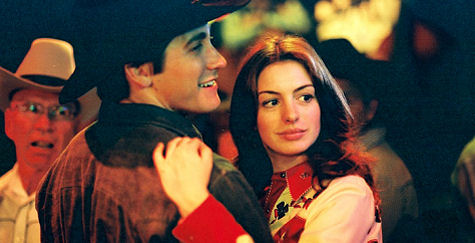
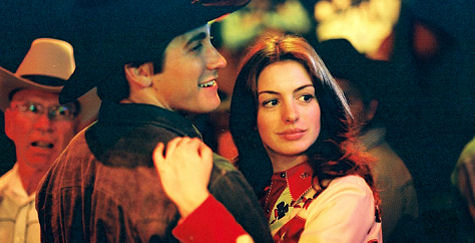
On the brink of a dishonest marriage: Jake Gyllenhaal, Anne Hathaway in Ang Lee’s Brokeback Mountain (Focus Features, 12.9)

The bottom line is that Brokeback Mountain is the only year-end prestige film that people are weeping over, and that matters. On top of which it has a simple philoso- phical theme (i.e., ignore the pleadings of your heart at your own peril), which all Best Picture winners tend to have.
This is mostly a gut feeling, but I’ve called around a bit and it’s the one film that seems to be truly gathering steam within L.A. and N.Y. screening circles (except for certain conservative harumphers and macho conquistadors) as an enlightened stand-out.
It’s the classiest tearjerker. The most bravely made. The year’s one big deck-re- shuffler. The stand-alone-under-a-lonely-nightscape movie that did something new and head-turning. A film that brought a sense of real compassion and vulnerability to the table, and is sure to goad anyone who sees it into a deeper understanding of what comprises human tragedy.
< ?php include ('/home/hollyw9/public_html/wired'); ?>
I haven’t conducted any kind of scientific poll, but I’m hearing that Academy mem- bers are saying to each other than Brokeback Mountain is an almost-certain Best Picture nominee, which confirms what I’ve long believed would eventually happen anyway.
But I have to acknowledge something else, however reluctantly, which is that there are people out there who are not on the team and never will be.
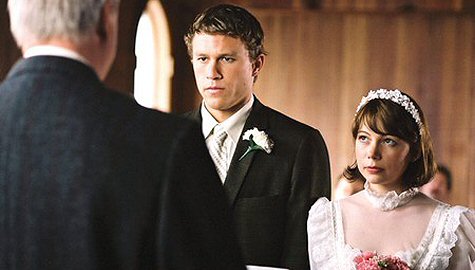
Brokeback Mountain is at heart an emotionally shielded and heterosexual-attitude piece about two rugged western guys named Jack Twist (Jake Gyllenhaal) and En- nis del Mar (Heath Ledger) who fall in love with each other in their early 20s and spend the rest of their lives feeling all screwed up about it.
They both get married and have kids and take a stab at conventional domesticity while continuing to get together for “fishing trips” now and then. But the denial fes- ters and eats away. Ledger’s gruff, emotionally plugged-up cowhand is especially unable to act on his feelings for Twist in any lasting way, and all kinds of bad stuff kicks in down the road.


Brokeback Mountain‘s Heath Ledger, Jake Gyllenhaal, Michelle Williams and Anne Hathaway at Toronto Film Festival press conference for the film.

My repeated promises that this film isn’t gay are getting tiresome, but it really and truly isn’t. But those nagging impressions about it being a “gay cowboy” movie aren’t going to go away, and the more recent (and catchy) “gay Gone With the Wind” label is going to stick also.
And I’m afraid…I’ll just spit it out…that homophobia and closet bubba-ism (which is a bigger factor than some of us may realize) are going to start elbowing their way into the Brokeback Mountain conversation over the next several weeks.
I’ve been picking up indications of resistance in letters here and there…just hints and simmerings (following this article is a letter from a 26 year-old Milwaukee guy who’s been picking up a certain vibe when the trailer plays)…but I’m starting to sense there may be more where this comes from.
And I’d be kidding myself if I didn’t admit to the possibility of a subterranean, grumpy-straight-male, anything-but-Brokeback groundswell. If there’s enough heft behind this, there’s a chance that the scales could tip against Lee and producer James Schamus and everyone who loves and supports this film.
The fact that Matt Drudge, a conduit of conservative opinion but also a guy with a very sharp nose for what’s happening in the hinterlands, has run at least two uh-oh items about Brokeback Mountain… this is a significant barometric reading.


Brokeback Mountain director Ang Lee after winning the Golden Lion at last September’s Venice Film Festival

Focus Features wants to take the high road and I understand that, but The Battle of Brokeback Mountain is starting to take shape, and will fundamentlally be about whether people can look beyond their personal agendas and aversions and look into the fundamental truths contained in its story.
The more I consider the competition, the more I’m persuaded that no other film has come close to staking out, much less laying claim to, the emotional turf occupied by Brokeback Mountain.
The issue of whether or not it will gather more support than Steven Spielberg’s Munich, which my ass-teletype and insect-antennae readings keep telling me is going to be received in a couple of weeks’ time as a pretty good film but which has almost no chance of being this year’s Million Dollar Baby, is almost moot at this stage.
How can I say that? What do I know? But just wait.
The older ooh-ahh crowd…the journalists and Academy members who voted or campaigned for Rob Marshall’s Chicago two years ago…seem to be lining up behind Memoirs of a Geisha, and already I can see this emerging as a possible anything-but-Brokeback alternative (although I gag at the thought).
Capote is a sublimely haunted film that gets better every time you re-see it or think back on it. The New World will almost certainly be a compositional stunner (and perhaps more). Crash broke through and found its audience and deserves an industry-wide salute. And The Constant Gardener is thrillingly crafted piece that fuses the emotional and political into a kind of African third-world symphony.

But Brokeback Mountain is the daddy…the one movie with a grip on a profound human truth that we all recognize.
This is what we’re all sitting on…the rumble of mid-November. And the question seems to be whether or not the resistant types out there will summon the char- acter to overcome their macho chortlings about the cornholing-in-the-tent-on-the- fishing-trips, and find the calm and coolness that will allow them to be big-hearted and open-hearted enough to…fuck it…let this film in.
We’re all lonely. We’ve all let chances at happiness slip through our fingers. Life is so damn short it’s not funny. What we feel in our hearts we’d better damn well act upon, or we’ll sure as shit feel the consequences down the road.

Attaboy

Thanks to Buffalo News columnist Greg Connors for giving me and this column a plug in last Monday’s edition.

Milwaukee, Baby

“I’m starting to worry about Brokeback Mountain‘s appeal in Milwaukee and surrounding environs. I live in Milwaukee and we have two Landmark theatres here — the Oriental and the Downer. And the trailer for BBM has been playing for a month or so in front of most films at both theaters, and I’ve seen it about four or five times within that time period.
“Though the audience is pretty typical for an art house/indie theatre, reactions have not been positive. Each time I’ve felt something like confusion, followed by the reali- zation that it’s ‘the gay cowboy movie.’ followed by either snickering or outright laughter. It seems like people don’t know what to make of it.


Landmark’s Oriental theatre in Milwaukee, haven to a group of Brokeback snickerers whose numbers are undetermined.

“I know the people I was at the theatre with snickered. Some had heard of it and some had not. But when they realize that it’s a love story between two cowboys, they laugh…regardless of whether or not they had heard of it.
“Not that I’d know how to sell it any better than Focus has. I hope I’m wrong. I think it looks great and I can’t wait to see it.
“I am 26. I would say that the snickerers in the audiences I’ve seen the trailer with are on the younger side. Maybe younger viewers just aren’t interested in Brokeback Mountain and that’ll be that.” — Paul Doro, Milwaukee, WI.


Another place for chortlers and snickerers to congregate

Young-male aversion to the trailer is mentioned in Sean Smith’s currently-running Newsweek story about Brokeback Mountain.
By way of Smith, producer James Schamus addresses the guys who are laughing at the trailers: ‘If you have a problem with the subject matter, that’s your problem, not mine,’ he says. ‘It would be great if you got over your problem, but I’m not sitting here trying to figure out how to help you with it.’
Smith also reports, “In an early meeting, Schamus told Lee that, from a marketing standpoint, they were making this film for one core audience. ‘Yes, of course,’ Lee said. ‘The gay audience.’ No, Schamus said. ‘Women.'”

Cash It

Editor’s note: I’m re-running the review I ran last September about Walk the Line because it opens tomorrow on Friday, 11.18.]
Walk the Line (20th Century Fox, 11.18) is a frank, straight-from the-shoulder bio- pic about the late Johnny Cash, and I’m cool with it and admire it in most of the ways that usually count.
For above all (and because there are many pleasures in the way it unfolds), Walk the Line is a solid, strongly composed thing — cleanly rendered and always touch- ing the bottom of the pool.
Just as George Clooney’s Good Night, and Good Luck plays, appropriately, like a live 1950s TV drama, Walk the Line is constructed and delivers like a good Johnny Cash song…no b.s., down to it, hurtin’ feelings, etc.


Walk the Line costars Joaquin Phoenix (as Johnny Cash) and Reese Witherspoon (as June Carter)

It’s easily Mangold’s best film ever, and from the guy who directed Girl Interrupted, the respectable Cop Land, the unsettling Identity, the nicely composed Kate & Leopold and the excellent Heavy, that’s saying something.
And you can definitely take Joaquin Phoenix and Reese Witherspoon’s performances as Cash and the apple of his eye, June Carter, to the bank. They’re both spot-on…fully believable, living and breathing on their own jazz, and doing their own singing and knocking down any resistance or concerns you might have about either one being able to inhabit or become the real deal.
Phoenix is a lock for a Best Actor nomination, and Witherspoon for a Best Actress nom — no question.
You will not in any way feel burned by this movie, and in many ways it will leave you with a feeling of finely-honed honesty and conviction…isn’t that the bottom line?


Johnny Cash and Elvis Presley, backstage after a show they gave in ’56.

At the same time I have to be dirt straight and say that the story of the film, which can basically be boiled down to “when will Johnny and June finally get married?”, didn’t exactly throttle me.
Walk the Line is very austere and manly, but when you look at it in sections, it’s just a standard showbiz saga progression thing…this happened, that happened, this happened, etc.
But the real reason it might run into trouble with the Academy is one that David Poland alluded to last summer, which is that Walk the Line is a bit too much like Ray…it’s too deja-vu.
Both films tell stories about a famous but flawed musical performer…the boy-born-into-southern-poverty thing, the rural hand-to-mouth upbringing, the sympathetic loving mother, the brother dying in childhood and marking the singer-to-be for life, an early marriage followed by drug abuse and infidelity, the cleanup detox scene, etc.
And frankly? It doesn’t get you emotionally all that much, although it does get you in retrospect because it feels honest and solid and doesn’t flit around. This movie never snickers or leers or tugs at your shirtsleeves — it says it plain, take it or leave it. And that grows on you.

The basic arc of this thing is, when will Johnny Cash attain a state of togetherness and a lack of encumbrance due to this or that gnarly issue (drug problems, marriage to first wife, etc.) to finally win over June Carter and get her to accept his marriage proposals? When will Johnny and June finally get hitched? That’s the basic shot.
It’s not meant as a put-down, but I don’t happen to feel that this or that woman (I don’t care how beautiful or giving or strong-of-spirit she is) can save any man’s life. Happiness can only be self-created — it must come from within.
I understand and respect that Johnny felt differently and needed June like a rose needs rainwater, etc., but I couldn’t empathize.
But I did feel it…that’s the odd thing. I felt a sense of absolute completeness, of bare-boned reality and complexity…in no persistent way did Walk the Line make me feel under-nourished.
Make of this what you will. I obviously can’t figure it out myself, but I’ve tried to be true to the spirit of this film by just saying it and letting the chips fall.

Wham Bam

Cinderella Man re-opens this Friday in a bid to get people to reconsider it for Oscar nomination, and maybe to make a bit more money. The most honest thing I can do is to re-print what I wrote late last May, the morning after seeing it at the AMC Empire on 42nd Street:
It isn’t quite stupendous, but Cinderella Man is honest and earnest and has dignity and heart, and if you don’t respond to it on some deep-down human level there’s probably something you should have inside that’s not there.
It’s easily the best, most emotionally rewarding mainstream flick of the year so far, and that’s not a left-handed way of saying it’s the best application of traditional thematic uplift…although it is that, I suppose.


Russell Crowe as the legendary Jim Braddock, Paul Giamatti as his manager Joe Gould in Ron Howard’s Cinderella Man.

Like Seabiscuit, Cinderella Man is a 1930s Depression saga about a sports figure — an Irish boxer named James Braddock (Russell Crowe) — who was up and flush in the late 20s and then down after the 1929 crash and then fighting badly and presumed to be over…like a lot of people were assuming about themselves and even the country as a whole.
But then Braddock lucked into another chance and made good on it big-time by taking the heavyweight championship title from the formidable Max Baer, who had killed a guy in the ring and maybe another one besides (a delayed response thing), and in so doing struck a chord with working people struggling to make do in that horrible period.
The mythological similarities aside, Cinderella Man has been crafted by director Ron Howard with a good deal more poignancy and grace and laid-back confidence than Gary Ross was able to summon for Seabiscuit.
And Crowe can act circles around the horses who played Seabiscuit, and looks an awful lot like the real Jim Braddock…as far as his weight loss and genetic inheritance and the first-rate makeup allow for, I mean.

Cinderella Man also has the absolutely genius-level Paul Giamatti, who got a round of applause during the closing credits at last night’s all-media screening at Manhattan’s AMC Empire 25.
Let’s say it right here and now — Giamatti is a guaranteed lock for a Best Supporting Actor nomination next year.
It’s way too early to even think about making blanket calls about winners, but given the fact that everyone knows that Giamatti has been burned twice — last year when he wasn’t nominated for Best Actor for Sideways and the year before when the Academy ignored his American Splendor performance — he’s looking like a very heavily favored guy at this stage.
Every movie that connects with audiences says something that everyone including your grandfather recognizes as honest and true. The message of Cinderella Man, simply put, is that there’s nothing like getting heavily and repeatedly kicked in the ass (like having to deal with hopelessness and soup kitchens and bread lines, having no job, being unable to pay the electricity bill, seeing your kids go hungry) to give your life a certain focus.
What did I love about Cinderella Man the most, apart from the story and production designer Wynn Thomas’s convincing `30s milieu and Salvatore Totino’s cinematography and the pitchperfect performances? The fact that Howard hangs back for the most part and doesn’t push the emotional buttons too strongly.
I love that after an establishing prologue of six or seven minutes Howard takes things into a downer struggling mode and keeps them there for a full 45 minutes.

And then when the turnaround stuff finally starts to happen he doesn’t lather it and try and beat you up with it. We know that the story is a classic come-from-behind uplifter and this is why Howard is making the film, etc., but it doesn’t feel as if he’s hustling you. He’s telling a true story, after all, and holding back for the most part and just letting it come together on its own terms.
Okay, he throws in some inspirational Irish music here and there and gives us a few Ron Howard-y touches here and there, but not so you’d really notice.
Over the last few years, and particularly since he got into his 50s, Ron Howard has been getting better and better. A Beautiful Mind, The Missing (an undervalued, tough-as-nails western) and now this…perhaps the best film of his life.
Cinderella Man is longish (two hours and 20 minutes), but it doesn’t feel that way because the attention paid to this and that detail in the early sections totally pays off in the third act. Congratulations to Howard, his partner/producer Brian Grazer, and screenwriters Cliff Hollingsworth and Akiva Goldsman (A Beautiful Mind ) for deciding to let the story takes its time and in so doing imparts a certain confidence.
The climax of the down period comes when the destitute Braddock, desperate to get the power in his family’s cold-water flat turned back on, goes to a bar to beg change from his former cronies and supporters in the boxing game. It’s a painful scene, but it’s real and believable and penetrating as hell.
The five or six fight sequences are exciting and beautifully cut, and I didn’t care if they were as original as Scorsese’s Raging Bull sequences appeared back in `80.


The real Jim Braddock (left) and Max Baer, in snaps taken sometime around 1934 or ’35 or thereabouts.

The big climax, which lasts about 25 or 26 minutes, depicts, of course, Braddock’s fight against the heavyweight champion Max Baer (Craig Bierko). I knew who the winner would be, obviously, but it didn’t matter because the film is so well shot and edited, blah, blah.
Crowe’s performance is an absolute home run. As Braddock’s wife Mae, Renee Zellweger gives her least tedious and off-putting performance since Jerry Maguire. (She almost made me forget about the last Bridget Jones film.)
Bierko’s Baer is a trip and a half. I loved his wild-ass expressions and goofing off in the ring, and how he flips this over in an instant and turns into a beast out for blood.
I loved Bruce McGill’s hard-nosed fight promoter character. McGill nails it every time (Collateral, Matchstick Men, The Insider) and has become one of most dependable character actors around, bar none.
I even found a place in my heart for Paddy Considine’s friend-of-Jim-Braddock character…a political activist-slash-working man….and that’s saying something given my lingering feelings about that “fee-fi-fo-fum” scene in Jim Sheridan’s In America.

War of the Wires

“The question about whether Paramount Home Video should have erased the wires in the just-out DVD of George Pal and Byron Haskin’s War of the Worlds should be simple, but it has somehow become more complex.
“The basis of any serious film restoration is now, and has always been, reference to the original. Not the original negative — the original print.
“With any production, not even specifically special-effects films, the film’s creators had a knowledge of what the shot footage would yield on a final print. Costumes, sets, make-up and special effects devices were all based upon that specific knowledge.

“The problems began in the late 1980s, when Kodak’s newest mastering
and print release stocks for both B & W as well as color emulsions were produced with a much finer grain structure. And make no mistake — that was a good thing.
“It began to combine in the ’90s with newer film-to-tape transfer technologies which enabled a higher resolved record of the film image.
“We saw the earliest problems on what were beautifully rendered laser discs of the Chaplin classics from Image Entertainment. The best people were brought in to go through the elements and oversee the work.
“But here’s where it gets difficult. One might make the assumption that access to an original fine grain master of, let’s say, City Lights or The Circus would be a great thing. And it was.
“But Chaplin had taken that master, and from it created a dupe printing negative from which final release prints would have been struck.
“Chaplin, a master filmmaker, knew precisely what affect optics and grain structure would have on his final product.

“Take away one generation and suddenly we see production artifacts like wires.
“This same thing occurred with 70mm prints of 2001: A opace Odyssey struck on the newer stocks. Because of the higher resolution, the glass holding the revolving pen on the spaceship heading to Clavius could now be easily seen in theatrical projection.
“Although I haven’t seen an original dye transfer print of WotW in decades, I can tell you that the system worked as follows.
“In 1953 Technicolor was using optics which are nowhere near the resolution of today’s scanning devices. This softened the image, yielding a more pleasant, less grainy look to the film.
“The mordant which allowed the liquid dyes to adhere to the blank stock was also slightly different than used later, and allowed a very slight softening of the grain structure.
“The final look of the print was achieved by the optics used in the creation of the printing matrices, the mordant, and the liquid dyes. The image looked perfect and brilliant on screen because of the slightly higher contrast of the Technicolor system which created a higher perceived sharpness — not actual sharpness.

“Taking those three-strip elements today and negating everything that came between them and the final print can yield a final result which is of overall higher resolution than the original prints. Hence the quandary, and there are two camps.
“My belief is that anything that breaks the suspension-of-disbelief
between the film and the audience should be altered to look as it
did, but now within an overall image of higher resolution.
“So personally I would remove the wires, as I would remove bad matte lines which can make early effects laughable and stop a film in its tracks, making it look like an antique.” — Robert Harris, the producer-scholar who supervised the legendary photo-chemical restorations of Lawrence of Arabia, Vertigo, Spartacus, Rear Window, etc.

Fatigue Guy

“During my prior life as a Merrill Lynch stock analyst, I was quoted as saying this about Harry Potter fatigue. In the fifth paragraph from the bottom, I mean.
“And I was kind of right — each successive film has done less box office than the previous, but of course the books are still boffo.” — Dave Lichtman

War With Itself

The recently-issued Paramount Home Video DVD of the 1953 War of the Worlds, one of the most beautifully photographed Technicolor movies ever made, looks absolutely breathtaking. This sci-fi classic provides one of the lushest color-baths in Hollywood history and has always looked sumptuous…now it’s heavenly.
But there’s an unfortunate side effect to this clarity. The new DVD (released on 11.1) pretty much ruins the suspension-of-disbelief element because of the way- too-visible wires holding up the Martian spaceships. You can see them repeatedly during scenes of the initial assault against the military…a thicket of blue-tinted wires holding up each one.


You can see the wires in this photo (taken off my own TV) but if you have any kind of recently-manufactured big-ass flat screen, they look much more vivid than indicated here

And there’s no believing it. The wires are much too vivid. Clayton Forrester (Gene Barry) is explaining to General Mann (Les Tremayne) how the Martians keep their bright green ships aloft, that they’re using “some form of electro magnetic force” and “balancing the two poles” and so on, and it’s absurd. The illusion is shot.
The obvious solution is for Paramount Home Video to digitally erase the wires. It would make perfect symmetrical sense. Just as digital technology has made this 1953 film look sharper than ever before, it follows that digital technology needs to recreate the original illusion. The wires weren’t that visible 52 years ago, and they weren’t as visible in Paramount Home Video’s 1999 DVD.
I can’t believe there are people who feel that wire-erasing would be a violation of the original film and are actually arguing against a fix-up, but they’re out there.
One of those naysayers is the highly respected and very bright Glenn Erickson (a.k.a., “DVD Savant”). I’m stunned that a smart guy like Erickson could be so dead friggin’ blind.
“Many scenes [in War of the Worlds] that appeared blurry or poorly composited [before] are now crystal clear,” Erickson said in a review posted 13 days ago. “This means that the forest of fine wires supporting the fighting machines is now more visible than ever, so we can’t have everything.
“There was no CG wire removal in 1953,” he writes, “and it would be detrimental revisionism to change the picture now. Today’s enlightened filmmakers like George Lucas would never do such a thing! So be an adult and learn to live with it.”

Uh-huh. Suppose George Pal and Bryon Haskin couldn’t do anything to hide the wires in their film, and 1953 audiences could therefore see them as clearly as DVD watchers can now? Would Pal and Baskin have just shrugged and told Paramount and the exhibitors, “Sorry, guys… learn to live with it…it’s the best we can do”?
Obviously the new DVD is the provider of “detrimental revisionism” — it’s showing an image that wasn’t meant to be seen.
Obviously, clearly…hello?…erasing the wires will enable audiences of today to suspend their disblief with the same ease that audiences did 52 years ago. You can’t muddy up the image so they can’t be seen, so it’s the only thing to do.
I’m going to be charitable and consider the possibility that Erickson may be over- worked and wasn’t thinking all that clearly when he wrote what he wrote. All is forgiven if he recants.
John Lowry, the head of Lowry Digital who’s done some great clean-up and/or digital restoration work on loads of classic films, was the one hired by Paramount Home Video to clean up War of the Worlds .


Ann Robinson, Gene Barry in War of the Worlds

“Our job is always to serve the wishes of the client…we do what the client says …and we didn’t have orders to clean up the wires,” he says. “Plus we were working on a very tight budget.”
Lowry faced a similar issue when he was doing the digital remastering ofAlfred Hitchcock’s North by Northwest. “We were working onthe scene when the crop duster plane crashes into the gas truck,” he recalls, “and there were 25 or 30 frames of that particular shot in which you could see three wires holding up the rather large model of the airplane.
“And I said to myself, my God, too obvious…it spoils the illusion. And I asked myself, what would Hitchcock do? I knew what he would do. Take the wires out of there. So I did, and the Warner Bros. people approved.
“But ever since then we’ve been very attuned to original artistic intent. And with today’s technology, anything that interferes with the story-telling process or which degrades that process, is dead wrong.
“We got rid of the wires on the Mary Poppins DVD, for the Disney people. We asked and they said ‘get rid of them’ but they had the money to do it.

“When we were working on the snake-pit scene in Raiders of the Lost Ark you could see all kinds of reflections in the glass separating Ford from the snakes, and there was a very conscious decision made by Spielberg to take the reflections out.”
I called and e-mailed a few other guys who should have opinions about this story — restoration master Robert Harris, director and War of the Worlds fan Joe Dante (who riffs about the film on one of the DVD’s two audio tracks), and film restoration artist Mike Arick.
I’ll probably add to this story on Monday if any of these guys reply.

Grabs


George Clooney, New York Times editor-writer Lynn Hirschberg during a discussion at theatre #10 in Hollywood’s Arclight theatre complex — Saturday, 11.12.05, 4:35 pm. One piece of news that emerged is that Clooney is looking to direct a film currently being written by Joel and Ethan Coen called Suburbacon. Another is that he’ll direct but won’t act in the upcoming televised re-do of Network. He said it took him only about a month to gain 35 pounds for his role in Syriana. I told him I’d been told prior to seeing it by a critic friend that “Fat Clooney is one of the best [performances] that you’ll see this year”…and he was right.

Sunset Blvd. near Cole, looking east — Saturday, 11.12.05, 2:10 pm.

Pico Blvd. and La Brea Avenue, looking south — Saturday, 11.12.05, 6:40 pm.

In front of Arclight Dome theatre — Saturday, 11.12, 2:05 pm

Looking down on the Arclight lobby — Saturday, 11.12, 3:25 pm

Bring It On

Shoot any kind of outdoor footage of the Middle East (especially in Iraq, Saudi Arabia, Afghanistan, et. al.) and you get the same flat terrain…aflame, parched, bleachy…which makes for a kind of atmospheric monotony.
But movies shot there (or which happen there) don’t have to be dull. The Middle East is the dramatic boiling pot of our times. It’s just a matter of going there and absorbing the particulars and pruning them down into something fitting and well- sprung.


U.S. soldier involved in fighting in Falujah in ’04

I’ve recently seen a no-pulse, no-conflict, Waiting-for-Godot Middle East film (Sam Mendes’ Jarhead) and a complex, multi-layered, altogether fascinating one about the pernicious social and political political effects of big oil (Stephen Gaghan’s Syriana)…and leapin’ lizards, talk about a night-and-day response.
I’ll be waiting until 11.23 before running a Syriana review, but it’s obviously a far better film.
Jarhead was so bad and so nothing that it would feel almost refreshing to see a real Middle East war movie — a half-real, half- fictional narrative about the current conflict in Iraq, say. And why not? It’s time.
Hollywood didn’t feel safe about making Vietnam movies until 1978, and the first major Gulf War movie — David O. Russell’s Three Kings — didn’t happen until ’99, or about eight years after the fact. But the concepts of lag-time and the usual “gee, can we get into this?” no longer apply.
The reality of instant digital commnunications means that dramas (or black come- dies) about current military conflicts need to be shot and rescrambled with some urgency. Waiting around won’t do. Immediacy may not be the whole game, but it matters as much as anything else.
Syriana, which Gaghan researched in the Middle East for a full year, is a geo-political spellbinder that doesn’t feel the least bit dated. The story could have happened last summer, or even a year or two from now.


Matt Damon (center) in Stephen Gaghan’s Syriana (Warner Bros, 11.23)

Steven Bochco’s Over There, the first dramatic TV series about an ongoing war, much less one about U.S. troops in Iraq, had its debut on FX last summer. And Hany Abu-Assad’s Paradise Now, a respected film about a couple of would-be Palestinian martyrs, has a ripped-from-right-now quality.
Why not an Iraq War feature right now? Write it, shoot it…sort it out as you go along.
A writer-director of some vision and gumption needs to visit Iraq, get imbedded with the grunts like Gunner Palace‘s Michael Tucker did, soak it up, write it down, find the funding and make a feature film about what’s eally happening in that hell-hole.
Shoot the atmospheric stuff right there, maybe bring some of the cast over…risk it, dodge the bullets, burrow in. And then wrap it, cut it and open it quickly.
If Oliver Stone was the Oliver Stone of the mid to late ’80s, he’d be the guy to do this.
If Italian actor-filmmaker Roberto Benigni (who won a Best Actor and Best Foreign Film Oscar for Life Is Beautiful) can make an Iraqi War film, why can’t Americans?
Benigni just opened a comedy set against the backdrop of the Iraq conflict, althou- gh it was shot in Tunisia. An admired film (if not quite the anti-American rant some of his Italian fans had expected), The Tiger and the Snow opened on 10.14 in Italy and will debut in France in mid-December and probably open here during the first six months of ’06.


Syriana uncertainty: George Clooney’s CIA agent between a rock and hard place

A U.S.-produced drama about the current conflict obviously wouldn’t have to be shot in the streets of Baghdad or Fallujah.
A satisfying film for me would probably have to be something like Syriana or Traffic — a multi-character, five or six-plot-thread piece. I’m not going to try and dream up a story here and now, but it would either need to be a Costa Gavras-type condem- nation piece, or one that shows balanced compassion for U.S. troops as well as Iraqi locals.
Has anyone out there written a script or heard of a good one making the rounds? Is there a military veteran, freelance journalist and/or contract engineer who’s been to Iraq within the last couple of years who’s published stories or recollections on a site that could be made into a good script?
If there’s anything really good that’s been put into script form, or if anyone’s heard of something exceptional making the rounds, please advise.

Aniston Martin

Derailed has been handed a Rotten Tomatoes death sentence — only 19% of the critics approve. But it’s only somewhat bad because of certain hard-to-swallow developments that I won’t divulge. And it’s been well directed by Mikael Halfstrom, and by that I mean it feels solid, assured, nicely shot and well-cut.
Thrillers of this sort often get trashed by critics but supported by paying audiences. An agent told me this morning that Derailed, which opened today, has been doing well in New York theatres.
Like Fatal Attraction and Unfaithful, Derailed is a cautionary thriller about what happens when you cheat on your spouse.


Jennifer Aniston in Mikael Halfstrom’s Derailed

Clive Owen plays a Chicago advertising guy who succumbs to temptation after meeting Jennifer Aniston, a blue-chip financial consultant, on a commuter train. But then they get robbed and assaulted by Vincent Cassel in a seedy hotel room before they get down to it…
I’m not going any further, but Cassel basically becomes Bruno Antony to Owen’s Guy Haines (the two leads in Hitchcock’s Strangers on a Train), and I’d be lying if I said I wasn’t caught up in all the lever-pulling. It’s far from first-rate, but it’s reasonably decent.
The biggest problem is one that nobody seems to have written about so far, which is the casting of Jennifer Aniston as an adulterer who… well, as a woman who can’t be trusted.
As far as I’m concerned, the believabilty of Aniston as a conniving adultress is about the same as a hypothetical casting of Dean Martin as one of Christ’s disciples in George Stevens’ The Greatest Story Ever Told.
Aniston was a TV actress who deserved a fair shake when she played a cheating housewife in The Good Girl, but she’s since become a tabloid superstar — she’s known worldwide as the nice, emotionally temperate actresss who had her heart broken by Brad Pitt.


Dean Martin

Whatever the real truth and whomever she may actually be, Aniston is the good wife who got fucked over. It’s hard, but the public persona of some actors and actresses is so deeply imbedded that they can’t be absorbed into in certain roles..period.
Frank Sinatra as a priest in The Miracle of the Bells…get outta town.
Or John Wayne as Genghis Khan or, much worse, as a Roman Centurion standing at the foot of the cross while Jesus is dying in The Greatest Story Ever Told and saying, “This was truly the son of God.”
There must be dozens of other head-slappers. Send ’em in, please.

Ten Years and Two Weeks

I’m a Terrence Malick fanatic from way back, and it’s the nostalgia factor more than anything else that has me especially excited about seeing The New World (New Line, 12.25), which Malick wrote and directed.
I’m also one of the only journalists to have any kind of conversation with Malick since he went into his Thomas Pynchon withdrawal about 17 years ago (right after the release of Days of Heaven) and became this gentle phantom-like figure whom journalists couldn’t get to under any circumstance.
In this context speaking to Malick on the phone– which I managed to do on Octo- ber 25, 1995, around 11:35 am — was like snapping a photo of Bigfoot. It was a half-pleasant, half-awkward, quite meaningless conversation, but at least he picked up the phone.


Terrence Malick during filming of The Thin Red Line

Malick had been staying with producer Mike Medavoy, who wound up producing The Thin Red Line, but Medavoy was leaving for Shanghai and Malick would be staying elsewhere, so I called to get a forwarding number.
A cleaning woman answered and said Medavoy was out, but that Malick was nearby. She asked me to hold…
Malick: Hi.
Me: Hi, Terry. This is Jeffrey Wells speaking…
Malick: Hi.
Me: And uhh…I was just talking to Mike last night and he said, uh, you might be leaving today and I wanted to see if I could speak with you about an article I’m researching. It’s for Los Angeles magazine and my editor…he worked on that piece about ten years ago with David Handleman for California magazine. It was called “Absence of Malick.”
Malick: Yeah.
Me: I don’t know if…did you happen to read it?
Malick: No, I…I…uhnn…
Me: Anyway, I’m doing this piece and trying to sort things through here. About what’s going on with…well, to start with, The Thin Red Line and that rumored BAM stage production of “Sansho the Bailiff” and…I’ve wanted to speak with you about it, and now that I’m speaking with you I feel…well, I feel nervous.


Locust arrival scene in Terrence Malick’s Days of Heaven

Malick: Don’t be, Jeffrey. It’s not that. I just don’t feel comfortable talking about it yet.
Me: About Red Line, you mean?
Malick: Yeah and…it’s something that has no date, really. It may happen some- time in the indefinite future.
Me: The indefinite future? Uh-huh. So there’s no approximate, long-range plan at all? It’s not even on a low flame?
Malick: I…I’m…uhmm.
Me: I was only thinking, you know…heh-heh… ‘indefinite future.’ You could say the same thing about the sun collapsing and the end of the solar system, heh-heh.
Malick: Uhhmm…
Me: I’m only mentioning this because…well, you may have seen that item in Pre- miere that you said you had this reading of the script with Costner and Lucas Haas and Ethan Hawke.
Malick: We did it just to get a sense of how it flowed.
Me: How did it flow?
Malick: I just don’t feel comfortable talking about it. I appreciate your interest but…


Malick in 1979

Malick: Mike says you’re on the second or third draft, something…it’s a work that’s been through some development and progression, and…
Malick: I….
Malick: I dont want to grill you, Terry. Mike explained the rules and said that grilling you…’that’s the one thing we don’t do’…and I understand that. I had a hope, though, of just discussing movies in general…ones you’ve seen and been impressed by in recent years.
Malick: Well, I appreciate your interest. I guess I do feel uncomfortable talking right now.
Me: I’m just one of…who knows, hundreds of film journalists around the country who regard you as one of the best ever and have watched your films over and over.
Malick: You’re very kind, Jeffrey. I appreciate it and I feel it and it comes to me as very encouraging. But I feel uncomfortable talking about it. I spoke to my brother Chris and he said that you’re just trying to help. And of course I know you’re just trying to do your job.
Me: I was actually just reading about a new laser disc of Days of Heaven that’s coming out, and it’s really something I’m looking forward to because I’ve never seen a print of that film that equalled the first viewing at the Cinema 1 in New York when they showed a 70mm print with six-channel sound, and having a…are you a laser-disc aficionado?
Malick: I’m, uh…not..uh…
Me: Are you…you don’t watch TV? Videos? Do you ever catch movies on tape?
Malick: I’d be happy to talk to you at some later point, Jeffrey.

Me: I know. I understand know what the rules are.
Malick: And someone actually is here, Jeffrey, and I do have to keep an appointment. I would love to, later on…we could talk.
Me: I’ll look forward to it. I understand you’re in town for a few more days.
Malick: Yes, but I really do have to go now.
Me: Because if you have a moment later on, I’d like to run some basic points by you and just go over them one by one, for accuracy’s sake.
Me: I can’t really talk about this. I know what you’re trying to do and it’s not…if you’d try to understand. Chris told me you’d written and that you were trying to help.
Me: Well, I hope you have a good stay. I look forward to chatting again on a more…uhm, relaxed basis.
Malick: Okay, thank you.

Bring It On

Bring It On

Shoot any kind of outdoor footage of the Middle East (especially in Iraq, Saudi Arabia, Afghanistan, et. al.) and you get the same flat terrain…aflame, parched, bleachy…which makes for a kind of atmospheric monotony.
But movies shot there (or which happen there) don’t have to be dull. The Middle East is the dramatic boiling pot of our times. It’s just a matter of going there and absorbing the particulars and pruning them down into something fitting and well- sprung.


U.S. soldier involved in fighting in Falujah in ’04

I’ve recently seen a no-pulse, no-conflict, Waiting-for-Godot Middle East film (Sam Mendes’ Jarhead) and a complex, multi-layered, altogether fascinating one about the pernicious social and political political effects of big oil (Stephen Gaghan’s Syriana)…and leapin’ lizards, talk about a night-and-day response.
I’ll be waiting until 11.23 before running a Syriana review, but it’s obviously a far better film.
< ?php include ('/home/hollyw9/public_html/wired'); ?>
Jarhead was so bad and so nothing that it would feel almost refreshing to see a real Middle East war movie — a half-real, half- fictional narrative about the current conflict in Iraq, say. And why not? It’s time.
Hollywood didn’t feel safe about making Vietnam movies until 1978, and the first major Gulf War movie — David O. Russell’s Three Kings — didn’t happen until ’99, or about eight years after the fact. But the concepts of lag-time and the usual “gee, can we get into this?” no longer apply.
The reality of instant digital commnunications means that dramas (or black come- dies) about current military conflicts need to be shot and rescrambled with some urgency. Waiting around won’t do. Immediacy may not be the whole game, but it matters as much as anything else.
Syriana, which Gaghan researched in the Middle East for a full year, is a geo-political spellbinder that doesn’t feel the least bit dated. The story could have happened last summer, or even a year or two from now.


Matt Damon (center) in Stephen Gaghan’s Syriana (Warner Bros, 11.23)

Steven Bochco’s Over There, the first dramatic TV series about an ongoing war, much less one about U.S. troops in Iraq, had its debut on FX last summer. And Hany Abu-Assad’s Paradise Now, a respected film about a couple of would-be Palestinian martyrs, has a ripped-from-right-now quality.
Why not an Iraq War feature right now? Write it, shoot it…sort it out as you go along.
A writer-director of some vision and gumption needs to visit Iraq, get imbedded with the grunts like Gunner Palace‘s Michael Tucker did, soak it up, write it down, find the funding and make a feature film about what’s eally happening in that hell-hole.
Shoot the atmospheric stuff right there, maybe bring some of the cast over…risk it, dodge the bullets, burrow in. And then wrap it, cut it and open it quickly.
If Oliver Stone was the Oliver Stone of the mid to late ’80s, he’d be the guy to do this.
If Italian actor-filmmaker Roberto Benigni (who won a Best Actor and Best Foreign Film Oscar for Life Is Beautiful) can make an Iraqi War film, why can’t Americans?
Benigni just opened a comedy set against the backdrop of the Iraq conflict, althou- gh it was shot in Tunisia. An admired film (if not quite the anti-American rant some of his Italian fans had expected), The Tiger and the Snow opened on 10.14 in Italy and will debut in France in mid-December and probably open here during the first six months of ’06.


Syriana uncertainty: George Clooney’s CIA agent between a rock and hard place

A U.S.-produced drama about the current conflict obviously wouldn’t have to be shot in the streets of Baghdad or Fallujah.
A satisfying film for me would probably have to be something like Syriana or Traffic — a multi-character, five or six-plot-thread piece. I’m not going to try and dream up a story here and now, but it would either need to be a Costa Gavras-type condem- nation piece, or one that shows balanced compassion for U.S. troops as well as Iraqi locals.
Has anyone out there written a script or heard of a good one making the rounds? Is there a military veteran, freelance journalist and/or contract engineer who’s been to Iraq within the last couple of years who’s published stories or recollections on a site that could be made into a good script?
If there’s anything really good that’s been put into script form, or if anyone’s heard of something exceptional making the rounds, please advise.

Aniston Martin

Derailed has been handed a Rotten Tomatoes death sentence — only 19% of the critics approve. But it’s only somewhat bad because of certain hard-to-swallow developments that I won’t divulge. And it’s been well directed by Mikael Halfstrom, and by that I mean it feels solid, assured, nicely shot and well-cut.
Thrillers of this sort often get trashed by critics but supported by paying audiences. An agent told me this morning that Derailed, which opened today, has been doing well in New York theatres.
Like Fatal Attraction and Unfaithful, Derailed is a cautionary thriller about what happens when you cheat on your spouse.


Jennifer Aniston in Mikael Halfstrom’s Derailed

Clive Owen plays a Chicago advertising guy who succumbs to temptation after meeting Jennifer Aniston, a blue-chip financial consultant, on a commuter train. But then they get robbed and assaulted by Vincent Cassel in a seedy hotel room before they get down to it…
I’m not going any further, but Cassel basically becomes Bruno Antony to Owen’s Guy Haines (the two leads in Hitchcock’s Strangers on a Train), and I’d be lying if I said I wasn’t caught up in all the lever-pulling. It’s far from first-rate, but it’s reasonably decent.
The biggest problem is one that nobody seems to have written about so far, which is the casting of Jennifer Aniston as an adulterer who… well, as a woman who can’t be trusted.
As far as I’m concerned, the believabilty of Aniston as a conniving adultress is about the same as a hypothetical casting of Dean Martin as one of Christ’s disciples in George Stevens’ The Greatest Story Ever Told.
Aniston was a TV actress who deserved a fair shake when she played a cheating housewife in The Good Girl, but she’s since become a tabloid superstar — she’s known worldwide as the nice, emotionally temperate actresss who had her heart broken by Brad Pitt.


Dean Martin

Whatever the real truth and whomever she may actually be, Aniston is the good wife who got fucked over. It’s hard, but the public persona of some actors and actresses is so deeply imbedded that they can’t be absorbed into in certain roles..period.
Frank Sinatra as a priest in The Miracle of the Bells…get outta town.
Or John Wayne as Genghis Khan or, much worse, as a Roman Centurion standing at the foot of the cross while Jesus is dying in The Greatest Story Ever Told and saying, “This was truly the son of God.”
There must be dozens of other head-slappers. Send ’em in, please.

Ten Years and Two Weeks

I’m a Terrence Malick fanatic from way back, and it’s the nostalgia factor more than anything else that has me especially excited about seeing The New World (New Line, 12.25), which Malick wrote and directed.
I’m also one of the only journalists to have any kind of conversation with Malick since he went into his Thomas Pynchon withdrawal about 17 years ago (right after the release of Days of Heaven) and became this gentle phantom-like figure whom journalists couldn’t get to under any circumstance.
In this context speaking to Malick on the phone– which I managed to do on Octo- ber 25, 1995, around 11:35 am — was like snapping a photo of Bigfoot. It was a half-pleasant, half-awkward, quite meaningless conversation, but at least he picked up the phone.


Terrence Malick during filming of The Thin Red Line

Malick had been staying with producer Mike Medavoy, who wound up producing The Thin Red Line, but Medavoy was leaving for Shanghai and Malick would be staying elsewhere, so I called to get a forwarding number.
A cleaning woman answered and said Medavoy was out, but that Malick was nearby. She asked me to hold…
Malick: Hi.
Me: Hi, Terry. This is Jeffrey Wells speaking…
Malick: Hi.
Me: And uhh…I was just talking to Mike last night and he said, uh, you might be leaving today and I wanted to see if I could speak with you about an article I’m researching. It’s for Los Angeles magazine and my editor…he worked on that piece about ten years ago with David Handleman for California magazine. It was called “Absence of Malick.”
Malick: Yeah.
Me: I don’t know if…did you happen to read it?
Malick: No, I…I…uhnn…
Me: Anyway, I’m doing this piece and trying to sort things through here. About what’s going on with…well, to start with, The Thin Red Line and that rumored BAM stage production of “Sansho the Bailiff” and…I’ve wanted to speak with you about it, and now that I’m speaking with you I feel…well, I feel nervous.


Locust arrival scene in Terrence Malick’s Days of Heaven

Malick: Don’t be, Jeffrey. It’s not that. I just don’t feel comfortable talking about it yet.
Me: About Red Line, you mean?
Malick: Yeah and…it’s something that has no date, really. It may happen some- time in the indefinite future.
Me: The indefinite future? Uh-huh. So there’s no approximate, long-range plan at all? It’s not even on a low flame?
Malick: I…I’m…uhmm.
Me: I was only thinking, you know…heh-heh… ‘indefinite future.’ You could say the same thing about the sun collapsing and the end of the solar system, heh-heh.
Malick: Uhhmm…
Me: I’m only mentioning this because…well, you may have seen that item in Pre- miere that you said you had this reading of the script with Costner and Lucas Haas and Ethan Hawke.
Malick: We did it just to get a sense of how it flowed.
Me: How did it flow?
Malick: I just don’t feel comfortable talking about it. I appreciate your interest but…


Malick in 1979

Malick: Mike says you’re on the second or third draft, something…it’s a work that’s been through some development and progression, and…
Malick: I….
Malick: I dont want to grill you, Terry. Mike explained the rules and said that grilling you…’that’s the one thing we don’t do’…and I understand that. I had a hope, though, of just discussing movies in general…ones you’ve seen and been impressed by in recent years.
Malick: Well, I appreciate your interest. I guess I do feel uncomfortable talking right now.
Me: I’m just one of…who knows, hundreds of film journalists around the country who regard you as one of the best ever and have watched your films over and over.
Malick: You’re very kind, Jeffrey. I appreciate it and I feel it and it comes to me as very encouraging. But I feel uncomfortable talking about it. I spoke to my brother Chris and he said that you’re just trying to help. And of course I know you’re just trying to do your job.
Me: I was actually just reading about a new laser disc of Days of Heaven that’s coming out, and it’s really something I’m looking forward to because I’ve never seen a print of that film that equalled the first viewing at the Cinema 1 in New York when they showed a 70mm print with six-channel sound, and having a…are you a laser-disc aficionado?
Malick: I’m, uh…not..uh…
Me: Are you…you don’t watch TV? Videos? Do you ever catch movies on tape?
Malick: I’d be happy to talk to you at some later point, Jeffrey.

Me: I know. I understand know what the rules are.
Malick: And someone actually is here, Jeffrey, and I do have to keep an appointment. I would love to, later on…we could talk.
Me: I’ll look forward to it. I understand you’re in town for a few more days.
Malick: Yes, but I really do have to go now.
Me: Because if you have a moment later on, I’d like to run some basic points by you and just go over them one by one, for accuracy’s sake.
Me: I can’t really talk about this. I know what you’re trying to do and it’s not…if you’d try to understand. Chris told me you’d written and that you were trying to help.
Me: Well, I hope you have a good stay. I look forward to chatting again on a more…uhm, relaxed basis.
Malick: Okay, thank you.

Rent Renewal

The advance word on Rent (Columbia, 11.23) for the last few months has been that it’s going to feel slightly dated (being a late ’80s piece about some young AIDS-af- flicted Manhattanites), and Chris Columbus, not the grittiest and most naturalistic of directors, will gloss it up too much, so watch out.
The buzz was wrong. Say it again: the buzz was wrong.


Rosario Dawson, Adam Pascal during “Light My Candle” number in Chris Columbus’s film of Jonathan Larson’s Rent (Columbia, 11.23)

Call me emotionally impressionable, call me unsophisticated, call me a sap…but I saw Rent last night in Santa Monica, and in its vibrant, open-hearted, selling-the- hell-out-of-each-and-every-song-and-dance-number way, it’s a knockout and an ass-whooper and damn near glorious at times.
I didn’t just like it…I felt dazzled, amped, alpha-vibed. I got into each and every song, every character and conflict…I settled back and went with it. People were applauding after almost every song, and the film really does give you a “whoa… this is special” feeling.
Somewhere up there (out there, in there…whatever), Jonathan Larson, the guy who created the play but died in January 1996, just before the stage show opened, is breathing easy.
Columbus went with almost the entire original cast, and they’re all spot-on. A cer- tain theatricality is inevitable when actors are breaking into song, but everyone plays it down and naturalistic; they don’t project in a playing-to-the-balcony way that throws you out of the piece.
Adam Pascal’s Roger and Anthony Rapp’s Mark are note-perfect. Rosario Daw- son’s singing is surprisingly assured and satisfying, in addition to her usual first- rate emoting. Wilson Jermaine Heredia, Jesse L. Martin, Idina Menzel, Tracie Thoms, Taye Diggs…everyone gets a gold star.
Rent is a slicker, punchier, more revved-up movie musical than Milos Forman’s Hair, which had some of the same elements (kids in New York, in and out of love, looming tragedy). But it’s not that different from the Forman film; it has a similar elan.

I kept saying to myself last night, “What’s wrong with this film?….where’s the mis- calculation? Where’s the gross Chris Columbus saccharine overkill?”…and it just didn’t happen to any bothersome degree.
It may not be hip enough for some of my nyah-nyah, know-it-all critic friends. It may not be Alphabet City enough. It may be, for them, too far removed from the vitality of the original off-Broadway, pre-Broadway show…too much of a Holly- wood-style take on something that may have been a bit sweet or cloying, but which worked because of the Lower East Side funkitude balance-out factor.
Critics said the same thing about Robert Wise’s West Side Story. That overly Oscar-awarded film brought an overly sanitized, sound-stagey quality to the material, wich furthered the loss of the immediacy and excitement of the original B’way play. The dissers of Wise’s film were right. It was too 1961 mainstream.
But Columbus is not Robert Wise. He lived in Manhattan way back when and knew the Lower East Side, he knows the stage show backwards and forwards, he’s pruned it down a bit and has made a film that’s a lot tighter and brighter and a cleaner “sell.”
I saw Rent in ’96 with Jett, who was then about eight, and I remember enjoying the energy and a lot of the songs and feeling a general respect for it…but I wasn’t floored. For me, the film is a better ride.
I don’t want to compare apples and oranges, and I understand that Rent-heads might not agree that it’s “better,” but the film is a cleaner, more easily processed thing, and it delivers a fuller, riper feeling.


The “La Boheme” number

There’s really a lot to be said for being able to hear each and every song lyric. (I digested them only occasionally when I saw the stage version.) And being able to hear each and every voice in the chorus of “Seasons of Love” (and every song after that) provides an amazing high.
Has Columbus made a kicky and colorful c’mon-kids-let’s-put-on-a-show musical? Yeah, kind of…but what’s wrong with that? And what other way could Columbus have gone? Play down the energy, go grimmer, shoot in on Super 16mm, channel Darren Aronofsky or Larry Clark?
Rent is a big-studio movie musical. As I understand it, the idea is to turn people on, attract the fans of the stage show, sell tickets, etc.
It’s not Open City or Paisan or Rocco and his Brothers. It’s a revamp of Puccini’s “La Boheme” with all those primary emotions, catchy thrash-guitar songs, drama- tic condensings, lovers loving and losing each other, tomorrow belongs to no one so go for it today, etc.
And it’s Rent, after all…butter wouldn’t melt in its mouth.
I’m sorry to differ with the nyah-nyahs, but Columbus has taken these ingredients and made it all sound quadruple-fantastic (be absolutely certain you see Rent in a theatre with a great sound system) and punched it up and brought out the bells and whistles and made a movie musical that really delivers.


Rent creator Jonathan Larson, composer-lyricist Stephen Sondheim sometime around ’94 or ’95.

You’ll be more likely to feel this way if you’re a not-very-hip type like myself, or if you’re in the same kind of head-space as those 425 satisfied folks who saw it with me at the Aero theatre. And if you’re in the opposite camp…it’s your call.
Rent is set in 1989 — the stage show was written between 1988 and ’90. The show is basically about the effect that being close to death has upon your basic life atti- tudes. We all know the riff about “the clarity of mind experienced by a man stand- ing on the gallows is wonderful,” etc. That’s all that’s being said here, and that’s obviously a theme that will never lose relevance.
The young-gay-guys-and-urban-drug-users-dropping-like-flies-from-AIDS element isn’t the same today as it was in the early days of the first Bush administration , obviously (and thank fortune)…but this doesn’t date the film — it just places it in a certain cultural context, and that’s nothing to get over.
I know it when something is working. Call it subjective, but I felt it last night and it wasn’t just me.
A guy who loved the off-Broadway stage version said he’s heard it doesn’t work because the actors seem too old. “They’re all supposed to be in their early 20s …the actors all look like they’re 28 or 30,” he told me this morning. That’s bull- shit…they’re young-enough looking. It’s a non-issue.

There are three love relationships in Rent, and only one of them (Adam and Rosa- rio’s) is hetero. We’re really in a gay-friendly season these days, and there’s no watching Rent and missing the notion that we’re all God’s children. The Mel Gibson contingent can go stuff it.
The energy and punch of this show are there all the way through, and the emotion- al specifics of each and every character and situation are clearer and more vivid than they appeared to me when I saw the stage show…whoops, repeating myself.
There will be more to say about Rent in a week or two. Those crab-heads really need to be slapped around.
Columbus did a post-screening q & a with Variety‘s Ian Mohr, and here’s how it sounded. It’s a big fat (probably slow-loading) sound file, but it’s worth a listen.
You’ll hear me ask a couple of questions — one about an angry duet number between Pascal and Rapp that was cut, and another about the “dated” issue, which Columbus answers pretty well.

Debate

“I saw Rent yesterday, and I thought it absolutely blew chunks. I haven’t seen the stage play and knew nothing from the music. Went in with a totally open mind, but…
“The score is awful. Mediocre rock songs with banal lyrics — every single one of them seemingly introduced by the same string of piano chords. And they all sound alike except for the first number, which is the only memorable piece in the entire production. Just dreadful.
“Some of the production numbers — particularly ‘La Vie Boheme’ — are too loud, too crowded, too all-over-the-place. It also seems to me that Larson was incapable of writing a song that didn’t involve a multi-part chorus. Again, just dreadful.


Adam Pascal, Rosario Dawson in Chris Columbus’s film of Jonathan Larson’s Rent (Columbia, 11.23)

“And what’s with that performance piece that Idina Menzel performs? The one involving cows and metaphors about developers, and…sheesh! My brain hurts just thinking about it.
“I will say I didn’t have a problem with the age of the actors, although let’s admit that one or two look way too old for the roles.
“The book sucks also. Cardboard characters, one-dimensional situations, cliches all over the place. But I’ll be honest: you can say the same about a lot of musical theater.
“Thing is, I can understand why twentysomethings will probably dig this. But watching it, I felt how they must feel watching Hair . What the…?” — Lewis Beale
Wells to Beale: Whatever, but answer me this….
The movie is a shorter version of the play with some trims, and it allows you to hear each and every lyric, and it lets you sink into the characters a bit more.
The play has been running at the Nederlander since ’96. That means that it’s been striking chords with audiences on a fairly profound level.

So if the score is so awful and the production numbers are so shitty (and I really don’t know how you could feel this way), how do you explain the play’s popularity? It must be doing something right.
And if the movie is the play only clearer and more condensed (which it is), how can it be totally chunk-blowing, as you say it is?
Beale back to Wells: As I said, I can understand why twentysomethings respond to it. The whole camaraderie thing, the trying-to-find-your-place-in-the-universe thing, rebelliousness, love, etc.
“And let’s not get into the whole art vs. commerce thing. Plenty of plays, movies and CDs are aesthetic crap, but speak to audiences for whatever reason. ‘Phantom of the Opera’ is still on Broadway. ‘Mama Mia’ is a huge hit. Does anyone think these productions are grand artistic statements?”

Empty Vessel

“I’m no Keira Knightley fan but let’s be honest. The only thing that Rachel McAdams has over her is that she has made a film with not only Owen Wilson but Luke wilson too (!) and Keira hasn’t. That connection alone seems to be enough for you to give someone a free pass, or in McAdams’ case a promotion to ‘greatest thing since…’
“Maybe Holden sees something in Knightley that you don’t. It’s a little tiresome hearing you go on and on about someone or something as if it’s the greatest thing in cinema and then as soon as another passionate opinion is expressed that you don’t agree with you resort to describing it as ‘jizzing.'” — Tom Van


Keira Knightley

Wells to Van: Cream over? Wet himself? Experience critical arousal? McAdams’ Luke-and-Owen connection is impressive, yes, but take away Knightley’s looks and transitional aura and she’s treading water, at best. It would be polite for me to say otherwise, but it’s not valid for Stephen Holden to “see something in Knightley that I don’t” because there’s nothing there….end of discussion.
“I agree with your assessment of Keira Knightley. I think there is appeal there and after seeing her on The Daily Show this week, I think I understand what it is.
“She’s a great first date. You see her in little bites — in the trailer for Pirates, for instance — and she’s exciting and great. She made a great best friend in Bend It Like Beckham . Seeing her in a single movie can be okay, but she doesn’t hold interest through to the next morning. I mean, what would you talk about over breakfast?” — Reed Barker, Senoia, Georgia.

9/11 Songs

“The only 9/11-related song I can think of is Richard Thompson’s ‘Outside of the Inside,’ which is actually a commentary on the fundamentalist attitudes that lead people to extremist actions.
“I don’t know if you’re familiar with Thompson’s work, the song is on ‘The Old Kit Bag,’ his excellent record from 2003. He also scored Herzog’s Grizzly Man. His web site is http://www.richardthompson-music.com/default.asp.” — Scott Bishop

“There’s an Amy Rigby song called ‘Don’t Ever Change’ where the first verse (in my mind, at least) is about being in a small town right after 9/11. You can listen to it here: http://www.amyrigby.com/wheelslyrics.html” — Kristie Coulter
“If you missed ‘Where Were You (When The World Stopped Turning)’ by Alan Jackson, which is utterly unlike Springsteen’s business-as-usual lugubriousness, then you really have to stay in more and watch CMT.” — Richard Szathmary

Rent Renewal

Rent Renewal

The advance word on Rent (Columbia, 11.23) for the last few months has been that it’s going to feel slightly dated (being a late ’80s piece about some young AIDS-af- flicted Manhattanites), and Chris Columbus, not the grittiest and most naturalistic of directors, will gloss it up too much, so watch out.
The buzz was wrong. Say it again: the buzz was wrong.


Rosario Dawson, Adam Pascal during “Light My Candle” number in Chris Columbus’s film of Jonathan Larson’s Rent (Columbia, 11.23)

Call me emotionally impressionable, call me unsophisticated, call me a sap…but I saw Rent last night in Santa Monica, and in its vibrant, open-hearted, selling-the- hell-out-of-each-and-every-song-and-dance-number way, it’s a knockout and an ass-whooper and damn near glorious at times.
I didn’t just like it…I felt dazzled, amped, alpha-vibed. I got into each and every song, every character and conflict…I settled back and went with it. People were applauding after almost every song, and the film really does give you a “whoa… this is special” feeling.
Somewhere up there (out there, in there…whatever), Jonathan Larson, the guy who created the play but died in January 1996, just before the stage show opened, is breathing easy.
< ?php include ('/home/hollyw9/public_html/wired'); ?>
Columbus went with almost the entire original cast, and they’re all spot-on. A cer- tain theatricality is inevitable when actors are breaking into song, but everyone plays it down and naturalistic; they don’t project in a playing-to-the-balcony way that throws you out of the piece.
Adam Pascal’s Roger and Anthony Rapp’s Mark are note-perfect. Rosario Daw- son’s singing is surprisingly assured and satisfying, in addition to her usual first- rate emoting. Wilson Jermaine Heredia, Jesse L. Martin, Idina Menzel, Tracie Thoms, Taye Diggs…everyone gets a gold star.
Rent is a slicker, punchier, more revved-up movie musical than Milos Forman’s Hair, which had some of the same elements (kids in New York, in and out of love, looming tragedy). But it’s not that different from the Forman film; it has a similar elan.

I kept saying to myself last night, “What’s wrong with this film?….where’s the mis- calculation? Where’s the gross Chris Columbus saccharine overkill?”…and it just didn’t happen to any bothersome degree.
It may not be hip enough for some of my nyah-nyah, know-it-all critic friends. It may not be Alphabet City enough. It may be, for them, too far removed from the vitality of the original off-Broadway, pre-Broadway show…too much of a Holly- wood-style take on something that may have been a bit sweet or cloying, but which worked because of the Lower East Side funkitude balance-out factor.
Critics said the same thing about Robert Wise’s West Side Story. That overly Oscar-awarded film brought an overly sanitized, sound-stagey quality to the material, wich furthered the loss of the immediacy and excitement of the original B’way play. The dissers of Wise’s film were right. It was too 1961 mainstream.
But Columbus is not Robert Wise. He lived in Manhattan way back when and knew the Lower East Side, he knows the stage show backwards and forwards, he’s pruned it down a bit and has made a film that’s a lot tighter and brighter and a cleaner “sell.”
I saw Rent in ’96 with Jett, who was then about eight, and I remember enjoying the energy and a lot of the songs and feeling a general respect for it…but I wasn’t floored. For me, the film is a better ride.
I don’t want to compare apples and oranges, and I understand that Rent-heads might not agree that it’s “better,” but the film is a cleaner, more easily processed thing, and it delivers a fuller, riper feeling.


The “La Boheme” number

There’s really a lot to be said for being able to hear each and every song lyric. (I digested them only occasionally when I saw the stage version.) And being able to hear each and every voice in the chorus of “Seasons of Love” (and every song after that) provides an amazing high.
Has Columbus made a kicky and colorful c’mon-kids-let’s-put-on-a-show musical? Yeah, kind of…but what’s wrong with that? And what other way could Columbus have gone? Play down the energy, go grimmer, shoot in on Super 16mm, channel Darren Aronofsky or Larry Clark?
Rent is a big-studio movie musical. As I understand it, the idea is to turn people on, attract the fans of the stage show, sell tickets, etc.
It’s not Open City or Paisan or Rocco and his Brothers. It’s a revamp of Puccini’s “La Boheme” with all those primary emotions, catchy thrash-guitar songs, drama- tic condensings, lovers loving and losing each other, tomorrow belongs to no one so go for it today, etc.
And it’s Rent, after all…butter wouldn’t melt in its mouth.
I’m sorry to differ with the nyah-nyahs, but Columbus has taken these ingredients and made it all sound quadruple-fantastic (be absolutely certain you see Rent in a theatre with a great sound system) and punched it up and brought out the bells and whistles and made a movie musical that really delivers.


Rent creator Jonathan Larson, composer-lyricist Stephen Sondheim sometime around ’94 or ’95.

You’ll be more likely to feel this way if you’re a not-very-hip type like myself, or if you’re in the same kind of head-space as those 425 satisfied folks who saw it with me at the Aero theatre. And if you’re in the opposite camp…it’s your call.
Rent is set in 1989 — the stage show was written between 1988 and ’90. The show is basically about the effect that being close to death has upon your basic life atti- tudes. We all know the riff about “the clarity of mind experienced by a man stand- ing on the gallows is wonderful,” etc. That’s all that’s being said here, and that’s obviously a theme that will never lose relevance.
The young-gay-guys-and-urban-drug-users-dropping-like-flies-from-AIDS element isn’t the same today as it was in the early days of the first Bush administration , obviously (and thank fortune)…but this doesn’t date the film — it just places it in a certain cultural context, and that’s nothing to get over.
I know it when something is working. Call it subjective, but I felt it last night and it wasn’t just me.
A guy who loved the off-Broadway stage version said he’s heard it doesn’t work because the actors seem too old. “They’re all supposed to be in their early 20s …the actors all look like they’re 28 or 30,” he told me this morning. That’s bull- shit…they’re young-enough looking. It’s a non-issue.

There are three love relationships in Rent, and only one of them (Adam and Rosa- rio’s) is hetero. We’re really in a gay-friendly season these days, and there’s no watching Rent and missing the notion that we’re all God’s children. The Mel Gibson contingent can go stuff it.
The energy and punch of this show are there all the way through, and the emotion- al specifics of each and every character and situation are clearer and more vivid than they appeared to me when I saw the stage show…whoops, repeating myself.
There will be more to say about Rent in a week or two. Those crab-heads really need to be slapped around.
Columbus did a post-screening q & a with Variety‘s Ian Mohr, and here’s how it sounded. It’s a big fat (probably slow-loading) sound file, but it’s worth a listen.
You’ll hear me ask a couple of questions — one about an angry duet number between Pascal and Rapp that was cut, and another about the “dated” issue, which Columbus answers pretty well.

Silverman Live

I hate the way I sometimes tend to digress during inteviews (i.e., talking about myself rather than the subject). I feel like I’m being fairly precise and down to it when the interview is happening, but I always think otherwise when I listen to the recording because I sound like like a self-obsessed putz.


Times photo of Sarah Silverman, taken at a party last Monday night in Manhattan for her film Jesus Is Magic

That said, if you’re not too sound-filed out by the recording of the Chris Columbus q & a, here’s a recording of my time spent with Sarah Silverman in Boston last Friday afternoon.
The latest Silverman interview, written by New York Times correspondent Marcelle Clements, which went up today, is another good profile, aspiring to the level of the 10.26 New Yorker piece but shorter.

Modern Marketing

You’ll experience a fairly strong disconnect if you (a) read Peter Biskind’s interview with Woody Allen in the December Vanity Fair, and then (b) examine DreamWorks’ newspaper ad in last Sunday’s New York Times on behalf of Allen’s Match Point (opening 12.25, limited).

It’s not like you need a magnifying glass to see Allen’s name, which is right under Penelope Wilton’s, but you do have to kind of lean in and squint. The typeface is obviously less vivid than the one used for the actors’ names.

I can imagine the marketing execs’ memo to the art guys: “Okay, his name has to be in the credits above the title but let’s do what we can to obscure this. Okay? No casual reader of the ad is supposed to see his name. Just so we’re clear on that.”
The reason is that the name “Woody Allen” is a big negative with the under-30s. I don’t want to give this attitude any more respect or attention than I have to, but that’s the equation…”Woody Allen = stay away.”
Match Point may have an effect upon this attitude, but you can’t predict. I just know that under-30 movie tastes are really fascinating at times.

Girl Can’t Help It

There’s no question about Sarah Silverman being some kind of avatar of a new, out-there comic dispensation. She’s had a handle on it for a while…ten years or so, she told me last Friday…but most of us, I’m presuming, are just starting to tune in.
There’s something about that dry, super-perverse delivery of hers…the dingle-dan- gle rhythm of her schpiel…it’s just perfect. I could listen to that reedy chatty voice for hours. And those oh-and-by-the-way-I-was-licking-jelly-off-my-boyfriend’s-penis jokes…not sexy but so sublime.


Comic Sarah Silverman

I go to a comedy club maybe once every couple of years so I obviously don’t have the perspective, but Silverman seems possessed by and onto something extra.
There’s something Lenny Bruce-ian about her. She’s not really jazzy or free assoc- iative and she doesn’t do political humor (not my by my definition of it), but there’s an element of provocation, a kind of maybe-you’re-getting-this-and-maybe-you’re- not-but-maybe-you-should.
It’s all pretty much there in Silverman’s Jesus is Magic (Roadside Attractions, 11.11), a kind of get-acquainted performance film that includes a sassy little musical intro and an occasional staged, out-of-the-theatre short.
Don’t take this the wrong way, but I didn’t laugh that much during Jesus is Magic. Silverman is obviously funny-nervy, but I was too into watching her perform. And for some of us, mind-game humor is more heh-heh than hah-hah.
An online commentator wrote, “Instead of laughing at the content [of her jokes], you laugh at the attitudes she portrays and worry if you should find them funny. You either miss the irony of her comedy or you have to appreciate her genius as an actor, writer, comic, and social critic.”
The heart of Jesus is Magic (a dig at Christian mythology… what will the Mel Gib- son wackos say?) is Sarah doing her sly and very dry little-girl-telling-an-outrage- ously-provocative-joke routine.


Sitting in a dull corporate boardroom on the 16th floor or Boston’s Seaport Hotel — Friday, 11.4.05, 12:35 pm.

There are two sides to her stage manner — Silverman seemingly amused by the discomfort created by her choke-on-it riffs (i.e., a marketing proposal that would exploit the fact that American Airlines was the first to slam into the World Trade Center) and oblivious to her words in a very bright, manipulative-Jewish-girl-who- knows-how-to-push-her-father’s-buttons way.
Listen to these clips. Click on “Nanna.” Consider the way Silverman says. “I’m sorry… alleged Holocaust.” She almost mutters it, like she’s talking under her breath. Which is why it’s funny (to me). If she’d turned up the delivery just a bit, or pushed it in some other direction…
Listen to “St. Christopher Medal” and the kind of dreamy way she says, “I wear this St. Christopher medal sometimes because — I’m Jewish, but my boyfriend is Catholic — it was cute the way he gave it to me. He said if it doesn’t burn through my skin it will protect me.”
Silverman isn’t vulgar or “blue” or gripped by some fiendish rage. She’s sweet, friendly, prim, well-behaved. No element of madness… obviously disciplined…hip and shrewd, but concerned with basic Jewish-girl issues (love, family, being thin) deep down.
Of course, doing interviews with journalists involves a kind of performance.
An excellent profile of Silverman ran in The New Yorker a couple of weeks ago. Written by a poet named Dana Goodyear, it’s called “Quiet Depravity: The Dem- ure Outrages of a Standup Comic”.

“Silverman is thirty-four and coltish,” she writes early on, “with shiny black hair and a china-doll complexion. Her arms are long and her center of gravity is low: she is five feet seven, and moves like a vervet monkey.”
As lame as this sounds, Silverman’s black hair is mesmerizing. I was thinking all through the film how it’s a world unto itself…as black and freshly-shampooed-per- fect as Snow White’s.
“Onstage, she is beguilingly calm,” Goodyear observes. “She speaks clearly and decorously. The persona she has crafted is strangely Pollyanna-ish and utterly absorbed in her own point of view. She presents herself as approachable though deranged, a sort of twisted Gracie Allen, and she never breaks character.
“[Silverman] talks about herself so ingenuously that you can’t tell if she is the most vulnerable woman in the world or the most psychotically well defended. She cross- es boundaries that it would not occur to most people even to have. The more inno- cent and oblivious her delivery, the more outrageous her commentary becomes.”
Hence my interest, fascination, attraction…
A smart guy wrote me after reading in the column that I spoke to her last Friday, and asked about her in-person allure. I replied that “she’s really sweet and earnest in a girly, sitting-around-in-her-sweatpants way…like a lot of smart Jewish girls I’ve known. Endearing, straight-from-the-shoulder, confessional.


Silverman, boyfriend-comedian Jimmy Kimmel

“Okay, she seemed a tad hotter in the concert film than in person, but workout clothes have a way of toning things down. Plus she’s very fair-skinned and freck- ly…but also impish-pretty with lots of sparkle. I liked her right away.
“I loved that she’s not nuts (most comedians seem to live in dark, despairing pla- ces) and that she’s totally into discussing other actors or comedians or movies and doesn’t try to steer things back in her direction, like many actors and actresses do during interviews.”
I asked Silverman at what point did she realize she’d finally refined and gotten hold of her unique comedic voice and attitude. “Sometime around 24, 25,” she replied. Which meant around ’94 or ’95.
At one point she sat side-saddle on the half-sofa, tucking her feet off to the side, up against the arm rest…the exact same position she was sitting in during her reasonably funny Aristocrats interview.
Her boyfriend is comedian Jimmy Kimmel, the amiable, barrel-chested late-night ABC talk-show guy. I told Silverman I like his humor but I can’t stand the elephant- collar shirts he wears. It’s an under-40 GenX guy thing…the influence of the mythic Italian shirt designers of the ’80s never got through. The loyal Silverman told me she had no idea what I was on about when I tried to explain.

Silverman’s next performance is in Rent (Columbia). A guy she ran into recently told her she’s the funniest thing in the film. (Is that a distinction worth noting? It’s a film about kids dealing with AIDS in Manhattan’s Lower East Side in the early ’90s.)
Silverman has a meatier part is Todd Phillips’ School for Scoundrels, a comedy that will costar Billy Bob Thornton, Jon Heder and Michael Clarke Duncan.
I mentioned to Silverman that there’s a 1959 British comedy with the same name. She said she didn’t think so and suugested I might be thinking of School for Scandal. I didn’t push it, but Scoundrels did come out in ’59, and costarred Terry Thomas and Alastair Sim.
I really think it’s important to see Jesus is Magic and know who Silverman is and what she’s on about. She’s an echo chamber of sorts…tethered to certain aspects of our general cultural malaise in the same way that currents running beneath the culture of the mid ’50s are discernible when you look at blurry kinescopes of Sid Ceasar and Imogene Coca.

Tempest Approaching?

“If you’re looking for an angle on The Chronicles of Narnia: The Lion, the Witch and the Wardrobe, you might enjoy this one:
“The promotion and release of the film is going to bring about a red-blue religious wackos vs. the rest of us dust-up. It has the potential to be a moderately big deal, and thus far almost no one in the entertainment press is covering it.
“The series of fairy tales this Narniais based on are generally seen as an old-fashioned Christian parable, i.e., the New Testament rewritten with talking animals and magic standing in for disciples and theology, plus a big talking lion standing in for Jesus.

“The problem is that these days, it’s viewed — incorrectly, I might add — as a kid- targeted endorsement of Passion-style fundamentalism by a lot of the fringe- wacko hardliners, which is a shame and a joke as the theology expressed by the story is exactly the sort of kinder, gentler, more intellectual-and-philosophical brand of Christian thought that the Passion posse so despises.
“These fringe-wacko hardliners are already raring, ready and organized to try and piggyback their agenda onto this film, and Disney has gone so far as to hire special faith-oriented marketing firms to help them assuage concerns that they might ‘secularize’ the material.
“Plus some of the more faith-oriented fans are gearing up to mount what would have to be called a boxoffice holy war between this flick and the Harry Potter franchise, which they view as Narnia‘s pagan upstart enemy.
“Here’s the best part: The fan base will also be at war within itself, as there are basically two camps of heavy-duty Narnia devotees…an even split between those who appreciate it simply as a series of beloved children’s literature and those who want it viewed only as a kind of 700 Club recruiting pamphlet.

“The blood between these two camps is so bad it makes the Original Series/Next Gen split in Star Trek fandom look like a mild family quarrel, and if the Narnia movie makes any kind of notable mainstream splash in theaters it’s gonna be open war right out in the cultural square.
“Mark my words, this is going to be an interesting release no matter how good the flick turns out.” — MSTMario2@aol.com
Wells to Mario: I have to hunker down and do some studying about this. I don’t know anything…zilch.

Grabs


Boston statehouse — Friday, 11.4.05, 8:25 pm.

Sign in front of 2038 pairs of boots arranged in military formation on the Boston Common — Friday, 11.04, 8;40 pm.

Sign placed opposite the Boston Common display of U.S. military boots.

Waiting for the Red Line subway on way back from Long Beach airport — Sunday, 11.6.05, 9:40 pm.

Hollywood Boulevard near corner of Highland — Sunday, 11.6.05, 9:55 pm.

Mannequin inside Boston’s Prudential Center/Copley Square mall — Saturday, 11.5.05, 7:05 pm.

Jarhead Muddle

“I went to dinner and a movie with some friends Saturday night. The local theater didn’t have Capote so we were stuck with a choice between Shopgirl and Jarhead, and we decided on the latter.
“My expectations were low enough that I wasn’t disappointed when it was over; I was more disappointed going in then coming out. But two things struck me upon exiting the theatre.
“First, there are too many kids who treat the experience of watching a war film like it’s “so soooo coool” and “awesome” and exchanging quotes from Full Metal Jacket. Perhaps they would like to experience the ‘pink mist’ as well. At a risk of getting all Howard Beale on you, we are in a war now and kids are getting blown up almost everyday, there’s nothing cool about it, right? We’re in a war now. The audience seemed detached from this.


Jarhead costars Jake Gyllenhaal, Peter Sarsgaard

“Secondly, Jarhead seemed to play mostly as a deadpan postmodern black comedy. I laughed more than anyting else. Another measure was that during pivotal scenes there was a smacking irony, a harsh truth that you would have to either laugh through or become the Troy character.
“When Swoff and Troy are robbed of their kill at the end, it felt to me like dark comedy. The sexual angst was mostly played for yuks even though underneath the ramifications are ugly. Lines like “shooting my gun in celebration being the only time I fired it the entire war” or “that’s Vietnam music, we don’t even get our own music” are what stick in my mind, and they taste of dark humor.
“But I can’t tell if this was the intention of Sam Mendes. Was he boldly and delicately making a black comedy and not telling the execs, or is he just tone deaf? Am I the only one or did you notice this too?” — George Bolanis , Pittsburgh, PA.

Girth

“I dunno…somehow ‘The Fat Clooney’ sounds like the sequel to The Big LebowskiMike Mayo
Wells to Mayo: Exactly. Immediate coolness. My want-to-see on Syriana shot up ten-fold after hearing it.

Lifeboat

“Liked that WIRED bit about Hitchcock’s Lifeboat, a film I’ve loved for years. Hitch often gets dismissed as a serious filmmaker because his movies are fun to watch and were, in many cases, clearly commercial.
“It’s become fashionable for guys like Tarantino to bash on Psycho), but Hitchcock had an artistry to his filmmaking and a depth of understanding of the human condition that many of today’s so-called auteurs lack, in my opinion.
“I just saw Rebecca for the first time and was blown away. Even if Selznick did come along and put his own music in, etc., it’s still a visionary work by a filmmaker at the top of his game.” — Michael Goedecke

Choices

“I was reading your most recent comments on why some films that give off what I’d guess you’d call an emotionally burnished quality don’t seem to connect with the audiences in the way that some of us might expect. There’s no single thing that explains this, but I can think of a few.
“First is the inevitable focus on box office, which is one of the few, hard indicators of the ‘success’ of a film, but given the changing nature of entertainment options and methods of consumption, I don’t believe it’s the only, or in some cases, even the primary factor.
“There are many films that I’d like to see in the theater, but if I miss that two- or three-week window when they’re in wide release — either because I was busy or just not in the right frame of mind — than I’ll opt to buy the DVD. I’ve got a decent home theater set-up, and frankly I don’t think my experience watching, say, Hustle & Flow at home is going to be qualitatively different than seeing it in the theater.


Naomi Wattts in King Kong

“I also think you make an unfair distinction between those who might go to see Saw II and those who might prefer to see The Constant Gardener. At least among my particular group of friends, those are overlapping audiences, and going to catch one movie on opening weekend means we’re unlikely to see the other.
“It’s not a sign of lack of interest, but a matter of mood and social dynamics. And frankly, DVDs provide a safety net because there will always be a DVD, and then I can choose where, how, and with whom I want to watch the movie on my own timetable.
“Lastly, whenever anyone points to the disappointing response to Cinderella Man I just have to shake my heard. I can’t pretend to know what was in the hearts and minds of everyone who chose not to see the film, but I know that for me it was contempt borne of familiarity.
“I mean, I’ve seen this story. So. Many. Times. I know every single emotional beat that will be hit, every single turn of the plot screw, the entire shape of the dramatic arc.


Ralph Fiennes in The Constant Gardener

“And it’s simply not interesting, no matter who wrote, directed, or acted in it, unless they can give me something new, deeper, surprising. And the trailer did a great job of telling me that there was absolutely nothing like that in the film. It’s Oscar Model #21A, and frankly it just bores me, and seems to bore most other people I know.
“I also agree with the disinterest in King Kong, mainly because I’m uninterested in the original and all succeeding versions. It’s a personal thing, but I really hate the ‘misunderstood hero as antagonist.’ I’ll still probably go see it with a crowd, but not out of any passion for the material.” — Chris Todd

Widescreen Idiocy

“I saw that photo you ran of the widescreen TV with the extra-wide widescreen image of Batman Begins, and perhaps you’re the idiot here. A 2.35:1 film will still have black bars on a 16:9 TV. 16:9 is 1.78:1, and not 2.35:1.” — Grady Stiles

Wells to Stiles: I know exactly what I’m talking about. Black bars are fine…the point is that the anamorphic 2.35 image in that photo has been squeezed down to what looks like a 3 to 1 or 3.5 to 1 image. It’s a widescreen image for morons who don’t know aspect ratios from their anus. I know aspect ratios dead to rights….go to American Widescreen Museum (http://www.widescreenmuseum.com/) and poke around and learn a thing or two. It’s all there. A very smart and knowledgable site.

Girl Can’t Help It

Girl Can’t Help It

There’s no question about Sarah Silverman being some kind of avatar of a new, out-there comic dispensation. She’s had a handle on it for a while…ten years or so, she told me last Friday…but most of us, I’m presuming, are just starting to tune in.
There’s something about that dry, super-perverse delivery of hers…the dingle-dan- gle rhythm of her schpiel…it’s just perfect. I could listen to that reedy chatty voice for hours. And those oh-and-by-the-way-I-was-licking-jelly-off-my-boyfriend’s-penis jokes…not sexy but so sublime.


Comic Sarah Silverman

I go to a comedy club maybe once every couple of years so I obviously don’t have the perspective, but Silverman seems possessed by and onto something extra.
There’s something Lenny Bruce-ian about her. She’s not really jazzy or free assoc- iative and she doesn’t do political humor (not my by my definition of it), but there’s an element of provocation, a kind of maybe-you’re-getting-this-and-maybe-you’re- not-but-maybe-you-should.
It’s all pretty much there in Silverman’s Jesus is Magic (Roadside Attractions, 11.11), a kind of get-acquainted performance film that includes a sassy little musical intro and an occasional staged, out-of-the-theatre short.
< ?php include ('/home/hollyw9/public_html/wired'); ?>
Don’t take this the wrong way, but I didn’t laugh that much during Jesus is Magic. Silverman is obviously funny-nervy, but I was too into watching her perform. And for some of us, mind-game humor is more heh-heh than hah-hah.
An online commentator wrote, “Instead of laughing at the content [of her jokes], you laugh at the attitudes she portrays and worry if you should find them funny. You either miss the irony of her comedy or you have to appreciate her genius as an actor, writer, comic, and social critic.”
The heart of Jesus is Magic (a dig at Christian mythology… what will the Mel Gib- son wackos say?) is Sarah doing her sly and very dry little-girl-telling-an-outrage- ously-provocative-joke routine.


Sitting in a dull corporate boardroom on the 16th floor or Boston’s Seaport Hotel — Friday, 11.4.05, 12:35 pm.

There are two sides to her stage manner — Silverman seemingly amused by the discomfort created by her choke-on-it riffs (i.e., a marketing proposal that would exploit the fact that American Airlines was the first to slam into the World Trade Center) and oblivious to her words in a very bright, manipulative-Jewish-girl-who- knows-how-to-push-her-father’s-buttons way.
Listen to these clips. Click on “Nanna.” Consider the way Silverman says. “I’m sorry… alleged Holocaust.” She almost mutters it, like she’s talking under her breath. Which is why it’s funny (to me). If she’d turned up the delivery just a bit, or pushed it in some other direction…
Listen to “St. Christopher Medal” and the kind of dreamy way she says, “I wear this St. Christopher medal sometimes because — I’m Jewish, but my boyfriend is Catholic — it was cute the way he gave it to me. He said if it doesn’t burn through my skin it will protect me.”
Silverman isn’t vulgar or “blue” or gripped by some fiendish rage. She’s sweet, friendly, prim, well-behaved. No element of madness… obviously disciplined…hip and shrewd, but concerned with basic Jewish-girl issues (love, family, being thin) deep down.
Of course, doing interviews with journalists involves a kind of performance.
An excellent profile of Silverman ran in The New Yorker a couple of weeks ago. Written by a poet named Dana Goodyear, it’s called “Quiet Depravity: The Dem- ure Outrages of a Standup Comic”.

“Silverman is thirty-four and coltish,” she writes early on, “with shiny black hair and a china-doll complexion. Her arms are long and her center of gravity is low: she is five feet seven, and moves like a vervet monkey.”
As lame as this sounds, Silverman’s black hair is mesmerizing. I was thinking all through the film how it’s a world unto itself…as black and freshly-shampooed-per- fect as Snow White’s.
“Onstage, she is beguilingly calm,” Goodyear observes. “She speaks clearly and decorously. The persona she has crafted is strangely Pollyanna-ish and utterly absorbed in her own point of view. She presents herself as approachable though deranged, a sort of twisted Gracie Allen, and she never breaks character.
“[Silverman] talks about herself so ingenuously that you can’t tell if she is the most vulnerable woman in the world or the most psychotically well defended. She cross- es boundaries that it would not occur to most people even to have. The more inno- cent and oblivious her delivery, the more outrageous her commentary becomes.”
Hence my interest, fascination, attraction…
A smart guy wrote me after reading in the column that I spoke to her last Friday, and asked about her in-person allure. I replied that “she’s really sweet and earnest in a girly, sitting-around-in-her-sweatpants way…like a lot of smart Jewish girls I’ve known. Endearing, straight-from-the-shoulder, confessional.


Silverman, boyfriend-comedian Jimmy Kimmel

“Okay, she seemed a tad hotter in the concert film than in person, but workout clothes have a way of toning things down. Plus she’s very fair-skinned and freck- ly…but also impish-pretty with lots of sparkle. I liked her right away.
“I loved that she’s not nuts (most comedians seem to live in dark, despairing pla- ces) and that she’s totally into discussing other actors or comedians or movies and doesn’t try to steer things back in her direction, like many actors and actresses do during interviews.”
I asked Silverman at what point did she realize she’d finally refined and gotten hold of her unique comedic voice and attitude. “Sometime around 24, 25,” she replied. Which meant around ’94 or ’95.
At one point she sat side-saddle on the half-sofa, tucking her feet off to the side, up against the arm rest…the exact same position she was sitting in during her reasonably funny Aristocrats interview.
Her boyfriend is comedian Jimmy Kimmel, the amiable, barrel-chested late-night ABC talk-show guy. I told Silverman I like his humor but I can’t stand the elephant- collar shirts he wears. It’s an under-40 GenX guy thing…the influence of the mythic Italian shirt designers of the ’80s never got through. The loyal Silverman told me she had no idea what I was on about when I tried to explain.

Silverman’s next performance is in Rent (Columbia). A guy she ran into recently told her she’s the funniest thing in the film. (Is that a distinction worth noting? It’s a film about kids dealing with AIDS in Manhattan’s Lower East Side in the early ’90s.)
Silverman has a meatier part is Todd Phillips’ School for Scoundrels, a comedy that will costar Billy Bob Thornton, Jon Heder and Michael Clarke Duncan.
I mentioned to Silverman that there’s a 1959 British comedy with the same name. She said she didn’t think so and suugested I might be thinking of School for Scandal. I didn’t push it, but Scoundrels did come out in ’59, and costarred Terry Thomas and Alastair Sim.
I really think it’s important to see Jesus is Magic and know who Silverman is and what she’s on about. She’s an echo chamber of sorts…tethered to certain aspects of our general cultural malaise in the same way that currents running beneath the culture of the mid ’50s are discernible when you look at blurry kinescopes of Sid Ceasar and Imogene Coca.

Tempest Approaching?

“If you’re looking for an angle on The Chronicles of Narnia: The Lion, the Witch and the Wardrobe, you might enjoy this one:
“The promotion and release of the film is going to bring about a red-blue religious wackos vs. the rest of us dust-up. It has the potential to be a moderately big deal, and thus far almost no one in the entertainment press is covering it.
“The series of fairy tales this Narniais based on are generally seen as an old-fashioned Christian parable, i.e., the New Testament rewritten with talking animals and magic standing in for disciples and theology, plus a big talking lion standing in for Jesus.

“The problem is that these days, it’s viewed — incorrectly, I might add — as a kid- targeted endorsement of Passion-style fundamentalism by a lot of the fringe- wacko hardliners, which is a shame and a joke as the theology expressed by the story is exactly the sort of kinder, gentler, more intellectual-and-philosophical brand of Christian thought that the Passion posse so despises.
“These fringe-wacko hardliners are already raring, ready and organized to try and piggyback their agenda onto this film, and Disney has gone so far as to hire special faith-oriented marketing firms to help them assuage concerns that they might ‘secularize’ the material.
“Plus some of the more faith-oriented fans are gearing up to mount what would have to be called a boxoffice holy war between this flick and the Harry Potter franchise, which they view as Narnia‘s pagan upstart enemy.
“Here’s the best part: The fan base will also be at war within itself, as there are basically two camps of heavy-duty Narnia devotees…an even split between those who appreciate it simply as a series of beloved children’s literature and those who want it viewed only as a kind of 700 Club recruiting pamphlet.

“The blood between these two camps is so bad it makes the Original Series/Next Gen split in Star Trek fandom look like a mild family quarrel, and if the Narnia movie makes any kind of notable mainstream splash in theaters it’s gonna be open war right out in the cultural square.
“Mark my words, this is going to be an interesting release no matter how good the flick turns out.” — MSTMario2@aol.com
Wells to Mario: I have to hunker down and do some studying about this. I don’t know anything…zilch.

Grabs


Boston statehouse — Friday, 11.4.05, 8:25 pm.

Sign in front of 2038 pairs of boots arranged in military formation on the Boston Common — Friday, 11.04, 8;40 pm.

Sign placed opposite the Boston Common display of U.S. military boots.

Waiting for the Red Line subway on way back from Long Beach airport — Sunday, 11.6.05, 9:40 pm.

Hollywood Boulevard near corner of Highland — Sunday, 11.6.05, 9:55 pm.

Mannequin inside Boston’s Prudential Center/Copley Square mall — Saturday, 11.5.05, 7:05 pm.

Jarhead Muddle

“I went to dinner and a movie with some friends Saturday night. The local theater didn’t have Capote so we were stuck with a choice between Shopgirl and Jarhead, and we decided on the latter.
“My expectations were low enough that I wasn’t disappointed when it was over; I was more disappointed going in then coming out. But two things struck me upon exiting the theatre.
“First, there are too many kids who treat the experience of watching a war film like it’s “so soooo coool” and “awesome” and exchanging quotes from Full Metal Jacket. Perhaps they would like to experience the ‘pink mist’ as well. At a risk of getting all Howard Beale on you, we are in a war now and kids are getting blown up almost everyday, there’s nothing cool about it, right? We’re in a war now. The audience seemed detached from this.


Jarhead costars Jake Gyllenhaal, Peter Sarsgaard

“Secondly, Jarhead seemed to play mostly as a deadpan postmodern black comedy. I laughed more than anyting else. Another measure was that during pivotal scenes there was a smacking irony, a harsh truth that you would have to either laugh through or become the Troy character.
“When Swoff and Troy are robbed of their kill at the end, it felt to me like dark comedy. The sexual angst was mostly played for yuks even though underneath the ramifications are ugly. Lines like “shooting my gun in celebration being the only time I fired it the entire war” or “that’s Vietnam music, we don’t even get our own music” are what stick in my mind, and they taste of dark humor.
“But I can’t tell if this was the intention of Sam Mendes. Was he boldly and delicately making a black comedy and not telling the execs, or is he just tone deaf? Am I the only one or did you notice this too?” — George Bolanis , Pittsburgh, PA.

Girth

“I dunno…somehow ‘The Fat Clooney’ sounds like the sequel to The Big LebowskiMike Mayo
Wells to Mayo: Exactly. Immediate coolness. My want-to-see on Syriana shot up ten-fold after hearing it.

Lifeboat

“Liked that WIRED bit about Hitchcock’s Lifeboat, a film I’ve loved for years. Hitch often gets dismissed as a serious filmmaker because his movies are fun to watch and were, in many cases, clearly commercial.
“It’s become fashionable for guys like Tarantino to bash on Psycho), but Hitchcock had an artistry to his filmmaking and a depth of understanding of the human condition that many of today’s so-called auteurs lack, in my opinion.
“I just saw Rebecca for the first time and was blown away. Even if Selznick did come along and put his own music in, etc., it’s still a visionary work by a filmmaker at the top of his game.” — Michael Goedecke

Choices

“I was reading your most recent comments on why some films that give off what I’d guess you’d call an emotionally burnished quality don’t seem to connect with the audiences in the way that some of us might expect. There’s no single thing that explains this, but I can think of a few.
“First is the inevitable focus on box office, which is one of the few, hard indicators of the ‘success’ of a film, but given the changing nature of entertainment options and methods of consumption, I don’t believe it’s the only, or in some cases, even the primary factor.
“There are many films that I’d like to see in the theater, but if I miss that two- or three-week window when they’re in wide release — either because I was busy or just not in the right frame of mind — than I’ll opt to buy the DVD. I’ve got a decent home theater set-up, and frankly I don’t think my experience watching, say, Hustle & Flow at home is going to be qualitatively different than seeing it in the theater.


Naomi Wattts in King Kong

“I also think you make an unfair distinction between those who might go to see Saw II and those who might prefer to see The Constant Gardener. At least among my particular group of friends, those are overlapping audiences, and going to catch one movie on opening weekend means we’re unlikely to see the other.
“It’s not a sign of lack of interest, but a matter of mood and social dynamics. And frankly, DVDs provide a safety net because there will always be a DVD, and then I can choose where, how, and with whom I want to watch the movie on my own timetable.
“Lastly, whenever anyone points to the disappointing response to Cinderella Man I just have to shake my heard. I can’t pretend to know what was in the hearts and minds of everyone who chose not to see the film, but I know that for me it was contempt borne of familiarity.
“I mean, I’ve seen this story. So. Many. Times. I know every single emotional beat that will be hit, every single turn of the plot screw, the entire shape of the dramatic arc.


Ralph Fiennes in The Constant Gardener

“And it’s simply not interesting, no matter who wrote, directed, or acted in it, unless they can give me something new, deeper, surprising. And the trailer did a great job of telling me that there was absolutely nothing like that in the film. It’s Oscar Model #21A, and frankly it just bores me, and seems to bore most other people I know.
“I also agree with the disinterest in King Kong, mainly because I’m uninterested in the original and all succeeding versions. It’s a personal thing, but I really hate the ‘misunderstood hero as antagonist.’ I’ll still probably go see it with a crowd, but not out of any passion for the material.” — Chris Todd

Widescreen Idiocy

“I saw that photo you ran of the widescreen TV with the extra-wide widescreen image of Batman Begins, and perhaps you’re the idiot here. A 2.35:1 film will still have black bars on a 16:9 TV. 16:9 is 1.78:1, and not 2.35:1.” — Grady Stiles

Wells to Stiles: I know exactly what I’m talking about. Black bars are fine…the point is that the anamorphic 2.35 image in that photo has been squeezed down to what looks like a 3 to 1 or 3.5 to 1 image. It’s a widescreen image for morons who don’t know aspect ratios from their anus. I know aspect ratios dead to rights….go to American Widescreen Museum (http://www.widescreenmuseum.com/) and poke around and learn a thing or two. It’s all there. A very smart and knowledgable site.

Has It Down

Has It Down

Today (Friday, 10.4) is Peter Sarsgaard Meditation Day, if you want to think like that. You know…thoughts of who he is and how sharp his mind is, what he’s got stewing inside, what that easy smile and those hooded eyes really indicate deep down, where’s he’s heading.
Sarsgaard, 34, has two new movies opening today — Jarhead, a Waiting-for-Godot- ish Gulf War drama in which he plays Troy, the hardest and truest Marine of them all…an intense embodiment of the modern deballed warrior…and The Dying Gaul, in which he plays a gay screenwriter involved in a sexual-ethical muddle with a big-studio executive (Campbell Scott) who wants to make a movie of his script, and the executive’s curiously frustrated wife (Patricia Clarkson).


Peter Sarsgaard

Both of Sarsgaard’s characters are given to internal suffering, which he conveys with his usual particularity. A lot of actors are good at subtle conveyences, but Sarsgaard is always fascinating when most of the energy is being pushed down and there’s relatively little to do. He doesn’t ever seem to say, “Look at me”…but you can’t help doing that.
He can also be riveting when asked to go in the opposite direction. There’s a start- ling, almost-on-the-cusp-of-being-too-much sexual scene in Gaul that proves this and then some. It’s “honest” in a way that almost no other actor I can think of would be willing to touch.
< ?php include ('/home/hollyw9/public_html/wired'); ?>
I wouldn’t call either performance career-altering, but they’re a reminder of what everyone has come to realize about Sarsgaard over the least couple of years, which is that he’s an exceptional violin player, and that one day the right music and the right conductor are going to come along and…wham, out of the park.
Being an obsessive type, I keep wondering when Sarsgaard is going to play another quietly heroic, morally grounded role…a guy who knows much more than he’s saying, whose intelligence you can sense right away…another sympathetic, Chuck Lane-in-Shattered Glass type…a struggling 30ish guy with brains and integrity…maybe given to a little anxiety at times, maybe a sharp glance or two, but a guy you want on your team.


Campbell Scott, Patricia Clarkson, Sarsgaard in Craig Lucas’s The Dying Gaul

Like any artist with any kind of bravery, Sarsgaard doesn’t believe in repeating himself. He’s into discovery and twisting the dials in such a way that the audience is prodded into new territory, and would almost certainly find some way of saying “uhm, I don’t think so” if a producer were to take him to dinner and say, “I want you to do that again.”
But Sarsgaard is that guy…I think. That guy and then some. And he’s a lot more intriguing in person than what he is (or has been given to do) in his new films, not because the movies are shitty but because real-life conversation can sometimes turn your mind around in ways that performances can only poke at.
Sarsgaard “has become this year’s go-to guy by holding his feelings in check,” the Newark Star Ledger‘s Stephen Witty wrote today. “What exactly is going on behind those sleepy eyes? Sly and knowing, Sarsgaard’s characters always seem to be privy to some secret information…something always feels closeted.”
“As Robert convulses with wrenching emotional seizures, Mr. Sarsgaard gives the riskiest screen performance of his career,” wrote New York Times critic Stephen Holden. “Save perhaps for Sean Penn’s outbursts in Dead Man Walking and Mystic River, no actor in a recent American film has delivered as explosive a depiction of a man emotionally blasted apart.”
And yet Sarsgaard’s essence as a performer, I think, is about strength. He’s the guy who gets everything, who sees through every last dodge. That’s what those hooded eyes say to me…not malevolence, not some prickly loser attitude, but supreme perceptional confidence. In a friendly, non-arrogant way.


Sarsgaard, Maggie Gyllenhaal

It’s right there in that settled gaze and slight smile. I know, he’s saying. You know …we both do. You want me to tell you? I can but…we don’t need to play games, do we?
I met Sarsgaard late Wednesday afternoon near his place in the West Village, adjacent to Hudson Square.
My moody little fucking IPAQ 3115 didn’t feel like recording, but I remembered a few things without notes. Here’s a random sampling of topics explored at a little Italian place on the corner of Jane and West 4th Street.
He’s taller than he seems to be on-screen, and a bit fuller of face (especially with the beard) than he was in Shattered Glass. It may be an act (and wouldn’t that fit the whole picture if is is?), but his manner is about as easy and gracious as it gets.
Sarsgaard took some time off about doing four ’05 films in a row — The Skeleton Key, Flightplan (in which he played the villain), The Dying Gaul and Jarhead. He’s only just starting to read scripts again.
He can wait for the right ones to come along. He doesn’t spend his money (he drives a ’91 or ’92 car) and is under no financial pressure to do anything.

He’d like to play likable, sure, but he doesn’t get sent the pick-of-the-litter scripts (i.e., the ones that go to Tom Cruise, Bard Pitt, et. al.) and he often winds up getting offered this or that outsider-malcontent type. He’s pretty clear about which films are right for him and which aren’t, he says.
He’s loosely collaborating with Dying Gaul director-writer Craig Lucas on a new film project, although his input has been mostly in the vein of saying “this works” or “that doesn’t seem right” with Lucas doing the heavy lifting.
There’s a lot of concentration that goes into doing press junkets, he feels. He suggested to Jarhead costar Jake Gyllenhaal that he check out Albert and David Maysles’ Meet Marlon Brando (’66), a 28-minute doc about Brando doing press interviews for Code Name: Morituri in ’65,and never really getting into the promo- tional frame of mind, talking about this or that…an excellent behavioral guide for any actor looking to keep his/her dignity during a press junket.
His girlfriend Maggie Gyllenhaal is just starting work on Oliver Stone’s 9/11 movie, and Peter doesn’t claim to know too much about the when, where and how…not his deal.
After finishing shooting on The Dying Gaul, Peter and Maggie took a trip to Sicily but at one point decided to divert to Rome to visit the statue of the Dying Gaul (also known as the Dying Galatian or Dying Gladiator) in the Capitoline Museum. They stayed at Rome’s Hotel de Russie.


Dying Gaul statue at Rome’s Capitoline Museum.

A thought hit me during our chat that Sarsgaard (especially with his beard and all) would look right as an 1860s cabinet officer and Union military guy in Steven Spielberg’s Abraham Lincoln movie, which is supposedly going to begin filming in March ’06 with Liam Neeson in the lead.
We parted company around 6 pm, partly because Sarsgaard had to make it up to the Beacon Theatre to see Rufus Wainwright perform. He’s also a fan of a Rasta- farian group called Midnite (apparently they only perform in the wee hours). He later suggested my checking out two of their tunes on I-Tunes — “Propaganda” and “Mamma Africa.”
Check out this IMDB chat board showing that Sarsgaard has some revved-up female fans, with some singing his praises as a “soft” non-sculpted hottie.

Regular reader Dixon Steele wrote in this afternoon after reading an earlier, choppier version of this piece and said, “Peter Saarsgard is a very talented actor, always interesting…and I don’t think I’ve ever seen him in a total clunker.


“But on top of that, he gets to sleep with Maggie Gyllenhaal every night! Damn!! For that alone he gets our respect (and envy!). Maybe it’s the Double-A thing in their names.”
Acknowledgment: Special thanks to our friends at DigitalHit.com for allowing me to use the Sarsgaard photo at the top of the page.


Still from Albert Maysles’ 1966 documentary Meet Marlon Brando

Boston Grabs


Sarah Silverman during 20-minute q & a at Boston’s Seaport Hotel — Friday, 11.4.05, 12:40 pm.

On the way to the Silverman interview from Coolidge Corner on Beacon Street — 11.4.05, 12:05 pm.

On Chinatown bus to Boston, about 40 miles out — Thursday, 11.3.05, 4:10 pm.

On Green Line back to Brookline after Silverman interview — 11.4.05, 1:15 pm.

Jett Wells — Thursday, 11.3.05, 8:05 pm.

Coolidge Corner, looking southwest — 11.4.05, 11:58 am.

This is what I mean by widescreen TV idiocy, and I see it everywhere. Batman Begins, a 2.35 to 1 scope film, is stupidly misconfigured on this 16 x 9 screen — vertically, nonsensically compressed. The morons who set up hardware displays in electronics stores are always doing stuff like this, and when you mention it to them they always go “huh?”

Sarah Silverman — 11.4.05, 12:50 pm

Not Enough

An impassioned, extremely well-made film with a sincere emotional current (i.e., one that actually makes you feel something with an application of professional finesse rather than hokey button-pushing) opens after being acclaimed by critics or film festival audiences or both…and what happens?

The public doesn’t respond with much enthusiasm. The movie opens in third or fourth or fifth place, or it opens okay but not as strongly as it should have, and then it’s dead by the second or third weekend, if not sooner.


Terrence Howard, Taraji P. Henson in Craig Brewer’s Hustle & Flow

And then journos start thinking twice about putting this or that insufficiently-loved film on their best-of-the-year lists because they don’t want their editors to think they’re out of touch or living in their own realm.

All because the marketing wasn’t handled in exactly the right way…or the market- ing was fairly on the money and the paying public still didn’t care that much and went to see…whatever….Saw II, Flightplan, The Legend of Zorro, Wallace and Gromit, The 40 Year-Old Virgin, etc.

I’m not talking about a disconnect between effete critics loving the latest downer- head, hard-to-stay-with, impossible-to-really-like art film, and audiences doing their usual avoidance-rejection of anything that doesn’t deliver a rousing visual punch, or that isn’t arresting on some primitive horrific-comedic level.

I’m talking about fairly high-grade, non-elitist, feel-good movies getting the cold shoulder, or at least they’re not getting the love they deserve. Why? I could theorize but I’d wind up sounding like a misanthrope.

I don’t have a long list of examples, but 2005 has availed itself of a few modest calamities in this vein.

The two most obvious are Craig Brewer‘s Hustle & Flow ($22 million so far), a movie with some euphoric musical-high scenes and a fully-earned righteous-uplift finale, and Curtis Hanson’s In Her Shoes, a movie with a $70 or $80 million quality aura that’s taken in only $30 million so far. I’ve written enough about this film, but it qualifies.

Beautiful Country director Hans Petter Moland, Damien Nguyen during filming

I don’t care if anyone agrees with me, but Hans Petter Moland’s The Beautiful Country delivered in the general realm I’m describing — it’s a heart movie with a carefully rendered tone — and it was all but ignored.

I’m a bit worried that Thomas Bezucha‘s The Family Stone, a smart, sophisticated family-friendly comedy, might underperform or fail to reach an appropriate-sized audience…partly because it’s opening relatively late in the holidays (12.16) and will lose a bit of its appeal after January 1, 2006. And partly because rural-sector audiences might say, ‘Is this dopey enough? Are these people like the people in my family or…?’

I’m afraid Fox marketing might have erred in abandoning the original early Novem- ber release, and that audiences might be smelling this indecision and starting to go ‘hmmm.’

I’ve mentioned this before, but I’m wondering more and more how much ticket- buying support Ang Lee‘s Brokeback Mountain — easily one of the most emotionally affecting mainstream films I’ve seen this year — will be getting. I’m not predicting anything, but if it gets cold-shouldered…maybe I shouldn’t bring this up.

Quality movies obviously do well (or fairly well) from time to time, or at least man- age to avoid box-office humiliations. The $28 million earned so far by A History of Violence isn’t bad, given what it is. The Constant Gardener‘s nearly $33 million domestic gross is a moderately satisfying thing…depending on your attitude. Intriguing cultivated-audience films all seem to top out in the high 20s or low 30s.

We all know about disparate movie appetites making a world. There are Saw II fans vs. fools for Capote. It’s not a crime to like primitive boilerplate films which (here comes a troublesome statement) are primarily made for people who lead straight-from-the-shoulder, not-deeply-examined, Carl’s-Jr.-salad-bar lives, and there are films for those with somewhat more developed interiors…folks who’ve gone to college, grown up a bit, read a few books.


Heath Ledger, Michelle Williams in Brokeback Mountain

What staggers me is when the instinctuals, who obviously comprise the majority, blow off films that are relative no-brainers and are also emotionally shrewd and affecting.
I’ve always presumed people of all stripes and persuasions go to movies mainly to feel something profound…to connect with this or that lump-in-the-throat emotion that they’re not experiencing all that much in their day-to-day lives…but maybe not.

I know that Dylan, my extremely bright (i.e., smarter than me) 15 year-old son, doesn’t care at all for lump-in-the-throat movies. He’s partial to intensely visual movies, naturally, and stays away from anything that smells square or schmaltzy.

Shruggers

Movie reviews always seems to lean in the direction of “thumbs up” or “thumbs down.” But what about those relatively engaging, not-that-bad ‘tweeners?
I’ve seen a lot of films that I can’t really rave about, but I’ve had a moderately okay time with. Didn’t hate ’em, didn’t love ’em…they left me not hungry, not angry…and maybe a little more than half satisfied.
I’ve always thought Ebert and Roeper should add a “thumbs sideways” rating. Thumbs sideways would mean “wait for the DVD,” I know…and if I were paying to see movies, that’s how I’d process this reaction.

But thumbs sideways is better than thumbs down, and any honest critic will tell you that many, many films (roughly 15% or 20%) are not profound works of art or deliriously entertaining, but a long way from being pieces of shit.
Recent shruggers include North Country, Lord of War, Junebug, The War Within, Dreamer: Based on a True Story, Proof, Thumbsucker, Everything is Illiminated, New York Doll, The Libertine, Ellie Parker, The Untold Story of Emmett Louis Till, 2046 and Kings and Queen.
They’re not bad, they don’t stink, I didn’t hate them and I didn’t walk out in a bad mood. What do you want from a film…perfection and purity?

Tuesday Grabs


Dying Gaul costars Patricia Clarkson, Peter Sarsgaard at Kanvas (9th Avenue and 23rd Steet), site of the post-premiere party — Tuesday, 11.3.05, 10:15 pm.

Billboard at corner of 42nd and 7th Ave. — Tuesday, 11.3.05, 10:40 pm.

Wednesday, 11.4.05, 7:05 am.

Approaching Times Square from 40th Street — Tuesday, 11.3.05, 10:40 pm.

Cop cars assembled to handle some sort of security issue regarding New York City visit of Prince Charles and Camilla Parker Bowles…I think.

Peeking at Diane Sawyer through the big window outside Good Morning America studios at B’way and 44th — Wednesday, 11.4.05, 6:55 am.

Spiritual Sell

Gotta love that Bob Berney marketing audacity. Lay it on the line, sell the movie you have and damn the torpedoes.
I’m referring to Berney’s decision to call a certain heart-warming, Israeli-produced film, which his company, Picturehouse Films, picked up for U.S. distribution a few months ago…a movie that, let’s be honest, very few people other than Orthodox Jews in New York and Florida will want to see no matter what it’s called…a movie that Berney, in his admirably mule-stubborn way, has decided to sell with its orig- inal title, which is…ready?…Ushpizin.


Shuli Rand, star and screenwriter of Ushpizin, enduring a moment of anti-rapture

I would have called it Holy Guests or Bad Company or something like that. Partly because the movie’s about a Jewish Orthodox couple playing host to a couple of ne’er-do-wells during a holiday, but mainly because these titles are more…goy- friendly?
But then I’m not Bob Berney. I’m just this guy typing away inside a modest Brooklyn apartment while Berney sits in regal poobah splendor inside his $17 million Park Avenue triplex, tabulating profits from his offshore investments and making and breaking careers with a slight raising or lowering of his eyebrows…a much-feared and much-envied “big op” renowned for great wisdom and shrewd business judgment.
Okay, I’m kidding about the triplex and the eyebrows and the offshore investments, but Berney is a smart distributor so maybe he made the right call.
Let’s start with the Ushpizin basics, beginning with the correct pronunciation, which is oosh-peh-zeen.
Directed by Giddi Dar and written by the film’s star, Shuli Rand, Ushizpizin is about a poor Orthodox Jew named Moshe who lives in Jerusalem with his wife Malli and is trying to live by the spirit of the festival of Sukkot…I’m sorry, is this sounding too exotic already?

Moshe’s a nice pudgy middle-aged guy with a long squiggly beard, but he and his chubby wife Malli have no kids and he’s feeling a little bit blue about this and other matters.
And then these two jerky oddballs show up — Eliyahu, an old pal of Moishe’s from his pre-Orthodox, running-around days, and a pal called Yossef. They’re prison convicts on the run from the law, which eventually becomes known by Moshe and Malli, and from this complications ensue.
As with all spiritual fables, the visit by this unruly pair turns out to be a kind of blessing in disguise.
There’s a totally valid analogy between Ushpizin and David Cronenberg’s A History of Violence. You could also say it parallels Michael Mann’s Collateral, which is also about redemption arriving in the form of criminal behavior.
L.A. Daily News critic Bob Strauss, who doesn’t roll over for just anything, has called Ushpizin “one of the best character-based comedies of the year.”
Ushpizin has already played successfully in Israel for about a year. It just opened limited on Friday, 10.28, and is expanding on 11.4 to Philadelphia, Boston, Los Angeles and (I think I have this right) Florida. Basically anywhere there’s a heavy Jewish Orthodox population,okay?

Dar said that even in Israel he was told by distributors to change the title because “a lot of [Israelis] don’t know what it means.” (It means “guests” or “holy guests.”) But when he spoke to Berney about selling the film in the U.S., Berney said “let’s trust in God and keep it…let audiences break their teeth.”
Berney decided to stick with Ushpizin precisely “because it’s exotic. I just thought it made more sense to go with the original Hebrew name.”
Berney acknowledges that the interest in “small outside of New York City, but inside New York City it’s huge. We’re going to take it slowly, obviously playing to the core audience first….evangelicals, other faiths…it’s a film, after all, about belief and a test of faith. And there’s also the arthouse crowd.”
Berney and his wife Jeannie went to a screening of Ushpizin last week at a Brooklyn neighborhood called Borough Park.
“It’s a Hassidic, ultra-Orthodox neighborhood near Coney Island, and it’s really it’s own world. A very concentrated, ultra-Orthodox Hassidic community. It was at a high school auditorium and there were hundreds of people and many of them were coming up to me and telling me they were really pleased…it was mainly a 35 or 40 year-old crowd.”
Gadar agrees that the word “exotic” applies to the title of Ushpizin as well as the film itself, “but the interesting part is that when you cross the line and look at the world from Moshe and Malli’s point of view…you end up finding they’re very much like you.


Official Ushpizin T-shirt, available through official website.

Gadar says he’s “not religious at all” but says, “I think what this movie offers is that it’s a completely authentic movie about faith…teling a story which all faiths and cultures can identify with.”
When Ushpizin played in Isarel last year “everybody …secular, liberals, left- wing…saw it.” America is the first country outside of Israel to have theatrical playdates,he tells me.
“I showed the film to some Muslim people, but I don’t think Muslim countires will allow it to be played in their territories. I would like to show it in Iran…but it’s not that simple to put an Israeli film in Ian or even Egypt. It’s very hard. But the best thing about this movie is that it overcomes politics.”
And the best thing for Berney and Picturehouse Films, obviously, would be for Ushpizin to catch on with the goyim.
Honestly? I might not have gone to see this film if I hadn’t been given a screener. The title seems to be a statement that it isn’t for someone like me. But having seen it, I can say that it’s a film I respect for its heart and spiritual values, and that I feel a certain allegiance because of this.

Jarhead Support

“I haven’t seen Jarhead, but I read Anthony Swofford’s book while on my year-long tour in Iraq last year. And now that I’ve just read your commentary on the film, it appears that the filmmakers have actually tried to make a film that is honest about modern war, if not battle.
“I don’t yet know if that’s necessarily a problem, but an issue that I have with most war movies (now that I’m a ‘war’ veteran), is that they aren’t war films. Battles are exciting but war is boring. You also have to realize that except for the first wave of fighting in Faluha, there haven’t been pitched conflicts during the Iraqi occupation.


Jarhead costars Jake Gyllenhaal, Peter Sarsgaard

“Even those soldiers unlucky enough to have been under direct fire will tell you that 99% of their time is spent being bored out of their minds. So if you want to tap into the reality of a soldier (most of whom are not traditional triggermen, but support soldiers) you have to address the boredom and personal demons that soldiers focus on in the absence of anything to do. I mean, I too went batty about a girl back home.
“I was trained for three years and then I spent 10 months with a higher headquarters staff, where I stared at a computer screen for 12 hours a night, 7 nights a week, so I can really relate to the frustration that comes with not doing the job that you volunteered for and trained to do. It makes that time feel like it’s been stolen from you.
“I guess my point is that what Jarhead is about is what those who experience it feel about the boredom factor that is part of the totality of fighting a war. Non-veterans, it seems, don’t want to tap into that truth, and seem to prefer ideas of being entertained by their concepts of what war (or war movies) ought to be like.” — Andre Rember, formerly a Captain in the U.S. Army Artillery.
“I haven’t seen Jarhead, but your piece said there’s no story or plot and that’s upsetting (a little), but the waiting and many of your other descriptions sound exactly what life is like in the military.
“What your wrote actually makes it more intriguing to me now. How you described the movie is our reality. That is exactly what it is like. Train, train train…get ready, get ready…wait…okay, something happened so you’re not going now. (A constant emotion and adrenaline roller-coaster)

“That is enlisted life. I am wrapping up my fifth year in the military and although I haven’t been to the desert, your descriptions are dead on as to what it is like most of the time.
“Does that make Jarhead a good movie? Maybe not, especially for those outside of the military. But at least it sounds real. It could do well with military, depending on ‘if they get it.’ (Most of my military counterparts are more interested in Saw II) Many could come out saying, ‘Yep that is what it’s like.’ And tell their friends. But that won’t create a huge box office or push any awards.” — A senior Airman who asked for anonymity
“I disagree that Jarhead fails ‘to stir any primal chords about anything …to make anyone feel anything about what happened 14 years ag,’ as you said. It must be that I served my time in the Army and had those same feelings of anticipation, anxiety, fear, and regret.
“And I really didn’t see those things in Gunner Palace (which isn’t to say I didn’t like it and it didn’t hit close to home). Hell, Nick Moncrief (the Sgt. who raps in that movie) was in my Basic Training platoon at Ft Sill. To this day I have several family and friends over there and it’s a damn crime.
“That said, Jarhead does something that no other war’ film has done — it paints the portrait of what it is to be a soldier in a way that spooked me.
“When Peter Sarsgaard’s character announces to his buddies after seeing a newscast that ‘we are going to war,’ almost made me throw up with memories of the morning of Sept 11th and when the same reaction happened from my line NCO.

“Everything that follows is a pitch-perfect portrayal of the hurry-up-and-wait mentality of the U.S. armed forces. Jarhead is what it is to be a modern soldier. What you infer is that all of the little things about Jodie and other common military horror stories, is they are simply cliches. Well, they are real — this is what happens. Every soldier knows them and every soldier has expierenced them or knows someone who has.
“As far as the message of the film is concerned, Mendes & Co. simply were showing how dissapointing the whole ordeal was. Every thing from the tagline to the looks on the Marine’s faces when the Vietnam Vet enters their bus…it was all a disappointment.
“That scene is another (of many) that hit home way to well. As soon as an older vet finds out that I served in the Army, they immediately become freindly with me and share all of their sad tales of war and hardship, and just like the Marines on that bus all you can do is stare, because the life of a soldier is merely a disappointment, and not honorable…because what is honor in a pointless war?
“Because this movie spooked me, I think it is the best film of the year so far. For me.” — Michael Walsh, www.blackcarmediaworks.com

Meetings in Paris

“I was in Paris last week and saw Woody Allen’s Match Point on the day it opened (on a Wednesday), and I was astounded by how much I enjoyed it.
“Some of this reaction, I suppose, is about having having had low expectations despite yourself and other journalists running raves after seeing it last May at the Cannes Film Festival.
“Is it just me or shouldn’t Dreamworks be making some noise right now about how good it is? Maybe some whispers about Allen’s screenplay, at least?


Match Point star Scarlett Johansson.

“Maybe I’m delusional but I really quite enjoyed it. I re-watched Crimes and Misde- meanors when I got home and, all right, maybe Match Point isn’t quite up to that standard, but it just might be enough to renew some interest in Allen’s films after his last five abysmal outings.
“Speaking of Paris, I also ran into Wes Anderson there a few days ago. He was sitting with a woman at a sidewalk table in front of a small cafe on Blvd St. Ger- main between Rue De Seine and Rue Danton. And I was walking along with my friend Michael.
“Unnhh…Mr. Anderson.”
“Yes.”
“I thought it was you. I’m sorry to interrupt, but my friend and I were just discuss- ing you and your films about a block away and how you were living in Paris. Then I saw you and had to say something.”
“No problem,” he said. “What’s your name?”
“I’m Grant. This is Michael.”
“Hey, Michael…I’m Wes. This is Deborah.” And we all shook hands.
Sitting on Wes’s table was a large script that had drawings in red marker along the margins, with a small notebook on top of it.


Grant Peterson (l.) and Paris resident Wes Anderson on the occasion of a chance meeting on Blvd. St. Germain — Wednesday, 10.26, 3:45 pm

“About two weeks ago I read that Noah Baumbach mentioned you were living in Paris,” I said to him, “and I’m only here for the day before I head back to the States and I was thinking it would be really awesome to run into to you…and then it happens!”
He asked if I’d seen Noah’s film, The Squid and the Whale.
“No, I haven’t. Unfortunately it’s not out in Portland where I live. I think it’s opening this week.”
Then I asked Wes if Michael could take our picture together.
“Not a problem,” he said. He stood up and gestured for us to move over to an empty space next to the cafe. Wes put his arm around me and I smiled. We shook hands again and I thanked him profusely. He said it was no trouble.” — Grant Peterson

Mondo Kongo

“When I saw Heavenly Creatures six or seven years ago it not only became my favourite Peter Jackson movie, but led to increased interest in the then-upcoming Lord of the Rings trilogy that he would be directing.
Heavenly Creatures is still my favourite Peter Jackson movie, mainly because it’s my only favourite Peter Jackson movie. I really became pissed off with the LOTR films as they contained leading characters I hated (fucking Hobbits), multiple endings (especially Return of the King) and a director obviously going up his own rear.

“With all the internet correspondents writing about the Rings films like they were the second coming and that we have to see them, etc. I really did not like this overwhelming favouritism as I found it really hard to judge the films on their own merits, which I managed to do when I got them on DVD. I certainly didn’t like them as much as AICN fellowship had implored me to do.
“When I heard that King Kong is going to be three hours long, all interest in this film died on the spot. You know at least an hour is going to be useless filler. What audiences want, which has been lacking from a lot of blockbusters this year, is an element that keeps them glued to the screen. Maybe King Kong will be a masterpiece…who knows?
“I’llstart taking Jackson seriously when he makes a low-budget indie film without all his usual toys. A low-budget indie film, say, about a disintegrating family, written by Harold Pinter, But right now I seriously doubt a director who is a) so obviously full of himself, and b) is being told he’s the greatest thing since sliced bread. He’s like the film world’s equivalent of Bono.” — Ben Colegate, London
“Your observation about Jackson being at a place professionally where he can throw money (and extra scenes and CG and effects) at his film just because he can is very true. But I think you missed the main point, blinded are you are by reflexive Jackson-loathing.

“The point is more about Jackson having lost his way artistically. The textbook example is John Landis. After the success of Animal House and the Blues Brothers (blecch), he makes his horror-comedy An American WereWolf in London. Funny bits, decent cast (go Griffin Dunne!)…but it was fat and digressive with pointless (for me) spooky dream sequences involving Nazi pig monsters and too many squibs and too much blood.
“It seems that when the artists are starting out and have less money, they have to be more creative, and are forced to generate more innovate material. Once they’re established…well, money can’t buy love, but it can buy a lot of CG. Many artists fall prey to the temptation to take those kinds of shortcuts, not just Jackson or Cameron.
“The question is, can Jackson rise above his demonstrated tendencies to self-indulge? I guess we’ll have a clue about this soon enough.” — Roy “Griff” Griffis

Sunday Evening


Schiller’s Liquor Bar on Rivington, a couple blocks north of Delancey on Manhattan’s Lower East Side — Sunday, 10.30.05, 8:50 pm.

Ditto, exterior — 9:15 pm

Fuck Yoga, an attitude T-shirt boutique on Ludlow Street — Sunday, 10.30.05, 8:20 pm

Pseudo-hip discount Manhattan hotel…”only” $169 per night.

Walking back to good old ratty Brooklyn across Williamsburg bridge — Sunday, 10.30.05, 10:05 pm

Schiller’s again

Spiritual Sell

Spiritual Sell

Gotta love that Bob Berney marketing audacity. Lay it on the line, sell the movie you have and damn the torpedoes.
I’m referring to Berney’s decision to call a certain heart-warming, Israeli-produced film, which his company, Picturehouse Films, picked up for U.S. distribution a few months ago…a movie that, let’s be honest, very few people other than Orthodox Jews in New York and Florida will want to see no matter what it’s called…a movie that Berney, in his admirably mule-stubborn way, has decided to sell with its orig- inal title, which is…ready?…Ushpizin.


Shuli Rand, star and screenwriter of Ushpizin, enduring a moment of anti-rapture

I would have called it Holy Guests or Bad Company or something like that. Partly because the movie’s about a Jewish Orthodox couple playing host to a couple of ne’er-do-wells during a holiday, but mainly because these titles are more…goy- friendly?
But then I’m not Bob Berney. I’m just this guy typing away inside a modest Brooklyn apartment while Berney sits in regal poobah splendor inside his $17 million Park Avenue triplex, tabulating profits from his offshore investments and making and breaking careers with a slight raising or lowering of his eyebrows…a much-feared and much-envied “big op” renowned for great wisdom and shrewd business judgment.
< ?php include ('/home/hollyw9/public_html/wired'); ?>
Okay, I’m kidding about the triplex and the eyebrows and the offshore investments, but Berney is a smart distributor so maybe he made the right call.
Let’s start with the Ushpizin basics, beginning with the correct pronunciation, which is oosh-peh-zeen.
Directed by Giddi Dar and written by the film’s star, Shuli Rand, Ushizpizin is about a poor Orthodox Jew named Moshe who lives in Jerusalem with his wife Malli and is trying to live by the spirit of the festival of Sukkot…I’m sorry, is this sounding too exotic already?

Moshe’s a nice pudgy middle-aged guy with a long squiggly beard, but he and his chubby wife Malli have no kids and he’s feeling a little bit blue about this and other matters.
And then these two jerky oddballs show up — Eliyahu, an old pal of Moishe’s from his pre-Orthodox, running-around days, and a pal called Yossef. They’re prison convicts on the run from the law, which eventually becomes known by Moshe and Malli, and from this complications ensue.
As with all spiritual fables, the visit by this unruly pair turns out to be a kind of blessing in disguise.
There’s a totally valid analogy between Ushpizin and David Cronenberg’s A History of Violence. You could also say it parallels Michael Mann’s Collateral, which is also about redemption arriving in the form of criminal behavior.
L.A. Daily News critic Bob Strauss, who doesn’t roll over for just anything, has called Ushpizin “one of the best character-based comedies of the year.”
Ushpizin has already played successfully in Israel for about a year. It just opened limited on Friday, 10.28, and is expanding on 11.4 to Philadelphia, Boston, Los Angeles and (I think I have this right) Florida. Basically anywhere there’s a heavy Jewish Orthodox population,okay?

Dar said that even in Israel he was told by distributors to change the title because “a lot of [Israelis] don’t know what it means.” (It means “guests” or “holy guests.”) But when he spoke to Berney about selling the film in the U.S., Berney said “let’s trust in God and keep it…let audiences break their teeth.”
Berney decided to stick with Ushpizin precisely “because it’s exotic. I just thought it made more sense to go with the original Hebrew name.”
Berney acknowledges that the interest in “small outside of New York City, but inside New York City it’s huge. We’re going to take it slowly, obviously playing to the core audience first….evangelicals, other faiths…it’s a film, after all, about belief and a test of faith. And there’s also the arthouse crowd.”
Berney and his wife Jeannie went to a screening of Ushpizin last week at a Brooklyn neighborhood called Borough Park.
“It’s a Hassidic, ultra-Orthodox neighborhood near Coney Island, and it’s really it’s own world. A very concentrated, ultra-Orthodox Hassidic community. It was at a high school auditorium and there were hundreds of people and many of them were coming up to me and telling me they were really pleased…it was mainly a 35 or 40 year-old crowd.”
Gadar agrees that the word “exotic” applies to the title of Ushpizin as well as the film itself, “but the interesting part is that when you cross the line and look at the world from Moshe and Malli’s point of view…you end up finding they’re very much like you.


Official Ushpizin T-shirt, available through official website.

Gadar says he’s “not religious at all” but says, “I think what this movie offers is that it’s a completely authentic movie about faith…teling a story which all faiths and cultures can identify with.”
When Ushpizin played in Isarel last year “everybody …secular, liberals, left- wing…saw it.” America is the first country outside of Israel to have theatrical playdates,he tells me.
“I showed the film to some Muslim people, but I don’t think Muslim countires will allow it to be played in their territories. I would like to show it in Iran…but it’s not that simple to put an Israeli film in Ian or even Egypt. It’s very hard. But the best thing about this movie is that it overcomes politics.”
And the best thing for Berney and Picturehouse Films, obviously, would be for Ushpizin to catch on with the goyim.
Honestly? I might not have gone to see this film if I hadn’t been given a screener. The title seems to be a statement that it isn’t for someone like me. But having seen it, I can say that it’s a film I respect for its heart and spiritual values, and that I feel a certain allegiance because of this.

Sunday Evening


Schiller’s Liquor Bar on Rivington, a couple blocks north of Delancey on Manhattan’s Lower East Side — Sunday, 10.30.05, 8:50 pm.

Ditto, exterior — 9:15 pm

Fuck Yoga, an attitude T-shirt boutique on Ludlow Street — Sunday, 10.30.05, 8:20 pm

Pseudo-hip discount Manhattan hotel…”only” $169 per night.

Walking back to good old ratty Brooklyn across Williamsburg bridge — Sunday, 10.30.05, 10:05 pm

Schiller’s again

Nothing There

If I wanted to just blurt it out and cut to the chase, I could say that Jarhead (Univ- ersal, 11.4) is nothing. But it’s not entirely nothing — it’s the fall’s first major what- the-hell-were-they-thinking? movie, and that ain’t hay. Trust me, it’s going to send tens of thousands of viewers out of theatres and into the street next weekend (it’s tracking…it’ll open) asking themselves this very question.
Oo-rahh…
Based on Anthony Swofford’s first-person account of his experience as a Marine during the 1991 Gulf War, Jarhead was probably pitched to Universal execs as the first GenX war movie…the Nirvana generation’s answer to Full Metal Jacket.


Swofford (Jake Gyllenhaal) arrives at U.S. airbase in Saudi Arabia, ready to whoop ass.

It was probably also sold it as a kind of GenX woe-is-us movie…as a Douglas Coupland-referenced metaphor about feelings of impotence and powerlessness… about Gulf War grunts feeling robbed of immediacy and ground-floor opportunity during their Big Combat Moment.
Or maybe they (Mendes or producers Lucy Fisher or Doug Wick, or all three) sim- ply told Universal they would deliver an honest definitive portrait of what a letdown the Gulf War was for the combatants and how it felt to be bored out of your ass in the desert, and Universal execs listened, looked at each other and said in unison, “Cool, that’ll sell tickets.”
Universal bought the pitch, but Jarhead isn’t a movie. It’s about waiting in your seat for the movie to begin, and then waiting and waiting and eventually saying to yourself, “Oh, shit.” It doesn’t dig in or get down or manage to be any more than what Three Kings was during its first 15 minutes.
My respect for David O. Russell, the director and writer of Three Kings, is very much renewed. Great filmmaker!
Swofford’s book was fairly absorbing (I read about half of it), but the material that would make for a moderately absorbing movie simply isn’t there.
Jarhead is a series of scenes showing Marines being trained to be killers state- side, and then flying to Saudi Arabia in ’91 and waiting to go to battle against Saddam Hussein’s Republican Guard troops, and then never quite seeing battle.
And to give things a generically haunting vibe it tells us (by way of narration by Jake Gyllenhaaal, who plays Swofford, or “Swoff”) that a grunt can never forget that rockin’ feeling of having his finger on a trigger. To which you will say…to which your friends will say…to which anyone with a mind will say…”So what?”


Gylennhaal, costar Peter Sarsgaard (r.) in Sam Mendes’ Jarhead

If Jarhead wasn’t a Sam Mendes movie, and wasn’t a big-studio early November release (and hence a presumed Oscar contender on some level)…if it had opened in, say, March or August without a lot of hoopla…it might have been seen for what it is — a nicely textured, maddeningly empty film about grunts coping with boredom, loneliness and disappointment — without people resenting what it isn’t.
It’s not terrible. It’s well made, well acted, convincing, etc. But $1.75 and a movie like Jarhead will get you a bus ticket.
And I’m not going to be sucked into saying what some critics are probably thinking right now, which is, “Whoa…ballsy! A hall-of-mirrors film about nothing happening that actually becomes what it’s about!”
Watch out for any critic who tries this one out on you, because that critic will be totally full of shit.
I was in my local Montrose Avenue grocery store after Monday night’s screening and the counter guy — Hispanic, early 40s, unmarried – asked me about it after spotting the program notes in my hand. “A Gulf war movie…been wanting to see this,” he said. I said, “Well, I don’t know…it’s fairly well made but no fighting.” And he said, “No fighting?”
Not even the genius of Universal marketing honcho Marc Schmuger can save this film.
It’s kind of Full Metal Jacket-y at times, but it mainly resembles that film’s floun- dering middle section. That means no character intrigue or simmering conflict (like Vincent D’Onofrio’s Pvt. Gomer Pyle being slowly tortured into animal madness by F.Lee Ermey’s drill sergeant), and no third-act battle-scene climax or a very young dying enemy soldier lying on the ground and whispering “Shoot me…shoot me!”… and no final ironic statement that comes close to Stanley Kubrick’s grunts singing the Mickey Mouse Club song with the hell-fires of Hue in the background.

It has one big scene toward the end that isn’t really a big scene…it’s kind of a final “sorry, son but this war won’t be happening for you” scene. You start to feel something when it happens but then it’s over and it’s back to the same old blah.
And there’s one really good line that Gyellenhaal says about not wanting to hear Vietnam music (i.e., a cut by The Doors) in the middle of an early `90s desert war.
So Kubrick wins and Mendes loses. (He never had a chance, really.) The British -born director, a good guy, started things off with a bang with American Beauty six years ago, and managed a stirring followup with Road to Perdition, but he didn’t have Connie Hall to punch things up this time and the material was too unfocused and insubstantial…and he failed. Jarhead is the suck.
No Oscar nominations for anyone except cinematographer Roger Deakins. No acting awards or nominations for Jake Gyllenhaal, although he’s pretty good (as far as it goes). No Best Supporting Actor nom for the great Peter Sarsgaard because the script doesn’t let him do or say anything except for a single emotional crackup scene near the end (and it’s nowhere near enough).
Universal will get its first weekend gross and then the word will get out and it’ll be down-the-toilet time.
Okay, it’s well-crafted. Yes, it has a certain high-visual distinction (occasional sur- real or dream-like flourishes) and (I keep mentioning this but there’s nothing else to mention) a streak of apparent honesty in its depiction of what boredom it can be to park your eager-beaver Marine ass in the Arabian desert for months and months, etc.
But the script never grabs hold of anything in the characters and tries to make something happen. Nothing means nothing. “Swoff” is nervous about what his girlfriend may be up to with some guy she says she’s met…who cares? Sars- gaard’s Troy is wired tight and born-to-fight…and that’s it. Jamie Foxx is a sergeant who loves the Corps and doesn’t shrink from handing out discipline…nothing. Chris Cooper gives two pep-rally speeches…showboating.


Marine Sergeant Jamie Foxx (l.) and the guys

There’s no narrative through-line to hitch your wagon to…no sense of gathering force or anything of interest approaching…nothing emotional. A lot of presumed disloyal girlfriend stuff, a little homoeroticism here and there…but it’s all Waiting for Godot-ish. The actors have zip to work with. They do moderately well with what they’ve been given, but moderately well doesn’t cut it during Oscar season.
Deakins’ photography is fine…okay, better than fine…and the CG of the burning oil wells in the third act is my favorite kind of CG, which it to say pretty much invisi- ble.
But a supposed war movie about not fighting a war — about the boring nothing bullshit stuff that happens when soldiers who’ve been trained to kill are just hanging around in the desert with their dicks in their hands…I’m really amazed. Jarhead‘s audacity would be startling if it didn’t feel so inert.

Mondo Kongo

Anyone who’s seen the Lord of the Rings trilogy (or, more to the point, has sat through the extended versions on DVD) knows Peter Jackson has never been into brevity. He couldn’t operate farther from a less-is-more aesthetic if he tried.
Eye-filling visuals, teary emotionalism, portentousness, sets and costumes that are just so, probing closeups, dialogue scenes that go on longer and are more exacting than necessary…Jackson loves to heap it on.

It should therefore come as no surprise that King Kong, his latest film which Universal will open theatrically on 12.14 (or six and a half weeks from today), is going to run three hours, according to a 10.27 story by New York Times reporter Sharon Waxman.
The obvious implication is that Jackson’s Kong is going to be a lot more about Jackson — his brushstrokes, I mean, and the absolute power and perogative he has to throw as much paint at the canvas as he deems fit — than anything else.
It also seems that Jackson’s indulgent streak has most likely overwhelmed any chance of audiences getting to savor a straight, clean re-telling of a classic tale about a dishy blonde and a big heartsick ape.

Take a look at the Kong stills and it’s obvious the film is going to look awesome. They’re clearly mouth-watering. But that aside, all bets are off.
I know how some of you are reading this. I have a case against Jackson and have hated everything he’s done since Heavenly Creatures, blah blah, so anything I say in advance about King Kong is a broken-record “here we go again” deal.


This poster is an unoffical fanboy thing, but thanks anyway to Jeremy Huggins for fixing the spelling of Adrien Brody’s name.

But ask yourselves this: has there ever been a remake of any kind — play, film, televised — that has been judged to be superior because it went on longer and used more words, sets, costumes and tubes of paint than the original leaner version?
I’m not saying this hasn’t ever happened (and I will honestly love it if Jackson outdoes the original in any way…really), but I’m having trouble thinking of an example.

The whole idea in Jackson making this film, according to his own proclamations when he began work on it a couple of years ago, was to pay some kind of tribute to Merian C. Cooper’s 1933 original film. Not in a Gus Van Sant/Psycho way, but to essentially re-do a classic movie…to re-experience and re-deliver to modern audiences what he loved about Kong when he first saw it as a kid on TV.

The project, which has swollen in cost to $207 million dollars, has apparently evolved into something more obsessive than personal.
The 1933 Kong runs 100 minutes, and Jackson is pretty much using the same story and situations, or so I’ve understood all along. So what could the extra 80 minutes be about? Only a few people know, but I’m fairly certain they’re about one thing and one thing only: Jackson’s power to make this film any way he damn well pleases, and about nobody at Universal being able to say boo.
In other words, the extra 80 minutes are about the auteurist “wheee!” factor…the same carte blanche E-ticket that has allowed all powerful directors at the apex of their careers to go for broke.

Given his huge success with the Rings trilogy, Jackson is certainly in no position, contractually or psychologically, to alter his modus operandi. And he’s in no way obliged to listen to anyone else’s opinions, be they practical brass-tacks sugges- tions or what-have-you.
“The film is substantially longer than Universal had anticipated and presents dual obstacles,” Waxman writes. “The extra length has helped increase the budget by a third…while requiring the studio, owned by General Electric, to reach for the kind of long-term audience interest that made hits out of three-hour movies like Titanic and the films in Mr. Jackson’s Rings trilogy.
“Hollywood blockbusters have increasingly relied on big releases that bring in as much as half of their ticket sales on the first weekend. But long films receive far fewer showings per day, and the most successful ones, like Lord of the Rings: The Fellowship of the Ring (2001) by Mr. Jackson, which took in $315 million at the domestic box office for New Line Cinema, have remained in theaters for well over half a year.”
Asked about the length of King Kong, Universal executives told Waxman they saw it “as an advantage in an era when jaded moviegoers are hungering for something extraordinary.
“‘This is a three-hour feast of an event,’ said Marc Shmuger, vice chairman of Universal Pictures. ‘I’ve never come close to seeing an artist working at this level.'”

Waxman notes that “few elements of the film have been seen by the larger public, and even Universal executives saw a finished version of King Kong’s face — with its expressive eyes, broadly fierce nose and mane of computer-generated hair — only in recent days.”
“Expressive eyes”? Is that Waxman talking or something she was told by some other Universal exec? No telling yet, but a Golum-ish, Andy Serkis-ized Kong will be a very tough row to hoe.
“Exhibitors have long complained that very long films make it harder to draw audiences, though in this difficult year at the box office, they have complained louder about not having enough good films to show,” Waxman writes.
No one will be happier than myself if Kong kicks ass. And yet the indications are what they are. Snaggle tooth, Jack Black doing a half-comical spin on Carl Den- ham, three-hour running time, 11th-hour firing of composer Howard Shore, etc.
Talk me out of this. Tell me how I’m reading this the wrong way…I mean, without resorting to the usual you-can’t-see-straight-when-it-comes-to-Peter-Jackson argument.

Grabs


Lounge area on main floor of Algonquin Hotel — Monday, 10.24.05, 10:30 pm.

Tuesday, 10.25, 10:25 pm.

2004 Village Voice cover…never saw it before this week

Marilyn Monroe photo shoot, sometime around ’59 or ’60. (I think.)