End of Something

End of Something

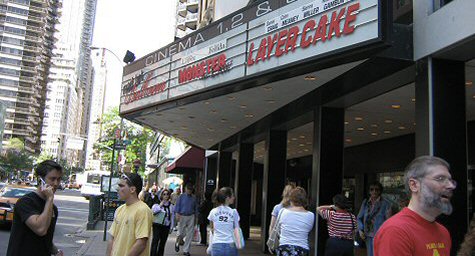
There’s more than a sense of unease in theatres across the land this summer. It’s something like mild panic, and is based upon fears that the “slump” affecting ticket sales this summer isn’t a slump but something more fundamental.
I’m not saying anything new here, but stories about the months-long slump keep coming and the authors keep missing the overall picture. The issue isn’t that movie attendance is “soft” this summer. The issue is that the fundamental idea of going out to the movies is losing its hold on the film-going populace. And I may be way behind the curve in using the word “losing.”

Certain industry-watchers are in denial about this (and you know who I mean), but there’s no hiding from this any longer: we’re experiencing a seismic shift in attitudes about how, when and where to get our entertainment fix.
It’s not a welcome thing to consider, but the hard fact is that the good old “let’s go to the movies so we can have fun and have something to talk about later over drinks” option is starting to slip down the pole a bit.
Seeing movies in theatres is being slowly de-popularized and retired by different demos for different reasons. I’m calling it the Big Fade.
< ?php include ('/home/hollyw9/public_html/wired'); ?>
The fade is on because the movie-going experience costs too much, which is happening because greedy actors and their agents have pushed their fees into the upper stratosphere. The higher the fees, the bigger the budgets…which in turn has forced studio-based producers to back away from making adult-friendly middlebrow movies and concentrate more and more on theme-park movies, which has pushed away the adults.
The fade is on because everyone knows this weekend’s movies will be in DVD stores in four to six months (if not sooner), so what’s the rush? For people like myself going to a new film in a theatre (especially a really good one) is an essential habit, but for more and more people the urge to see movies as soon as they’re released is not what it used to be.

The fade is on because kids (and you’ve heard this a million times) have all kinds of entertainment options at their disposal — video games, DVD watchings, online diversions, illegal movie downloads — and a lot of them are cheaper than going to movies in theatres.
The fade is on because older people don’t like the prices and having to listen to bozos talk during the movie, along with those laughably absurd prices for popcorn and cokes and having to sit through those awful TV ads.
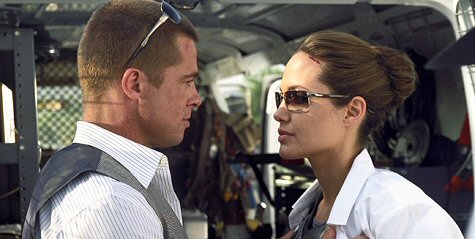
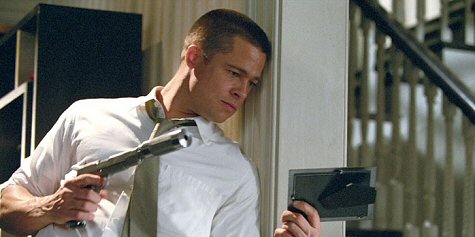
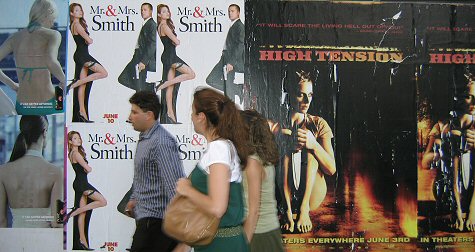
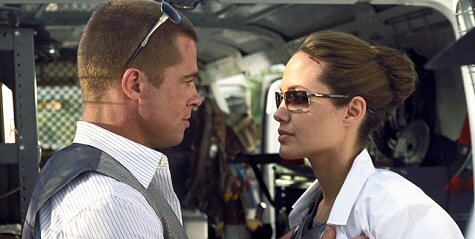
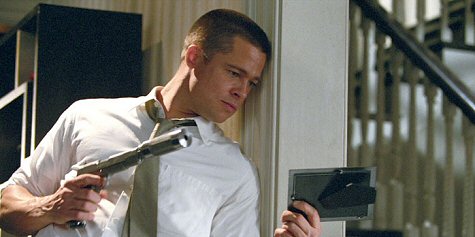
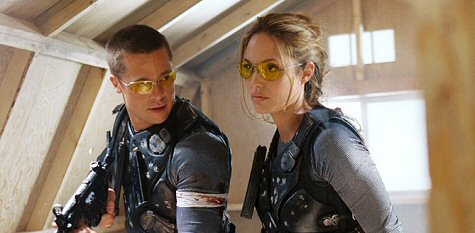
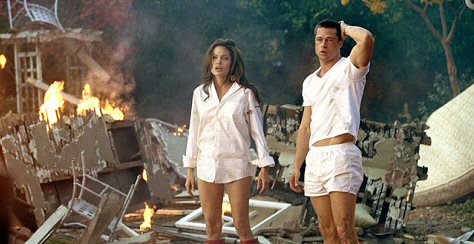
The fade is on because paying $30 or $35 (minimum) to take yourself and a date to see Mr. and Mrs. Smith, a totally rancid hell-movie you’ll barely want to rent when it hits DVD next November or December, is a repugnant joke.

Che Trigger

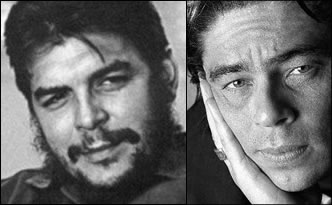
I’m told that Steven Soderbergh’s Che, which has been delayed and delayed and delayed, will finally roll film in Bolivia five months from now (i.e., December), with Benicio del Toro playing the legendary revolutionary Ernesto “Che” Guevara.
When I called to double-check Wednesday morning my guy wasn’t there and he didn’t call back, so check back Thursday for the final confirm.
The script by Soderbergh, Terrence Malick and Benjamin van der Veen isn’t about the Cuban period or any of the triumphs of Guevara’s life, but will focus entirely on the last failed chapter in his life, which was about trying to ignite a violent insurgency in Bolivia.
Guevara’s efforts in this regard resulted in his capture and execution by Bolivian authorities in 1967.

In other words, I’m hearing that Che (which I can’t seem to find a script of) will be the spiritual and political opposite of Walter Salles’ The Motorycycle Diaries, which was about youth and adventure and the birth of Che’s political conscience.
It will be about the end of the road…about death and pushing it too far…about falling out of touch and running out of gas…about manic political thinking taking over everything.
I’ve still no idea whether Soderbergh will shoot the film in English (which would be ghastly…a Richard Fleischer idea!) or in Spanish, or perhaps in both languages to assuage the fears of distributors about alienating both the English- and Spanish-speaking audiences for the film.
The dual-language option seems like the only way to go. It would seem fraudulent for the same director who shot those great Spanish-language sequences in Traffic to film the life of Guevara with various actors speaking in Spanish-inflected English…no?


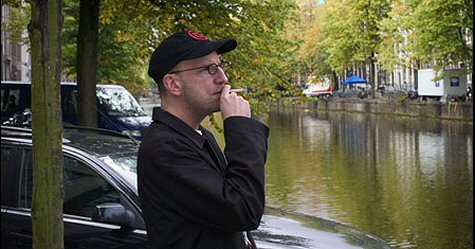
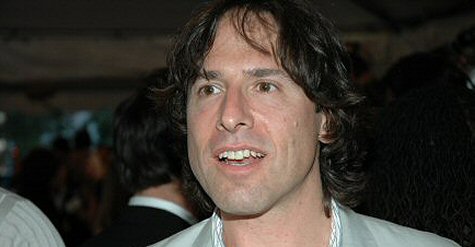
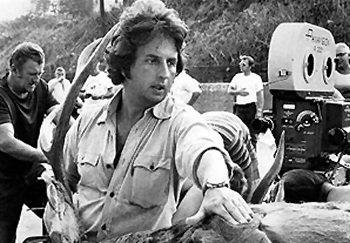
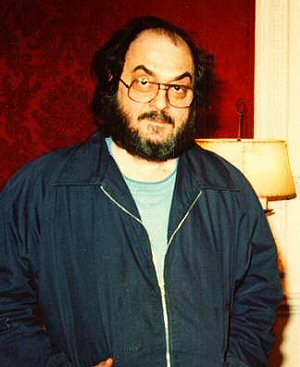
Steven Soderbergh, presumably during filming of Ocean’s 12 in Amsterdam.

If Fred Zinneman could shoot two takes of every scene in his 1955 film of Oklahoma! (one in 35mm Scope and another in 70mm Todd-AO), Soderbergh can certainly handle a similar discipline.
Soderbergh’s most recent film is Bubble, an under-the-wire Section Eight production about the “residents of a small Ohio town unraveling a murder mystery” (per the IMDB). He’ll presumably start pre-production on Che sometime in September.

Respected

Ernest Lehman, who died Saturday at age 89, wrote a lot of first-rate screenplays, including the ones for Sweet Smell of Success, Who’s Afraid of Virginia Woolf and Somebody Up There Likes Me. But for me, he’ll always be the North by Northwest guy.
I have enjoyed the dialogue from this Alfred Hitchcock film all my life. All right, some of it feels a bit clunky and cornball-y at times, but I’ve always loved the way the actors — Cary Grant, James Mason, Martin Landau, Jesse Royce Landis, Leo G. Carroll — make it work by finessing it just so.


The late Ernest Lehman

If you’re as into this film as I am, you’ll enjoy reading Lehman’s original script. You should also give a listen to Lehman’s commentary track on the North by Northwest DVD.
I’ve always enjoyed the constant references made to Grant’s (i.e, Roger Thornhill’s) acting within the film. His always being asked to play a part, and being told he’s either doing it well or not well enough. As in this scene with Mason’s Phillip Van Damm…

THORNHILL

Not that I mind a slight case of abduction now and then, but I have tickets to the theatre this evening, and to a show I was looking forward to. And I get…well, kind of unreasonable about things like that.
VAN DAMM

With such expert play acting you make this very room a theatre.
And this one in the Chicago auction room….


The famous R.O.T. matchbook containing a scrawled message (“They’re on to you — I’m in you room”) being inspected by Eva Marie Saint under the watchful eyes of James Mason and Martin Landau.

VAN DAMM

Has anyone ever told you that you overplay your various roles rather severely, Mr. Kaplan? First you’re the outraged Madison Avenue man who claims he’s been mistaken for someone else. Then you play a fugitive from justice, supposedly trying to clear his name of a crime he knows he didn’t commit. And now you play the peevish lover, stunned by jealousy and betrayal. It seems to me you fellows could stand a little less training from the FBI and a little more from the Actor’s Studio.
THORNHILL

Apparently the only performance that will satisfy you is when I play dead.
VAN DAMM

Your very next role. You’ll be quite convincing, I assure you.
For some reason the following is my favorite Northwest exchange. It never makes any sense trying to explain these things – some lines just do it for you. Thornhill and his mother (Landis) are “hotel-breaking” inside the Plaza, and he goes into the bathroom to inspect the toiletries used by the fictitious “George Kaplan.”
THORNHILL

Bulletin. [A bathroom product of the `50s.] Kaplan has dandruff.
MOTHER
In that case, I think we should leave.

Tradition

Tedium on Ice

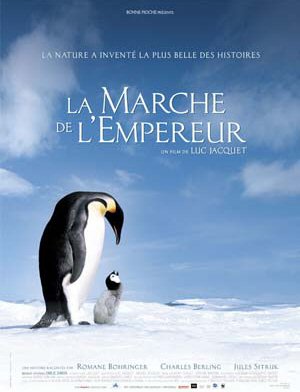
No one has pointed out the one big problem with Luc Jacquet’s March of the Penguins (Warner Independent). The Emperor penguins are cute and likable, etc., but the movie is oppressively boring after 45 minutes or so because the birds spend way too much time walking in caravans.
The females go diving for fish at one point and the males spend weeks and weeks huddling against the blizzard with penguin eggs between their legs, but mostly they just walk and walk and walk and walk and walk and walk and walk.
The reason they do this is because their mating, birthing and feeding patterns are irrational and rather dumb. I’m speaking specifically of the birds’ decision to annually march 100 kilometers from their feeding grounds near the sea to their nesting grounds. All of the penguin lunacy flows from this one thing.

Why march 100 kilometers to lay eggs? Antarctica is cold all over and full of snow and mountains everywhere you look, so what’s the difference where you lay the eggs as long as the chicks have a decent chance of being protected?
Why don’t the penguins lay the eggs closer to the sea so the females don’t have to walk 100 kilometers to catch fish for their young, and the males don’t have to tough it out for weeks with the eggs between their legs? You’d have to be insane to live anywhere except near the water because (hello?) that’s where the fish are and who needs all that relentless trudging around?
With other animal docs you can always figure out why lions do they do what they do, or elephants or hippos or beavers or whatever. There’s a certain natural logic to their game of survival. But not with the emperor penguins.
Why, then, are so many people going to this film and telling their friends about it? Why have so many critics given it a pass? Because cute animals always slide. Way of the world.

Grabs


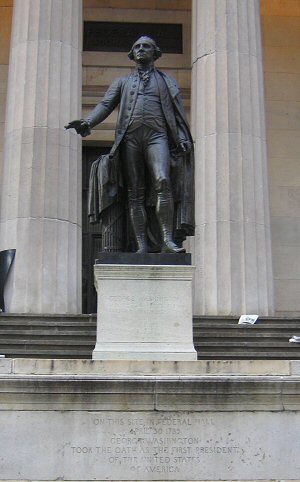
New York Stock Exchange facade on Wall Street — Monday, 7.4, 7:50 pm.

Portion of Szilvia Seke, diner in John’s Italian restaurant, 12th Street near 2nd Avenue — Tuesday, 7.6, 10:15 pm.

Early 20th Century fountain in park just south of City Hall

(l. to r.) Nancy Porter, Holly Porter, Jett Wells at 4th of July party at home of Robert Sharer of Westfield, New Jersey — Saturday, 7.2, 7:55 pm.

Last Monday’s fireworks from the South Street Seaport

Restaurant sign in Westfield, New Jersey near train station — Saturday, 7.3, 1:20 pm.

G train to L train, Brooklyn’s Lorimer station — Monday, 7.4., 11:40 pm.

Russell “Surfer” Story is Bullshit

Will Russell Surf?

Would you believe David O. Russell as the director of a big pandering Silver Surfer flick? Does this play even as a radical idea? Can anyone envision an impassioned eccentric like Russell working for a nuts-and-bolts type like Avi Arad?
Consider this interview with Arad, chairman and CEO of Marvel Studios, that ran on MTV.com about ten days ago. In the piece, written by Larry Carroll, Arad is asked who might direct the Surfer flick, which will apparently begin shooting either later this year or early next.


Didn’t Quentin Tarantino speak about writing a Silver Surfer flick back in ’95 or thereabouts? Does anyone remember the Silver Surfer dialogue that Tarantino wrote and Denzel Washington acted in Crimson Tide?

“There is a director who should make Silver Surfer,” Arad answered. “He is mentally committed to it [but] he’s doing another movie now.
“What’s most important to me about this guy, first, is that he’s incredible with visuals,” he added. “But he’s also a spiritual guy, a Zen Buddhist.”
There’s been a rumor out there for two or three weeks that Russell has been talking with Marvel about doing this. And Russell is certainly a Zen Buddhist, and he’s working on a film now — a lower-budgeted thing for Universal about radio talk-show host (Vince Vaughan) who starts taking on the traits of his wack-job callers.
< ?php include ('/home/hollyw9/public_html/wired'); ?>
I rang Russell’s office to check but they’ve all split for the 4th of July holiday. I called Russell on his cell and I think he picked up, but he just said “who is this?” three times and then hung up.
Baz Luhrman had been in the loop to direct this long-delayed effects film, but he is apparently no longer involved….but I don’t really know anything one way or the other. And I don’t even care that much, to be honest.


David O. Russell

It says something about the state of things when the best younger directors directors (Chris Nolan, David O. Russell, Bryan Singer) are all whoring themselves out to make superhero flicks.
The idea of Russell working for the Marvel factory and making a movie for kids and dealing with (how can I put this delicately?) a kind of elevated Menahem Golan mentality is a strange, fascinating prospect.
While Russell got along beautifully with Fox Searchlight and Peter Rice when he did I Heart Huckabees, I wonder how he’ll deal with Fox honcho Tom Rothman and his micromanaging approach to running a studio. Anyway, it’s something to consider over the holiday.

Goodnight Taste

An L.A. acquaintance has seen George Clooney’s Goodnight, and Good Luck (Warner Bros., 10.05), the ’50s drama about Edward R. Murrow vs. Senator Joseph McCarthy, and here’s his report:
“David Strathairn [who plays Murrow] is excellent. And I’d like to allay any fears you might have about him being able to summon Murrow’s authoritative voice. He nails it and then some.
“The film itself is high on atmosphere (especially during the opening scene….cigarettes, pointy glasses and tuxedo clad guests at a dinner reception) and does a very fine job of capturing the feeling of the 50’s.
“Clooney continues the good directorial work he did on Confessions of a Dangerous Mind. His camera is light and mobile, and the art design really showcases the beautiful black-and-white stock.


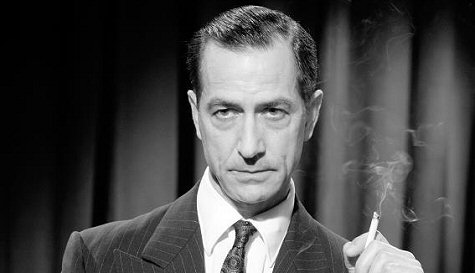
David Straitharn as Edward R. Murrow in George Clooney’s Goodnight, and Good Luck.

“The film itself is very quick and watchable, though I’m not sure how well it would play with people who don’t already have a real interest in the era of the Red Scare. It’s a bit like a civics lesson.
“I have some quibbles. A scrolling text intro that’s supposed to set up the era is unnecessary; as you watch the film you learn all you need to know about the background.
“It also lacks a certain central structure, and it could use a bit more bite. The enemy is paranoia, really, which doesn’t set Murrow up as the sort of heroic presence he was.
“There’s also an unnecessary scene between Robert Downey, Jr. and Patricia Clarkson [playing a husband and wife working for or in league with CBS] in which Downey is questioning whether they, at CBS, are doing the right thing in taking on McCarthy. It’s better left assumed that there was some self-doubt involved, rather than leaving it to this trite and obvious exchange.
“Overall it’s pretty fun stuff, especially since Strathairn is never less than enthralling. It’s just that it could use a bit more zip.”
Okay then — a good film with maybe some side issues. Straitharn, at least, seems positioned to pick up some Oscar heat….maybe.

Forever Cronicas

[Here’s a re-working of a January ’05 piece about Sebastian Cordero’s Cronicas. This excellent film is finally opening on 7.8 so why not?]
A creepy investigation piece and a penetrating morality tale about a tabloid TV news team on the trail of a serial child killer, Sebastian Corder’s Cronicas (Palm Pictures, 7.8) is easily one of the year’s best.
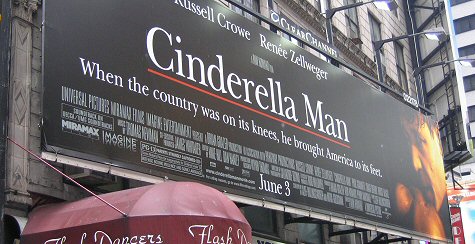
And I’m not just throwing that out. This hard haunting little film is right up there with Hustle & Flow, Cinderella Man, Crash, The Beat That My Heart Skipped, The Beautiful Country and Last Days.


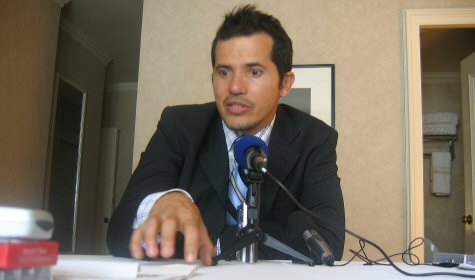
John Leguizamo during Cronicas round-table chat at Manhattan’s Regency Hotel — Monday, 6.27, 11:10 am.

Set in a low-income area of Ecuador and 98% Spanish-spoken, it boasts a first-rate cast (John Leguizamo, Damian Alcazar, Leonor Watling, Alfred Molina, Jose Maria Yazpik) and has been produced (or would grandfathered be the more appropriate term?) by Alfonso Cuaron and Guillermo del Toro.
And it shouldn’t be missed by anyone, partly for the impact of the drama itself (which holds onto its ethical focus from beginning to end, and never drops into an excitement-for-excitement’s-sake mode) and because it heralds the arrival of a major new Spanish-language director — 32 year-old Sebastian Cordero.
Cronicas is not about catching the bad guy as much as a study of journalistic corruption.
A series of child murders, all the apparent victim of a serialist called “the monster,” has caught the attention of a three-person news team shooting for a show called “Una Hora con la Verdad” (“An Hour with the Truth”), which is hosted in-studio by Molina’s character.

Jumping right into this cauldron is a hot-shot TV reporter named Manolo Bonilla (Leguizamo), along with his producer (Watling) and cameraman (Jose Maria Yazpik).
And they happen to be right there and shooting when a seemingly decent, soft-spoken salesman named Vinicio Cepeda (Alcazar) accidentally hits and kills a young kid with his truck. This almost gets Cepeda killed by an angry mob.
When Bonilla later visits Cepeda in jail, where he’s awaiting trial for manslaughter, what seems to be a major scoop is dropped into his lap. Cepeda tells Bonilla that he’s met the serial killer and can provide crucial information about him…which he’ll pass along in trade for a sympathetic TV story about the accident, which may lead to his legal exoneration.
Cepeda’s information (or some of it, rather) turns out to be solid, which of course leads Bonilla to decide to keep his scoop from the cops so he can make a big splash. And this is all I’m going to say, except that the movie has a riveting ending that doesn’t leave you alone.
The thrust at the end is that Leguizamo’s character may be just as malicious or threatening as the child-killer he’s trying to get the goods on.

Cronicas was filmed in Babahayo, a capital city of the province of Los Rios, apparently one of Ecaudor’s poorest areas.
After leaving the first screening my 15 year-old son Dylan said, “It’s funny, but it’s like almost all the really good films these days are being made by guys from Mexico and South America.”
And Spain, I added. It’s certainly seemed this way over the past three or four years. It’s always fascinated me how the Movie Gods seem to serendipitously pick certain countries and cultures to produce especially vital and profound films during a given period.
The film industry, in any event, can add Cordero to the south-of-the-border Kool Kat list headed by Alejandro Gonzalez Innaritu (21 Grams, Amores Perros), Guillermo del Toro (Hellboy ), Alejandro Amenabar (The Sea Inside), Pedro Almodovar (Bad Education), Fernando Meirelles (City of God), Julio Medem (Sex and Lucia) and Fabiane Beilinsky (Nine Queens).

Grabs


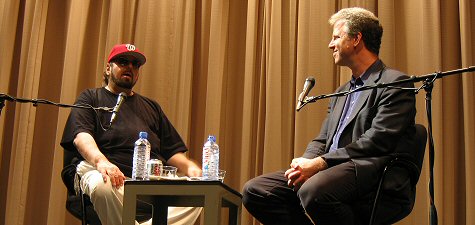
Director-writer James Toback (l.) speaking to Museum of Moving Image director David Schwartz after screening of his 1977 film Fingers and prior to showing of Jacques Audiard’s The Beat That My Heart Skipped — Thursday, 6.30.05, 9:20 pm.

L train heading to Brooklyn — Thursday, 7.1.05, 12:05 am.

Hollywood Elsewhere contributors Rachel Sear, Jett Wells (now working for N.Y. Daily News columnist George Rush) at party for Palm Pictures’ Cronicas — Tuesday, 6.28.05, 10:25 pm.

Graffiti on poster space at Queens subway stop near Kaufman Astoria Studios — Thursday, 6.30.05, 11:35 pm.

The real Domino Harvey, who will be played by Keira Knightley in the forthcoming Tony Scott film Domino (New Line, 8.19). Harvey was found dead last Monday night in her West Hollywood home.

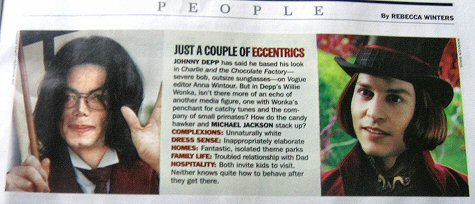
The linkage between Johnny Depp’s Charlie and that other weird guy with light skin who hangs out with kids has again been pointed out by Time magazine. This idea never seemed to get much traction outside of media circles.

Get Estrada

“Thank you, Mr. Wells, for having written a viewpoint of the Russell Crowe telephone incident that makes sense. Should Mr. Crowe have thrown the phone? Of course not, but finally a columnist questions Josh Estrada’s contribution to the incident.
“Does the Mercer hotel go unscathed here? A guest is paying over $3,000 a night for a room and no one gives a hoot that he has no working phone in that room. Yet when he tries to resolve the problem he is met with indifference and ‘whatever.’
“Trust me, sir…I am a seventy-six year old woman, and I would have had some choice words for Mr. Estrada and the Mercer had I been in Mr. Crowe’s position. Does that hotel really expect their guests to come down to the Lobby at 4:30 A.M. to make a phone call?
“Someone should also mention that if Mr. Crowe wanted to hurt Estrada he would have used his fists, he certainly has been well trained to do so in the past year.” — RhodaM41@aol.com

“Celebrities do not rate special attention and respect because they are celebrities. All accounts I’ve read about the incident indicate that it was late and Crowe had been drinking and was being an ass.
“I don’t know when, if ever, you’ve worked in a service job, but having to deal with obnoxious assholes after they’ve spent a night out drinking is highly stressful. That doesn’t excuse Estrada from being unprofessional to a customer, but his inappropriate response would require a reprimand from his supervisor and not being assaulted by a petulant jerk.
“I’m not a fan of frivolous lawsuits, but according to some reports, Estrada was looking for an apology and a handshake and didn’t get one…If the humorless Crowe is going to behave like a spoiled brat then he deserves what he gets. Since juries never want to convict the famous, (unless they’re female and Martha Stewart) then maybe wasting a celebrities time and costing him some money and p.r. is the only way to go to teach them a lesson.” — Michael Zeigler.
“Do you honestly think that Estrada, the concierge at the Mercer, would give Russell Crowe a ‘whatever’ just because he’s some prissy narcissist? Estrada, I mean, and not Crowe. Seems highly doubtful.
“A concierge with that general attitude would have a gig at the Mercer for, oh, about two days tops, if he hadn’t already been weeded out by what I’m sure is a fairly vigorous vetting process at one of the top Soho hotels.
“So Crowe’s paying four grand a night for a suite and he can’t get a call out to his wife to reassure her he’s not in the throes of (a) alcohol poisoning, (b) an orgy, (c) in the clink, or (d) all of the above? Must be a swell marriage. Objection, yer honor! Sustained. Withdrawn.
“I suggest to you that Crowe pushed this guy to the living end over a period of days, but that he, as the concierge at the Mercer, could muster no other retort but the pathetically passive-aggressive ‘Whatever.’

“More to the point, to quote Brando in Larry Grobel’s book, ‘Vas you dere, Charley?’ I’m sure when the tape rolls (ands I hope it’s on Court TV) it’s going to be fascinating. I have many hours under my belt one-on-one with Crowe….not counting the junkets, the press conferences..and the dude’s intimidating, even when he’s trying to be nice. It’s all in the eyes, man.
“And yeah (chuckle) it’s also in the karate-stance he assumes after hurling a couple pieces of bric-a-brac at your head. If I’m Estrada, I’m suing. Or what’s a celebrity for?” — Josh Mooney
“I found your comments on the Russell Crowe phone-throwing incident absolutely amazing. To miss an opportunity to diss Russell Crowe puts you in a class by yourself. Yes, Russell was an idiot in losing his temper but not one person has commented on Estrada’a contribution except you — this incident did not occur in a vacuum.
“Describing Estrada as a ‘…waahh, I’m telling the teacher’ kid aptly describes a 10 year old who grew up to be a celebrity blackmailer.” — Lorraine Shaw.
Thank you! That has been how I have felt all along. Sure Russell over-reacted. Guess what? He’s human. He has limits of tolerance. If a person is paying $4000 a night for a room he should be able to expect some service from the people working there. Thank you again for saying what I have been feeling.” — Vickie Sherman, Scappoose, Oregon.

Grabs 2


Big fat Roman-empire post office at corner of Eighth Avenue and 34th Street.

Video camera with super-telescopic lens aimed at Central Park West apartment building where Pale Male, the famous Manhattan hawk, was hanging toward the end of last Sunday afternoon.

This guy has been at the Museum of Natural History since I was five or six years old.

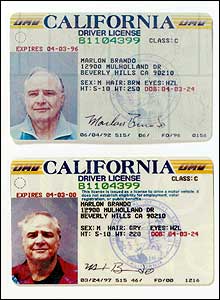
The just-concluded Marlon Brando auction at Christie’s brought in $2.3 million. Brando’s annotated Godfather script sold for $312,000. A letter from Godfather author Mario Puzo asking Brando to take the role of Don Corleone sold for $132,000. No word on how much these driver’s licenses went for.

Sunday, 6.26, 4:05 pm.

34th Street looking west from Eighth Avenue — Saturday, 6.25, 4:40 pm.

Pale Male on one of his periodic float-arounds.

Mural in underground lobby of Lincoln Plaza cinemas.

Worlds Apart

“I saw this last night…and I was very happy with the film overall, aside from a few believability issues here and there…nothing worth mentioning. But…
“Spielberg and Co.’s decision midway through the film to have Tom Cruise’s teenage son die added a great deal of emotional heft to the film, and I agree that the groaning of folks at the ending will have nothing to do with the bacterial problems that the aliens experience. That part of the finale is just fine and works wonderfully and pays appropriate tribute to Wells’ original story.
“But when Cruise and Fanning walk into Boston, find Miranda Otto and her entire clan in what looks to be the one neighborhood in all of Boston that wasn’t destroyed, I had to groan….but that was okay because I knew it was coming. No way Spielberg was going to avoid a family reunion of some kind. I could let the mother/daughter cryfest happen…whatever. The mom could have survived since we didn’t last see her running into a field of fire or anything.

“But then Justin Chatwin, the teenage son, runs out to his dad and I had to declare ‘bullshit’ on this movie. I mean come on…the kid was toast! How he managed to survive running into a battlefield that two seconds later was incinerated by alien death rays is utterly ridiculous.
“The worst part of this happy-ass reunion is that Chatwin’s supposed death had been such a refreshingly realistic event in a film where whole families are being dusted left and right. Spielberg had handled his departure in a very sad and abstract way, and when Cruise is insisting to Tim Robbins later on that his son ‘will just meet them in Boston’ it was a horrifyingly sad moment of parental denial that added so much resonance to the film.
“Then that’s all ripped away at the end. I’ve been a big supporter of Spielberg for years, and I’ve always felt he’s been a bit underrated in his efforts on many films, but he and his screenwriters chickened out here and robbed a potential masterpiece of lean mean sci-fiction filmmaking of an honest ending.
“I’ve been pissed off about it all morning. My advice to people is when the alien dies, leave the theater, and make up your own ending.” — Michael Felsher.
“I usually agree with you and could not agree more with you this time
about the endings of Spielberg’s films, and particularly the one used in War of the Worlds. I just saw it, and that ending really takes something MAJOR away from how great it could have been. As it is, I’d say it’s good. But Spielberg always does this with his more scary/thrilling/serious movies.
Jaws is the worst offender. Having Richard Dreyfuss survive
really took something away from the tone established throughout the movie and steered the film even farther from the book. Think of how much scarier that movie would have been if, like the book, even your fancy shark cage and gadgets do nothing for you? Would we have been really upset if Dreyfuss had been eaten like Quint?

“Spielberg did it again with Saving Private Ryan. Having the old Ryan at the grave with every member of his family lamenting over ‘did I deserve it?’ really took something away from that movie for me and is the only reason why I think The Thin Red Line is better.
“There’s no question that one of the cornerstones of Spielberg’s rep is his tendency to pull some punches that really need to be landed.” — Jason Tanner
“The ending alone knocked the film down from being a problematic but entertaining three-star flick to a mediocre two-star.
“Does Spielberg assume that his audience is so dumb to believe that Cruises kid just somehow managed to survive the wall of fire and brimstone? Like Cruise finding the extra belt of hand grenades just in time to get snagged by the tripod, I found the conclusion an example of very lazy storytelling. More riveting would of been the son risking his life at the end for his dad and sister.
“But no…Spielberg had to have the bullshit happy ending which nobody in my audience except for the women bought.
“The film has one glaring inconsistency. As has been pointed out, the aliens use an electro magnetic pulse to disable all electronic items prior to their first attack. And yet in the first destruction scene we witness a guy operating a camcorder. He’s not just a background character either — Spielberg frames one of his ‘clever’ shots around the device.
“Plus the editing was choppy in parts. Cruise walks into the bathroom covered with human soot and then a cut later is fully cleaned up.

“Why did Dakota Fanning have to scream in every scene? Was it in her contract? Why do all the kids in Spielberg films act the same way in scene after scene? Here you have world destruction and the kids are bickering over how Tom Cruise is a bad dad. It sucks you right out the movie because it’s forced drama. It’s borderline blackface in it’s vulgarity as it’s repeated over and over.” — Michael Meyerotto
“I’m scratching my head over your War of the Worlds review. Isn’t this the kind of review that usually makes you roll your eyes and become somewhat contemptuous? This sounds like one of those ‘if you just turn off your mind and don’t think about it much, it’s great fun’ reviews that you so dislike.
“In fact, your review made it less likely that I’ll go see this. Personally, I just don’t like the idea of giving my money to Spielberg and Cruise for something half-baked — I’m a bit sick of both of them, (especially Cruise), and lately I’ve gotten very particular about how I spend my movie dollar.
“I saw and loved Batman Begins. Before that, the last movie I’d seen was Sin City, and I walked out halfway through. I don’t go to the theater often for a number of reasons. One of them is the kind of movie you described in your WotW piece.
“I’m watching Letterman as I write this, and he just said something that hits home for me. He said, ‘Today was the big opening of War of the Worlds. It’s a film about space aliens that activate these enormous alien pods that have been buried in the earth for millions of … oh, who cares?” — Ray Garton
“The only thing that gets my goat about the movie is that the ending is the only overtly sentimental part of the flick. You had bodies being floated downriver, people turning to dust, someone getting blood sucked out of them and then sprayed over. How did this get a PG-13 again?” — Lee Goettl
“I hate it when you’re wrong about a movie because you infuriate me — but I think I hate it more when you really nail the thing, because I then have to admit you’re right, and that your words and emotions so precise and deserving that you pierce the heart of the matter. And in the case of WotW, you got my feelings exactly, and expressed it better than I could, so fuck you.” — Peter Martin.

“So I kept waiting for this awful, groan-inducing ending of War of the Worlds and it never came. What the hell is everyone bitching about? The final scene isn’t played with even a hint of sap or melodrama. The son is just there. There’s no swelling music cue, no shots of Dad and Lad running to each other, arms outstretched…just a warm smile.
“I think Spielberg — and the audience — earned that moment after sitting through almost two hours of terror, which is what this movie really is. This is one of Stevie’s greatest efforts, right up there with Close Encounters, Jaws and (dare I say it) A.I…speaking of movies with unfairly derided endings.
“And there certainly wasn’t any laughing or booing at the end. But there was plenty of clapping. And this was at an 11:30 a.m. show with half a house…not a psyched, rowdy Friday-night crowd. This movie’s going to score huge with most of America, and the NY/LA film snobs and snotty teenagers be damned.
“Roger Friedman at foxnews.com characterized the reviews as ‘so-so’ and Drudge has been running pretty much only the negative stuff about it. But the truth of the matter is that the flick has been generally well-reviewed, scored well at Metacritic and Rotten Tomatoes and got absolute raves from Kenneth Turan and Variety, to name but a few.” — Sean Stangland

Tragic Synch Over Domino’s Real-Life Death

Tragic Synch

New Line Cinema’s decision to move the release date of Tony Scott’s Domino from 11.23 back to mid-August (which is when the film was originally scheduled to open for several months) may look like an exploitation of a tragedy to some…but apparently it’s not.
I was shocked to learn Tuesday that 35 year-old Domino Harvey, the former model-turned-bounty hunter portrayed by Keira Knightley in Scott’s action thriller, was found dead in a bathtub in her West Hollywood home on Monday night.


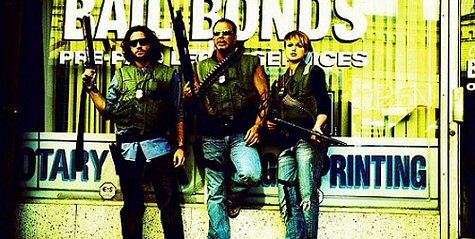
Edgar Ramirez, Mickey Rourke, Kera Knightley in Tony Scott’s Domino.

The daughter of late actor Laurence Harvey was facing jail time over drug-dealing charges after feds busted her a month ago. She was charged with conspiracy to distribute drugs (i.e., amphetamines), possession, trafficking and racketeering, and was apparently looking at a possible long sentence.
Domino, based on a sharply written script by Richard Kelly and costarring Mickey Rourke and Christopher Walken, is a partly fictionalized story about Harvey’s giving up modeling in the early ’90s to become a bounty hunter.
< ?php include ('/home/hollyw9/public_html/wired'); ?>
New Line bumped the film from its 8.19 date to late November sometime around 5.25, which was about six days after the news of Harvey’s drug arrest hit the papers.
The reason New Line is now looking to push it back to a mid-August release, I’m told, is because another Keira Knightley film, Pride and Prejudice (Focus Features), is moving its opening date to November 11 from a previous opening date of September 23, and such a conflict would only hurt both films.
There’s also some mucky-muck about Knightley’s busy schedule (she’s currently shooting the Pirates of the Caribbean sequel) and her consequent availability for p.r. duties being a factor in pushing up the Domino release date.
Kelly talked to me earlier today about Harvey, whom he spoke with last year “for a couple of hours” during research for his script. “I know she was very troubled,” he said. He called her recent drug bust and death (which looks like a suicide, although no official ruling has come down) “a very sad situation as Tony was close with her.”


Kera Knightley in studio-issed still from Domino.

He said he last saw Harvey during filming of Domino last fall in Las Vegas. Her head was shaved, he said, and she looked a little worse for wear.
“She has a cameo in the Vegas sequence of the film…actually she is in the final image,” he said. He called the footage of her “very haunting, especially now that she is gone, as the themes of life and death and the precarious/arbitrary nature of both are huge themes in the story.”
A New Line spokesperson said nothing would be changed in the film as it’s “pretty much locked.”
Scott, who knew Harvey on a personal basis, said in a statement that she “never failed to surprise or inspire me over the last 12 years. She was a free spirit like no other I have ever known.”
Domino producer Sammy Hadida said, “We were enormously saddened to hear of Domino’s untimely passing. She and I had been conferring about her music to be used in the film only weeks ago.
“Although our film is not intended as a biographical piece, hers was the dynamic personality and indomitable spirit that spawned an exciting adventure, not just on screen but in real life.”

Pulse-Pounder

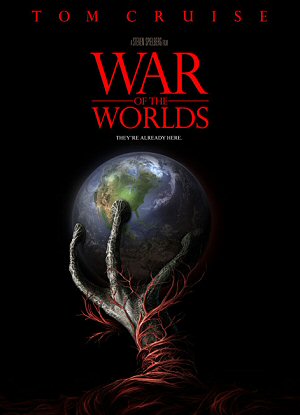
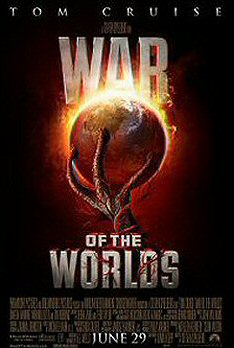
War of the Worlds is, on a certain level, a close-to-great, sonically haunting, occasionally scary summer superflick…and anyone who dismisses it by saying things like “it doesn’t suck but it’s not very good either” is being disingenuous, really and truly.
There is no way this film won’t deliver most of what you’re expecting, even after reading this sentence, and I realize how presumptuous this sounds but I’m not wrong.


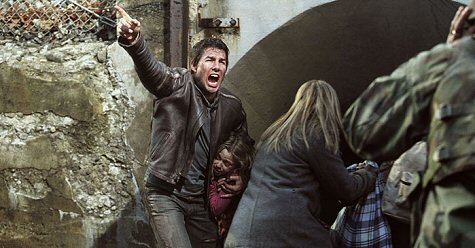
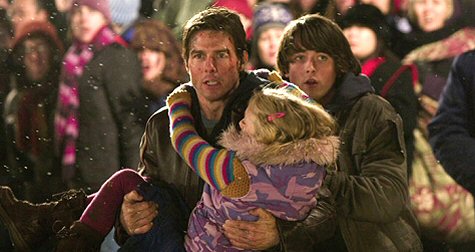
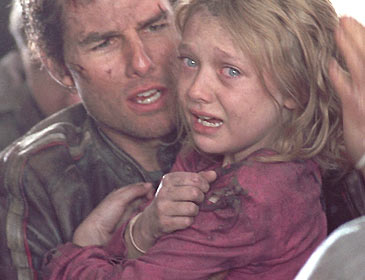
Ray Ferrier (Tom Cruise) carrying daughter Rachel (Dakota Fanning) as his emotionally and intellectually-challenged teenage son Robbie (Justin Chatwick) glares at the world and wonders how to make his mark in his own way…get ’em, Robbie!

The film is not without problems — it has four, to be exact, including a stinkbomb of a finale that people will be talking about all across the country for the next five days — but it delivers your money’s worth and then some, and anyone who tries to tell you differently isn’t talking about what this film literally and actually is. Don’t listen to them.
War of the Worlds is surprisingly scary here and there. I thought I was CG’ed and FX’ed out and couldn’t be affected by another grotesquely expensive, broad-assed alien-invaders film…but I was wrong.
It’s not cold or savage or unembroidered enough, but even with its various weaknesses WOTW is the new standard-setter for what it takes to arouse a cynical, distracted audience with I-Pods and Blackberrys in their pockets into going yeah, wow…whoa!!…and sit up and stare and forget about going to the bathroom.
At times it is halfway between being merely visually “impressive” and a genuinely fearful thing to sit through, and that’s no small feat. Everyone’s taken note of the 9/11 recreations (there are several, but the most vivid for me is the powdery gray dust covering Tom Cruise’s head after the first alien attack), and this is certainly part of what the film summons.


Tom Cruise, Dakota Fanning

But it’s the sheer flattening force of what the alien invaders do to everything and everybody (and especially the sound of all this carnage) that counts. Make sure you see War of the Worlds in a theatre with a fortified Tyrannosaurus Rex sound system.
Forget all that David Poland stuff about the lack of thematic elements or the metaphor not making it or the narrative threads failing to fuse together and make WOTW into something more than what it is. He’s partly right but it doesn’t matter because he doesn’t get it.
I know I’ve hated films that eschew the delicate interior stuff in favor of gross physicality, but this is one of those occasions in which the exteriors are good enough that it’s easy to let the absence of interior values slide. Trust me, this film is as good as this sort of thing can reasonably be expected to be.
Except for four bad things: one mildly bad thing, one puzzlingly bad thing, one irritatingly bad thing and only breathtakingly awful thing.
There’s an opening and closing narration sequence — taken straight from the H.G. Wells novel and spoken by Morgan Freeman — that should have been cut. There are times when paying respect to the original author or the original film is a mistake, and this is one of them.

The narration was passable when Sir Cedric Hardwicke read it in the 1953 George Pal War of the Worlds, but Freeman’s reading sounds too storybooky and “once upon a time”-ish. (People began to snicker almost immediately at the screening I attended.)
I appreciate the urge to have H.G. Wells’ opening line digested, but literary tributes are fairly off-track in a film of this sort. The visuals say it all. We’re living in an age of sub-literacy and as nuts as this sounds, sometimes it’s best for filmmakers to just go with the sub-literate flow.
There’s a very queer idea in this film about the alien tripods not coming down from the heavens but buried and waiting under the earth’s surface for a long time and being activated by lighting bolts carrying aliens or alien vessels or whatever.
This is obviously nonsensical…unless, of course, one throws out credibility and just accepts it as metaphor. We are being destroyed by elements from within. This doesn’t add up, but …what?…malignancies in our systems, ourselves, our souls…waiting to be cut loose by time or fate or some built-in trigger?
Why do the aliens have to come from inside the ground? I suspect it’s because Spielberg fell in love with the idea of a tripod bursting its way out of a Hoboken street (it’s a fantastic thing visually, I have to admit) and said to screenwriter David Koepp, “Make it work.”
I ignored it, waved it away…but it bothered me later. People weren’t buying it outside the Zeigfeld theatre on Monday night, I can tell you. One guy was saying, “What the hell was that about?”

The son of Cruise’s Ray Ferrier, called Robbie and played by Justin Chatwin, should have been killed early on and stayed that way.
Chatwin is a good actor caught playing a badly written role. Robbie is a total dumbass. He’s feeling lots of anger and resentment about his irresponsible dad, see…but this emotional posture is unaffected by a smidgen of practical caution or strategic intelligence when the aliens start attacking. But he is sure is emotional!
Robbie and Ray and sister Rachel (Dakota Fanning) are driving through the carnage with one of the world’s last remaining working autos. (The others have had their batteries neutralized by an electro-magnetic pulse.) Ray asks Robbie to take the wheel but tells him to stick to the back roads and avoid crowds for obvious reasons. What does Robbie do while Ray is catching some z’s? You have to guess?
That settled it. Like Frankie Pantegelli barking at Michael Corleone about the hated Rosotto brothers in The Godfather, Part II, I was telepathically text-messaging the same message over and over…”I want this kid dead…mort!”
Then Robbie makes a spur-of-the-moment decision to join the National Guard while they’re trying to stop the aliens from advancing on the populace. Utterly ridiculous, of course, but at least the fucker is gone, I was telling myself. He’s been zapped to death, turned into dust…great!
And then…no, I can’t say it.


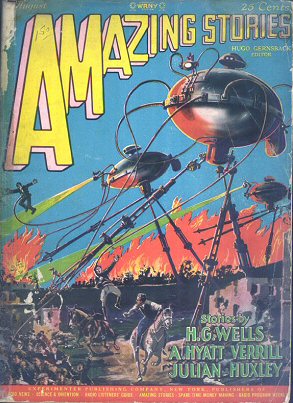
Spielberg’s alien tripods aren’t that different from this comic-book depiction from at least 50 years ago, if not further back than that.

The final scene of War of the Worlds is beyond bad. It is so diseased it will send you into grief spasms. There’s a sense of quiet jaw-dropping horror at what Spielberg is choosing to show us and the way he’s gotten dp Janusz Kaminski to shoot it (it’s almost as treacly as the fantasy scene when Anne Baxter waltzes down the steps to meet Montgomery Clift in I Confess) and the actors he’s chosen to cast in this scene.
This is the kind of terrible, terrible finale that only Steven Spielberg is capable of. Jett said as we were leaving the theatre, “Why did he do that? He almost had it!”
Why can’t Spielberg restrain himself on this sentimental shit? If WOTW had been a bit tougher and colder and had excised the emotional cushioning it could have been brilliant. But no…Spielberg has to be Spielberg. He has to pick up that shotgun, he has to put the shells in the chamber, he has to aim it at his left foot and blamm!
I shared this reaction with a director friend yesterday, and he said, “Well, of course…this is Spielberg, the most egregiously sentimental and pandering filmmaker anywhere except for George Lucas.”
This guy, who’s been around for 30 years and knows everyone and all the stories, said that Spielberg is actually a very cold and manipulative guy deep down (Julia Phillips used to say this too), and that he injects sentimentality into his films because he thinks it sells, and he’s right most of the time, but that’s not who he really is.

I don’t know how to go from loathing the last scene back to a sincere admiration of the whole, but that’s what this movie is. As bad as the shitty stuff is, it doesn’t get in the way of the portions that are stunning. I can’t emphasize enough that I was knocked flat and awestruck throughout most of it.
Cruise the Scientology meltdown nutter was out the window and gone in a matter of seconds. The 9/11 references seemed superfluous and unintegrated to me, and it was obvious WOTW would have been better off not referencing it so strenuously.
War of the Worlds could have been 20% better…it could have been staggering if Spielberg had pruned the crap and the sentiment out. It could have been scarier still if Spielberg had tried for a chillier tone and more of a “take it or leave it, life is hard and alien invasions are really hard and brutal…deal with it” type of thing.
But that’s not Spielberg and it never will be. The man is his own worst enemy.

Persistence of “Crash” & Likely Oscar Heat to Come

Persistence of Crash

Sometime within the next week or two, Paul Haggis’s Crash is going to pass the $50 million mark in theatrical revenue. That’s an extraordinary haul for a film that’s not exactly a downer but is about as divorced from the conventional definition of a feel-good audience hit as you can imagine.
It’s a socially observant thing that ends with a hopeful or balanced view of who and what we are in terms of racial attitudes. It also says that widespread racism has made us all fairly miserable inside the prison of our own skins. And yet people are going for it.


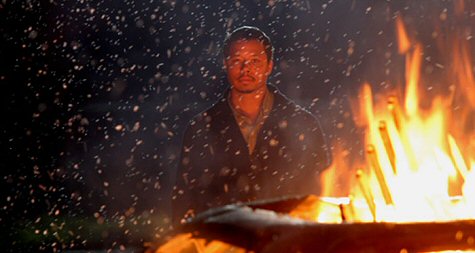
Terrence Howard’s character, a Hollywood filmmaker, during a contemplative, settle-down moment in Crash.

Crash has performed so surprisingly well that year-end awards and Oscar nominations are starting to seem inevitable. The year-end hoopla will be spurred along by the release of the DVD sometime in the early fall, and a limited theatrical re-release aimed at Academy voters sometime in December or perhaps January.
The cultural-political element seems to have caught on also and made Crash into a shorthand term for crude racial pigeonholing, and, in another sense, a recognition that racism is as pernicious as ever.
< ?php include ('/home/hollyw9/public_html/wired'); ?>
Like Oprah Winfrey spokesperson Michelle McIntyre describing Winfrey’s being denied entrance to that Hermes store a few days ago in Paris as “her Crash moment.”
Or Al Sharpton visiting Mexico president Vicente Fox in late May and slipping him a DVD of Crash to watch.
Or recently elected Los Angeles mayor Antonio Villagrosa referring to the film while making a point about racism during an interview last Monday (6.20) on Ted Koppel’s Nightline.
When Crash opened seven weeks ago — on Friday, 5.6 — the commercial expectations were upbeat but modestly so. Lions Gate had acquired it for about $3.3 million at last September’s Toronto Film Festival, and this seemed like an appropriate price. “We thought it would do a minimum of $25 to $30 million,” Lions Gate president Tom Ortenberg recalls.
It’s now in 492 theatres and has taken in over $47 million.


Crash costar Thandie Newton

A sharply written ensemble piece about racial divides in and around Los Angeles, Crash had been generally well reviewed with a 78% Rotten Tomatoes rating, and yet it was panned by some big guns — N.Y. Times lead critic Tony Scott, L.A. Times second-stringer Carina Chocano, Jamie Bernard of the N.Y. Daily News, the Boston Globe‘s Ty Burr.
The reactions were very favorable when I showed Crash at my UCLA Sneak Previews class in early April, which seemed significant in that the class is mainly composed of people in their 40s and 50s, who tend to shy away from push-comes-to-shove dramas.
Crash‘s co-screenwriter Bobby Moresco says he knew something was up when he went to see how the film was performing at a Burbank megaplex during the opening weekend. “It was a show in the middle of the afternoon, there was a long line waiting to get in, and the theatre was 80% filled,” he said.
Moresco noticed the same level of response when he went back the next day — i.e., Sunday afternoon.
“It was obvious to us that we had something,” Ortenberg told me yesterday. “The Friday to Sunday trajectory was very strong, there were great exit polls, and business was very good on the Monday and Tuesday after the first weekend.
“And then week after week, it was clear not only that audiences were discovering Crash, but the picture was becoming a water-cooler movie.”
Crash “is really the perfect Lions Gate film,” he said. “Indie crediblity along with commercial viability.
“We opened up at #4, and yet we stayed in the top five for four weeks. Kingdom of Heaven more than doubled our gross on opening weekend, but by the third weekend we outgrossed them. Clearly we had a film that was affecting people.”


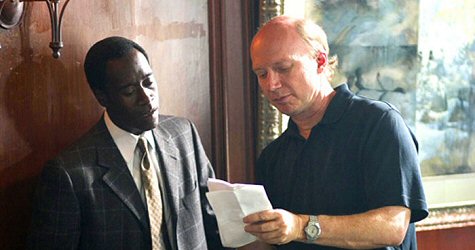
Crash star Don Cheadle, director and cowriter Paul Haggis during filming

My opinion is that it’s working with audiences because it hits hard in showing racial incidents but at the same time leaves you with a sense of balance and even compassion.
Everyone in this sharply written ensemble drama is shown to be a racist or a victim of racism, but they’re also given a balancing trait or shown having a moment of clarity and self recognition. Matt Dillon’s beat cop is depicted as racist pig on one hand, but also a guy capable of heroism when he saves Thandie Newton from that car fire and also a guy who grieves over his ailing father…that kind of thing.
“In many respects today’s movie-marketing world is about cookie-cutter distribution and massive ad budgets and the usual usual,” Ortenberg comments. “And so it’s especially gratifying when you have a film that needs TLC to get through and is benefiting from word of mouth and really taking off on this level.
“If I could single out one person at Lion’s Gate who orchestrated this more than anyone else, it would be (exec vp publicity) Sarah Greenberg,” Ortenberg says.
“Sarah did a text book long-lead critic and opinion-maker screening program where she was able to identify the supporters and champions of the film, and get them to come out visibly for the film in a big way. Ebert and Roeper went with their rave fairly early, about two weeks before the release. David Denby at the New Yorker wrote a great review, and he also hosted a New Yorker screening program showing.
“Unlike some of the others who bid on this film in Toronto, we always saw Crash as a wide release movie.” It opened on 5.6 in about 1800 theatres.


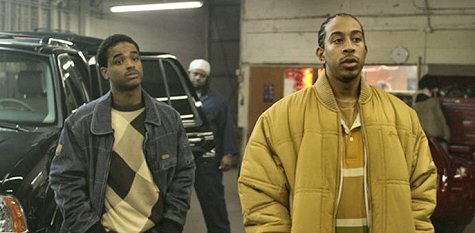
Crash Larenz Tate, Chris “Ludacris” Bridges.

“I have gotten more calls and e-mails from colleagues…more calls congratulating Lions Gate for picking this movie up and doing well with it,” Ortenberg remarks. “And we always got similar reactions from screening programs around the country.
“Our two worst reviews in the country came from the New York Times and the LA Times . There were naysayers, there always are…but the film really did well at the end of the day.”
The movies that tend to connect are the ones that prompt a sense of basic recognition. I think people are privately acknowledging their feelings of racism when they see Crash. Remember what Randy Newman said a long time ago about us all being rednecks, etc.?
I think people are also responding to the film’s optimistic view of this common failing. It says that we’re flawed, yes, but we’re not that bad, and we’re capable now and then of being noble and kind.

Earnestly

I wrote this up in the WIRED section late last night but I’m feeling emphatic and I don’t care if I’m repeating myself: I was blown away by Fernando Meirelles’ The Constant Gardener (Focus Features, 8.26) at a screening last night, and I found this surprising since I was told a few months ago by a filmmaker in a position to know that it might not be all that much.
As murder mysteries go (and it does fall under this category…sort of), this Focus Features release may be too thoughtful and complex and emotionally subtle to play big with younger audiences, and we all know that Ralph Fiennes and Rachel Weisz are not marquee names. But trust me when I say it’s very high-quality merchandise with a decent shot at year-end awards and Oscar noms.
This is easily the best theatrical adaptation of a John le Carre novel since The Spy Who Came In From The Cold (1966).


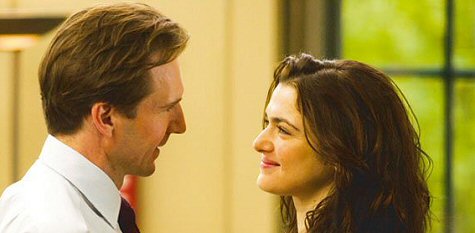
Ralph Fiennes, Rachel Weisz in Fernando Meirelles’ The Constant Gardener.

I expected something fairly good, as anyone would from the director of the magnificent City of God, but I didn’t expect The Constant Gardener to be quite this smart and impassioned and as pointedly political.
Why is it that American directors (Oliver Stone and Warren Beatty excepted) never seem to deliver films with hard political content? Meirelles seems to understand this story about poor Africans being exploited by rich drug companies because he’s made a film about poor Brazilians coping with similarly oppressive conditions.
It’s a combination love story and whodunit wrapped inside a realistic political drama that feels as raw and teeming as City of God and then some. Set mostly in Kenya, its about the murder of activist Tessa Quayle (Rachel Weisz ) and the efforts of her mild-mannered diplomat husband Justin Quayle (Ralph Fiennes) to find out why she was killed and who did it.
The only disappointing aspect is the casting of Danny Huston in a supporting role as yet another morally compromised scumbag.
I’m not quite sure why Focus Features is opening this exceptional film in very late August, which is kind of a dumper period. It seems as if October or early November would be a better time to open it, but maybe they know something I don’t.
Here’s the trailer.

Delayed Action

I have to put things on hold for a few hours, but I promise to do what I can to tarnish or call into question the reputation of March of the Penguins (Warner Independent, opening today) when I return.
This French-made nature doc is a bore and a con and I’m not buying it, and neither should you unless you’re a sucker for the general cuteness of penguins. Women love this film but there are times in life when sentimentality must be resisted, and this is one of them.


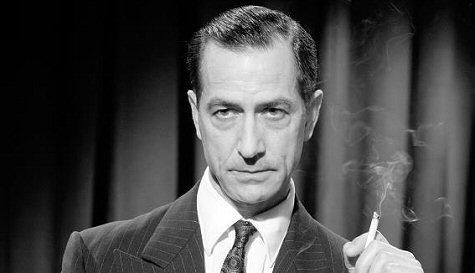
David Straitharn as legendary CBS newsman Edward R. Murrow in George Clooney’s Good Night and Good Luck.

One of the stories I’m especially cranked about is the apparent intention of Warner Bros. to put George Clooney’s Good Night and Good Luck, a modestly budgeted black-and-white feature about the 1954 battle between CBS newsman Edward R. Murrow (David Straitharn) and the anti-communist demagogue Sen. Joseph McCarthy, into theatres in October or November.
The idea is apparently for the film to play either the Venice or Toronto or New York film festivals, or perhaps all three. I know nothing at all about the quality of Straitharn’s performance, but one presumes he will be quite good in the role. When has Straitharn ever not been exceptional?
I have to cut out in order to attend an NYU Pre-College Orientation class that starts at 2 pm. Jett should be attending this but he’s taking his last two finals at Brookline High School today so I’ll be there with my notepad.
I’ll put up the remaining material tonight and tomorrow morning.

Armond Says…

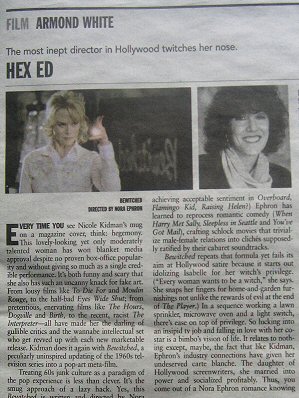
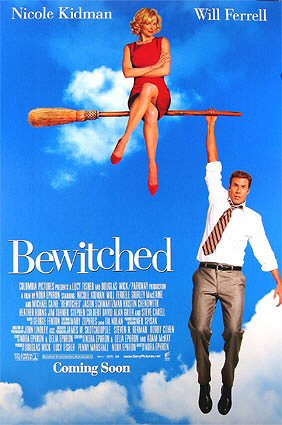
When New York Press critic Armond White rips into someone, he really goes to town. If I were Nora Ephron I would grab a hard copy of this Bewitched review and frame it and put in on my wall, as a way of showing my friends (and myself) what a good sport I am.

Here’s a photo and here’s the online page link
I’m thinking of something Joseph P. Kennedy once said about his son Robert: “The kid hates like I do.” I don’t think of White as any kind of junior-level presence (quite the contrary), but he does tend to assign notions of almost Biblical-scale evil to certain mainstream filmmakers, and I’ve always found this endearing on a certain level.

Grabs


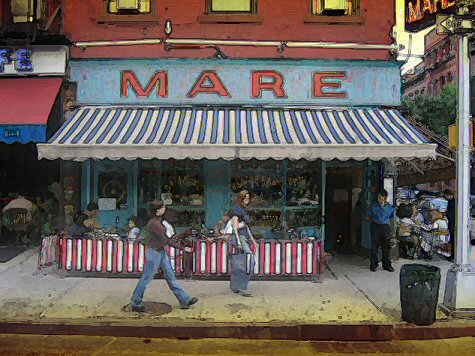
Wednesday’s Mare photo tweaked by Ken Bell of Graphic Planet.

I’ve thought and thought about what to call this photo, and I’ve finally decided upon “Cement Guy.”

Sign hanging on chain-link fence bordering far eastern barrier of Ground Zero.

Latest in a series of R.O.T. photos. I relate to R.O.T., or rather the spiritual condition alluded to by this acronym.

The Ground Zero crucifix made out of a remaining portion of a steel framework that was part of one of the towers.

Back by popular demand! Many people (okay, guys) have sent in compliments. A director friend told me yesterday he believes this photo deserves to be hung in the Museum of Modern Art. I completely agree.

Witch Girls….Nicole Kidman or Kim Novak?

My hopes were up during the first three or four minutes of Bewitched because it starts out like Bell, Book and Candle, the 1958 film with James Stewart and Kim Novak.

Nicole Kidman, playing a cheerfully perky witch named Isabel Bigelow, says at the beginning that all she wants is to be loved in a normal everyday way by a regular “helpless” boyfriend who needs her. Not to be repetitive, but at this point I leaned over to Bill McCuddy, the Fox News anchor guy who was watching it with me last week, and I said, “This is Bell, Book and Candle.”


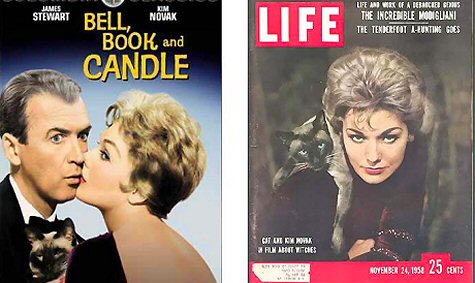
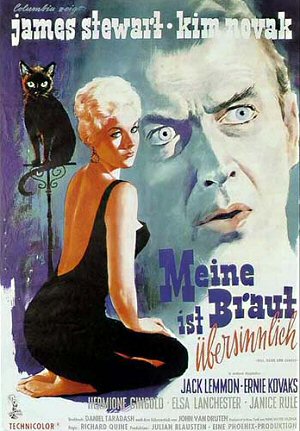
James Stewart and Kim Novak on DVD art jacket for Bell, Book and Candle; Novak’s November 1958 Life magazine cover promoting the film.

And almost as soon as I said this, Bewitched dropped this very relatable theme — an oddball exotic woman who wants to have a relationship with a regular schlub — and split itself into six or seven other directions and went all to hell.
It wound up being about personalities and letting Will Ferrell be Will Ferrell and the usual toxic (I think the standard adjective is “bubbly”) amusements that constitute your standard romantic-comedy-made-by-a-big-studio these days. It’s pure fizz, or is that giving the film too much credit?

And for this you can put the blame squarely on director and cowriter Nora Ephron and her cowriter sister Delia Ephron.
So a movie based on a TV comedy series from the `60s and early `70s, about an actual witch who just happens to get hired to play a pretend witch on a brand new remake of the Bewitched TV series. How coincidental is that?

This happens because the star of this new Bewitched series, an empty-cavity asshole actor named Jack Wyatt (Will Ferrell), happens to run into Isabel at Book Soup (the West Hollywood book store) and falls for her right away, partly because she’s beautiful but mainly because she can do that Elizabeth Montgomery/ Samantha nose-wrinkle thing to perfection.

Here I am summarizing a totally inane plotline and hating myself for doing so and determined to stop right now.

The bottom line is that Ferrell is playing such a repulsively insecure twit and a run-at-the-mouth Hollywood phony that you can’t help but lose all feelings of empathy for Kidman’s Isabel because anyone being attracted to a guy with Jack Wyatt’s personality is fairly grotesque.

So with the foundation making no sense the whole thing is a waste of time, and that goes for the efforts of several appealing actors who’ve been given very thin, barely-written parts — Michael Caine, Shirley MacLaine, Jason Schwartzman, Kristin Chenoweth….although I’m sure they were well paid.

The only walk-on role that really comes through is Steve Carrell’s third-act cameo as Paul Lynde’s “Uncle Arthur.” Like I said a few days ago, if only the Ephrons had decided to weave Carrell into the film as a major character, etc.
There is one amazingly funny moment, when Isabel wrinkles her nose and causes a large chandelier to fall upon a character neither she nor we like. Radical! Then we realize the sequence has been one of those cheap-ass fantasy projections that isn’t really happening.
Opposite of radical!


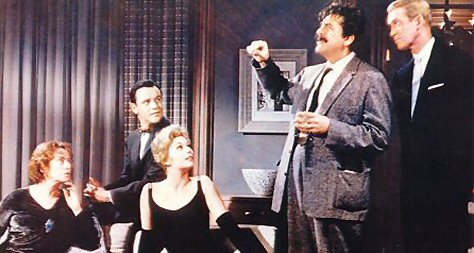
(l. to r.) Elsa Lanchester, Jack Lemmon, Kim Novak, Ernie Kovacs, James Stewart.

The rule used to be if Larry King turned up in a film (i.e., playing himself interviewing one of the fictional characters), it sucked. The same rule applies today if the shamelessly unctuous James Lipton, the Actor’s Studio interviewer, shows up in the same way, which he does in Bewitched.

I need to stop the nitpicking and segue back to Bell, Book and Candle, which the Bewitched TV series was partly based upon (along with that Rene Clair comedy I Married a Witch, with Veronica Lake and Fredric March).

The basic idea behind John van Druten’s original stage play, which was first performed in 1950, was that seemingly weird people (i.e., quirky individualists) are like everyone else in that they want someone to love them in a very soothing and traditional way.
Gillian Holroyd, played by Kim Novak in the Richard Quine-directed film, has her exotic leopard-skin-leotard lifestyle and the power of witchery at her fingertips, and all she wants in the end is a cute stodgy guy in a suit to love her and make her feel the way we all want to feel.

Not a very hip idea, granted, but…well, don’t we? Don’t we all want love and security and spotless kitchens and tidiness, on top of great sex and the other stuff? The most peculiar and aloof among us want this…even if they won’t act on it, much less admit it.

Van Druten’s witches and warlocks living in Greenwich Village are, of course, stand-ins for the beats and bohemians of the late `40s and `50s. Screenwriter Daniel Taradash stayed with the basic metaphor. Novak’s Gillian, Jack Lemmon’s Nicky (Gillian’s goofily irresponsible younger brother), Elsa Lanchester’s Queenie…all of them mildly eccentric, anti-conformist, below-14th-Street types.


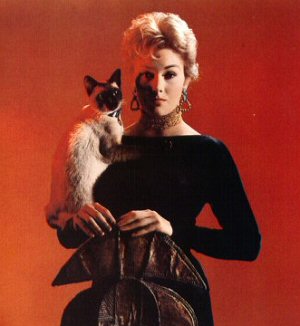
Kim Novak and “Piewacket” in Bell, Book and Candle. Was it Candy Darling or Holly Woodlawn who did that terrific imitation of Novak calling for Piewacket (“Pie! Pie!”) in one of those ’70s Paul Morrissey films?

At first Novak just wants to sexually sample the straight-arrow uptown book publisher Shep Henderson, played by James Stewart, which she manages by casting a spell. But then her vulerable side comes through and she falls in love with the guy. And to have and hold him, she is later told by Queenie, she has to give up her witchy powers and become like everyone else.

A metaphor for tedious Eisenhower-era conformity, okay, but also for the process of surrendering certain selfish perogatives and “giving it up” to make a relationship work.

It’s a widely understood theme, which is why Bell, Book and Candle, sappy as it may seem from your basic hipster perspective, is still performed in regional theatre companies today, and why the Columbia Tristar Home Video DVD of the film is still a mildly pleasant thing to sit through. You can feel what Kim Novak is feeling, what she wants. Hokey as it is, the story connects.

Plus it has a tasty supporting performance by Ernie Kovacs as an alcoholic writer. I love that the slurry-voiced, shaggy-haired Kovacs is in the bag for the entire film and is always scrounging around for “a little post-Christmas cheer.” And I love the way he chuckles when a realization hits him.

(There’s an article in how alcoholics in movies used to be reliable comic figures, or even portrayed as lovable because of their alcoholic personalities. Lee Marvin in Cat Ballou , Dudley Moore in Arthur, Arthur O’Connell in Anatomy of a Murder, etc.)

I’m not saying Bell, Book and Candle is a deeply profound thing, but if the Ephron sisters had focused on van Druten instead of swizzle-sticking the formula of an old TV series that was basically about domestic female empowerment (all Samantha has to do is wrinkle her nose and all predators are stopped in their tracks), they would have at least had something.

They would have had an adult love story about a recognizable emotional tendency or current instead of what Bewitched is now, which is nothing.

But if they’d gone this way they couldn’t have used Will Ferrell as the book publisher be cause he can only play insecure boobs, and one of the main reasons they made this film was because Ferrell sells tickets to young men, so they kept Ferrell and booted Bell, Book and Candle and went for the easily identifiable TV series hook and everyone cashed their checks, and this is why almost everything made by a big studio these days stinks.

Scrappy Guys

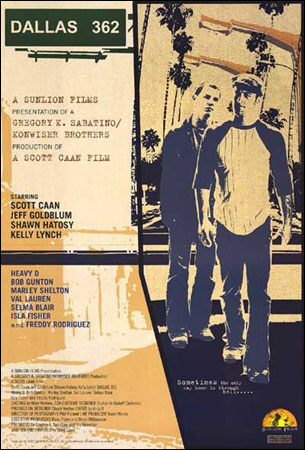
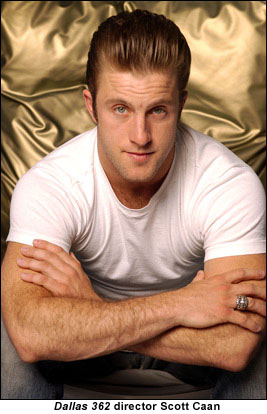
I first saw Scott Caan’s Dallas 362 during the ’03 Toronto Film Festival, and now it’s finally getting a New York opening this Friday (6.24) at the Village East. It’s played here and there around the country (Ohio, Austin, Los Angeles) and hasn’t exactly caught a wave, but it’s a tangy, smartly written, nicely performed first film.
That’s not damnation with faint praise. I’m just giving it a solid B-plus and saying it’s worth seeing because Caan gets a whole lot of things right. It’s partly a middle-American Mean Streets and partly a dark relationship comedy. It’s got spunk, personality and at times a wack sense of humor, which is nearly enough to take the film across the finish line in itself.
It’s a low-budget male relationship movie, which yanks it out of the running right away as a date movie. And except for a pair of older boomer-aged characters played by Kelly Lynch and Jeff Goldblum, it’s mostly about some fringe-y, wild-ass GenX types with self-destructive behavior patterns. And we all know that demimondes of this sort tend to play best with esoteric DVD renters.

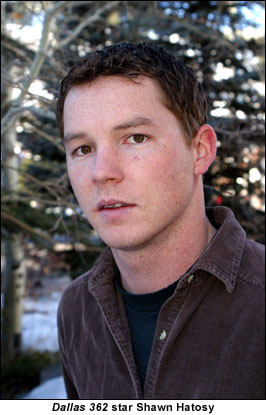
Not surprisingly, and to some extent autobiographically for Caan, Dallas 362 is a dear-dad movie. It contains echoes of the writer-director’s relationship with his father, actor James Caan, although Scott casts himself in a second-lead role and gives the lead to Shawn Hatosy, a squatly-built young actor with Irish skin and small dark-brown eyes that made me think of that Michael Caine line in Get Carter — “piss-holes in the snow.”
Hatosy is better than adequate in Caan’s film, but he doesn’t have star chemistry. Caan, who does — he’s always had an effortlessly grounded macho prescence and a ready-to-pounce intensity — should have played the lead, and Hatosy, good as he is in Rusty’s shoes, should have played Dallas.
It’s interesting that it’s Caan who’s front-and-center in the release poster with Hatosy standing behind him.
Rusty (Hatosy) and Dallas (Caan) are a couple of L.A. guys in their mid 20s who are always getting into bar fights. They keep telling themselves it’s always the other guy’s fault, but they’re obviously into rage. Rusty, who’s slightly more stable than Dallas, is pushed into therapy sessions by his mom, Mary (Kelly Lynch), with an amiable, pot-smoking psychologist named Bob (Jeff Goldbum), who also happens to be her new boyfriend.
For the first 30 to 45 minutes, the movie is mainly about kicking around, chasing girls, meeting this and that edgy character, and getting banged up in pool halls and juke joints at night.
Dallas’s day job is collecting money for a bookie, but he’s working on two plans to rip off rich guys in their homes — one being the bookie he works for, and the other a guy he won’t know anything about until the night of the job.

Rusty, meanwhile, starts getting in touch with his feelings during his therapy sessions with Bob. One revelation is that he’s pining heavily for his dead father, a rodeo rider who died after being gored by a steer, and wants to follow in his footsteps.
Another is his deep kinship with Dallas, whose loyalty and fearlessness makes Rusty feel safe, he says, even though Dallas is obviously pulling him in the direction of chaos.
The going-to-Texas dream has a roadblock in the form of Mary, who doesn’t want to endure another rodeo tragedy and has told Rusty to forget it.
What kind of 24 year-old doesn’t follow his dream because him mom says no? Maybe the kind who hasn’t quite realized what that dream exactly is…yet. But once Rusty achieves clarity on this, he starts edging away from Dallas, who is determined to pull off the two home invasion robberies despite his friend’s disapproval. Rusty is appalled at his friend’s recklessness, in fact, but he decides not to stand in his way either.
The real-life parallels or references? The younger Caan is obviously following in his father’s footsteps, both as an actor and a director,. James Caan was on a very reckless personal streak in the ’80s. He also had a liking when he was younger for outdoorsy macho stuff, including bronco riding, if I remember correctly.

There are some occasional misfiring bits in Dallas 362, but nothing too bothersome. There’s a scene in a diner between Hatosy and a beautiful blonde stranger who walks in with lust (or something very close to that) in her eyes. Rusty tells the blonde he’d like to “save ” her by carrying her away, but can’t right now. Then he leaves without asking for her phone number, or giving her his. What the….?
The opening credit sequence — a series of black-and-white photos portraying Dallas and Rusty’s raucous nighttime adventures — is magnificent.
Bottom line: Dallas 362 is a highly assured debut of a new writer-director with a genuine sense of style. Caan’s dialogue is extraordinary at times, and he gets top-notch performances out of everyone. The result is far better than most of the mainstream pics playing at your local plex. Naturaly, given all this, it’s had some difficulty finding its audience.
Here’s the site .

Grabs


8th Avenue and 22nd Street — Sunday, 6.19, 5:45 pm.

1st Street South facing west from Bedford Avenue — Monday, 6.20, 8:40 pm.

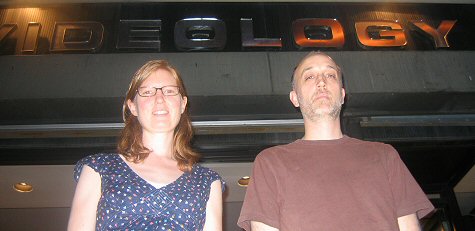
Wendy Chamberlain and James Leet, gracious co-owners of Videology (308 Bedford Ave., Brooklyn, NY 11211), easily the hippest and most refined video store in the Williamsburg area — Monday, 6:20, 8:55 pm.

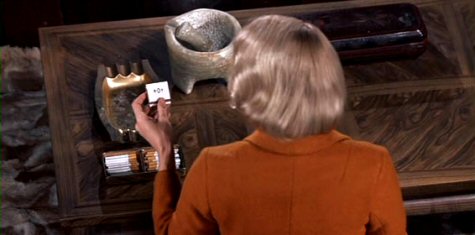
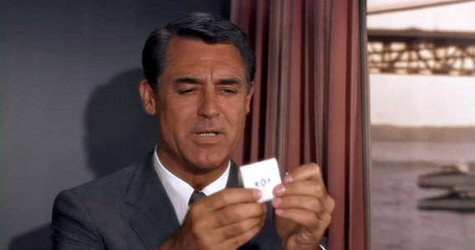
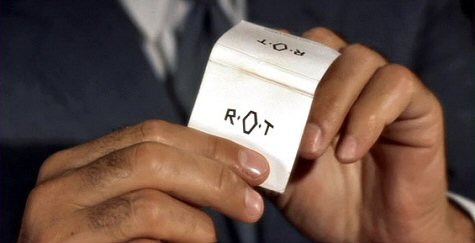
Hands belonging to a certain widely-admired, acrobat-trained actor born in Bristol, England. Letters on matchbook do not signify the initials of the character he portrays in a certain well-known thriller (from which this closeup still is derived) as much as they allude to the character’s ethical-moral state as the film begins.

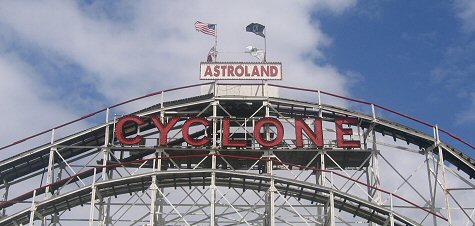
Most New Yorkers know this, I’m sure, but this world-famous roller coaster at Coney Island is rather small in scale and a bit of a relic. Riding the damn thing seemed pretty thrilling to me, but my hardcore 15 year-old son Dylan says the Cyclone doesn’t cut it alongside the much scarier rides found in today’s extreme amusement parks. Plus it lasts only two minutes (if that). The fare is $5 bucks — it’s worth $3.

Dies For Our Sins

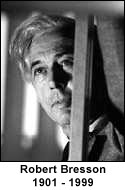
The long-awaited Criterion Collection DVD of Robert Bresson’s Au Hasard Balthazar hits the shelves on 6.14, and there’s no excuse for not going out and buying this sucker now and keeping it close for the rest of your life.
This is a great, transcendent film because it conveys and seems to truly inhabit that sense of primal serenity and all-knowingness some call God.
Set in rural France, shot in black and white and released in 1966, Au Hasard Balthazar is about the sad life and death of a donkey.

Balthazar is loved by few (a teenager named Marie, played by Anne Wiazemsky, is his most devoted soul-mate), and is mostly treated with cruelty. This poor saintly animal goes through all kinds of hell and indifference. Beaten, worked to the bone, sold and resold, shat upon.
But as critic Jim Hoberman once wrote, the film’s real concern “is the state of being. Crowned with flowers, spooked by firecrackers, struck without cause, Balthazar bears patient witness to all manner of enigmatic human behavior. This expressionless donkey is the most eloquent of creatures — he is pure existence, and his death, in the movie’s transfixing final sequence, conveys the sorrow that all existence shares.”
I’ve seen Bresson’s masterpiece twice — once a year and a half ago at the Nuart, and once in the late ’70s. I remember after my initial viewing sad and heartbreaking it felt, and how I was so turned around by the idea of a donkey being presented as the bearer of our sins — a mute observer, martyr, sufferer.
If it sounds religious to you, then so be it. I know I felt the presence of “God” (a remnant in my head of some kind of sentimental, lamenting, all-penetrating cosmic heart) in this film very clearly.
Absolute masterpieces don’t come down the pike very often. It was voted one of the 20 greatest films of all time by the critics and filmmakers who voted in 2002’s British Film Institute’s SIGHT AND SOUND poll. Film lovers have been extolling its legend for decades.

Bresson wasn’t into manipulating audiences. He began as a painter and was very conscious of unity and precision. He was into pruning down and purifying his films. He would never fake anything. He’s known for austere camerawork (he always used the same 50mm lens, which most closely replicates how the world seems to the naked eye), eschewing theatricality, and making sure his actors never gave “performances.”
Bresson’s best-known classics besides Balthazar are Diary of a Country Priest and Pickpocket. My second favorite Bresson is L’Argent (’83), his final film, made at the age of 81.
Bresson died five and a half years ago, at age 98. There are several easy-to-find Bresson websites, but here’s one of the more thorough.

More Grabs


I don’t know how good this fabled 8th Avenue seafood restaurant is (but I can guess) — what matters here is how cool it looks from the outside.

Bedford Ave. and South 1st Street, looking east — Monday, 6.20, 8:35 pm.

8th Avenue and 19th Street (or so I recall) — Sunday, 6.19, 5:40 pm

What does it matter when this shot was taken? Who cares? Even the slightly off-focus look I was going for didn’t pan out (too soupy-looking) and I almost didn’t run this as a result. But I like that glare effect from the subway car lights.

Why do people flock to Coney Island? It takes forever to get here by subway (just under an hour from Williamsburg) and believe me, it’s not much when you finally arrive. It feels crampled, provincial, unexciting…a ’60s time-capsule park. You’re ready to scoot fifteen or twenty minutes after you get there. Taken Sunday, 6.19, 2:50 pm.

Dining-car art by Claude Gazier (www.claudegazier.com).

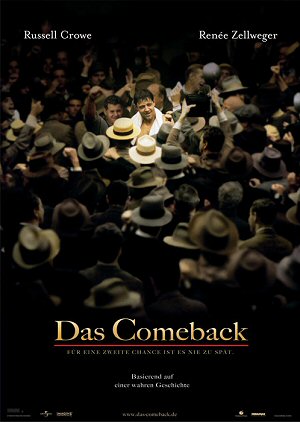
Heralding the upcoming release of Das Comeback, which will open in Germany on 9.8.05. It will open in most other European countries on this day or on 9.9. It will also open around this time in Argentina, where it will be called El Luchador (“The Fighter”), according to a director friend from Buenos Aires.

On Scorsese’s “The Departed”

Good Stuff

It’s possible that Martin Scorsese’s The Departed won’t work, but it appears as if all the elements for a genuine Scorsese comeback are in place. An urban crime movie (Marty’s home turf), a terrific cast (Leonardo DiCaprio, Matt Damon, Jack Nicholson, Alec Baldwin, Ray Winstone, Vera Farmiga) and a really fine script.
This is probably Scorsese’s last chance to raise himself back up to the level of Goodfellas or better. If he screws this up he should just throw in the towel.
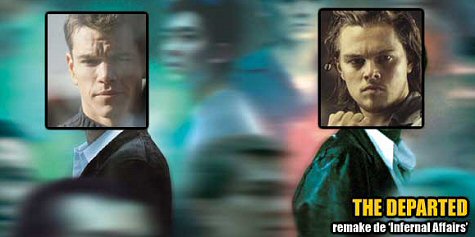

Slapdash pseudo poster art for The Departed that I would normally be too embarrassed to put up, but I can’t find anything else.

I’m saying this because I’ve finally read William Monahan’s script for this remake of Infernal Affairs, a 2002 Hong Kong crime flick about a pair of moles infiltrating the mob and the police department at the same time. Frankly? I saw it in Toronto and I found it too complex and hard to follow.
Monahan’s version is much more clearly plotted, not to mention tight and slangy and gritty in the good old east-coast street fashion. It’s also a well-constructed suspense piece.
The two moles, Billy and Colin, are respectively portrayed by DiCaprio and Damon. Billy is an angry undercover cop infiltrating the mob; Colin is a calm and collected mob guy serving as a police detective.
< ?php include ('/home/hollyw9/public_html/wired'); ?>
Jack Nicholson is playing Costello, a ranking mob boss Billy is trying to take revenge upon for an old family wound, one that’s fairly close to what drove DiCaprio’s character in Gangs of New York.
Just as DiCaprio’s Amsterdam Vallon won the affection of Daniel Day Lewis’s Bill the Butcher by being extra-snarly and game for anything, Billy wins Costello’s trust by being exceptionally loyal, smart and ferocious.
Damon’s Colin works his way up the ranks of the police department and eventually lands a job as the head of Internal Affairs and is given the job of trying to find out who the mob mole is — i.e., himself.
Costello knows there’s a mole somewhere under him, and to uncover the truth he leans entirely on Colin, whom he’s known since the latter’s childhood. All kinds of stuff goes down, and yet DiCaprio and Damon never face off until the last 15 or 20 pages.


The Departed costar Vera Farmiga

The only thing vaguely dismaying is the fact that Farmiga has the lead female role, that of a therapist who’s has sessions with both Billy and Colin. Farmiga is a very good actress (last in The Manchurian Camdidate) but she does nothing for me chemically. She’s one of those obliquely attractive museum-pretty types that everyone loves except for regular guys who buy burritos at the 7-11.
A good part of the flavor of The Departed, apart from the bounty of Monahan’s rich and robust dialogue, will, I presume, come from the performances of supporting actors Peter Mullan, Anthony Anderson, Winstone and Baldwin. These guys are aces every time out so…
Warner Bros. will release The Departed sometime in ’06. It reads like a fall movie, but it’ll probably be finished in editing by mid-fall ’05 so maybe it’ll come out sooner.

And…

I’ve got three other scripts I’m going to try to read this weekend:
* Russell Gewirtz’s Inside Man, a bank robbery-hostage drama that Spike Lee will be shooting in Brooklyn this summer, with Denzel Washington, Jodi Foster and Clive Owen in the lead roles. Universal will release it in ’06.
* Terence Winter’s Get Rich or Die Tryin’, the drama based on 50 Cent’s struggle to leave behind a drug-dealing life and become a successful rapper. The great Jim Sheridan (In America) is directing. 50 Cent is playing himself, and the costars include Viola Davis, Bill Duke and Terrence Howard (who stars in his own film about an underworld type trying to become a musician, Hustle and Flow, this summer).
* Terrence Malick’s The New World, about explorer John Smith (Colin Ferrell) and the clash between Native Americans and the British in 17th century Virginia. The subtitle is “Story of the Indies.” New Line is releasing on 11.9.

Rock My Wordsoul

Every time I get on the subway I get out my new copy of “The Rock Snob’s Dictionary” (Broadway Books), a very snide and tidy little sum-up guide about the who, what, when and why of rock-music elitism.
Last night I pulled it out on the R train going downtown from 42nd Street and when I looked up we were pulling into Cortland Street, about five or six stops farther than I wanted to go. I wasn’t very happy about that, but at least this tells you how much fun this thing is to flip through.
I read this 148-page paperback whenever I can because it’s so exquisitely written. Every sentence is a Hope diamond, chiseled and honed and phrased to perfection with just the right seasoning of know-it-all attitude…aimed, naturally, at the snobs who initially created it.
I don’t get rock music as fully as I do movies, but I understand it well enough to recognize that the authors, David Kamp and Steven Daly, who both write for Vanity Fair, know it over under sideways down.
Their definition of a rock snob, found on the book’s front cover, is “the sort of pop connoisseur for whom the actual enjoyment of music is but a side dish to the accumulation of arcane knowledge about it.”
Just go to the site and read their writing samples (which Kamp is a bit more responsible for than Daly, being the editor between them) and you’ll see what I mean.
If you care about rock music at all, you have to get this thing. I’m serious. It’s so sublime I’ve read it through twice. And there’s a nifty English school-book quality to the hand-drawn illustrations by Ross McDonald.

Why am I writing about this, apart from the fact that it was a much-appreciated gift from departing Doubleday/Random House publicist Marc Winter, who’s moving into film producing? Because Kamp and Lawrence Levi have written The Film Snob’s Dictionary, which will come out in February ’06, and this is something I imagine readers of this column will want to have.
The preview page for this book on the Random House website describes it thusly: “By helping to close the knowledge gap between average moviegoers and incorrigible Snobs, the Film Snob Dictionary lets you in on hidden gems that film geeks have been hoarding (such as Douglas Sirk and Guy Maddin movies) while exposing the trash that Snobs inexplicably laud (e.g., most chop-socky films and Mexican wrestling pictures).”
Mexican wrestling pictures? Somebody help me out here.
I called Kamp yesterday morning to talk about the currently available Rock Snob’s Dictonary ($12.95). I tried to reach him through normal channels but it was taking too long so I just found his number and called and he picked right up.
“Whenever you talk to rock people or when you read the rock press, there’s this curve that pretty much goes unexplained,” Kamp said. “People refer to Brian Eno or Televison without any acknowledgement of what these terms mean.”
Their book, obviously, intends to close the gap between snobs and Average Joe’s.
“It’s a very simple idea,” he told another interviewer who was better at asking the right questions. “Just put some things in boldface and define them: these terms that make up this code you can’t quite crack when you’re reading rock magazines or discussing music with people in your dormitory.”
Kamp and I had a nice conversation but it was kind of boilerplate (my fault) without any really great quotes coming forth.
He did tell me, however, that other Random House snob books are being worked on. He’s preparing a wine snob book now with a guy named David Lynch, who works as the wine director at Babbo, the Italian restaurant on Waverly Place. There’s also a food snob and a football snob book coming up.
The Rock Snob’s Dictionary originated as a feature in Vanity Fair, as did some of the Film Snob material.
“I would say that [this] particular condition of rock snobbery is probably a lack of sexual intercourse,” Daly told an interviewer last month.
“Think of when a person becomes interested in rock music: the teen-into-college years,” Kamp has explained. “Politically, that’s when you’re going to change the world. It’s also when you have your most strongly held taste convictions. So you take everything very seriously, you’re very territorial. You really think these bands are the most important bands.
“At the same time, you don’t want them to be too well known, because then they wouldn’t be yours anymore — they’d be sellouts. So there’s this whole proprietary quality to rock snobbery that isn’t there even with film snobbery.
“To me, actually, film snobs are more insufferable. But rock snobs are the most, ‘this is my turf, keep off!'”

Grabs


Lexington and 61st, during Thursday’s (6.16) rainstorm around 3:30 pm.
Last Days star Michael Pitt following round-table journalist chit-chat — 6.16, Regency Hotel, Park and 61st, 5:25 pm.
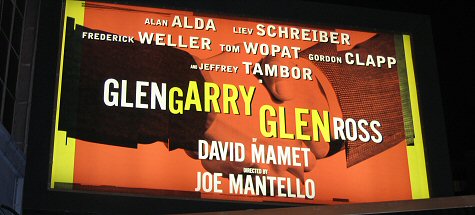
Marquee of Bernard B. Jacobs theatre, 242 W. 45th Street — 5.15, 10:25 pm.

L train heading east to Williamsburg, Brooklyn — Thursday,6.17, 11:15 pm.

Rainwater and plastic detritus flowing into drain at corner of 2nd Ave. and 62nd Street — Thursday, 6.16, 6:10 pm…during Thursday afternoon’s rainstorm.
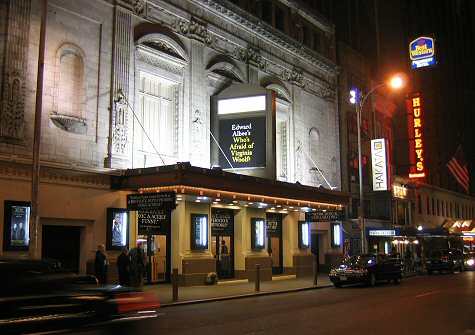
Exterior of Longacre Theatre, 220 W. 48th Street — Wednesday, 6.15, 10:12 pm.

Tom and Katie

“Isn’t this whole Tom/Katie thing just totally creepy? I don’t fault her – she’s been swept up into his celebrity and personality, although you’d think a woman of 26 would be a bit more cautious. But Tom’s creep-out factor is through the roof!
“I’m not a fan of his as an actor but he certainly has his niche in the movie world. Still, why suddenly all of these public declarations and displays of love from this man who sues anyone who dares to encroach on his privacy in even the smallest way? And the Scientology thing just makes it all more discomfiting.
“I believe that every move Tom Cruise makes, every minute of every day, is calculated and planned. The man does not have a spontaneous bone in his body, so all of the leaping and shouting and kissing is just…icky because it seems so orchestrated.
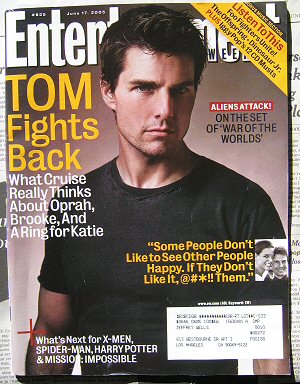
“I usually find these high profile celebrity relationships nothing more than light entertainment, because they normally play out in a predictable and harmless way. This one is just plain disturbing because Tom Cruise is so weird and Katie seemed so normal …until recently. Let’s hope the frog realizes the water is close to boiling and hops out before it’s too late!” — Lisa in Denver
“I like Tom Cruise. He’s made some good films and I applaud him for some of the roles he’s taken on. I have to confess I don’t know much about Katie Holmes, but she seems like a nice young lady. I wish them both all the best. But when you add the Scientology aspect to the mix, things start to get very strange.
“I’m all for religious freedom and tolerance, but this so-called religion strikes me as more than a little weird. My skepticism automatically kicks in because the founder of Scientology was an author of science fiction. Scientology may actually help some people handle this crazy life, but any religion that requires you to pay for the various states of enlightenment increases my skepticism.
“And then to add a Scientologist shadow (i.e., Jessica Rodriguez) to follow Ms. Holmes around, and things are certainly getting curiouser and curiouser.” — Edward Klein.
“As a pretty unapologetic Scientology basher, I can’t help but wonder how the 26 year old Jessica Rodriguez is OT-IV. Have you any idea how much money that takes? I’m not sure I’ve ever heard of anyone getting past OT III before their 30th birthday, and it takes several $100K more, plus time, to get to OT IV. Not that it really matters, but it doesn’t really jibe.
“Why, in any event, is the ‘serious’ entertainment press afraid to touch this with anything resembling a magnifying glass?
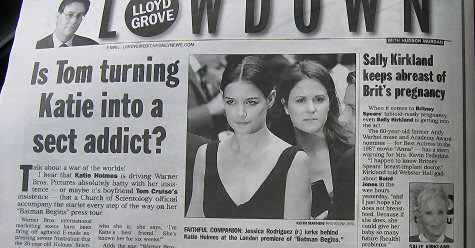
“Cruise’s publicist sister is a pussy compared to Pat Kingsley. Tom Cruise is actively proselytizing for a government recognized cult! He fired Kingsley when she disagreed with his desire to speak out about $cientology, and now he’s spitting out their ridiculous lies (Carl Jung was an editor for the Nazi papers in World War II, methadone was originally called Adolophine and named after Adolf Hitler, etc.) and being quoted in bold in major wire stories.” — Joel Sadler
“Congratulations to Cruise for finally finding love…even if it is with a woman who seems less extraordinary, magnificent and especially less of a woman than Cruise has proclaimed her to be. Holmes’ way of responding to questions reminded me of a 13 year old, but the heart wants what it wants and I’m sure Holmes isn’t on the rebound at all after calling off a five-year relationship including some years of
engagement.
“I’m not buying George Hickenlooper’s explanation that Holmes rejected the role of Edie Sedgwick in Factory Girl because of her obligations to the promotional tour for Batman Begins. The Bat movie is an already-hyped big movie with its own in-built fan base. Holmes’ role doesn’t serve as any kind of crux in the story line, and the bottom line is her role in the movie is not big enough to require her to be a key part of the promotional tour. Choosing to make a movie like the Sedgwick project or going on a promotional tour for Batman is certainly a no-brainer.
“I wonder if Cruise was under a rock during Bennifer or if he believes that he is likable enough for people not to care too much about his very public relationship.” — Akilis.

Cinderella Blues

“My gut feeling is that while Russell Crowe’s phone tag incident certainly didn’t help matters, I can’t imagine some guy in Gary, Indiana, refusing to see a movie because Crowe is a hot-head. Maybe some concerned soccer mom in Denver, perhaps, but I don’t think that would be the rule.
“If anything, Cinderella Man‘s embarrassing returns probably have something to do with the title, for one. You’ve got tough guy Russell Crowe in a boxing film and you call it Cinderella Man? Why not just call it Girly Man? I can see that guy in Gary, Indiana, saying to his buddies, `Hey, wanna go see Cinderella Man?’ and them saying back, `Cinderella what?’
“The second and biggest thing is that Cinderella Man has the unfortunate timing of following another critically acclaimed boxing movie, directed by a respected Hollywood veteran. Million Dollar Baby was a tough sell (as are most boxing films, it could be argued), but it won out commercially and critically because the quality was there.
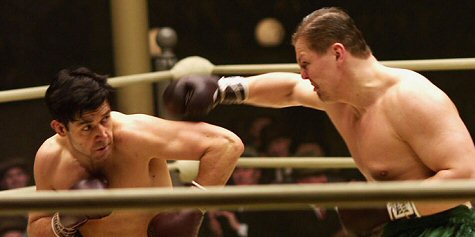
“You and I know that a great film is a great film, no matter what the concept is, but to an average filmgoer out on a Saturday night, the quick and easy appraisal of Cinderella Man is: “Hey, didn’t we just see a boxing movie? Let’s go see Brangelina!”
“Sad, but true.” — David Scott
Wells to Scott: You’re describing or hypothesizing the behavior of a group of people committed to an instinctual, submental, “what, me read reviews?” approach to seeing movies. You’re talking about people who are flat-out refusing to use that arcane skill they were taught early in life called “reading” or deploy that trait known to many thousands of us called “curiosity” and take five minutes and go online and look into a new film.
I know…that’s out, can’t happen, forget it. But as long as it’s Gorilla Cage time out there, movies will rise or fall for gut-response reasons, and trailers and TV spots will continue to be the propelling factor in spurring people to see or not see a film, and the quality of mass-market movies will get more and more abysmal.
“I have a tough time believing that Russell Crowe’s recent headline-grabbing fracas had much at all to do with the box office slip of Cinderella Man. My guess is that those that were inclined to see it (and I’d imagine a fair share of blue hairs were in this bunch) jumped on it the first weekend, especially considering the drought of decent flicks at the local ‘plex. Nothing new here. The thing just didn’t have legs. Tweens and teens couldn’t care less, and the core audience already paid their $8.50.
“I think another big issue is the fact that the film, however well crafted, is simply predictable. We all know how it’s gonna end. It’s an age-old story we’ve all seen a hundred times. No surprises. Why bother?
“I’d venture to guess a vast majority of the paying audience doesn’t pay to see a movie for nuanced performances or beautiful picturesque cinematography or finely crafted period production design. The across-the-middle crowd just wants to be entertained and sometimes surprised. My guess is there is a huge cross section of audience that when push came to shove, wavered on seeing it because they already knew how it ends. I know I did.” — Jeffrey Wright
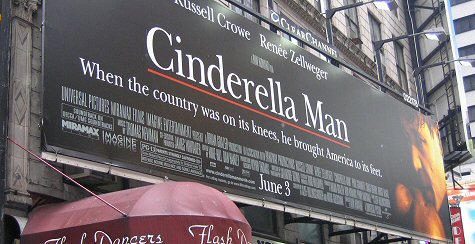
Wells to Wright: From my perspective, from any perspective that presumes a certain awareness on the part of the general public (which may be a mistake, I realize), there was simply no glaring negative attached to Cinderella Man other than Crowe’s phone-throwing incident. That was and remains the only downside to this film in actuality, dumb-ass presumptions and suspicions aside.
Cinderella Man isn’t just entertaining, but quite touching. It isn’t depressing unless you’re a complete idiot. It uses a gloomy 45-minute setup as a springboard into a soulful, feel-good payoff that lasts for over an hour. It’s a somewhat predictable tale, yes, but most people over the age of twelve or thirteen realize that there are only so many stories out there and what really matters is the singer, not the song.
C’mon…to not see a movie because you know how it’s probably going to end is absurd. The percentage of movies that knock you flat with a surprise ending or twist of some kind is very small, and everyone knows that. What counts is how good the ride is along the way.
“It is not necessarily the culture of tabloid, as New York Times writer Caryn James has stated recently, that somewhat causes the movie experience to be tarnished due to the burring of the line between the art itself and the offscreen exploits of the actor playing the character.
“The actor as well as the film industry is arguably at fault for much of this. Many of them simply enjoy the attention for whatever narcissistic reasons they have. Ben Affleck and Jennifer Lopez. Angelina Jolie on Actor’s Studio talking openly about things that are completely insane. It’s as if these people feed off the system.
“You even said yourself that maybe they think they can follow different rules than ourselves. Christian Slater and his late-night ass-grabbing, for one example.
“For what it’s worth, if someone self-destructs there is always another fine performer to replace the burnout. Sure, some very good films may be damaged by the offscreen antics, but other movies are always there. But in general, I’d say it really doesn’t matter that a film is damaged by such activity and causes it to be dismissed. No one has to watch a film and if they do not want to view it because of the actor’s political beliefs, their criminal record, or they don’t like people with red hair, so be it. Heck, I wouldn’t choose to view a chick flick even if it did get four stars…there really is no difference.” — Phillip C.Perron.
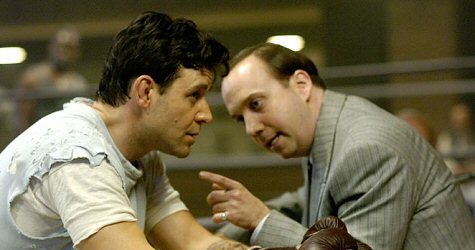
“I saw Cinderella Man last Friday night and it was obviously first rate, if a little schmaltzy. My father loved it in a way I’ve never seen him like a picture before. But he’s 73, not exactly anyone’s target audience.
“Anyway, I think the picture became a commercial disappointment for the following reasons:
1. Bad title. Yeah, I know that this was Braddock’s nickname, but so what? It’s obviously a turnoff for some.
2. Period Pieces are Tough Sells, and this period in particular — the Great Depression. And yes, the film is emotionally wrenching at times and some may think a bit depressing (that is, if they haven’t seen it). My sister is ill and hasn’t been to a movie in 18 months. Feeling well enough to go yesterday, she thought about CM, but thought it would be too depressing. She went to see Brad & Angie instead (and loved it, as did my other sister and her female friend).
3. Summer Release — Big Mistake. This would’ve been the perfect fall release, lining it up right timing-wise for year-end awards. Do you think it’ll get any now? Universal’s Nikki Rocco and Mark Schmuger must be reeling, not to mention Grazer and Howard.
4. Russell Crowe — This guy is a great actor, but his own worst self-destructive enemy. A colleague of mine, a first rate assistant director, did a picture with him years ago, before he was a star, and said he was a total prick. And my buddy gets along with everyone!
“Looks like a perfect storm of negativity. Too bad, because it really is a good picture. So is The Lords of Dogtown, which most thought would do some business. But it really tanked…hard. Don’t you love the movie biz?” — Dixon Steele, Hollywood, CA.
“I think they made a strategic mistake in opening it simultaneously with the first wave of big summer films. I believe you can open an essentially serious, quality-level picture in summer. But I think they missed the crucial lesson of Seabiscuit‘s success, which was that you open such a film mid-summer, after even the dimwits have begun tiring of the big-budget crap and are willing to search around for something with a slightly different flavor. I truly believe if Universal had waited a month, they’d have been in much better shape with this one.” — Todd.
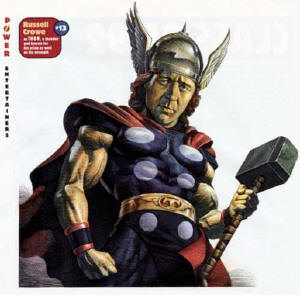
“To suggest that Russell Crowe’s career is in trouble after the phone incident and the poor second-weekend box office returns of Cinderella Man is premature. Who would we replace him with, Brad Pitt?
“This is not condoning his actions in NYC, for which he has already apologized for and undoubtedly will have to suffer consequences. But in the end he will survive this and continue his unparalleled work. Universal should take the blame for releasing Cinderella Man at an inappropriate time. Why release the film here in June while releasing it in the fall in the rest of the world? Which marketing genius took the credit for that?” — Tommasina Papa-Rugino.
“I saw your column on the murphsplace site and noted the comment from one journalist about the possible loss of an Oscar nomination for Russell Crowe. As your column is widely read do you think you could do a favor for those of us who belong to the more fair-minded part of society, and remind the Academy’s members that they are…
“NOT PERMITTED to vote on moral grounds but only on the basis of what they have seen and heard in the cinema not what they read in the gossip columns or seen on the chat shows, and NOT QUALIFIED to sit in moral judgment of anyone (let he who is without sin cast the first stone, as a much better man than any of them once said.
“Whilst on this issue you might also try reminding your readers of the concept of the Presumption of Innocence, and how important that right is — particularly your fellow journalists who happily crucified Russell Crowe on the front pages of their newspapers without once bothering to ask whether or not he should even have been arrested.
“As to the arrest itself, let’s try for a few facts, just for a laugh…
“1. Russell Crowe was paying the better part of $4,000 per night for the use of a room which was supposed, among other things, to contain a working international telephone.


Soho’s Mercer Hotel on Prince Street.

“2. By the time of the disputed incident he had been staying there for a week and the telephone had not worked properly in all that time.
“3. The hotel had failed to address the problem in any way, despite by this point having taken nearly $28,000 from Russell.
“4. After finding the phone to be no use for making an international call yet again Russell tried calling down to Reception to sort out the problem for the 7th time.
“5. Apparently being unable to make himself clearly understood he disconnected the phone, which he was entitled to do as its licensed user having given valuable consideration (nearly $28,000) for the duration of his booking, and took it downstairs to prove that it was not working.
“6. The receptionist was apparently unhelpful and rude, to the point where Russell lost his temper, (what on earth did the man say to get such a reaction?!), and threw the telephone at the wall, from where it rebounded and hit the recalcitrant clerk. This DOES NOT constitute assault in the 4th or indeed any other degree as again there is no evidence of intent to cause injury – an absolute prerequisite when bringing a charge of assault. What it does constitute is disorderly conduct and possibly criminal damage.
“7. Why was the receptionist so rude to a man known to have a short fuse, and at a time of day (4.20am) which repeated academic research has shown to be the lowest point of the human psyche?
“8. What if any training policy and customer service policy does the hotel have and did the receptionist comply with them?
“9. Why did the hotel make no effort to provide a working telephone after receiving complaints every day for a week? What is the hotel’s equipment replacement policy and did the hotel’s staff comply with it? The Mercer’s contract with Russell included the use of a working telephone for which, and for other services including common courtesy from the hotel’s staff, he had paid nearly $28,000.

“10. Where has the figure of $1,000,000 in damages come from? No jury, American or otherwise, is going to award such a sum for a 1” long cut, which has caused no permanent damage of any kind and which will be invisible to the naked eye in six months’ time. If a jury did make such an award it would be struck down on appeal for being a perverse award, as the law requires.
“Moreover, Russell has an overwhelming case for a counterclaim of contributory negligence which could reduce any award by as much as 50%.” — Amelie Smith, London, England.
“Russell Crowe is the best actor alive today, and the unfortunate incident at the Mercer Hotel doesn’t change that. To be fair, why don’t you remind folks of Johnny Depp’s drug arrests before his Tim Burton movie opens this summer? Or Sean Penn’s…?
“At least Mr. Crowe was just trying to get in touch with his family, and had the character to own up to his mistake.” — L. Steinberg.

Bad Collars

“With regard to those bad-collar shirts at Banana Republic, you need to understand that 90% of post-college, under-35 men have to wear these things because instead of getting raises and job security, most of us work for companies that would rather let you wear khakis and golf shirts to work rather than having to pay you.

“Some of them must be aimed at an urban gay group, but the rest of us are just simply left with nothing else to wear to work. Chalk it up to trying to find pants and shirts that don’t make you look like you work at radio shack. ” — Evan Boucher.

Smiths

“I had no interest in seeing Mr. & Mrs. Smith when I first heard about it and would have happily passed on it except my wife wanted to see it and it was our anniversary, so I decided it wouldn’t kill me and besides, if I take her to see the films she really wants to see I can then get her to go to films I want to see — the give and take of marriage.
“While I didn’t loathe it quite so much as you did, it wasn’t a complete waste of our time and money. The stars were decent and it had moments. The first quarter of the film wasn’t bad, but it did get bad…very bad. After it was over we chatted about the pointlessness of it all and the stupidity of the gunfight in the store and why it had to be so over the top.
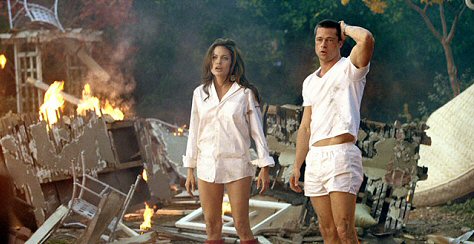
“There was a kernel of an idea in the film; it could have been something fun and maybe inventive. It seems that Doug Liman had no choice in making something good. He had lots of money thrown at them and the studio wanted something expensive big, loud and stupid. I have to wonder how much control a director has in today’s Hollywood. And why anyone would want to make something like Mr. & Mrs. Smith.
“Why couldn’t Liman have said he could save the studio some money and re-tool the script cutting out the crap and trying to make something reasonably clever and original? Obviously there was a fat paycheck involved, but don’t directors ever read these scripts and have some input on what the final product is? In this case the answer was a big no.” — Edward Klein
“I always enjoy your stuff, but please get a grip about Mr. & Mrs. Smith.
“I saw it last weekend largely because of the positive reviews from Kenneth Turan and Desson Thomson, two movie critics that I have tremendous respect for. I am a woman, but I do not read tabloids, so I’m not quite the demographic that you denigrate for flocking to the film this weekend. I wanted some adult summer fun that received pretty decent reviews, and Mr. & Mrs. Smith fit the bill.
“I also saw the heartwarming Mad Hot Ballroom this weekend so it’s not like I lack for taste.
“So keep up the good work with your website and chill on the Mr. & Mrs. Smith vitriol. Far worst things have happened to the movies.” — Quin.
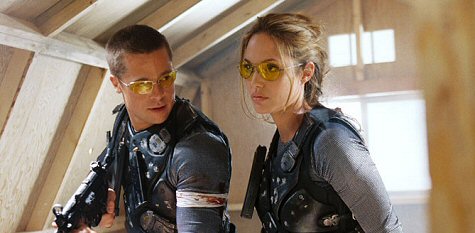
Wells to Quin: Ahah…Freudian slip! “Far worse things” have happened to movies, eh? Then you admit Mr. and Mrs. Smith constitutes some kind of bad thing, right? That’s because you’re basically an honest woman and you know deep down, even though you “liked” watching it for the “summer fun” element, that movies of this type are not just bad but aesthetic pollutants…the spiritual movie-aura equivalents of pesticides in the water table.
I am telling you, Quin, that if there is any aesthetic justice in the after-life, Liman, Pitt, Jolie and the New Regency guys who produced this thing will eternally roast on a spit for their contributions to this film.

More Grabs
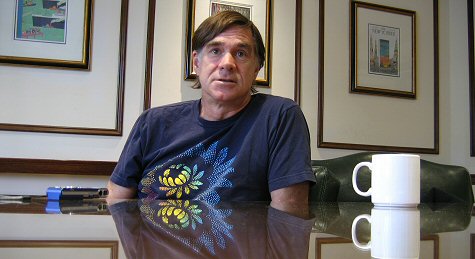

Last Days director-writer Gus Van Sant at start of one-on-one interview at Manhattan’s Regency Hotel — Thursday, 6.16, 4:15 pm.
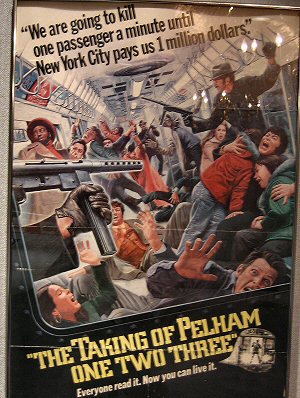
Several men execute a daring hostage-taking scheme aboard a New York subway train in order to persuade the city of New York to pay them one million dollars. Wasn’t this a joke in one of the Austin Powers films?
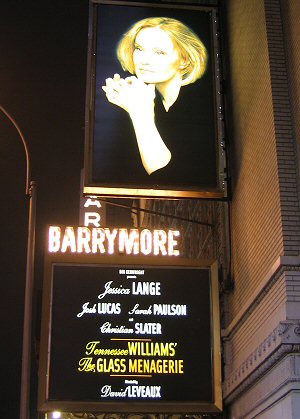
Exterior of Barrymore Theatre, 242 W. 47th Street — Wednesday, 6.15, 10:20 pm.

Last Days guitar picks…I grabbed at least five or six.
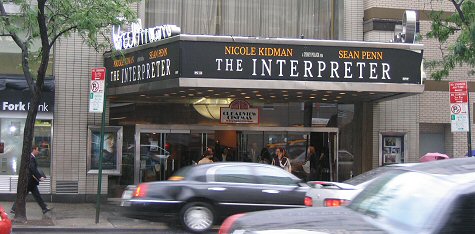
Soon-to-be-destroyed Beekman Theatre prior to all-media screening of the not-very-good but relatively inoffensive Bewitched — Thursday, 6.16, 6:25 pm.
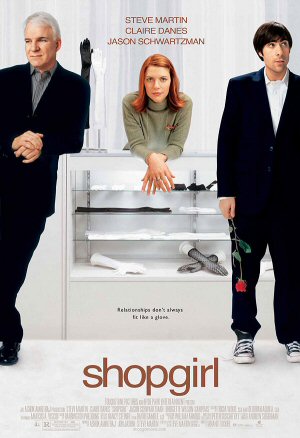
I read the hardbound version of Steve Martin’s original Shopgirl sometime in ’03 (I think) and found it concise and well observed and psychologically probing. The sadness of it — the bittersweet stuff — stayed with me. Martin wrote the screenplay, and if the movie (Touchstone, 10.21) is half as good it’ll be a fairly absorbing piece. What finally makes it, for me, is the casting of Jason Schwartzman (and not, thank God, Jimmy Fallon) as the younger guy who muscles in and makes a play for Claire Danes and basically ushers in an end to her relationship with Martin’s character, who is partly exploiting her youth and vulnerability but at the same time feels genuine tenderness and caring. The trailer isn’t up yet, but here’s the Touchstone site…just click through.

Tomkat Goes to Oklahoma

Free and Clear?

On Friday, May 27, Tom Cruise took Katie Holmes to a town called Canadian, Oklahoma, partly to acquaint his newly beloved to a phase in her indoctrination into the Church of Scientology.
The Hollywood couple were in this remote corner of America’s heartland to visit a Scientology-backed drug rehabilitation center called Narconon Arrowhead, located about an hour from Tulsa on the shores of Lake Eufaula. And Tom basically took Katie through the whole this-is-Scientology, start-the-education-process thing.


Smiles and giddiness: Tom Cruise, Katie Holmes.

Cruise’s sister and press rep LeeAnne DeVette called from Germany early this afternoon (Manhattan time) to say “yeah,” the story is true.
Details of the visit were relayed by an anti-Scientology blogger named Dave Touretzsky, who’s been called a solid and trustworthy source by two journalists I know and trust — a reputable east-coast big-city journo I spoke to this morning, and a journalist pal and book author who knows the whole Scientology scene cold.
< ?php include ('/home/hollyw9/public_html/wired'); ?>
I e-mailed the Pittsburgh-based Touretsky to get some more particulars but he didn’t respond by deadline.
The visit wasn’t denied this morning by Luke Catton, who works for Narconon Arrowhead’s public relations representative Gary Smith. “Tom’s a supporter, but I really can’t say anything and I think I should leave this up to LeeAnne to comment,” Catton said.
Holmes’ representative, Leslie Sloane of Baker Winokur Ryder’s New York office, said she’s “never been told” about the Oklahoma visit.


One of several T-shirts (among many different styles and colors) offered on www.freekatie.net.

According to Touretzsky, who wrote that the story came from “a hidden source” within the Narconon organization, Cruise and Holmes visited the facility for roughly four and a half hours. They left after Tom gave a speech at the weekly Narconon “graduation” ceremony.
The Hollywood couple’s brief visit ended when Cruise took Holmes by the hand and led her up to a hilly, sand-covered area next to an old wooden fence. Cruise released Holmes from his grip, an eerie Martian chorus came up on the soundtrack (“Uhhhaahhhhahhh!”), a hole in the sand appeared and suddenly Holmes was gone….
Sorry, but I felt I needed to throw in a laugh.
All Scientology inductees are sent through a “purification process,” which is apparently what Holmes is doing now.
DeVette says that Narconon Arrowhead “is not a Scientology center. It’s a secular program…it’s not a Scientology church.” She says one of the items on her brother’s agenda that day was showing the facility to a German journalist from Bild magazine.


Katie Holmes (l.), Scientology babysitter Jessica Rodriguez (r.) at London premiere of Batman Begins as they appeared in photo on page 26 of Tuesday’s N.Y. Daily News, adjacent to Lloyd Grove’s column.

According to the facility’s website, Narconon Arrowhead “offers not only a comprehensive model drug treatment program in a non-traditional, non-institutional setting, but also a full training and apprenticeship or internship program for professionals interested in this new and effective approach to drug rehabilitation and prevention.”
It also says that Narconon Arrowhead “houses the Narconon network’s International Training Center,” blah, blah…but it’s a Scientology operation, okay?
If you want to know more, here are two websites exploring the whole Narconon program and history in a thoroughly nasty and negative fashion.
The more I read about it, the odder the whole Cruise-Holmes-Scientology thing sounds. I can’t fully explain or articulate it, but those hairs on the back of my neck are picking up some curious vibes.
Cruise and Holmes may be genuinely in love (c’mon…you have to bend over and at least allow for this), and there’s certainly nothing wrong with a little spiritual focus and discipline to keep a relationship on track, and I don’t know about every last aspect of the Church of Scientology, although I’ve done some reporting about it and know the general lay of the land.


Rodriguez-free Holmes on Batman Begins red carpet at London premiere.

All I know is that after reading Lloyd Grove’s column yesterday in the N.Y. Daily News about Cruise and Holmes and that Scientologist baby-sitter Jessica Rodriguez, the one who’s been following Holmes around like a bodyguard as she does publicity chores for Batman Begins …for some reason Grove’s story has uncorked images from John Carpenter’s They Live and Don Siegel’s Invasion of the Body Snatchers.
By mentioning these famously paranoid thrillers I’m obviously casting a negative light upon the Church of Scientology. But they’re a very guarded and controlling organization with a penchant for paranoia and secretiveness, and if you ask me they’ve more than earned their reputation.
And I think there’s something seriously diseased about Cruise professing to love and honor and respect Holmes but at the same time arranging, according to Grove’s column, to have her followed around by a Scientology “minder” like Rodriguez.
I just know creepy vibes when I feel them.
On the other hand, at least one story about Cruise trying to control Holmes is apparently bogus. I’m speaking of the one that ran in the New York Post about Cruise allegedly telling Holmes not to play the doomed Warhol model Edie Sedgwick in George Hickenlooper’s Factory Girl.
Hickenlooper, a friend, wrote me about this a couple of days ago and referred me to a statement he put up on the IMDB about this (see next story).

The key declaration in Hickenlooper’s statement is that the story about Cruise telling Holmes not to do Factory Girl because Sedgwick was a druggie and portraying such a person would go against Scientology beliefs is “blatantly untrue and stupid.”
“I don’t even know what Factory Girl is,” Cruise recently told an interviewer. He added, “The thing you’ve got to know about Katie is that she’s an incredibly bright and self-determined woman. She makes her own decisions.”
Okay, cool…but if that’s the case, why is Cruise allegedly paying Rodriguez, a 26 year-old Scientology upper-cruster (I’m told she’s on Cruise’s OT IV level within the organization) to “keep Katie on the path,” according to Grove’s source, as well as monitor her press interviews and encounters with people and, according to Grove’s story, give Holmes religious instruction from time to time?
In other words, Cruise believes there’s a chance that Katie might stray from the path and become…what?….infected by the skepticism of all those lurking non-Scientologists (journalists, etc.)?
There’s a report at Radar magazine’s website that refers to a Scientology magazine called Source in reporting that Rodriguez “ascended to the level of ‘New Operating Thetan IV’ (the same as Cruise) in January 2004.
“According to sources close to the Church, this means Rodriguez has joined the elite group of Scientologists who’ve been enlightened with the six-figure secrets of Xenu, the evil intergalactic ruler who implanted ‘thetans,’ or alien spirits, in earth’s volcanoes 75 million years ago, after which they escaped and invaded human bodies.

“As a ‘new OT IV,’ Rodriguez has the power to ‘control life, thought, matter, energy, space, and time,’ according to Scientology’s official site. Rodriguez has the ability to spot any ‘suppressive persons’ who interact with her celebrity charge.”
I know how strange this all sounds, but it gets a lot weirder than this…trust me. To really know and subscribe to the theology of Scientology after you get to OT III is to be suspended several feet above the earth’s surface with little Martian tentacles sticking out of your forehead.
Really…what kind of boyfriend hires someone to keep his girlfriend on the spiritually straight and narrow? I’ll tell you what kind of boyfriend does this. A control-freak boyfriend does this.
Cruise is extremely likable and engaging to all who meet him, but he is also very clenched and wired tight. He does terrific work and a few directors I know personally think he’s one of the greatest guys to work with. Nonetheless, I keep getting this sense of a guy who needs to obsessively micro-manage every last detail of his life, and who strongly believes in keeping the castle walls high and thick and well-fortified.
Maybe that’s necessary in these crazy tabloid times, but when you reach the point of hiring a twentysomething Scientology hardcase to keep tabs on your new girlfriend as a way of keeping her from saying or thinking the wrong thing, then I think you’ve really crossed the Rubicon.

Rodriguez “goes everywhere with Katie,” Grove’s source said. “She’s never more than a quarter-step behind her. When you ask her who she is, she says, ‘I’m Katie’s best friend.’ She’s known her for six weeks!”
Holmes announced at a London press conference on Monday that she’s officially converting to Scientology. Grove reported that this announcement “seemed to provoke a glare from her Batman Begins co-star Michael Caine.”
My anonymous big-city journalist friend, who’s been investigating and writing stories about Scientology for 25 years, says “there’s no such thing as conversion to Scientology. It’s a very gradual, step-by-step process. You have to do the basic communication courses, and then you have to eventually go ‘clear.’ And all Homes is right now is an initiate.
“But eventually the water will rise and she will eventually be a boiled frog. Drop a frog into boiling water and he’ll jump out. But if the frog isn’t aware that the water is slowly heating up, he gets more and more acclimated to the rising heat and then eventually he’s boiled and in the pot.”
I’d like to think Katie Holmes is going to wake up from this episode one day and roll her eyes and say to herself and hopefully everyone else, “What was I thinking?” After all, a lot of Scientology believers (not just beginners but people on upper levels) bail out.
And when she does, Homes is going to start to realize that all the Scientology skeptics and dissers — including people like Sheila Cameron, the creator of FreeKatie.net — were on her side all along.
Cameron launched the site after watching Cruise’s couch-bouncing appearance on The Oprah Winfrey Show last month. She’s been quoted as saying she’s surprised by the amount of attention the site has attracted.

“I just wanted to make a funny comment on a poorly handled media storm,” she told E! Online. “No one can deny that there is a feeling of unease about many of the couple’s public appearances, and I’m happy to create a place where people can vent on the issue from whatever side they like.”
Holmes, needless to add, doesn’t feel as if she’s a prisoner and is just sailing on the enzymes that kick in when you really connect with someone, and that’s great. If she and Tom are really in love, fine.
Holmes being receptive to Scientology “isn’t necessarily about psychological fragility,” my east-coast journalist friend comments. “Maybe she just wants to have sex with Tom Cruise and be his girlfriend and so she naturally wants to go along with the program. She used to have his poster on the wall in her bedroom, and he’s richer than God and he’s the biggest actor there is.”
And maaaybe she felt her career needed a little boost.
Holmes has also been making some changes in her professional life. Last week she canned her CAA agent, Brandt Joel, and replaced him with Cruise’s CAA reps, Rick Nicita and Kevin Huvane. This week she fired her longtime manager, John Carrabino, according to a report on E! Online.

George Says…

Director-writer George Hickenlooper (The Man From Elysian Fields, The Mayor of Sunset Strip) has something to say about Tom Cruise and Katie Homes, and it’s all groovy and glowing.
Hickenlooper is in pre-production on Factory Girl , a biopic about the tragic life of model and Andy Warhol scenester Edy Sedgwick. The film will be produced by Bob Yari, and is based from a script by Captain Mauzner and Simon Monjack.
Holmes was going to play the lead role but now she’s not, but Hickenlooper want sit known the casting didn’t go south because Tom Cruise talked her out of it because of some Scientology objection.


Andy Garcia, George Hickenlooper, Mick Jagger on set of The Man From Elysian Fields.

George has posted the following on his IMDB site; here’s a slightly edited version of it:
“First let me say that Katie Holmes is one of the most elegant, intelligent and charming actresses I have met during my career in film. She’s a delight to talk to and has a real old-world sophistication that I find tremendously appealing.
“This is one of the reasons I thought she would be a wonderful Edie. Katie’s own charm would capture an early moment in Edie’s life when she was living in Cambridge, was still innocent, before she went to New York and began her downward spiral.
“At the same time, I thought it would be exciting for an audience to watch Katie Holmes (who has previously played strong, girl-next-door type roles) play a character who takes this dark journey. Katie thought it would be exciting too.
“Over the course of several months, we had almost half a dozen meetings where we talked extensively about the script. On one of those occasions in New York, Katie came dressed very much like Edie. She was breathtaking. I was convinced she was my girl for the role.
“About two weeks ago, the New York Post (which has become nothing more than a muckraking tabloid) wrote a very defamatory piece about why Katie decided to ‘drop out’ of Factory Girl. They claimed that Tom Cruise didn’t want her playing a role where she would be a drug addict because that would go against his Scientology beliefs. This is blatantly untrue and stupid.


Edie Sedgwick

“If Tom Cruise felt that way, would he have ever appeared in a film like Magnolia ? Come on… Katie dropped out of Factory Girl because her commitment to doing press for Batman is overwhelming. She has an extensive press tour over the summer in Europe and Asia that would cut in to our rehearsal time.
“Shooting for Factory Girl begins in two months. Both of us felt she couldn’t balance both and that she wouldn’t have the time to do the research to take on this very demanding role, which would be very different from anything else she has ever done.
“Katie is not doing my project because she is the consummate professional, and wouldn’t want to take on a role where she couldn’t give 100%. No actor would want that, no director would want that. Tom Cruise had nothing to do with it. Cruise is a true gentleman and I feel bad about how he is currently being treated in the press. Leave the poor guy alone. He’s in love. That New York Times piece that ran about him last week was a disgrace. It felt more like Star magazine.
“Anyway, I guess it just goes to show you how cynical the media has become about love. Journalists should get lives of their own and stop destroying other people’s.”
Hickenlooper adds at the end of his statement that a piece is supposed to run [this Friday] in Entertainment Weekly about all this. In case it doesn’t, he says, here’s the straight poop.

More Grabs


Late-night eats on Kenmare Street and Lafayette Street — Sunday, 6.12.05, 11:10 pm.

McDonalds sign located in a Polish neighborhood…just checking to see if anyone’s paying attention. The sign is actually located on Canal Street just around the corner from….Chinatown! (Brilliant guess.)

Nicely renovated, freshly-painted condos on Brooooklyn’s Montrose Avenue, just west of Bushwick and a stone’s throw from my summer apartment

View of Manhattan skyline from north 6th Street, which cuts into Bedford Avenue in the western section of Williamsburg, the hip Brooklyn neighborhood that’s been totally Anglicized and yuppified and made expensive for all concerned.

Myself, web designer and Samizdata creator Perry DeHavilland at Laurel Canyon party that happened sometime in late April. I just happened to run across this, and it has nothing to do with anything.

This sturdy, German-built contraption is called a Party Bike. It’s for hire in the Times Square-Rockefeller Center area for $150 per hour (roughly $21.40 per person), and it seats seven people. Everyone pedals while the commandant controls the steering and braking. Naturally, there’s a Party Bike website.

Relatively small, oddly located Party Crashers sign on 41st street between Broadway and 7th Avenue.

This very cheerful female MTA worker (right), working in a booth at the R station on Broadway and 40th, told me she felt she had no choice but to write this posterboard sign to help out the hundreds of tourists who’ve become totally disoriented once they walk down the subway entrance staircase.

This vertical cluster of signs, located at B’way and 43rd, looks much bigger and more…I don’t know, a lot more “whoa” than what this photo suggests.

Shot of Chicago’s downtown theatre district taken by Look magazine photographer Stanley Kubrick in 1949.

Best Batman, You Bet!

Best Batman

Christopher Nolan’s Batman Begins (Warner Bros., 6.15) is the smartest and most adult-minded superhero film Hollywood has ever made.
For the first time ever, a major studio has made a comic-book movie that plays it fairly straight and grown up without letting the usual downmarket distractions run the show.

Batman Begins is somewhere between exceptionally good and awesome during the first hour or so, which is what sold me and put me in a relatively placated and open-to-whatever place for the film’s slightly more conventional remainder, which — don’t get me wrong — is entirely decent and rousing and even spooky here and there.
I love the way Christian Bale’s Batman is always hunching over and scowling…this is one very pissed-off bat…and the general fact that Batman Begins is always a sharp, intelligent, well-written ride, and is exceptionally well acted by everyone.
< ?php include ('/home/hollyw9/public_html/wired'); ?>
Especially by Bale (in the dual role of Batman/Bruce Wayne), Michael Caine (Alfred the butler), Liam Neeson (Zen criminal Henri Ducard) and Morgan Freeman (Batman’s congenial tech-support guy Lucius Fox). It’s just pleasurable as hell when a movie is as well-cast as this one and nobody drops the ball.
I was even excited by Katie Holmes, who nails her part as a childhood friend of Wayne’s and a Gotham City prosecutor so nicely and skillfully that I momentarily forget about the bogus offscreen show she’s been putting on lately with a certain couch-bouncing actor.
But then at the very end, after the bad guys have been wasted, Batman is told by his plainclothes detective ally, Lt. Gordon (Gary Oldman), that there’s a new troublemaker on the horizon, a guy with a flair for the theatrical…


Christian Bale, star of Batman Begins.

And Gordon hands Batman a business card that says “Joker” on it, and my heart sank.
Nolan has saved the Batman franchise by taking it seriously and treating every aspect and line of dialogue and character like they really and truly matter without any Joel Schumacher attitude mucking things up, and for his Big Follow-up he’s going back to the old Batman vs. Joker routine?
Screw that, Chris. Create new villains, new perils…the hell with the damn comic book.
I thought this was going to be the Nolan Way when I realized the big threat to Gotham in Batman Begins is, believe it or not, mass psychedelic insanity…a gas that sends people into a state of instant hallucinatory psychological torment. This is way darker and stranger than the kind of material that Bob Kane, the original Batman comic-book guy, used in the ’40s and ’50s.
Well, enjoy this installment anyway. Batman Begins is the only comic-book superhero movie I’ve ever truly admired and enjoyed. And for a crabhead like myself, that’s saying something. I know a tiny bit about the original Batman comics, and that they never smirked or screwed around or cracked wise. This movie gets that, honors that.
Especially in the how-Bruce-got-to-be-Batman section, which is edited in a not-entirely-linear, time-flipping way that, for me, improves the delivery. Cosmetic improvements can really enhance a film if they’re well applied, and this is one such occasion.
This section is about overcoming rage and cynicism…about channeling energy and facing one’s fears. About Wayne getting past his parents’ violent death by blowing town and ending up in some snow-blanketed section of what appears to be northern India or Tibet.

Here in Kundun-by-way-of-Insomnia country (surrounded by the same chunky bluish-gray ice fields that put the spell on Al Pacino) Wayne learns to be a hard-core opponent of evil from a team of gangster monks called the League of Shadows, led by Henri Ducard (Li am Neeson) and Ra’s Al Ghul (The Last Samurai‘s Ken Watanabe).
I love Nolan and co-screenwriter David S. Goyer’s decision to bring Neeson and his Zen goons back in the third act in a nicely symmetrical way. I guess what I really mean is that I love their not using some prancing-around supervillain to go mano e mano against Batman/Wayne.
I’m amazed, frankly, that a genre film this good came out of Warner Bros., a studio that encouraged and supported the anti-Christ Schumacher in the making of Batman and Robin and Batman Forever…movies that everyone despised and which showed, really, that Warner Bros. was kind of an anti-Christ movie studio, which is a harsh way of saying they couldn’t stop being clueless.
And then came all that ridiculous floundering around with Darren Aronofsky’s Batman: Year One and those different Superman movies (including one proposed with McG as director) and also that moronic notion of making a Batman vs. Superman film. It’s obvious these guys never had an idea what works, and still don’t.
Nolan’s pitch to Alan Horn about how to save the Batman franchise (which I read about recently) was probably approved with some kind of hunch on the way to lunch.
“Let’s see…everything we’ve tried to do to revive Batman and Superman has been a total embarrassment or a wipeout or has run out of steam,” Horn probably said to himself. “We look like total fools, the fanboys think we’re retarded…how badly can Nolan’s approach turn out, given our embarrassing track record?
“I don’t know if it’s a good or bad approach…I don’t know anything…but I know nothing’s worked so far so I might as well roll ’em.”


Batman Begins director Chris Nolan, Christian Bale, and Ken Watanabe.

Don’t get the idea that Batman Begins is anything more than a very smart and well-made programmer. It’s not Tokyo Story or highbrow suggestive like Val Lewton’s Cat People or anything in that realm, but it is high-quality merchandise because it digs in and tells a mythical, hyper-real story about people who think and behave with logic and reason.
Aside from Tom Wilkinson’s Falcone, a grossly mannered gangster guy, and 28 Days Later star Cillian Murphy as a double-dealing (make that drug-dealing) psychopath called Scarecrow. Both are a bit mannered, but then criminals in a comic-book movie can’t act like notary publics.
There’s plenty of action in this film, but it all flows from Wayne’s pain. I liked Bale for the first time in this role, and I say this having never warmed up to him before this. Nolan’s decision to have him bend over and get all raspy-voiced and rodent-like when he puts on the suit was inspired. Bale’s character is no smoothie. The ground he’s standing on is never that solid, and he’s just waiting for the next trap door to fall through.

Batman Begins is definitely breakthrough material. The fanboys are going to love it. It’s going to be fairly big and stay that way for, I don’t know, five or six weeks….maybe longer.
I’m glad I finally found a comic-book film I could stand behind. It’s a relief. I’m just sorry I was too backed up by Wednesday’s column to go see the IMAX version, which will surely be a trip in itself.

Bad Collars

I’m shocked — shocked — that there are guys out there who will walk into a Banana Republic tomorrow or next week and look at these shirts and go, “Cool…gotta pick these up.” Or a wife or girlfriend pointing them out to a significant other and saying, “Look…perfect for you.”
I shot these utterly revolting dress shirts two days ago at a Banana Republic in the West Village, on the corner of Bleecker and Sixth Avenue. I would go to jail before putting one of these on. It’s the bulky collars. They’re getting close to the size of those elephant collars of the `70s, so named for their resemblance to elephant ears.

Collars are for the wearing of ties. Without a tie they’re the stupidest and most pointless fashion accessory of all time, unless you’re X-factor and wearing some cool Italian-designed thing and the collars are narrow and delicate or in some way unobtrusive.
Clunky collars prove nothing, add nothing, accomplish nothing…and they’re ugly.
Tell this to the Ed Norton-Brad Pitt generation. These guys wet themselves over collars and zippers and shirts with absolutely horrible designs and rancid color schemes. I’m tellin’ you, men’s stuff was in a much cooler phase back in the late `80s…before the tastes of GenX Fight Club-bers started running the show.

Country Guy

“Thanks for mentioning my contribution to The Beautiful Country , since the Writer’s Guild arbitrated me out of credit, and when Pressman and Malick listed me as a producer they were threatened with a lawsuit for the sin of offering ‘consolation credit.
“That’s the Writers Guild for you, harming its own membership for as long as I can recall, but that, as they say, is another story.
“The project began as an idea of Terry Malick’s and was developed by Sunflower Films, a company belonging to Malick and [producer] Ed Pressman. I believe they had a low-budget overhead deal with Sony.


The Beautiful Country screenwriter Larry Gross.

“Sabina Murray, a published writer of fiction, had worked with Terry as a consultant on The Thin Red Line because of her expertise concerning events in Asia during WWII. She worked initially on the Wonderful Country script under the guidance of Zhang Yimou (Hero, House of Flying Daggers).
“Around this time Terry was offering Zhang post-production assistance on some of the smaller films he made in cooperation with Sony Classics. After a couple of drafts Zhang Yimou stepped away.
“Then Wayne Wang came on, and suggested that I rewrite Sabina’s script. I wrote a couple of drafts for Wayne, and then he stepped away too.
“Pressman, however, finally had a script everyone now liked. He had a list of indie and foreign directors with English-speaking experience or credentials, and Hans Petter Moland was on the list.
“I had just been at Telluride and seen Moland’s superb Aberdeen, a dysfunctional family drama, with Stellan Skaarsgaard, Lena Heady and Ian Hart. Moland had also been responsible for launching Skaarsgaard’s movie career in Scandinavia with a naturalistic period action film called Zero Kelvin.


The Beautiful Country director Hans Petter Moland, star Damon Nguyen during filming.

“Moland is a filmmaker of wide humane interests and tremendous skill I recommended him avidly to Pressman. Terry screened Aberdeen and promptly told Ed that Hans Petter Moland was the guy who should do this.
“It took two years to get the money. And it was a ridiculously tiny amount of money to make so physically arduous a film.
“The element that stayed firm and true to the project from before my involvement, I`m forgetting to mention, was Nick Nolte. I think his fifteen minutes at the end is some of the finest work in his glorious career. The most recent bit of comparable stature was his superb part in The Thin Red Line. Obviously he and Terry have a connection;
“Again, thanks for supporting the work.” — Larry Gross (also screenwriter of We Don’t Live Here Anymore, the excellent Gunshy, Crime and Punishment in Suburbia, 48 HRS.

Rent

“Great riff on the new Rent trailer, although I have to say I share your fears about Revolution Pictures (i.e., the can’t-get-it-right Joe Roth) and Chris Columbus having their mitts on this one.
“This was arguably the best musical of the 90s. It helped to push the boundaries of what the mainstream could digest in that wonderful pre-millennium time. The rawness of the piece just might be best suited for the dreary Nederlander Theatre. Time will tell if it translates to the screen.


Adam Pascal, Rosario Dawson in Rent, due Nov. 11 from Columbia.

“I am encouraged that 90% of the original cast is back to do the movie. If they can bring one tenth of the energy to the screen that they brought to the stage, they might just push the film to the fresh side.
“I will say this: the Rent trailer is the best music video I have seen this year. (Not that I watch them anymore.) You are 100% right — Jonathan Larson wrote a beautiful song in ‘Seasons of Love.’ The cast knows it, the audience knows it — I just hope Columbus can do the whole thing justice.” — Brendan Noone

Smith Shame

The only significant addition to the Mr. and Mrs. Smith roster of shame, announced two days ago in this space to try and hold certain critics accountable for liking or giving even a mixed pass to Doug Liman’s action thriller, is Jamie Bernard’s review in the N.Y. Daily News.

Smith Agonistes

“I was so happy to read your reaction to Mr. and Mrs. Smith. Perfect. I haven’t seen the film itself, but I saw the trailer, and that was all I needed to see. Ever.
“I’m so tired of films that not grounded in reality. It seems like 90% of all action movies have to have The Matrix style of effects, without being in a sci-fi world that would allow any of it to be remotely plausible. The action is so ludicrous that it takes me right out of the picture.
“The real stunner is that Doug Liman would resort to the McG school of filmmaking. Why, why, why?!? There are so few directors that can lay down a quality, gritty, realistic action picture, and Liman is, or at least was, one of those guys. It’s an awful waste of talent, and it’s disgraceful for him as a filmmaker.
“I know that people eat this crap up, as I always hear the classic line `the story was o.k., but the effects were really great.’ It kills me. I really, really hope this thing tanks.” — Jeff Horst

“I’m beginning to develop this theory that marquee-level critics in the last 10 years seem to have resigned themselves to the realization that certain films are critic-proof and to attack them is a fruitless Tar Baby exercise.
“Films like Mr, and Mrs, Smith may have their merits, but we all know if they starred the guy from Law & Order: Special Victims Unit and one of the chicks from Charmed instead of Brangelina then all those 13 to 35 year olds would deny it the $45 million opening it will most probably earn and just make it an X-Box weekend.
“Certain critics apparently have a `choose your cinematic battles carefully’ attitude when it comes to major studio releases. The worst offender seems to be Roger Ebert who has given a pass to a veritable sewer of shitty films.
“I mention this because I was thinking of the reaction to the Mr. and Mrs. Smith trailer I witnessed on opening day of Revenge of the Sith. In a crowd of Summer ’05 blockbuster-to-be trailers that included War of the Worlds and Fantastic Four, the loudest reaction was for the Smiths, so be prepared for more positive reviews.” — Steve Coppock
“The overriding thought I have whenever I see a promo for Mr. and Mrs. Smith is not that it’s about gorgeous people acting out their fantasies — shooting guns, doing stunts, not acting but play-acting the way children do. What I think of is what Hitchcock could’ve done with the same basic premise.
“Instead of allowing Carole Lombard to hornswoggle him into directing a rather tepid domestic comedy, imagine he and, say, Ernest Lehman, coming up with a black comedy centered not around big guns and explosions, but a couple surreptitiously and cleverly trying to kill each other, all the while remaining polite to each other’s faces and never admitting openly what they’re up to.


Brad Pitt

“Of course, at the end, after one of them finally, perhaps even accidentally, dispatches the other, he or she sits down to eat the sandwich and glass of milk the other one so courteously laid out for them.” — David Ludwig.
“I agree with you on this movie. There is no way I am seeing this thing. It seems to me that the director knew of the happenings between Pitt and Jolie, and he used that chemistry (if there is any) to try to make the movie slicker, because people are going to see it just to check out said chemistry between the two.
“I also can’t help thinking about True Lies. They just made the Jamie Lee Curtis part as a spy. How many people would like to see Ms. Jolie in the bedroom dance scene from that movie?” — Gil Padilla, Dayton, Ohio.

Alien Confusion


Werner Herzog

“It’s been a while since I’ve actually laughed out loud at something I had read online, but your piece about that War of the Worlds picture made me do just that this morning. Thanks for that — made my day. ” — Jeremy Wockenfuss
“I always love your stuff, but there’s something wonderful and, I dunno, vaguely magical about your breakdown of that War of the Worlds publicity photo in [Wednesday]’s column. Every face you describe just makes the description you’re writing a little more perfect, until you’re no longer just making a point, you’re creating a perfect little work of art. That’s really beautiful writing, man.” — Name lost in the shuffle
“Your description of that War of the Worlds still is hilarious! I love that you caught that girl smiling behind Tom Cruise. Also love the NYC shots you’re putting in – I miss it there. ” — Sharon Mann, Paris, France.

Grabs


Not an all-girl restaurant, appearances to the contrary. Tartine on West 4th Street — Wednesday, 6.8.05, 7:35 pm.

West 4th Street near Charles — Wednesday, 6.8.05, 7:20 pm.

There’s a Whole Foods on 14th street in Union Square — full of exquisite pickings and a great salad bar and costly as hell. (The nickname, I’m told, is “Whole Paycheck.”) I was there the other night and filled up one of those plastic trays full of salad and vegetables, and was told by the cashier that I owed them $20. I’ve never paid $20 for a salad in a restaurant. Le Basket (pictured above) is about four or five blocks south of Whole Foods with a nice salad bar of their own, and they only hit you for about $10, so Whole Foods can bite me.

Northeast corner of Broadway and 47th — Thursday, 6.9.05, 6:10 pm.

Dragon

“I remember seeing Year of the Dragon when it came out and enjoying it. It became a guilty pleasure of mine. I rented it a couple of times over the years and always enjoyed the performances of some of the supporting actors (Raymond Barry, Caroline Kava).
“Mickey Rourke’s hair is quite strange, but what also is curious is the noticeable sore on his nose, which changes shape and size depending on the scene.
“And Ariane, giving the worst performances by an actress in the history of movies.
“And Rourke’s salty language in front of couple of old Nuns. And the old character actor who I remember being on Barney Miller speaking through what Howard Stern calls a ‘cancer kazoo.’
“And Rourke interrogating a chinese gangster girl that he’s just shot (‘Look, you’re not gonna make it.’) It’s the gift that keeps on giving.” — Sean Griffin

Litter

“As a lifetime New Yorker, I was amused by your comments about the garbage littered sidewalk … Please realize, nobody in NY gives a crap about anyone or anything but themselves. The only ones who can be nice (and its rare) are the tourists who don’t know any better.” — Ron KofflerCinderella Slogan
“When the country was on its knees, he threw a telephone at its face.” — Kevin Kusinitz, New York, NY.
“I think the real problem is the title. Cinderella Man reads to your average moviegoer like a film about a transvestite. People equate Cinderella with the fairy tale who’s main character happened to be a female. It’s not that people are stupid but in today’s headlines about Michael Jackson it subconciously has a negative vibe.
“I don’t care for the title either mainly because it comes off too cloying or clever.” — Steven Hanna, brother of Detective Vincent Hanna, LAPD….keeping on the edge, with his angst, where he needs to be.


Werner Herzog

“The problem with the punchdrunk ad syntax for Cinderella Man is that it goes from a generalization to a specific, in essence choosing one out of many possible paths, and calling undo attention to itself as a result.
“Simply by switching it so the specific flows into the generalization, there is no subliminal ‘surprise’ and it is less disorienting, such as: When America was on its knees, he brought the country to its feet. Although, that said, ‘When America was on its knees, he brought the nation to its feet,’ is somewhat better focused, and ‘When America was on the ropes, he found the strength to inspire the nation,’ gets rid of that bothersome sexual double entendre.” — Doug Pratt DVD Newsletter.
“The reason for the repetition of `country’ and `America’ in the Cinderella Man slogan seems pretty straightforward to me. The marketing guys want to make the movie sound as broadly-appealing as possible and connect it to a certain patriotic sentimentality, so the word `America’ has to be in there somewhere. But at the same time, people don’t want to think of `America’ as being on its knees, implying that America is weak. So they have to make it abstract, substituting a pronoun, and making the sentence awkward.” — Jason Edgecombe

Herzog

“Just read your excellent article on Werner Herzog. I’ve been an authentic fan of his ever since seeing Aguirre, the Wrath of God many years ago in San Diego. I lend this movie out whenever I can and to whomever I can, but always with the caveat that the movie be watched without interruption at a time when there is no chance of being too tired to pay adequate attention.
“But I’m writing to say how pleased and surprised I was to read the following which you wrote, `Herzog’s films should not be rented — they should be owned and pulled out every few months and not just watched in a social way with friends but seriously absorbed in a state of aloneness…like meditation, with incense burning.’
“Never were there truer words said on any subject under the sun. I thought I was strange admonishing my friends the way I described, but you’ve given me vindication. The paragraph above perfectly describes how I feel about Herzog and Aguirre especially. It took me by surprise, it was so on the mark.” — John Rosen.


Werner Herzog

“Thanks for the piece on Werner Herzog. Thank God that there are filmmakers like him — filmmakers with vision and passion still plugging away. In this age of loud, empty, mindless, obscenely expensive, loud, dumb films there is at least one filmmaker who, as you say, `cares more about getting viewers to trust their eyes … or more importantly their dreams.’
“How many filmmakers today are as obsessive, or crazy as Herzog to follow their vision to completion, like he did with Fitzcarraldo? I’ve been a fan ever since Aguirre, the Wrath of God, but unfortunately haven’t seen any of his documentaries. I’ll take your advice and head to the video store to purchase one of his docs and relish it. Then I’ll have to decide which of his narrative films to purchase; one that my family, who don’t care for foreign language films, should see. If they only knew the glut of riches they were missing out on.” — Edward Klein, Salem, Oregon.
“Cheers for your Herzog plug. I’d also recommend some other of his older documentaries, particularly Lessons of Darkness. On the feature film front, the recent Herzog/Kinski box set is a showcase for the (arguably) greatest director/actor pairing ever.” — Laura Clifford, Reeling Reviews.

Grabs, Part 2


Extra Virgin, 259 West 4th Street. Appetizers, $6 to $12, Entrees from $17 to $19. All major credit cards.

Waiting for L train in Union Square station — Thursday, 6.9.05, 10:05 pm.

West 4th near Jane — Wednesday, 6.8.05, 7:50 pm.

Extremities & Werner Herzog

Extremities

Werner Herzog, perhaps the greatest poet-documentarian of our time and certainly one of the world’s most go-for-broke filmmakers, is seeping into my inner places left and right.
I saw his latest documentary, the touching and very beautiful The White Diamond, which Herzog is self-distributing, at Manhattan’s Film Forum last Saturday.


The great Werner Herzog, now 63, and the teardop-shaped helium-filled flying contraption that is the ostensible focus of The White Diamond.

Press screenings of Herzog’s Grizzly Man, which I saw 90% of at Sundance last January, are happening in New York in support of the film’s August 5th release from Lion’s Gate.
And the still-fascinating Burden of Dreams, the 1982 Les Blank documentary about the making of Herzog’s Fitzcarraldo, came out on a Criterion DVD just about a month ago, and I happened to see it last weekend.
To see these three films in a row is to be reminded what a truly great life-gulper, risk-taker, nature-worshipper and madman Herzog is.
< ?php include ('/home/hollyw9/public_html/wired'); ?>
There is no filmmaker I know of who cares more about getting viewers to trust their eyes (which almost no one does anymore, he says, quite accurately, since special effects began to dictate visual terms to action-adventure film starting about 25 years ago) or, much more importantly, their dreams.
There may be filmmakers out there who are more earnestly committed to a particular vision of things or more determined to express cinematic worship about all things natural, eternal and transcendent than Werner Herzog, but I don’t know who they are.
Herzog’s films should not be rented — they should be owned and pulled out every few months and not just watched in a social way with friends but seriously absorbed in a state of aloneness…like meditation, with incense burning.
Except for The Mystery of Kaspar Hauser, which I’ve always found slightly hateful, I know that Herzog’s films have always had a jolting head-turning effect upon me and the way I look at movies.
The White Diamond is about Herzog going back to the South American jungle, like he did in Aguirre, the Wrath of God some 33 years ago with his “best fiend” Klaus Kinski, and again for Fitzcarraldo.
The place this time is the rain forest in Guyana, in northeastern South America, and the risky activity (which there usually is in a Herzog doc) is flying in a helium airship above the treetops with a British engineer named Graham Dorrington.

The movie is about Herzog wanting to capture whatever he can in this hallowed environment, especially as it relates to the purity of the non-technological, anti-intellectual lives and customs of the natives as well as the wonder of the rain forest itself.
It’s also about Dorrington wanting to somehow to work through and maybe exorcise the guilt he feels about the death of a friend named Dieter Plage, a German cameraman who met his demise after falling out of a similar Dorrington-made helium airship in Sumatra in 1993.
Neither vein proves entirely cathartic, but I didn’t care because the movie still put me into a mystically spooky, deeply beautiful jungle environment with Herzog trying to touch and uncover wondrous things, and sometimes deliberately not uncovering them.
The spiritual epicenter of The White Diamond is the glorious footage of Kaieteur Falls with its urine-colored water plunging over the crest and creating magnificent mist clouds below…all mighty and roaring and wonderful for simply staring at for hours.
Below and behind the falls is a vast cave where thousands of swifts — white-breasted birds with broad wing-spans — mate and nest and hang. There’s a stunning sequence when one of Herzog’s guys is lowered down to a position where he can shoot into the swift cave.
Herzog is later told by the locals that including this footage in the film will somehow intrude upon the spirit of the falls and violate its other-ness on some level, and so he doesn’t show us the swift-cave footage, and this somehow becomes more fascinating than if he had.

I didn’t mention earlier that there’s a third Herzog documentary about devotees of eastern mysticism (made a couple of years ago, according to the IMDB) called Wheel of Time, which will apparently open on or around June 15.
And there’s an ’05 Herzog film called The Wild Blue Yonder in which Brad Dourif “plays” an alien, although the film is described on the IMDB as a documentary.
Readers living in the boonies should at least buy or rent Burden of Dreams (it’s easily available through Amazon.com) and then grab the docs when they hit DVD, which should be…well, I don’t know exactly but I would think sometime later this year or in early ’06.

Shame

It takes all sorts to make a world and anybody can like any movie for any reason…we all know this. It’s all subjective and there are no absolutes about the goodness or badness of anything…except in the case of a film like Mr. and Mrs. Smith.
A movie this repugnant calls for drastic measures. The usual critical civil liberties need to be put aside. A kind of aesthetic martial law must be temporarily imposed.
This film is a discharger of a certain rancid corporate nerve gas that has been affecting our culture and our souls, and the regular readers of this column know what I’m talking about. It isn’t just bad — it’s putrid.


As New Yorker critic David Denby writes, Mr. and Mrs. Smith stars Brad Pitt and Angelina Jolie “are so pleased with themselves [in this film] that audience approval seems almost superfluous.” To me they seem smug and arrogant the way certain too-beautiful guys and girls used to seem back in high school…you know the ones I mean. The ones with the big smiles and too-white teeth and too-carefully-chosen clothes we all used to faintly scowl at as we passed them in the hallways.

It’s also one of the saddest examples of Mephistopholean corruption of a once-clever and noteworthy director (Swingers, Go and Bourne Identity helmer Doug Liman) in a long time, and it will poison or at least pollute the popularity wells of Brad Pitt and Angelina Jolie for months to come…mark my words.
It is just too vile and repellent a film to be winked at or shrugged over, much less be given a rave or even a pass because (clever idea!) it uses gunplay as a substitution for sexual foreplay and an exercise that re-ignites desire in a marriage gone stale.
It is therefore unacceptable for A-grade critics (i.e., elite writers for the big publications who’ve shown they’ve got some good chops and serious film knowledge) to put on their tap shoes and figure some way to air-kiss this film. Approving of Mr. and Mrs. Smith is just wrong, doing so is bad politics and bad voodoo for film critics and film lovers everywhere, and it cannot be condoned.
At the risk of sounding like Sen. Joseph McCarthy of Wisoncsin, I feel obliged to keep a watch on any well-respected critics (I’m leaving out the junket freeloaders, easy lays and less-well-knowns) who decide to tumble for this thing over the next few days. Hopefully the world will take note of this.

As well as disregard explanations like the one put forward by the Philadelphia Weekly‘s Sean Burns that Mr. and Mrs. Smith is making an anti-materialist argument. The film is saying “that the rituals and commodities we’re all programmed to associate with a stereotypical happy marriage turn out to be the very obstacles that keep couples from truly knowing one another,” according to Burns, and that “only by trashing the paradigm (and literally blowing up the McMansion) that we’ll finally start seeing the other person for who they really are.”
Good God…this is precisely what I’m talking about! The fact that there isn’t the faintest hint that anyone involved in the making of Mr. and Mrs. Smith had the slightest awareness of such a theme should have, at the very least, given Burns pause.
The names so far on the Mr. and Mrs. Smith roster of shame are Burns, Michael Rechtstaffen of the Hollywood Reporter, Newsweek‘s David Ansen and New York magazine’s Ken Tucker .

Not Quite Right


West-facing billboard on Seventh Avenue near 52nd Street.

The advertising slogan for Cinderella Man is making me wince every time I read it, and I love the film so it’s not like I’m looking for trouble.
It’s just that the rulebook says there’s no using the same noun, even if you use different terms for it, twice in the same sentence.
This is why Lou Reed never wrote “when the smack begins to flow the heroin starts to feel really good.”
Of course, ad guys have never been that concerned about bad writing.
How should it read? I read an earlier version on a poster somewhere (or in a Variety ad) that said, “When the country was on its knees, he brought us to our feet.” That almost works. Or: “When the country was on its knees, he made everyone stand and cheer.” Hmmm…
If anyone has a better one, send it along so I can run it Friday.

Distractions

This is the funniest terrified-crowd-reaction shot I’ve ever seen that comes from a presumably scary movie.
Almost everyone in this War of the Worlds shot is expressing some slightly different emotion or reaction…they’re all off on their own trip. It’s almost as if the photographer said to them, “Okay, now remember…nobody is allowed to look in the same direction or exhibit the same anything…got it?”
Starting from the extreme left, we’ve got a woman in a hat showing us her right profile and talking to an invisible friend. Behind her and slightly to her right is a serene-looking bearded guy in a skull cap who’s thinking about his career or maybe what restaurant to take his girlfriend to later on. To his right and slightly in front is the blonde girl with the knit cap who looks more spaced than scared.

Behind Tom Cruise’s right arm is a young kid in a hooded sweatshirt (resembling a young John Cusack) who’s looking up and to his right and going, “Uhhh…whoa.” Then you’ve got Cruise looking slightly up and straight ahead and properly alarmed. Next to him is Dakota Fanning reacting to a signal from her agent that he’s just gotten her another role as a really cute, whip-smart little girl in another big-budget movie.
Next to Fanning is her mother (and Cruise’s wife) Miranda Otto, who’s reacting to a very scary something-or-other that no one else is quite focusing on.
To Cruise’s immediate left (and mostly in his shadow) you’ve got a young woman who’s smiling at one of the aliens. Then way behind her is a black guy in a skull cap who looks bored. To his right is a middle-aged guy reacting to some kind of anal probe. Then you’ve got another black guy behind Otto and slightly to her left who seems perturbed about life in general….or is he smirking?
So everyone is looking at several different aliens or alien ships, or it’s just one of those stills that shouldn’t have been released but it was anyway because everyone was in a huge hurry to get War of the Worlds done in time for the 6.29 opening.

Dead Smiths?

“I attended a media opinionmakers screening Monday of Mr. and Mrs. Smith, and for the most part the silence was deafening. There may be some curiosity business the first weekend, but does anyone actually think this film has legs?
“Frankly, even Xanadu and Charlie’s Angels: Full Throttle got better reactions from what I can remember — and I saw both of those at similar screenings.
“The audience was willing to buy the Smiths for the first 40 minutes or so, when it looked as if it was going to be a dark domestic comedy. But when it exploded (literally) into full-blown action mode, you could sense a definite disconnect. No applause at the end although the last session with the therapist earned a few giggles, and not many positive comments on the way out.
“Three hours later, I saw Batman Begins and the reaction was the absolute reverse: Everyone seemed caught up in the film from beginning to end (and they did applaud on the way out). My guess is that whatever biz Mr. and Mrs. Smith is going to do is going to happen this weekend — and the money machine is going to conk out abruptly next Wednesday.” — James Sanford.

Moments


Tenement buildings between 5th and 6th streets on Bedford Avenue, Brooklyn — Sunday, 6.5.05, 6:10 pm.

Looking south down Seventh Avenue from northeast corner of 53rd Street, a half-hour or so before Monday evening’s Batman Begins screening at WB’s very covertly located screening room, which has a Sixth Avenue address but is actually about 75 feet to the east of 7th Avenue on 53rd Street.

Clean streets and sidewalks are an indicator of neighborhood pride and self-esteem. Clearly the residents of the Bedford district’s south side (near south 5th Street and Driggs Avenue) have a little ways to go. If all this crap were lying on the sidewalk in front of my building I would get a Hefty plastic garbage bag and pick it up and throw it in the dumpster. Where is the dignity with these people? Obviously somewhere else.

Sherry Netherland hotel (older building, right) and Hotel Pierre to its left. Pic taken from area near the eastern entrance to the formerly alive and pulsing Plaza Hotel, which is being turned into condos for the grotesquely rich…terrific. Another pat on the back for George Bush and his efforts to restrict middle-class opportunity and let the super-rich go hog wild and turn the pricier sections of this country into a super-rich pigpen. And another big pat on the back for those red-state security moms who voted him in…very wise, ladies! Completely contrary to your own financial interests plus the 911 Commission guys are saying they don’t believe that the Bushies have done all they can about preventing another World Trade Center catastrophe…so voting for Bush just made loads of sense.

Looking west on 57th Street from Sixth Avenue, just as Monday afternoon’s rainstorm was about to begin — 6.7.05, 4:15 pm.

Sixth Avenue bus stop during Monday afternoon’s cloudburst — 6.6.05, 4:20 pm.

Taken from Sony corporate headquarter’s 7th floor after screening of Sony Classics’ Heights, which wasn’t half-bad — 6.5.05, 3:00 pm.

Sixth Avenue again, from entranceway to Starbucks during that same old rainstorm you’re now starting to get tired of hearing about — 6.6.05, 4:17 pm.

Approaching Marcy Street subway station in another enterprising but vaguely shitty area of Brooklyn. Just after taking this I was walking past some low-rent cheeseball hot-dog stand with my Canon camera in hand, and I must have looked like a tourist because a couple of guys who looked like close relations of R. Crumb’s Weasel J. Weisenheimer gave me a look that said, “Whoa…can we take this guy? We could get that camera.” I gave them a Dirty Harry look that said, “Go ahead, try it.”

Swimming Pool


There is rarely a work day (or any day, because I’m online every damn day no matter what, including holidays) when I don’t click on this photo and think about how the water would feel.

Love Hurts: The Agony of “Mr. and Mrs. Smith”

Romances between immensely attractive, super-successful movie stars don’t last for all kinds of reasons. I won’t go into all the usual factors but one thing that really throws a monkeywrench into these relationships is when their children — i.e., the movies they make together — turn out badly.
The Brad Pitt and Angelina Jolie alliance is toast. I don’t actually know if they’re “with” each other and it’s none of my damn business anyway, but they’re in Mr. and Mrs. Smith together and if my observation has any validity they’re doomed as a couple because their child is a rank embarrassment…thoughtless, pointlessly prettified, emotionally neutered.


Brad Pitt, Angelina Jolie in Mr. and Mrs. Smith

It’s Charlie’s Angels 2 bad, Xanadu bad, Hook bad, Howard the Duck bad. It’s soulless, unfunny (except for some of costar Vince Vaughn’s lines), bombastic, totally sterile and inhuman. Did I leave out hateful?

I don’t want to go over the top here so let me take a breath and step back for a minute or two and collect myself. (Beat.) Okay, I’ve done that…fine. I’m calm. I’m breathing easy. This movie has cancer of the soul. It made my skin crawl.

But it’s tracking really well and 20th Century Fox is going to get a very big opening weekend out of it, and then the word will go out and the public will do whatever. I’m told that the $110 million-plus tab was fronted by New Regency Pictures so Fox probably won’t be hurt that badly.

Mr.and Mrs. Smith might even turn a modest profit. (I just winced after writing that.) I told a friend at Fox News this morning what I think and he replied, “Really? I’ve heard good word of mouth.” And the Hollywood Reporter‘s Michael Rechtshaffen is calling it “a blast” and “explosively funny.” There’s really no accounting for taste.

Rechtstaffen says that Pitt and Jolie “expertly [toss] off the type of well-sharpened banter that was the domain of Gable and Lombard and Tracy and Hepburn, [and] make one swell combative couple.” Forget the banter. The only thing these two have going for each other in this film is the fact that they’re attractive and well photographed.

What happened here? Doug Liman, the director, is one of the hippest and brightest guys working in the big leagues right now. I’m a fan from way back (loved Swingers, adored Go, really liked The Bourne Identity) and I’m just in shock about this.

Remember that wild Las Vegas car chase in Go? Fantastic and funny, beautifully staged and edited…and there isn’t a shred of the same cleverness or whoopee humor in any of the Smith action sequences.

That Matt Damon car-chase sequence through the streets (and over the sidewalks and down the stone staircases) of Paris in The Bourne Identity? It was nearly a classic, right up there with the John Frankenheimer Paris chase sequence in Ronin…and that old Bourne magic vanishes when the Smiths hit the road.

I’m speaking of a freeway car-chase shootout in the third act that reminded me of the highly-touted freeway blastaway in The Matrix Reloaded, which wasn’t that great in retrospect.

Don’t studio execs understand that without a fresh idea or subversive attitude of some kind that sequences filled with bullets and velocity and crashing metal are numbing and infuriating, not to mention totally over?


Doug Liman during shooting of The Bourne Identity.

I’m referring to the Fox and New Regency executives who rode herd on this because Mr. and Mrs. Smith feels a lot more like their film than Liman’s. I know that Liman was very precise and exacting on the set, but this movie is an almost total perversion of everything the words “a Doug Liman film” have meant to me over the last eight or nine years, so I’m figuring studio muscling had to be at least part of the equation…right?

If it wasn’t then I don’t know what to think. I’m stunned.

Ludicrous isn’t the word for the basic idea, which is that John Smith (Pitt) and his wife Jane (Jolie) are both highly skilled assassins who’ve kept their professions hidden from each other and so both are totally clueless until fate intervenes.

The only way to run with this set-up is to accept it as a metaphor. A look at a marriage gone dry in a soulless, money-obsessed culture, and how a typical fast-lane couple manages to renew their desire for each other and fall back in love again.

They accomplish this feat by trying to kill each other. It gets them hot and bothered and re-arouses their libidos.

The problem is that the metaphor isn’t developed or played with to any degree. The internals barely register. You don’t given a damn about Pitt or Jolie’s hearts or souls, much less their marriage, because the film is so invested in gloss and hardware and terrific clothes and one stupendously dull video-game action sequence after another.


Angelina Jolie

Except, that is, for some marital-therapy sessions between Pitt and Jolie that Liman uses as bookends. (I’m guessing these were from the post-principal additional photography shoots, thrown in to humanize their relationship.) Their rapport in this footage feels loose and less constrained in a semi-improvised, Soderbergh-y way. It’s the only thing Pitt and Jolie do in this film that feels the least bit engaging.

I really can’t believe this Rechtshaffen review. He calls it “adult-skewing.” He says “it could have easily been a Hitchcock vehicle.” The “bottom line” tagline above his review says it’s “The Bourne Identity meets The War of the Roses.”

If you want a less obliging, more hard-nosed opinion, consider Todd McCarthy’s
5.29 review
in Variety.

If you want a really good film about married-to-each-other assassins, go rent John Huston’s Prizzi’s Honor.

Kelly’s Return

I wrote a piece last March about Donnie Darko director Richard Kelly for the print version of Radar, which had its newsstand debut in mid May. Here’s the article off the Radar site.
Most of what I originally wrote never saw print because Radar wanted the piece tight and quick. The Radar guys are doing a good job. They’ve assembled an attractive, well-designed read, and the online component has been getting some media attention lately, but I figure it can’t hurt to run the Kelly piece in its original form:
In less than two hours, Richard Kelly’s Donnie Darko went from being the most buzzed-about new film at the 2001 Sundance Film Festival to something of a disappointment. As far as a good number of buyers and journalists sitting in the audience at Park City’s Eccles theatre were concerned, that is. Lights down, lights up…thud.


Richard Kelly, director-writer of Donnie Darko and the forthcoming Southland tales, snapped at the West Hollywood location of Le Pain Quotidien on 3.17.05

Then Darko tanked in theatres when it opened ten months later, and the 26 year-old Kelly (just four years out of USC film school) began his jail sentence in hell.
“I went into a long period of depression,” he says. “2001 was a pretty miserable year. 2002 was nearly as bad. I felt like my career was sliding off the edge of the coast.”
Darko is about a schizophrenic high school kid (Jake Gyllenhaal) who sees into the future while coping with the attentions of a tall phantom rabbit with silver teeth. It gets the loneliness of being a smart perceptive kid living on his own wavelength…which is probably why (eureka!) Darko eventually caught on as an under-30 cult flick. (The DVD has made $10 million, and the director’s cut, re-released into theatres last summer and out on DVD last February, has taken in about $4.7 million.)
Sometime last fall, after three years of being a what’s-your-name-again? director whose projects couldn’t get financing, the fog lifted.
The word got around that Kelly had a pulse again because his script for Domino (New Line, 8.3) — a smartly aggressive action piece that Tony Scott was directing about the real-life Domino Harvey (Keira Knightley), a Beverly Hills model who became a bounty hunter — whupped ass.
It also began to seep through that Kelly’s long-planned Southland Tales — a futuristic, darkly comic, vaguely musical L.A. fantasia — had solved its funding problems and was preparing to shoot in July.


Darko star Jake Gyllenhaal, Kelly during filming in ’00.

It was Darko`s dispiriting reception that led Kelly to write Southland Tales “at the height of my depression,” in the spring and summer of ’01. It was about anger and frustration, but also wanting to put together “something really epic, a big tapestry about Los Angeles…given my state of mind at the time, it was bound to be subversive.”
Scott (Man on Fire, Top Gun) became a fan of Tales after reading it in ’02, and translated this enthusiasm into an insistence that Kelly write the Domino script.
Getting this gig “certainly helped my career,” says Kelly, but the tide really turned when a British distribution executive named Ben Roberts, who had distributed Darko in the U.K. before getting hired to run Universal International, “fought really hard” to persuade Universal Pictures to greenlight Southland Tales for $15 million.
A key reason Tales was able to get rolling, according to Kelly’s producer Scott McKittrick, was the commitment of actors like Dwayne Johnson (a.k.a., “the Rock”), Seann William Scott and Sara Michelle Gellar to lower their fees, which was largely about their admiration for Darko.
Kevin Smith, who did the voice-over commentary with Kelly on the Darko DVD, is playing a legless Iraqi War veteran.
Tales is set in Los Angeles of 2008, over the 4th of July weekend. It’s partly about the loneliness of life in L.A. and trying to hustle a living in the entertainment industry, and partly about coming political chaos — the action occurs in the wake of political hysteria that has turned the country into an ultra-surveilled police state.
Kelly says some of the music will be composed by Moby. (The film’s website has a quote from Perry Farrell, which seems to indicate he’s also part of the mix.) He also warns against anyone looking for any kind of traditional break-into-song scheme.
“If you don’t like musicals there’s no way this will fall into the category of offense,” he says. “When people see it they’ll go `Hmm…that’s subtle.’ In the end, I may be the only human being on earth who actually considers it to be a musical.”


An early visualization of the police-state atmosphere in Southland Tales.

Kelly, who turned 30 on 3.28, is Irish-looking — fair skin, freckles — and has an easy-going manner. He calls himself “an aging frat guy who likes to go out and have a good time.” But when he puts on his filmmaker’s cap he becomes the Sorcerer’s Apprentice and a different mentality comes through.

It’s not like Kelly is against commercial films, but so far the indications are that he’s into satiric, subversive, sci-fi mindblower-type stuff …and come what will of it. His current passion is for Philip K. Dick (the author of “Blade Runner” and “I Can Remember It For You Wholesale,” which became Total Recall) and, as Southland Tales shows, the whole illuminate-the-present-by-showing-a-twisted-future thing.
The son of a NASA engineer, Kelly was born and raised near Richmond, Virginia. His talent at drawing and painting got him into art studies at USC, but he transferred to film studies when art courses drove him crazy.
Kelly might be lonely and a bit of a dweeb at heart (like all writers…don’t get him started on women). He talks like a grounded adult and seems to know about focus and discipline. But ask him a question and he digresses and meanders. (You have to keep going back and ask it repeatedly — he’ll eventually cough up an answer.)
Becoming famous “has certainly helped me get more dates with women,” he comments. “All the sorority girls at USC thought I was interesting but kind of dark and weird. They were more into the guys from Orange County who were going to be stockbrokers. I got made fun of a lot for being a cinema student, and after a while it started to get to me. I started to doubt myself, and writing Darko was my response to that self-doubt.
Kelly isn’t all about ominous heavy-osity. He once made an “aggressively stupid” frat-boy movie in film school — a Super 8 effort called The Vomiteer.


Jake Gyllenhaal, Jena Malone in Donnie Darko

“It was just me being an idiot frat guy with a fraternity brother…being that guy, a guy who can’t stop vomiting, and he’s isolated because of that. It was a ridiculously stupid short film…it was basically about me trying stage to really good puke scenes. We found different ways of using the hose and having it come out of his mouth.”
But his next student film, The Goodbye Place, was more serious and ambitiously filmed, and when it was done and shown to his fellow students, Kelly knew (or at least began to believe) that he had the makings of real filmmaker.
USC’s film school “is a very cutthroat environment,” he recalls. “If your film sucks, you’re going to hear that. Everyone goes to USC thinking they’re going to be the next George Lucas, and when they get there they realize it’s a lot harder. But after I showed this film at the end of my junior year, I got an overwhelming feedback. The instructors were giving me pats on the back.”
Kelly’s favorite films of all time, he says, are two Kubricks — 2001: A Space Odyssey and “the masterpiece, one of the most profound films ever made,” Barry Lyndon.
Kelly’s most recent gun-for-hire gig was writing a screenplay for a $100 million, special-effects-heavy World War II film about the sinking of the USS Indianapolis, based on Doug Stanton’s “In Harm’s Way.”
The Warner Bros. production would be about the torpedoing of the famed U.S. destroyer in July 1945, as well as the horrible five-day ordeal that roughly 900 sailors went through in the water while waiting to be rescued. Over 300 were eaten by sharks, and only 317 survived. Kelly calls it “the tightest thing I’ve ever written.”


Painting depicting the rescue of the survivors of the sinking of the U.S.S. Indianapolis in July, 1945.

Because of the 317 men who lived, Kelly has titled his WWII script Optimistic. Does this suggest a basic philosophy? There’s a temptation to presume that.
Attention: For a taste of the mood and some of the musical inclinations of Southland Tales, check out the very cool website that Kelly has been developing and constantly adding to over the last few months.

Batman Shutout

Devin Gordon’s recent, very glowing Newsweek article got me excited about seeing Chris Nolan’s Batman Begins (Warner Bros., 6.15), and then I was invited to see it last night (Thursday, 6.2) at 7 pm.
But my friend at Warner Bros. assumed I knew where the screening room was and I didn’t, and I couldn’t find the damn thing and now I’ll have to wait until Monday night’s showing.
First I went to the old Warner Bros. headquarters at 75 Rockefeller Plaza, which is where Warner Bros. used to have a screening room when I was living here and starting out 25 years ago. No go, and the guy at the desk didn’t have a clue where it might be.


The bicycle rickshaw guy who peddled me over to Columbus Circle, taken on our way up Sixth Avenue — Thursday, 6.2.05, 7:12 pm.

I kept asking and pleading, and then another lobby security guy in a blue sports jacket finally said, “Columbus Circle!”
It was 7:05 pm…shit! I sprinted over to Sixth Ave. but there were no cabs, so I took one of those coolie bicycle cabs — 20 bills! — up Sixth and over to Columbus Circle, and it was kinda cool riding in one of those things. These coolie cabs can really maneuver around traffic and make good time. But I felt badly for the driver when we hit the slight uphill grade going west on Central Park South. The poor guy was huffing and puffing and sweating like a dog.

The guy dropped me off and I finally found the Warner headquarters on the side of the building but again, no go. Screening? Who? Batman? What?
By this time it was 7:25 pm and I knew the game was over. As I stood in the lobby Larry King walked in and some well-tended middle-aged woman came up to him and went “Lahrry!” and gave him a hug and an air-kiss. This only made me feel worse, for some reason.
I walked outside and sat down on some kind of shiny knee-high chrome sculpture…dejected, depressed and faintly pissed.

And So It Starts

A guy named Chuck Rudolph wrote Wednesday with a beef about my Cinderella Man review, and I responded to him point for point. Here’s how it went down:
“I just read your piece on Cinderella Man shortly after reading a review by one of the best critics out there (and one on your temp turf), Matt Seitz of the New York Press.
“I thought your piece did a fair job of summing up what you found to be the film’s perks without grandstanding or overselling, yet I couldn’t help but wonder why you seemed content to skim the surface and never get into the real meat of the film.
Cinderella Man is obviously going to be considered a serious film by a lot of people, so why not treat it as such with a sharper review?”


Russell Crowe (left) as Jim Braddock in Cinderella Man.

Wells to Rudolph: I got into the meat that is there, as presented and assembled by Howard. I don’t think he made a feel-good movie about the Depression. I think he made a movie about a guy who got focused and motivated by life kicking him and his family in the ass. I relate to this. This is how it works sometimes. This is how it worked with Jim Braddock.
Ron Howard’s films will always be indictable for attempting to stir the emotions in ways that are not in synch with the aesthetics of raw unvarnished realism. Matt isn’t wrong in saying what he’s said, but it’s just a way of looking at this thing. It’s not the only way. You should go to see it before spouting off.
Rudolph: You write that Braddock lucked into his underdog run…
Wells: He did, pretty much.

Rudolph: “And that suggests his second chance at a boxing career ran no deeper than such.”
Wells: As Tennessee Williams once wrote, “Sometimes there’s God…so quickly!”
Rudolph: “You go on about the performances (and you’re probably right about Giamatti), but you seem disinterested in the nature of the characters that are being performed and what they represent in the film’s scheme. (Paddy Considine is of so little importance his character is really called “friend-of-Jim Braddock”?)

Wells: Considine’s character is a representation of the leftist social ferment that was brewing back then. Big fucking deal. It’s okay that he’s there, it’s another thread in the weave, but I’m not going to disgress into a big political thing because of this character.

Rudolph: Overall you seem to be playing down the fact that this is a Ron Howard movie (‘a few Ron Howard-y touches here and there, but not so you’d really notice’) because you know what that entails but you fell for it anyway: manipulative bullshit.
Wells: It’s manipulative, but it’s not bullshit. It is recognizably real in terms of facts, emotionality, behavior. The story is based on truth.
Rudolph: “I may be oversimplifying but as someone who through experience has come to more or less believe in the auteur theory (by way of Truffaut, recently reprinted in the Jules and Jim DVD), and the statement that ‘I don’t believe in good and bad films. I believe in good and bad directors.’ There’s nothing in your piece that indicates, no matter how much you want to talk about Howard not pushing the buttons too much, that this is anything other than a Ron Howard movie, i.e. a movie that glosses over facts and ignores reality in order to make his subject more audience-friendly.”
Wells: I don’t doubt that Howard has ignored something (or some things) in Braddock’s story. And so fucking what? Everybody cuts and prunes and shapes in order to achieve the end that they’re after. Elia Kazan chopped out two thirds of Steinbeck’s East of Eden to make the movie that he made. Does that mean he’s a manipulative bullshitter?
Rudolph: “Who cares about the emotional buttons when Howard so easily manipulates deeper themes to sell his audience lies about themselves and this country?”
Wells: Howard will always sugar-coat (but not as much as he used to) and romanticize and fiddle around with things in order to make what he wants to come out, come out. This is not a criminal offense.
Rudolph: “Maybe you think he does a good job of examining the social conditions of Braddock’s life and makes a fair case for him as an honest underdog champion, but then why not talk about it in your review?”


The real Jim Braddock (left) and Max Baer, in snaps taken sometime around 1934 or ’35 or thereabouts.

Wells: He does a fairly decent job of depicting the social conditions. It didn’t seem deceptive or dishonest to me. I recognized the Depression milieu he created as more or less the same Depression milieu I’ve been absorbing through books, movies, articles and documentaries since I was ten or twelve years old. I used to hate Ron Howard and his overly massaged and commercial approach to moviemaking, but he’s a much better, significantly more honest filmmaker now. He’s not making Far and Away here.
Rudolph: “What’s sticks out to me in Seitz’s review is the line ‘the movie encourages us (just as the Depression-era media encouraged fight fans) to view Braddock as an emblem of the common man’s aspirations.’ What that’s saying is that Howard is hustling audiences with this movie just like fight promoters hustled crowds back during the Depression.
Wells: Is Matt saying that the people who identified with Braddock and fell for the come-from-behind legend were being sold a bill of goods and were suckers? That the real Braddock story was…what?….less difficult or more layered than the ones we’re shown in the film, or the one that was conveyed to the masses by newspaper writers back in the early to mid ’30s? If this is the case, okay. The reality probably was blurred to some extent. But this doesn’t invalidate the central theme of the film, which is that when life puts your feet to the fire and really clobbers you two or three times, you can either get going and fight back…or you can fold your tent and become a drunk or whatever.
Rudolph: I would hope that a contemporary film about this subject would have the intelligence to at the very least acknowledge this symmetry, but knowing Howard’s track record it seems doubtful that Seitz is off-base here, and your review more or less confirms that for me — the film didn’t have you looking any deeper than the superficiality Howard was shoving down your throat, and that you’re praising him for doing it in such a mild-mannered fashion only speaks to the insidiousness of his touch. You sound like one of the people who got hustled, and you’re happy about it.


Russell Crowe as the legendary Jim Braddock, Paul Giamatti as his manager Joe Gould in Ron Howard’s Cinderella Man.

Wells: I am content that what Howard showed me was a reasonable facsimile of life (and particular lives) back then. I recognized what I saw as a reasonably accurate depiction of a lot of things, both sociologically specific and metaphorical and spiritual and what-have-you. I don’t feel the hate about this film that I’ve felt about Howard’s films in the past. I hate crapola in all its forms. I don’t feel this way about Cinderella Man.
Rudolph: “I guess I’m just disappointed that you seemed to have been suckered by the film. Your nose for bullshit is usually pretty strong and you not too long ago even coined the incredibly perceptive term “ape cage” in your ’05 preview (which my friends and I have been using ever since to describe movies like, well, Cinderella Man)…but this review makes it sound like you’ve fallen into that very demographic.”
Wells: It’s a stirring, compassionate film. It does not shovel what I could call bullshit. It massages things to tell a kind of truth that has a basic validity. Ron Howard and Ken Loach live on different planets. Frankly? I like the post-Apollo 13 Howard for his filmmaking chops and tendencies better than I do Loach.
I know — that makes me an idiot. But Ken Loach is not God. He’s just a middle-aged British guy who feels and sees things a certain way, and has drawn certain conclusions and put them into his films. Fine. That doesn’t make him the Dalai Lama.


No explanation or relation to anything in today’s column, but this happens to be one of the more alluring snaps I’ve ever taken. And not just that. I can seriously see this photo hanging on a gallery wall some day. It’s got something. Maybe because it was taken in a kitchen.

Interior of the Brooklyn-based office of Hollywood Elsewhere — Tuesday, 5.31, 4:40 pm.

Wham-Bam “Cinderella Man”

Wham Bam

Cinderella Man isn’t quite stupendous, but it’s honest and earnest and has dignity and heart, and if you don’t respond to it on some deep-down human level there’s probably something you should have inside that’s not there.
And it’s an actual movie, which definitely qualifies it as an oddity in the current summer season. So count on this one plus Hustle & Flow, Mad Hot Ballroom, Cronicas and Hans Petter Moland’s The Beautiful Country to do the job between now and Labor Day, at the very least.


Russell Crowe as the legendary Jim Braddock, Paul Giamatti as his manager Joe Gould in Ron Howard’s Cinderella Man.

Cinderella Man is easily the best, most emotionally rewarding mainstream flick of the year so far, and that’s not a left-handed way of saying it’s the best application of traditional thematic uplift…although it is that, I suppose.
And the Fistbiscuit crack applies, yes, but there’s no turf-sharing in terms of quality.
Like Seabiscuit, Cinderella Man (Universal, 6.3) is a 1930s Depression saga about a sports figure — an Irish boxer named James Braddock (Russell Crowe) — who was up and flush in the late 20s and then down after the 1929 crash and then fighting badly and presumed to be over…like a lot of people were assuming about themselves and even the country as a whole.
< ?php include ('/home/hollyw9/public_html/wired'); ?>
But then Braddock lucked into another chance and made good on it big-time by taking the heavyweight championship title from the formidable Max Baer, who had killed a guy in the ring and maybe another one besides (a delayed response thing), and in so doing struck a chord with working people struggling to make do in that horrible period.
The mythological similarities aside, Cinderella Man has been crafted by director Ron Howard with a good deal more poignancy and grace and laid-back confidence than Gary Ross was able to summon for Seabiscuit.
And Crowe can act circles around the horse (or horses) who played Seabiscuit and he can also box like a sonuvabitch. And damned if he doesn’t look an awful lot like the real Jim Braddock…as far as his weight loss and genetic inheritance and the first-rate makeup allow for, I mean.

Cinderella Man also has the absolutely genius-level Paul Giamatti, who got a round of applause during the closing credits at last night’s all-media screening at Manhattan’s AMC Empire 25.
Let’s say it right here and now — Giamatti is a guaranteed lock for a Best Supporting Actor nomination next year.
It’s way too early to even think about making blanket calls about winners, but given the fact that everyone knows that Giamatti has been burned twice — last year when he wasn’t nominated for Best Actor for Sideways and the year before when the Academy ignored his American Splendor performance — he’s looking like a very heavily favored guy at this stage.
Every movie that connects with audiences (and believe me, this one will) says something that everyone including your grandfather recognizes as honest and true. The message of Cinderella Man, simply put, is that there’s nothing like getting heavily and repeatedly kicked in the ass (like having to deal with hopelessness and soup kitchens and bread lines, having no job, being unable to pay the electricity bill, seeing your kids go hungry) to give your life a certain focus.
What did I love about Cinderella Man the most, apart from the story and production designer Wynn Thomas’s convincing `30s milieu and Salvatore Totino’s cinematography and the pitchperfect performances? The fact that Howard hangs back for the most part and doesn’t push the emotional buttons too strongly.

I love that after an establishing prologue of six ro seven minutes Howard takes things into a downer struggling mode and keeps them there for a full 45 minutes.
And then when the turnaround stuff finally starts to happen he doesn’t lather it and try and beat you up with it. We know that the story is a classic come-from-behind uplifter and this is why Howard is making the film, etc., but it doesn’t feel as if he’s hustling you. He’s telling a true story, after all, and holding back for the most part and just letting it come together on its own terms.
Okay, he throws in some inspirational Irish music here and there and gives us a few Ron Howard-y touches here and there, but not so you’d really notice.
Over the last few years, and particularly since he got into his 50s, Ron Howard has been getting better and better. A Beautiful Mind, The Missing (an undervalued, tough-as-nails western) and now this…perhaps the best film of his life.
Cinderella Man is longish (two hours and 20 minutes), but it doesn’t feel that way because the attention paid to this and that detail in the early sections totally pays off in the third act. Congratulations to Howard, his partner/producer Brian Grazer, and screenwriters Cliff Hollingsworth and Akiva Goldsman (A Beautiful Mind ) for deciding to let the story takes its time and in so doing imparts a certain confidence.
The climax of the down period comes when the destitute Braddock, desperate to get the power in his family’s cold-water flat turned back on, goes to a bar to beg change from his former cronies and supporters in the boxing game. It’s a painful scene, but it’s real and believable and penetrating as hell.
The five or six fight sequences are exciting and beautifully cut, and I didn’t care if they were as original as Scorsese’s Raging Bull sequences appeared back in `80.


The real Jim Braddock (left) and Max Baer, in snaps taken sometime around 1934 or ’35 or thereabouts.

The big climax, which lasts about 25 or 26 minutes, depicts, of course, Braddock’s fight against the heavyweight champion Max Baer (Craig Bierko). I knew who the winner would be, but it didn’t matter because the film is so well shot and edited and you’re so heavily invested.
Crowe’s performance is a total home run. As Braddock’s wife Mae, Renee Zellweger gives her least off-putting performance since Jerry Maguire. (She almost made me forget about the last Bridget Jones film.)
Bierko’s Baer is a trip and a half. I loved his wild-ass expressions and goofing off in the ring, and how he flips this over in an instant and turns into a beast out for blood.
I loved Bruce McGill’s hard-nosed fight promoter character. McGill nails it every time (Collateral, Matchstick Men, The Insider) and has become one of most dependable character actors around, bar none.
I even found a place in my heart for Paddy Considine’s friend-of-Jim-Braddock character…a political activist-slash-working man….and that’s saying something given my lingering feelings about that “fee-fi-fo-fum” scene in Jim Sheridan’s In America.
See this movie at an early and an off-hour show this weekend and avoid the lines. They’ll be there, trust me.

Resolved


Hal Holbrook, who played “Deep Throat” in All The President’s Men (but without the moustache, and lit so darkly he was barely visible), and former FBI honcho Mark Felt (circa 1980), who’s been revealed by Vanity Fair as the actual Deep Throat who passed along hot leads about the Watergate scandal to Bob Woodward in that mythical underground garage. It’s interesting that President’s Men director Alan Pakula chose Holbrook, who vaguely resembled Felt (grey hair, shape of face and nose, etc.). It was just a coincidence, but now we finally know that Holbrook and the real guy weren’t that genetically dissimilar.

Change

Sixteen columnist Jett Wells will turn 17 on June 4th, so we changed the name of his column accordingly. Just wanted to announce this in case anyone is thrown by this. Jett will be bunking it at Hollywood Elsewhere’s Brooklyn headquarters this summer, and will be interning afternoons for columnist George Rush at the New York Daily News while taking a couple of journalism courses at NYU.

Rourke Did It

In my piece last Friday about Michael Cimino’s Year of the Dragon (just out on DVD) and particuarly Mickey Rourke’s mood hair, I asked critic and screenwriter F.X. Feeney if he could offer whatever he knows, as Feeney is a Cimino confidante from way back. F.X. replied a day or so later:
“You’re wrong [in your negative recollections about] Year of the Dragon,” he began, “and I’ll say why in a moment, but let’s first address the issue of ‘mood hair.’
“I’ve never talked with Cimino about it, though other folks who were involved in the film told me that Michael had grayed Mickey’s hair simply to give him a bit of wintery gravitas in the role. They ‘froze’ the level of gray before cameras rolled.

“But then Mickey, who had his own hairstylist, felt compelled to experiment. He also didn’t tell Michael, who didn’t discover the problem (he had countless other fish to fry) until it was too late to fix. Ah, well!
“Fortunately there is so much else to admire about the film. I can certainly understand why I was in the minority, loving it in 1985. The vociferous racism of Stanley White was off-putting, and to many fellow boomers watching even felt foolishly heretical, given the bloodily hard won successes of the civil rights movement in the previous two decades.
“I nevertheless felt it was authentic — I’m the cousin and nephew of cops. They’re all good yet hard-hearted guys, one way or another. They have to be. White’s roughness is even a necessary evil — he’s the guy we ask to do society’s dirty work.
“White’s displays of racism were thus redeemed in my mind by being so open. Everybody else in the room was just as racist if not more so (including all the Chinese guys) but Stanley’s prejudices were on the table for all to see. A deliberate provocation, by way of clearing the air and coming straight to the point.
“Look at how fully dimensional Joey Tai, played by John Lone, is. He’s as much the protagonist of the film as Rourke’s Stanley. Proof is in the long digressive sequence when we follow Joey high into the hills of Burma, where he meets the drug-smuggling mercenaries in whose ranks he was schooled.
“It’s a homecoming filmed with a peculiar grandeur — a kind of Palm Sunday sequence. Joey is both a messianic figure and entirely self-made. He’s capable of love and loyalty, as we see when (however deadpan) he bargains for the life and dignity of his former master. The depth of his ruthlessness (as an evil necessity in its own right, if he is to survive) comes a breathtaking instant later when he parks the severed head of White Powder Ma on the table.


Michael Cimino during making of The Deer Hunter.

“Thus, I accept (the aptly named) White’s racism as not the point of the film, but as a bold figure in its design, just as I do that of Ethan Edwards (John Wayne) in John Ford’s The Searchers. Neither that classic nor this one is racist at heart — both are humanist films which acknowledge racism as a tragic if high energy given of the human condition.
“I’m really surprised that American film critics haven’t about-faced en masse regarding Year of the Dragon over the past 20 years. European and Asian critics have always loved it, as have audiences. I blame prejudice in the American critical establishment, against Cimino.
“John Ford’s The Searchers (one of American crix’s holiest of holies); Hong Kong action flicks, which came into its super-duper vogue three or four years after Year of the Dragon; the racism pouring from the mouths of Tarantino’s characters…these things are either tolerated without qualm or openly celebrated by American critics. And yet Year of the Dragon still gets beat up on a small technical foul like `mood hair.’ Amazing!”
Wells to Feeney: An excellent reply, F.X., and well thought-out…thanks. It’s entirely possible that the DVD release of Year of the Dragon will rejuvenate its reputation and perhaps, to some extent, even Cimino’s.
But let’s re-acknowledge that in the minds of many critics and film historians Michael Cimino will always be regarded, fairly or unfairly, as the self-indulgent pariah who singlehandledly decimated the power (psychological or otherwise) that auteur-level directors were still enoying in the film industry when Heaven’s Gate came out in ’81.
With one fell swoop this magnificent era was over after the flop of that turgid, bloated, still-ignominious film, and then Steven Bach’s “Final Cut” — the former UA exec’s first-hand recollection of the Heaven’s Gate debacle — cemented Cimono’s reputation as a guy who did more to bring this era to a crashing close than anyone or anything else.


Michael Cimino in Paris in 2001.

And then Cimino became this cruious recluse and all-around weird guy. What was his thing about wearing cowboy hats all the time? I remember that straw shitkicker cowboy hat he wore during his time on the dais at a Showest in ’94 or ’95, and all the journalists there saying “what the fuck?”
Cimino has always been a filmmaker who at least deserves respect if not admiration, but he’s seemingly done everything he can to create this counter-impression of a guy whose various quirks and weirdnesses mean more to him than anything else. What’s with the radical plastic surgery and lightening his hair color and all?
These phsycal alterations probably triggered that dopey mid ’90s rumor about Cimino having had a sex-change operation. I always loved your theory about this, F.X., which is that Cimino was too visually exacting and demanding to settle for a surgically altered female version of himself…his standards were too high to allow this to happen.
I just think if Cimino really wanted to get back into things and be a normal human being again, he would just loosen and up and come out into the world and get funding for new movies somehow and just go for it. And then, probably, critics would start to take another look and reconsider or re-think things. But no…Cimino has to be “Michael Cimino” the nutbag, and that’s pretty much his doing.

Snaps


Manhattan skyline from Williamsburgh bridge — Sunday, 5.29, 5:30 pm.

Looking northeast from corner of 7th Avenue and 42nd Street — Tuesday, 5.31, 9:05 pm…just after Cinderella Man screening.

Wall art just west of Bedford Avenue, Brooklyn.

Looking west on 42nd Street toward Eighth Avenue — Tuesday, 5.31, 9:12 pm.

Most Holy Trinity church, Catholic, built in 1884 — Montrose Avenue, Brooklyn.

Earnest proletariat-style facade of Brooklyn headquarters of Hollywood Elsewhere during the summer of ’05.

East side of Third Avenue between 59th and 60th, facing north — Sunday, 5.29, 5:40 pm.

“Neckface”-defaced Batman billboard — facing south, adjacent to Williamsburg bridge.

“The subways are rank…with the smell of urine!”

El Brilliante cafe on Montrose — a big plate of eggs, real greasy sausage, toast, hot potatoes and coffee for only $3 bucks and small change.

Main entrance of Most Holy Trinity church.

“Neckface” refrain — Bedford Avenue near 1st Street.

Midnight Hour

I haven’t paid to see a midnight movie in a lonng time. I don’t even go to midnight madness screenings at film festivals. I don’t even watch DVDs at midnight in my crib. But I’m glad they’re happening and that people like going to them. If for nothing else than tradition’s sake.
Today’s midnight movie culture (if you want to call it that) may not have much of a relation to what it was in the `60s and `70s, when the phenomenon was festive and throbbing and influencing this and that mainstream filmmaker. Youth culture was turning everything upside down back then, and midnight movies were the cinematic component of this.


Zombie shuffle scene from George Romero’s Night of the Living Dead.

The difference is that today’s midnight screenings, however enjoyable they might seem to you or your friends, are about marketing. There are eclectic venues here and there — Seattle’s Grand Illusion cinema comes to mind — showing fringe stuff. But the feeling of grass-roots taboo-breaking and discovery has fallen away, for the most part.
It was de rigueur to get high before seeing these `70s films, partly (largely?) because they played better this way. I almost don’t want to see Greaser’s Palace or Putney Swope again because I don’t turn on any more and I don’t want to spoil memories of laughing my ass off, ripped, at the absurdist humor. Directed and written by the once-great Robert Downey Sr., these films never said to the audience, “This is funny — you’re supposed to laugh now.” Either you got it or you didn’t.
In any event, for those too young or insufficiently adventurous to have sampled this culture in its prime, there’s now an authoritative documentary by Stuart Samuels called Midnight Movies: From the Margin to the Mainstream.
< ?php include ('/home/hollyw9/public_html/wired'); ?>
It will air on Starz Encore sometime this summer, and maybe, says Samuels, in a theatre somewhere near you before that. It should play the midnight circuit, right? And there will be a long shelf life for the DVD, which will have all kinds of extras.
Midnight Movies is about the “hidden history” of six low-budget cult flicks — Alejandro Jodorowky’s El Topo, George Romero’s Night Of The Living Dead, Perry Henzell’s The Harder They Come, John Waters’ Pink Flamingos, Jim Sharman’s Rocky Horror Picture Show and David Lynch’s Eraserhead.

The reason these films played and played and played at theatres like New York’s Elgin, L.A.’s Fox Venice, Cambridge’s Orson Welles cinema and other such venues is that underground flicks were fairly exotic back then, and cineastes and stoners looking for a couple of skewed or outrageous hours in the dark had nowhere else to go.
Weird movies have since become corporatized, of course, and kids don’t go to theatres as much these days with DVDs and downloading and other distractions. But at least the midnight syndrome has kept on in some form. The ritual is well ingrained and people have a good time, and that’s great.
I sat down with Samuels during the Cannes Film Festival (where it played a couple of times) and talked about this $600,000 production, which he says was made for Mpix and Movie Central, the Canadian TV stations. Starz Encore has some kind of tie-in with these guys. And Telefilm, the Canadian government agency, paid for Samuels’ trip to Cannes, so they’ve got their fingers in also.
Samuels based the film on his own 1983 book, “Midnight Madness.”
“I taught film at ‘Penn’ (University of Pennsylvania in Philadelphia) in the `70s, and I wrote the book as my going-away present,” he says. “Things were changing, you could feel the chill as the `80s began, and I figured that 30 years hence people are not going to know what the midnight movie experience was all about.
“I knew there was something special about this group of films. So I sat down and wrote it as an academic, but there was another midnight movie book by Jonathan Rosenbaum and Jim Hoberman that came out four weeks after mine, and we wound up canceling each other out.


Stuart Samuels, director-writer of Midnight Movies: From the Margin to the Mainstream, at the American Pavilion during the Cannes Film Festival — Friday, 5.20, 11:20 am.

“Midnight movies are dead as a cultural phenomenon, but Rocky Horror is still doing business everywhere. It has always stayed because it deals with innocence and sexuality, and that is a constant that people can always relate to. It flopped when it first came out, but by the end of the `70s it was spelling the difference between profit and break-even for theatres and distributors everywhere. It’s earned about $200 million so far.
“The phenomenon is very circumscribed. It started at the end of the `60s with El Topo — that was really the first one. The films I’ve focused on in the film were handmade films, and they really changed film attitudes. But by 1980, Hollywood had co-opted it with cult films, and then video came along.
“It’s still being done now because it’s ritualized. The only new film to have been discovered by younger crowds was The Blair Witch Project, which took off because of the internet.
“I made this film for two reasons. One, we’re in the period of the end of something now. People are looking for something that’s more authentic, more direct…the young people like this film, but they didn’t know the story. And two, for older people, it contextualizes everything. I’m taking it to the heart of the enemy. I’m making a film about films that critics loved when they grew up.
“There are three elements to this story. The directors…the people who made these films. The theatre owners and distributors who showed them…Ben Barenholz, Larry Jackson, Bill Quigley. And the audiences. Like Bob Shaye, who went to El Topo at the Elgin. And I found a lot of interesting archive footage.”


Divine in a classic pose from John Waters’ Pink Flamingos
“I prescript everything. I know more about the subject than the interview subjects do. I know what’s inside that piece of stone. And I never use a narrator.
“The rights to the footage are clear. I know that morass. The only negotiation problem was with Fox. Rights are the reason no decent film can be made about the history of film. Documentaries about popular culture are going nowhere because the people who own all the rights, particularly the music rights…these people won’t give, nor will they deal on a reasonable basis. It’s insidious. One third of the budget on this film went to lawyers. This is why we get pap.”
Midnight Movies will show at the Silverdocs Festival in Silver Spring, Maryland, on 6.14. Samuels is also taking it to the Karlovy Vary Film Festival in the Czech Republic.

Hold On…

“I’d like to remind you that Reservoir Dogs had a midnight showing every Saturday for years at the New Beverly Cinema. Midnight screenings obviously haven’t died out. The rituals are not gone — they’ve just changed.
“Surely the persistence of a small theater called the Grand Illusion Cinema in
Seattle means something. They play lots of odd choices…at 11 pm. Where else in the world will Garbage Pail Kids (i.e., the movie) get screened? Or the 1980 Flash Gordon, or Yor, or Spawn of the Slithis?

“Don’t worry — they play good movies too. But the screenings I’ve been to have never been less than wild (Transformers: The Movie screened one night to a sold-out crowd) and a smell of absurdity always seems to permeate when an equally strange picture shows.
“Most midnight movies today are shown by the Landmark Cinema chain, but their choices are somewhat conservative compared to the Grand Illusion. Even so, it’s great to see old movies in a time when revival houses are nearly extinct.
“You have no idea how spoiled you are living in Los Angeles. LA, New York and Seattle are the last places in the US where you can see old movies in a theater. And any place where you can see an old movie is welcome these days.” — Gabriel Neeb.

Echo

The visual of the Martian hand grabbing the globe has always looked pretty cool to me. It’s rich and precise and makes its point.
The similarity to the design of the cover of the L. Ron Hubbard book is probably coincidental. I don’t know if Tom Cruise has it in his contract to approve or reject concepts for Paramount’s War of the Worlds one-sheet campaigns. I would be surprised if this were the case. Marketing execs tend to treasure their autonomy.

That said, it wouldn’t surprise me if Cruise, who is one of the film’s producers, didn’t have some kind of authority about the ad art. He is known for being exacting and particular about things. And we all know about the Scientology stand (or tent or whatever it was) on the set of War of the Worlds, which was seen by observers as a kind of recruitment attempt.
Without coming to any conclusions, it seems fair to at least take note of this. I mean, it does kind of pop out.

Silverado

I always smile when I think of Michael Cimino’s Year of the Dragon, which comes out on DVD on 5.31. Not because I liked this 1985 Chinatown-based crime film, which I found tediously crude and violent. I know I’ve never had the slightest desire to see it since, but it’s been twenty years so I guess I could let my guard down and give it another go.
Mostly I remember Mickey Rourke as a bullying racist New York police captain named Stanley White, and Cimino’s decision to streak Rourke’s hair with a lot of white, to go along with the name or something. It sounds trite, but that wasn’t the problem.
The problem was that Rourke’s hair changed color from scene to scene. It would be frosty white with dark streaks, and then grayish white and then blondish white and then brownish silver. It never seemed quite the same in any two scenes in a row.
And I smile because I’m always reminded of a term that former New York Times film critic Elvis Mitchell used to describe Rourke’s coif. He called it “mood hair.”

Those two words have been the foundation of my admiration for Mitchell ever since, no matter what gig he happens to be holding. (He’s an acquisition executive these days for Sony, and he might still be teaching at Harvard. I’d write him and ask, but he never answers back.)
Anyway, I intend to rent the DVD next week and take several digital photos of Rourke in different scenes in order to prove the point.
I’m also inviting Year of the Dragon‘s hair stylist Jon Sahag, who apparently tended to hair on only one other film, Michael Almereyda’s Najda, to get in touch and tell his side of the story and clear up any misconceptions.
Maybe Rourke’s hair was intended to change tints as a way of suggesting internal struggles or something.
Maybe F.X. Feeney, a longtime Cimino enthusiast, could get in touch and explain what he knows. I wrote him about this but it’s deadline time.
A reader named Joe Hanrahan has perked my interest on another front, without telling me exactly what he’s referring to.
Dragon, he says, “has at least one great scene. Rourke has left his wife for the Chinese news gal, and the scene starts with him sitting on their porch after a confrontation with her. Rourke goes back inside and notes that his wife has locked herself in the bathroom.
“Being a normal self-centered, guilt-infused male, my first thought as I watched was that she was committing suicide, but the scene takes a twist from there, and turns into one of the few mainstream movie scenes that have ever really shocked me.”

Kubrick Taschen

Instead of spending 10 bucks to see Adam Sandler stomp on prison guards this weekend, think about dipping into your slush fund and coughing up a portion for The Stanley Kubrick Archives (Taschen). Take it home and bolt your doors and let it seep in, page by lustrous page.
I’m so in love with the thing that I packed it in my suitcase earlier this month and hauled it all the way from Los Angeles to New York, and then up to my parent’s home in Connecticut. I almost took it with me to the Cannes Film Festival. It’s my best friend, my rock `n’ roll, my lump-in-the-throat. I haven’t felt this way about a mere possession in a long, long time.


Stanley Kubrick (r.) directing Peter Sellers in his President Merkin Muffley guise on the set of Dr. Strangelove, or How I learned to Stop Worrying and Love the Bomb.

I’m not buying the claim on Amazon.com that this 544-page beast weighs 14.6 pounds. It felt like at least triple that when I was lugging it around Kennedy Airport.
The cost weighs pretty heavily too. 200 dollars, according to the Taschen website. But if you’ve ever thought about laying down serious coin for a first-rate coffee-table book, this might be the deal-maker. Besides, you can get it on Amazon for only about $125. I’ve blown $125 on things that I wasn’t all that thrilled about the morning after. I know I’m going to feel good about having this book twenty years from now.
Of course, you have to be a fool for Kubrick’s films in the first place. You have to get the Kubrick thing altogether, which means not just worshipping Paths of Glory or Dr. Strangelove or admiring most of Barry Lyndon, but also coming to terms with Eyes Wide Shut, which wasn’t easy at first but I got there.
I did this by facing up to the fact that resistance was futile. I’ve watched that red-felt pool table scene when Sydney Pollack explains the facts to Tom Cruise over and over, and I don’t even know why exactly…it’s like voodoo.
I presume this same susceptibility has enveloped most of the readers of this column.
The Archives text — articles, essays, interview excerpts, all kinds of data — has been edited and assembled by Alison Castle. It’s all smart, elegant and informative stuff, but this is par for a book of this size and scope from Taschen, the Rolls Royce of prestige publishers.

It’s the purely visual stuff that does it to you, in a strategy that mirrors that of Kubrick’s films. There are something like 1600 images in this thing — 800 immaculate frame blowups from all the films, and another 800 behind-the-scenes stills and various “items” (drawings, script notes, letters), most of which have never seen before. Plus essays by Kubrick scholars Michel Ciment, Gene D. Phillips and Rodney Hill
There are two keepsakes in The Stanley Kubrick Archives that are nearly worth the price alone: a twelve-frame film strip from a 70mm print of 2001: A Space Odyssey, taken from a print in Kubrick’s private vault, and a CD containing a 70-minute audio interview with Kubrick by Jeremy Bernstein in 1966…when Kubrick was at the summit of his powers.
All through my first reading I was feeling envious of Castle, who was given complete access by Kubrick’s widow, Christiane, and his longtime producer and brother-in-law, Jan Harlan. What an amazing job she had for two or three years.
All those details, all that minutiae…and she and the Taschen editors only got one little thing wrong. I’m referring to a photo taken on the Spartacus set that identifies costar Rudy Bond (who played a loud-mouthed gladiator, although for some reason this role isn’t listed on his IMDB page) as the film’s producer, Edward Lewis. There’s a very slight chance I’m wrong about this (Lewis may have been a dead ringer for Bond), but I doubt it.
This is a spa book…something to sink into and be replenished by. And yet it’s not quite the ultimate down-to-the-bone Kubrick book of all time. It’s more the ultimate Kubrick massage…a thinking person’s pleasure cruise…a first-class voyage into a very sumptuous and particular world.
It’s been called the most comprehensive book on Kubrick thus far. It is that, but in a selectively affectionate way.

Is it the most penetrating exploration of who Stanley Kubrick really was, and what his life and work finally amounted to, warts, missed opportunities and all? That’s not the intention here.
Does it explore the conflicts Kubrick had with Marlon Brando in the development of One-Eyed Jacks, which resulted in Brando firing him? I would have loved to have read something specific about this, but no.
Does it get into the specific clashes Kubrick had with Kirk Douglas over the making of Spartacus? Here and there, but not to any great detail.
The best books about artists should not only celebrate but dish some rude stuff here and there.
It’s been reported before that Douglas was offended by Kubrick’s pre-production suggestion that he, Kubrick, be given screen credit for Dalton Trumbo’s script, since Trumbo, it was assumed at the time, couldn’t be given this due to his blacklisted screenwriter status. (Douglas eventually gave Trumbo this credit, which helped to end the blacklist era.)
Was this the only reason that Douglas referred to Kubrick during a 1982 interview I had with him as “Stanley the prick”? Douglas was famously egotistical and a scrapper, but I always wanted to know more about his and Kubrick’s relationship.
I guess what I’m saying is that Archives would have been a tad more interesting if Castle and Kubrick’s family hadn’t been so fully committed to the late director’s perspective and had brought in a few naysayers or nitpickers for added flavor.

Does it take a hard look at Kubrick’s fastidious, increasingly isolated way of living and working, removing himself more and more from life’s rough and tumble as he got older…more exacting, more of an aesthetic unto himself? Again, not the shot.
Does it ponder the regrets and might-have-been’s and shortfalls? Somewhat, but family-sanctioned tributes are never about tough love.
It would have steered in this direction if I had been the editor. Not to take Kubrick down (I’m as much a fan as Castle or anyone else on the team) but to explore the ironies more fully. I’m saying I would have zeroed in on the paradoxical lesson of Stanley Kubrick’s life and career, which is that absolute creative control is not necessarily the glorious thing it’s cracked up to be.
The truth is that the more he became “Stanley Kubrick,” the more he ate his own creative tail. The political power Kubrick gained from the financial success and cultural esteem of Dr. Strangelove and 2001: A Space Odyssey in the 1960s, which led to the carte blanche support he got from Warner Bros. starting with the making of A Clockwork Orange, allowed him to follow his intrigues to his heart’s content, and this became both his salvation and his trap.
This is an old tune with me, but as watchable as his movies are and always will be, the more remote and mercurial Kubrick became the more his films became about stiffness and perfection. This is why I’ve always been more of a fan of his work from The Killing to A Clockwork Orange than the last 24 years of his career, during which he produced only four films — Barry Lyndon , The Shining, Full Metal Jacket and Eyes Wide Shut.
I realize that the emotional bloodlessness of Barry Lyndon is partly what makes it a masterwork, but you can’t tell me Kubrick’s personality wasn’t at least a partial ingredient in this.


Christiane Kubrick signing copies of The Stanley Kubrick Archives a few days ago in London. Her brother Jan Harlan, who produced Kubrick’s later films, sits to her left.

The opening 20 or 25 minutes of The Shining are among the spookiest ever captured in any film (that interview scene between Jack Nicholson and Barry Nelson is sheer perfection) but the very last shot, the one that goes closer and closer into that black-and-white photo of Jack Nicholson’s character celebrating at an Overlook Hotel black-tie ball sometime in the 1920s, is one of the lamest epilogues ever…it’s metaphysical claptrap.
(I was one of the few who saw a version of The Shining with an excised scene between Nelson and Shelley Duvall that comes right before this shot — Kubrick cut it before the film went into general release. I don’t have the book with me as I’m writing this, but I don’t think it makes any mention of this last-minute edit.)
(And while we’re on the subject, it would have been really special if the book had included frame blowups from the reported five minutes or so from 2001‘s “Dawn of Man” segment that Kubrick trimmed out just after a critics preview. But it doesn’t.)
The labored dialogue in the Vietnam portions of Full Metal Jacket (like “I say we leave the gook for the mother-lovin’ rats” or “Am I a heartbreaker? Am I a…whoo-hoo!..life-taker?”) makes Jacket feel like some kind of stage production rather than something actually going down in that war-torn region in the late ’60s. I read somewhere that some of the actors (Adam Baldwin, for one) bitched behind Kubrick’s back about this, or maybe to his face…I don’t precisely recall.
And yet that final battle sequence (going after that female Vietcong sniper in Hue) is breathtaking.
Don’t get me started on Eyes Wide Shut, but Kubrick’s belief that he would get an R rating (which he was contractually obliged to deliver) for that mansion-orgy sequence footage indicated a man who had stopped taking the pulse of things outside his country estate.


Kubrick at his home in January 1984, in a snap taken by a friend.

And yet for a guy hooked on visual fastidiousness and an increasingly misanthropic view of human affairs, Kubrick nonetheless made films that were tantalizing and seductive….each one a feast.
There’s a Kubrick quote in this book that I’m paraphrasing here, which is that the final measure of lasting motion picture art — all art — lies in the emotional.
It comes down to simple visual pleasures…the thought-out, strongly fortified kind that has led me to watch the Barry Lyndon DVD 15 or 20 times, even thought I don’t care very much for the funereal tone of the film’s second half. I sit through it because I love the Lord Bullington duel sequence and the final epilogue card that states, “Rich or poor, happy or sad, they are all equal now.”
I wouldn’t want to suggest that The Stanley Kubrick Archives is too softball. It is what it is, and that’s a hell of a thing.
The second half takes you in to Kubrick’s deliberative mind more thoroughly (i.e., more personally) than anything I’ve read. From the perspective of first-hand creative immersion, of recreating a world as the artist himself tried to know it and lick it as best he could, it’s one of the finest books on a film director ever published.


Tom Cruise, Stanely Kubrick, Nicole Kidman on the set of Eyes Wide Shut. It never occurred to me before reading this book that Kubrick was on the short side, or shorter than Cruise anyway.

Slightly Gentler Neil

I was so traumatized by the weakness of the dollar during my stay in London last Saturday through Tuesday that I was having anxiety attacks the whole time. I did a lot of speed-walking and visiting different internet cafes and questioning my dumb impulsiveness in flying there in the first place. I didn’t eat anything except fruit and coffee and fast food….awful.
And yet in the face of this I decided last Monday night to pop for a ticket to Neil Labute’s Some Girls, which opened a day or two later at the Gielgud. I’d missed Labute’s last two, Fat Pig and This Is How It Goes (which both played in New York), as well as The Mercy Seat and The Distance From Here, which I didn’t even know about until I read the program. Anyway, I needed to catch up.


Some Girls costars Catherine Tate, Saffron Burrows, David Schwimmer, Sarah Tate, Lesley Manville.

And I wanted to see how former Friends star David Schwimmer, who began on the Chicago stage, would handle himself in the lead role. Verdict: he’s relaxed and assured and does quite well.
He’s playing a nominally sensitive short-story writer who’s run away from relationships all his semi-adult life, and is now feeling a bit guilty about this as he prepares to get married. So he pays a visit to four ex-girlfriends in four different cities to talk things over and see if any of them are still pissed about being dumped.
He’s really looking to be forgiven or at least hear that he’s not so bad. This doesn’t happen. He gets a good stiff shot of reality from each ex.
Labute’s plays and films are usually about what pigs or weaklings men are in their relationships with women, and in this light the dealings in Some Girls aren’t as searing or corrosive as usual. It’s not lacking in emotional bruisings, but it’s not quite mild-mannered either.
And Schwimmer’s character makes an effort to at least talk a sensitive game when he catches up with the women. But who and what he really is — a serial escape artist — comes through soon enough, and at the end you feel for his young fiance (whom we never meet) because you know what she’s in for.
The one-act play is funny here and there, briskly paced (at roughly 100 minutes) and sometimes very biting. A moderately engaging piece. But it doesn’t build or develop all that excitingly and it basically leaves you with a “yeah, not bad” reaction. Is it a movie? No, but maybe an HBO or a Showtime thing.

Schwimmer’s first visitation is in Seattle with Sam (Catherine Tate), whom he dropped just before the senior prom in high school. Married to a guy who works in a food store and raising kids, she’s still riled about what Schwimmer did (especially his having taken another girl to the prom) and having her emotions stirred.
Then there’s Tyler (Sara Powell) from Chicago, a randy easygoing type who needs a little time to remember what a bastard Schwimmer was to her…and then the anger catches fire.
In Boston he pays a call on Lindsay (Lesley Manville), a married woman he had an affair with behind her husband’s back, and who is also quite angry and looking for revenge.
Finally there’s Bobbi (Saffron Burrows) from Los Angeles, who is hurt but still cares for him…although she’s too smart and proud to open up a second time, even when he tells her she’s the love of his life.
The actresses are all sharp and on top of their roles, and each scene deftly reveals a surprise or two about their past relationship with Schwimmer. LaBute is a gifted writer and psychologically shrewd, but Girls is basically laying out Schwimmer’s history without adding anything urgent or present-tense to it.

Randomly

I was so upset by London I decided to get back to States as quickly as possible to take stock and lick my wounds. That meant flying Easy Jet from London to Amsterdam for the connection back home, and since I had a few hours to kill I decided to go into town and look around.
I don’t get high so the whole cannabis side of things didn’t hold any appeal, but it’s mildly startling to be in the Abraxas Cafe and see the wide variety of hallucinogenic brownies being sold. Amsterdam is cool but English is spoken so widely and there are so many Brits and Americans running around that the exotic appeal feels diminished for a European city.
It’s obviously more than just a party town for stoners, but that’s what it felt like during my three-hour visit. Stoners and flower markets (what exactly do you do with a tulip?) and prostitutes and Burger Kings.


Southern sector of Hyde Park near Lancaster Gate — Sunday, 5.22, 5:50 pm.

McDonald’s delicacy available primarily to Londoners.

Four or five blocks due south of London’s Piccadilly Square — Monday, 5.23, 4:45 pm.

Near London’s Sussex Gardens — Sunday, 5.24, 2:35 pm

Valentino and Swanson at Amsterdam’s Calypso Bellevue — Tuesday, 5.24, 3:10 pm

Tuesday, 5.24, 5:05 pm.

Amsterdam — Tuesday, 5.24, 3:50 pm.

Tuesday, 5.24, 4:10 pm.

Tuesday, 5.24, 10:10 am.

Canal-adjacent theatre in Amsterdam — Tuesday, 5.24, 3:05 pm.

Amsterdam commuters — Tuesday, 5.24, 3:20 pm.

Near London’s Sussex Gardens — Sunday, 5.22, 2:15 pm

Residential street near London’s Sloane Square — Sunday, 5.22, 4:20 pm.