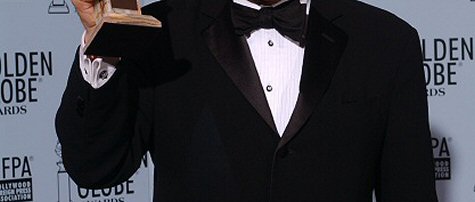
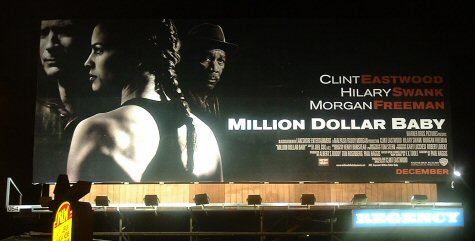
Why Wait? Million Dollar Baby

Why Wait?

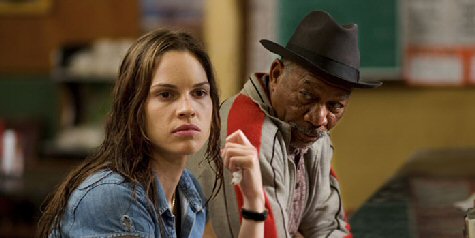
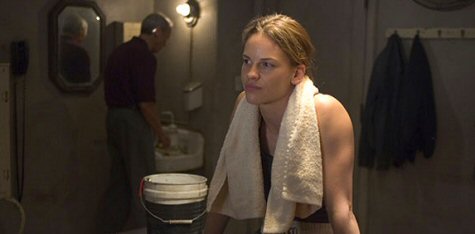
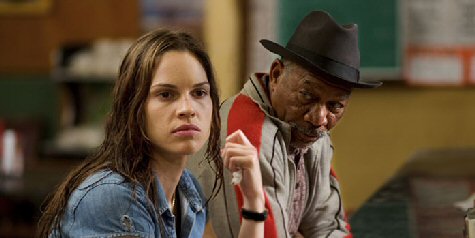
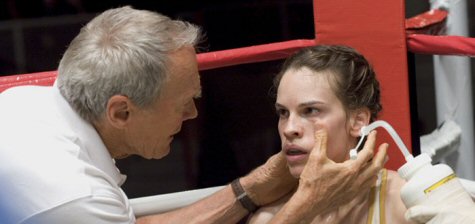
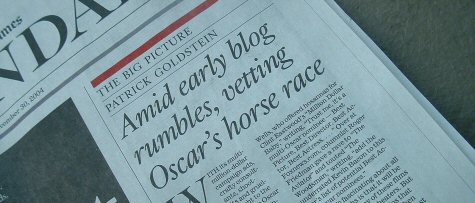
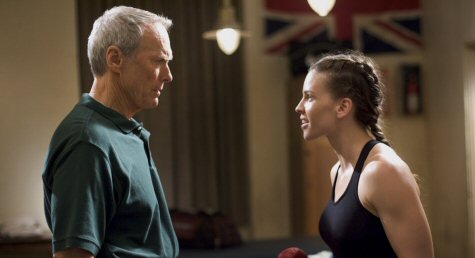
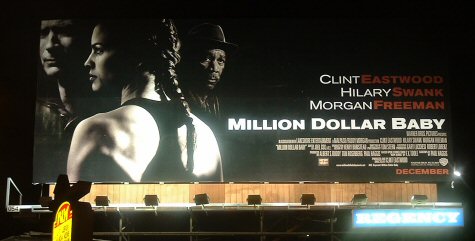
Million Dollar Baby is easily one of the finest films of the year and the most likely winner of the ’04 Best Picture Oscar. Why then have Warner Bros. execs been keeping it hidden from most of the nation since it opened limited two weeks and two days ago?
Some people I’ve spoken to say they’re playing it smart, but I don’t know.
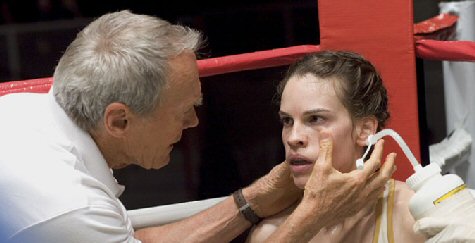
So far Baby has been showing in New York, Los Angeles, Chicago, San Francisco and Toronto only…and in precious few theatres at that. I’ve been telling friends around the country since I first saw it in late November that it’s the one to see, the emotional grabber with the art-film pedigree, etc.
But they can’t see it because they live in one of the hundreds of cities where it’s not playing — Danbury, Boston, Houston, Birmingham, Louisville, et. al.
The reason is that Warner Bros. marketing execs don’t really believe it will travel all that well with regular ticket buyers who’ve been prompted by the usual marketing efforts, so they’re waiting for the Academy nominations on 1.25 to nudge them into a state of receptivity.
< ?php include ('/home/hollyw9/public_html/wired'); ?>
Moviegoers probably will be more interested in lining up after the expected happens, which would be nominations in most of the major categories– Best Picture, Best Director and Best Actor (Clint Eastwood), Best Actress (Hillary Swank), Best Adapted Screenplay (Paul Haggis), Best Cinematography (Tom Stern), Best Musical Score (Eastwood) and so on.
But you’d think during a period when audiences flock to the plexes hoping to see a big year-end winner and, in one or two cases, dip into that communal emotional bath that goes with it, Warner Bros., having something fairly “big” and special on their hands, would want to supply this.
Eastwood’s boxing film is a critics darling, obviously, but it also seems to work with average audiences. (I’ve seen it with two paying audiences.) It has an unpretentious, un-fussed-with quality and appears to touch people where they live. Women especially.
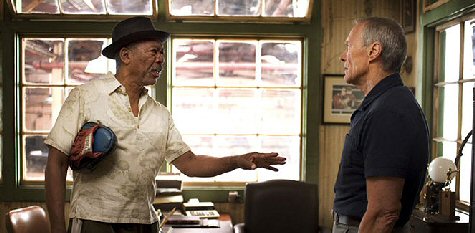
I’ve seen it separately with two 40ish women who aren’t exactly jaded cinephiles, and they were both obviously moved by the film, especially by the father-daughter relationship thing between Eastwood and Swank.
On the other hand…
“Right now the awareness of the film is dicey,” says Movie City News columnist and box-office reporter Len Klady. “I have to assume that people probably like the picture so far, but they’re also probably a little uncomfortable about it.”
Klady then went on to mention a certain third-act plot element which this story won’t get into. But he also speculated that among those who haven’t seen Baby , they’ve at least come to know Eastwood over time and know his films don’t usually peddle escapism and tend to lean towards darker material, and some might say to themselves, `Let’s see something lighter….for now.”
This may account for the fact that Baby has so far been playing well but not spectacularly in New York, Los Angeles, et. al.
“There’s something that just comes out of the pavement,” says Klady. “Intuitive feelings that come out of the atmosphere, like microbes…very quickly the country knows what a film is.”
There is nothing unwelcome or sluggishly downer-esque about Million Dollar Baby . What it is, inescapably, is a film that knows itself and leaves you with something fully realized and affecting. The only thing tempering the Baby business so far, I’m assuming, is that same old reliable American aversion to any movie that doesn’t appear to be upbeat escapism. People will always go first for the fizzy high.
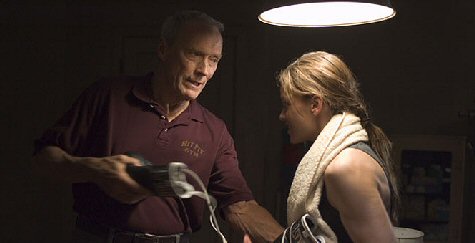
And so as the Xmas holidays approached, WB execs probably figured Baby wouldn’t do all that well against esteemed, high-quality competitors like Meet the Fockers, Lemony Snicket’s A Series of Unfortunate Events, In Good Company, Phantom of the Opera, etc.
And they sensed on some pavement level that audiences probably wouldn’t, in the last analysis, embrace Million Dollar Baby like the critics have, and the third- act wallop wouldn’t be quite enough to sell it, and they just didn’t want to risk it.
So they hedged and said, “Screw it…let’s wait for word to build, for knowledge about the critics awards to get around, for the Oscar nominations.” Why bet on viewer awareness and risk getting kicked around?
A week from today (9.7) Warner Bros. will finally be expanding Million Dollar Baby into some other cities and territories…modestly. I don’t know where exactly (WB distrib execs were holidaying and not picking up the phone), but some people in other areas of the country will get to see it.
The bigger breaks, I gather, will be on 1.21 and 1.28, just before and just after the Oscar noms are announced.

Say What You Want

Million Dollar Baby is the third best film of ’04 according to the Movie City News chart of film critics choices, and it’s been tagged as the year’s finest by New York Times critic A.O. Scott, and third-best by Times critic Manohla Dargis.
But hold on…it’s also been called the second worst film of the year by James Rocchi, the resident film critic for Netflix .
It takes all sorts, variety is the spice of life, that’s what makes a ball game, etc. But we’re in a dead news cycle, I need to fill space and this is a mildly intriguing sidelight.
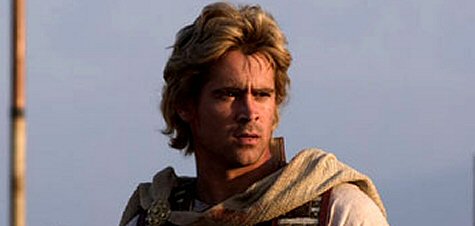
Rocchi’s Ten Worst Movies of the Year list had been finished as of December 16th, at which point he reported, “Dang! Just when you post the 10 Worst Films of the Year, they pull you back in. Clint Eastwood’s latest — Million Dollar Baby — is now in serious contention to take the crown of thorns from Alexander.”
As it turned out, this didn’t quite happen. I think Rocchi should have gone for it. Then he would have really made history.
A member of the Broadcast Film Critics Association and the Online Film Critics, Rocchi also called The Hunting of the President, in my opinion a clearly assembled, seemingly thorough examination of the commonly acknowledged right-wing attack-dog efforts to get President Clinton during the ’90s, the 7th worst film of ’04.
Rocchi doesn’t lack for readers or listeners. His site bio reads, “In addition to providing movie reviews and recommendations for more than 2 million Netflix members, James has been a special guest on CNBC, CNN Headline News, MSNBC Scarborough Country and is a movie reviewer in 20 to 30 regional TV morning programs in top markets across the nation.”
Let’s see…hated The Hunting of the President, supplied guest commentary on the conservative-leaning Scarborough Country. Wait a minute, let’s not jump to conclusions.
Anybody can love or hate anything they want. I despised the Lord of the Rings movies and I’m in the extreme minority on that score, but I never called them the worst of anything. Peter Jackson, the trilogy’s auteur-creator, is a smart, impassioned and exacting filmmaker, and I really liked Heavenly Creatures. (That said, let me say again: beware of King Kong!)
Rocchi is fully entitled to hate the way the direction a film takes in its third act, or just despise things about a film that he considers manipulative or old-hat. I’m assuming, naturally, that he almost called Million Dollar Baby the worst film of ’04 because it got to him on a very primal level. It’s a startling call, but hey, James…knock yourself out.

Crumbling Plaster

My 15 year-old son Dylan is hanging with me over the holidays, and while I’ve been writing my columns he’s been spending a lot of time on the couch playing Grand Theft Auto: San Andreas, the latest in a series of Grand Theft Auto video games that first hit the market in `98 or ’99.
The San Andreas upgrade was released in October for use with PlayStation 2 game consoles. The players of the game control the actions of a deranged homicidal hip-hop asshole who runs around blasting the bejeezus out of anybody and anything, while enjoying protection (supplied by the game’s programmers) from being seriously harmed by enemies.
Since Dylan got the game a couple of months ago, he estimates that he’s “killed” about 5000 people, and that includes a lot of cops and regular-Joe bystanders. I’ve seen him run his victims down with cars he’s been driving, or machine-gun them to death, blow them up, beat them to death with clubs…any which way. And they’re always left lying in a pool of blood.

The game isn’t about achieving a goal or defeating your bad-ass enemies. A review I found of GTA: SA says that players “go on a series of missions to take back the streets.” Bullshit — it’s about running around and wasting anyone you feel like wasting.
A reviewer with Video Game Radio wrote that “most gamers will tell you that video games merely allow them to live out fantasies in the safety of their own homes. Whatever your opinion is on video-game violence, Grand Theft Auto: San Andreas is by far the most controversial video game on the market today.”
The main-character asshole — described by the creators as a 1990s California gang member who found out that his neighborhood had been taken over by another gang when he got out, blah, blah — can instantly change weapons. The game also allows him to fly planes (my favorite aspect).
Spray paint cans can be used to deface buildings or cover up graffiti left by rival gang within the “story,” but Dylan hasn’t once resorted to this. He’s my son and spray-painting isn’t part of his history…the guy’s got standards.
I understand what these games are about and I can feel their juice and why everyone likes playing them, but at the same time how can anyone take part in simulated murder hundreds or thousands of times — day after day, week after week — and not have their sensibilities affected on some level?
I’m not trying to get all fuddy-duddy and imply that Dylan or any similar Grand Theft Auto fan (teenaged, well-educated, middle-class, productive parents) is more susceptible to violent impulses in real life as a result of playing this game. Maybe he is, but I don’t think so.

But I think less intelligent kids without less-than-cultivated social habits or who’ve suffered from low-rent upbringings might be a bit more prone to sociopathic behavior due to this influence. Just a little bit, I’m saying.
The Entertainment Software Rating Board has given San Andreas an “M” (for mature) tag, recommending it for users aged 17 and older. The rating was given for “blood and gore, intense violence, strong language, strong sexual content and use of drugs,” according to the board’s website.
The ESRB “M” rating for the previous Grand Theft Auto game, called Vice City, was described as having only “violence” (the “intense” adjective wasn’t used) and didn’t mention “use of drugs.” Obviously the creators, Rock Star Games, are upping the ante.
Grand Theft Auto: San Andreas is morally repulsive but undeniably cool from the POV of a player looking for fast, anything-goes action and steadily improving graphics. The question is how its popularity (and that of hundreds of similar games) may be affecting the moviegoing appetites of its fans, at least as far as their attention spans are concerned, or their ability to feel revulsion towards violence, which in real life is a deeply ugly thing in all its forms.

Finally

A much longer version of Michael Mann’s Heat is finally coming to DVD, although not in a unified form.
Warner Home Video’s two-disc Heat “special edition,” out on 2.22.05, will have 11 additional scenes that weren’t included in Mann’s 172-minute theatrical cut that came out in 1995. A WHV publicist tells me the extra footage amounts to 100 minutes, give or take, “which would total 272 minutes” — four hours and 32 minutes — “including the feature itself.”
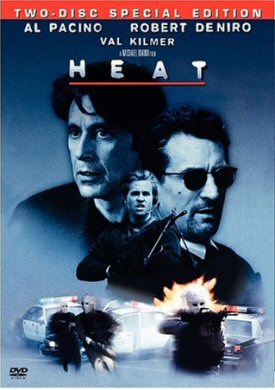
This means that the alleged 257-minute running time of this DVD, posted last week by two websites — www.dvd.town.com and www.amazon.com — is incorrect.
When you press “play feature” on the new DVD, the 1995 theatrical version is what you’ll see. But if you’ve got video editing software and you’re clever and industrious, you’ll be able to construct a four-hour, 32-minute version for your own amusement.
DVD Town says that NBC aired a re-cut 188-minute Heat. (DVD Town’s exact wording calls it an “original pre-aired NBC version.”)
I don’t know if this is true, but if it happened it means Mann was obviously willing to re-cut his film to meet a commercial requirement. Why, then, didn’t he re-cut Heat and make it into a 272-minute extravaganza for the DVD? Obviously because he feels the 172 minute theatrical cut is the best, but deranged people like me would love to wallow in a much longer cut for the hell of it.
Disc #1 of the new version will offer the original film plus Mann’s optional commentary.
Disc #2 will offer five making-of documentaries:
(1) “Return to the Scene of the Crime,” with location manager Janice Polley and associate producer Gusmano Cesaretti visiting the real life L.A. locations used in the film;
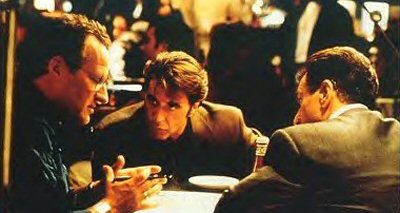
(2) “Pacino and De Niro: The Conversation,” in which Mann and others recall the shooting of the showdown scene between Robert De Niro’s Neal McCauley and Al Pacino’s Vincent Hanna at Kate Mantellini’s, a restaurant in Beverly Hills;
(3) “The Making of Heat: True Crime,” with Mann and Chuck Adamson, the film’s technical advisor who was also the real life inspiration for Hanna, discussing the Chicago crime scene and the events surrounding the real McCauley (whom Adamson took down in the late `60s) that inspired the film;
(4) “The Making of Heat: Crime Stories,” with Mann and others reviewing the 20-year origin of the script, the film’s genesis, and the complexity of the characters portrayed on screen; and…
(5) “The Making of Heat: Into the Fire,” with Mann and his cast and crew discussing training for their roles, filming in LA, shooting the climatic downtown heist, and the film’s post production.

Heaven Disputes

“However you feel about US involvement right now in Iraq, the Crusades are far more complicated than you make them out to be. And not terribly analogous to today’s perilous reality.
“For example, the population of what was known as the `Holy Land’ during the 11th and 12th centuries was, at least until jihad did its nasty work, mainly Christian. (But then so many liberals seem to forget the plight of Christian Arabs, both in the past and now.)
“Although from about the 9th century on there were Arab tribes in the area of Jerusalem, to which they’d wandered from the Arabian peninsula in search of better living conditions, they in no way constituted an ethnic majority when Godfroi de Bouillon and his companions recaptured Jerusalem from its Muslim occupiers in 1099.
“The final spur to the decision in the West to launch the Crusades, incidentally, was the Byzantine defeat at the (not terribly well-known) battle of Manzikert in 1076, although it took some five years for news of this battle to reach Rome and another ten or so for its import to really sink in, which thus opened up the Holy Land to Muslim hegemony. And to oppression, I’ll add.
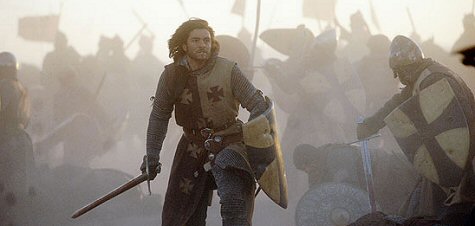
“Despite what many liberals also seem to believe, the period of Muslim rule immediately before the Crusaders landed in the Holy Land was a cruel one for Christians and Jews alike. Have you never heard the terms `dhimmi’ and `dhimmitude,’ which refer both to non-Muslims in a Muslim land and to the Koranically dictated way to treat them, including extra taxation?
“At least get hold of Richard Fletcher’s `Moorish Spain’ (it’s a short book) and read it for the way Christians were treated under that supposedly mild group of invaders; Fletcher himself admits he wrote it to dispel the myths concerning how non-Muslims fared during medieval times under Muslim rule.
“Also, too, Saladin happens to have been a Kurd. Thus a member of, today, an oppressed minority, one in fact oppressed by its fellow Muslims. Got that? There is an irony there that is biting, and I wonder if Scott will even mention it in his upcoming movie.
“One of the best books out there on the complicated issue of what the Crusaders were actually like is Zoe Oldenbourg’s `The Crusades.’ I think that if you even only page idly through it, you’ll learn that the image of them as racist butchers has little to do with reality. Perhaps, too, you’ll no longer quite see Saladin as the absolute paragon of chivalry that many writers still portray him to be. I don’t know if Scott will similarly have done his homework, but you still can.
“Something else that might even amuse you is that the bulk of Crusaders were, in fact, French (although it wasn’t referred to as `France’ at that time in the sense it is today). There is a train of thought among historians that holds that France from 1940 on owes its destiny to the simple truth that for the preceding 600 years the country had been bled white by a succession of (in general) losing wars, with WWI thus only constituting the final such catastrophe.
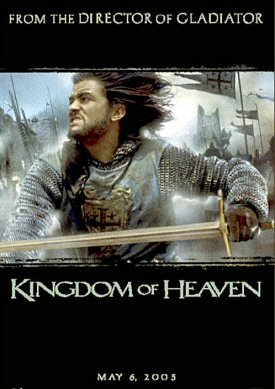
“This way of thinking holds that since, say, 1100, it’s just been one long slide downwards for France, culminating in the truly rapid and shameful way the better-armed and more numerous French forces were defeated by the German Army in 1940. At the same time, of course, perhaps because so many of them `stayed home’ during the 12th century, England rose as a world power and, for about a hundred years, even occupied large chunks of France.
“Really, Jeffrey, you’re a fine film critic in my opinion, and you’re especially great at the visceral reaction stuff, but you’d be even better if your writing indicated some familiarity with history.” — Richard Szathmary
Wells to Szathmary: “The general theme of European Anglos (French, British) invading the Middle East and trying to restore Christian culture and Christian dominance in the Holy Land (whatever the history of Christian vs. Muslim clashes back then) carries inescapable parallels for Anglo-American forces today trying to implement/impose a Western-style democracy in Iraq in the wake of a takeover, etc.
“In a basic sense, I mean….without getting into all the jejune, finger-up-the-rectum historical mucky-muck.
“Your knowledge of Crusades history is more vast and scholarly than mine, but c’mon…. the basic bones of the two situations are obviously similar enough for a casual viewer of Kingdom of Heaven to say, “Aha, yes…of course. There are echoes in this situation.”
“You seem to be saying not only that the leaders of Muslim culture back then were discriminatory and ugly towards their lessers, but that there’s something inherently brutal and oppressive about Muslim culture that refuses to tolerate the culture of anyone or anything that isn’t Muslim. They’re purist fuckheads, in other words, just like the Jihadists are today…completely dedicated to the conquering and wiping out of impure non-Muslims around them. In a phrase, Natural Born Tyrants.
“So why don’t we just launch a U.S. Crusade today and just wipe ’em all out….every last one of them….man, woman and child? Okay, I’m kidding…but given your belief that Muslims and their brethren are really venal and bad news down to the bone, what’s the remedy?”

Szathmary back to Wells: I think you could have a fine, Oxford Union-style debate on the topic of `Resolved: That Islam Is Incompatible With Democracy.’ Just as there was a fine symposium on whether or no Islam is compatible with feminism this very morning at www.frontpagemagazine.com.
“As to what the answer would then be, I honestly don’t know. But the truth also is, neither of us can truly name a country with an Islamic majority that also is constituted as a democracy. Nor can either of us locate one in the past. That does not mean I’m espousing a white man’s burden” theory of history, either. Nobody (well, not too many of us, certainly not me) wants to wipe out all these radical Islamist motherfuckers (see, now you’ve got me lapsing into profanity!), but it’d be nice in your work, which I generally admire a great deal, to see some occasional acknowledgement that many of those motherfuckers do in fact want to wipe us out. Completely. Along with the Jews, of course.
“Forget al-Jazeera television. Look up some stuff about the al-Manar network some time if you want a real eye opener.
“And I’m sorry — well, no, I’m not really sorry, it’s just a figure of speech — but I think you have a greater responsibility to the yahoos out there, just as many of whom now seem to be disgruntled Democratic voters as Republicans (from which, even I’ll admit, the ranks are usually filled), to be more sensitive to history. More attentive to accuracy. This in turn might even contribute to some eventual good coming out of this debate down the line.
“Yes, it’s fun to go with your gut, and I admire that in your criticism, but temper it just a bit sometimes with a nod to fact.”

Pranksters

There’s an article on the legacy of Ken Kesey and the Merry Pranksters in the 12.31 issue of the L.A. Weekly.
One piece of slightly-dated news in the piece, written by by Michael Hoinski, is that Kesey’s son, Zane, has assembled a 55-minute documentary about the adventures of the Pranksters on their 1964 cross-country tour on their day-glo bus. The doc, available on www.key-z.com, is purchasable for $25. (Actually, there’s a couple of other videos about the tour, plus one or two others about Kesey.)
Coincidentally, a reader (as well as HE’s volunteer editor) Mark Griffey wrote me the following just three days ago:

“Being interested in the film, I found a website called http://www.key-z.com/video. html that seems to be run by Ken Kesey’s son, Zane. Before he died in 2001, Kesey finally finished the Merry Prankster movie (45 hours of footage were shot). Given Kesey’s legacy and all, I was surprised to find that the guys who run the site won’t sell it to video stores. The only way to get it is to buy it from them on VHS for $25. Where’s the brotherly love?
“On top of this, the guys who run the site are currently bidding on the one copy that is up on Ebay. They don’t want anyone to get it unless they buy it from them! It’s crazy. Because to me, this doc seems to be a very important artifact.
“Kesey, Cassady and the Pranksters single-handedly started the entire psychedelic-hippie craze way back in 1964, long before Sgt. Pepper and all that shit. It’s like having a video of Newton getting hit in the head with the apple.
“Of course, the video is purportedly out-of-focus and a big mess, although I haven’t even seen it, but I just think it’s all very interesting. The Pranksters thought the movie would change the world, and now that it’s finally being released 40 years later, it’s practically a secret” — Mark Griffey.
Wells to Griffey: You’d think Zane would at least make a DVD version. You know, like…join the ’90s?
If The Shoe Fits The

If The Shoe Fits

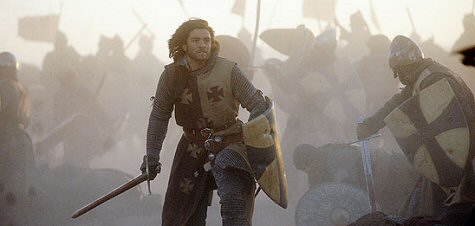
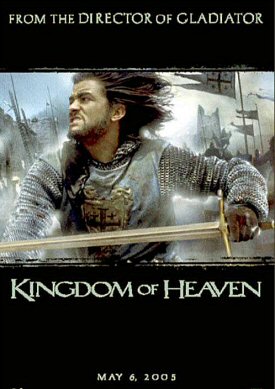
The plot of Ridley Scott’s Kingdom of Heaven (20th Century Fox, 5.6) is on the complex side, but if you let yourself think plain like Tom Joad and avoid getting smeared with your own intellectual whipped cream, it all boils down nicely.
Aside from the upscale distinction of being a Ridley Scott film in the big-canvas Gladiator mode, Heaven is a 12th Century armies-on-horseback movie about Eastern vs. Western forces. You know…one of those Muslim vs. Christian, olive-skinned natives vs. white-guy invader type deals, taking place during the Crusades and set in war-torn Jerusalem.


Orlando Bloom in Ridley Scott’s Kingdom of Heaven.

It’s also one of those pageant-type flicks about a really cute brave guy (Orlando Bloom, as a French blacksmith who eventually comes to be called Balian of Ibelin), and how he falls in love with a foxy, well-born hottie (Sibylla, the princess of Jerusalem, played by Eva Green) and then gets to be El Cid-like when push comes to shove.
Or something along these lines. I’m fairly sure Bloom whups ass. You have to figure after he played a girlyman Paris in Troy his agent wouldn’t let him go there a second time.
< ?php include ('/home/hollyw9/public_html/wired'); ?>
Balian of Ibelin was a Crusader knight who led the defense of Jerusalem in 1187. His formidable opponent was a Muslim leader named Saladin, who defeated him. With this element Kingdom sounds a bit like a 12th Century Black Hawk Down, about white guys in armor and shields getting their butts kicked by the Muslims in their tunics and turbans and curved swords.
I’m not a scholar on the Crusades and I haven’t read William Monahan’s Kingdom of Heaven script, but c’mon….how can anyone not see cultural parallels between Scott’s tale and the fighting going on now between U.S. forces and native guerillas in Iraq? You’d have to be suffering from enzyme blockage to say they aren’t there.
The Christian Crusaders were arrogant in presuming to claim and run the Holy Land in the first place, and the Saracens were in a more spiritually justified place in their battle against these Bible-reading, pale-faced invaders.

Can anyone think of another occupying Anglo force that went into a Middle Eastern country for bogus reasons and is probably fated to leave with its tail between its legs?
New York Times reporter Sharon Waxman explored this issue in a story that ran on 8.12.04.
“With bloody images of Muslims and Westerners battling in Iraq and elsewhere on the nightfly news, it may seem like odd timing to unveil a big-budget Hollywood epic about the ferocious fighting between Christians and Muslims over Jerusalem in the Crusade of the 12th Century,” Waxman’s story began.
“While the studio has tried to emphasize the romance and thrilling action, some religious scholars and interfaith activists…have questioned the wisdom of a big Hollywood movie about an ancient religious conflict when many people believe that those conflicts have been reignited in a modern context.”
I got into a dopey argument the other day with a guy who says it’s journalistically sloppy to point to Kingdom‘s present-day allusions. I found it staggering that he would even argue this point.
If a history professor were to show his class a movie about the Crusades (Christians vs. Muslims in the Holy Land) and ask his students to point out current echoes in a term paper, I said, he would be right to flunk any student who doesn’t at the very least mention Bush-Rummy-Iraq.
The guy replied that Kingdom was developed before Bush was elected and was greenlit before the U.S. went into Iraq. The Crusades, therefore, have nothing to do with Iraq, he said…unless, of course, the person making this connection is a fringe whack-jobber.

You’re tap dancing too much on this thing, I replied. Your thinking is too pretzel-like. You have to boil it down to basics. Anglo army occupying Middle Eastern territory, shouldn’t be there, natives hate them, etc.
9/11 was three years and three months ago, the invasion of Iraq happened in March ’03, and principal photography on Kingdom of Heaven began in Morocco last January. And in the minds of Scott and his creative team, the U.S. vs. Iraqi insurgent situation didn’t weave its way into the film on this or that level?
This is certainly an allowable interpretation, I argued, given the basic bones.
That said, I can’t wait for Kingdom of Heaven, which looks great in the trailer and cost around $130 million. After Bloom and Green, the costars are Liam Neeson, Jeremy Irons, David Thewlis and Chassan Massoud as Saladin.
There isn’t much happening right now on Kingdom of Heaven‘s official site , but it’s a start.

Miscalculation

The Napoleon Dynamite DVD story is a great success with a blemish. This is because the people at Fox Home Video blew it when they ordered their initial run.
Roughly 1.4 million units were sold when the disc hit stores on 12.21, but the suits didn’t order enough of them to be pressed because the available Dynamite‘s sold out right away (in West Coast urban areas, at least) and as of Monday, 12.26, copies were still scarce.
The clerks at Laser Blazer in West L.A. are telling me people keep coming in and asking for Napoleon and they keep answering, “Sorry, man…sold out. Nope, not even a rental.” A Seattle-based guy named Aaron Stewart (one of HE’s newly engaged Discland contributors) told me yesterday that the same thing is happening up there.

Figuring an average price of $20 per DVD, Dynamite retail sales totals come to about $28 million, which is more than half of the film’s $44 million domestic earnings.
Fox spokesman Steven Feldstein was quoted as saying that when the first shipment came close to selling out, Fox ordered a motherload of new Napoleon‘s from their plant in Huntsville, Alabama, but the trucks attempting to deliver the discs got stuck in a Kentucky snowstorm. I don’t know…does this sound to anyone else like “the dog ate my homework”?
Sooner or later the trucks will make it through and the stores will have enough copies, but the Fox Video guys could have posted some kind of astronomical sales figure in the trades if they’d been more accurate in gauging public interest.

Plugging Away

If you’re looking for the key provocateurs in the sacking of Vincent Ward from the historical drama River Queen, you wouldn’t be far off if you settled on two people.
One is Richard Soames of Film Finances, River Queen‘s guarantor. He’s the guy who actually lowered the boom on the film’s director last October, and not the producers, Silver Screen Films and The Films Consortium, who were surprised at the canning and immediately tried to get Ward his job back. They eventually succeeded.
The other is costar Samantha Morton, who has been described by a source close to the production as a bit of a harridan whose hair-pulling episodes have not been limited to her behavior on River Queen.


River Queen costar Samantha Morton.

Morton clashed with Ward about this and that — rather bitterly, I’m told — during the first half of the filming. This rancor, compounded by Ward’s perfectionism and lousy weather during much of the New Zealand-based shoot, led to an atmosphere of delay and disharmony that caught Soames’ attention and led to his action.
Ward didn’t stay fired for long. He was actually re-hired in late November despite an announcement earlier this week that he’s just returned to the payroll.
Ward declined to speak about the situation, but a source close to the shoot chimed in.
Ward is now in London trying to finish the editing before the end of March. It’s that or Ward and his producers will face some kind of stiff financial penalty, as English tax laws allowed for the majority of the financing.
The expectation is that the historical war drama, set during the New Zealand Maori Wars of the 1860s and about the efforts of an Irish mother (Morton) trying to find her kidnapped child with the help of a soldier (Kiefer Sutherland), will be shown at the 2005 Cannes Film Festival.
Given the title it’s a reasonable assumption that (a) Morton and Sutherland do some of their searching while traveling on a river boat, and (b) that some kind of bond develops between them, although hopefully of a different cast than the romance that occurs between Humphrey Bogart and Katharine Hepburn in John Huston’s The African Queen.
River Queen is known to have been a labor of love for Ward (Map Of The Human Heart, The Navigator, Vigil). He co-wrote the script with Toa Fraser, and has tried to put together production funding for quite a spell.
Ward’s axe-ing happened in October, three weeks after Morton came back to the set after being felled by influenza.

My production source says Ward was replaced as director following a continual series of “incidents” with Morton, who had already caused the production to close down once due to her illness.
Soames stepped in to get control of things, but right away colleagues and friends of Ward’s pointed out that the project would be worthless without Ward’s input and guiding hand, and the only way for anyone to recoup was for him to be restored as director.
River Queen was directed for the final three weeks of shooting by the director of photography, Alun Bollinger (Heavenly Creatures), with day-to-day guidance from Ward by phone and email.
“One thing for certain is that the film did not go any smoother after Ward left,” the source confides, “nor did it progress any faster. The number of shots per day stayed the same, and Morton’s various illnesses and troubles continued.”

Good News

In the wake of my 12.17 praising of Adam Curtis’ brilliant BBC2 documentary called The Power of Nightmares, I’m happy to report it will screen in either late January or early February as a special presentation of the Santa Barbara Film Festival, which kicks off on 1.28.05.
SBFF director Roger Durling was shown a copy of the doc by Telluride Film Festival director Tom Luddy after my piece came out, and Curtis was contacted and agreed to provide a screenable copy of the film. No word as to whether Curtis will attend the festival, but he should. The San Francisco Film Festival is also reportedly mulling over a showing of Nightmares.
Author (The Whole Equation) and essayist David Thomson wrote the following about Nightmares on 12.26 for his column in the London Independent:


Nightmares producer-writer Adam Curtis (l.); a non-related plaque outside a BBC office.

“I share the sentiments behind Michael Moore’s Fahrenheit 9/11, but I cannot look at or listen to Moore without smelling the demagogue. Which leads me to this point: the most arresting thing I saw in 2004 (in a poor-quality duplicated tape) was Adam Curtis’s three-part TV documentary series, The Power of Nightmares.
“The program may be prompting soul-searching within the BBC as to the function and role of that diminishing institution, but it will likely never find a large public in the U.S., because no one will be brave enough to air so lucid, caustic and comic an account of the sham of Islamic terror.
“Now, in America, as you have heard, the ordinary television watcher often has hundreds of channels to choose from. But the four networks will not touch The Power of Nightmares, because of the subsequent charge of being anti-Bush. Public television (PBS), the nearest equivalent to the BBC, will almost certainly decline because of the fear of putting their funding in jeopardy.”
“That leaves HBO, for several years now the most enterprising movie/TV studio in the world. But even there, I’m not sure that anyone has the stomach for this superb, Swiftian satire or the absolute insolence with which Curtis delivers his message.”

Dicey Intrigue

If you find these photos interesting or alluring, there’s something wrong with you.
There’s only one way to process the horror of over 114,000 people drowning from that big tsunami three or four days ago, and that’s with muted sadness and a slight shaking of the head, like you’re sitting in a church pew at a funeral for a friend.
You can’t express any kind of fascination in how the Indian Ocean tsunami might have looked or sounded because if you do you’re a pig and a creep and you have no heart.

I didn’t die from the big tsunami because I was in Los Angeles when it happened, and I don’t have any personal connections with any of the sufferers. I’m appalled by the death and the hurt and my heart goes out, but I’m curious, dammit.
I’ve never seen a real tsunami. The only kind I’ve ever seen has been Jim Cameron’s mile-high tsunami in The Abyss and that other stupid CG tsunami in Deep Impact (you know…the one that instantly flattened Maximillian Schell and Tea Leoni…which I’m thinking of watching again, in all candor, in the wake of Leoni’s performance in Spanglish).

On 12.27 there was an AP story about how news agency representatives are hunting for video of this event.
“There will still be, I think, the definitive shot, the wall of water,” Sandy MacIntyre, director of news for Associated Press Television News in London, said Monday.
APTN was said to be “competing fiercely” with Reuters to try and snag some good tsunami video footage. APTN producers were reportedly sent to six airports in Europe and Asia on Monday to ask tourists if they had captured the scene on their home video cameras, MacIntyre said.
Who knows how to process or make sense of over 114,000 people dying in the space of five or ten minutes?
I used to have nightmares about big waves when I was a kid. I would be on a beach and a tidal wave would be getting bigger and bigger and I’d try to run and my feet would be like anvils and I could barely take a step. And the approaching monster would get louder and louder.

Convert

“I’ve been reading your column for years and I must say that although I disagree with your politics and some of your film choices I admire the fact that you will push a film to the forefront for the attention it deserves. Sideways has been garnering a great deal of attention now and you were one of the first, if not the first to call it.
“You’ve also been pushing Million Dollar Baby, and you even ran a blip about it last summer, as I recall. I must admit I was not really interested in seeing this film, but then I kept reading your column concerning this picture and I finally went to the Grove Theatre and plucked down my ten bucks for a late morning viewing.

“This film is one of the most powerful things I have ever seen put to celluloid. It’s a little predictable at times and uses some cliches, but it’s the way the story is told and the confidence in the way the narrative is handled that makes it great. This film deserves the good attention that it is receiving. Those naysayers that could be disciples of Kael need to let their opinion be known as well, even though they’re way off.
“Ever since I left the theatre I’ve been imploring various people to take in a viewing of this film and calling up relatives to tell them to be the first in line when it goes nationwide. It is a shame that Warner Brothers has not been pushing this gem and I thank you for bringing this film to my attention. I plan on viewing it again with friends when the holiday cycle calms down.
“Also you need to give Collateral a look on DVD. It has a great commentary by Michael Mann that has not been advertised and it would be a shame not to give it a listen. This guy is a genius and his films should be studied more. Bring on the new special edition Heat DVD!” — James Wallace

Paulettes

“Philip Kaufman, Fred Schepisi, Walter Hill, Brian De Palma and Robert Benton. What do these guys have in common? Nothing…except that you’ll probably find each film made by these guys have gotten a thumbs-up or something close to it from the Paulettes.
“Michael Sragow would fit nicely onto that little list that includes Charles Taylor, David Edelstein and Armond White.
“I think this has to with the fact that the French and Dave Kehr and some other guys who followed the Andrew Sarris auteurist school of thought picked up on Eastwood first, thereby making him persona non grata with the Paulettes since anything the French and Sarris (especially Sarris) gave the okay to was bound to stink according to the Kael gospel.
“Among the Paulettes there was some sort of party-line that had to be toed when it came to certain film makers. Thumbs up for the above worthies and thumbs down for Eastwood, Hitchcock, John Ford, Howard Hawks, Orson Welles, etc. They were young and easily led, I guess. And here you were thinking that film criticism was mostly about the movie!
“I think that the only Paulette to have escaped out of that cultish orbit has been Roger Ebert, and more power to him for that.” — Vinod Narayanan

Armond!

“A few years back I spent some time talking about movies with Armond White and the more we spoke, the more I began to suspect his entire approach to movie, and in fact to reality.
“He kept going on about Spinal Tap and how real metal fans were offended by the film, and that Spinal Tap was a fictious band. And even when I pointed out that the guys in the movie played their own instruments, wrote the songs and even toured without a film crew, he refused to admit that at their core, Spinal Tap was as real of a band as any other ’80s metal band.

“Their songs ‘Big Bottom,’ ‘Hell Hole’ and ‘Sex Farm’ go up their with anything Ratt ever released. Sure they made up their background, but what band doesn’t fake their story? What makes Spinal Tap less real than Led Zeppelin’s ‘Song Remains the Same’? I just gave up on Armond at that point.
“And you’re right about HBO being the place to make a drama. Have you seen The Wire? Best 12-hour movie of the year.” — Joe Corey
“Armond White plays it safe and says that he likes both Kael and Sarris although that’s a bit like saying that you like the Republicans and the Democrats. He gave a thumbs up to Bloodwork and a thumbs down to both Mystic River and Million Dollar Baby and he thinks that Tomcats and Bubble Boy are masterpieces. Nuff said.
“Look, anyone who froths at the mouth in sheer untrammelled glee at the sight of a Brian De Palma film should probably not be throwing any stones ‘cuz that’s a big-ass glass house they’re livin’ in.” — V.N.

Hold Up

“Is the Napoleon Dynamite DVD shortage really as bad as you say in today’s column? I was just at the Best Buy in West Los Angeles, and there were at least 30 copies just sitting there waiting to be purchased.” — Grady Styles.
Wells to Styles: Great. The truck drivers must have finally gotten their act together. That or the people who frequent Laser Blazer and that video store in Seattle have hipper tastes than your typical Best Buy customers and therefore bought up all the available copies quicker.
Big-studio publicist to Wells: Interesting. I tried to buy Napoleon Dynamite at Borders across from the Arclight last night and they were sold out. But I found a bunch of ’em at Virgin.

Popcorn Shards

A guy said this to me (if not in this precise sequence) the other day. He knows this town and how it’s been evolving, etc. And in a moment of despair…
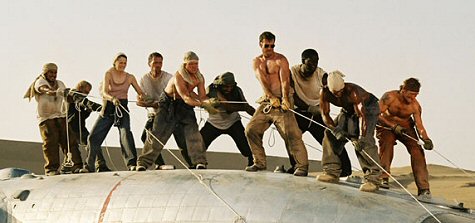
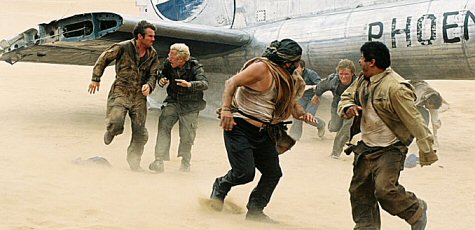
“It was going to be Deliverance in the Gobi desert. The script was about character with everyone slowly going insane as the days went on, and when the new plane was built the pilot is reluctant to fly it because the desert crash was his fault and his confidence is shot.

“And he couldn’t be Mel Gibson. If it was Gibson you’d want to see him do it. You’d be waiting for that.

“Then the studio said they wanted the Bedouins to come back and attack the plane at the last minute, just as they were trying to lift off. But hold on. If the baddy Bedouins are close enough to regroup and gather their forces they must be within shouting distance of some kind of half-civilized outpost, so why don’t the survivors just walk to wherever that is? That didn’t get through. The studio didn’t care about that.

“It was the first movie I ever worked on in which notes on the script were sent along by the head of marketing. Mainly because suddenly the movie was costing $60 million dollars. The average movie costs $65 million, and then it’s $35 million to open it.

“This business has become so wag-the-dog, so marketing driven. And with $60 million being spent no one can look like they’re really hurt or dying, no one can lose their minds, there can’t be any swearing, and no heavy character stuff.

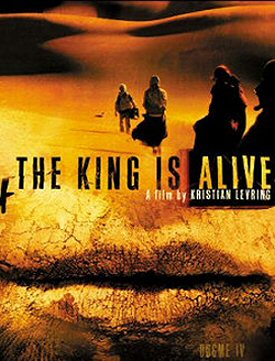
“There was another stranded-in-the-desert thing called The King is Alive. It was a Dogma movie, didn’t cost anything, same basic deal, people stranded in the wilderness. But on a stripped-down budgetary level, Hollywood doesn√ɬØ√Ǭø√ǬΩt know how to make a film like that. They don’t want to know, I mean.

“I’ve actually heard studio guys refer to drama as “the ‘d’ word.

“The phrase you always hear when it comes down to the crunch about whether to greenlight a movie is ‘let’s run the numbers.’ The new kind of studio heads like Jeff Robinov who are ex-studio agents, they all have the same matrix in their heads. They run their p and l’s, profit and loss projections, expectations of earnings in this market, that territory. And I’m telling you this mentality of running the numbers is killing the business.

“Bill Mechanic was the original guy on it, and Michael Mann and Eric Roth worked on it. But then Mann and Mechanic couldn’t come to terms on the deal. But it kept on. Five or six guys wound up writing it in stages.

“Remember when Jeffrey Katzenbeg was running Disney? All the movies started to feel the same? That’s what happening to the movie business as a whole now. They all have to meet the same requirements, and the audience is so chicken these days. Nobody wants to see what’s on the other side, and nobody wants exotic…not really. Everybody wants to see more-or-less familiar. And the adult film is being killed. Studios used to make genre films for adults, and that’s over now.

“We’re getting what we’ve asked for. We really are.

“If I were starting my career now, I would want to be David Chase. That’s who I’d want to be. Doing a show like The Sopranos is the only way to explore character and theme these days and make something that feels like art.

“The old-time executives would bet on a few really good films. Today’s executives have been programmed to skip the heartbeat part. Formula is all. Studio-level jobs are the worst jobs in the world. The way it’s decided, when things are sussed out, they’re all in the room together including the marketing guy, and he always has a very strong voice.
“It’s a free-market economy, and what’s being made is determined by what people want to see. There was this marketing guy who said to me once, “We’re trying to get a younger audience, so we’re retooling the campaign to get the 60 year-olds in.”

“If they were making Dog Day Afternoon today Sonny wouldn’t be robbing a bank to get money for a sex change operation for his lover. He’d need the money now to try and keep his son from dying of cancer.”

Baby Killers

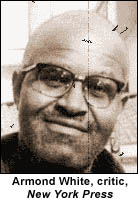
The other shoe on Million Dollar Baby clomped down on the pavement a week or so ago. I’m referring to slams by three fairly heavy cats — Slate‘s David Edelstein, Salon‘s Charles Taylor and New York Press critic Armond White.

These guys are far from nutso. They’re sharp and witty samurais who are fully in touch with their aesthetic standards and can expertly slice and dice when they’ve a mind to.
It’s not that I disagree strongly with Taylor and Edelstein√ɬØ√Ǭø√ǬΩs complaints, which boil down to things in this Clint Eastwood film that they find hokey, hard to swallow, manipulative or old-fashioned. White says the movie proves that Eastwood “thinks in simplistic terms that actually deny modern political complications.” He also describes Baby (or is he talking about the third-act turn?) as “the ghost of bogus Hollywood uplift.”

What these guys are saying is like spitting in the wind. They can take shots with their Anthony Mann Winchester repeat-action rifles and it doesn’t matter. If a movie works, you can feel it and there’s no disputing this. Million Dollar Baby may be this, that or the other thing, but it’s basically about a riveting third act that’s been extremely well set up.

As Taylor wrote, “You’re not prepared — even with the air of fatalism — for the jump from one shameless genre to another. It’s impressive, in the sense that a sucker-punch impresses itself on your skull.”

White says it’s all so hoary and predictable that when Eastwood eventually swings his left hook, gullible viewers are caught unawares. They respond inordinately, as if they’d just seen a ghost.”

With Regrets

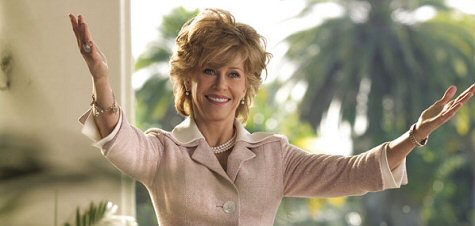
“There is already buzz about Jane Fonda’s comeback in New Line’s comedy, Monster-In-Law,” Emanuel Levy wrote the other day.
“The most brilliant American actress of the 1970s has not acted since the disastrous Stanley and Iris in 1990,” he continued. “Fonda proves that, contrary to what Henry James said, there are second (and third and fourth) acts in American lives. Fonda is now beginning her next phase.”

I haven’t heard any buzz at all about Monster-in-Law but c’mon…it’s got Jennifer Lopez in the lead, which means there’s a built-in curse because the Gods are four-square against her these days, and there’s no defeating the Gods when they’re in this kind of mood.

Let me tell you about Jane Fonda’s 21st Century comeback, which is actually a case of a thrown-away opportunity along with a disappointing turndown, followed by a fallback decision to star in a who-knows? New Line comedy.

Last year Cameron Crowe offered Fonda an exquisitely written small part in his recently-wrapped Elizabethtown (Paramount, 7.29.05). It was the role of Hollie Baylor, the mother of Drew Baylor, the romantic lead played by Orlando Bloom.

Once Fonda let it be known a year and a half ago (or was it in early ’02?) that she was interested in getting back into acting, Crowe did everything he could to seduce her into playing the part. I’m told he went so far as to drive out to her ranch in New Mexico to personally deliver the script.

But Fonda felt there wasn’t enough to Holly. She had a point at the time. Early drafts made spare use of Holly in the first and second acts — her only big moment was a speech-before-the-family scene in the third act. Crowe understood what Fonda wanted but asked her to take the journey with him on faith, pledging that together they would fix the problems. Fonda hemmed and hawed but finally said no, and Susan Sarandon wound up taking the part.

If you’re a 60ish woman trying for a comeback, you can’t do better than play a plucky mom in a Cameron Crowe film. Opportunities simply don’t get any better than this, but Jane couldn’t show trust and shot herself in the foot. That’s a fact.

Then she tried to land the alcoholic mother role in Jim Brooks’ Spanglish, but Brooks wasn’t quite sure and asked her to read for the part, which Fonda did. Brooks turned her down, giving the role to Anne Bancroft instead. Then Bancroft had to drop out for health reasons and Cloris Leachman stepped in.
So Fonda took the part of Lopez’s nuptial adversary in Monster-in-Law. It might be a great little comedy and Fonda may be perfect in it, but the premise is basically Meet the Parents with Fonda in the Robert De Niro part. The director is Robert Luketic (Win a Date with Tad Hamilton!, Legally Blonde). Really…all kidding aside…how good does anyone honestly expect this film to be?

Blues Project

I’m okay. It√ɬØ√Ǭø√ǬΩll all be over soon. Just one more week, and then New Year’s Eve and the final weekend, and then the system will start up again.
Christmas is great as an approaching emotional feeling, but when it finally gets here all you want is for it to be over. It�s good for reading books, though. Good for doing quiet-type things. Good for not hearing from anyone. Good for feeling the world has stopped. Good for bike riding, long walks, watching documentaries. Good for testing your mettle by not eating. For me, Christmas is apples and grapes and canned pineapples.

I spent a good part of Thursday editing and composing other columns (two), typing out invoices and insert orders, dealing with technical matters and wondering if it matters if I write a 12.24 column or not. I wish I had the character to blow it off during the down times.

I also watched Paul McGuigan’s Wicker Park on DVD. Not bad. At least it wasn√ɬØ√Ǭø√ǬΩt a thriller. It doesn’t quite deliver as a relationship drama, and there’s no way it’s “a dangerously sexy thriller,” which is a quote from In Touch weekly on the front of the DVD cover.
But I wasn√ɬØ√Ǭø√ǬΩt in agonizing pain watching it, and the leads — Josh Hartnett, Rose Byrne, Diane Kruger, Matthew Lillard — hold up their end fairly well.

Ship vs. Planes

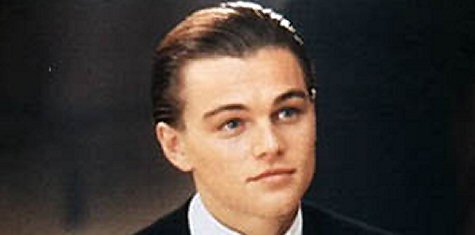
There’s a scene in Titanic when Leonardo DiCaprio’s Jack Dawson — an independent-minded, self-starting, vaguely bumpkinish guy who lives by his own rules — sits down with a bunch of white-tie swells in the first-class dining room. Jack’s a little intimidated at first, but he stands his ground by being himself and explaining a personal philosophy that’s hard to disagree with, which is to always “make it count.”

It’s not a great scene, but it’s a moderately satisfying one. It instills respect for Jack, and at the same time lends a certain warmth by saying that even the blue-bloods can relax and laugh at themselves and show respect for a guy who can look them in the eye.

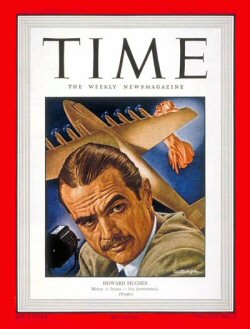
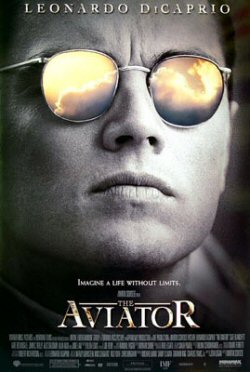
There’s a scene in The Aviator when DiCaprio’s Howard Hughes — vaguely bumpkinish, independent-minded, self-starting, living by his own rules — sits down with a bunch of Connecticut swells, or rather the family of his girlfriend, actress Katharine Hepburn.

Howard’s a little intimidated at first, but the Hepburns are absurdly rude and snooty to him, which eventually leads to his getting testy and a little bit rude himself.
“We don√ɬØ√Ǭø√ǬΩt care about money here, Mr. Hughes,” says Mrs. Hepburn.

“That’s because you have it,” Howard answers.
“Would you repeat that?”
“You don’t care about money because you have it,” he says again. “And you’ve always had it. My father was dirt poor when I was born…”
“Back in torrid Houston, this would be?” asks Mrs. Hepburn.
“Oh, shut up,” snaps Howard.
“Howard!” Kate exclaims.
“I care about money, Mrs. Hepburn, because I know what it takes out of a man to make it,” Howard continues. “Now if you’ll excuse me I have some aviation nonsense to take care of.”

And then he gets up and bolts out of the room like a six year-old. Kate joins him later on for a croquet game on the back lawn. “I think father rather likes you,” she tells him. “But really, though…you can√ɬØ√Ǭø√ǬΩt retire from the field of battle like that or they’ll never respect you.”

Exactly. Nobody likes a quitter. I suppose this scene (written by John Logan) was meant to act as a counter-weight to the scene at the end when Hughes boldly jousts with Senator Owen Brewster (Alan Alda) in front of a battery of cameras and microphones. But I don’t get why a guy with the balls to slap down an aggressive politician can√ɬØ√Ǭø√ǬΩt handle himself better with the Hepburns. It doesn’t add up.

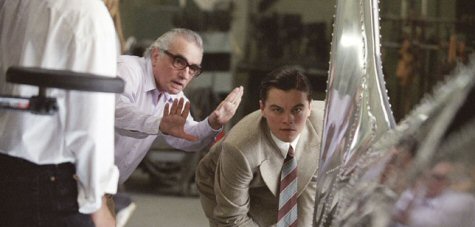
A lot of serious-minded critics are saying The Aviator is a near-great film that should win director Martin Scorsese his long-overdue Oscar. They’re dreaming. The dinner-with-the-Hepburns scene is one reason it doesn’t make it. The stylish thing over the last five or six years among critics has been to loathe Titanic, but it’s a far more satisfying thing to watch than The Aviator.

Voice Critics Poll

“Something about that poll seems to bring out the cunty side of too many critics. The snarky comments turn me off; they often dehumanize actors, filmmakers and devalue the sincerity of movies the critics don’t happen to respond to.

“Some of the participants behave like the smart-ass outsider kids in high school who were shut out of the school’s power elite, and avenged themselves by congregating at a particular cafeteria table and making shitty remarks about everyone else in the room, or by going to a school dance and not dancing, but standing off to the side and making fun of everybody else’s dancing.

“That kind of behavior makes the participants feel more powerful, but the power is illusory, and it inadvertently validates other peoples’ negative opinions of them. The Voice poll is a good idea in theory, but in practice I think it gives the general public one more reason to think of critics as smug, elitist bastards.” — Respected New York film critic

How Bad is This?

“As a holiday treat, I took my staff to see a matinee showing of Meet The Fockers. No wonder why Dustin Hoffman referred to it as ‘this thing.’

“There were definitely a few amusing scenes in it — I laughed mildly at those. But it was such a blown opportunity — most of the jokes fell flat and it was full of the most awful ethnic stereotyping I’ve seen in a movie in years. While the Byrnes (DeNiro and Danner) are still the uptight, conservative couple, the portrayal of their opposites was positively offensive.

“This movie probably set back blue-state causes 100 years. The Fockers are portrayed in the film as the most obnoxious, overbearing, nosy and loud Jewish couple on the Eastern seaboard. Their sentences are filled with Yiddish and Hebrew words, and stereotyped ethnic intonation (especially Streisand), that you really had to wonder what country this couple was born in.

“Hoffman is supposed to be a former 60’s radical from Detroit, but every other word out of his mouth was Yiddish or Hebrew — what baby boomer in their 60’s talks like this? Streisand was saying ‘buballeh’ all the time — you’ve got to be kidding!!

“Clearly the movie was meant to have this ‘blue state’ versus ‘red state’ understory, and you could see there was real potential to explore that — but it barely got out of the gate. Teri Polo looks awful compared to the original film — her makeup looks bad and she looks like she’s aged more than a few years. Stiller and DeNiro sleepwalk. I was most excited to see Hoffman, and it was great to see him in a broad comedy — but NOT THIS ONE, in retrospect.

“Frankly, I don’t understand how Hoffman and Streisand, who are both Jewish, would have bought into this ludicrous script and portrayal of their own people. I guess I can play Devil’s Advocate and say ‘This is a comedy and these guys are supposed to be stereotypes.’ But it’s just so extreme in their case that I’m just waiting for the B’nai Brith to go on the warpath.

“Spare yourself.√ɬØ√Ǭø√Ç¬Ω — Drew Kerr

Wes

“Regarding Christopher Lee’s thoughts on The Life Aquatic and Bill Murray’s comment that he had to see his own movie three times before he ‘got it’, that’s been the same experience I’ve had on all of Wes Anderson’s movies.
“The first time I watched Bottle Rocket, Rushmore and The Royal Tenenbaums, my reaction was, ‘This is it? this is what the fuss is all about?’ And then you watch the movies again and again, and they grow on you.
Tenenbaums is now one of my favorite movies and I have endless admiration for Wes Anderson, a director talented enough to actually pull meaningful performances out of two of the 21st century’s most irritating and overrated actors, Ben Stiller and Gwyneth Paltrow.” — Michael Zeigler.

“There’s a reason people have to watch Wes Anderson’s movies multiple times (except Bottle Rocket). With every new feature there is less and less narrative flow, less and less development — merely a collection of fully formed, isolated characters that barely interact with one another.
“Once the disconnected vignettes or emotional set-pieces (like car chases in an action film) are seen once and it is clear that they do not form a cohesive whole (except in terms of tone), then upon second and third viewing the audience doesn’t have to worry about ‘where is this film going?’ or ‘what does this all mean?’
“The repeated viewings are therefore like putting on a comfortable pair of shoes, and thus easier on the viewer and so the films sink in, regardless of the fact they seem to be merely tasteful collections of music videos. I don’t think this is a good thing at all, and I am a big Wes Anderson fan. He takes the easy way out and his films have less and less meaning.” — Craig Kaplan

Kissing Santa

“This time of year in Aspen is amazing. It’s Golddigger week (the last week) and you pretty much get every golddigger and high-end hooker in the country flocking to Aspen like swallows to Capistrano.
“I’ve met some of the contenders and there’s a real hierarchy. The best ones are bright, interesting, charming and very presentable. And very attractive. And worth it.
“The next level down is the aspiring actress type. Donald Trump goes for these women — the top level is out of his league.

“The next level down is a real Town and Country look and an attitude that suggests sophistication and breeding, but if you’ve ever known anyone with real sophistication and breeding you know they make an effort to act normal, not snotty. They’re kinda fascinating and sad. And usually from white trash stock. (They measure everything by dollar value). And when they get too old and haven’t found their scholarship, they can get pretty desperate.
“Next level down from the snotties are the expensive call girls with a slightly sleazy look, all in search of a meal ticket.” — Industry Guy Partying in the Rockies
Wells to L.A. Guy: I take it you’ve had an unsatisfying encounter with a Town and Country girl?

Hacked Again For the second

Hacked Again

For the second time during the Xmas holiday, Hollywood Elsewhere has been hacked. But it’ll all be back to normal within hours, maybe only two or three.
For the record, this is being written at 3:06 pm Pacific, on Tuesday, 12.28.04.
The most recent Hollywood Elsewhere column (the one that went up on Friday, 12.24) will be restored and back up by 4 or 5 pm Pacific. The rest of the site, including the proper ads (the currently viewable ads are from our server’s last fully-backed up version of the site, dated December 3rd), will be up and rolling in their proper and timely configuration by the end of the day.
I apologize to all concerned for not being fast or vigilant enough to stay ahead of the hackers or, in this instance, the Fanty worm. For what it’s worth, this latest hacking has happened today on hundreds of other sites. I will be doing everything I can do (and spending everything I can) to keep this from happening again.
I think it’s only fair to lay part of the blame for this latest disruption on the lack of vigilance of the folks at Interland, our Atlanta-based server. They failed to install a protective (or preventive) software called php5 in the wake of the last hacking, which was the weekend before last. If they had things might not have turned out so badly today.

33 and 1/3

It√¢‚Ǩ‚Ñ¢s too much of a task to forecast √¢‚Ǩ‚Ñ¢05 altogether, so let√¢‚Ǩ‚Ñ¢s just concentrate on the first third. I’m guessing I’m not the only one who’s giving in to kick-back holiday feelings right about now.
Movie quality tends to slack off (okay, plummet) between January and April, but I’m spotting at least seven films during this period that appear to be worth the price, and two that might qualify as half-decent throwaway’s.


Upside of Anger writer-director Mike Binder guiding costars Kevin Costner (l.) and Erika Christensen and Keri Russell (r.) during filming.

All but two will open in March or April, so grim up for a dud January and a fairly tepid February. In the order of scheduled openings…
Inside Deep Throat (directors: Fenton Bailey, Randy Barbato — producer: Brian Grazer), Universal, 2.11. Serious minded, fully considered documentary about the social impact and cultural legacy of Deep Throat, the 1972 porn film that ranks as the most profitable feature of all time. Hard-luck star Linda Lovelace was grossly under-compensated, and the mafia wound up taking almost all the serious profit. Talking heads include Erica Jong, Norman Mailer, Gore Vidal, John Waters, Harry Reems, etc. World premiere-ing at ’05 Sundance Film Festival.
< ?php include ('/home/hollyw9/public_html/wired'); ?>
The Upside of Anger (director-writer: Mike Binder), New Line, 3.11. Terms of Endearment with four daughters and without the cancer. Feisty, middle-aged mom (Joan Allen), randy suitor (Kevin Costner), and four Wolfmeyers — Andy (Erika Christensen), Lavender (Evan Rachel Wood), Emily (Keri Russell) and Hadley (Alicia Witt). Great performances, should have been released last fall, will probably put Binder (now finishing Man About Town with Ben Affleck) on the map. Rated R for language, sexual situations, brief comic violence and some drug use.
Melinda and Melinda (director-writer: Woody Allen) Fox Searchlight, 3.18. Acclaimed by Screen International as Woody√¢‚Ǩ‚Ñ¢s best in a long while. A discussion between playwrights about the nature of comedy and drama leads to the story of a woman named Melinda (Radha Mitchell, said to be terrific), and a look at her life as a piece of tragedy and comedy. Has already played in Spain, will have played everywhere in Europe by the time it opens here. As a character in the movie puts it, a certain character is “despondent, desperate, suicidal…all the comic elements are in place.” Co-starring Chiwetel Ejiofor, Johnny Lee Miller, Josh Brolin, Will Ferrell, Wallace Shawn, Amanda Peet.

\
Nicole Kidman in Sydney Pollack’s The Interpreter

The Weather Man (dir: Gore Verbinski) Paramount, 4.1. Not about a radical planting bombs in the early √¢‚ǨÀú70s, and at least partially about the stand-out toupee worn in this film by star Nicolas Cage. Gore Verbinski√¢‚Ǩ‚Ñ¢s direction of The Ring) has given him newfound respect. Word around the campfire is that this one√¢‚Ǩ‚Ñ¢s okay…maybe better than okay. Cage is a Chicago weatherman named Dave Spritz with an extremely chaotic personal life. I don√¢‚Ǩ‚Ñ¢t know what this involves precisely, but the writer is Steve Conrad (Wrestling Ernest Hemingway) and the costars are Michael Caine and Hope Davis.
Sin City (directors: Frank Miller, Robert Rodriguez) Dimension, 4.1. Any genre movie shot in black-and-white gets my vote sight unseen, and I love the straight-from-a-comic-book visual style of this thing, and the Dick Tracy-like prosthetics worn by some of the actors (Mickey Rourke, Benicio del Toro). Based on three stories taken from Miller√¢‚Ǩ‚Ñ¢s graphic novels, the likely emphasis will be on “look” over story and character, but disappointments of this sort are par for the course with comic-book adaptations. Lots of violence, pretty girls, partial nudity, etc. Briefly appearing costars include Bruce Willis, Clive Owen, Brittany Murphy and Rosario Dawson. Pic won√¢‚Ǩ‚Ñ¢t be press-screened until mid-March (Rodriguez likes to tweak until the very last minute) so who knows? GenX comic-book freaks will lap this one up.


Hope Davis, Nicolas Cage in Gore Verbinski’s The Weather Man

The Interpreter (dir: Sydney Pollack) Universal, 4.22: A smart, politically sophisticated thriller set within the United Nations community, with a exotic-accented Nicole Kidman and a straight-ahead Sean Penn in the leads. Pollack at the helm means this one will be intelligently assembled and that the characters will have (I√¢‚Ǩ‚Ñ¢m assuming) unusual angular aspects, if his past work (like his last New York-based thriller, Three Days of the Condor) is any indication. Universal bumping this from February to mid-April prodded mild concern, but I’m now told this happened only because Kidman will be working in Australia on Jocelyn Moorhouse’s Eucalyptus through the end of March, and wouldn’t have been around to promote a February Interpreter opening.
Crash (dir: Paul Haggis), Lions Gate, 4.29. Screened at Toronto Film Festival, bought by Lions Gate, and kept under a cloak of secrecy since. Not to be confused with David Cronenberg’s Crash, it’s about a group of L.A.-ers united by their involvement in a multi-car pileup. Matt Dillon, Sandra Bullock, Don Cheadle, Brendan Fraser, Jennifer Esposito, Thandie Newton, William Fichtner, Ryan Phillipe, Larenz Tate and Keith David costar. Written and directed by Paul Haggis, the Canadian-born screenwriter of Million Dollar Baby.
And the possibly passable duo…
Be Cool (dir: Gary Gray) MGM, 3.4. Chili Palmer (John Travolta) shows some low-life L.A. types how to do that preternaturally calm Zen street-guy thing…again. Elmore Leonard, the Michigan-based author of Get Shorty (the basis of the 1995 Barry Sonenfeld film with Travolta, Gene Hackman, Ren Russo) and his hard-bound follow-up Be Cool, tells me Gray√¢‚Ǩ‚Ñ¢s film is playing well with audiences, so we√¢‚Ǩ‚Ñ¢ll see. The trailer makes it look as if Gray pushed the slapstick humor stuff a little too hard. The best Leonard adaptations have been about character and criminal mood, not hah-hah pratfalls. But trailers can be deceptive, so let’s hold our water. One promising sidelight: Travolta re-united with his old Pulp Fiction dance partner Uma Thurman. Costarring Vince Vaughan, Harvey Keitel, the Rock, Danny DeVito. I just don√¢‚Ǩ‚Ñ¢t trust Gray — how can anyone after A Man Apart?

Assault on Precinct 13 (director: Jean-Francois Richet), Rogue Pictures, 1.19. A remake of John Carpenter√¢‚Ǩ‚Ñ¢s admired 1976 noir shoot-em-up, itself an homage to Howard Hawks√¢‚Ǩ‚Ñ¢ Rio Bravo, has to retain some of the genetic inheritance…right? Plus it has a first-rate cast — Ethan Hawke, Laurence Fishburne, Maria Bello, John Leguizamo, Drea de Mateo, Gabriel Byrne, Brian Dennehy, Ja Rule. Carpenter√¢‚Ǩ‚Ñ¢s original was set in a South Central L.A. police station, but the synopsis for the new one says it takes place √¢‚Ǩ≈ìduring a snowy New Year’s Eve,√¢‚Ǩ¬ù so I guess that deep-sixes L.A. Screenplay by the not-related to-James-Monaco James DeMonaco.
I was going to run a spring-summer piece, but the summer slate depressed me. It√¢‚Ǩ‚Ñ¢s looking even more formulaic and lowbrow than usual. Keep your head down, hold your nose and hope for the best. And may God protect us from Peter Jackson√¢‚Ǩ‚Ñ¢s on-the-nose instincts in his direction of King Kong…whoops, unnecessarily negative!

New Chat Room

Hollywood Elsewhere has a brand-new live chat room going. It can be reached through a link on the Poet’s Corner page. There’s something wrong with my Java or whatever because every time I go the chat room my browser freezes up and crashes. HE’s Ohio-based consultant and column editor Brian Walker says it’s working fine and I’m the problem. If anyone else has any complaints, send ’em in.

Reminder

I ran this a couple of weeks ago in the WIRED column, but just to be extra-clear everyone should know that the currently-playing War of the Worlds teaser is, from a strict visual-content perspective, almost entirely b.s.
I’m speaking of two elements: (a) those middle-American families standing in their nightgowns and bathrobes on a small-town neighborhood street at night, looking with concern at those flashing sky lights in the clouds on the far horizon, and (b) those shots of various European capitals.

An insider has told me that the middle-American milieu stuff is horseshit because they’re not in the movie and don’t really represent the film at all. Ditto those images of Paris and London and whatnot, since the film never strays from the limited viewpoint of Tom Cruise’s lead character, a New Jersey longshoreman who just happens to be the grandson of Marlon Brando’s Terry Malloy. (Kidding!)
As reported in a New York Times story about the Worlds shoot in Bayonne, New Jersey, director Steven Spielberg has gone to great lengths to avoid suburban settings. The action takes place largely in Cruise’s blue-collar neighborhood — rusted, down-at-the-heels — and, in certain portions, out in the Jersey countryside.

Thirteen

“I’ve seen the upcoming remake of Assault on Precinct 13, and it blows.
“Unlike Carpenter’s original — a spare, stripped-down ‘B’ pic which understood its iconic origins — the new one is just a bunch of action set pieces strung together, none of them particularly memorable.
“Filled with cliched characters — the oversexed secretary (Drea de Matteo), the guilt-ridden cop who feels he’s responsible for a partner’s death (Ethan Hawke), the geezer cop due for retirement (Brian Dennehy, totally slumming) — the film also features Laurence Fishburne as a kingpin drug dealer, but he’s still doing his stentorian Morpheus thing!
“For this they got some French director I’ve never heard of?
“If I were Carpenter, I’d be really, really pissed at the rape of what is, I think, one of the best ‘B’ films ever made.” — Unsung (in this instance) New York journalist

Wes’s Shortfall

The Life Aquatic with Steve Zissou didn’t look like a masterpiece in the trailer. It didn’t look like director Wes Anderson was trying to perfect the same old riff. It looked like Wes was changing the format and the ground rules. It appeared to be an adventure movie with explosions, stop-film animation, and like it was taking its cues from Spielberg and Fellini. None of the above can be said about his previous films.
“I hoped there would be Wes touches. He has a personality and a voice, and it seemed as if he was trying to hit a new register with this one. It might be a little off key, I thought, as I’d only heard a touch, but it sounded like a new melody.

“And then I saw it, and now I largely agree with what you’ve said. It felt like Wes was trying to break out of his past, but he failed. But if this turns out to be his worst movie, then he’ll have a great run. Then again, Bill Murray said on Letterman that he had to see it three times to really get it. That’s asking a lot of people, but I’ll check it out again and maybe I’ll change my mind.” — Christopher Lee.
Wells to Lee: Aquatic is the same old Tenenbaums melody with modifications. Wes has a voice — that’s what makes him good, makes him Wes — but the boat and Italy and the deep blue sea don’t interfere with the increasingly detail-minded Wes aesthetic. It’s the same basic thing, only less charming and less emotionally involving.

The Other Shoe

Million Dollar Baby is a powerful and rewarding film, and superior to Mystic River, but I’m starting to roll my eyes at all the critics fawning over Eastwood’s bare bones, not-one-superfluous-frame method of storytelling.
“Did every little scene and fragment of dialogue — from Frankie√¢‚Ǩ‚Ñ¢s Gaelic to the number of Scrap√¢‚Ǩ‚Ñ¢s fights, to pie at Ira√¢‚Ǩ‚Ñ¢s diner — require greater significance on the other end? When it√¢‚Ǩ‚Ñ¢s so stripped down, I felt myself waiting for payoffs.
“One of the last great character-study movies, The Insider, could have easily been trimmed down 50 minutes. The scenes in that movie that don√¢‚Ǩ‚Ñ¢t necessarily drive home the plot, but they still add to the richness and complexity of the overall.
“And am I the only one wishing that Jim Brown had played Scrap? I suppose you can never go wrong with Freeman, though I never saw him as a boxer, and I wasn√¢‚Ǩ‚Ñ¢t buying it when he won his last fight.” — Mark Frenden

Coyle

“I ended up watching my VHS copy of The Friends of Eddie Coyle the other day. It’s such an amazing gem and deserves a great DVD. But Paramount’s DVD division has a few putzes on the payroll. They couldn’t even produce great extras for the Saturday Night Fever DVD. And promoting it? Beyond their skills. It’s a shame that Warners didn’t release Coyle.” — Joe Corey.

Nutters vs. Nutters Two days

Nutters vs. Nutters

Two days ago I ran a 2004 sum-up piece about the year’s best and worst, but I may have spoken too soon. That same day a completely riveting documentary arrived in the mail from Telluride Film Festival director Tom Luddy, who told me the next day that it might be “the most important film of 2004.” And he may be right. At least in a political vein.
It’s called The Power of Nightmares. It’s written and produced by the BBC-funded documentarian Adam Curtis, who also made the brilliant four-hour doc The Century of the Self. I raved about this knockout film a year and a half ago after seeing it at the `03 San Francisco Film Festival, and now here we go again. Curtis has a sharp mind and a fresh way of seeing things, and is putting a lot more on the table than just flashy provocation.

This new three-hour doc weaves together all sorts of disparate historical strands to relate two fascinating spiritual and political case histories, that of the American neo-conservatives and the Islamic fundamentalists. The payoff is an explanation of why they’re fighting each other now with such ferocity (beyond the obvious provocation of 9/11), and why the end of their respective holy war, waged for their own separate but like-minded motives, is nowhere in sight.
That’s right — the Islamics vs. the neo-cons. You might think the United States of America is engaged in a fierce conflict with Middle-Eastern terrorists in order to prevent another domestic attack, but what’s really going on is more in the nature of a war between clans. Like the one between Burl Ives vs. Charles Bickford in The Big Country, say, or the Hatfields vs. the McCoys.
< ?php include ('/home/hollyw9/public_html/wired'); ?>
It’s not that Curtis’s doc is saying anything radically new here, certainly not to those in the hard-core news junkie, academic or think-tank loop, but it makes its case in a remarkably well-ordered and comprehensive way, which…you know…helps moderately aware dilettantes like myself make sense of it all.
The film contends that the anti-western terrorists and the neo-con hardliners in the George W. Bush White House are two peas in a fundamentalist pod, and that they seem to be almost made for each other in an odd way, and they need each other’s hatred to fuel their respective power bases but are, in fact, almost identical in their purist fervor, and are pretty much cut from the same philosophical cloth.
It says, in other words, that Bush, Dick Cheney, Donald Rumsfeld and Paul Wolfowitz have a lot in common with Osama bin Laden. It also says that the mythology of “Al-Qeada” was whipped up by the Bushies, that the term wasn’t even used by bin Laden until the Americans more or less coined it, and that the idea of bin Laden running a disciplined and coordinated terrorist network is a myth.


Nightmares producer-writer Adam Curtis (l.); a non-related plaque outside a BBC office.

Nightmares doesn’t trash the Bushies in order to portray the terrorists in some kind of vaguely admiring light. It says — okay, implies — that both factions are too in love with purity and consequently half out of their minds.
This conclusion leaves us with a feeling that we ought to stand up and act like good reasonable Gregory Peck-styled liberals and separate ourselves from these guys and their nutbag holy war, and maybe send the Islamics and the neo-cons off to a desert island and let them fight it out alone with clubs and knives.
The neo-cons and the Islamists “believe that the main problem with modern society is that individuals question everything,” Curtis told a reporter for London Time Out last October, “[and] by doing that the questioners have already torn down God, that eventually they will tear down everything else and therefore they have to be opposed.”
In other words, they’re both enemies of liberal thought and the pursuit of personal fulfillment in the anti-traditionalist, hastened-gratification sense of that term. They believe that liberal freedoms have eroded the spiritual fabric that has held their respective societies together in the past. Curtis’s doc shows how these two movements have pushed their hardcore agendas over the last four or five decades to save their cultures from what they see as encroaching moral rot.
I genuinely feel that Curtis’s film is more wide-ranging and sees right into the heart of these warring ideological beasts in a much sharper and more revelatory fashion than Michael Moore’s Fahrenheit 9/11.
You will probably never see this doc on American broadcast television and perhaps not even on any U.S. cable channels, but there’s something about Curtis’s pointed, relentless and irreverent British perspective that seems to cut right through the cobweb of our perceptions and draw a bead on what’s really happening.

The Power of Nightmares showed on BBC2 in three one-hour installments just a few weeks ago, in late October and early November.
The three chapters are titled “Baby, It’s Cold Outside”(about the growth of both camps from the `50s through the `80s), “The Phantom Victory” (about the Reagan years and how the Neo-Cons and the Islamics got together in battling the Russians during the Afghanistan War) and “Shadows in the Cave” (about how things have gone from 9.11 until the present).
The likelihood is that no one except for certain people I happen to know (or whom Luddy happens to know) is going to see it this year, so let’s kick back and call The Power of Nightmares one of the most important films of 2005.
I’ve been telling various industry lefties about it, and maybe it’ll turn up at the forthcoming Santa Barbara or San Francisco Film Festivals. There are indications that it might.

Same Difference

This is one of those curious-coincidence stories, as opposed to being one about a pair of studios looking to shoot films based more or less on the same story, which is fairly common in this town.
Two high-profile directors — Vadim Perelman (House of Sand and Fog) and Paul Weitz (In Good Company, About a Boy) — are both planning to make (or produce, in the case of Weitz and his brother, Chris) a movie about the brief Christmas truce that happened between British and German soldiers in 1914 somewhere around Belgium in the early days of World War I.

Perelman’s project is called The Truce. I wasn’t told what the literary source material is, but Collateral screenwriter Stuart Beattie wrote the script, casting is now underway, and the studio backing is from Warner Independent.
The Weitz film, Silent Night, is based on a book about the truce that has the same title and was written by Stanley Weintraub. The book has been adapted into screenplay form by Jon Robin Baitz (People I Know). The Weitz’s partner Andrew Miano, who runs their Depth of Field production company, would produce along with Paul and Chris. The funding would come from Universal, and the plan is to shoot it somewhere in Europe.
Miano says no one’s pulling the trigger just yet, although he says he and the Weitz brothers have been working on Silent Night longer than Perelman has been developing his version. He says they intend to hire a director for their project right after the holidays.
What’s interesting is that New York Times reporter Sharon Waxman just happened to mention the idea of a Christmas truce movie in a story about Xmas flicks that ran last Tuesday, without knowing about the Weitz or Perelman projects.
The concept came from a conversation Waxman had with David Thomson (author of the just-released The Whole Equation) during her research for the story.
“Mr. Thomson has tried, so far unsuccessfully, to interest Hollywood decision makers in a Christmas story from World War I that he first heard as a child,” Waxman wrote. “The story goes that one morning on Dec. 25, after months of warfare across German-English battle lines, the soldiers decided to lay down their arms, come out of the trenches and mingle and play soccer, just for the day.

“‘I’ve been trying to sell it to people for ages,’ Mr. Thomson said. `But they say: ‘I don’t know. People wouldn’t believe it happened.'”
Last Tuesday night I went to a screening of Million Dollar Baby (my third) on the Warner Bros. lot, and I happened to run into Perelman at the after-party. I asked him what was happening and he told me about The Truce, but asked that I not write about it. The next day I called Thomson and told him about the Perelman project, which I knew he’d be interested in, and then I called Waxman about it, and she told me about the Weitz project.
The appearance of Waxman’s Times story followed by the revealing of the duelling truce movies changed the dynamic — it’s a conflict story, a coincidence, and a turning-of-the-wheel all at the same time. The upshot is that I’m running this story despite Perelman’s request. He may be pissed off at me for doing so, but this information would have surfaced sooner or later, and probably sooner.
And by the way, there’s an excellent, unsentimental British animated film about the Christmas truce that’s viewable online.

Standout

In The Morning, a short film that will play at the 2005 Sundance Film Festival, is tight and hard and true to itself in more ways than one. I probably shouldn’t get into it too deeply, but it has to do with honor killings, a grotesque phenomenon in which young women who have been raped are put to death by the men in their families so as to preserve family honor.
Yes, it happens routinely…and not just in fundamentalist Middle-East cultures.

I’m mentioning In The Morning not just because it’s a solid, well-crafted effort, or because the 9-minute, 59-second short is performed in Turkish, even though no one among the cast or crew was a Turkish-speaking native. (The film was shot in Los Angeles.) And I’m not running this solely because the writer-director is Danielle Lurie, the younger sister of writer-director Rod Lurie (The Last Castle, The Contender), who’s been a friend for the last ten years or so.
I’m running this because Danielle’s movie really got to me, and because she’s in the process of putting together a feature-length version, which I’m sensing will also be a strong thing, and because films about honor killings need to be made and seen, for obvious reasons.

Bel-Air Horrors

Speaking of despising liberal values, James L. Brooks’ Spanglish made me want to forget my blue-state attitudes and turn myself into an Okie from Muskogee. I wrote in the WIRED section that for years to come red-state politicians will point to this film and say, “This is what’s wrong with liberal lifestyles.” And there will be no argument.
Such is the power of Tea Leoni’s portrayal of Deborah Clasky, arguably the most diseased and over-pampered Type-A nightmare woman in the history of motion pictures. I am putting it very, very delicately when I say that Deborah makes the watching of Spanglish (Columbia, now playing) a chore. Her hyper-neurotic manner and chalk-on-a-blackboard affectations are so deplorable that you just want her gone…or you want to get yourself gone from the theatre. There’s no third way.

I’m going to paraphrase a line that Anthony Quinn said in The Guns of Navarone : “One bullet now. Better for her, better for us.”
The odd thing is that Brooks, who reportedly had a hard time getting this totally dreadful performance out of Leoni during shooting, seems to be encouraging this reaction.
He’s clearly in love with Flor (Paz Vega), the Mexican mother of twelve-year old daughter (Shelbie Bruce) who becomes the housekeeper for the Clasky’s (Adam Sandler is the husband, a well-off highbrow chef with a laid-back manner). And he obviously wants us to sympathize with Flor’s not wanting her daughter to be corrupted by upscale liberalism. Leoni is obviously there to represent the other side of the scale…the wacked queen.
Who could have predicted that Brooks, a respected chronicler of the difficult lives of extremely bright, neurotic-eccentric but also charming and/or impassioned people of a sensitive liberal bent…who would have guessed that a director-writer known for his open-to-delicate-feelings, westside-of-Los-Angeles attitudes in his films….who could have foreseen that Brooks would make a comedy-drama that clearly frowns upon and in fact, through the eyes of Flor, clearly condemns the affluent, neurotically afflicted way of life represented by the Clasky’s?
Except Brooks is a longtime Bel-Air rich guy who (rumor has it) was once married to a woman who vaguely fit the Deborah Clasky mold, so what’s he saying here? He hates what he represents, hates himself for marrying her…? It feels unresolved.

I certainly don’t believe that a woman like Flor would be this strongly averse to having her daughter hang out with the rich and go to a rich-kid’s private school. I don’t believe she’d have that kind of integrity. Money is hard to come by, no? And wouldn’t removing her daughter from a rich kid’s school rob her of all kinds of opportunities, scholastic and otherwise?
One thing that’s driving Brooks, I’m guessing, is a case of the deep-down hots for Flor. Remember Inez, the pretty Venezuelan non-English speaking motel maid in Wes Anderson and Owen Wilson’s Bottle Rocket? Brooks, the producer and godfather of that 1995 film, made sure that Wes and Owen dipped heavily into the relationship angle between Inez and Anthony (Luke Wilson) during the development process. I remember saying to myself after hearing that Spanglish would be about a non-English-speaking Mexican domestic, “Uh-huh…there he goes again.”
The reason I think Brooks has a case on the character is because he presents her in totally non-sexual, virginal-earth-mother terms in the film. In other words, he’s in denial. Only a blocker could photograph (much less work with) Paz Vega and not acknowledge her sexual energy on some level. Check out those photos of her in the January 2005 Esquire…c’mon.
I love this line about Sandler from Village Voice reviewer Dennis Lim: “The beauty of Sandler’s performance — a superbly modulated suite of crestfallen groans and grimaces — is that he often seems to be reacting not just to his crazy wife but also to the dismal movie he’s stuck in.”


Paz Vega on page 105 and 107 on the January ’05 Esquire

There’s absolutely no believing in these two as a married couple. The notion that a relaxed curly-haired Jewish guy like Sandler might have ever been attracted to, much less found a way to groove with, an insecure wackjob shiksa like Leoni is beyond my absorption levels. There’s just no accepting that this woman was ever sane in her entire life (not even when she was six or seven), or that she’s ever going to change or mellow out to any significant degree.
When Sandler goes back to Leoni at the end after flirting with Flor for a single innocent evening (which doesn’t amout to anything meaningful for us or them), you feel deeply sorry for him. He’s goes back to be with their daughter and, I guess, to protect her from Leoni, but he’s going to get grayer a lot sooner in life because of this choice, and you know he’ll probably die sooner unless he finds the courage to leave her.
Not a pretty picture, and that’s where the movie leaves you at the end. Great.

If It Bends…

It’s interesting to consider how a scene involving cold-blooded murder of an unarmed person can seem appropriately dark and disturbing in one film, but how the depiction of the same thing in another movie can seem oddly comedic.
Deranged as this may sound, this is the difference between two similar moments in Francis Coppola’s Apocalypse Now (1979) and John Moore’s The Flight of the Phoenix (20th Century Fox, opening today).
How did Alan Alda’s obnoxious celebrity character put it in Woody Allen’s Crimes and Misdemeanors? “Comedy is tragedy plus time. If it bennnds, it’s funny. If it doesn’t bend, it’s not.” Or something close to that.

I’m not going to describe the Phoenix scene in any detail, but I can say without hesitation that I laughed out loud at it, and so did a bunch of other guys in the screening I attended last Wednesday evening, and the notion of laughing at a scene in which a guy is shot to death gave me pause immediately following, but c’est la cinema.
It is without question the most memorable scene in the film, which, you may have heard, is a passable adventure thing.
The Apocalypse Now scene happens when a young Vietnamese girl on a small sampan has been wounded by machine-gun fire fired by Lawrence Fishburne’s Clean character, prompting Albert Hall’s top sergeant to call for medical attention. This in turn prompts Martin Sheen’s Cpt. Willard, who won’t accept a delay in his mission to travel upriver into Cambodia and kill Marlon Brando, to raise his pistol and kill the girl with a single shot.
A very sad and upsetting scene, but believe it or not the same action is played for laughs in Phoenix, and it works. I’d like to know if people are laughing at this scene in commercial showings this weekend.

Tribute

I’ve been putting this off and I shouldn’t have. I want to pay tribute to the guy who did the cool new re-design of Hollywood Elsewhere, which I think looks pretty damn good. His name is Christopher Risdon and I owe him big-time.
Chris was a marketing type and internet strategist in Seattle and London previously. After six years of doing this he decided he wanted to go from telling people what to create to actually creating himself. He became a print and interaction designer two years ago and is currently finishing his MFA in Graphic Design and MA in Interactive Design.
He now combines his previous life architecting web sites with his current life designing them through his design studio, Live By Satellite (http://www.livebysatellite.com). Some of his recent projects include www.zoccadesigns.com and www.screwidea.com. His email is chrisrisdon@mac.com.

Airplane Seats

“I’m with you on the lean-all-the-way-backers. What gets me more inclined to a fistfight is incessant talkers during movies in theatres. I find the problem much worse out here in the supposed film capital of the world than where I grew up in the simple, mouth-breathing red-state southeast. I think it’s a combo of indifferent parenting and gross egocentrism, which maybe explains why I see it more in SoCal?” —Jason Williams, Garden Grove, CA.
“Oh, so you’re one of those assholes. The ones who think that the person leaning their seat back is rude, the ones who believe it’s their right to have the person in front of them not lean their seat back.
“Let me tell you this — you can make all your contentions about necessary personal space etc., but I believe there’s a stronger case for necessary comfort by being able to lean back as far as I fucking want in those goddamn airline seats without one of you whiners behind me. And I never have a problem with the person in front of me leaning back — because it’s their right and it would be rude of me to complain.

“I don’t lean back all the way while meals are being served, but I’ve also been able to eat with someone in front of me leaned back. I’m not sympathetic to your laptop complaint. I don’t understand you guys.
“And I’ll never forget the flight to Europe I took where the asshole behind me had his knees deliberately jammed into my seatback the whole way so I had to remain completely upright for six hours. I glared; he smugly smirked. Who was being rude? Who had manners?
“By the way, you should fly American. They really do have more room in coach.” — Jay Smith
Wells to Smith: I’m totally with that guy who had his knees jammed in there….he’s my bro.
Smith back to Wells: “A curse on your family then!”
“My equivalent beef is over people who will insist on using the empty seat next to them on a bus or a subway to put their bags. Even when it’s rush hour and seat spaces are a premium. Now me, I try to be considerate of the fact that there are other human beings that ride public transit and put my bags (or in some cases, big honking boxes, like when I bought my first DVD player) on my lap.
“It’s a little uncomfortable for me, sure, but it sure beats feeling like a heel who won’t allow someone else to sit down just so I can let people know I’ve gone shopping.
“More power to ya! If you are ever on a plane and hear someone clapping after you’ve laid into someone for leaning their seat back all the way so their head is basically resting in your lap, you never know, it just might be me saying `Right on, Jeffrey’!” — Christopher Hyatt

As Good As It Got

As Good As It Got

Everyone has been calling ’04 a fairly weak year, but this same tune is played every damn December. 2004 may not have been gold bullion, but it was better than okay.
I’ll allow that ’04 didn’t measure up to 1999, the last truly stunning year (VISITORS contributor Steve Coppick made a good case for this in his 9.15 column), but I’ve just tallied my best and worst films of `04, and the numerical facts are these:

There were not just 10, but 16 2004 features that could be called extremely good. Added to these are 36 features I would describe as good’s, pretty good’s and/or not half bad’s, for a grand total of 52 films. That’s par for most years.
Add to these my list of 17 tolerables (i.e., movies that may not exactly have lifted you off the ground, but didn’t deliver a feeling of having been burned) and you’ve got 69 films — one movie released every 5.3 days throughout the whole year that was tip-top, pretty good or didn’t piss you off.
< ?php include ('/home/hollyw9/public_html/wired'); ?>
On the other side of the ledger I’ve only come up with 36 crap films — 14 stinkers, 3 surprisingly bad’s (given the calibre of the filmmakers) and 19 pretty bad’s that weren’t 100% terrible due to a few redeeming characteristics.
The general rule of human endeavor says that 80% of everything is crap or close to it, so obviously I’m not paying enough attention to the duds (I don’t even see the ones that smell especially bad), but it’s still noteworthy, I think, that the good’s numerically outweigh the not-good’s.
It was a fairly decent year, then. Not weak, not so-so…a relative goodie. There are many ’04 films not worth mentioning, or that I missed or haven’t yet seen. Forget those films — here are the ones that stood out in some pertinent way:

Best of the Best (in order of preference): 1. Sideways (Fox Searchlight); 2. Million Dollar Baby (Warner Bros.); 3. The Incredibles (Disney/Pixar); 4. Collateral (DreamWorks); 5. Maria Full of Grace (Fine Line); 6. Touching the Void (IFC Films); 7. The Motorcycle Diaries (Focus Features); 8. Kinsey (Fox Searchlight); 9.Fahrenheit 9/11; 10. Man on Fire (20th Century Fox).
Highly Honorable Mentions (in order of preference): Friday Night Lights (Universal), Napoleon Dynamite (Fox Searchlight), Before Sunset (Warner Independent), I Heart Huckabees, The Sea Inside (Fine Line), Orwell Rolls in His Grave (Sag Harbor-Basement Pictures) (6).

Good’s, Pretty Good’s, Not Half Bad’s (in order of quality): Miracle (Buena Vista); Ray (Universal), Bad Education (Sony Pictures Classics), Closer (Columbia), A Very Long Engagement (Warner Independent), Open Water (Lion’s Gate), The Dreamers (Fox Searchlight), Hotel Rwanda (MGM), Monsieur Ibrahim (Sony Pictures Classics), Hellboy (Columbia), I’m Not Scared (Miramax), Alfie (Paramount), Stander (Newmarket), Young Adam (Sony Pictures Classics), Kill Bill Vol. 2 (Miramax), Spartan (Warner Bros.), The Return (Kino Int’l), Dogville (Lions Gate), Starsky and Hutch (Warner Bros.), Intermission (IFC Films), The Woodsman (Newmarket), Dawn of the Dead (Universal), The Manchurian Candidate (Paramount), We Don’t Live Here Anymore (Warner Independent), Carandiru (Sony Pictures Classics), The Mother (Sony Pictures Classics), The Hunting of the President (Regent Releasing), The Door in the Floor (Focus Features), The Bourne Supremacy (Universal), Hero (Miramax), The Punisher (Lions Gate), Bush’s Brain, Shaun of the Dead (Focus Features), P.S. (Newmarket), House of Flying Daggers (Sony Pictures Classics), Eternal Sunshine of the Spotless Mind (Focus Features). (36)

Tolerable: Garden State (Fox Searchlight), Birth (New Line), The Polar Express (IMAX 3-D version) (Warner Bros.), Finding Neverland (Miramax), The Aviator (Miramax), Ocean’s Twelve (Warner Bros.), The Life Aquatic with Steve Zissou (Touchstone), The Phantom of the Opera (Warner Bros.), The Assassination of Richard Nixon, In Good Company (Universal), A Love Story for Bobby Long (Lions Gate), The Stepford Wives (except for the copout ending) (Paramount), Danny Deckchair (Lions Gate), Harry Potter and the Prisoner of Azkaban, Shall We Dance (Miramax), A Dirty Shame (New Line), Spider-Man 2 (Columbia). (17)

Vaguely Shitty (in order of descending quality) [note: distribs not listed due to encroaching deadline, and who cares at this point anyway?]: The Ladykillers, Ned Kelly, Fifty First Dates, Connie and Carla, Troy, Shrek 2 , The Notebook, ending of The Stepford Wives, King Arthur, Anchorman, I Robot, Vanity Fair, Stage Beauty, Around the Bend, Team America: World Police, Eulogy, Sky Captain & World of Tomorrow, The Alamo, Head in the Clouds, Beyond the Sea. (19)

Shockingly Disappointing, Considering Highly Respected Track Record of Filmmaker: Spanglish (dir: James L. Brooks), Alexander (director: Oliver Stone), The Village (M. Night Shyamalan) (3).
Out and Out Stinkers: De-Lovely, Catwoman, Shark Tale, Van Helsing, Silver City, The Terminal, White Chicks, Little Black Book, The Exorcist: The Beginning, Ladder 49, Surviving Christmas, Bridget Jones: The Edge of Reason, Christmas with the Kranks, It’s All About Love. (14)

Seeing It Thursday Night (nope…no room at the premiere!), although I’m presuming it’s at least agreeable, even though costar Dustin Hoffman referred to it as “this thing” : Meet the Fockers (Universal).
Stand-Alone, Belongs-In-Its-Own-Category Appalling: The Passion of the Christ (Newmarket)…although Caleb Dsechanel did a nice job of shooting it, and Jim Caviezel was quite good as Yeshua, although I got really tired of watching him get slugged or whipped 170-something times.
Don’t Wanna See ’em…Maybe on a Plane!: Lemony Snicket’s A Series of Unfortunate Events (Paramount), The Spongebob Squarepants Movie (Paramount), National Treasure (Touchstone), Blade: Trinity (New Line). (4)
As I’m rushing to finish, I have a feeling I may be leaving out a couple of major titles that I’ve seen and simply forgotten to mention. Any help in this regard will be appreciated.

Solution

I’ve just come up with a way to fix Finding Neverland, which I thought was an awfully nice and sweet film, but also dead boring because it felt overly genteel and mannered, almost to the point of constipation. It’s the kind of thing that gives “sensitive” a bad name.
What this movie needs is story tension, and if this were 2001 or ’02 and the movie hadn’t been made yet here’s how this could be done: Make Johnny Depp’s J. M. Barrie character into an unambiguous child molester.
Although there is no basis for believing the rumors, Barrie has long been suspected of having harbored suppressed feelings for children. (The evidence is that he never was a “short eyes,” and that he was probably asexual.) And yet everyone has heard the stories, and Finding Neverland acknowledges this undercurrent in a scene in which Barrie’s friend, Arthur Conan Doyle (Ian Hart) warns him of gossip that he may be molesting Kate Winslet’s sons.

I just know that if you want to make a strong film you sometimes have to throw the facts out the window and make the piece play on its own dramatic terms. You have to be willing to lie, distort…whatever it takes to make it work.
Obviously the copyright holders of Barrie’s Peter Pan (the playwright gave the rights to the administrators of London’s Great Ormond Street Hospital for Children in 1929) would turn into Palestinian terrorists if Neverland director Marc Forster had urged David Magee to take his script (based on a play by Allan Knee) in this general direction, but making Barrie into an actual child molester would for a fascinating character study.
On one hand you would have Barrie, a British playwright, pretending to believe in the inner lives of children and never growing up, but in fact being a conflicted man who doesn’t see himself as a monster but is, in the eyes of any knowledgable parent of any child who might come into contact with him, precisely that.
And yet Barrie is also a man who created a work of lasting art that captured the mindset of eternal youth in people of all ages.
He would be, in short, a child molester who understood kids better than anyone else of his era, and who created a piece of lasting emotional import out of his intimate knowledge of where kids emotionally live. Obviously the tension between these two ways of reading Barrie would yield a profoundly strong dose of something.
Along with some repulsion, probably. And financial panic, undoubtedly, for the Great Ormond Street Hospital. (Of course, the child-molester version of Finding Neverland could never see the light of day, as the hospital’s lawyers would probably sue the producers and stop the film from even being made, much less distributed). But if this darker tale had been shot it would have made for a much better story, and a much better film, than the version currently playing.
If you’re going to be a true artist, sometimes you have to willing to be a prick and make nice people call their attorneys and provoke others into standing outside your home with picket signs.

Pigs in the Sky

There is one excellent way to tell if a person is half-civilized, but you have to fly with them coast-to-coast in the cramped coach section of a major airline like Continental to find out.
I would never dream of reclining my coach seat all the way back (i.e., into the sleeping position) for a fairly simple reason. To do this would invade the personal space of the person behind me to a gross and obnoxious degree, and because he/she would also be unable to eat or work on their laptop on the back-of-the-seat tray table because of the sharp angle created by my rude interference.
On the other hand (or should I say on the other planet?), there are those who routinely push that button on their armset and recline their seat all the way back, and the courtesy considerations I’ve just pointed out don’t even occur to them.

When I ask them to please not do this they always say, “Why don’t you just lean your seat back?” And I always say to them, “Because then I’d be doing the same rude thing to the person behind me, and I don’t think it’s cool to mess with their space.”
When that fails to work (as it always does), I say to them, “I have an even better idea, if you don’t mind my saying this. Why don’t you just — hello? — not lean your seat back so far in the first place, and everyone can try and respect each other’s territory?”
And their answer is always, whether phrased in these words or not: “Nope, I paid for this seat, my comfort is my own issue, and I’m entitled to lean it back as far as I want.”
And then I say, knowing full well my words are falling on deaf ears: “I have a news bulletin for you, chief — we’re not sitting in first class, and you are increasing the levels of psychological oppression that airlines are willing to impose on their budget-conscious travelers by putting them in pigmy-sized seats in the first place, so please, I’m asking you nicely — try and show some consideration.”
Most people who’ve made it past the tenth or eleventh grade in high school know that humans need a minimum of 18 inches of free head space in all directions in order to feel relatively calm and un-invaded. It’s a basic animal thing. Coach sections in airplanes are, of course, constructed in perverse defiance of this.
Do I ever lean my seat back? Yeah…somewhat. But never all the way. Even if I’m on a red-eye and everyone’s sleeping. Why? Because maybe the guy behind me might not want to sleep. I’m different, I guess. Concern about the feelings and comfort levels of those nearby actually occurs to me.
I haven’t been in a fist fight with anyone since the seventh grade, but the urge to get physical with these all-the-way-back types has been pretty strong, I have to say. But I always forget about it by the time we’re at the luggage carousel.
You can’t teach adults to be civilized. Either their parents drilled it into them when they were seven or eight, or they didn’t. I wish I had enough dough to fly first-class, or at least business.

Empty Jape Ocean’s Twelve (Warner

Empty Jape

Ocean’s Twelve (Warner Bros., playing everywhere) isn’t quite abominable. You could be a hard-ass and call it that, but then you wouldn’t be cool.
It’s expensive and smart-assed and scenic as hell, and not in the least bit stupid. It’s a very hip enterprise. There’s just nothing there. Some goofy guy humor but no major laughs, no thrilling set pieces, no especially tasty performances, no suspense…just a bunch of kool kats (George Clooney, Brad Pitt, Matt Damon, et. al.) having a lot of fun shooting in Europe and getting paid a shitload.

Take our money this weekend, Steven Soderbergh…please. We’re giving it to you and your Warner Bros. corporate pallies because the trailers are cool and we love paying $10 bucks a head to sit through smooth Americanized Euro-crap. That’s what this is, right?
I wish I could have been there for the filming. I love being in Rome, especially tearing around the streets at night on a fast scooter. Vincent Cassel’s big villa on the shore of Lake Como is a real honey. (The Locarno Film Festival, which I went to in August ’03, is right near there.) But frankly? The scenery seemed a bit more luscious in The Italian Job.
There’s one scene, however, that really works, and ironically it’s the one that some critics have been singling out for being too smug and self-referential.
< ?php include ('/home/hollyw9/public_html/wired'); ?>
Screen International‘s Mike Goodridge complained that “in the final heist sequence the film buckles under the weight of its own conceit by having Julia Roberts’ character Tess Ocean pretend to be…Julia Roberts. Even Bruce Willis pops up as himself and thinks Tess is Roberts. It’s a moment in which any pretense that the director and actors are trying to spin a compelling yarn is shattered.”
This shattering is precisely what I enjoyed about it. This is where Ocean’s Twelve completely drops its pants and says “all right, we really don’t care” and just tosses the whole Ceasar salad out the window and starts goofing off on a seriously fuck-all level.

If more of the film had been this willly-nilly and (seemingly) improvisational…if it had been more sincere about not being any kind of story-driven movie that adds up to anything of any consequence and just become the movie I sense Soderbergh always wanted it to be deep down, it could have been something else. Of course, the Warner Bros. chiefs would have vetoed any such notion, had Soderbergh had been nuts enough to suggest it.
I still say that the high-water mark for the frivolous jerkoff heist genre is Peter Yates’ The Hot Rock (’71). It was totally throwaway, but it was reasonably well-plotted in an absurdist way, and it had a clear-cut comedic tone.
I’m tired of saying this — we’re all tired of saying this — but Clooney really has to learn to be someone else besides that dry, flip, know-it-all guy. Really. David O. Russell tried to get Clooney to be stiller and less affected during the shooting of Three Kings (this story is in Sharon Waxman’s new book, Rebels on the Backlot), and he was absolutely on-target in trying to do that.

Thanks, Kevin

I went for the provocative headline rather than the fair-minded one. Kevin Spacey has not single-handedly boosted the Best Picture nomination odds for Ray.
But a serious argument can be made that his Bobby Darin biopic, Beyond the Sea, has made Taylor Hackford’s Ray Charles flick seem a bit more skillful and even artful than people were willing to give it credit for when it first opened.
You may have divined elsewhere that Ray is flatlining a bit. Not true. Or at least, not with the Academy voters, and Jamie Foxx’s Best Actor shot is as locked in as it ever was.

But the buzz around Ray does seem to be plateau-ing. We’re all mindful that Ray opened in late October and yaddah-yaddah, but to stay in the game and assure a Best Picture nomination (which is where the real box-office payoff comes from) it may — I say “may” — need some kind of second surge around the holidays, so the boys at Universal should probably get cracking, just to be safe.
Here’s where Spacey comes in with the fourth-quarter assist.
Ray has long been regarded as a good film, highly enjoyable but “not quite Ivy League,” as Richard Masur once said to Tom Cruise. But now that three other biopics have opened in its wake, among them a certain musical starring a singing guy in a bad toupee, you could say with some conviction that Ray‘s “invisible architecture” (a term borrowed from this guy I know) seems a bit more assured and crafty by comparison.
Ray tells a story that’s just as layered and particular as Beyond the Sea‘s, and it’s similar in some ways (gifted kid copes with medical handicap, works his way up the circuit, grapples with personal demons after he hits it big).
Ray may not be high falutin’ art, but it’s smooth and relatively efficient, and it doesn’t create any speed bumps for itself. Like, for instance, casting a too-old actor in the lead role, going with vaguely cornball Arthur Freed dance numbers, and starting out as a movie-within-a-movie and then dropping this device like a bad habit.

It’s not entirely that Beyond the Sea drops the ball and Ray doesn’t, it’s…well, maybe that’s it.
I happen to feel Kinsey is a better film than Ray and, frankly, more deserving of a Best Picture slot. But we’re in a political phase right now and the buzz levels for this Fox Searchlight pic feel even flatter than Ray‘s right now (am I wrong?), and there’s no arguing that Hackford’s film is more of a conventional Academy rouser than Bill Condon’s. Not to be a lowbrow, but there is a lot to be said for the raw rambunctious energy that Ray dispenses in short bursts.
That’s one of the problems I had with another postRay biopic — Finding Neverland. It’s a precise, quality-level thing, but it plays so delicately and with such ultra-sensitive regard for the feelings of Johnny Depp’s J.M. Barrie, Kate Winslet’s dying mom and all those adorable kids I wanted to smack it upside the head.
The things that make up a well-made biopic are not so easy to get hold of and assemble. The best biopics have always been about a lot more than “he had a rough childhood and then this happened and then his wife left him.” They have to have rhyme, reason and, in a manner of speaking, song.

Spellbinding

The overriding criteria for digital effects in a reality-based, non-fantasy movie is that they can’t look like digital effects. They have to blend right in and not seem too pixellated or hard-drivey. In a word, invisible.
I don’t know why visual effects supervisors working for big Hollywood films always seem to ignore this rule, and why European filmmakers are much more careful about it, but that’s how it seems to be. Last year I noticed a totally spotless CG shot in Goodbye Lenin (i.e., a statue of Nikolai Lenin being helicoptered across an afternoon sky), and now another great one has come along in Jean Pierre Jeunet’s A Very Long Engagement (Warner Independent).

Engagement is set in France during World War I and just after. Every frame is composed like a restored Rembrandt painting, but there’s an exceptional “wow” to be had from a five- or six-second shot of the massive plaza area in front of the Place de l’Opera and the nearby Cafe de la Paix in Paris, as it looked in 1920 or thereabouts.
The alchemist is Alain Carsoux, a longtime Jeunet colleague who did the effects on Amelie and The City of Lost Children, among others. He served as visual effects supervisor for the film. His professional base is Duboi, a state-of-the-art special effects company that he’s been with for roughly sixteen years.
We spoke briefly yesterday on the phone. His English was a bit rough and my French is embarassing, so we only spoke for ten minutes.
“Jean Pierre always wants integrity in the texture of the movie, and he never wants to show the digital fake of the shot,” he told me. “So when we work for him, we always push for the integration of the digital into the reality element, as it is captured by film.”

They started by shooting a nearly vacant Place de l’Opera very early on a Sunday morning. Then they found a massive parking lot in the suburbs and created their own Place de l’Opera with old cars and buses and actors dressed in period, with certain aspects (like the Cafe de la Paix) temporarily dressed in digital blue.
Then, obviously, they married the two shots, but Carsoux and Jeunet were careful not to make the finished panorama look too new or pretty. They made the color muted and a little yellowy, as if the scene had actually been shot in 1920 (if there had been widescreen color film back then) and then digitally restored. As Coursoux says, “We let it look old.”
Before composing the final version of the shot, Carsoux and Jeunet assembled the final married image in 3-D for a reason I couldn’t discern. Caroux explained it as best he could but I didn’t get the gist.
Carsoux says that 70 people worked on A Very Long Engagement at Duboi’s headquarters in Bologne. (I think that’s what he said. It sounded like Bologne.) They employ 20 people full-time. Their website is www.duboi.com.

Les Journos

The end-of-the-year forecasts will be acquiring a firmer configuration over the next five days with the Los Angeles and New York film critics groups rendering final judgements. It’s widely presumed that Academy members don’t give a toss what the critics think, but if the critics’ choices are uniform or at least emphatic, they can be guilt-tripped to some degree.
The Los Angeles Film Critics Association will be announcing its ’04 awards tomorrow (Saturday, 12.11). Two days later come the tallies from the New York Film Critics Circle, followed by the slightly more populist, meat-and-potatoes calls from Broadcast Film Critics Association — the highly-aggressive L.A.-based group looking to de-throne the Hollywood Foreign Press Association’s Golden Globe awards as the leading indicator of Academy sentiments — on Wednesday.
And oh yeah…the Golden Globe nominations are being announced Monday morning.

I know what’s going to happen in New York and L.A….I think. Baby showers, mostly. I really can’t imagine the bountifulness of Alexander Payne and Jim Taylor’s Sideways script being overlooked, but I suppose it’s possible. Aviator helmer Marty Scorsese definitely has his LAFCA homies, and the group likes to split things up so maybe he’ll be graced with what will be interpreted as a LAFCA Life Achievement Award.
In L.A., Sideways‘ Virginia Madsen is seen as a near-lock for a Best Supporting Actress honor. And it would be right and just if her costar, Paul Giamatti, wins a Best Actor trophy on at least one coast.
My New York journo pals aren’t sharing any tea-leaf readings about Monday’s NYFCC voting. I guess they want to preserve the element of surprise. But here are a couple of astute-sounding forecasts about tomorrow’s balloting.
“It seems that the strongest right now with LAFCA are Million Dollar Baby (one of my top picks) and Sideways (not),” says one critic. “Although I wonder if the group will give Payne yet another nod after winning for About Schmidt two years ago.

“The concern with M$B had been if enough critics had actually seen it, but Warners has just now sent out DVD screeners (arriving at doors as we speak) and they’ve got a Grove screening tonight [i.e., last night]. This last-minute exposure could give M$B a boost — seeing it fresh just before voting tends to help critics who tend to be playing a lot of catch-up, and who just don’t know what’s out there worth seeing.
“I greatly fear a Best Foreign Film surge for House of Flying Daggers, which would be a hugely disappointing pick in my view, given the wonderful spread of choices this year — always a much stronger list of films than the domestic group.”
The other guy says, “I know of several who are diehard Million Dollar Baby supporters, including Henry Sheehan, the president of the group. I would figure the film will come away with a least a couple of major awards — Best Picture or Best Director, though probably not both (the group tends to spread the wealth, which I think is a good thing).
“There will also be some support for Eastwood in the lead actor category, though given the number of contenders, it’s hard to make a strong prediction here. I would even make a case for Eastwood’s score in the film, although I know Team America has some strong backers (myself included).

“I know Eternal Sunshine‘s Kate Winslett has some support in the lead actress category. Almodovar has many fans, though people seem a little more divided on Bad Education than on his past couple of films.
“Virginia Madsen would seem a Best Supporting Actress slam-dunk for Sideways , if only because every heterosexual male in the group would like to…well… give her an award.
“And I know so many people who loved Payne’s movie. In fact, it’s such a critical favorite, I’m wondering if there’s almost some kind of attitude against voting for it … too obvious a choice? That seems fucked, I know. And I fully expect it to come away with a couple of decent awards. Best Picture or Best Director…but who knows?”
The noteworthy “tell” in this assessment is the critic’s enthusiasm for Eastwood’s score. (He’s right about how good it is.) When support for a film reaches down to tributes for the musical accompaniment, you know passions are running high.

Joe Groans

“I am not sanguine about The Aviator, either. Video game verisimilitude?Gwen Stefani is a video game. And while Leonardo DiCaprio is a talent, he is
not the guy to portray someone who collected his urine, and had Mormon flunkies
hand him the telephone wrapped in Kleenex.
“The life of Howard Hughes was a rich banquet and recondite fare. But Scorsese has turned Hughes into palatable kink for the masses, the same people who prefer Jimmy Buffett to Keith Richards.
“As far as Soderbergh and his Oceans canon, George Clooney is a lot of things but he is not Frank Sinatra, much less Dean Martin. So what’s the point? Is it just arrivisite stars of our generation pandering to a philistine audience?
“Wes Anderson has a fecund mind, and The Royal Tenenbaums and The Life
Aquatic
are amusing. But I think we need something both more relevant and more
ironically escapist during a misguided war, a plummeting U.S. dollar, and a President supported by a confederacy of dunces.
“We live in a stagnant, jejune society. Where are our new Beatles? I don’t see them in the film industry.” — Arizona Joe
Wells to Joe: Clint Eastwood is kind of like the Beatles. I’m serious. Were Frank Sinatra and Dean Martin undeniably cool in the original Ocean’s 11? Look at that movie again. All they do is hang around, and Sinatra is always wearing those orange sweaters.
Just after disc jockey Murray the K died in…what was it, the mid ’80s?…a joke went around that referred to the fact that Murray billed himself as “The Fifth Beatle” in the mid ’60s, trading on his much-ballyhooed friendship with the band. The joke went, “What do they call Murray the K in heaven?” The answer was, “The second Beatle.”

Game Over The ’04 Oscar

Game Over

The ’04 Oscar Best Picture race is all over but the shouting and the ad buys. Clint Eastwood’s Million Dollar Baby (Warner Bros., 12.15) is it, and that’s that.
I’m saying this with a twinge of regret since it affects the chances of my personal Best Picture favorite, Alexander Payne’s Sideways. I wish it were otherwise.

The only thing that can stop Million Dollar Baby at this stage is some kind of backlash about the elements that don’t quite work — the retarded kid in the gym, the roteness of Hilary Swank’s first-round knockouts, etc. But I don’t think these things are stoppers.
Emanuel Levy can beat the Aviator drum for Martin Scorsese’s work on The Aviator until he’s blue in the face (“Will Scorsese win the Oscar at his fifth nomination? And how high will The Aviator fly with the Academy voters?”) and it won’t matter. I’ve worshipped Scorsese for decades, and I’m sorry to slap down the hoo-hah, but a reality check is required at this stage.
< ?php include ('/home/hollyw9/public_html/wired'); ?>
The Aviator (Miramax, 12.17 limited) will grab six or seven Oscar noms but mostly, I’m guessing, for below-the-line tech stuff.
But maybe not. Scorsese could luck out with a Best Director nomination, but this will be mainly seen as a tribute to his rep. Leonardo DiCaprio might also snag a Best Actor nomination for his Howard Hughes performance because he’s one of the fiercest, go-for-broke actors of our times, and thereby manages to overcome a gut feeling I couldn’t ignore in the opening reels that he’s just not the right guy physically.
And it’s possible that the film might land a Best Picture nomination, but as God is my witness The Aviator isn’t close to being satisfying or elevating enough, and all this Oscar talk is just wishful thinking.

From where I sit today Million Dollar Baby is probably going to take the bulk of the Best Picture honors…from most of the critics’ groups (an L.A. critic tells me he’s “getting the vibe that Million Dollar Baby may be becoming a strong consensus pick, passing aside The Aviator , which perhaps can’t gather a consensus”), probably from the Hollywood Foreign Press (i.e., the givers of the Golden Globes), and almost certainly from the Academy.
I’ll be a confirmed Sideways man to the bitter end, but Payne’s wonderfully finessed film just doesn’t have the heat that Baby does right now. His work is a tiny bit better than Eastwood’s, I feel. It has a livelier assortment of moods and shadings, and is more emotionally supple, agile and surprising — but it doesn’t have Baby‘s arthouse austerity, and it’s not as strong emotionally.
Just to round things out and maintain a sense of artificial suspense (in the same way that Chris Matthews and the MSNBC news team kept saying “maybe” about Kerry’s election-night chances long after it was clear he was finished), you’ll be hearing about Ray, Finding Neverland, Kinsey, Maria Full of Grace, The Incredibles and so on, but it’s pretty much over and settled.

Aviator Slaps

I didn’t believe for a split second that I was getting a look at anything close to the actual life and times of Howard Hughes when I saw The Aviator. Most of it felt like play-acting, dysfunctional weirdness, time-travel disorientation and phony-baloney CGI.
DiCaprio looks like a 17 year-old kid doing his best at pretending, but once you get past this he’s great. (Does that make sense?) Otherwise, The Aviator is an OCD freak show that drags in the middle, feels somewhat overlong and at the same time strangely choppy and over-accelerated in the beginning, and, some brilliant sequences aside (like the plane crash in Beverly Hills), is a very bumpy ride.
You sit there and you just don’t give a damn about Howard Hughes, and all through it you’re saying, please God…please make this movie about something besides not enough green peas on a plate, urine-filled milk bottles and lint on the lapels.
I’m referring (again) to the relentless attention paid by Scorsese to Hughes’ obsessive compulsive disorder mishegoss. Portions exploring this aspect of his psychology seem to take up nearly half the running time.

Very little about The Aviator seems to be tethered to anything except the front-and-center obviousness of it. The fact that it’s a big pricey period thing shot by Marty Scorsese never leaves your head. I don’t know if it’s the lighting or the cinematography or what, but visually it feels phony and swaggered-up and pushed too hard. (Unlike, for instance, the evocative historical aroma one gets from Jean Pierre Jeunet’s A Very Long Engagement.)
In all sorts of little needling ways, The Aviator never stops offending. Some of the CG-amped flying sequences, for me, are only a step or two away from video-game verisimilitude. I hated that Scorsese picked Gwen Stefani to inhabit Jean Harlow, and I hated those inane lines she says into the mike during the Hell’s Angels premiere scene. (She sounds like some checkout girl at Target.) And I despised Rufus Wainwright’s preening theatrical gestures as he sang on the bandstand in that early party scene at the Coconut Grove. I started to turn off to the film right there and then. I’m just being honest.
New York Press critic Matt Zoller Seitz summed up a perception problem — an unwillingess to roll with Scorsese’s big-canvas, post-Goodfellas phase — with an e-mailed comment on Tuesday, ironically prior to seeing The Aviator that evening.
He said he was “looking forward to it but also dreading it, to be honest. I love Scorsese and think he has gotten a bit of a bum rap in certain quarters recently, because he has evolved from a micro filmmaker specializing in subjective, emotional stories to a macro filmmaker who is concerned with the mechanics of particular societies, and critics have been somewhat unwilling to adapt to this evolution.”
Some took exception yesterday to my anti-Aviator comments in the WIRED column a couple of days ago and sent me some toughly worded e-mails. A couple of them sounded like Peter Jackson fans from last year, saying “you think you know everything but you don’t, asshole!” and so on.
So I asked some journos to see if they’ve gotten the same noise. I told them I was getting a street-thug attitude from Aviator admirers. I said it felt like I’m a struggling tavern owner in 1931 and Jimmy Cagney is striding into my place, grabbing me by the collar and slapping me silly and threatening worse if I don’t buy his brand of bootleg beer.

A trade-paper critic said I had brought the Cagney aggression upon myself “because your comments on the film have been — now let’s be honest — particularly hostile. Perhaps the hostility engendered a hostile response. I do particularly enjoy films that divide the room, though I’m not sure if the division is equal here. It seems that the Aviator supporters outnumber its detractors.”
No argument there. The Rotten Tomatoes rundown shows that reviews are running about 90% positive.
The rest of the comments ignored my Cagney riff and just dealt with the film.
L.A. Daily News critic Glenn Whipp said he had “had no idea The Aviator had ardent supporters, [as] everyone I know is mixed about the thing. The Hells Angels stuff is fine, damn entertaining even, but finding the drama in [Hughes] being afraid to touch a doorknob seems elusive.
Gangs of New York was much more entertaining,” he continued. “And there’s no performance here on the level of Daniel Day Lewis going apeshit in Gangs….unless you count Cate Blanchett’s butchering of [Katharine] Hepburn’s accent.
“Tell those hard-asses to stuff a bar of hypoallergenic soap where the sun don’t shine,” Whipp concluded, “and catch Million Dollar Baby. That will put The Aviator‘s ‘greatness’ into proper context.”
Along with his post-Goodfellas directions, said Seitz, Scorsese “has run into the realities of Hollywood filmmaking — i.e., he’s somehow able to get the massive funding required for peculiar big projects like Bringing Out the Dead, Gangs of New York and The Aviator , but to get that funding, he has to accept severe studio interference, unwelcome notes and marketing input, and the presence of problematic stars like Nicolas Cage, Leonardo DiCaprio and Cameron Diaz, whose names guarantee studio support but who frankly aren’t always strong enough to pull off the very specific emotional effects his recent movies require.”

Oregonian critic Shawn Levy said, “Not to come off sounding like a thumb-breaker or anything, but I thought The Aviator was a really wonderful picture, easily Scorsese’s best since Goodfellas and lots of fun all the way through. Couldn’t believe it was 160 minutes when it was over. I’m virtually certain that it’s gonna win major gold in February. We can still be chums, of course. I just won’t let you hold the remote when we’re channel-surfing.”
Christopher Kelly of the Fort Worth-Star Telegram recently wrote a piece on how Sideways‘s Oscar chances are, in his view, looking much better since he saw The Aviator. He called himself “an Aviator shrugger, not a basher.”
Philip Wuntch of the Dallas Morning News said, “Sorry, Jeffrey, but I really liked The Aviator.”
New York-based journalist Lewis Beale said he hasn’t spoken to enough people about this, but confides he sat next to a big-name critic at the screening he attended, and “this guy said afterwards in an e-mail exchange that (a) the flying effects didn’t work [and] just called attention to themselves, (b) Leo is okay but this critic always relates to him as a little kid playing dress-up, (c) the OCD stuff was way over the top, (d) the film rates 2 and 1/2 stars, and (e) Cate Blanchett’s Kate Hepburn is the best thing in the film.”
But the critic “also felt the pressure was on to give Marty his Oscar for this one. Which, needless to say, he does not agree with.”
One final Seitz thought, rendered post-screening: “In marked contrast to other big Scorsese productions like Goodfellas, Casino and The Age of Innocence, The Aviator is not about a crafty player or alienated pariah pretending to be an insider. It’s about an outsider who truly, deeply, sincerely wants to be an insider. It’s about a visionary who wishes to belong to a club that would not have someone like him as a member. Which I suppose makes it a Groucho Marx joke stretched out to three hours.”

Perfect

I really need to pay tribute to the brilliant new Aviator one-sheet that popped through a week or two ago. It captures the Hughes essence in a stunningly attractive way that the film never manages. It portrays him as a kind of fearless alien, not quite of this world and with powers beyond the norm, and at the same time blinkered and keeping the world from penetrating his inner sanctum.

I guess I’ll find out later today who the artist was, whether he/she is with an outside agency or working for Miramax’s in-house marketing department. If the film had delivered more of what this poster conveys and less of what I’ve been ranting about today, it might have amounted to a different equation. Not a portrait of a nutbag Hughes, but a man whose inner turbine was so relentless and who was possessed of such unique vision and fierce reach that he was not quite of this earth.

Court

Today’s column was 95% finished as of late Tuesday evening, and I’ve got a fantastic excuse for not getting it up until Wednesday afternoon. I sat in courtroom #602 at Beverly Hills Superior Court all this morning waiting for a small-claims issue to be resolved, and it was all for naught because I didn’t have that pink form that proves the defendant (I’m the plaintiff) had been served.

Defending Soderbergh

“I’d hate to read what you’d be writing about Soderbergh if he was actually making bad movies. As it is, at least from my perspective, he seems to be making films that are either safe and entertaining, or risky and flawed.
Oceans 11 was mild but fun enough. Given the huge cast and complicated story it could’ve been a smug fiasco but it was entertaining and, despite its strangely off-key trailers, I’m expecting the same from Ocean’s 12. Would you call Eastwood a Warner Bros. go-along boy? He alternates serious fare with popcorn flicks for them, too.
Solaris wasn’t effective but it stuck with me and, for a film I’d rate at about a 5 or 6 out of 10, it’s still something I find myself turning over in my head from time to time. Full Frontal was a wank — Schizopolis Lite — but I’d rather see something that took a chance and failed than played it safe.

“And you didn’t mention the aborted HBO series K Street, which was another one of those A-for-effort endeavors. It didn’t quite work but if it had found a stronger groove, it would’ve been great. Even at its worst it still felt like an R-rated TV show directed by an at-his-prime Alan Pakula. Soderbergh tried to base a series on the big political events of the week, using real political figures, real events, D.C. locations; he shot-edited-directed the whole thing himself on a week-to-week basis. Sounds like more work than is healthy. I was almost relieved for him when the series upchucked its own intestines.
“Anyway, my point is he’s out there trying and for the past four years, he’s unfortunately been getting his ass kicked. Given his level of self-deprecation and candor in interviews (see any post Underneath remarks or post Oscar remarks for that matter) I’m sure he’ll admit at some point if your reading on him was accurate or not.
“I personally have more ire for directors who don’t seem to be doing anything at all. Where’s Paul Thomas Anderson? I love him but it’s been two years since Punch Drunk Love and we’ve yet to even hear an announcement about an upcoming project. Can I borrow his clout if he’s not going to use it? What’s taking John Cameron Mitchell so long to follow up Hedwig? Yeah, he’s doing the sex flick but where’s it at? David O. Russell hit a cult homer with Huckabees, but it came five years after Three Kings.
“Understand, I mention these guys because I love and respect the hell out of them but I’d hate to see anybody I like fall prey to the Tarantino syndrome. Therein lies stagnation, I think, and a failure of nerve and instinct. ” — Neil Harvey

“What’s with your bizarre psychoanalysis of directors lately? Okay, Wes Anderson and Steven Soderbergh aren’t making films that precisely match your sensibilities anymore but that doesn’t mean they’ve gone crazy and sold out. As far as I can tell, The Life Aquatic looks very much like something the Anderson we all know and love would make. If it’s too weird for popular tastes, good for him. I’d be happy if he made something with an even more unusual rhythm than his other films. Nobody bashes Kubrick for his cold, precise attention to detail. Why bash Anderson? Is it because he doesn’t return your calls anymore? I thought you were above that kind of thing.
“As for Soderbergh, he definitely hasn’t been asleep for four years. As anyone who’s seen the complete K Street will tell you, it’s one hell of a five-hour movie. Also, you’re in a minority when it comes to Solaris. Yes, it was rejected by the mainstream, 1+1 = 2 film industry crowd but most serious students of film that I know felt this was one of Soderbergh’s best films to date.
Full Frontal was a flawed but worthwhile experiment and definitely not the work of a sell-out. And don’t forget the countless interesting films that Soderbergh has supported as a producer over the last four years (Insomnia, Far From Heaven, Naqoyqatsi, A Scanner Darkly).
“The one area where I turn against Soderbergh is in the Oceans department but…wait a second, didn’t you write a favorable review of Ocean’s 11 in 2001? I remember being excited to see it, based on your review, then being terribly disappointed with the actual film. Now, in order to justify your out-there Soderbergh thesis, you’re pretending you hated it all along. Also to Soderbergh’s credit, don’t forget that several risky projects were green-lit as a result of his involvement in Ocean’s 12. (Soderbergh’s Insider-like whistle-blower project, The Informant, is one.)
“I don’t know why you expect these filmmakers to keep repeating themselves. You can go back and watch The Limey or Rushmore any time. Even if they’re not going in the direction you want them to go, give them some credit. They’re intelligent, film-loving auteurs who put a lot of care into their work and you can’t say that about very many filmmakers these days. ” — Jonathan Doyle, Montreal, Quebec.
Wells to Doyle: Here’s a portion of what I wrote in my early December ’01 piece about Ocean’s 11:

“A little less than two years ago, I reviewed an early draft of Ted Griffin’s script of Ocean’s 11. I said it plays ‘a lot like The Sting‘ but that it ‘lacks the wit and character that made that 1973 film so richly entertaining. The Sting devoted its first 20 to 25 minutes to setting up the job (i.e., providing motivation, ability), and the rest of its running time to playing it out, with no consequences at the finale other than success. That’s pretty much what Ocean’s 11 does.’
“I was wrong. Ocean’s 11 doesn’t do what The Sting does. It doesn’t do what The Hot Rock — another minor but hugely enjoyable early ’70s heist film — does either. And it’s not Rififi or Topkapi or the original Ocean’s 11. It’s not anything, really. It’s a shell of a heist film covered in a yellowish haze. (You’ll know what I mean after seeing it.) One slick move after another, adding up to nothing and leaving you with less than you came in with. That’s Vegas for you.”
Does this excerpt strike you as a rave?
“Good lord! I’m hoping that your Soderbergh rant (and, come to think of it, your son’s QT-inspired pass on tipping) was nothing more than an attempt to prod readers.
“Sure, I’d like another Limey or Out of Sight or sex, lies & videotape. Shit, I’d make do with Kafka. But why all the hostility towards Ocean’s 11 and Ocean’s 12? The former was fun and clever. Not nearly as fun or clever as Out of Sight, but not worthy of that kind of bile. Have you watched it since? I was very surprised to find that I enjoyed it more the second time around. I liked the smug little asides between the actors. They were having a good time, and, against all my instincts, I felt like I was in on the joke with them. The movie is ridiculous, but it’s not stupid.
“When he was super-hot, I considered Soderbergh to be the only American filmmaker who mattered. Maybe he’s not working at that level right now, but give him a break. Say what you will about Full Frontal and Solaris, but they felt like home to me. They reminded me of my favorite `70s films — they had a presence. You could wrap them around you like a blanket. They have a voice that I enjoy hearing.

“Soderbergh was going at a breakneck pace from `98 on — 7 films in 5 years. Who came close to that output with half the results?
“I refuse to begrudge Soderbergh for making a big Hollywood movie. Because even if it is a big Hollywood entertainment, it’s not Coppola making The Cotton Club or Dracula or Jack. O12 is a silly thing made with some friends. No more complicated or important than that. And I feel like SS knows that. Make it good, don’t insult anyone, no huge effects, just a nice little caper built on snarky dialogue and silly situations. I’ll take that over Beyond the Sunset any day.” — Sean Cameron
“There aren’t many directors who haven’t hit this kind of snag. Remember that the same man who directed The Maltese Falcon, The African Queen and The Asphalt Jungle also directed Annie, Reflections in a Golden Eye and Victory. And yet he came back from the ashes periodically to bestow upon us The Man Who Would Be King, Fat City and Prizzi’s Honor. Roman Polanski drudged through Pirates, Frantic and The Ninth Gate before he knocked everybody off their asses with The Pianist.” — Christopher Hyatt.

Underground Man Remember when the

Underground Man

Remember when the prospect of a new, soon-to-open Steven Soderbergh film would bump up your pulse rate a bit?
It came out of that electric surge he had between ’98 and ’00, that dam burst of creative energy manifested in Out of Sight, The Limey, Erin Brockovich and Traffic. The 38 year-old Soderbergh won a Best Director Oscar for Traffic in March ’01, and I remember watching from some crowded Oscar party and loudly whoo-whooing when this happened. Great achievement, glorious night.

It was precisely four years ago when I first saw the superb Traffic, and I remember purring in my screening room seat and giving silent thanks to God or fate or whatever for putting Steven Soderbergh films in my life.
But in the four years since the dream has turned into cottage cheese. Green cottage cheese, okay, because a lot of money has been (and will be) made, but the upshot is that nobody in my rarified circle cares very much any more. It used to be, “Wow…Soderbergh.” Now it’s like, “Okay, here he comes again…another in-and-out so-whatter.”
< ?php include ('/home/hollyw9/public_html/wired'); ?>
I don’t know who Steven Soderbergh is anymore, but the guy who made The Limey has, by all appearances, lumbered off into a very deep bear cave and curled up for a snooze. We all need to do this at times and maybe he’s recharging, but for four years?
When I think of Soderbergh these days I think of this in-house Warner Bros. go-along guy. He’s not the GenX Mr. Cool with the horn-rim glasses any more. He’s the guy who makes big expensive fuck-all movies like the two Ocean flicks, or the pretentious guy who made Solaris, or, depending on who you talk to, the axe man who didn’t stand by or protect former pally and close colleague Ted Griffin (his Ocean’s 11 screenwriter) when push came to shove on the filming of the film now called Rumor Has It.
I’ve been thinking recently that Soderbergh may have evolved into a 21st Century version of director Stuart Rosenberg (Cool Hand Luke, Brubaker, The Pope of Greenwich Village, Pocket Money). Rosenberg made some decent films, so it’s not an insult to invoke this comparison. But it is disappointing that the Soderbergh of ’98 to ’00 has folded up shop.

He sure as hell isn’t carrying on the tradition of Richard Lester anymore…not with Ocean’s Bullshit 11 to his credit and the firing of Griffin on his conscience, and the visually swampy, what-the-fucky Full Frontal to answer for, on top of the crib-death failure of Solaris and now the likelihood of another big-budget jape…or is romp the more accurate term?…with Ocean’s Who-Gives-a-Crap? 12.
I don’t mean to sound like a rank sourpuss. I like japes, romps, caper movies …whatever. As long as they’re clever and winning and well-acted. Peter Yates’ The Hot Rock (’71) is a example of a great jape movie. I love it — I’ve seen it maybe eight times. If Ocean’s 12 (which I won’t see until early next week) has the same kind of vibe and agility, cool. Soderbergh will still be the Hollow Man, but at least I won’t feel burned.
I realize it may all turn around when he does his Che Guevara movie with Benicio del Toro. Maybe that will be the Big Turnaround and after it’s made Soderbergh will start admitting in interviews what a fallow period ’01 to ’04 was, etc. Let’s hope so.
Soderbergh’s malaise is clearly tracable to his production company deal with Warner Bros. Maybe he wanted to live on his partner George Clooney’s level and maybe he wanted a better class of girlfriend, so (in all likelihood) he went for the dough. Maybe there’s some kind of vague Samson-and-Delilah thing going on and Soderbergh’s wife, Jules Asner, is somehow sapping his essence or messing with the purity of his genius-geek boy-nerd sensibility.
Maybe he needs to just renounce everything and start wearing sandals and sarapes and go to Guatemela and live in a cave and find his soul again. I don’t know. Thoughts?

Feel His Pain

I’ve only read portions of David Thomson’s The Whole Equation (Knopf, now in stores), but it’s obviously another brilliant work by a man I believe to be our greatest film essayist and critic. Thomson’s books are always sublime. And like all the others, this one is written in a clean and graceful prose style that’s not too academic or snooty, and is always serving up thoughts, insights and asides of a wholly fascinating nature.
The Whole Equation is a detailed, penetrating, here-and-there history of the psychology of American filmmaking over the last 100 years.
The title comes from a line of dialogue taken from F. Scott Fitzgerald’s The Last Tycoon, a novel about the Hollywood career of MGM producer Irving Thalberg. I don’t know the speaker, but a guy is saying Hollywood “can be understood, but only dimly and in flashes. Not half a dozen men have ever been able to keep the whole equation of pictures in their heads.”

Thomson is one of those guys. His book juggles and eyeballs and sorts through the whole shmear. It focuses in on the core elements, and then puts them all into a pan and turns on the heat and sprinkles on seasoning, and then lays it out on the table.
I love that it’s not written in some sequential history-book way, and it has all kinds of great anecdotal data. I love reading what stars got paid for this or that role. I wonder how Humphrey Bogart spent the $35,000 and change he made for starring in Casablanca. Marlon Brando earned $125,000 for acting in the great On the Waterfront, but $5 million for his stupid 10-minute cameo in Christopher Columbus: The Discovery . I eat this shit up.
My favorite parts are those that explain the personalities and manic compulsions of Hollywood craziest (as in crazy-beautiful) — folks like Robert Towne, Louis B. Mayer, Eric von Stroheim, Nicole Kidman, David O. Selznick, Steven Spielberg, and Joe Gillis.
Especially Joe Gillis — the famously embittered screenwriter played by William Holden in Billy Wilder’s Sunset Boulevard. As this haunting 1950 classic starts up, Gillis, who’s marginally talented but probably isn’t good enough all the way around the track, is in a pickle. He’s broke, can’t get a job and is about to have his car repossessed. He winds up working for a has-been movie queen named Norma Desmond on a rewrite job, and then becomes her gigolo lover, and winds up floating in her swimming pool with two slugs in his back. Or is it three?
Equation offers a very amusing riff about what the terms of Joe’s humiliation would be today. If, that is, he had been born around the time of Sunset Boulevard‘s release. Here’s how most of it reads:

“It is 2000 or so, and Joe is a modest success in Hollywood. He has some good credits, and he gets new assignments. He is, of course, a member of the Writers Guild, and as such — so long as he keeps working — he enjoys the Guild health plan (it covers dental), the pension scheme (Joe is in his fifties), and death benefits. And because of the Guild’s steady pressure to raise the respectability of the writer, and because of Joe’s agent’s endeavors, he can get $350,000 for a script. In return, he owes the Guild $100 a year plus 1.5 percent of his gross earnings.
“Now let’s do a little gentle math on Joe. He has a house in Santa Monica, one he bought seven years ago (at the time of his second marriage). He got it for $850,000 then, and with refinancing his monthly mortgage payment is $5000 (though he now owes $970,000 on the house). Thanks to Jarvis-Gann (Proposition 13 it was called), Joe pays only about $8500 a year in property taxes. But the state has suffered in other ways because of Proposition 13: it has lost the quality public schools it once had.
“This hits Joe quite sharply. He had a first wife and a divorce, and although California is a no-fault state, the judge nailed him. He plays alimony of $5000 a month. He has a nineteen year-old at Dartmouth (that’s $40,000 a year if you count plane tickets) and a fifteen year-old in a private high school ($25,000). Then he has a six year-old boy by the second marriage ($15,000 a year at a Montessori school).
“Joe also likes to keep a small office in Venice; he works better there, and he has learned that a man deserves a private life. The office and his secretary (just three days a week) run him $25,000.
“Are you counting? The annual total so far is $313,850.
“I forgot to mention the therapy; not for Joe (he bears up), but the two older kids go once a week and that is $14,000 a year. Now his second wife is saying it’s unfair that the six-year-old doesn’t go, too.

“So far the expenses are $327,000, against income this year of $350,000. Joe is lucky. He has work and a nice house and three kids who are all sound of body if inert in the mind. He has a little left over for a vacation. But the second wife (she is a lot younger than he is) wants to open a dance studio that could be very capital-greedy in its first few years. And Joe really needs a new car. Living in Santa Monica, his drives to the studios are rough and getting rougher. His Volvo is creaking. He has his eye on something just a bit spiffier.
“Look, he’s in trouble, which is why he is considering this second job, a moonlighting polish called Bases Loaded about a girls’ softball team. It doesn’t really need writing, so much as catching the way teenagers talk in the mall. And Joe has traded on having teenagers — he talks to them incessantly; it troubles them, but he has the latest slang. It’ snto going to be anything Joe will be proud of, but he needs the second check. It’s that or some TV stuff.
“Anyone living in Hollywood will have detected an extra irony in the equation of Joe’s economy. If he does better, his fiscal parameters will expand to keep him pinched. His house, on Montana, is rather shabby. To mix usefully with the A-list people, he needs to live in Beverly Hills. That is not going to happen at under $2.5 million. In turn that would push his mortgage payments to $120,000 a year. To say nothing of staff — he’s going to need a housekeeper, a gardener, and catering services from time to time.
Thomson runs another tabulation of Joe’s income and expenses, noting that he makes about $1 million but has to spend $1 million to keep his life rolling, which, as his accountant points out, leaves the accountant unpaid.

“Joe lives in another trap. At his standard of living, he cannot yield to even his own great ideas, supposing he has them. Suppose he thinks of a lovely, simple story; the whole arc of it comes to him as he knots his tie. But it’s a small film, a little gem. How small? Well, it could happen — Joe knows a start-up company that would fund it (at a modest level). Joe could write it and direct it (the thing he’s always dreamed about), for $200,000 — two thirds of that deferred. Here it is — the apple of his eye.
“But he can’t do it. He can’t afford to step down. He needs projects of a certain size. Maybe his wife or a child (I ilke that better) taunts him: “You’re only doing it for the money, Dad!” He protests. He argues. He turns angry. He is a writer, isn’t he?
“But when he sleeps, he has a dream in which God (or is it his agent?) comes to him — they are sitting up on Mulholland, surveying the city on a warm night – and says: “Here’s the deal. You can make the film you want, the film of your best moments – for nothing. Or, we’ll never make another film you touch, but we’ll give you $2 million a year.”

Intrigue

“Find out the movies a man saw between the age of ten and fifteen…which ones he liked, disliked…and you would have a pretty good idea of what sort of mind and temperament he has.” — Gore Vidal, Paris Review interview, 1974, as excerpted in David Thomson’s The Whole Equation.

Overheard

“I liked it, it’s well done but I wasn’t crazy about it. I didn’t believe he’d stay with that neurotic wife. I could be in the minority…I didn’t hate it… but the ending is the ending and that’s what you go out with. It’s no home run ending. There’s no reason to stay with her. She had an affair, which she admits to him. There’s a line that she had an affair, she says yes, I slept with him. I don’t get it. It doesn’t ring true for me. [The director] shot all kinds of different endings, but he just didn’t know what to do at the end, and the ending he chose is flat. And yet overall the whole picture is very well done.”

Prick Up Your Ears

Nancy Porter of Sierra Madre (east of Pasadena), California, was first to identify last Wednesday’s dialogue clips.
Clip #1 is Laurence Olivier using metaphor in an attempt to seduce his servant, played by Tony Curtis, in Stanley Kubrick’s Spartacus; Clip #2 is George C. Scott’s doctor in Arthur Hiller’s The Hospital, describing the emotional shambles of his life, and Clip #3 is Barnard Hughes from the same film, explaining all about “death by irony”; and Clip #4 is an Tilda Swinton and.
Today’s Clip #1 is an exploration of the implications of silence, and Clip #2 is a response to a particular conclusion about this. Clip #3 is from a conversation on a beach in Mexico; and Clip #4 is a “eureka!” scene from the annals of advertising.
I’ll post the winner on Wednesday, 12.8.

Air Hugs

“If memory serves, you’re the writer who gave a close reading to that photo of Leslee Dart with Nicole Kidman that ran in the N.Y. Times. In any case, if you’re interested in further study of Hollywood publicist body language, check out the photo that runs with the Kingsley-Dart story in the current (12/6) New York magazine.

“In this one, Dart has her arm around Harvey Weinstein, and she’s doing the exact same thing to Harvey that Nicole did to her — she’s got her arm around him, but only her thumb is touching him. And not even that, because her thumb is only barely touching his should and is resting on its side The rest of her fingers are awkwardly poised above his shoulder, hovering in mid-air.
“Maybe these days, Harvey is even more of an untouchable than she is. Or maybe both Leslee and Nicole are covertly flashing some sort of gang sign.” — Walter van Tilburg Clark

Makeover

It may be total bullshit, but if there’s any truth to the 007 franchise-destroyers Michael Wilson and Barbara Broccoli giving serious thought to hiring Colin Salmon as the new James Bond, it would be the absolute coolest move of their mediocre lives.
Britain’s Sun newspaper is basing a speculative story that Salmon might be the guy on ]nothing but the fact that Salmon signed an autograph for a young fan by wrting, “To Sebastian, have a wonderful life!! Colin Salmon 007”, on a photograph of himself in Alien Vs Predator.

Salmon played the British intelligence officer Charles Robinson opposite Pierce Brosnan in the last three Bond flicks.
“The casting of Salmon would certainly bring a new twist to Ian Fleming’s creation — after a Scot, an Australian, an Englishman, a Welshman and an Irishman, Salmon would be the first black Bond,” the Sun story wrote.
Filming on the untitled Bond 21 is set for sometime in 2006.

Bitch Slap

“Well, Mr. Wells, you dodged a bullet. As an enlightened female whose ears start shooting steam every time some male tries to tell me how women and their domestic tyranny are the cause of all of man’s collective sufferings, I was prepared to bawl you out as soon as you started in on your `drop that bitch’ rant.
“But you surprised me (okay, I admit it, I shouldn’t have prejudged you), and by the time I realized what you were getting around to I figured that you were just stating a fact that’s true for a lot of guys (though this truth may be their own fault, and have nothing to do with their wives) and not going for the cheap misogynist insult.
“And I could go into a whole tirade about how too many men do end up leaving their wives in the lurch to pursue fantasy women in spite of the fact that said wives have botoxed and belly-crunched themselves half-to-death in the hopes of preventing exactly that occurrence, but that would be going for the cheap misandrist insult, and you don’t deserve that (at least not today.)

“Instead, I’d like to mention that it’s not only men who are leading the lives of quiet desperation that you describe. Women go to the movies for fantasy, too. When you go to a romantic comedy, plenty of the women in the audience are married, and they’ve come there to drool over Colin Firth and Hugh Grant even while trying to avoid the unpleasant mental comparison with their own balding, beer-bellied, football-watching husbands.
“And why do you think Erin Brockovich was such a big hit? The (straight) women in the audience weren’t there to stare at Julia Roberts’s breasts, but because they loved the idea of a sassy southern woman with three children sticking it to an evil utility company while hooking a sexy/dangerous biker guy to stay home with the kids so she can go out and kick corporate ass. This is the stuff female dreams are made of, and if
Spanglish draws in a huge female audience, I can tell you it won’t be because the women in the theatre really like Tea Leoni’s self-loathing harpie (if that’s what she is), but because they’re turned on by the idea of an honest, patient husband who takes his wedding vows seriously and heroically resists the (understandable) urge to leave his wife for the sweet, young, non-English-speaking-and-therefore-emotionally-low-maintenance household help. Because that kind of guy is, in too many cases, just a fantasy.
“But here’s my last point (and the only one you’re probably even remotely interested in): Buck up! I went into As Good As It Gets with a similar attitude: why would I want to watch Jack Nicholson get paid to act like an ass for two hours? But I was won over, because the movie transcended the lame marketing slogan that read “Brace yourself for Melvin,” and became a story about people who seemed real to me and whose lives I was invested in without necessarily wanting to be best friends with any of them.
“If Brooks does what he’s capable of doing (and do we have any reason to believe he won’t?), then Spanglish will follow suit, and that gag-inducing ‘every family has a hero’ tag line will have nothing to do with the reality of the film, which won’t pander and won’t make anyone into a stock whipping-boy or harridan and won’t leave all the straight males in the audience feeling emasculated and depressed. Here’s hoping.” — Ashley Reed, Atlanta, GA.
“Regarding your item about whether or not the premise of Spanglish will appeal to most men, I have one comment. Bitter much?

“This is just speculation, of course, because I haven’t seen it either, but maybe Brooks and company aren’t concerned with bringing men another fantasy piece about how wives are evil shrews and pretty new acquaintances are hot. Maybe they’re offering women a portrait of a man who loves his children.
“Or maybe the film isn’t meant to appeal to any particular subgroup of human beings at all. Maybe they’re simply offering a quality script based on real human emotions portrayed by solid performances, a talented director, and (with any luck) Sandler’s follow-up to the potential he showed us in Punch Drunk Love.
“Again, I don’t know if any of this is right, and admittedly it could very well be overly optimistic and a bit naive. But, I haven’t seen it yet and neither have you. Just curious why you’re so quick to damn the concept before you’ve seen how it’s handled.” — Sarah Lenzini, “a non-toxic wife in training,” St. Louis, MO

Rahoi vs. Zelter

“Jon Rahoi sounded a little naive in his article when he suggested that it was just limited economic growth which kept the mainland Chinese from seeing Hollywood films.
“Let’s not forget that the source of that limited growth comes from the Chinese living under a totalitarian communist country, in which wages for actual effort are artificially deflated to subsistence levels, rather than the actual value of their contributions.
“Not to mention the authorities in question have the power to review each and every single film, and either ban them or demand they be edited to conform with their politically-correct policies. So even if the people want the real thing, they have to settle for bootlegs, because the party decides what’s appropriate for them to consume.” — Daniel Zelter

Rahoi responds: Sorry to burst your bubble, but China is Communist in name only these days. Your summary of Chinese life is in fact pure fantasy to me, cribbed from whatever textbook you used in tenth-grade Sociology.
“While the culture you described might have been the case two decades ago, China today is a much different place. The ‘totalitarian communist country’ you mentioned is, in reality, a thriving economic juggernaut, with private ownership of land and businesses. In this, the southern part, I can watch uncensored Hong Kong broadcasts as easily as state news, check U.S. websites, and write about China unchecked from my apartment.
“You’re right that the government still keeps a lid on the media, but it’s blown way out of proportion when mentioned in the states. The truth is, there just isn’t much of a film-distribution infrastructure yet, and absolutely no market for most crappy American movies. Just because Red Corner didn’t open here doesn’t mean it’s Soviet Russia — the movie just sucked.
“Your wages for actual effort are artificially deflated to subsistence levels’ statement is laughable. Wages here, while low, are determined by market forces alone. The Chinese government is far more laissez-faire than our own, and the next ten years will bear that out. Don’t come crying to me when the Chinese guy who takes your job buys your house and rents it out to you at a profit.”

Neverland

“Jeff, you don’t get Neverland. I think everyone who reads your column understands that. But you spend most of your late column praising the National Board of Review’s choice of Michael Mann as director, but their choice is, of course, horribly compromised. If only they hadn’t chosen Neverland as Best Picture!
“Jeff, you just don’t get it. You don’t have the receptors, you’re too narcissistic, you’re too antsy, you’re worried about what’s young, hip, and really edgy. Okay, we get it . You don’t think Neverland is any good….for you. And if not you, then who?
“But just acknowledge that maybe there are certain cinematic mysteries that are beyond your grasp and let it go. And quit calling older people blue hairs, you fucker. Perhaps if you quit yammering so damn much, and paid a little bit of attention to what other loved and why, you could learn something new. Or not.” — Kathleen Denning .

Flyboys

Universal Home Video isn’t making a huge effort to inform you about this…they care but not all that deeply, I mean…but there’s a very decent-looking looking DVD of Howard Hughes’ Hells Angels (or so I’m told) hitting video stores on 12.7.

I would have gotten into it a bit more, but the publicists at UHV don’t consider me a prime word-spreader about DVD’s, and I was frankly too crazed to get around to asking them for a copy, which is always an effort.
The Los Angeles County Museum of Art is having a screening of Hells Angels on Friday, 12.10, at 7:30. This, one could argue, would be the preferable way to see a classic film — biggish screen, appreciative crowd, etc. I just hope the sound is loud enough.

The Goonies It’s time once

The Goonies

It’s time once again to respond to the salutations of those New York secular know-nothings, the National Board of Review…even though they make calls every so often that I agree with. Like this morning’s decision to give their Best Director award to Collateral‘s Michael Mann…yes!
The NBR announced their 2004 movie awards around 11 am this morning (12.1), and will hand them out at their usual Tavern on the Green ceremony on 1.11.05.

I think giving the Best Picture prize to Finding Neverland is from the Planet Neptune. Marc Forster’s moderately-appealing period drama has a sweetly touching finale in which a dying Kate Winslet delights to a private living-room performance of James Barrie’s Peter Pan…fine. But celebrating a piece of chaste Victorian period whimsy over Sideways, Million Dollar Baby, Collateral, Kinsey, et. al.??
I’m not saying the NBR membership should consider medication, but it strikes me as a queer call.
< ?php include ('/home/hollyw9/public_html/wired'); ?>
The NBR Awards are first out of the gate…that’s all they are. People talk about them for a day or so and then they’re forgotten until the following year. Still, that said, they can sometimes portend what other award-givers might be kicking around in the heads.
Does it mean anything that this group of middle-aged Manhattan oddballs completely ignored The Phantom of the Opera? It’s supposed to be an Oscar favorite, and it didn’t make their Top Ten list. I’ve been saying that Phantom should play well with the Academy squares and blue-hairs (I know it’s playing fairly decently with this crowd, having talked to a few of them), and probably end up with a Best Picture nomination. It could still happen, I suppose.
Jamie Foxx (who was at Tuesday night’s Michael Mann party at North with his head pretty much shaved for his role in Sam Mendes’ Jarhead) won Best Actor for Ray — deserved and no surprise. Annette Bening won Best Actress for Being Julia…the fact that the film isn’t grade-A obviously isn’t bothering the NPR any more than it’s bothering people out here.

It may not mean much in the greater scheme, but I’m still delighted that Sideways ‘ Thomas Hayden Church won for Best Supporting Actor and Kinsey ‘s Laura Linney won for Best Supporting Actress.
Alejandro Amenabar’s The Sea Inside was given their Best Foreign Film award…good call. Xan Cassevetes’ Z Channel: A Magnificent Obsession should have won their Best Documentary Award, but it came in second to Born Into Brothels.
The NBR’s Breakthrough Performance Actor trophy went to Topher Grace for his work in P.S. and In Good Company…fine. The Breakthrough Performance Actress award went to Phantom‘s Emmy Rossum.
Michael Mann winning their Best Director may conceivably tip things a bit in his favor as far as being named a Best Director nominee by the Directors Guild. If this happens, his Oscar chances will significantly increase.
Congrats to Sideways‘Alexander Payne and Jim Taylor for winning the best Adapated Screenplay award, and to Charlie Kaufman for taking the Best Original Screenplay award for Eternal Sunshine of the Spotless Mind.

Mann of Honor

I’ve been writing about Michael Mann’s films and having the occasional random chat with the guy since the mid `90s Heat days, but I’ve never sat down with him and gotten into this or that topic to any degree, much less listened or considered his brain transmissions firsthand.
Well, I’ve now done this in a manner of speaking, having listened to Mann converse with 21 Grams director Alejandro Gonzalez Innaritu in front of an audience at the Writers Guild theatre late last night (11 pm to midnight), and then take questions from the audience.
And I came away with an impression that’s never quite penetrated over the last eight or nine years: The guy is a friggin’ celestial physicist. He’s Albert Einstein, and all this time I had him pegged as Robert Oppenheimer or maybe Werner von Braun.

<
Collateral star Jamie Foxx, director Michael Mann at Tuesday night’s party at North (photo: John Kopaloff)

The stuff that Mann said last night to Innaritu and various audience members showed he’s got a massive and beautifully ordered data base in his head that can address and finesse every emotional and technical aspect of filmmaking under the sun or moon. It was also clear that he expresses himself in a laid-back, confident, needle-precise fashion that draws on what sounded to me like a Rennaissance Man rich-guy beatnik sensibility.
I was going to quote all the stuff he said last night, but I’d rather just report that Mann used the word “logarithms” twice.
The case that he’s a superb filmmaker has, of course, been made several times over. Since Mann’s latest film, Collateral opened last August, I’ve been making the case that it’s easily one of the best films of the year, and that Mann deserves a Best Director nomination for it. He really, really does, and not just because it’s so precisely and immaculately composed, but it tells a great story, and because a profound emotional chord is struck between the two main characters, hit-man Vincent (Tom Cruise) and cab-driver Max (Jamie Foxx).
In describing Stuart Beatty’s “beautifully harmonic” screenplay last night, Mann said that “everything these two characters have been all their lives is collapsed into one night, and this one night is a crucible.”
I’ve always seen Collateral as a movie about redemption — about waking up and being saved.
I recognize that a lot of people aren’t on the same page. They see it as a quality genre piece…but they’ve put it into a box with a label that says, “Good but no Oscar cigar because it’s a wham-bam urban thriller.”
And it may be Mann’s fate that he’ll be more richly appreciated in 20 or 30 years time, and that in his lifetime Oscar glory will be out of reach, partly because his movies don’t make staggering amounts of money (although they usually do pretty well) and partly because his films are laws unto themselves in certain ways, and because they don’t traffic in brand-name emotion.

But they do make you feel things. Profoundly. They always have. Is anyone going to try and tell me that the trials that Al Pacino’s Lowell Bergman and Russell Crowe’s Jeffrey Wigand go through in The Insider don’t generate serious emotion? Or that Detective Vincent Hanna (Pacino again) holding the hand of the dying Neil Macauley (Robert De Niro) on the LAX airstrip at the conclusion of Heat wasn’t a deeply touching thing?
I’m more moved when emotion leaks out of some hard-guy type, almost of its own will, rather than emotion gushing out of some teary-faced girl in her 20s who’s in touch with her feelings. And I’m definitely more affected when the seeds of the hard-guy emotion are planted early and carefully nourished, and brought out by excellent acting, which is always the case in any Michael Mann film.
David Denby recognized this in his 8.9.05 New Yorker review: “The plot of Collateral is just a movieish contrivance, and the violence no more than thuggishly casual and chic — that is, very enjoyable. But Collateral picks up some genuine weight as this odd couple carry on their weird, terse dialogue. After a while, Vincent takes on a small measure of Max’s gentleness, and Max, passive and dreamy by nature, learns to seize the moment.”
Denby said in the same piece that “shot by shot, scene by scene, Michael Mann may be the best director in Hollywood.
“Methodical and precise, he’s become a master builder of sequences, the opposite of the contemporary action directors who produce a brutally meaningless whirl of movement,” Denby continued. “He analyzes a scene into minute components — a door closing, an arm thrust out — and gathers the fragments into seamless units; he wants you to live inside the physical event, not just experience the sensation of it.”
There are those, of course, who will never get this, and can only see things in terms of practical industry politics.
I was speaking to a veteran Academy member about Mann’s being in the running for a Best Director nomination, and he said, “People respect him and admire him, but I don’t think it’s going to sell.”

<
Mann, Foxx, Collateral screenwriter Stuart Beattie at North (photo: John Kopaloff)

I’ve always thought that opinions about a person’s personality or the way they handle the day-to-day has no place in a process that’s supposed to be about applauding artistry, but people always bring it up regardless. And so my friend carped that Mann “doesn’t know from financial restraint, he never has…and he’s got an ego bigger than the Empire State…and the only one who made any money on this film is Tom Cruise. His check is bigger than the money DreamWorks will make off the whole thing.”
I guess he means that other world-class artists are known for being conservative when it comes to spending what it takes to make their creations as good as they can be, and are also known for adopting shoulder-shrugging, comme ci comme ca `tudes when it comes to making creative choices.
If Mann’s Best Director nomination happens, it’ll happen as a bounce-off if and when he gets nominated by the Directors Guild for their own awards presentation. No DGA nom, no Oscar nom — it’s that simple.
I’d like to say that his being named Best Director by the National Board of Review means something, but I don’t think really think so. Those people are just too weird.

Raison d’etre

Much obliged to L.A. Times columnist Patrick Goldstein for plugging me (but not, for some reason, the column by name) in Tuesday’s “Calendar” piece about how Hollywood industry bloggers are influencing the buzz about Oscar nominations.
I hate being thought of as a blogger — I’m a journo with print credits stretching back a ways, and Hollywood Elsewhere is, like, a website. All right, WIRED is a bloggy-type thing but it’s only one of many components.

Goldstein’s motive in writing the piece seems to be…well, it might be a feeling of pique about Hollywood Elsewhere, David Poland’s Movie City News, Roger Freidman’s Fox 411 and Tom O’Neill’s Oscar Derby.com getting into screenings early here and there and, now and then, expressing views about the Oscar worthiness of this or that new film.
Whatever the value of this game, it’s one that a plugged-in print journalist laboring under the mandate of having to write weekly issue- and reporting-driven columns can’t play, although Goldstein did play it when he mentioned in Tuesday’s column that he’d seen James L. Brooks’ Spanglish and that he thinks it’s an Oscar contender.
Of course, Goldstein gets into many more early-bird screenings than I do. He’s always among the first to see anything.
Bottom line: web revenues are climbing, the internet economy is bouncing back, the internet is obviously faster than print (unless you’re unable to write as quickly as you ought to and sometimes have difficulty making your deadlines, like me), and this whole Hollywood blogger stand-out thing makes the Times seem a step or two behind. You know….slower.

Prick Up Your Ears

After Wednesday’s column wrapped 8 or 9 hours later than it was supposed to, I did some cleaning, watched some TV, stumbled over to a pizza parlor and forgot to do the sound clips. Why put up new ones now if they’re only going to be up until tomorrow morning, when the next column appears? I know this makes me sound like a slacker, but I think I’ll just wait and post fresh clips tomorrow.

What Men Want

Radio shock-jock Tom Leykis doesn’t intend irony when he implores his male listeners to “drop that bitch.” He means it, although the thing he’s most sincere about is wanting to expand his audience and rake in as much money as possible. As he has said many times, Likus is definitely in it for the scratch.
It follows that Likus wouldn’t have ever chanted “drop that bitch” on his show if he didn’t think it would help accomplish his goals. He’s got all kinds of market researchers telling him if this or that line is playing or not. He’s not guessing.
The obvious reason Likus has voiced this charming slogan is because there are hundreds of thousands of unhappy, spiritually moribund husbands and boyfriends out there (many of whom, no argument, may be absolute assholes) who’d like nothing more than to tell their significant others where to go and fly the coop and find some hot new fantasy girlfriend…but they don’t because they’re wimps, or because they’re trying to feel hopeful about things and don’t want to give up. Or because they’ve got kids and mortgages and can’t see a way out.

Or, like too many of us, they’re simply terrified of giving up the routine, and so they do their best and haul themselves down to the offices of marriage counselors in the evenings and maybe have tacky little affairs on the side and hold tight to the status quo.
I’m saying this because I strongly suspect that the nation of guys nursing the occasional fantasy of telling their wives to shove it…and let me first say I think this amounts to a majority, because all guys are at least somewhat frustrated in their live-in relationships (what woman isn’t?) and at least think about tomcatting around because they’re basically dogs…yeah, I just straddled species, and this isn’t even a sentence.
These guys do not go to the movies to see the dull horror of their domestic lives replayed on the big screen. They want movies to tell stories that dream about something other than the whisker shavings in their bathroom sink. A movie that thinks about getting out in some way, or at least tries to instruct in ways they might lead these guys to feel things more positively or more deeply, and perhaps as a result feel better about themselves.
I`m saying, finally, that it’s hard to imagine a vaguely unhappy male taking pleasure from a movie about a nice-guy husband with a good job whose domestic life is clouded by his neurotic bitch of a wife…a woman who is seemingly doing damage to her children on some level…a woman who’s admitted to having an extramarital affair…a woman who has her good points and saving graces, but is mainly a guarantee of domestic hell and…jeez, another run-on sentence.
Let’s start again: I can’t see vaguely unhappy guys going nuts over a movie about a nice-guy husband starting to fall for someone else, and that woman being sexy and vulnerable and sincere of heart, and the nice-guy husband thinking about going off with this new girl, but finally abandoning her and turning around and returning to the self-loathing bitch because he can’t bring himself to leave the fort, and then terror-wife saying at the finish, “I’m glad you’re back.”

If a woman is for the most part a negative-minded harridan with low self-esteem issues and given to seeing life as a series of anxious, teeth-gritting rituals, she’s not going to wake up one morning like Ebenezer Scrooge and become someone else. So if you go back to her, you’re saying to yourself, “I need more hell. I’m not unhappy enough.”
I could possibly see going for a story like this if the terror-wife had an alcohol problem, let’s say, and the nice-guy husband feels he has to go back because she’s said she realizes she has to go into the program and he wants to help her succeed. That’s a decent, noble thing to do. But to blow off a seemingly wonderful new rrelationship with a seemingly balanced and wholesome woman to return to a neurotic hell-pig who will give you a shock of gray hair and re-order your life according to Edgar Allan Poe and drive you into the pit?
This sounds about as emotionally appealing as the final 15 minutes of Richard Brooks’ In Cold Blood. A better analogy, come to think, is that last bit in Alfred Hitchcock’s Notorious when those Nazi conspirators call out to Claude Rains, who’s just outside the front door of a large mansion, and say, “Alex…will you come in, please? We’d like to talk to you.”
This ramble has a point, but because I haven’t seen the movie that inspired it (although some have) I’m just going to let it go and wait for a screening and hope for the best. I’m just saying life is short and housemates with toxic personalities are worth their weight in strychnine and who needs it?

Xmas Stuffing

“I just got an e-mail from the publicist promoting The Aviator, which screens in nearby St. Louis tomorrow, saying it’s now moved to Christmas Day. Did you hear anything of this? Doesn’t that seem unwise?
Instead of having only one older moviegoers’ draw to compete with on Dec. 17 (i.e., Spanglish), now The Aviator will have Meet the Fockers (more or less, having opened only three days before), The Life Aquatic, Phantom of the Opera and, I would argue, Flight of the Phoenix — a movie about plane-flying characters that looks more adrenalized. Christmas Day is going to be crazy now.” —
Nick Rogers
, A&E Editor, The State-Journal Register.

Sticks and Stones There’s a

Sticks and Stones

There’s a scene in Lawrence of Arabia that comes just after General Allenby (Jack Hawkins) tells his artillery officers to bomb the hell out of the Turks. “Pound them, Charlie…pound them,” he says.
Cut to Lawrence (Peter O’Toole) and Ali (Omar Sharif) riding their camels at the head of the Arab army at night, looking at the flashes of artillery fire on the horizon and listening to the distant thunder. “God help them,” says Ali. “They’re Turks,” says an unconcerned Lawrence. “God help them,” Ali repeats.

It’s 11:55 pm on Tuesday night, Oliver Stone’s Alexander opens tomorrow, and the Rotten Tomatoes artillery is raining death upon it. When a movie gets hammered this hard, my tough-guy thing goes out the window and I start feeling all soft and mushy. “Poor Oliver,” I hear myself saying. “He tried so hard, wanted so much to make this film great.” Forget it, most of my colleagues are saying. He’s fried, he’s over, the movie’s a mess. “He tried so hard,” I repeat.
< ?php include ('/home/hollyw9/public_html/wired'); ?>
All right, Alexander is a mess. There’s no way around that. You don’t need to hear any details from this corner. Go to Rotten Tomatoes…it’s amazing. The page is soaked in green. 37 pans out of 43 reviews.
“It’s one of the greatest adventure tales of all time,” Stone told the Toronto Sun ‘s Bruce Kirkland the other day. “It’s equal to Sinbad or any of them. You would have to say that this guy outdid Achilles, he outdid Jason, he outdid Dionysus. He’s a god! And the guy did it in his lifetime. It’s a great story.”
But it’s not a great story. That’s the odd thing about it. It’s a military saga writ large, a fascinating ancient myth, a tale of great hunger and ambition and mother-loathing and competing with dad…but a great story it’s not. Not the one that Stone tells, at least. But I still worship Rosario Dawson’s breasts.
I have this half-formed idea kicking around in my head about the fact that Stone started thinking about making a movie about Alexander the Great 30 years ago, and then spent major portions of the past 15 years working to bring his story to the screen.

Maybe sometimes when a film stews inside a filmmaker for too long, it becomes too big like some swollen oversized fetus, and gets all caught up in itself with the umbelical cord wrapped around its neck, and a successful delivery is impossible. This happened also with Toys, Barry Levinson’s long-delayed dream movie.
And yet Clint Eastwood’s years-long effort to make Unforgiven turned out splendidly. But then Clint didn’t write it or work it through in his head (that was David Webb Peoples’ job), so maybe that’s a different deal.
I wrote a big report on Alexander the Great for my Ancient and Medieval History class when I was twelve or thirteen. I really wanted this movie to work. I’m not happy that it doesn’t.
I was even mildly disappointed by the big battle scene between Alexander’s troops and the much larger forces of the Persian king Darius. I was expecting a battle pumped up with adrenaline and ecstasy and all kinds of Oliver craziness, but Stone doesn’t handle it that much better than Robert Rossen did in the 1956 Richard Burton version. And Rossen shot his version without title cards.
I was also surprised to learn that the Persian king’s name, according to Stone’s film, is pronounced Dar-EYE-us. Wow, I’ve been saying it wrong my whole life.

Palookaville

The single overriding concern henceforth for any journo writing about Clint Eastwood’s Million Dollar Baby (Warner Bros., 12.17, limited), even cryptically, is to not spill the plot. That means don’t even hint at it…right?
I went into Monday night’s screening expecting some kind of Clint riff on Girlfight, and it is that for the first 100 minutes or so….but then it turns and does something else and it’s like “whoa, daddy…oh, man” time. It hits you like a freight train and leaves you saddened and bent over and coping with the backwash.
Before seeing it the night before last I didn’t know anything about the source material — “Rope Burns: Stories From the Corner”, a short-story collection by the late fight manager and cutman Jerry Boyd, who wrote under the pen name of F.X. Toole — and not one iota of buzz had gotten through. It’s a great thing to see a good movie cold.

Okay, I’m warming it up a little for the readership, but I’m holding my water. I don’t trust critics to keep their hint-hint instincts at bay, so play it safe and put on your blinders and don’t read any reviews on opening day. See it first, I mean.
Repeating my WIRED praise, Baby is a major art film. It is in the same realm of accomplishment and penetration as Clint’s Unforgiven, and may be his best film ever. In the view of at least one major critic who attended Monday’s screening, it emphatically is that.
It follows that it’s an Oscar contender on several fronts — Best Picture, Best Director (Eastwood), Best Actor (Eastwood), Best Actress (Hilary Swank). I’m not alone on this — the four or five serious journos I’ve spoken to who’ve seen it are all seriously impressed. Nobody’s hedging.
All right, one former critic I spoke to was shaking his head, but mainly because he wanted to see something else.
My kids, I fear, are going to be reluctant to see it, much less embrace it. It’s as far away from an MTV heebie-jeebie movie as you can get. Eastwood may be the only major director left in this industry who paces his films without regard to velocity for its own sake…..who just lets his stories unfold according to their own speed. Baby takes its time but it gets where it’s going.
The widescreen cinematography by Tom Stern (Mystic River, Blood Work) is straight and unpretentious, but I love the more-than-occasional detours it takes into darkness and shadows. It felt to me like the return of Gordon Willis or Gregg Toland in their respective heydays.
All the hoo-hah means that Swank is once again up against Annette Bening — they faced each other before in the ’99 race when Swank’s Boys Don’t Cry performance beat out Bening’s in American Beauty.

What’s partly amazing about Million Dollar Baby is how quickly it was thrown together.
I’m told it went into production only last August 1 and wrapped in late October, or something close to that. The script by Paul Taggis (who also wrote and directed Crash, one of the hits of last September’s Toronto Film Festival…which Lions Gate is opening next year) was, I’m told, put into production only a couple of months after Eastwood first read it. Eastwood said okay, hired his cast, called up his crew people and said “let’s go, we’re doing this”…wham.
Here’s a letter from a guy named Kyle Long. He says he’s a legit screenwriter (sold a spec, gotten two jobs since) and not a Warner Bros. plant. I think I believe him:
“I saw this film last night at the DGA. Wow…what a movie! Thanks to the fact that the idiots at WB have yet to produce one trailer or commercial, I wasn’t that excited going in — I just thought it was some chick boxing flick, and who could get excited about that?
“But in my humble opinion, what I saw rivals Sideways as the best movie of the year.
“Without ruining it for you (if you haven’t seen it already), Million Dollar Baby is really two movies in one. The first is an excellent take on a kind of boxing movie that we’ve seen before. It’s funny and inspiring and it just works. The second movie (basically the third act) completely caught me by surprise and moved me to tears on several occasions.
“Based on what I’ve seen so far, it gets nominated in every major category and may be my favorite right now for Best Picture. Paul Haggis is a lock for best adapted screenplay. Eastwood (in his best performance…well, maybe ever) gets a nod, as does Hillary Swank and Morgan Freeman (is there another actor on the planet who delivers voice-over lines better?).

“Eastwood has hit his stride at 74…unbelievable.
“I really can’t believe how poorly a job Warner Bros. has done marketing this flick. I mean, I live in LA, work in the biz and I barely knew about it. Not only will this flick be a critical fave, but it could be a major hit as well (it will play everywhere). Meanwhile, the suits have decided to blow their wad on Alexander, which makes no sense at all.
“This biz can suck the creativity right out of you sometimes and if nothing else, movies like Million Dollar Baby and Sideways recharge me and remind me why I wanted to write movies in the first place. Just a great, great flick.”
I included Long’s rant about Warner Bros. publicity only to debunk this impression. The Burbank crew only just saw Baby a little while ago because Eastwood played it that way. True to form, the guy’s been holding his cards to his chest. Clint runs his own show on his own clock, and won’t be muscled into anything he doesn’t feel like doing.
So lay off WB marketing — they’re just playing cards they’ve been dealt.

Talking Funny

If there’s a choice, movie stars should steer clear of exotic accents unless they can do them perfectly. Sometimes it’s not even a good idea if they can.
For the most part U.S. audiences don’t want their name actors to try and be Laurence Olivier. Stars become stars partly because people like their unchallenging steadiness.
Exceptions crop up every now and then. Owen Wilson is a star because he’s Owen Wilson in everything he does — same delivery, same intelligent-stoner phrasing, no variations. And yet he manages a surprisingly good Kentucky accent in The Life Aquatic with Steve Zissou. I’m impressed.

Renee Zellweger didn’t have a choice with Bridget Jones Diary: The Edge of Reason (Miramax, now dying in theatres everywhere). Bridget is a London working girl and that’s that. Zellweger went with what I remember was a passable English accent in the original Bridget Jones Diary three years ago, but some feel she fudges it in the sequel, and she’s taking a shellacking for this.
A less confident director than Mike Nichols might have asked Julia Roberts to go with a British accent for her performance as Anna, a divorced London-based photographer, in Closer (Columbia, 12.3). But he didn’t, wisely, and it’s fine.
You might think for a minute or two as this London-based drama begins, “Hey, she’s not sounding British”…and then you’ll forget about it. Roberts probably would have blown it if she’d tried. She’s not Cate Winslet.
Ancient-era period dramas can get away with any kind of accent as long as it’s uniform. I have no problem with Colin Farrell and his Macedonian officers speaking in Irish accents in Oliver Stone’s Alexander.
Same deal with Jesus Christ, John the Baptist and the twelve disciples sounding like New York-area goombahs in Martin Scorsese’s The Last Temptation of Christ — a uniform system. It’s also acceptable that Kirk Douglas and his slave army lieutenants in Spartacus use regular-guy American accents and their Roman opponents talk in British or cultivated mid-Atlantic accents.
As long as everyone sticks to the scheme…

Angelina Jolie’s Russian accent (Time critic Richard Corliss describes it as “crypto-Carpathian”) obviously goes against the system in Alexander. The idea, apparently, is to convey that she’s a Medusa snake woman who has no allegiances or agenda other than her own, but it threw me anyway. The campiness seemed overbaked.
Actors shouldn’t do medieval English history dramas without sounding vaguely like like they belong in the milieu, but half-assed attempts are worse than none at all.
Kevin Costner could have easily gotten away playing himself in Robin Hood: Prince of Thieves, but he went with a mid-Atlantic accent instead and seemed off-center all through the film. His Boston accent in Thirteen Days made me want to hit him, and I still flinch at the memory of his Jim Garrison Nyawlins-speak in JFK.
Clark Gable played Rhett Butler accent-free in Gone With the Wind, and it was one of his smartest moves ever. He would have sounded grotesque with an attempted Charleston drawl.
Even character actors need to watch their step with this stuff. Every time I watch Shane Elisha Cook, Jr.’s Alabama accent (“Ain’t no one runnin’ me off maaah cleem!”) makes me wince.

Blowing Town

This column is shutting down until Monday. I’ll be doing the Thanksgiving thing in Connecticut with my parents. I may tap out a WIRED item or two if boredom creeps in but don’t hold your breath.

Two Strangelove‘s

I said this in a short piece a few weeks ago but it’s gift-buying time so here goes again for good measure. Dr. Strangelove fanatics should think twice before buying Columbia Tristar Home Video’s 40th anniversary two-disc special edition, which hit stores three weeks ago.
The extras are great (four doc featurettes plus a quickie interview with former Defense Secretary Robert MacNamara, who never gets around to actually mentioning the film) but the presentation of the film isn’t right.
The problem is the decision by CTHV to present Stanley Kubrick’s 1964 black comedy in a matted 1.85-like format, with black bars on the top and bottom of the image.
In accordance with Kubrick’s wishes, it should be framed instead in a 1.33 to 1 aspect ratio with an occasional shifting to a rough 1.66 to 1. This is what you get on the still-purchasable CTHV Strangelove DVD that came out in February ’01. That’s why it’s the better buy, even if it doesn’t have as many extras as the new version.

On top of which I did a comparison of the ’04 and the ’01 versions on my TV set, and I swear the ’04 didn’t look as bright or sharp as the earlier version…even though it makes no sense that CHTV would degrade the quality.
Kubrick wasn’t into having his films shown in 1.85 matted formats. He was a full-frame type of guy, and you may have noticed that the full-frame images in his films really are full frame — not just 1.85 images with sides chopped off.
In any event, the framing on the ’01 DVD is quite beautiful, I feel, because of all the extra space in each shot. I don’t know why I just used the word “extra” because it looks just right — exquisitely framed and airy, and no boom mikes popping in.
The irony is that the Amazon.com description of the transfer of the 40th anniversary DVD explains exactly how it should look but doesn’t — or didn’t, to be precise, on the screener I was sent by CHTV a few weeks ago.
The Amazon copy reads, “Because this movie was originally shot using various aspect ratios, the proportions of the screen image will change periodically throughout the movie. This transfer (with its changing aspect ratio) was approved by director Stanley Kubrick himself.”
If anyone has a purchased copy of the 40th anniversary Strangelove that conforms to this standard (which would mean I was sent a screener that hadn’t been formatted correctly by accident), please write in and say so.

Prick Up Your Ears

Vikram Weet of Los Angeles was first to identify last Friday’s dialogue clips.
The “lesson in civics” in Clip #1 is spoken by Otto Kruger in Fred Zinneman’s High Noon; the lawman he’s speaking to is Gary Cooper. The interrogator in Clip #2 is Peter Sarsgaard in a third-act scene from Shattered Glass; the irritating little twinkle-toes with the nasal Toronto accent is Hayden Christensen; the dialogue in Clip #3 and Clip #4 is spoken by Gene Hackman and Jeanne Tripplehorn in Sydney Pollack’s The Firm.
Today’s clips are it for a week because there won’t be a new column on Friday, 11.26. Clip #1 is an actor of international renown using metaphor to lay some moves upon a young man he happens to fancy for the moment; Clip #2 and Clip #3 are two longish confessionals, one spoken by a despairing middle-aged character (and played by a certain Oscar-winning actor) and the other by a renowned Broadway character actor; and Clip #4 is an interrogation scene between a somewhat older woman and a teenage male.
Send in your answers before the holiday starts. I’ll post the winner on Wednesday, 12.1.

More Alexander

“I went to a recent screening of Alexander feeling reasonably sure that it would be superior to Troy, which it somewhat resembled. On the way out, however, I wasn’t at all sure that that’s the case.
“What was Oliver Stone thinking? Angelina Jolie as Colin Farrell’s mother? A mother who ages at least 20 years over the course of the story — which is set in a time when the average life expectancy was, what, maybe 35? — without so much as gaining a wrinkle or a gray hair?
“And all of Alexander’s men speaking in Irish accents? I would never have guessed Macedonia was a stone’s throw from Dublin.
“How about all the pointless flirting with that dancer who looked like he was auditioning for a remake of The Crying Game, or the irritating will-they-or-won’t-they? scenes with Farrell and Jared Leto?

“And what about those dozens of endless, stilted speeches that seemed to stop the film dead every time it needed a strong shot of adrenalin instead?
“And once again, Stone proves that in his world women exist only to be painted in the most vicious and unflattering colors. There are only two major female roles in the film: a demented, snake-charming man-eater of a mom, and an ill-tempered hottie whose few lines are dripping with venom.
“A few of the battle sequences were impressive (and most of the others were ruined by the shaky cinematography, which made the scenes in the Indian jungle stuff seem like Alexander and company had strolled into Jurassic Park by mistake) and the sets looked great…
“But what a horrible waste of Farrell: an inventive, charismatic actor is reduced to little more than a wide-eyed, slack-jawed mannequin, crowned with an amateurish dye job that reminded me of the girls in my junior high who tried to emulate Farrah Fawcett and failed miserably.
“The critics I saw it with were silently respectful for the first hour, but they eventually lost control and began giggling (and at times groaning) at the folly of it all. When Alexander gazed into the bowl of wine and saw the image of his mom as Medusa just about everyone in the room was roaring.
“Warners must be thanking Zeus that they’ve got Ocean’s Twelve and Phantom of the Opera to replace this one on first-run screens within the next few weeks. It’s gonna bomb but good.” — James, Portage, Minnesota.

Wes Speaks

To me, Wes Anderson was always this very smart, ultra-particular, vaguely dweeby guy who happened to be this great filmmaker. Then he evolved into this Manhattan clothes horse with his suits cut a tiny bit shorter and tighter than the norm. And now he’s got shoulder-length hair and a copy line next to his portrait on last week’s cover of Paper that says, “Wes Anderson makes us wet.”
He’s definitely morphed into this other person, and I guess all I’m saying is that it’s interesting when people you’ve known from an earlier stage in life spread out and adopt dramatic flourishes and all. It’s fascinating. In any case, The Life Aquatic with Steve Zissou is a seafaring adventure thing and kind of splashed all over with salt water…I guess that’s what the copywriter meant, in part.

Anderson and Zissou costars Owen Wilson and Jeff Goldblum did a q & a on Monday night after a Variety series screening at Hollywood’s Arclight theatre. I would have made it but I was off seeing Million Dollar Baby. Moderator Pete Hammond told me all about it the next day.
“[Wes] was very good, very upbeat, but there wasn’t anything that he really said that he hasn’t said before. I opened it by reading an interview he did three years ago when Tenenbaums came out, about what he wanted to do next. He said, ‘I want to do something with big sets and but at the same time smaller and more emotional with a doumentary feel,’ and that’s exactly what he did with Aquatic.
“I asked him this time what he’s going to do next, and he said, ‘I don’t know….I think I’m gonna do something in India.”
Oh, no…he’s thinking about doing a Bollywood film? Or some kind of deadpan comedy about some New York advertising guy who burns out and goes to an ashram in northern India and meets up with the corrupt and bisexual son of Mararishi Mahesh Yogi? The mere thought of Owen Wilson sitting in the lotus position gives me the willies.

Thighs and Whispers Forget the

Thighs and Whispers

Forget the implications in Lou Lumenick’s 11.18 New York Post story about the allegedly pronounced gay content in Oliver Stone’s Alexander (Warner Bros., 11.24).
The opening line reads, “Is Oliver Stone’s $150 million epic Alexander too gay for mainstream audiences?”
In other words, will hetero stalwarts stay away out of some kind of vaguely anticipated discomfort factor? Alarmed, perhaps, by a line of Alexander narration spoken by Anthony Hopkins’ Ptolemy character: “It was said that Alexander was never defeated except by Hephastion’s thighs”?

First, the movie’s scenes of same-sex intimacy and affection aren’t that pronounced. If anything, they’re timid. They’re presented in any case within the context of ancient Greek warrior culture, which allowed for degrees of sexual intimacy but wasn’t “gay” as we know the term.
< ?php include ('/home/hollyw9/public_html/wired'); ?>
One post-screening comment I heard from a critic friend after seeing the film last week was that Stone “didn’t have the guts to really show it.” Stone reportedly told a Playboy interviewer that “we may have had a few takes of them [Alexander and Hephaistion] kissing, but it wasn’t my intention” to show anything physically explicit.
Stone’s handling of suggested sexual intimacy between men in Alexander is no stronger than the way director Peter Glenville handled it 40 years ago in Becket .
I’m speaking of a first-act scene in which Peter O’Toole’s Henry II flops down on a bed inside a castle chamber room and then says to Richard Burton’s Becket, “I don’t want to be alone tonight, Thomas.” Burton nods and then picks up a candelabra and blows out the candles, one by one, as he quietly speechifies about his moral-ethical nature.

Alexander is said to be tracking very well, so it doesn’t appear as if anyone out there is particularly hesitant about seeing it.
But there is an element of spin, apparently, in what Alexander lead Colin Farrell said at the Alexander premiere last Tuesday in response to a question about gay content having been edited out. “”There was nothing really re-edited, man,” Lumenick quoted him as saying. “The film that you see is the film that was originally intended.”
A journalist friend told me a couple of days ago that an L.A.-based critic was shown a three hour and 40 minute cut of Alexander not long ago, and that the male-to-male intimacy in this version was more assertive that in the final version, which runs about 2 hours and 55 minutes.
Alexander was originally scheduled to open on 11.5. Lumenick writes that “there were widespread reports — since denied — that Warner Bros. postponed the release because of flak about the gay content at early screenings.”
“I don’t know how people are going to respond” to the film, WB production chief Jeff Robinov told an Entertainment Weekly reporter, “but I know Oliver didn’t run from who [Alexander] was.”

The Hand

This is going to seem like a slightly weird piece to some, but I noticed something fascinating this morning as I was reading Stuart Elliot’s piece in the New York Times about Pat Kingsley’s firing of Leslee Dart from the big-time p.r. agency PMK/HBH.
What got me is a telling detail in a photo of Dart posing with PMK/HBH client Nicole Kidman (taken by Michael Caulfield of Wire Image) than ran alongside the story.
People can say what they want to say and believe what they want to believe, but body language never lies.

I’m not saying Kidman doesn’t support and admire Dart as far as it goes, and I’m sure she’ll be offering encouragement as Dart starts up her own agency in the coming weeks and months, but on some deep-down level Kidman was feeling ambivalent about an aspect of their relationship, or perhaps about publicists in general, when this photo was snapped.
The proof is in the positioning of Kidman’s left hand, which is draped around Ms. Dart’s left shoulder. What the tips of her fingers are touching (or not touching, I mean to say) says it all.
Only Kidman’s left index finger is touching — pressed upon — Dart’s sweatered shoulder. The other three fingers are curled under and resting upon it. Kidman’s left thumb is not touching Dart’s shoulder either — it is stiffly positioned in a kind of noncomitted limbo state and surrounded by air.
You can call me an obsessive, but I don’t fool around when I hug my friends or put my arm around their shoulder. My thumb might be in the air — thumbs are often ambivalent in a social context — but all four finger tips are always touching or pressed into their flesh. That’s a standard homo sapien way of saying, “I mean it.”

Straight Story

A gifted young director with a style and sensibility all his own doesn’t exactly hit the jackpot with his first film (which he co-wrote), but anybody who knows or cares about movies loves it.
The next film is damn near perfect…a jewel. It still has the reputation of being his best ever.
But the one after that disappoints in some quarters, the primary complaint being that attention paid to the director’s exacting and very particular brushstrokes (as well as a certain deadpan quality to the performances) has gotten in the way, to some degree, of what the film is trying to say or be about.

Then the fourth film starts making the rounds, and it’s clear to many viewers this gifted, very precise guy has painted himself into a corner with an even greater focus on detail and brushstrokes and deadpan acting, and in so doing has pretty much outsmarted himself.
The particulars are fine but the essentials are missing. The film feels dry and perfunctory and won’t lift off the ground. It’s a mathematical equation without the magic.
Then you hear from a guy who’s known him for years and also knows many of the behind-the-scenes players who’ve known or worked with this filmmaker, and he says the problems in the film are reflections of a basic problem having to do with how the filmmaker has come to operate as well as see himself over the last two or three years.
The basic situation, he says, is that Mr. Gifted and Particular has gotten caught up in his own mythology, that he lives in a special self-created membrane, and has positioned himself so that no one with any kind of challenging input can get through on a creative/collaborative level.
“And now he’s basically come to the end of this thing that he’s been doing these last few years,” the inside guy says, “and now he needs to find something else.”

Big vs. Small

As long as we’re running blind descriptions of filmmakers, there’s the case of a greatly respected director who’s been working in the big-budget realm over the last few years and, one presumes, pocketing big paychecks for his trouble.
But directing expensive widescreen movies with historical backdrops and lavish production values is not what this guy is best at. His calling is more in the contemporary urban realm, which he’ll apparently be getting back into for his next film. Good.
His latest big movie, which cost well over $100 million to make, is a difficult sit and will most likely tank after the first weekend. In fact, it may tank so decisively (partly due to the uncompromising way in which the darker subject matter is handled) that he may never be handed the reins of a $100 million-plus movie again.

This, I submit, will be an excellent thing all around. History has shown that he’s a much better filmmaker when he’s working with medium or lower-scaled budgets. He’s better at imagining or creating his way around a problem instead of resorting to the usual big-budget solution, which is to throw money at it.
A metaphor of what this director may be facing (may be about to face) can be found in Ulu Grosbard’s True Confessions (’81).
Robert De Niro plays a wheeler-dealer Catholic priest caught up in all kinds of real estate deals and political chess-playing in late 1940s Los Angeles. But he loses his job due to his involvement in a sex scandal, and the church sends him to a small Palm Springs church… for the rest of his life, it turns out.
The scandal was triggered by an investigation by his brother (Robert Duvall), a homicide detective. But the gray-haired De Niro is not angry at the film’s conclusion. He thanks his brother for saving his life and helping him find God again. He was lost playing power games and dealing with big-money contributors in Los Angeles, he says. Being sent to the desert purified him and got him back on track.
The filmmaker I’m speaking of needs to do the same thing.

Prick Up Your Ears

The same guy who was first to identify last Friday’s dialogue clips — Eddie Smith of Bainbridge Island, Washington — did it again just minutes after I posted Wednesday’s clips two days ago. I don’t like repetition. Stop Eddie Smith!
The philosophical riff in Clip #1 is spoken by Gregory Peck’s Captain Ahab in John Huston’s Moby Dick (1956). Clip #2 and Clip #3 are from Ridley Scott’s Matchstick Men (2003) and a conversation between Nicolas Cage and Bruce Altman; and Clip #4 is Charles McGraw, William Conrad and Harrry Hayden in Robert Siodmak’s The Killers (1946).
Among today’s clips, Clip #1 is from a very familiar classic from the early ’50s; Clip #2 features the voice of an actor with one of the most irritating regional accents in the history of motion pictures; and Clip #3 and Clip #4 are from the same film and feature the same actors.
Send in your answers quickly and I’ll post the winner next Wednesday, as long as he’s not Eddie Smith.

New Design

Hollywood Elsewhere is being re-designed to some degree. I had hoped that it would be up today (i.e., Friday, 11.19), but you know how these things go. I’m told the newbie will be up and viewable by sometime tomorrow.
The new Elsewhere is not going to look radically different. Mainly a slight upgrading in terms of this and that design element. The home page is being harmonized with the look of the other column pages. When you click from one page to the other it will all seem fluid and smoother. Gray gutters are being added, some new lettering on the navigation bar…stuff like that.
The guy who’s been doing all the work is Christopher Risdon. He’s from Georgia and has a Masters in Graphic Design, and I think he’s done a really excellent job so far. Any comments or criticisms anyone may have will be welcome. Sometimes it helps to hear from people who haven’t been involved in the step by step.

As I Was Walking…

…up Sunset Blvd. the other night in front of Tower Records, across from Book Soup, I happened to look up and there was this brand-new billboard. Million Dollar Baby is finally starting to be screened, and with any luck I’ll catch up with it early next week.
After that happens there will be just one more possible award-level contender to go — Jim Brooks’ Spanglish — but I’m told no one will see it until sometime in early December. I was also told I was wrong about the final music being on the version that was shown early last week in Orange. The final scoring session hasn’t happened yet.