Boiled Down

Boiled Down

Movie City News editor David Poland saw United 93 last night (I know because I saw and spoke to him at the screening), and he has asked two questions on his Hot Blog about it: What is it really about and who is it really about?
The answer to the first question isn’t that simple, but the answer to the second is as plain as a green apple sitting on a glass table in a nice restaurant in the late afternoon.
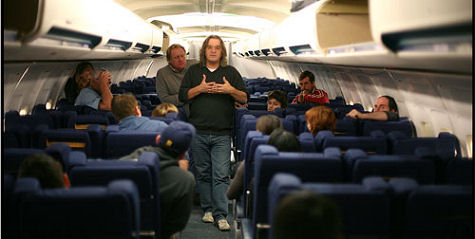

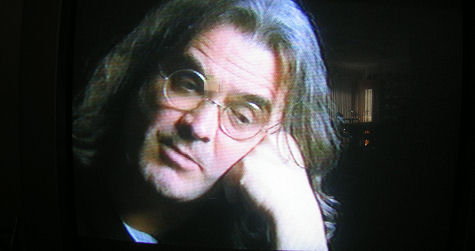
Director Paul Greengrass during filming of United 93

United 93 may have been made with the “idea” of it being about the heroism, selflessness and standing-up-to-terrorism valor shown by the passengers on flight #93, but honestly, actually…? The passengers in the film are mainly reacting to a realization that the hijackers are on a suicide mission and that they’re basically all dead, and so the bravest among them say “screw it, let’s do something instead of just waiting for it.”
This kicks in toward the very end, but the movie is really not about that (and thank God it isn’t) because, as Poland says, the drama is never delivered on any kind of individual character level. A kind of frantic heroism happened, an undeniable valor, but the film isn’t about that. Well, it is…but not finally.
< ?php include ('/home/hollyw9/public_html/wired'); ?>
Director Paul Greengrass may have begun with the idea of developing a heroism-of- the-passengers story, but I think he said along the way, “Sod it…let’s just make a minute-by-minute, you-are-there, this-is-how-it-probably-felt movie from the POV of the United #93 passengers and the perspective of the professionals charged with keeping tabs on commercial plane activity…and then we’ll sort it out in the editing room.”
And yet the movie has, ironically, a big current running through it.
This current, for me, is Greengrass’s big inspiration, his brainwave. Because it’s the first two thirds of this film — the experience and the perspective of the people trying to keep tabs on what’s happening from the air control centers — that gives United 93 its intrigue and electricity.
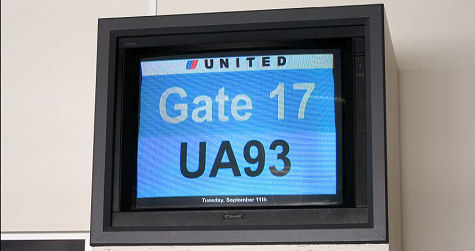
What, then, is United 93 “about”? It’s about revisiting, recapturing, reanimating… living through the particulars. Which means that Poland will be chasing his own tail around a tree trying to find the Big Meaning…unless, of course, he breaks through all that.
The theme of United 93 is the deceptive nature of “reality” as it unfolds. The reality of what life in these particular spaces felt like, and Greengrass’s striking ability to reconstitute recent history with a feeling of gripping verisimilitude, which I regard as a kind of cinematic theme or belief system in and of itself.
In short, I believe in Paul Greengrass when he’s working at the top of his form. As far as this movie is concerned, that’s my religion and my faith. Nobody needs a high falutin’ analysis about “what it’s really about” to make it feel whole or justified, because what it’s about is its own constitution. A big resounding echo isn’t the point in a film composed of a thousand echoes of minutae.
Poland also asks who is it really about?
That’s the really interesting question, and the answer is that United 93 is about us. Then and right now. Us.

Greene Grab
Blown Away

Is Paul Greengrass’s United 93 (Universal, 4.28) a knockout, a time-stopper, a mind-blower? It sure as hell is.
You’re probably going to need to stand outside the theatre for a few minutes after it’s over and just chill…trust me. And then you’re going to want a drink, even if you don’t drink. And then talk it out with friends for an hour or so. See it with some. Don’t go alone.
Is feeling power-drilled all over again by one of the worst real-life nightmares of all time a good thing? To me, it is.
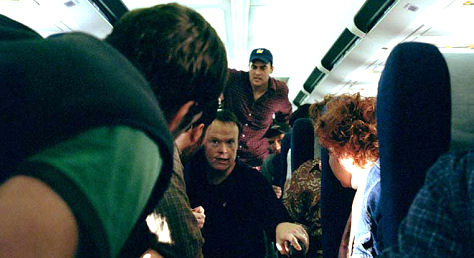

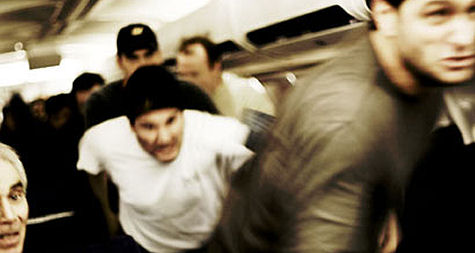
Christian Clemenson (kneeling) as Thomas Burnett in the middle of passenger huddle during last act of United 93; Cheyenne Jackson, as Mark Bingham, is standing behind with the maroon shirt and hat.

It happened, it’s real, and this film knocks your socks off because it takes you right back to that surreal morning and that feeling, that almost-afraid-to-breathe feeling, and to me, that’s partly what good films do — they lift you out of your realm and make you forget about everything but what’s on-screen.
All I know is that I was watching and taking it all in, and that the old feelings started to build and churn around and then pour back in, like a damburst. The chills and forebodings of doom were back, and this time with a closer, more comprehensive perspective.
United 93 didn’t make me “happy” but I relished it. I’m not a baby or a coward. I’m not a “too-sooner.” Show me anything that smacks of honesty and hard truth or at least skillful manipulations of same, and I’m there for firsts, seconds and thirds.
Time‘s Richard Corliss called it “unbearable and unmissable.” Mainly the latter, I’d say. As long as it’s not a cheap-ass horror film, I eat “unbearable” for breakfast.
Not one frame of this film struck me as distasteful or exploitative. It shows what needs to be shown with as much restraint as could be managed without changing the known facts.
We were told at the screening that the print shown wasn’t quite finished. It looked pretty finished to me. No obviously raw effects, nothing that screamed out, “Oops …sorry!”
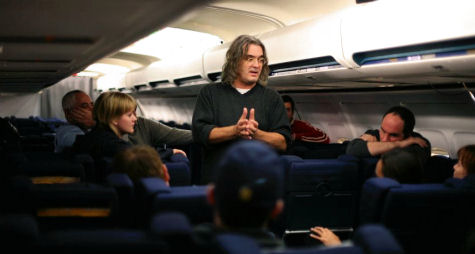

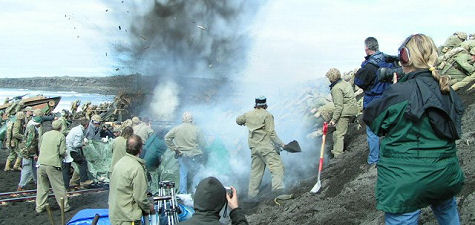
United 93 director Paul Greengrass during filming on set of Pinewood Studios.

What surprised me is that two-thirds of United 93 don’t have a whole lot to do with United #93. They’re about what happened as air traffic controllers, the FAA and the military tried to monitor what was happening with American Airlines #11, United #193 and American #77 (i.e., the flights that slammed into the North Tower, the South Tower and the Pentagon, respectively). It’s about how a lot of focused dec- ent professionals tried to keep up with the horror and couldn’t.
United 93 runs about an hour and 45 minutes. It’s about 30 minutes before Flight 93 takes off, but you’re not really paying that much attention, frankly, to those doomed souls on the plane…not at first. It’s the confused folks in the control rooms who pull you in. The second plane hits about 45 minutes in, give or take, and it’s another 15 minutes — a full hour — before the hijackers, who’ve waited and eyeball- ed each other from their first-class seats and stalled, it seems to me, like nervous nellies, before finally making their move.
For me, that opening hour is classic. Greengrass has never done anything quite as good. The tension and verisimilitude surpasses his work in Bloody Sunday, and that’s saying something. Each and every bit actor, every line…every last piece of it screws you to your seat.
Those guys playing air-traffic controllers are perfect. Remember the tension in that air-traffic controller scene in the opening moments of Close Encounters of the Third Kind? It’s that tripled or quadrupled. Ben Sliney, a gray-haired office mana- ger type who was having his first day on 9/11 as national operations manager for the FAA, plays himself. Nobody, really, seems to be “acting” in this. Every bit player rules in every control-room scene in this film.
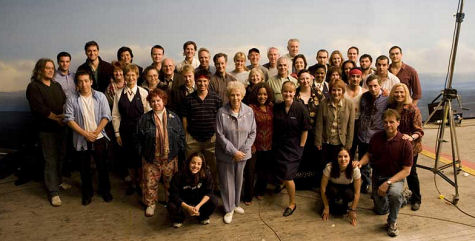

Cast of United 93 on Pinewood sound stage.

What’s so affecting is that you know what’s coming, and Greengrass just lets it come…tick, tock, tick. There’s a spellbinding moment when it all starts…when a 40ish Boston air traffic controller first realizes that American #11 is off-course and not communicating. The moment isn’t especially heightened or emphasized. It’s just this guy going, “Okay…something’s off here”
Once the hijacking on United #93 begins and the killings and screamings and all the rest of that sad melodrama kicks in, then it’s a bit more familiar, especially if you’re up on what’s known to have happened and if you saw A&E’s Flight 93 movie last January. That was an okay film. I didn’t like the family members crying and saying “I love you” to their loved ones who were calling from the plane (which felt almost icky to me), but it was all right. And yet United 93, no offense, is about two and a half to three times better.
I saw it at the first non-Time magazine press screening on Tuesday night in Santa Monica, and a woman sitting two seats away got up twice, and it’s measure of how caught up I was that I was vaguely irritated when she left the second time. How many times does this woman need to take a leak? I wondered. Or is she leaving the room to give herself a break from the tension? Either way, I was vaguely irked. (Why should I care, right? It was her business. But I didn’t want any nearby move- ment.)
The remarkable accomplishent, for me, is that I felt no sense of time while watch- ing United 93. It lasts about 105 minutes, and it could have been 40 or 50 minutes. I didn’t care, didn’t think about it. The damn thing held me, vise-gripped me. Did I have a good time? Definitely, by my standards. I haven’t sat through a pulse-poun- der like this in months, and I can’t wait to see it again.
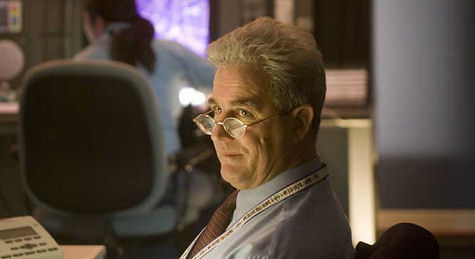

Ben Sliney, who was having his first day as national operations manager for the FAA on 9.11.01, plays himself.

Cheyenne Jackson, who plays Mark Bingham, the gay guy who died on United #93, was one of those at last night’s screening. I spoke to him briefly, told him it’s a hell of a film. He seemed kind of choked up and needed some alone time. Chris- tian Clemenson, who plays Thomas Burnett, was also there, but he was gone in a flash as soon as the credits started rolling.
One tiny beef: The last piece of copy on the black screen says that after 9/11, “America’s war on terror had begun.” The implied statement, of course, is, “And it continues today!” That it does, but if anyone thinks that what’s happening in Iraq right now (and what may even happen with Iran…who knows?) is a blow against terror they’re very much mistaken, and that final line struck me as a bit of a rah-rah statement. I think Greengrass should have just let what happened in the film (as he chose to dramatize it) stand on its own and leave well enough alone.

Puck Everlasting

The movies that seem to grab me the most are the ones that ask us to consider the mystical, the undefined, the intangibles…the ones that say “look up, look out, look beyond…there’s more to this world than what you can own, eat, taste or feel.”
The latest film to do this kind of thing well, and frankly one of the more interesting, amusing and affecting films I’ve seen over the last few weeks (if you don’t include An Inconvenient Truth, that is), is a new documentary about a bunch of guys who love to play air hockey.
It’s called Way of the Puck — and no one anywhere has seen it, except for a handful of film festival programmers. It’ll be having its world premiere at Houston’s Worldfest Film Festival in mid to late April.
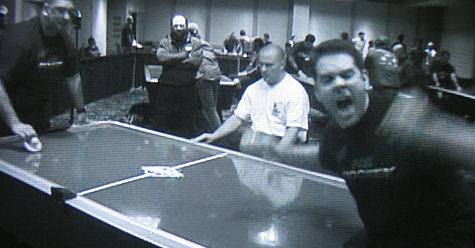

Atypical action moment in Eric D. Anderson’s Way of the Puck, meaning that 98% of it was shot in regular color video.

I’m not saying it’s wet-your-pants fantastic, but if you can imagine something as arcane as a thinking man’s air-hockey film…one that doesn’t so much focus on a stupid plastic puck getting knocked back and forth by a couple of guys leaning over a gleaming blue plastic surface as much as…well, the zen approach to this simple-ass game, keeping a light touch, concentrating hard and yet not concen- trating as much as feeling the force…this is it.
The “maker” is Eric D. Anderson, a Los Angeles-based guy who works on music videos and commercials and has spent the last two-plus years putting this doc together, partly (as you might expect) because he’s a big air hockey nut himself, but also because he sees a Great Beyond inside it…a world within a world.
“On the surface air hockey seems like a story with very low stakes,” he writes on the film’s website. “Or no stakes at all. I get a lot of this. ‘Air hockey?’ people say, nodding slowly. ‘That game from the ’70s? Hunh.’
“Air hockey isn’t the unpopular kid who gets kicked around at recess. Air hockey is the kid no one notices, including the teacher. It’s a forgotten arcade game, a kid’s game, a relic, a jobby, a diversion, a trifle…and what could be less important than that?”
But in the making of this film, says Anderson, “I discovered a passionate and intelligent community of players. These are underdogs, participating in a fringe sport. They know they are dismissed and sometimes mocked and that air hockey will proably never be accepted by the mainstream. And yet they continue to travel thousands of miles to compete against the best players in the world.”
Way of the Puck is a guy film, mostly, obviously, but a smart one. Alert, spiritual, philosophically loaded. “Small” and a little familiar in certain ways, maybe a tiny bit repetitive (and maybe a little long…just a wee bit) but within its own territory it feels solid and connected and complete.
It’s a real middle-class film about a gaggle (somehow that word feels right rather than ‘group’) of five or six American middle class guys, most of them married and either pudgy or bearded or balding (or all three) who are serious air hockey freaks, and who all happen to be quite thoughtful and intelligent.
That’s the first big revelation — air hockey doesn’t seem to be played by meatball blue-collar types but by unusually bright and creative guys. Or so this film implies.


Eric D. Anderson

These aren’t exactly rugged individualists, but guys with a certain consistency and tenacity. Not the kind of men whom anyone would call intense or magnetic or start- ling, but men with an undeniable passion and dignity. And maybe a certain sadness or resignation thrown in, marital responsibilities and the day-to-day slog being what they are.
And yet they share an obvious, unshakable, undeniable belief in air hockey as some kind of transcendent pursuit…something that sustains their spirit, gets them through the rough patches, puts a special kind of English on their existence, makes life feel whole (or at least gives it a certain weight and dimension) and worth living.
More so from the audience perspective because air hockey isn’t that recognized or celebrated…far from it…but it’s their own thing, played as it is in those little rooms, and they’re happy with that. Or happy enough.
And there’s that cool robot. A one-armed guy resembling one of those Empire droids in Attack of the Clones playing a pretty good game of defensive air hockey with very some very fast reflexes. I’ve only seen human-sized robots with arms and legs do things like walk dogs and vacuum rugs. This guy’s different. Impressive.
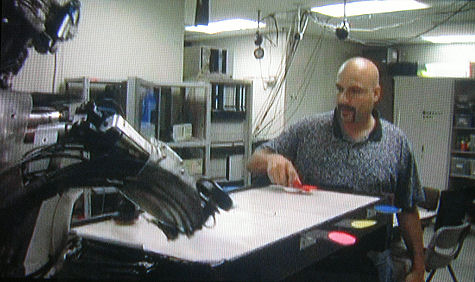

Robot air hockey

The point of Way of the Puck is that an air-hockey player needs to be alive and alert and in touch with something inward and flowing to get anything out of the game. More than just a fast hand and a light touch, but man…that robot.
Anderson believes that air hockey is “the culmination of 2500 years of human thought — connected to astronomy and artificial intelligence, music and missiles, comics and country + western dancing, painting and punk rock.” I don’t know if I can go that far, but Way of the Puck convinced me that air hockey amounts to something, or at least the players do.

Memory Lane

April has barely begun and the media drumbeat over the year’s two big 9/11 films, both produced with the upcoming five-year anniversary in mind, is already pretty loud.
Press screenings for United 93 are beginning this week, stories attempting to gauge the public’s interest in seeing this and other 9/11 presentations are running (the Wall Street Journal and Newsweek ran theirs on 4.7 and 4.10, respectively), and we’ll be hearing more and more about Oliver Stone’s World Trade Center next month when a 20-minute reel from the 8.11 Paramount release is shown at the Cannes Film Festival.
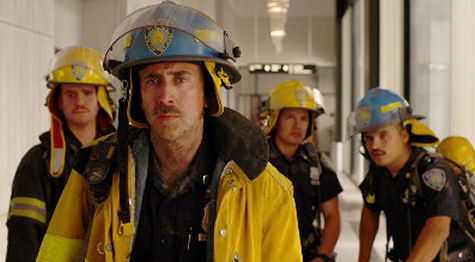

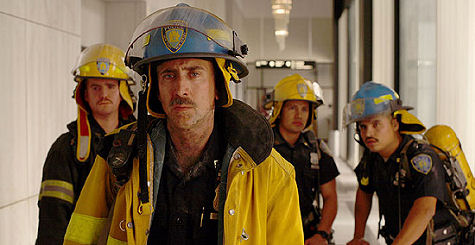
Nicolas Cage as Sgt. John McLouglin in Oliver Stone’s World Trade Center (Paramount, 8.11)

The 9/11 anniversary isn’t for another five months, of course, but I’ve been thinking about another startling event that happened in Manhattan nearly five years ago — a panel discussion on Saturday, October 6, 2001, at Alice Tully Hall called “Making Movies That Matter: The Role of Film in the National Debate.”
I reported on this right after it happened and I’ve mentioned it since (most recently in a WIRED item around noon on Sunday, 4.9), so why dredge it up for the third or fourth time? Because what panelist Oliver Stone said that day is, to me, still bang -on-the-head thrilling, and I’ve been wondering what’s changed in the four and a half years since…if anything?
It’s Sunday, it’s sunny outside, birds are chirping and I’m just going to run this piece again. (Most of it.) It’s a portrait of what’s been happening in this town for a long time, but the precision and candor in Stone’s rant still resonates.
Stone tried to describe the mindset and inclinations of corporate-run Hollywood as he saw it back then. Has the situation abated, remained the same, gotten worse or what? Read this through and think about it. I’m asking.
I’m repeating what I said in the WIRED item, but this sure was a long time ago, especially considering the apparent repositioning that has happened inside Stone himself, who was obviously more than a bit of a firebrand on 10.6.01 and now look at him, the director of a 9/11 pic about a couple of Port Authority guys who got buried under the fallen towers…a film that’s starting to sound, frankly, like it may be a head-in-the-sand emotional comfort blanket disguised as a rescue thriller.
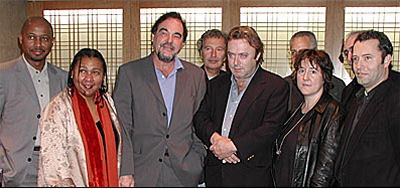

Before the ’01 debate: Lumumba director Raoul Peck, essayist Bell Hicks, director Oliver Stone, New Line Cinema honcho Robert Shaye, political writer Christopher Hitchens, former Universal Pictures chairman Tom Pollock, indie producer Christine Vachon (Boys Don’t Cry, Storytelling), former Universal Pictuers chairman Tom Pollock (almost completely hidden), and HBO executive Colin Callender.

I’m not saying World Trade Center won’t be a well-crafted or emotionally affecting drama. (Alexander aside, Stone is still a top-notch filmmaker). And who knows? Maybe it will contain echos and undercurrents that will add dimension to what screenwriter Andrea Berloff believes it is (“a boy-down-a-well saga’). But read the following and tell me Stone hasn’t trimmed his sails just a tad.
“Say what you will about Oliver Stone’s political views, but he’s a master at whipping up a crowd,” I began. “This was plainly evident during a panel discussion he participated in last Saturday at New York’s Alice Tully Hall called ‘Making Movies That Matter: The Role of Film in the National Debate.’
“The same brio that has enlivened many of Stone’s politically driven films, including JFK, Born on the Fourth of July, Platoon, and Nixon, was in full force during the sometimes brawl-like, HBO-sponsored discussion.
“Stone’s chief nemesis during the discussion — which also included some volleys from from political writer Christopher Hitchens, former Universal Pictures chairman Tom Pollock, indie producer Christine Vachon (Boys Don’t Cry, Storytelling), Lumumba director Raoul Peck, and political essayist Bell Hooks — was New Line Cinema chairman and CEO Robert Shaye.
“It fell to Shaye to articulate the status-quo views of corporate Hollywood, which elicited not only the wrath of Oliver but occasional groans from the audience. Much of what Shaye said was fair and sensible, but it was no match for the sweep of Stone’s oratory, which occasionally vaulted past the concerns of the entertainment industry to include speculation on the whys and wherefores of the 9/11 disaster.
“The central issue was whether Hollywood’s increasing reluctance to finance films with a strong political undercurrent (particularly in the wake of the World Trade Center attack) was being caused by a corporate-driven aversion to anything that isn’t essentially banal or superficial, as Stone asserted, or whether the main impediment to the funding of risky and/or controversial films is ‘the tyranny of talent,’ as Shaye put it, referring to astronomical fees demanded by actors and certain high-profile directors.
“Stone launched into one of his hardest-hitting points by recalling the relatively modest financing that gave birth to Born on the Fourth of July, his Oscar-winning 1989 drama about Vietnam veteran Ron Kovic that starred Tom Cruise.
“‘We struggled to make it,’ said Stone. ‘We had fights. The picture cost $16 million, and then it went to $17 or $18 million, and we fought for that extra two million like crazy.
“‘But this was 1989 — and there’s been no significant inflation in the United States since then,’ he continued. ‘Why, in 2001, does a picture that was done very tightly in 1989…[would] that picture today cost $60 to $80 million? With the marketing costs added in, which are inflated, putting it into the $90s…advertising and television…we’re talking a $100 to $135 million event.
“‘This would no longer be a movie, but an event. And someone like Tom Pollock would say…’Born on the Fourth of July? I’m not going to make that for $130 million!’ Because [this kind of film] can’t work any more in a system that has gone bananas .’


Lincoln Center’s Alice Tully Hall

“Stone was greeted by a passionate, sustained round of applause. Who doesn’t feel that films like Born on the Fourth of July, for which Stone won a Best Director Oscar and Cruise was nominated as Best Actor, are in woefully short supply these days?
“‘And this ties in to the Arab situation,’ Stone went on. ‘Why have we gone, in a non-inflationary era, to a [place] where our corporations have become huge over the last 10, 12 years? We’ve let them go. There’s been no trust-buster around. Teddy Roosevelt is long dead. And these media corporations have conglomerated themselves into six principal fiefdoms run by barons…they’re bigger than barons. They’re kings.’
“Stone was referring to Sumner Redstone who runs Viacom, which owns Paramount; Barry Meyer of Time-Warner, which owns Warner Bros. and New Line Cinema; Rupert Murdoch of Fox Newscorp., which runs 20th Century Fox; Mel Harris of Sony Pictures; Michael Eisner, the chairman/CEO of the Walt Disney Company; and Jean-Marie Messier of Vivendi, which owns Universal Pictures.”
[Note: Today’s media barons are Viacom’s Redstone, Newscorp’s Murdoch, Richard D. Parsons of Time-Warner, Sony Corp.’s chairman and CEO Howard Stringer, Disney CEO Bob Iger and Jeffrey R. Immelt, CEO of General Electric, which owns NBC Universal.]
“And these six companies decide,” said Stone. “Rupert Murdoch says ‘I would not make JFK,’ or Mike Eisner says ‘I would not do a film on Martin Luther King, Oliver, [because] there’s gonna be rioting at the gates of Disneyland’…you know, this is bullshit!”
“Gales of applause greeted this one, with some scattered yelps and cries of ‘right on!’
“‘These six people have control of the world and that’s what the new world order is,’ he explained. ‘Six men are deciding what you’re seeing in film, and they own all the small companies…it’s hard to find one that’s not owned by one of these huge companies buying new companies, so it’s a dilemma. There’s a control of culture, ideas, everything.
“Now, within reason, they let [filmmakers] do certain things, and that is far better obviously than, say, the Arabs where they don’t let you do anything, and I agree it’s relative. But we are in a dilemma. We have too much order.”
“‘And I think the revolt on September 11 was about order,’ Stone went on. “It was about fuck you, fuck your order…it was an eruption of rage about this. And is it time perhaps to reconsider the world order? Is it time to wonder why the banks have joined the movie companies and all the corporations, and where this is all going?”
“Hitchens, who writes for The Nation and Vanity Fair , bridled at the use of the term ‘revolt’ and said the September 11 massacre ‘was not a revolt. It was a state-supported mass murder using civilians as missiles. It was an attack on civil society and civilization.’ This drew vigorous applause, albeit slightly more subdued.
“Shaye said, ‘I disagree with Oliver about this. I think he’s talking about an era and the studio system of 30 years ago. I will tell you, and Tom Pollock will back me up on this, that this is a tyranny of talent right now, and I don’t know what Oliver gets for directing a film, but I know what a lot of other people get, and it’s way too much. I do know that the last guys to get paid, believe it or not, are the studios that put up the money, and…’
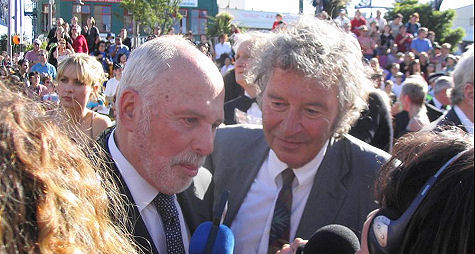

Robert Shaye (r.), co-chairman and co-CEO of New Line Cinema (pictured with Michael Lynne (l.)

“At this last remark, Stone shuddered and flopped back in his chair and looked up at the ceiling as if to say, ‘Did he just say that? I give up!’ Torrents of laughter. The hall was jumping.
“‘And if there’s a tyranny, it’s a tyranny of talent,’ Shaye concluded, drawing muted sneers and guffaws.
“Pollock, who was running Universal’s movie division when Born on the Fourth of July got made, said the go-ahead happened ‘because Oliver Stone was willing to make it for no money, and Tom Cruise was willing to make it for no money. The film was successful, they made a lot of money, and so did Universal, but it would not have been made had they not done that.
“‘Controversial films can still get made,’ said Pollock, ‘but films cost what they cost because most of the people who make them want to get paid as much as they can. They want control, but there is still that trade-off of money for control. We are in an oligarchy now where the large companies control what we see…yes, Rupert Murdoch has a political agenda, but by and large Rupert Murdoch is only interested in money.
“‘The problem with the six guys running the six companies is, they want to take no risks at all,’ he concluded. ‘They want movies that entertain only, if they can be marketed. There was little room before September 11 to make political movies inside the system. There’s less room now. It isn’t that it’s not going to happen. But it is going to be harder. And to that extent, Oliver is right.’
“Shaye said that New Line Cinema ‘started out in my apartment on 14th Street. We made our way in the world. We started out with Sympathy for the Devil. Talk about political…give me a break. And you know why it made money? Because the Rolling Stones were in it, not because Jean-Luc Godard had anything particularly profound to tell the world.’ Random hoots and snorts greeted this one.
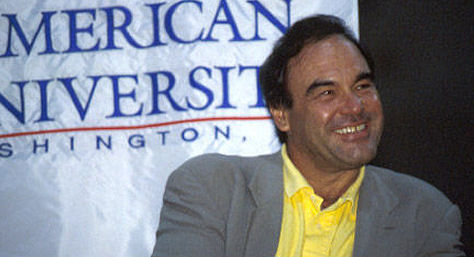
“‘It’s a little disenchanting,’ Shaye continued. ‘The truth of the matter now is, right now, that with high-definition and video and stuff like that you can make a good movie for not very much money. The great thing about the entertainment business and the movie business is that when a movie’s good, you attract people. People talk about it, the whole word-of-mouth thing…the quality of a movie is a self-fulfilling mechanism.”
“Stone jumped back in. ‘Thirty years ago, Bob said before. That’s when he got started. It was all…it was another world. [But] nobody here has answered that question why, between ’89 and 2001, everything has become so uniform…what’s basically happened in the last 10 years is that the studios have bought television stations. And why?’
“Referring to the so-called ‘syn-fin’ legislation passed under the Clinton administration a couple of years ago that allowed studios to own more TV stations, Stone asked, ‘Why did that telecommunications bill get passed at midnight? It was basically a division of the world by a few media moguls and it was a giveaway and it was done at midnight and it’s a disgusting thing. To own TV stations is the basis upon which movie companies today have to exist. And that’s changed everything. There are only so many television stations. Each one has their big build-up and that’s their base of operation.
“‘And Bob [Shaye] knows it because he sold his little movie company to Warner Bros. for more money than I could ever dream of making,” Stone continued. He acknowledged that certain high-profile directors, such as himself, are well paid for helming big-studio films. But the majors these days “don’t need a top director, they feel. Just make the movie. Because for them it’s all about marketing and about subject. That’s what they think.
“‘So there’s no ‘left’ point of view. It’s not financially interesting for them to make a movie with a director who costs more money…they’d rather go with a marginal director. It’s all about product…movie product…and it’s all about this new world order.
“‘And the Arabs have a point. Whether it’s right or wrong, there’s an objection to the way the world is going. There’s a lot of hate and revolt in that state. It may continue and although the shoe may drop on the other foot the next time, the point is they’re objecting to something. And I say that we’re not dealing with that objection on this stage today. There was a breakdown in the ’90s, in the system, the world system, the world banking system…it’s the new world order, and it’s about order and control, but this control comes with a cost.
“‘One of the most banal ways for censorship to operate in America,’ Stone continued, ‘is to drive out thought by explosions of People magazines and celebrity culture and…our culture is focused on Sarah Jessica Parker and kind-of inane, superficial stuff…it just becomes the noise, the white noise of our society.”
“Turning to Pollock, Stone said, ‘I don’t want to pick on you, Tom, but you’re ignoring the banks, you’re ignoring television, you’re ignoring the size of this thing, and you’re saying this thing is okay because that’s the way of the world because capitalism will go that way.
“‘The so-called ways of capitalism are not inevitable,’ Stone exclaimed. ‘It’s changed historically. Teddy Roosevelt changed the direction of it. Franklin Roosevelt changed the direction of it. Everybody in Hollywood says, ‘Well, what can I do about it?” These six companies have taken over just like the oil companies, and it’s wrong, wrong, wrong because they’re subverting political will.'”

Ales & Stouts
Blown Away

Is Paul Greengrass‘s United 93 (Universal, 4.28) a knockout, a time-stopper, a mind-blower? It sure as hell is. You’re probably going to need to stand outside the theatre for a few minutes after it’s over and just chill…trust me. And then you’re going to want a drink, even if you don’t drink. And then talk it out with friends for an hour or so. See it with some. Don’t go alone.


Christian Clemenson (kneeling) as Thomas Burnett in the middle of passenger huddle during last act of United 93; Cheyenne Jackson, as Mark Bingham, is standing behind with the maroon shirt and hat.

Is feeling power-drilled all over again by one of the worst real-life nightmares of all time a good thing? To me, it is. It happened, it’s real, and this film knocks your socks off because it takes you right back to that surreal morning and that feeling, that almost-afraid-to-breathe feeling, and to me, that’s partly what good films do — they lift you out of your realm and make you forget about everything but what’s on-screen.

All I know is that I was watching and taking it all in, and that the old feelings started to build and churn around and then pour back in, like a damburst. The chills and forebodings of doom were back, and this time with a closer, more comprehensive perspective.

United 93 didn’t make me “happy” but I relished it. I’m not a baby or a coward. I’m not a “too-sooner.” Show me anything that smacks of honesty and hard truth or at least skillful manipulations of same, and I’m there for firsts, seconds and thirds.

Time‘s Richard Corliss called it “unbearable and unmissable.” Mainly the latter, I’d say. As long as it’s not a cheap-ass horror film, I eat “unbearable” for breakfast.

Not one frame of this film struck me as distasteful or exploitative. It shows what needs to be shown with as much restraint as could be managed without changing the known facts.

We were told at the screening that the print shown wasn’t quite finished. It looked pretty finished to me. No obviously raw effects, nothing that screamed out, “Oops …sorry!”


United 93 director Paul Greengrass during filming on set of Pinewood Studios.

What surprised me is that two-thirds of United 93 don’t have a whole lot to do with United flight #93. They’re about what happened as air traffic controllers, the FAA and the military tried to monitor what was happening with American Airlines #11, United #193 and American #77 (i.e., the flights that slammed into the North Tower, the South Tower and the Pentagon, respectively). It’s about how a lot of focused decent professionals tried to keep up with the horror and couldn’t.

United 93 runs about an hour and 45 minutes. It waits about 30 minutes before Flight 93 takes off, but you’re not really paying that much attention, frankly, to those doomed souls on the plane…not at first. It’s the confused folks in the control rooms who pull you in. The second plane hits about 45 minutes in, give or take, and it’s another 15 minutes — a full hour — before the hijackers, who’ve waited and eyeballed each other from their first-class seats and stalled, it seems to me, like nervous nellies, before finally making their move.

For me, that opening hour is classic. Greengrass has never done anything quite as good. The tension and verisimilitude surpasses his work in Bloody Sunday, and that’s saying something. Each and every bit actor, every line…every last piece of it screws you to your seat.

Those guys playing air-traffic controllers are perfect. Remember the tension in that air-traffic controller scene in the opening moments of Close Encounters of the Third Kind? It’s that tripled or quadrupled. Ben Sliney, a gray-haired office manager type who was having his first day on 9/11 as national operations manager for the FAA, plays himself. Nobody, really, seems to be “acting” in this. Every bit player rules in every control-room scene in this film.


Cast of United 93 on Pinewood sound stage.

What’s so affecting is that you know what’s coming, and Greengrass just lets it come…tick, tock, tick. There’s a spellbinding moment when it all starts…when a 40ish Boston air traffic controller first realizes that American #11 is off-course and not communicating. The moment isn’t especially heightened or emphasized. It’s just this guy going, “Okay…something’s off here”

Once the hijacking on United #93 begins and the killings and screamings and all the rest of that sad melodrama kick in, then it’s a bit more familiar, especially if you’re up on what’s known to have happened and if you saw A&E’s Flight 93 movie last January. That was an okay film. I didn’t like the family members crying and saying “I love you” to their loved ones who were calling from the plane (which felt almost icky to me), but it was all right. And yet United 93, no offense, is about two and a half to three times better.

I saw it at the first non-Time magazine press screening on Tuesday night in Santa Monica, and a woman sitting two seats away got up twice, and it’s measure of how caught up I was that I was vaguely irritated when she left the second time. How many times does this woman need to take a leak? Or is she leaving the room to give herself a break from the tension? Either way, I was vaguely irked. (Why should I care, right? It was her business. But I didn’t want any nearby movement.)

The remarkable accomplishent, for me, is that I felt no sense of time while watching United 93. It lasts about 105 minutes, and it could have been 40 or 50 minutes. I didn’t care, didn’t think about it. The damn thing held me, vise-gripped me. Did I have a good time? Definitely, by my standards. I haven’t sat through a pulse-pounder like this in months, and I can’t wait to see it again.


Ben Sliney, who was having his first day as national operations manager for the FAA on 9.11.01, plays himself.

Cheyenne Jackson, who plays Mark Bingham, the gay guy who died on United #93, was one of those at last night’s screening. I spoke to him briefly, told him it’s a hell of a film. He seemed kind of choked up and needed some alone time. Christian Clemenson, who plays Thomas Burnett, was also there, but he was gone in a flash as soon as the credits started rolling.

One tiny beef: The last piece of copy on the black screen says that after 9/11, “America’s war on terror had begun.” The implied statement, of course, is, “And it continues today!” That it does, but if anyone thinks that what’s happening in Iraq right now (and what may even happen with Iran…who knows?) is a blow against terror they’re very much mistaken, and that final line struck me as a bit of a rah-rah statement. I think Greengrass should have just let what happened in the film (as he chose to dramatize it) stand on its own and leave well enough alone.

Puck Everlasting

The movies that seem to grab me the most are the ones that ask us to consider the mystical, the undefined, the intangibles…the ones that say “look up, look out, look beyond…there’s more to this world than what you can own, eat, taste or feel.”

The latest film to do this kind of thing well, and frankly one of the more interesting, amusing and affecting films I’ve seen over the last few weeks (if you don’t include An Inconvenient Truth, that is), is a new documentary about a bunch of guys who love to play air hockey.

It’s called Way of the Puck — and no one anywhere has seen it, except for a handful of film festival programmers. It’ll be having its world premiere at Houston’s Worldfest Film Festival in mid to late April.


Atypical action moment in Eric D. Anderson’s Way of the Puck, meaning that 98% of it was shot in regular color video.

I’m not saying it’s wet-your-pants fantastic, but if you can imagine something as arcane as a thinking man’s air-hockey film…one that doesn’t so much focus on a stupid plastic puck getting knocked back and forth by a couple of guys leaning over a gleaming blue plastic surface as much as…well, the zen approach to this simple-ass game, keeping a light touch, concentrating hard and yet not concen- trating as much as feeling the force…this is it.

The “maker” is Eric D. Anderson, a Los Angeles-based guy who works on music videos and commercials and has spent the last two-plus years putting this doc together, partly (as you might expect) because he’s a big air hockey nut himself, but also because he sees a Great Beyond inside it…a world within a world.

“On the surface air hockey seems like a story with very low stakes,” he writes on the film’s website. “Or no stakes at all. I get a lot of this. ‘Air hockey?’ people say, nodding slowly. ‘That game from the ’70s? Hunh.’

“Air hockey isn’t the unpopular kid who gets kicked around at recess. Air hockey is the kid no one notices, including the teacher. It’s a forgotten arcade game, a kid’s game, a relic, a jobby, a diversion, a trifle…and what could be less important than that?”

But in the making of this film, says Anderson, “I discovered a passionate and intelligent community of players. These are underdogs, participating in a fringe sport. They know they are dismissed and sometimes mocked and that air hockey will proably never be accepted by the mainstream. And yet they continue to travel thousands of miles to compete against the best players in the world.”
Way of the Puck is a guy film, mostly, obviously, but a smart one. Alert, spiritual, philosophically loaded. “Small” and a little familiar in certain ways, maybe a tiny bit repetitive (and maybe a little long…just a wee bit) but within its own territory it feels solid and connected and complete.

It’s a real middle-class film about a gaggle (somehow that word feels right rather than ‘group’) of five or six American middle class guys, most of them married and either pudgy or bearded or balding (or all three) who are serious air hockey freaks, and who all happen to be quite thoughtful and intelligent.

That’s the first big revelation — air hockey doesn’t seem to be played by meatball blue-collar types but by unusually bright and creative guys. Or so this film implies.


Eric D. Anderson

These aren’t exactly rugged individualists, but guys with a certain consistency and tenacity. Not the kind of men whom anyone would call intense or magnetic or start- ling, but men with an undeniable passion and dignity. And maybe a certain sadness or resignation thrown in, marital responsibilities and the day-to-day slog being what they are.

And yet they share an obvious, unshakable, undeniable belief in air hockey as some kind of transcendent pursuit…something that sustains their spirit, gets them through the rough patches, puts a special kind of English on their existence, makes life feel whole (or at least gives it a certain weight and dimension) and worth living.

More so from the audience perspective because air hockey isn’t that recognized or celebrated…far from it…but it’s their own thing, played as it is in those little rooms, and they’re happy with that. Or happy enough.

And there’s that cool robot. A one-armed guy resembling one of those Empire droids in Attack of the Clones playing a pretty good game of defensive air hockey with very some very fast reflexes. I’ve only seen human-sized robots with arms and legs do things like walk dogs and vacuum rugs. This guy’s different. Impressive.


Robot air hockey

The point of Way of the Puck is that an air-hockey player needs to be alive and alert and in touch with something inward and flowing to get anything out of the game. More than just a fast hand and a light touch, but man…that robot.

Anderson believes that air hockey is “the culmination of 2500 years of human thought — connected to astronomy and artificial intelligence, music and missiles, comics and country + western dancing, painting and punk rock.” I don’t know if I can go that far, but Way of the Puck convinced me that air hockey amounts to something, or at least the players do.

Memory Lane

April has barely begun and the media drumbeat over the year’s two big 9/11 films, both produced with the upcoming five-year anniversary in mind, is already pretty loud.

Press screenings for United 93 are beginning this week, stories attempting to gauge the public’s interest in seeing this and other 9/11 presentations are running (the Wall Street Journal and Newsweek ran theirs on 4.7 and 4.10, respectively), and we’ll be hearing more and more about Oliver Stone’s World Trade Center next month when a 20-minute reel from the 8.11 Paramount release is shown at the Cannes Film Festival.


Nicolas Cage as Sgt. John McLouglin in Oliver Stone’s World Trade Center (Paramount, 8.11)

The 9/11 anniversary isn’t for another five months, of course, but I’ve been thinking about another startling event that happened in Manhattan nearly five years ago — a panel discussion on Saturday, October 6, 2001, at Alice Tully Hall called “Making Movies That Matter: The Role of Film in the National Debate.”

I reported on this right after it happened and I’ve mentioned it since (most recently in a WIRED item around noon on Sunday, 4.9), so why dredge it up for the third or fourth time? Because what panelist Oliver Stone said that day is, to me, still bang -on-the-head thrilling, and I’ve been wondering what’s changed in the four and a half years since…if anything?

It’s Sunday, it’s sunny outside, birds are chirping and I’m just going to run this piece again. (Most of it.) It’s a portrait of what’s been happening in this town for a long time, but the precision and candor in Stone’s rant still resonates.

Stone tried to describe the mindset and inclinations of corporate-run Hollywood as he saw it back then. Has the situation abated, remained the same, gotten worse or what? Read this through and think about it. I’m asking.

I’m repeating what I said in the WIRED item, but this sure was a long time ago, especially considering the apparent repositioning that has happened inside Stone himself, who was obviously more than a bit of a firebrand on 10.6.01 and now look at him, the director of a 9/11 pic about a couple of Port Authority guys who got buried under the fallen towers…a film that’s starting to sound, frankly, like it may be a head-in-the-sand emotional comfort blanket disguised as a rescue thriller.


Before the ’01 debate: Lumumba director Raoul Peck, essayist Bell Hicks, director Oliver Stone, New Line Cinema honcho Robert Shaye, political writer Christopher Hitchens, former Universal Pictures chairman Tom Pollock, indie producer Christine Vachon (Boys Don’t Cry, Storytelling), former Universal Pictuers chairman Tom Pollock (almost completely hidden), and HBO executive Colin Callender.

I’m not saying World Trade Center won’t be a well-crafted or emotionally affecting drama. (Alexander aside, Stone is still a top-notch filmmaker). And who knows? Maybe it will contain echos and undercurrents that will add dimension to what screenwriter Andrea Berloff believes it is (“a boy-down-a-well saga’). But read the following and tell me Stone hasn’t trimmed his sails just a tad.

“Say what you will about Oliver Stone’s political views, but he’s a master at whipping up a crowd,” I began. “This was plainly evident during a panel discussion he participated in last Saturday at New York’s Alice Tully Hall called ‘Making Movies That Matter: The Role of Film in the National Debate.’

“The same brio that has enlivened many of Stone’s politically driven films, including JFK, Born on the Fourth of July, Platoon, and Nixon, was in full force during the sometimes brawl-like, HBO-sponsored discussion.

“Stone’s chief nemesis during the discussion — which also included some volleys from from political writer Christopher Hitchens, former Universal Pictures chairman Tom Pollock, indie producer Christine Vachon (Boys Don’t Cry, Storytelling), Lumumba director Raoul Peck, and political essayist Bell Hooks — was New Line Cinema chairman and CEO Robert Shaye.

“It fell to Shaye to articulate the status-quo views of corporate Hollywood, which elicited not only the wrath of Oliver but occasional groans from the audience. Much of what Shaye said was fair and sensible, but it was no match for the sweep of Stone’s oratory, which occasionally vaulted past the concerns of the entertainment industry to include speculation on the whys and wherefores of the 9/11 disaster.

“The central issue was whether Hollywood’s increasing reluctance to finance films with a strong political undercurrent (particularly in the wake of the World Trade Center attack) was being caused by a corporate-driven aversion to anything that isn’t essentially banal or superficial, as Stone asserted, or whether the main impediment to the funding of risky and/or controversial films is ‘the tyranny of talent,’ as Shaye put it, referring to astronomical fees demanded by actors and certain high-profile directors.

“Stone launched into one of his hardest-hitting points by recalling the relatively modest financing that gave birth to Born on the Fourth of July, his Oscar-winning 1989 drama about Vietnam veteran Ron Kovic that starred Tom Cruise.

“‘We struggled to make it,’ said Stone. ‘We had fights. The picture cost $16 million, and then it went to $17 or $18 million, and we fought for that extra two million like crazy.

“‘But this was 1989 — and there’s been no significant inflation in the United States since then,’ he continued. ‘Why, in 2001, does a picture that was done very tightly in 1989…[would] that picture today cost $60 to $80 million? With the marketing costs added in, which are inflated, putting it into the $90s…advertising and television…we’re talking a $100 to $135 million event.

“‘This would no longer be a movie, but an event. And someone like Tom Pollock would say…’Born on the Fourth of July? I’m not going to make that for $130 million!’ Because [this kind of film] can’t work any more in a system that has gone bananas .’


Lincoln Center’s Alice Tully Hall

“Stone was greeted by a passionate, sustained round of applause. Who doesn’t feel that films like Born on the Fourth of July, for which Stone won a Best Director Oscar and Cruise was nominated as Best Actor, are in woefully short supply these days?

“‘And this ties in to the Arab situation,’ Stone went on. ‘Why have we gone, in a non-inflationary era, to a [place] where our corporations have become huge over the last 10, 12 years? We’ve let them go. There’s been no trust-buster around. Teddy Roosevelt is long dead. And these media corporations have conglomerated themselves into six principal fiefdoms run by barons…they’re bigger than barons. They’re kings.’

“Stone was referring to Sumner Redstone who runs Viacom, which owns Paramount; Barry Meyer of Time-Warner, which owns Warner Bros. and New Line Cinema; Rupert Murdoch of Fox Newscorp., which runs 20th Century Fox; Mel Harris of Sony Pictures; Michael Eisner, the chairman/CEO of the Walt Disney Company; and Jean-Marie Messier of Vivendi, which owns Universal Pictures.”

[Note: Today’s media barons are Viacom’s Redstone, Newscorp’s Murdoch, Richard D. Parsons of Time-Warner, Sony Corp.’s chairman and CEO Howard Stringer, Disney CEO Bob Iger and Jeffrey R. Immelt, CEO of General Electric, which owns NBC Universal.]

“And these six companies decide,” said Stone. “Rupert Murdoch says ‘I would not make JFK,’ or Mike Eisner says ‘I would not do a film on Martin Luther King, Oliver, [because] there’s gonna be rioting at the gates of Disneyland’…you know, this is bullshit!”

“Gales of applause greeted this one, with some scattered yelps and cries of ‘right on!’
“‘These six people have control of the world and that’s what the new world order is,’ he explained. ‘Six men are deciding what you’re seeing in film, and they own all the small companies…it’s hard to find one that’s not owned by one of these huge companies buying new companies, so it’s a dilemma. There’s a control of culture, ideas, everything.

“Now, within reason, they let [filmmakers] do certain things, and that is far better obviously than, say, the Arabs where they don’t let you do anything, and I agree it’s relative. But we are in a dilemma. We have too much order.”

“‘And I think the revolt on September 11 was about order,’ Stone went on. “It was about fuck you, fuck your order…it was an eruption of rage about this. And is it time perhaps to reconsider the world order? Is it time to wonder why the banks have joined the movie companies and all the corporations, and where this is all going?”

“Hitchens, who writes for The Nation and Vanity Fair , bridled at the use of the term ‘revolt’ and said the September 11 massacre ‘was not a revolt. It was a state-supported mass murder using civilians as missiles. It was an attack on civil society and civilization.’ This drew vigorous applause, albeit slightly more subdued.

“Shaye said, ‘I disagree with Oliver about this. I think he’s talking about an era and the studio system of 30 years ago. I will tell you, and Tom Pollock will back me up on this, that this is a tyranny of talent right now, and I don’t know what Oliver gets for directing a film, but I know what a lot of other people get, and it’s way too much. I do know that the last guys to get paid, believe it or not, are the studios that put up the money, and…’


Robert Shaye (r.), co-chairman and co-CEO of New Line Cinema (pictured with Michael Lynne (l.)

“At this last remark, Stone shuddered and flopped back in his chair and looked up at the ceiling as if to say, ‘Did he just say that? I give up!’ Torrents of laughter. The hall was jumping.
“‘And if there’s a tyranny, it’s a tyranny of talent,’ Shaye concluded, drawing muted sneers and guffaws.

“Pollock, who was running Universal’s movie division when Born on the Fourth of July got made, said the go-ahead happened ‘because Oliver Stone was willing to make it for no money, and Tom Cruise was willing to make it for no money. The film was successful, they made a lot of money, and so did Universal, but it would not have been made had they not done that.

“‘Controversial films can still get made,’ said Pollock, ‘but films cost what they cost because most of the people who make them want to get paid as much as they can. They want control, but there is still that trade-off of money for control. We are in an oligarchy now where the large companies control what we see…yes, Rupert Murdoch has a political agenda, but by and large Rupert Murdoch is only interested in money.

“‘The problem with the six guys running the six companies is, they want to take no risks at all,’ he concluded. ‘They want movies that entertain only, if they can be marketed. There was little room before September 11 to make political movies inside the system. There’s less room now. It isn’t that it’s not going to happen. But it is going to be harder. And to that extent, Oliver is right.’

“Shaye said that New Line Cinema ‘started out in my apartment on 14th Street. We made our way in the world. We started out with Sympathy for the Devil. Talk about political…give me a break. And you know why it made money? Because the Rolling Stones were in it, not because Jean-Luc Godard had anything particularly profound to tell the world.’ Random hoots and snorts greeted this one.

“‘It’s a little disenchanting,’ Shaye continued. ‘The truth of the matter now is, right now, that with high-definition and video and stuff like that you can make a good movie for not very much money. The great thing about the entertainment business and the movie business is that when a movie’s good, you attract people. People talk about it, the whole word-of-mouth thing…the quality of a movie is a self-fulfilling mechanism.”

“Stone jumped back in. ‘Thirty years ago, Bob said before. That’s when he got started. It was all…it was another world. [But] nobody here has answered that question why, between ’89 and 2001, everything has become so uniform…what’s basically happened in the last 10 years is that the studios have bought television stations. And why?’

“Referring to the so-called ‘syn-fin’ legislation passed under the Clinton administration a couple of years ago that allowed studios to own more TV stations, Stone asked, ‘Why did that telecommunications bill get passed at midnight? It was basically a division of the world by a few media moguls and it was a giveaway and it was done at midnight and it’s a disgusting thing. To own TV stations is the basis upon which movie companies today have to exist. And that’s changed everything. There are only so many television stations. Each one has their big build-up and that’s their base of operation.

“‘And Bob [Shaye] knows it because he sold his little movie company to Warner Bros. for more money than I could ever dream of making,” Stone continued. He acknowledged that certain high-profile directors, such as himself, are well paid for helming big-studio films. But the majors these days “don’t need a top director, they feel. Just make the movie. Because for them it’s all about marketing and about subject. That’s what they think.

“‘So there’s no ‘left’ point of view. It’s not financially interesting for them to make a movie with a director who costs more money…they’d rather go with a marginal director. It’s all about product…movie product…and it’s all about this new world order.

“‘And the Arabs have a point. Whether it’s right or wrong, there’s an objection to the way the world is going. There’s a lot of hate and revolt in that state. It may continue and although the shoe may drop on the other foot the next time, the point is they’re objecting to something. And I say that we’re not dealing with that objection on this stage today. There was a breakdown in the ’90s, in the system, the world system, the world banking system…it’s the new world order, and it’s about order and control, but this control comes with a cost.

“‘One of the most banal ways for censorship to operate in America,’ Stone continued, ‘is to drive out thought by explosions of People magazines and celebrity culture and…our culture is focused on Sarah Jessica Parker and kind-of inane, superficial stuff…it just becomes the noise, the white noise of our society.”

“Turning to Pollock, Stone said, ‘I don’t want to pick on you, Tom, but you’re ignoring the banks, you’re ignoring television, you’re ignoring the size of this thing, and you’re saying this thing is okay because that’s the way of the world because capitalism will go that way.

“‘The so-called ways of capitalism are not inevitable,’ Stone exclaimed. ‘It’s changed historically. Teddy Roosevelt changed the direction of it. Franklin Roosevelt changed the direction of it. Everybody in Hollywood says, ‘Well, what can I do about it?” These six companies have taken over just like the oil companies, and it’s wrong, wrong, wrong because they’re subverting political will.'”

Ales & Stouts

Puck Everlasting

Puck Everlasting

The movies that seem to grab me the most are the ones that ask us to consider the mystical, the undefined, the intangibles…the ones that say “look up, look out, look beyond…there’s more to this world than what you can own, eat, taste or feel.”
The latest film to do this kind of thing well, and frankly one of the more interesting, amusing and affecting films I’ve seen over the last few weeks (if you don’t include An Inconvenient Truth, that is), is a new documentary about a bunch of guys who love to play air hockey.


Atypical action moment in Eric D. Anderson’s Way of the Puck, meaning that 98% of it was shot in regular color video.

It’s called Way of the Puck — and no one anywhere has seen it, except for a handful of film festival programmers. It’ll be having its world premiere at Houston’s Worldfest Film Festival in mid to late April.
I’m not saying it’s wet-your-pants fantastic, but if you can imagine something as arcane as a thinking man’s air-hockey film…one that doesn’t so much focus on a stupid plastic puck getting knocked back and forth by a couple of guys leaning over a gleaming blue plastic surface as much as…well, the zen approach to this simple-ass game, keeping a light touch, concentrating hard and yet not concen- trating as much as feeling the force…this is it.
< ?php include ('/home/hollyw9/public_html/wired'); ?>
The “maker” is Eric D. Anderson, a Los Angeles-based guy who works on music videos and commercials and has spent the last two-plus years putting this doc together, partly (as you might expect) because he’s a big air hockey nut himself, but also because he sees a Great Beyond inside it…a world within a world.
“On the surface air hockey seems like a story with very low stakes,” he writes on the film’s website. “Or no stakes at all. I get a lot of this. ‘Air hockey?’ people say, nodding slowly. ‘That game from the ’70s? Hunh.’
“Air hockey isn’t the unpopular kid who gets kicked around at recess.
Air hockey is the kid no one notices, including the teacher. It’s a forgotten arcade game, a kid’s game, a relic, a jobby, a diversion, a trifle…and what could be less important than that?”

But in the making of this film, says Anderson, “I discovered a passionate and intelligent community of players. These are underdogs, participating in a fringe sport. They know they are dismissed and sometimes mocked and that air hockey will proably never be accepted by the mainstream. And yet they continue to travel thousands of miles to compete against the best players in the world.”
Way of the Puck is a guy film, mostly, obviously, but a smart one. Alert, spiritual, philosophically loaded. “Small” and a little familiar in certain ways, maybe a tiny bit repetitive (and maybe a little long…just a wee bit) but within its own territory it feels solid and connected and complete.
It’s a real middle-class film about a gaggle (somehow that word feels right rather than ‘group”) of five or six American middle class guys, most of them married and either pudgy or bearded or balding (or all three) who are serious air hockey freaks, and who all happen to be quite thoughtful and intelligent.
That’s the first big revelation — air hockey doesn’t seem to be played by meatball blue-collar types but by unusually bright and creative guys. Or so this film implies.


Eric D. Anderson

These aren’t exactly rugged individualists, but guys with a certain consistency and tenacity. Not the kind of men whom anyone would call intense or magnetic or start- ling, but men with an undeniable passion and dignity. And maybe a certain sadness or resignation thrown in, marital responsibilities and the day-to-day slog being what they are.
And yet they share an obvious, unshakable, undeniable belief in air hockey as some kind of transcendent pursuit…something that sustains their spirit, gets them through the rough patches, puts a special kind of English on their existence, makes life feel whole (or at least gives it a certain weight and dimension) and worth living.
More so from the audience perspective because air hockey isn’t that recognized or celebrated…far from it…but it’s their own thing, played as it is in those little rooms, and they’re happy with that. Or happy enough.
And there’s that cool robot. A one-armed guy resembling one of those Empire droids in Attack of the Clones playing a pretty good game of defensive air hockey with very some very fast reflexes. I’ve only seen human-sized robots with arms and legs do things like walk dogs and vacuum rugs. This guy’s different. Impressive.


Robot air hockey

The point of Way of the Puck is that an air-hockey player needs to be alive and alert and in touch with something inward and flowing to get anything out of the game. More than just a fast hand and a light touch, but man…that robot.
Anderson believes that air hockey is “the culmination of 2500 years of human thought — connected to astronomy and artificial intelligence, music and missiles, comics and country + western dancing, painting and punk rock.” I don’t know if I can go that far, but Way of the Puck convinced me that air hockey amounts to something, or at least the players do.

Memory Lane

April has barely begun and the media drumbeat over the year’s two big 9/11 films, both produced with the upcoming five-year anniversary in mind, is already pretty loud.
Press screenings for United 93 are beginning this week, stories attempting to gauge the public’s interest in seeing this and other 9/11 presentations are running (the Wall Street Journal and Newsweek ran theirs on 4.7 and 4.10, respectively), and we’ll be hearing more and more about Oliver Stone’s World Trade Center next month when a 20-minute reel from the 8.11 Paramount release is shown at the Cannes Film Festival.


Nicolas Cage as Sgt. John McLouglin in Oliver Stone’s World Trade Center (Paramount, 8.11)

The 9/11 anniversary isn’t for another five months, of course, but I’ve been thinking about another startling event that happened in Manhattan nearly five years ago — a panel discussion on Saturday, October 6, 2001, at Alice Tully Hall called “Making Movies That Matter: The Role of Film in the National Debate.”
I reported on this right after it happened and I’ve mentioned it since (most recently in a WIRED item around noon on Sunday, 4.9), so why dredge it up for the third or fourth time? Because what panelist Oliver Stone said that day is, to me, still bang -on-the-head thrilling, and I’ve been wondering what’s changed in the four and a half years since…if anything?
It’s Sunday, it’s sunny outside, birds are chirping and I’m just going to run this piece again. (Most of it.) It’s a portrait of what’s been happening in this town for a long time, but the precision and candor in Stone’s rant still resonates.
Stone tried to describe the mindset and inclinations of corporate-run Hollywood as he saw it back then. Has the situation abated, remained the same, gotten worse or what? Read this through and think about it. I’m asking.
I’m repeating what I said in the WIRED item, but this sure was a long time ago, especially considering the apparent repositioning that has happened inside Stone himself, who was obviously more than a bit of a firebrand on 10.6.01 and now look at him, the director of a 9/11 pic about a couple of Port Authority guys who got buried under the fallen towers…a film that’s starting to sound, frankly, like it may be a head-in-the-sand emotional comfort blanket disguised as a rescue thriller.


Before the ’01 debate: Lumumba director Raoul Peck, essayist Bell Hicks, director Oliver Stone, New Line Cinema honcho Robert Shaye, political writer Christopher Hitchens, former Universal Pictures chairman Tom Pollock, indie producer Christine Vachon (Boys Don’t Cry, Storytelling), former Universal Pictuers chairman Tom Pollock (almost completely hidden), and HBO executive Colin Callender.

I’m not saying World Trade Center won’t be a well-crafted or emotionally affecting drama. (Alexander aside, Stone is still a top-notch filmmaker). And who knows? Maybe it will contain echos and undercurrents that will add dimension to what screenwriter Andrea Berloff believes it is (“a boy-down-a-well saga’). But read the following and tell me Stone hasn’t trimmed his sails just a tad.
“Say what you will about Oliver Stone’s political views, but he’s a master at whipping up a crowd,” I began. “This was plainly evident during a panel discussion he participated in last Saturday at New York’s Alice Tully Hall called ‘Making Movies That Matter: The Role of Film in the National Debate.’
“The same brio that has enlivened many of Stone’s politically driven films, including JFK, Born on the Fourth of July, Platoon, and Nixon, was in full force during the sometimes brawl-like, HBO-sponsored discussion.
“Stone’s chief nemesis during the discussion — which also included some volleys from from political writer Christopher Hitchens, former Universal Pictures chairman Tom Pollock, indie producer Christine Vachon (Boys Don’t Cry, Storytelling), Lumumba director Raoul Peck, and political essayist Bell Hooks — was New Line Cinema chairman and CEO Robert Shaye.
“It fell to Shaye to articulate the status-quo views of corporate Hollywood, which elicited not only the wrath of Oliver but occasional groans from the audience. Much of what Shaye said was fair and sensible, but it was no match for the sweep of Stone’s oratory, which occasionally vaulted past the concerns of the entertainment industry to include speculation on the whys and wherefores of the 9/11 disaster.

“The central issue was whether Hollywood’s increasing reluctance to finance films with a strong political undercurrent (particularly in the wake of the World Trade Center attack) was being caused by a corporate-driven aversion to anything that isn’t essentially banal or superficial, as Stone asserted, or whether the main impediment to the funding of risky and/or controversial films is ‘the tyranny of talent,’ as Shaye put it, referring to astronomical fees demanded by actors and certain high-profile directors.
“Stone launched into one of his hardest-hitting points by recalling the relatively modest financing that gave birth to Born on the Fourth of July, his Oscar-winning 1989 drama about Vietnam veteran Ron Kovic that starred Tom Cruise.
“‘We struggled to make it,’ said Stone. ‘We had fights. The picture cost $16 million, and then it went to $17 or $18 million, and we fought for that extra two million like crazy.
“‘But this was 1989 — and there’s been no significant inflation in the United States since then,’ he continued. ‘Why, in 2001, does a picture that was done very tightly in 1989…[would] that picture today cost $60 to $80 million? With the marketing costs added in, which are inflated, putting it into the $90s…advertising and television…we’re talking a $100 to $135 million event.
“‘This would no longer be a movie, but an event. And someone like Tom Pollock would say…’Born on the Fourth of July? I’m not going to make that for $130 million!’ Because [this kind of film] can’t work any more in a system that has gone bananas .’


Lincoln Center’s Alice Tully Hall

“Stone was greeted by a passionate, sustained round of applause. Who doesn’t feel that films like Born on the Fourth of July, for which Stone won a Best Director Oscar and Cruise was nominated as Best Actor, are in woefully short supply these days?
“‘And this ties in to the Arab situation,’ Stone went on. ‘Why have we gone, in a non-inflationary era, to a [place] where our corporations have become huge over the last 10, 12 years? We’ve let them go. There’s been no trust-buster around. Teddy Roosevelt is long dead. And these media corporations have conglomerated themselves into six principal fiefdoms run by barons…they’re bigger than barons. They’re kings.’
“Stone was referring to Sumner Redstone who runs Viacom, which owns Paramount; Barry Meyer of Time-Warner, which owns Warner Bros. and New Line Cinema; Rupert Murdoch of Fox Newscorp., which runs 20th Century Fox; Mel Harris of Sony Pictures; Michael Eisner, the chairman/CEO of the Walt Disney Company; and Jean-Marie Messier of Vivendi, which owns Universal Pictures.”
[Note: Today’s media barons are Viacom’s Redstone, Newscorp’s Murdoch, Richard D. Parsons of Time-Warner, Sony Corp.’s chairman and CEO Howard Stringer, Disney CEO Bob Iger and Jeffrey R. Immelt, CEO of General Electric, which owns NBC Universal.]
“And these six companies decide,” said Stone. “Rupert Murdoch says ‘I would not make JFK,’ or Mike Eisner says ‘I would not do a film on Martin Luther King, Oliver, [because] there’s gonna be rioting at the gates of Disneyland’…you know, this is bullshit!”

“Gales of applause greeted this one, with some scattered yelps and cries of ‘right on!’
“‘These six people have control of the world and that’s what the new world order is,’ he explained. ‘Six men are deciding what you’re seeing in film, and they own all the small companies…it’s hard to find one that’s not owned by one of these huge companies buying new companies, so it’s a dilemma. There’s a control of culture, ideas, everything.
“Now, within reason, they let [filmmakers] do certain things, and that is far better obviously than, say, the Arabs where they don’t let you do anything, and I agree it’s relative. But we are in a dilemma. We have too much order.”
“‘And I think the revolt on September 11 was about order,’ Stone went on. “It was about fuck you, fuck your order…it was an eruption of rage about this. And is it time perhaps to reconsider the world order? Is it time to wonder why the banks have joined the movie companies and all the corporations, and where this is all going?”
“Hitchens, who writes for The Nation and Vanity Fair , bridled at the use of the term ‘revolt’ and said the September 11 massacre ‘was not a revolt. It was a state-supported mass murder using civilians as missiles. It was an attack on civil society and civilization.’ This drew vigorous applause, albeit slightly more subdued.
“Shaye said, ‘I disagree with Oliver about this. I think he’s talking about an era and the studio system of 30 years ago. I will tell you, and Tom Pollock will back me up on this, that this is a tyranny of talent right now, and I don’t know what Oliver gets for directing a film, but I know what a lot of other people get, and it’s way too much. I do know that the last guys to get paid, believe it or not, are the studios that put up the money, and…’


Robert Shaye (r.), co-chairman and co-CEO of New Line Cinema (pictured with Michael Lynne (l.)

“At this last remark, Stone shuddered and flopped back in his chair and looked up at the ceiling as if to say, ‘Did he just say that? I give up!’ Torrents of laughter. The hall was jumping.
“‘And if there’s a tyranny, it’s a tyranny of talent,’ Shaye concluded, drawing muted sneers and guffaws.
“Pollock, who was running Universal’s movie division when Born on the Fourth of July got made, said the go-ahead happened ‘because Oliver Stone was willing to make it for no money, and Tom Cruise was willing to make it for no money. The film was successful, they made a lot of money, and so did Universal, but it would not have been made had they not done that.
“‘Controversial films can still get made,’ said Pollock, ‘but films cost what they cost because most of the people who make them want to get paid as much as they can. They want control, but there is still that trade-off of money for control. We are in an oligarchy now where the large companies control what we see…yes, Rupert Murdoch has a political agenda, but by and large Rupert Murdoch is only interested in money.
“‘The problem with the six guys running the six companies is, they want to take no risks at all,’ he concluded. ‘They want movies that entertain only, if they can be marketed. There was little room before September 11 to make political movies inside the system. There’s less room now. It isn’t that it’s not going to happen. But it is going to be harder. And to that extent, Oliver is right.’
“Shaye said that New Line Cinema ‘started out in my apartment on 14th Street. We made our way in the world. We started out with Sympathy for the Devil. Talk about political…give me a break. And you know why it made money? Because the Rolling Stones were in it, not because Jean-Luc Godard had anything particularly profound to tell the world.’ Random hoots and snorts greeted this one.

“‘It’s a little disenchanting,’ Shaye continued. ‘The truth of the matter now is, right now, that with high-definition and video and stuff like that you can make a good movie for not very much money. The great thing about the entertainment business and the movie business is that when a movie’s good, you attract people. People talk about it, the whole word-of-mouth thing…the quality of a movie is a self-fulfilling mechanism.”
“Stone jumped back in. ‘Thirty years ago, Bob said before. That’s when he got started. It was all…it was another world. [But] nobody here has answered that question why, between ’89 and 2001, everything has become so uniform…what’s basically happened in the last 10 years is that the studios have bought television stations. And why?’
“Referring to the so-called ‘syn-fin’ legislation passed under the Clinton administration a couple of years ago that allowed studios to own more TV stations, Stone asked, ‘Why did that telecommunications bill get passed at midnight? It was basically a division of the world by a few media moguls and it was a giveaway and it was done at midnight and it’s a disgusting thing. To own TV stations is the basis upon which movie companies today have to exist. And that’s changed everything. There are only so many television stations. Each one has their big build-up and that’s their base of operation.
“‘And Bob [Shaye] knows it because he sold his little movie company to Warner Bros. for more money than I could ever dream of making,” Stone continued. He acknowledged that certain high-profile directors, such as himself, are well paid for helming big-studio films. But the majors these days “don’t need a top director, they feel. Just make the movie. Because for them it’s all about marketing and about subject. That’s what they think.
“‘So there’s no ‘left’ point of view. It’s not financially interesting for them to make a movie with a director who costs more money…they’d rather go with a marginal director. It’s all about product…movie product…and it’s all about this new world order.

“‘And the Arabs have a point. Whether it’s right or wrong, there’s an objection to the way the world is going. There’s a lot of hate and revolt in that state. It may continue and although the shoe may drop on the other foot the next time, the point is they’re objecting to something. And I say that we’re not dealing with that objection on this stage today. There was a breakdown in the ’90s, in the system, the world system, the world banking system…it’s the new world order, and it’s about order and control, but this control comes with a cost.
“‘One of the most banal ways for censorship to operate in America,’ Stone continued, ‘is to drive out thought by explosions of People magazines and celebrity culture and…our culture is focused on Sarah Jessica Parker and kind-of inane, superficial stuff…it just becomes the noise, the white noise of our society.”
“Turning to Pollock, Stone said, ‘I don’t want to pick on you, Tom, but you’re ignoring the banks, you’re ignoring television, you’re ignoring the size of this thing, and you’re saying this thing is okay because that’s the way of the world because capitalism will go that way.
“‘The so-called ways of capitalism are not inevitable,’ Stone exclaimed. ‘It’s changed historically. Teddy Roosevelt changed the direction of it. Franklin Roosevelt changed the direction of it. Everybody in Hollywood says, ‘Well, what can I do about it?” These six companies have taken over just like the oil companies, and it’s wrong, wrong, wrong because they’re subverting political will.'”

Ales & Stouts

Obsession

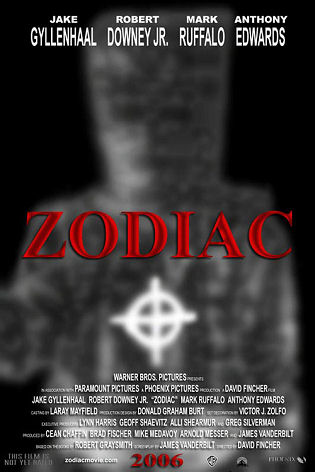
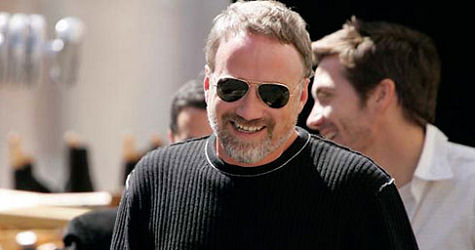
The last truly exceptional hunt-for-a-serial-killer movie was David Fincher’s Se7en. And the next one, I’m fairly convinced, is going to be Fincher’s Zodiac (Paramount, 11.10).
I’m basing this on a recent read of James Vanderbilt’s script, which runs 150-plus pages. This persuades me that what I heard last week is true: Zodiac is going to be a three-hour movie, or close to it.


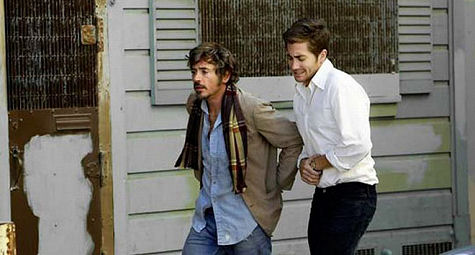
Jake Gyllenhaal, Mark Ruffalo in David Fincher’s Zodiac (Paramount, 11.10)

Scripts never really tell you that much, but reading Zodiac planted an idea that Fincher is again pushing the thriller boundary. Not just in the tradition of Se7en but also Alan Parker’s Angel Heart, another chasing-a-monster film that ended with something pretty startling.
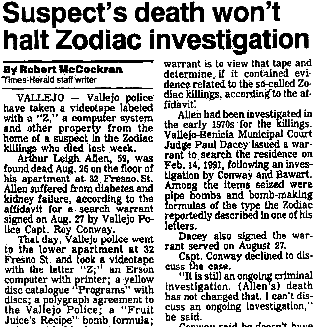
Zodiac is based on two best-sellers by Robert Graysmith, “Zodiac” and “Zodiac Unmasked: The Identity of America’s Most Elusive Serial Killer Revealed“, which are first-hand accounts about the hunt for the Zodiac killer who terrified the San Francisco area in 1968 and ’69.
The chief Zodiac hunters in Fincher’s film (as they were in actual life) are Gray- smith, a San Francisco Chronicle cartoonist at the time (Jake Gyllenhaal), and a blunt-spoken, never-say-die San Francisco detective named Dave Toschi (Mark Ruffalo).
Toschi is understood to have been the real-life model that Steve McQueen based his tough-nut San Francisco detective on in the 1968 Peter Yates film Bullitt.
And of course, the Zodiac killer was the model for Andy Robinson’s psycho killer in Dirty Harry , the 1971 Don Siegel-Clint Eastwood classic…right down to the Zodiac claim about wanting to kill a busload of school children.

Zodiac is partly about the thrill and fascination of the hunt (the scores of hints and clues that pile up are more and more fascinating as the story moves along), and partly about how the complex, seemingly never-ending nature of the case makes Graysmith and Toschi start to go a bit nuts.
Is there such a thing as being too determined to stop evil? At what point do you ease up and say, “I’ve done all I can.” Is it always essential to finish what you’ve started? Should never-say-die always be the motto, even at great personal cost?
Zodiac isn’t just about sleuthing. Deep down I think it’s a metaphor piece about obsessions wherever you find them, and how the never-quit theme applies to heavily-driven creative types (novelists, painters, architects, musicians) as much as cops or cartoonists or stamp collectors or baseball-card traders.
Zodiac and Se7en have at least a couple of things in common: both are heavily focused on the bottled-up emotions and personal frustrations of their two main protagonists, and both films end on a note in which the “crime doesn’t pay” motto doesn’t exactly ring out from the belltower.


Zodiac director David Fincher during filming; laughing Gyllenhaal in b.g.

Let’s just say it: these are two catch-the-bad-guy movies in which the good guys try like hell, but they can’t quite manage to be McQueen or Eastwood in the end.
Partly because the up-and-down life of a cop generally isn’t that heroic or simple. And because Fincher would probably have trouble staying awake if somebody forced him to direct a Bullitt or a Dirty Harry.
Fincher and screenwriter Andrew Kevin Walker ended Se7en with a mind-blowing twist in which the killer won and the good guys lost, and in such a way that the final fate of the killer didn’t matter as much as the fact that his vision (which had a certain moral foundation) ended up being fulfilled.
The more I think about Se7en, the more certain I am that it was and is a truly brilliant cop thriller. Not just in the way the story was put together and paid off, but because it echoed a certain clouds-are-forming, it’s-all-starting-to-rot-from-within attitude…a kind of geiger-counter reading of the despair in the air in 1994 and ’95, when Se7en was made and released.

I attended a Writers Guild event last night that celebrated the 101 Greatest Screenplays ever written, and bless their hearts but the WGA voters were blind as bats for not including Se7en.
I’m not going to spill the Zodiac finale in any detail, but anyone who’s read even a little bit about the the hunt for the Zodiac killer knows the culprit was never charged or convicted, although his more ardent pursuers were convinced that he was a pudgy alcoholic and an ex-school teacher named Arthur Leigh Allen, who died in 1992.
The script uses a substitute name instead of Allen’s. It wouldn’t be that big of a deal to mention it, but I’m trying to go lightly here.
Graysmith is the best part Gyllenhaal has ever had, and I’m including Jack Twist in this equation. If he does it right he’ll generate a lot of heat for himself, and I can’t see how he wouldn’t.
Graysmith is a very strongly written guy with a lot of struggle and frustration inside, and the pressure on him just builds and builds. The coup de grace comes at the end when Graysmith delivers a spellbinding 12-page oratory that ties up all the loose ends. (I was reminded of Simon Oakland’s this-is-what-actually-happened speech at the end of Psycho.)


Downey, Gyllenhaal

Robert Downey, Jr. has several good scenes as a Chronicle reporter named Avery. It seems at first as if he’ll be a prominent costar along with Gyllenhaal and Ruffalo, but nope. Anthony Edwards, as Toschi’s partner, has a smaller role than Downey.
Dermot Mulroney, Chloe Sevigny, Ione Skye, Donal Logue and Brian Cox have supporting roles. The IMDB says Cox plays famed San Francisco attorney Melvin Belli, but my script doesn’t even have Belli in it.

Memory Lane

Memory Lane

April has barely begun and the media drumbeat over the year’s two big 9/11 films, both produced with the upcoming five-year anniversary in mind, is already pretty loud.
Press screenings for United 93 are beginning this week, stories attempting to gauge the public’s interest in seeing this and other 9/11 presentations are running (the Wall Street Journal and Newsweek ran theirs on 4.7 and 4.10, respectively), and we’ll be hearing more and more about Oliver Stone’s World Trade Center next month when a 20-minute reel from the 8.11 Paramount release is shown at the Cannes Film Festival.


Nicolas Cage as Sgt. John McLouglin in Oliver Stone’s World Trade Center (Paramount, 8.11)

The 9/11 anniversary isn’t for another five months, of course, but I’ve been thinking about another startling event that happened in Manhattan nearly five years ago — a panel discussion on Saturday, October 6, 2001, at Alice Tully Hall called “Making Movies That Matter: The Role of Film in the National Debate.”
I reported on this right after it happened and I’ve mentioned it since (most recently in a WIRED item around noon on Sunday, 4.9), so why dredge it up for the third or fourth time? Because what panelist Oliver Stone said that day is, to me, still bang -on-the-head thrilling, and I’ve been wondering what’s changed in the four and a half years since…if anything?
< ?php include ('/home/hollyw9/public_html/wired'); ?>
It’s Sunday, it’s sunny outside, birds are chirping and I’m just going to run this piece again. (Most of it.) It’s a portrait of what’s been happening in this town for a long time, but the precision and candor in Stone’s rant still resonates.
Stone tried to describe the mindset and inclinations of corporate-run Hollywood as he saw it back then. Has the situation abated, remained the same, gotten worse or what? Read this through and think about it. I’m asking.
I’m repeating what I said in the WIRED item, but this sure was a long time ago, especially considering the apparent repositioning that has happened inside Stone himself, who was obviously more than a bit of a firebrand on 10.6.01 and now look at him, the director of a 9/11 pic about a couple of Port Authority guys who got buried under the fallen towers…a film that’s starting to sound, frankly, like it may be a head-in-the-sand emotional comfort blanket disguised as a rescue thriller.


Before the ’01 debate: Lumumba director Raoul Peck, essayist Bell Hicks, director Oliver Stone, New Line Cinema honcho Robert Shaye, political writer Christopher Hitchens, former Universal Pictures chairman Tom Pollock, indie producer Christine Vachon (Boys Don’t Cry, Storytelling), former Universal Pictuers chairman Tom Pollock (almost completely hidden), and HBO executive Colin Callender.

I’m not saying World Trade Center won’t be a well-crafted or emotionally affecting drama. (Alexander aside, Stone is still a top-notch filmmaker). And who knows? Maybe it will contain echos and undercurrents that will add dimension to what screenwriter Andrea Berloff believes it is (“a boy-down-a-well saga’). But read the following and tell me Stone hasn’t trimmed his sails just a tad.
“Say what you will about Oliver Stone’s political views, but he’s a master at whipping up a crowd,” I began. “This was plainly evident during a panel discussion he participated in last Saturday at New York’s Alice Tully Hall called ‘Making Movies That Matter: The Role of Film in the National Debate.’
“The same brio that has enlivened many of Stone’s politically driven films, including JFK, Born on the Fourth of July, Platoon, and Nixon, was in full force during the sometimes brawl-like, HBO-sponsored discussion.
“Stone’s chief nemesis during the discussion — which also included some volleys from from political writer Christopher Hitchens, former Universal Pictures chairman Tom Pollock, indie producer Christine Vachon (Boys Don’t Cry, Storytelling), Lumumba director Raoul Peck, and political essayist Bell Hooks — was New Line Cinema chairman and CEO Robert Shaye.
“It fell to Shaye to articulate the status-quo views of corporate Hollywood, which elicited not only the wrath of Oliver but occasional groans from the audience. Much of what Shaye said was fair and sensible, but it was no match for the sweep of Stone’s oratory, which occasionally vaulted past the concerns of the entertainment industry to include speculation on the whys and wherefores of the 9/11 disaster.

“The central issue was whether Hollywood’s increasing reluctance to finance films with a strong political undercurrent (particularly in the wake of the World Trade Center attack) was being caused by a corporate-driven aversion to anything that isn’t essentially banal or superficial, as Stone asserted, or whether the main impediment to the funding of risky and/or controversial films is ‘the tyranny of talent,’ as Shaye put it, referring to astronomical fees demanded by actors and certain high-profile directors.
“Stone launched into one of his hardest-hitting points by recalling the relatively modest financing that gave birth to Born on the Fourth of July, his Oscar-winning 1989 drama about Vietnam veteran Ron Kovic that starred Tom Cruise.
“‘We struggled to make it,’ said Stone. ‘We had fights. The picture cost $16 million, and then it went to $17 or $18 million, and we fought for that extra two million like crazy.
“‘But this was 1989 — and there’s been no significant inflation in the United States since then,’ he continued. ‘Why, in 2001, does a picture that was done very tightly in 1989…[would] that picture today cost $60 to $80 million? With the marketing costs added in, which are inflated, putting it into the $90s…advertising and television…we’re talking a $100 to $135 million event.
“‘This would no longer be a movie, but an event. And someone like Tom Pollock would say…’Born on the Fourth of July? I’m not going to make that for $130 million!’ Because [this kind of film] can’t work any more in a system that has gone bananas .’


Lincoln Center’s Alice Tully Hall

“Stone was greeted by a passionate, sustained round of applause. Who doesn’t feel that films like Born on the Fourth of July, for which Stone won a Best Director Oscar and Cruise was nominated as Best Actor, are in woefully short supply these days?
“‘And this ties in to the Arab situation,’ Stone went on. ‘Why have we gone, in a non-inflationary era, to a [place] where our corporations have become huge over the last 10, 12 years? We’ve let them go. There’s been no trust-buster around. Teddy Roosevelt is long dead. And these media corporations have conglomerated themselves into six principal fiefdoms run by barons…they’re bigger than barons. They’re kings.’
“Stone was referring to Sumner Redstone who runs Viacom, which owns Paramount; Barry Meyer of Time-Warner, which owns Warner Bros. and New Line Cinema; Rupert Murdoch of Fox Newscorp., which runs 20th Century Fox; Mel Harris of Sony Pictures; Michael Eisner, the chairman/CEO of the Walt Disney Company; and Jean-Marie Messier of Vivendi, which owns Universal Pictures.”
[Note: Today’s media barons are Viacom’s Redstone, Newscorp’s Murdoch, Richard D. Parsons of Time-Warner, Sony Corp.’s chairman and CEO Howard Stringer, Disney CEO Bob Iger and Jeffrey R. Immelt, CEO of General Electric, which owns NBC Universal.]
“And these six companies decide,” said Stone. “Rupert Murdoch says ‘I would not make JFK,’ or Mike Eisner says ‘I would not do a film on Martin Luther King, Oliver, [because] there’s gonna be rioting at the gates of Disneyland’…you know, this is bullshit!”

“Gales of applause greeted this one, with some scattered yelps and cries of ‘right on!’
“‘These six people have control of the world and that’s what the new world order is,’ he explained. ‘Six men are deciding what you’re seeing in film, and they own all the small companies…it’s hard to find one that’s not owned by one of these huge companies buying new companies, so it’s a dilemma. There’s a control of culture, ideas, everything.
“Now, within reason, they let [filmmakers] do certain things, and that is far better obviously than, say, the Arabs where they don’t let you do anything, and I agree it’s relative. But we are in a dilemma. We have too much order.”
“‘And I think the revolt on September 11 was about order,’ Stone went on. “It was about fuck you, fuck your order…it was an eruption of rage about this. And is it time perhaps to reconsider the world order? Is it time to wonder why the banks have joined the movie companies and all the corporations, and where this is all going?”
“Hitchens, who writes for The Nation and Vanity Fair , bridled at the use of the term ‘revolt’ and said the September 11 massacre ‘was not a revolt. It was a state-supported mass murder using civilians as missiles. It was an attack on civil society and civilization.’ This drew vigorous applause, albeit slightly more subdued.
“Shaye said, ‘I disagree with Oliver about this. I think he’s talking about an era and the studio system of 30 years ago. I will tell you, and Tom Pollock will back me up on this, that this is a tyranny of talent right now, and I don’t know what Oliver gets for directing a film, but I know what a lot of other people get, and it’s way too much. I do know that the last guys to get paid, believe it or not, are the studios that put up the money, and…’


Robert Shaye (r.), co-chairman and co-CEO of New Line Cinema (pictured with Michael Lynne (l.)

“At this last remark, Stone shuddered and flopped back in his chair and looked up at the ceiling as if to say, ‘Did he just say that? I give up!’ Torrents of laughter. The hall was jumping.
“‘And if there’s a tyranny, it’s a tyranny of talent,’ Shaye concluded, drawing muted sneers and guffaws.
“Pollock, who was running Universal’s movie division when Born on the Fourth of July got made, said the go-ahead happened ‘because Oliver Stone was willing to make it for no money, and Tom Cruise was willing to make it for no money. The film was successful, they made a lot of money, and so did Universal, but it would not have been made had they not done that.
“‘Controversial films can still get made,’ said Pollock, ‘but films cost what they cost because most of the people who make them want to get paid as much as they can. They want control, but there is still that trade-off of money for control. We are in an oligarchy now where the large companies control what we see…yes, Rupert Murdoch has a political agenda, but by and large Rupert Murdoch is only interested in money.
“‘The problem with the six guys running the six companies is, they want to take no risks at all,’ he concluded. ‘They want movies that entertain only, if they can be marketed. There was little room before September 11 to make political movies inside the system. There’s less room now. It isn’t that it’s not going to happen. But it is going to be harder. And to that extent, Oliver is right.’
“Shaye said that New Line Cinema ‘started out in my apartment on 14th Street. We made our way in the world. We started out with Sympathy for the Devil. Talk about political…give me a break. And you know why it made money? Because the Rolling Stones were in it, not because Jean-Luc Godard had anything particularly profound to tell the world.’ Random hoots and snorts greeted this one.

“‘It’s a little disenchanting,’ Shaye continued. ‘The truth of the matter now is, right now, that with high-definition and video and stuff like that you can make a good movie for not very much money. The great thing about the entertainment business and the movie business is that when a movie’s good, you attract people. People talk about it, the whole word-of-mouth thing…the quality of a movie is a self-fulfilling mechanism.”
“Stone jumped back in. ‘Thirty years ago, Bob said before. That’s when he got started. It was all…it was another world. [But] nobody here has answered that question why, between ’89 and 2001, everything has become so uniform…what’s basically happened in the last 10 years is that the studios have bought television stations. And why?’
“Referring to the so-called ‘syn-fin’ legislation passed under the Clinton administration a couple of years ago that allowed studios to own more TV stations, Stone asked, ‘Why did that telecommunications bill get passed at midnight? It was basically a division of the world by a few media moguls and it was a giveaway and it was done at midnight and it’s a disgusting thing. To own TV stations is the basis upon which movie companies today have to exist. And that’s changed everything. There are only so many television stations. Each one has their big build-up and that’s their base of operation.
“‘And Bob [Shaye] knows it because he sold his little movie company to Warner Bros. for more money than I could ever dream of making,” Stone continued. He acknowledged that certain high-profile directors, such as himself, are well paid for helming big-studio films. But the majors these days “don’t need a top director, they feel. Just make the movie. Because for them it’s all about marketing and about subject. That’s what they think.
“‘So there’s no ‘left’ point of view. It’s not financially interesting for them to make a movie with a director who costs more money…they’d rather go with a marginal director. It’s all about product…movie product…and it’s all about this new world order.

“‘And the Arabs have a point. Whether it’s right or wrong, there’s an objection to the way the world is going. There’s a lot of hate and revolt in that state. It may continue and although the shoe may drop on the other foot the next time, the point is they’re objecting to something. And I say that we’re not dealing with that objection on this stage today. There was a breakdown in the ’90s, in the system, the world system, the world banking system…it’s the new world order, and it’s about order and control, but this control comes with a cost.
“‘One of the most banal ways for censorship to operate in America,’ Stone continued, ‘is to drive out thought by explosions of People magazines and celebrity culture and…our culture is focused on Sarah Jessica Parker and kind-of inane, superficial stuff…it just becomes the noise, the white noise of our society.”
“Turning to Pollock, Stone said, ‘I don’t want to pick on you, Tom, but you’re ignoring the banks, you’re ignoring television, you’re ignoring the size of this thing, and you’re saying this thing is okay because that’s the way of the world because capitalism will go that way.
“‘The so-called ways of capitalism are not inevitable,’ Stone exclaimed. ‘It’s changed historically. Teddy Roosevelt changed the direction of it. Franklin Roosevelt changed the direction of it. Everybody in Hollywood says, ‘Well, what can I do about it?” These six companies have taken over just like the oil companies, and it’s wrong, wrong, wrong because they’re subverting political will.'”

Ales & Stouts
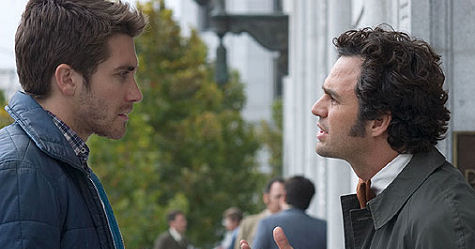
Obsession

The last truly exceptional hunt-for-a-serial-killer movie was David Fincher’s Se7en. And the next one, I’m fairly convinced, is going to be Fincher’s Zodiac (Paramount, 11.10).
I’m basing this on a recent read of James Vanderbilt’s script, which runs 150-plus pages. This persuades me that what I heard last week is true: Zodiac is going to be a three-hour movie, or close to it.


Jake Gyllenhaal, Mark Ruffalo in David Fincher’s Zodiac (Paramount, 11.10)

Scripts never really tell you that much, but reading Zodiac planted an idea that Fincher is again pushing the thriller boundary. Not just in the tradition of Se7en but also Alan Parker’s Angel Heart, another chasing-a-monster film that ended with something pretty startling.
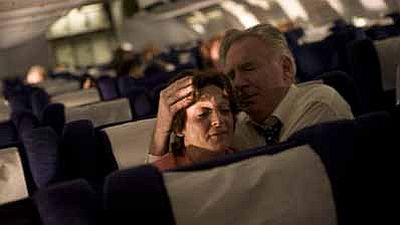
Zodiac is based on two best-sellers by Robert Graysmith, “Zodiac” and “Zodiac Unmasked: The Identity of America’s Most Elusive Serial Killer Revealed“, which are first-hand accounts about the hunt for the Zodiac killer who terrified the San Francisco area in 1968 and ’69.
The chief Zodiac hunters in Fincher’s film (as they were in actual life) are Gray- smith, a San Francisco Chronicle cartoonist at the time (Jake Gyllenhaal), and a blunt-spoken, never-say-die San Francisco detective named Dave Toschi (Mark Ruffalo).
Toschi is understood to have been the real-life model that Steve McQueen based his tough-nut San Francisco detective on in the 1968 Peter Yates film Bullitt.
And of course, the Zodiac killer was the model for Andy Robinson’s psycho killer in Dirty Harry , the 1971 Don Siegel-Clint Eastwood classic…right down to the Zodiac claim about wanting to kill a busload of school children.

Zodiac is partly about the thrill and fascination of the hunt (the scores of hints and clues that pile up are more and more fascinating as the story moves along), and partly about how the complex, seemingly never-ending nature of the case makes Graysmith and Toschi start to go a bit nuts.
Is there such a thing as being too determined to stop evil? At what point do you ease up and say, “I’ve done all I can.” Is it always essential to finish what you’ve started? Should never-say-die always be the motto, even at great personal cost?
Zodiac isn’t just about sleuthing. Deep down I think it’s a metaphor piece about obsessions wherever you find them, and how the never-quit theme applies to heavily-driven creative types (novelists, painters, architects, musicians) as much as cops or cartoonists or stamp collectors or baseball-card traders.
Zodiac and Se7en have at least a couple of things in common: both are heavily focused on the bottled-up emotions and personal frustrations of their two main protagonists, and both films end on a note in which the “crime doesn’t pay” motto doesn’t exactly ring out from the belltower.


Zodiac director David Fincher during filming; laughing Gyllenhaal in b.g.

Let’s just say it: these are two catch-the-bad-guy movies in which the good guys try like hell, but they can’t quite manage to be McQueen or Eastwood in the end.
Partly because the up-and-down life of a cop generally isn’t that heroic or simple. And because Fincher would probably have trouble staying awake if somebody forced him to direct a Bullitt or a Dirty Harry.
Fincher and screenwriter Andrew Kevin Walker ended Se7en with a mind-blowing twist in which the killer won and the good guys lost, and in such a way that the final fate of the killer didn’t matter as much as the fact that his vision (which had a certain moral foundation) ended up being fulfilled.
The more I think about Se7en, the more certain I am that it was and is a truly brilliant cop thriller. Not just in the way the story was put together and paid off, but because it echoed a certain clouds-are-forming, it’s-all-starting-to-rot-from-within attitude…a kind of geiger-counter reading of the despair in the air in 1994 and ’95, when Se7en was made and released.

I attended a Writers Guild event last night that celebrated the 101 Greatest Screenplays ever written, and bless their hearts but the WGA voters were blind as bats for not including Se7en.
I’m not going to spill the Zodiac finale in any detail, but anyone who’s read even a little bit about the the hunt for the Zodiac killer knows the culprit was never charged or convicted, although his more ardent pursuers were convinced that he was a pudgy alcoholic and an ex-school teacher named Arthur Leigh Allen, who died in 1992.
The script uses a substitute name instead of Allen’s. It wouldn’t be that big of a deal to mention it, but I’m trying to go lightly here.
Graysmith is the best part Gyllenhaal has ever had, and I’m including Jack Twist in this equation. If he does it right he’ll generate a lot of heat for himself, and I can’t see how he wouldn’t.
Graysmith is a very strongly written guy with a lot of struggle and frustration inside, and the pressure on him just builds and builds. The coup de grace comes at the end when Graysmith delivers a spellbinding 12-page oratory that ties up all the loose ends. (I was reminded of Simon Oakland’s this-is-what-actually-happened speech at the end of Psycho.)


Downey, Gyllenhaal

Robert Downey, Jr. has several good scenes as a Chronicle reporter named Avery. It seems at first as if he’ll be a prominent costar along with Gyllenhaal and Ruffalo, but nope. Anthony Edwards, as Toschi’s partner, has a smaller role than Downey.
Dermot Mulroney, Chloe Sevigny, Ione Skye, Donal Logue and Brian Cox have supporting roles. The IMDB says Cox plays famed San Francisco attorney Melvin Belli, but my script doesn’t even have Belli in it.

Obsession

Obsession

The last truly exceptional hunt-for-a-serial-killer movie was David Fincher’s Se7en. And the next one, I’m fairly convinced, is going to be Fincher’s Zodiac (Paramount, 11.10).
I’m basing this on a recent read of James Vanderbilt’s script, which runs 150-plus pages. This persuades me that what I heard last week is true: Zodiac is going to be a three-hour movie, or close to it.


Jake Gyllenhaal, Mark Ruffalo in David Fincher’s Zodiac (Paramount, 11.10)

Scripts never really tell you that much, but reading Zodiac planted an idea that Fincher is again pushing the thriller boundary. Not just in the tradition of Se7en but also Alan Parker’s Angel Heart, another chasing-a-monster film that ended with something pretty startling.
Zodiac is based on two best-sellers by Robert Graysmith, “Zodiac” and “Zodiac Unmasked: The Identity of America’s Most Elusive Serial Killer Revealed“, which are first-hand accounts about the hunt for the Zodiac killer who terrified the San Francisco area in 1968 and ’69.
< ?php include ('/home/hollyw9/public_html/wired'); ?>
The chief Zodiac hunters in Fincher’s film (as they were in actual life) are Gray- smith, a San Francisco Chronicle cartoonist at the time (Jake Gyllenhaal), and a blunt-spoken, never-say-die San Francisco detective named Dave Toschi (Mark Ruffalo).
Toschi is understood to have been the real-life model that Steve McQueen based his tough-nut San Francisco detective on in the 1968 Peter Yates film Bullitt.
And of course, the Zodiac killer was the model for Andy Robinson’s psycho killer in Dirty Harry , the 1971 Don Siegel-Clint Eastwood classic…right down to the Zodiac claim about wanting to kill a busload of school children.

Zodiac is partly about the thrill and fascination of the hunt (the scores of hints and clues that pile up are more and more fascinating as the story moves along), and partly about how the complex, seemingly never-ending nature of the case makes Graysmith and Toschi start to go a bit nuts.
Is there such a thing as being too determined to stop evil? At what point do you ease up and say, “I’ve done all I can.” Is it always essential to finish what you’ve started? Should never-say-die always be the motto, even at great personal cost?
Zodiac isn’t just about sleuthing. Deep down I think it’s a metaphor piece about obsessions wherever you find them, and how the never-quit theme applies to heavily-driven creative types (novelists, painters, architects, musicians) as much as cops or cartoonists or stamp collectors or baseball-card traders.
Zodiac and Se7en have at least a couple of things in common: both are heavily focused on the bottled-up emotions and personal frustrations of their two main protagonists, and both films end on a note in which the “crime doesn’t pay” motto doesn’t exactly ring out from the belltower.


Zodiac director David Fincher during filming; laughing Gyllenhaal in b.g.

Let’s just say it: these are two catch-the-bad-guy movies in which the good guys try like hell, but they can’t quite manage to be McQueen or Eastwood in the end.
Partly because the up-and-down life of a cop generally isn’t that heroic or simple. And because Fincher would probably have trouble staying awake if somebody forced him to direct a Bullitt or a Dirty Harry.
Fincher and screenwriter Andrew Kevin Walker ended Se7en with a mind-blowing twist in which the killer won and the good guys lost, and in such a way that the final fate of the killer didn’t matter as much as the fact that his vision (which had a certain moral foundation) ended up being fulfilled.
The more I think about Se7en, the more certain I am that it was and is a truly brilliant cop thriller. Not just in the way the story was put together and paid off, but because it echoed a certain clouds-are-forming, it’s-all-starting-to-rot-from-within attitude…a kind of geiger-counter reading of the despair in the air in 1994 and ’95, when Se7en was made and released.

I attended a Writers Guild event last night that celebrated the 101 Greatest Screenplays ever written, and bless their hearts but the WGA voters were blind as bats for not including Se7en.
I’m not going to spill the Zodiac finale in any detail, but anyone who’s read even a little bit about the the hunt for the Zodiac killer knows the culprit was never charged or convicted, although his more ardent pursuers were convinced that he was a pudgy alcoholic and an ex-school teacher named Arthur Leigh Allen, who died in 1992.
The script uses a substitute name instead of Allen’s. It wouldn’t be that big of a deal to mention it, but I’m trying to go lightly here.
Graysmith is the best part Gyllenhaal has ever had, and I’m including Jack Twist in this equation. If he does it right he’ll generate a lot of heat for himself, and I can’t see how he wouldn’t.
Graysmith is a very strongly written guy with a lot of struggle and frustration inside, and the pressure on him just builds and builds. The coup de grace comes at the end when Graysmith delivers a spellbinding 12-page oratory that ties up all the loose ends. (I was reminded of Simon Oakland’s this-is-what-actually-happened speech at the end of Psycho.)


Downey, Gyllenhaal

Robert Downey, Jr. has several good scenes as a Chronicle reporter named Avery. It seems at first as if he’ll be a prominent costar along with Gyllenhaal and Ruffalo, but nope. Anthony Edwards, as Toschi’s partner, has a smaller role than Downey.
Dermot Mulroney, Chloe Sevigny, Ione Skye, Donal Logue and Brian Cox have supporting roles. The IMDB says Cox plays famed San Francisco attorney Melvin Belli, but my script doesn’t even have Belli in it.

Miami-Baghdad

There’s been a sense of stagnation out there for the last two or three weeks. All I’ve been able to think or write about have been movies to come — United 93, Snakes on a Plane, Cannes Film Festival likelies, summer movies, etc. Along with the occasional side-trip — Anthony Pellicano, Marlon Brando, local film festivals.
I finally woke up Tuesday night (3.4) after seeing a striking, not-yet-finished film by Philip Noyce (The Quiet American) called Hotstuff (Focus Features), a true saga of an ordinary South African man’s fight against apartheid in the early ’80s, with Derek Luke and Tim Robbins starring. It’s not just well-made, but well-immersed. It’s a re-creation, of course, but it doesn’t feel like one. You’re “in” it from the start.


Ranpage director George Gittoes, burgeoning rap star Denzel Lovett during filming in Miami’s violent “Brown Sub” neighborhood

This took me back to a couple of hip-hop movies I saw a few weeks ago – Asger Leth’s Ghosts of Cite Soleil and George Gittoes’ Rampage — that had a similar urgency and verisimilitude.
I’ve been lazy in writing about Rampage , which played at February’s Berlin Film Festival and which I saw about three weeks ago. I met Gittoes when he stopped in Los Angeles on his way back from Berlin to meet with local distributors, and we recorded a phone interview just before he flew back to Sydney. He’s now trying to arrange for U.S. distribution.
Rampage is an unusual hybrid — a true-to-form urban hip-hop documentary that exudes the dispassionate mood and attitude of life in a dangerous ‘hood, but at the same time is a kind of “heart” movie.
It’s half-set in one of the deadliest environments in the United States and half-set in the realm of promise (or at least hope). What gets you is that it’s more than just a hard-edged doc about a tough situation but a haunting portrait of death and birth, and is all the more affecting due to the major “characters” all being in their teens and early 20s.

Shot in ’04 and ’05, it’s about four brothers living in a hardscrabble Miami ghetto called “Brown Sub,” a place said to be more dangerous to walk around in than present-day Baghdad.
The “down” story is about one of the brothers, named Marcus Lovett, being shot at a party in Brown Sub over some stupid-assed gang war. The “up” story is about Marcus’ kid brother, a very good-looking, hugely-talented 14 year-old rapper named Denzel Lovett, trying to get a recording career going with Gittoes’ assistance.
And the Big Friggin’ Irony is that Denzel’s lyrics, which are all about the hard- smack realities of living in Brown Sub (shootings, drug deals, dead guys), get in the way of his being signed due to record company executives being nervous about his lyrics not being “age-appropriate.”
The kid is telling it like it is…this is my life, one out of eight kids in my neighbor- hood catches a bullet by the time they’re 23 or 24 years old, it ain’t no picnic or walk in the park…and even though Denzel is attractive and spirited and obviously has what it takes to be a star, the producers all say, “Uhm, really great, Denzel …but can you rap about something less violent and more positive?”


Elliot Lovett, Gittoes, Denzel Lovett

Marcus’s death is obviously tragic, and anyone watching it happen in this film (and how his family reacts) will feel sad, but the reaction of recording execs to Denzel’s material will make you want to vomit.
Gittoes, a war photographer since the late `60s (he’s covered Vietnam, Rwanda, Bosnia-Herzogovina, Somalia, Iraq), a renowned im presionist in Australian art gallery circles, and director of a 2004 Iraq documentary called Soundtrack to War, has called Rampage “the hardest film he’s ever made.”
It started with Gittoes meeting Iraq-based G.I. Elliot Lovett when he shot Sound- track and hearing the line “we get shot more in Miami than Baghdad,” which led Gittoes to follow him home to Miami on leave.
Rampage barely delves into the details about how the Lovett boys make money (there apparently aren’t many options except getting into the drug trade), but he certainly captures what the day-to-day is like. It’s hell…Chicago in the 1920s and then some. Feuds, shootings, territorial imperatives, macho bullshit.


George Gittoes during our interview just off Santa Monica’s Ocean Avenue a few weeks ago

A cop tells Gittoes at one point that kids have used rocket launchers against each other. There’s also a sequence in which Denzel and the gang drive over to Miami’s South Beach district, and we learn they’ve never been there before, and barely looked at the beach or the water.
They live in a vacuum, these guys. Cut off from everything outside the Sub and not at all interested in looking beyond it. Strange, curious…a bit sad.
Gittoes has said that “the place that I found was most like Brown Sub was Moga- dishu. I thought I was back in Mogadishu and the drug lords were very similar to Aidid and his people.”
After Marcus’s death, Gittoes abandons any pose of neutrality and does everything he can to shop Denzel to the music industry, taking him to meet the right people in New York and Los Angeles, and also on a relaxation trip to Australia.
“What interested me in Iraq was, a lot of Iraqis were walking up to African-Ameri- can soldiers saying ‘what are you doing fighting George Bush’s war?’ Gittoes has recalled. ‘You should be back in America fighting your own’…but these soldiers weren’t there because they were patriotic. They were in Iraq because it was safer.”

Rampage ran 118 minutes when it played Berlin. Gittoes heard some comments there and in Los Angeles that he should trim it down some. (The critic for Screen Daily called it “lively, insightful and even shocking,” but added “it needs to be cut drastically.”) Gittoes wrote me from Sydney about a week and a half ago saying he was doing just that.
An Australian journalist who saw Rampage in Berlin said it was “more urgent, more moving, than entries here by master directors like Robert Altman, Claude Chabrol and Sidney Lumet.”
Gittoes has urged people in the entertainment media (including journalists) “to wake up to hip-hop as an artistic movement.”
The Brown Sub boys “have got nothing and yet the whole time I was with them, I felt that I was poorer than they were,” Gittoes said during the Berlin festival. “I felt that they were in a culture which was much, much richer than mine.
“This is a culture where people are creating poetry spontaneously… They just love words and language — they play with words in a way that’s not unlike Shakespeare or Oscar Wilde or James Joyce. But these middle-class yuppie-type people who are a big proportion of the people that come to arts festivals, a lot of them are against popular art. They just can’t see the cultural value in it.”


Denzel Lovett

It was reported in February that Gittoes and his producer, Gabrielle Dalton, have signed to write a feature screenplay from Soundtrack to War and Rampage.
Gittoes has sunk $500,000 out of his own pocket into Rampage , and is hoping to at least be made whole with enough left over to finance his next film. Here’s hoping for that, and also that the very happening Denzel — who must be about 16 now — gets signed and becomes the big thing he ought to be.
Again, here’s the interview I did with him in mid March.

Skepticism

“I have a problem with George Gittoes’ comment about the Brown Sub boys, to wit: ‘They’ve got nothing and yet the whole time I was with them, I felt that I was poorer than they were. I felt that they were in a culture which was much, much richer than mine.’
“Their culture is richer than yours? You must be dead in the grave then. I live right on the border of the ghetto in Baltimore (which is otherwise known as Bodymore, Murdaland), specifically Park Heights, and I’ve been all over the city, and the ‘culture’ Gittoes is talking about is one of macho thuggery, irresponsibility, misogyny, short-sightedness, ignorance, and generally not giving a shit about anything.


The deceased Marcus Lovett (dressed in light blue, second from left) with Brown Sub homies in George Gittoes’ Rampage

“They have a really rich culture there…one that tries to get middle schoolers into dealing and using drugs to hook them young. They’re less of a problem if they get arrested because they just go to juvie, and if they don’t they’re hooked and have to stay in — they’ve dropped out anyway. And the coolest thing you can do is do wheelies on your dirt bike up and down streets hours at a time.
“You can’t blame these kids for being like this because their parents are are awful (if they exist at all), the infrastructure they have is useless, and the drug wars ravage everything. They can’t even get access to decent food — all their corner stores and liquor stores have is packaged trash.
“Anyone halfway connected to this knows this, and in fact has known for decades, and what’s changed? Nothing. The same pointless drug war, the same white middle-class distaste for black men (except for palatable ones like Tiger Woods or Colin Powell), the same lack of infrastructure.
“In reference to 14 year-old Denzel Lovett being considered too young to spout lyrics of his violent reality, who cares? Oh, so he has to wait three or four years and then he can rap about the same bullshit everyone else raps about? What a tragedy.


Denzel Lovett

“I also love the concept of black soldiers leaving the ghetto to go to Iraq, where it’s ‘safer.’ How about going somewhere that isn’t incredibly dangerous? Like, say, anywhere else? This brings up the idea of getting out, which is explored in the documentary The Boys of Baraka, about boys from Baltimore going to Kenya to gain perspective, and how that changes them. Sorry — no hip-hop in that film. I guess that makes it boring.
“I’m open to seeing Rampage, but I had to take issue with what I read in your piece.” — Mike Jasik

Not-So-Bad Summer

A typical summer season always seems to come down to one big-budget, lowest- common-denominator no-brainer after another…Hollywood being sort of like Steve McQueen firing diseased buckshot into the body aesthetic with a pump shotgun… wham!…discharge…wham!…discharge.
I was thinking along these lines myself the other day, but that was before I began to really go over the May-to-August releases with a fine tooth comb. It gradually hit me after an hour or so that the 2006 summer is looking a little bit craftier and less dumbed-down than usual.


Jamie Foxx, Colin Farrell in Michael Mann’s Miami Vice (Universal, 7.28)

Four late summer films in particular — an exotic end-of-the-world action drama from Mel Gibson, a sad-eyed World War II combat drama from Clint Eastwood that’s squarely aimed at adults, some kind of undercover drug-smuggling thriller from the masterful Michael Mann, and Oliver Stone’s right-in-your-face depiction of the horrors of 9.11 in downtown Manhattan — are giving the ’06 summer a pedigree all by themselves.
I’m ready to concede, in fact, that out of 15 major summer releases, only two or three seem deliberately aimed at the bozos. And there’s only one, really, that seems to relish the idea of being an empty big-studio wanker — Gore Verbinski’s Pirates of the Caribbean: Dead Man’s Chest (Disney, 7.7).
The Big 15 are so described because they have big, obvious selling points (stars, sequels, high concepts), because they cost the most to produce and are obviously going to enjoy the benefits of saturation advertising well before they open. (The preceding sentence could’ve been written ten or twenty years ago. I think I might have used it in a summer preview piece I wrote in April 1984.)
From the top…
Mission: Impossible III (Paramount, 5.5). Cast: Tom Cruise, Philip Seymour Hoffman, Ving Rhames, Laurence Fishburne, Billy Crudup, Michelle Monaghan, Jonathan Rhys-Meyers, Keri Russell. Director: J.J. Abrams. Guaranteed score factor : Hoffman as the villain. Concern: What are the odds that Abrams, a first-timer, will be able to do anything except hold the pieces together, or that he’ll deliver any kind of visual flair in the vein of Brian DePalma? Bad trailer/website thing: That ghastly theme music. Worthwhile alternate 5.5 openers : Sydney Pollack’s Sketches of Frank Gehry, Magnolia’s One Last Thing.


Mission: Impossible III (Paramount, 5.5)

Poseidon (Warner Bros., 5.12). Cast: Josh Lucas, Kurt Russell, Emmy Rossum, Jacinda Barrett, Richard Dreyfuss. Director: Wolfgang Petersen Screenwriter : Mark Protosevich. Guaranteed score factor : (a) That kinda-fake-but-still-cool CG footage of a massive rogue wave toppling a huge luxury liner, (b) costar Kurt Russell, who always rocks in an action mode; (c) “There’s nothing fair about who lives or dies”, (d) savoring the various deaths, and (e) knowing this is basically a revisionist 9/11 film in disguise. Concern: The possibility that Rossum’s character might survive; the suspicion that Peterson-Protosevich will pretty much adhere to what most of us are expecting — a 2006 version of a 1972 disaster film with better effects. Bad trailer/website thing: Characters talking about feelings of love for their mates and family members. (Compensation: the more someone in a disaster film talks about being in love with someone else, the more likely it is that they or their loved one will die a horrible death.) Worthwhile alternate 5.12 opener: New Line and Nic Cassevetes’ Alpha Dog.
The DaVinci Code (Columbia, 5.19). Cast: Tom Hanks, Jean Reno, Audrey Tautou, Ian McKellen, Alfred Molina, Paul Bettany. Director: Ron Howard Screenwriter: Akiva Goldsman. Guaranteed score factor : Howard is simply too proficient at mainstream filmmaking these days to seriously blow it, so I guess this amounts to a score factor; the Paris locations. Concern: Big, beefy Tom Hanks looks kind of old and ample of girth opposite his pixie-ish costar, Audrey Tatou; the more I look at those shots of Hanks and Tatou runnning while holding hands….hurry! hurry! we haven’t much time! — the more turned off I get. Worthwhile alternate 5.19 opener: Dominik Moll’s Lemming (Strand Releasing).


Poseidon (Warner Bros., 5.12)

X-Men: The Last Stand (20th Century Fox, 5.26). Cast: Hugh Jackman, Halle Berry, Ian McKellen, Famke Janssen, Anna Paquin, Kelsey Grammer, Rebecca Romijn, James Marsden, Shawn Ashmore, Aaron Stanford, Vinnie Jones, Patrick Stewart. Director: Brett Ratner Screenwriters: Zak Penn, Simon Kinberg. Guaranteed score factor : The fact that the bar has been set very low, due to the fact than nobody expects this third (and quite possibly final) installment to be as good as the first two because the director, Brett Ratner, isn’t on the same aesthetic-creative plane as Bryan Singer. Concern: Brett Ratner. Worthwhile alternate 5.26 opener: Al Gore’s global-warming documentary An Inconvenient Truth (Paramount Classics).
The Break-Up (Universal, 6.2). Cast: Vince Vaughn, Jennifer Aniston, Joey Lauren Adams, Ann-Margret, Judy Davis, Vincent D’Onofrio, Jon Favreau, Cole Hauser. Director: Peyton Reed Screenwriters: Jeremy Garelick, Jay Lavender Guaranteed score factor : Not sure if there is one except for a general presumption that this is the big definitive GenX relationship comedy of the summer. Everyone wants to re-sample Vaughn’s wise-ass motormouth character, which made him a star in last summer’s The Wedding Crashers. Concern : Aniston needs to be in a quality vehicle sooner or later, or she’ll eventually be in trouble. Worthwhile alternate 6.2 opener: Robert Altman’s A Prairie Home Companion (Picturehouse).


Nacho Libre (Paramount, 6.14)

Cars (Disney, 6.9). Cast: Owen Wilson, Paul Newman, Bonnie Hunt, “Larry the Cable Guy”, Cheech Marin, George Carlin, Richard Petty, Michael Keaton, Tony Shalhoub, Paul Dooley. Director/screenwriter: John Lasseter. Guaranteed score factor : The superb-looking animation, “name” voice actors delivering sharp punch-line humor. Concern: Word around the Pixar campfire is that it’s “okay,” “entertaining,” et. al. but not quite the knockout that Brad Bird’s The Incredibles was. (One guy who saw it two or three weeks ago actually said, “Well…I’d rather not say anything.”)
Nacho Libre (Paramount, 6.14). Cast: Jack Black, Ana de la Reguera, Hector Jimenez, Richard Montoya, Peter Stormare. Director: Jared Hess Screenwriters: Hess, Jerusha Hess, Mike White. Guaranteed score factor : Napoleon Dynamite ‘s Jared Hess doing his dry, visually static, neo-Wes Anderson thing and letting Jack Black go to town as a Mexican priest moonlighting as a lucha libre wrestler…certainly a marketable combo. Concern: Disciplined enough? A developed-enough script? Too lowbrow? Worthwhile alternate 6.14 opener: Patrick Creadon’s Wordplay (IFC Films).
Superman Returns (Warner Bros., 6.30). Cast: Brandon Routh, Kate Bosworth, James Marsden, Frank Langella, Eva Marie Saint, Parker Posey, Sam Huntington, Kal Penn, Kevin Spacey. Director: Bryan Singer Screenwriters : Michael Dougherty, Dan Harris. Guaranteed score factor : The DC Comics brand plus the presumption of smarts and stylistic pizazz from Singer, and yet the more you think about this thing and listen to Marlon Brando’s voiceover in that trailer… Concern: Take away the gay maroon-red bikini briefs on Brandon Roush and it all seems a little too similar to the 1978 Richard Donner Superman. (Singer has been fairly upfront about this, apparently.) Many of the same characters turn up. (Kevin Spacey’s Lex Luthor will be half about whatever he brings to it, and half about avoiding the tone and attitude of Gene Hackman’s Luthor in the ’78 film). And the same old places (Krypton, Smallville, Daily Planet) are used, and even some similar-looking sets. (No missing the Donner influence in that Singer set that’s supposed to be Krypton or Superman’s North Pole lair). And it seems like yet another origin story. I’ve been sensing geek resistance to this thing all along, frankly. Worthwhile alternate 6.30 opener : The Devil Wears Prada (20th Century Fox).


M. Night Shyamalan, Paul Giamatti during filming of Lady in the Water (Disney, 7.7)


Pirates of the Caribbean: Dead Man’s Chest
(Disney, 7.7). Cast: Johnny Depp, Orlando Bloom, Keira Knightley, Stellan Skarsgard, Bill Nighy, Jack Davenport, Kevin R. McNally, Jonathan Pryce. Director: Gore Verbinski. Screenwriters: Ted Elliott, Terry Rossio. Guaranteed score factor: I’ve already spoken bluntly about this film. No point in beating a dead horse…not to suggest in any way that Dead Man’s Chest is a dead commercial prospect. Far from it. Concern: I can’t stand the thought of watching Depp do Keith Richards again…I just can’t take it.
Lady in the Water (Warner Bros., 7.7). Cast: Paul Giamatti, Bryce Dallas Howard, Jeffrey Wright, Bob Balaban, Freddy Rodriguez, Sarita Choudhury, Jared Harris, Bill Irwin. Director/screenwriter : M. Night Shyamalan. Guaranteed score factor : The M. Night brand is widely appreciated by audiences these days — they know they’re at least going to get something distinctive and particular. And you can’t go wrong with Paul Giamatti these days. Concern: The story was initially written for Night’s children, apparently, and the trailer refers to the movie as a “bedtime story.” Worthwhile alternate 7.7 opener: Richard Linklater’s A Scanner Darkly (Warner Independent).
Miami Vice (Universal, 7.28). Cast: Jamie Foxx, Colin Farrell, Gong Li, Naomie Harris, Ciaran Hinds, Justin Theroux. Director/screenwriter : Michael Mann Guaranteed score factor : The legend of the ’80s TV series, Farrell and Foxx, the hand of Michael Mann, and costar Gong Li. This has to be some kind of knockout. The creator of Heat, Collateral, The Insider and Ali is too exacting and ambitious to have anything to do with a lazy summer movie. Concern : I tried reading a draft of the script early last year and I couldn’t stay with it. It felt like it was more about expensive toys and South Beach machismo than anything else. (But then I bailed, so what do I know?) And then there were those set stories about Mann not having a decent ending worked out until the tail end of the shoot. Worthwhile alternate 7.28 opener : Jonathan Dayton and Valerie Faris’s Little Miss Sunshine (Fox Searchlight).
Flags of our Fathers (DreamWorks/Paramount, 8.4). Director : Clint Eastwood. Screenwriter: Paul Haggis. Cast: Ryan Phillippe, Jesse Bradford, Adam Beach, Paul Walker, Jamie Bell. Guaranteed score factor : It’s a rare thing these days for a big studio to produce and distribute a high-calibre drama aimed at the over-30 trade, but that’s what this is. Flags is essentially a World War II art film about the space between ordinary soldiers and the civilians and family members who regard them as “war heroes.” Eastwood’s track record as a winner of two Best Picture Oscars lend an expectation that this may rank as one of the year’s most affecting dramas, whether or not it ends up as an ’07 Oscar finalist. Concern : The script I read doesn’t have much of a through-line. There’s a lot of time-trip, back-and-forth cutting and it certainly progresses in a manner of speaking…but it doesn’t exactly “build” and pay off according to the Robert McKee definition of those terms. Worthwhile alternate 8.4 opener: Michel Gondry’s The Science of Sleep (Warner Independent).


Nicolas Cage in Oliver Stone’s World Trade Center (Paramount, 8.11)

Apocalypto (Disney, 8.4). Director: Mel Gibson. Screenwriters: Gibson, Farhad Safinia. Cast: Buncha no-namers. Guaranteed score factor : The family righties who came out for Gibson’s The Passion will most likely be attuned to Apocalypto‘s story about an ancient civilization going through a period of self-destruction from within, which obviously conveys an end-of-days metaphor. Concern : Gibson is a good, go-for-broke filmmaker. If there are serious concerns about Apocalypto, I dont know what they are.
World Trade Center (Paramount, 8.11). Director: Oliver Stone. Screenwriter: Andrea Berloff. Cast: Nicolas Cage, Michael Pena, Maria Bello, Maggie Gyllen- haal, Jay Hernandez. Guaranteed score factor : The “too soon!”-ers who are claiming they won’t go to Paul Greengrass’s United 93 probably won’t go to this one either, but an awful lot of us are going to find it hard to resist wanting to know how Stone will depict the nightmarish events of that day, even though his story focus (the fate of two Port Authority guys who were buried alive in the rubbble) is fairly narrow. Concern: Stone and producers Michael Shamberg and Stacy Sher have, in their press statements, seemed so concerned about offending anyone that their melodrama may, in the end, be so ultra-politically correct it won’t have any teeth. Worthwhile alternate 8.4 opener: Ryan Fleck’s Half Nelson (THINKFilm).
Snakes on a Plane (New Line, 8.18). Director: David Ellis. Screenwriters: John Heffernan, David Loucka. Cast: Samuel L. Jackson, Nathan Phillips, Benjamin McKenzie. Guaranteed score factor : Everyone’s going to want to see this thing after all the internet hypeSOAP geeks, mainstreamers, young kids, African- Americans, etc. Concern : That the tone will be a bit too lampoonish. It has to be more or less straight with just a hint of a wink. Worthwhile alternate 8.18 opener : Kevin Smith’s Clerks 2 (Weinstein Co.).

Grabs


Westbourne Drive and Melrose Avenue during this morning’s rain — 3.4.06, 9:05 am.

Melrose and Westbourne, looking west — 3.4.09, 9:08 am.

Miami-Baghdad

Miami-Baghdad

There’s been a sense of stagnation out there for the last two or three weeks. All I’ve been able to think or write about have been movies to come — United 93, Snakes on a Plane, Cannes Film Festival likelies, summer movies, etc. Along with the occasional side-trip — Anthony Pellicano, Marlon Brando, local film festivals.
I finally woke up Tuesday night (3.4) after seeing a striking, not-yet-finished film by Philip Noyce (The Quiet American) called Hotstuff (Focus Features), a true saga of an ordinary South African man’s fight against apartheid in the early ’80s, with Derek Luke and Tim Robbins starring. It’s not just well-made, but well-immersed. It’s a re-creation, of course, but it doesn’t feel like one. You’re “in” it from the start.


Ranpage director George Gittoes, burgeoning rap star Denzel Lovett during filming in Miami’s violent “Brown Sub” neighborhood

This took me back to a couple of hip-hop movies I saw a few weeks ago – Asger Leth’s Ghosts of Cite Soleil and George Gittoes’ Rampage — that had a similar urgency and verisimilitude.
I’ve been lazy in writing about Rampage , which played at February’s Berlin Film Festival and which I saw about three weeks ago. I met Gittoes when he stopped in Los Angeles on his way back from Berlin to meet with local distributors, and we recorded a phone interview just before he flew back to Sydney. He’s now trying to arrange for U.S. distribution.
< ?php include ('/home/hollyw9/public_html/wired'); ?>
Rampage is an unusual hybrid — a true-to-form urban hip-hop documentary that exudes the dispassionate mood and attitude of life in a dangerous ‘hood, but at the same time is a kind of “heart” movie.
It’s half-set in one of the deadliest environments in the United States and half-set in the realm of promise (or at least hope). What gets you is that it’s more than just a hard-edged doc about a tough situation but a haunting portrait of death and birth, and is all the more affecting due to the major “characters” all being in their teens and early 20s.

Shot in ’04 and ’05, it’s about four brothers living in a hardscrabble Miami ghetto called “Brown Sub,” a place said to be more dangerous to walk around in than present-day Baghdad.
The “down” story is about one of the brothers, named Marcus Lovett, being shot at a party in Brown Sub over some stupid-assed gang war. The “up” story is about Marcus’ kid brother, a very good-looking, hugely-talented 14 year-old rapper named Denzel Lovett, trying to get a recording career going with Gittoes’ assistance.
And the Big Friggin’ Irony is that Denzel’s lyrics, which are all about the hard- smack realities of living in Brown Sub (shootings, drug deals, dead guys), get in the way of his being signed due to record company executives being nervous about his lyrics not being “age-appropriate.”
The kid is telling it like it is…this is my life, one out of eight kids in my neighbor- hood catches a bullet by the time they’re 23 or 24 years old, it ain’t no picnic or walk in the park…and even though Denzel is attractive and spirited and obviously has what it takes to be a star, the producers all say, “Uhm, really great, Denzel …but can you rap about something less violent and more positive?”


Elliot Lovett, Gittoes, Denzel Lovett

Marcus’s death is obviously tragic, and anyone watching it happen in this film (and how his family reacts) will feel sad, but the reaction of recording execs to Denzel’s material will make you want to vomit.
Gittoes, a war photographer since the late `60s (he’s covered Vietnam, Rwanda, Bosnia-Herzogovina, Somalia, Iraq), a renowned im presionist in Australian art gallery circles, and director of a 2004 Iraq documentary called Soundtrack to War, has called Rampage “the hardest film he’s ever made.”
It started with Gittoes meeting Iraq-based G.I. Elliot Lovett when he shot Sound- track and hearing the line “we get shot more in Miami than Baghdad,” which led Gittoes to follow him home to Miami on leave.
Rampage barely delves into the details about how the Lovett boys make money (there apparently aren’t many options except getting into the drug trade), but he certainly captures what the day-to-day is like. It’s hell…Chicago in the 1920s and then some. Feuds, shootings, territorial imperatives, macho bullshit.


George Gittoes during our interview just off Santa Monica’s Ocean Avenue a few weeks ago

A cop tells Gittoes at one point that kids have used rocket launchers against each other. There’s also a sequence in which Denzel and the gang drive over to Miami’s South Beach district, and we learn they’ve never been there before, and barely looked at the beach or the water.
They live in a vacuum, these guys. Cut off from everything outside the Sub and not at all interested in looking beyond it. Strange, curious…a bit sad.
Gittoes has said that “the place that I found was most like Brown Sub was Moga- dishu. I thought I was back in Mogadishu and the drug lords were very similar to Aidid and his people.”
After Marcus’s death, Gittoes abandons any pose of neutrality and does everything he can to shop Denzel to the music industry, taking him to meet the right people in New York and Los Angeles, and also on a relaxation trip to Australia.
“What interested me in Iraq was, a lot of Iraqis were walking up to African-Ameri- can soldiers saying ‘what are you doing fighting George Bush’s war?’ Gittoes has recalled. ‘You should be back in America fighting your own’…but these soldiers weren’t there because they were patriotic. They were in Iraq because it was safer.”

Rampage ran 118 minutes when it played Berlin. Gittoes heard some comments there and in Los Angeles that he should trim it down some. (The critic for Screen Daily called it “lively, insightful and even shocking,” but added “it needs to be cut drastically.”) Gittoes wrote me from Sydney about a week and a half ago saying he was doing just that.
An Australian journalist who saw Rampage in Berlin said it was “more urgent, more moving, than entries here by master directors like Robert Altman, Claude Chabrol and Sidney Lumet.”
Gittoes has urged people in the entertainment media (including journalists) “to wake up to hip-hop as an artistic movement.”
The Brown Sub boys “have got nothing and yet the whole time I was with them, I felt that I was poorer than they were,” Gittoes said during the Berlin festival. “I felt that they were in a culture which was much, much richer than mine.
“This is a culture where people are creating poetry spontaneously… They just love words and language — they play with words in a way that’s not unlike Shakespeare or Oscar Wilde or James Joyce. But these middle-class yuppie-type people who are a big proportion of the people that come to arts festivals, a lot of them are against popular art. They just can’t see the cultural value in it.”


Denzel Lovett

It was reported in February that Gittoes and his producer, Gabrielle Dalton, have signed to write a feature screenplay from Soundtrack to War and Rampage.
Gittoes has sunk $500,000 out of his own pocket into Rampage , and is hoping to at least be made whole with enough left over to finance his next film. Here’s hoping for that, and also that the very happening Denzel — who must be about 16 now — gets signed and becomes the big thing he ought to be.
Again, here’s the interview I did with him in mid March.

Skepticism

“I have a problem with George Gittoes’ comment about the Brown Sub boys, to wit: ‘They’ve got nothing and yet the whole time I was with them, I felt that I was poorer than they were. I felt that they were in a culture which was much, much richer than mine.’
“Their culture is richer than yours? You must be dead in the grave then. I live right on the border of the ghetto in Baltimore (which is otherwise known as Bodymore, Murdaland), specifically Park Heights, and I’ve been all over the city, and the ‘culture’ Gittoes is talking about is one of macho thuggery, irresponsibility, misogyny, short-sightedness, ignorance, and generally not giving a shit about anything.


The deceased Marcus Lovett (dressed in light blue, second from left) with Brown Sub homies in George Gittoes’ Rampage

“They have a really rich culture there…one that tries to get middle schoolers into dealing and using drugs to hook them young. They’re less of a problem if they get arrested because they just go to juvie, and if they don’t they’re hooked and have to stay in — they’ve dropped out anyway. And the coolest thing you can do is do wheelies on your dirt bike up and down streets hours at a time.
“You can’t blame these kids for being like this because their parents are are awful (if they exist at all), the infrastructure they have is useless, and the drug wars ravage everything. They can’t even get access to decent food — all their corner stores and liquor stores have is packaged trash.
“Anyone halfway connected to this knows this, and in fact has known for decades, and what’s changed? Nothing. The same pointless drug war, the same white middle-class distaste for black men (except for palatable ones like Tiger Woods or Colin Powell), the same lack of infrastructure.
“In reference to 14 year-old Denzel Lovett being considered too young to spout lyrics of his violent reality, who cares? Oh, so he has to wait three or four years and then he can rap about the same bullshit everyone else raps about? What a tragedy.


Denzel Lovett

“I also love the concept of black soldiers leaving the ghetto to go to Iraq, where it’s ‘safer.’ How about going somewhere that isn’t incredibly dangerous? Like, say, anywhere else? This brings up the idea of getting out, which is explored in the documentary The Boys of Baraka, about boys from Baltimore going to Kenya to gain perspective, and how that changes them. Sorry — no hip-hop in that film. I guess that makes it boring.
“I’m open to seeing Rampage, but I had to take issue with what I read in your piece.” — Mike Jasik

Not-So-Bad Summer

A typical summer season always seems to come down to one big-budget, lowest- common-denominator no-brainer after another…Hollywood being sort of like Steve McQueen firing diseased buckshot into the body aesthetic with a pump shotgun… wham!…discharge…wham!…discharge.
I was thinking along these lines myself the other day, but that was before I began to really go over the May-to-August releases with a fine tooth comb. It gradually hit me after an hour or so that the 2006 summer is looking a little bit craftier and less dumbed-down than usual.


Jamie Foxx, Colin Farrell in Michael Mann’s Miami Vice (Universal, 7.28)

Four late summer films in particular — an exotic end-of-the-world action drama from Mel Gibson, a sad-eyed World War II combat drama from Clint Eastwood that’s squarely aimed at adults, some kind of undercover drug-smuggling thriller from the masterful Michael Mann, and Oliver Stone’s right-in-your-face depiction of the horrors of 9.11 in downtown Manhattan — are giving the ’06 summer a pedigree all by themselves.
I’m ready to concede, in fact, that out of 15 major summer releases, only two or three seem deliberately aimed at the bozos. And there’s only one, really, that seems to relish the idea of being an empty big-studio wanker — Gore Verbinski’s Pirates of the Caribbean: Dead Man’s Chest (Disney, 7.7).
The Big 15 are so described because they have big, obvious selling points (stars, sequels, high concepts), because they cost the most to produce and are obviously going to enjoy the benefits of saturation advertising well before they open. (The preceding sentence could’ve been written ten or twenty years ago. I think I might have used it in a summer preview piece I wrote in April 1984.)
From the top…
Mission: Impossible III (Paramount, 5.5). Cast: Tom Cruise, Philip Seymour Hoffman, Ving Rhames, Laurence Fishburne, Billy Crudup, Michelle Monaghan, Jonathan Rhys-Meyers, Keri Russell. Director: J.J. Abrams. Guaranteed score factor : Hoffman as the villain. Concern: What are the odds that Abrams, a first-timer, will be able to do anything except hold the pieces together, or that he’ll deliver any kind of visual flair in the vein of Brian DePalma? Bad trailer/website thing: That ghastly theme music. Worthwhile alternate 5.5 openers : Sydney Pollack’s Sketches of Frank Gehry, Magnolia’s One Last Thing.


Mission: Impossible III (Paramount, 5.5)

Poseidon (Warner Bros., 5.12). Cast: Josh Lucas, Kurt Russell, Emmy Rossum, Jacinda Barrett, Richard Dreyfuss. Director: Wolfgang Petersen Screenwriter : Mark Protosevich. Guaranteed score factor : (a) That kinda-fake-but-still-cool CG footage of a massive rogue wave toppling a huge luxury liner, (b) costar Kurt Russell, who always rocks in an action mode; (c) “There’s nothing fair about who lives or dies”, (d) savoring the various deaths, and (e) knowing this is basically a revisionist 9/11 film in disguise. Concern: The possibility that Rossum’s character might survive; the suspicion that Peterson-Protosevich will pretty much adhere to what most of us are expecting — a 2006 version of a 1972 disaster film with better effects. Bad trailer/website thing: Characters talking about feelings of love for their mates and family members. (Compensation: the more someone in a disaster film talks about being in love with someone else, the more likely it is that they or their loved one will die a horrible death.) Worthwhile alternate 5.12 opener: New Line and Nic Cassevetes’ Alpha Dog.
The DaVinci Code (Columbia, 5.19). Cast: Tom Hanks, Jean Reno, Audrey Tautou, Ian McKellen, Alfred Molina, Paul Bettany. Director: Ron Howard Screenwriter: Akiva Goldsman. Guaranteed score factor : Howard is simply too proficient at mainstream filmmaking these days to seriously blow it, so I guess this amounts to a score factor; the Paris locations. Concern: Big, beefy Tom Hanks looks kind of old and ample of girth opposite his pixie-ish costar, Audrey Tatou; the more I look at those shots of Hanks and Tatou runnning while holding hands….hurry! hurry! we haven’t much time! — the more turned off I get. Worthwhile alternate 5.19 opener: Dominik Moll’s Lemming (Strand Releasing).


Poseidon (Warner Bros., 5.12)

X-Men: The Last Stand (20th Century Fox, 5.26). Cast: Hugh Jackman, Halle Berry, Ian McKellen, Famke Janssen, Anna Paquin, Kelsey Grammer, Rebecca Romijn, James Marsden, Shawn Ashmore, Aaron Stanford, Vinnie Jones, Patrick Stewart. Director: Brett Ratner Screenwriters: Zak Penn, Simon Kinberg. Guaranteed score factor : The fact that the bar has been set very low, due to the fact than nobody expects this third (and quite possibly final) installment to be as good as the first two because the director, Brett Ratner, isn’t on the same aesthetic-creative plane as Bryan Singer. Concern: Brett Ratner. Worthwhile alternate 5.26 opener: Al Gore’s global-warming documentary An Inconvenient Truth (Paramount Classics).
The Break-Up (Universal, 6.2). Cast: Vince Vaughn, Jennifer Aniston, Joey Lauren Adams, Ann-Margret, Judy Davis, Vincent D’Onofrio, Jon Favreau, Cole Hauser. Director: Peyton Reed Screenwriters: Jeremy Garelick, Jay Lavender Guaranteed score factor : Not sure if there is one except for a general presumption that this is the big definitive GenX relationship comedy of the summer. Everyone wants to re-sample Vaughn’s wise-ass motormouth character, which made him a star in last summer’s The Wedding Crashers. Concern : Aniston needs to be in a quality vehicle sooner or later, or she’ll eventually be in trouble. Worthwhile alternate 6.2 opener: Robert Altman’s A Prairie Home Companion (Picturehouse).


Nacho Libre (Paramount, 6.14)

Cars (Disney, 6.9). Cast: Owen Wilson, Paul Newman, Bonnie Hunt, “Larry the Cable Guy”, Cheech Marin, George Carlin, Richard Petty, Michael Keaton, Tony Shalhoub, Paul Dooley. Director/screenwriter: John Lasseter. Guaranteed score factor : The superb-looking animation, “name” voice actors delivering sharp punch-line humor. Concern: Word around the Pixar campfire is that it’s “okay,” “entertaining,” et. al. but not quite the knockout that Brad Bird’s The Incredibles was. (One guy who saw it two or three weeks ago actually said, “Well…I’d rather not say anything.”)
Nacho Libre (Paramount, 6.14). Cast: Jack Black, Ana de la Reguera, Hector Jimenez, Richard Montoya, Peter Stormare. Director: Jared Hess Screenwriters: Hess, Jerusha Hess, Mike White. Guaranteed score factor : Napoleon Dynamite ‘s Jared Hess doing his dry, visually static, neo-Wes Anderson thing and letting Jack Black go to town as a Mexican priest moonlighting as a lucha libre wrestler…certainly a marketable combo. Concern: Disciplined enough? A developed-enough script? Too lowbrow? Worthwhile alternate 6.14 opener: Patrick Creadon’s Wordplay (IFC Films).
Superman Returns (Warner Bros., 6.30). Cast: Brandon Routh, Kate Bosworth, James Marsden, Frank Langella, Eva Marie Saint, Parker Posey, Sam Huntington, Kal Penn, Kevin Spacey. Director: Bryan Singer Screenwriters : Michael Dougherty, Dan Harris. Guaranteed score factor : The DC Comics brand plus the presumption of smarts and stylistic pizazz from Singer, and yet the more you think about this thing and listen to Marlon Brando’s voiceover in that trailer… Concern: Take away the gay maroon-red bikini briefs on Brandon Roush and it all seems a little too similar to the 1978 Richard Donner Superman. (Singer has been fairly upfront about this, apparently.) Many of the same characters turn up. (Kevin Spacey’s Lex Luthor will be half about whatever he brings to it, and half about avoiding the tone and attitude of Gene Hackman’s Luthor in the ’78 film). And the same old places (Krypton, Smallville, Daily Planet) are used, and even some similar-looking sets. (No missing the Donner influence in that Singer set that’s supposed to be Krypton or Superman’s North Pole lair). And it seems like yet another origin story. I’ve been sensing geek resistance to this thing all along, frankly. Worthwhile alternate 6.30 opener : The Devil Wears Prada (20th Century Fox).


M. Night Shyamalan, Paul Giamatti during filming of Lady in the Water (Disney, 7.7)


Pirates of the Caribbean: Dead Man’s Chest
(Disney, 7.7). Cast: Johnny Depp, Orlando Bloom, Keira Knightley, Stellan Skarsgard, Bill Nighy, Jack Davenport, Kevin R. McNally, Jonathan Pryce. Director: Gore Verbinski. Screenwriters: Ted Elliott, Terry Rossio. Guaranteed score factor: I’ve already spoken bluntly about this film. No point in beating a dead horse…not to suggest in any way that Dead Man’s Chest is a dead commercial prospect. Far from it. Concern: I can’t stand the thought of watching Depp do Keith Richards again…I just can’t take it.
Lady in the Water (Warner Bros., 7.7). Cast: Paul Giamatti, Bryce Dallas Howard, Jeffrey Wright, Bob Balaban, Freddy Rodriguez, Sarita Choudhury, Jared Harris, Bill Irwin. Director/screenwriter : M. Night Shyamalan. Guaranteed score factor : The M. Night brand is widely appreciated by audiences these days — they know they’re at least going to get something distinctive and particular. And you can’t go wrong with Paul Giamatti these days. Concern: The story was initially written for Night’s children, apparently, and the trailer refers to the movie as a “bedtime story.” Worthwhile alternate 7.7 opener: Richard Linklater’s A Scanner Darkly (Warner Independent).
Miami Vice (Universal, 7.28). Cast: Jamie Foxx, Colin Farrell, Gong Li, Naomie Harris, Ciaran Hinds, Justin Theroux. Director/screenwriter : Michael Mann Guaranteed score factor : The legend of the ’80s TV series, Farrell and Foxx, the hand of Michael Mann, and costar Gong Li. This has to be some kind of knockout. The creator of Heat, Collateral, The Insider and Ali is too exacting and ambitious to have anything to do with a lazy summer movie. Concern : I tried reading a draft of the script early last year and I couldn’t stay with it. It felt like it was more about expensive toys and South Beach machismo than anything else. (But then I bailed, so what do I know?) And then there were those set stories about Mann not having a decent ending worked out until the tail end of the shoot. Worthwhile alternate 7.28 opener : Jonathan Dayton and Valerie Faris’s Little Miss Sunshine (Fox Searchlight).
Flags of our Fathers (DreamWorks/Paramount, 8.4). Director : Clint Eastwood. Screenwriter: Paul Haggis. Cast: Ryan Phillippe, Jesse Bradford, Adam Beach, Paul Walker, Jamie Bell. Guaranteed score factor : It’s a rare thing these days for a big studio to produce and distribute a high-calibre drama aimed at the over-30 trade, but that’s what this is. Flags is essentially a World War II art film about the space between ordinary soldiers and the civilians and family members who regard them as “war heroes.” Eastwood’s track record as a winner of two Best Picture Oscars lend an expectation that this may rank as one of the year’s most affecting dramas, whether or not it ends up as an ’07 Oscar finalist. Concern : The script I read doesn’t have much of a through-line. There’s a lot of time-trip, back-and-forth cutting and it certainly progresses in a manner of speaking…but it doesn’t exactly “build” and pay off according to the Robert McKee definition of those terms. Worthwhile alternate 8.4 opener: Michel Gondry’s The Science of Sleep (Warner Independent).


Nicolas Cage in Oliver Stone’s World Trade Center (Paramount, 8.11)

Apocalypto (Disney, 8.4). Director: Mel Gibson. Screenwriters: Gibson, Farhad Safinia. Cast: Buncha no-namers. Guaranteed score factor : The family righties who came out for Gibson’s The Passion will most likely be attuned to Apocalypto‘s story about an ancient civilization going through a period of self-destruction from within, which obviously conveys an end-of-days metaphor. Concern : Gibson is a good, go-for-broke filmmaker. If there are serious concerns about Apocalypto, I dont know what they are.
World Trade Center (Paramount, 8.11). Director: Oliver Stone. Screenwriter: Andrea Berloff. Cast: Nicolas Cage, Michael Pena, Maria Bello, Maggie Gyllen- haal, Jay Hernandez. Guaranteed score factor : The “too soon!”-ers who are claiming they won’t go to Paul Greengrass’s United 93 probably won’t go to this one either, but an awful lot of us are going to find it hard to resist wanting to know how Stone will depict the nightmarish events of that day, even though his story focus (the fate of two Port Authority guys who were buried alive in the rubbble) is fairly narrow. Concern: Stone and producers Michael Shamberg and Stacy Sher have, in their press statements, seemed so concerned about offending anyone that their melodrama may, in the end, be so ultra-politically correct it won’t have any teeth. Worthwhile alternate 8.4 opener: Ryan Fleck’s Half Nelson (THINKFilm).
Snakes on a Plane (New Line, 8.18). Director: David Ellis. Screenwriters: John Heffernan, David Loucka. Cast: Samuel L. Jackson, Nathan Phillips, Benjamin McKenzie. Guaranteed score factor : Everyone’s going to want to see this thing after all the internet hypeSOAP geeks, mainstreamers, young kids, African- Americans, etc. Concern : That the tone will be a bit too lampoonish. It has to be more or less straight with just a hint of a wink. Worthwhile alternate 8.18 opener : Kevin Smith’s Clerks 2 (Weinstein Co.).

Grabs


Westbourne Drive and Melrose Avenue during this morning’s rain — 3.4.06, 9:05 am.

Melrose and Westbourne, looking west — 3.4.09, 9:08 am.

Not-So-Bad Summer

Not-So-Bad Summer

A typical summer season always seems to come down to one big-budget, lowest- common-denominator no-brainer after another…Hollywood being sort of like Steve McQueen firing diseased buckshot into the body aesthetic with a pump shotgun… wham!…discharge…wham!…discharge.
I was thinking along these lines myself the other day, but that was before I began to really go over the May-to-August releases with a fine tooth comb. It gradually hit me after an hour or so that the 2006 summer is looking a little bit craftier and less dumbed-down than usual.


Jamie Foxx, Colin Farrell in Michael Mann’s Miami Vice (Universal, 7.28)

Four late summer films in particular — an exotic end-of-the-world action drama from Mel Gibson, a sad-eyed World War II combat drama from Clint Eastwood that’s squarely aimed at adults, some kind of undercover drug-smuggling thriller from the masterful Michael Mann, and Oliver Stone’s right-in-your-face depiction of the horrors of 9.11 in downtown Manhattan — are giving the ’06 summer a pedigree all by themselves.
I’m ready to concede, in fact, that out of 15 major summer releases, only two or three seem deliberately aimed at the bozos. And there’s only one, really, that seems to relish the idea of being an empty big-studio wanker — Gore Verbinski’s Pirates of the Caribbean: Dead Man’s Chest (Disney, 7.7).
< ?php include ('/home/hollyw9/public_html/wired'); ?>
The Big 15 are so described because they have big, obvious selling points (stars, sequels, high concepts), because they cost the most to produce and are obviously going to enjoy the benefits of saturation advertising well before they open. (The preceding sentence could’ve been written ten or twenty years ago. I think I might have used it in a summer preview piece I wrote in April 1984.)
From the top…
Mission: Impossible III (Paramount, 5.5). Cast: Tom Cruise, Philip Seymour Hoffman, Ving Rhames, Laurence Fishburne, Billy Crudup, Michelle Monaghan, Jonathan Rhys-Meyers, Keri Russell. Director: J.J. Abrams. Guaranteed score factor : Hoffman as the villain. Concern: What are the odds that Abrams, a first-timer, will be able to do anything except hold the pieces together, or that he’ll deliver any kind of visual flair in the vein of Brian DePalma? Bad trailer/website thing: That ghastly theme music. Worthwhile alternate 5.5 openers : Sydney Pollack’s Sketches of Frank Gehry, Magnolia’s One Last Thing.


Mission: Impossible III (Paramount, 5.5)

Poseidon (Warner Bros., 5.12). Cast: Josh Lucas, Kurt Russell, Emmy Rossum, Jacinda Barrett, Richard Dreyfuss. Director: Wolfgang Petersen Screenwriter : Mark Protosevich. Guaranteed score factor : (a) That kinda-fake-but-still-cool CG footage of a massive rogue wave toppling a huge luxury liner, (b) costar Kurt Russell, who always rocks in an action mode; (c) “There’s nothing fair about who lives or dies”, (d) savoring the various deaths, and (e) knowing this is basically a revisionist 9/11 film in disguise. Concern: The possibility that Rossum’s character might survive; the suspicion that Peterson-Protosevich will pretty much adhere to what most of us are expecting — a 2006 version of a 1972 disaster film with better effects. Bad trailer/website thing: Characters talking about feelings of love for their mates and family members. (Compensation: the more someone in a disaster film talks about being in love with someone else, the more likely it is that they or their loved one will die a horrible death.) Worthwhile alternate 5.12 opener: New Line and Nic Cassevetes’ Alpha Dog.
The DaVinci Code (Columbia, 5.19). Cast: Tom Hanks, Jean Reno, Audrey Tautou, Ian McKellen, Alfred Molina, Paul Bettany. Director: Ron Howard Screenwriter: Akiva Goldsman. Guaranteed score factor : Howard is simply too proficient at mainstream filmmaking these days to seriously blow it, so I guess this amounts to a score factor; the Paris locations. Concern: Big, beefy Tom Hanks looks kind of old and ample of girth opposite his pixie-ish costar, Audrey Tatou; the more I look at those shots of Hanks and Tatou runnning while holding hands….hurry! hurry! we haven’t much time! — the more turned off I get. Worthwhile alternate 5.19 opener: Dominik Moll’s Lemming (Strand Releasing).


Poseidon (Warner Bros., 5.12)

X-Men: The Last Stand (20th Century Fox, 5.26). Cast: Hugh Jackman, Halle Berry, Ian McKellen, Famke Janssen, Anna Paquin, Kelsey Grammer, Rebecca Romijn, James Marsden, Shawn Ashmore, Aaron Stanford, Vinnie Jones, Patrick Stewart. Director: Brett Ratner Screenwriters: Zak Penn, Simon Kinberg. Guaranteed score factor : The fact that the bar has been set very low, due to the fact than nobody expects this third (and quite possibly final) installment to be as good as the first two because the director, Brett Ratner, isn’t on the same aesthetic-creative plane as Bryan Singer. Concern: Brett Ratner. Worthwhile alternate 5.26 opener: Al Gore’s global-warming documentary An Inconvenient Truth (Paramount Classics).
The Break-Up (Universal, 6.2). Cast: Vince Vaughn, Jennifer Aniston, Joey Lauren Adams, Ann-Margret, Judy Davis, Vincent D’Onofrio, Jon Favreau, Cole Hauser. Director: Peyton Reed Screenwriters: Jeremy Garelick, Jay Lavender Guaranteed score factor : Not sure if there is one except for a general presumption that this is the big definitive GenX relationship comedy of the summer. Everyone wants to re-sample Vaughn’s wise-ass motormouth character, which made him a star in last summer’s The Wedding Crashers. Concern : Aniston needs to be in a quality vehicle of some kind or sooner or later she’ll be in trouble. Worthwhile alternate 6.2 opener: Robert Altman’s A Prairie Home Companion (Picturehouse).


Nacho Libre (Paramount, 6.14)

Cars (Disney, 6.9). Cast: Owen Wilson, Paul Newman, Bonnie Hunt, “Larry the Cable Guy”, Cheech Marin, George Carlin, Richard Petty, Michael Keaton, Tony Shalhoub, Paul Dooley. Director/screenwriter: John Lasseter. Guaranteed score factor : The superb-looking animation, “name” voice actors delivering sharp punch-line humor. Concern: Word around the Pixar campfire is that it’s “okay,” “entertaining,” et. al. but not quite the knockout that Brad Bird’s The Incredibles was. (One guy who saw it two or three weeks ago actually said, “Well…I’d rather not say anything.”)
Nacho Libre (Paramount, 6.14). Cast: Jack Black, Ana de la Reguera, Hector Jimenez, Richard Montoya, Peter Stormare. Director: Jared Hess Screenwriters: Hess, Jerusha Hess, Mike White. Guaranteed score factor : Napoleon Dynamite ‘s Jared Hess doing his dry, visually static, neo-Wes Anderson thing and letting Jack Black go to town as a Mexican priest moonlighting as a lucha libre wrestler…certainly a marketable combo. Concern: Disciplined enough? A developed-enough script? Too lowbrow? Worthwhile alternate 6.14 opener: Patrick Creadon’s Wordplay (IFC Films).
Superman Returns (Warner Bros., 6.30). Cast: Brandon Routh, Kate Bosworth, James Marsden, Frank Langella, Eva Marie Saint, Parker Posey, Sam Huntington, Kal Penn, Kevin Spacey. Director: Bryan Singer Screenwriters : Michael Dougherty, Dan Harris. Guaranteed score factor : The DC Comics brand plus the presumption of smarts and stylistic pizazz from Singer, and yet the more you think about this thing and listen to Marlon Brando’s voiceover in that trailer… Concern: Take away the gay maroon-red bikini briefs on Brandon Roush and it all seems a little too similar to the 1978 Richard Donner Superman. (Singer has been fairly upfront about this, apparently.) Many of the same characters turn up. (Kevin Spacey’s Lex Luthor will be half about whatever he brings to it, and half about avoiding the tone and attitude of Gene Hackman’s Luthor in the ’78 film). And the same old places (Krypton, Smallville, Daily Planet) are used, and even some similar-looking sets. (No missing the Donner influence in that Singer set that’s supposed to be Krypton or Superman’s North Pole lair). And it seems like yet another origin story. I’ve been sensing geek resistance to this thing all along, frankly. Worthwhile alternate 6.30 opener : The Devil Wears Prada (20th Century Fox).


M. Night Shyamalan, Paul Giamatti during filming of Lady in the Water (Disney, 7.7)


Pirates of the Caribbean: Dead Man’s Chest
(Disney, 7.7). Cast: Johnny Depp, Orlando Bloom, Keira Knightley, Stellan Skarsgard, Bill Nighy, Jack Davenport, Kevin R. McNally, Jonathan Pryce. Director: Gore Verbinski. Screenwriters: Ted Elliott, Terry Rossio. Guaranteed score factor: I’ve already spoken bluntly about this film. No point in beating a dead horse…not to suggest in any way that Dead Man’s Chest is a dead commercial prospect. Far from it. Concern: I can’t stand the thought of watching Depp do Keith Richards again…I just can’t take it.
Lady in the Water (Warner Bros., 7.7). Cast: Paul Giamatti, Bryce Dallas Howard, Jeffrey Wright, Bob Balaban, Freddy Rodriguez, Sarita Choudhury, Jared Harris, Bill Irwin. Director/screenwriter : M. Night Shyamalan. Guaranteed score factor : The M. Night brand is widely appreciated by audiences these days — they know they’re at least going to get something distinctive and particular. And you can’t go wrong with Paul Giamatti these days. Concern: The story was initially written for Night’s children, apparently, and the trailer refers to the movie as a “bedtime story.” Worthwhile alternate 7.7 opener: Richard Linklater’s A Scanner Darkly (Warner Independent).
Miami Vice (Universal, 7.28). Cast: Jamie Foxx, Colin Farrell, Gong Li, Naomie Harris, Ciaran Hinds, Justin Theroux. Director/screenwriter : Michael Mann Guaranteed score factor : The legend of the ’80s TV series, Farrell and Foxx, the hand of Michael Mann, and costar Gong Li. This has to be some kind of knockout. The creator of Heat, Collateral, The Insider and Ali is too exacting and ambitious to have anything to do with a lazy summer movie. Concern : I tried reading a draft of the script early last year and I couldn’t stay with it. It felt like it was more about expensive toys and South Beach machismo than anything else. (But then I bailed, so what do I know?) And then there were those set stories about Mann not having a decent ending worked out until the tail end of the shoot. Worthwhile alternate 7.28 opener : Jonathan Dayton and Valerie Faris’s Little Miss Sunshine (Fox Searchlight).
Flags of our Fathers (DreamWorks/Paramount, 8.4). Director : Clint Eastwood. Screenwriter: Paul Haggis. Cast: Ryan Phillippe, Jesse Bradford, Adam Beach, Paul Walker, Jamie Bell. Guaranteed score factor : It’s a rare thing these days for a big studio to produce and distribute a high-calibre drama aimed at the over-30 trade, but that’s what this is. Flags is essentially a World War II art film about the space between ordinary soldiers and the civilians and family members who regard them as “war heroes.” Eastwood’s track record as a winner of two Best Picture Oscars lend an expectation that this may rank as one of the year’s most affecting dramas, whether or not it ends up as an ’07 Oscar finalist. Concern : The script I read doesn’t have much of a through-line. There’s a lot of time-trip, back-and-forth cutting and it certainly progresses in a manner of speaking…but it doesn’t exactly “build” and pay off according to the Robert McKee definition of those terms. Worthwhile alternate 8.4 opener: Michel Gondry’s The Science of Sleep (Warner Independent).


Nicolas Cage in Oliver Stone’s World Trade Center (Paramount, 8.11)

Apocalypto (Disney, 8.4). Director: Mel Gibson. Screenwriters: Gibson, Farhad Safinia. Cast: Buncha no-namers. Guaranteed score factor : The family righties who came out for Gibson’s The Passion will most likely be attuned to Apocalypto‘s story about an ancient civilization going through a period of self-destruction from within, which obviously conveys an end-of-days metaphor. Concern : Gibson is a good, go-for-broke filmmaker. If there are serious concerns about Apocalypto, I dont know what they are.
World Trade Center (Paramount, 8.11). Director: Oliver Stone. Screenwriter: Andrea Berloff. Cast: Nicolas Cage, Michael Pena, Maria Bello, Maggie Gyllen- haal, Jay Hernandez. Guaranteed score factor : The “too soon!”-ers who are claiming they won’t go to Paul Greengrass’s United 93 probably won’t go to this one either, but an awful lot of us are going to find it hard to resist wanting to know how Stone will depict the nightmarish events of that day, even though his story focus (the fate of two Port Authority guys who were buried alive in the rubbble) is fairly narrow. Concern: Stone and producers Michael Shamberg and Stacy Sher have, in their press statements, seemed so concerned about offending anyone that their melodrama may, in the end, be so ultra-politically correct it won’t have any teeth. Worthwhile alternate 8.4 opener: Ryan Fleck’s Half Nelson (THINKFilm).
Snakes on a Plane (New Line, 8.18). Director: David Ellis. Screenwriters: John Heffernan, David Loucka. Cast: Samuel L. Jackson, Nathan Phillips, Benjamin McKenzie. Guaranteed score factor : Everyone’s going to want to see this thing after all the internet hypeSOAP geeks, mainstreamers, young kids, African- Americans, etc. Concern : That the tone will be a bit too lampoonish. It has to be more or less straight with just a hint of a wink. Worthwhile alternate 8.18 opener : Kevin Smith’s Clerks 2 (Weinstein Co.).

Grabs


Westbourne Drive and Melrose Avenue during this morning’s rain — 3.4.06, 9:05 am.

Melrose and Westbourne, looking west — 3.4.09, 9:08 am.

Rally Round

If a movie is going to try and tell the truth about a real event, I believe it should stick as closely as possible to what is actually known, and if certain things about this event aren’t crystal clear then that should be acknowledged and somehow worked into the film.
With this theory in mind, it hit me this morning how United 93 (Universal, 4.28), Paul Greengrass’s 9/11 thriller, should best unfold. Since nobody knows what specifically happened during the last few minutes before United #93 slammed into muddy ground in Shanksville, Pennsylvania, the best way is to end it, I feel, is with three different scenarios a la Rashomon .


United 93 director-writer Paul Greengrass as he appears in a promotional video sent to the media earlier this week by Universal publicity

One, passengers burst into the cockpit, grapple with terrorists and plane goes down over a struggle for the controls. Two, passengers charge but are kept out of the cockpit, and then panicky terrorists take the plane into a suicide dive to keep them from taking back the plane.** And three, passengers rush the hijackers but before anything can happen a white military plane hits United #93 with a missile, smoke pours into the cabin and the disabled plane goes down.
Showing all three is not only the most open way to come at it, but it also wouldn’t get in the way of the basic, agreed-upon scenario about the passengers having been courageous and self-sacrificing and doing the hard thing.
Granted, a multiple ending would be more satisfying for bring-it-on types like myself than the “no, no…too soon!” types who reportedly groaned and snorted around the country last weekend when the United 93 trailer, attached to prints of Spike Lee’s Inside Man, had its theatrical debut.
Is there any chance that director-writer Greengrass isn’t aware of the too-soon crowd and hasn’t made his film with the idea of somehow luring them in and winning them over?
It’s probably a safe assumption that scenario #3, which probably didn’t happen in actuality but can’t be 100% dismissed, was never considered for inclusion in United 93. And scenario #2, obviously, isn’t quite “there” in a dramatic sense.


Scene from United 93

I mean, think about it. Angry passengers chasing the bad guys into the cockpit, and then minutes of banging on the cockpit door, and then wham.
I won’t see the film for another two and a half weeks, but if you’re looking for a slam-bang finish then scenario #1 plays best. Wouldn’t it? Universal seems to be looking to sell this movie as a stirring uplift thing, after all, and it must have been clear to Greengrass all along that any 9/11 film that fails to stir is probably going to tank.
I’m sure that Oliver Stone, Michael Shamberg and Stacy Sher are also keeping this in mind as they prepare World Trade Center, a true-life rescue drama about a couple of Port Authority workers who were buried under the rubble of the collapsed towers, for release in August.
But even with the scenario #1 ending there are indications that United 93 may be facing some resistance from the public.
The strongest evidence of this is that Universal publicity has sent out a promotional video to the media (and also made it available online — click on “A Look Inside”) that directly addresses the “too soon!” attitude. Here’s how it sounds from start to finish.
It features four people whose mates or family members died on United #93, and shows them saying that they fully support the film because it shows their deceased loved ones in a courageous and inspirational light.


Lyzbeth Glick Best, wife of passenger Jeremy Glick, as she appears in Universal promotional video

The video begins and ends with Greengrass saying that before deciding to make United 93 he and his producers visited the victims’ families, and “what we found when we went to each of these families, is that they all want this film to be made.”
The message, clearly, is that if these family members are down with this film after losing one of their own, surely those who simply feel squeamish about a 9/11 recreation drama can deal with it and maybe derive something also, especially since it doesn’t seem to be a downer as much as a heart movie about courage.
The four people in the video are Kenny Nacke, brother of United #93 passenger Louis Nacke II; Allison Vadhan, daughter of passenger Kristin White Gould; Lyzbeth Glick Best, former wife of passenger Jeremy Glick; and Sandy Felt, whose husband, Edward P. Felt, was also on board.
Vadhan says that United 93 is “about standing up for what you believe in, never letting fear take over and doing everything you possibly can…until you can’t.
Felt says at one point that “I want this movie to encourage people to believe that we have [this courage] within all of us.”


Sandy Felt, wife of Edward P. Felt

Greengrass returns at the end and says that not only “immense courage and fortitude” were shown by the United #93 passengers that day, but also “wisdom.”
Greengrass finishes with the following: “I don’t think you ever know when is the right time to make a film like this, and that’s why you start by going to these families…they feel clearly feel this is the right time, and we should listen…we should listen to what their story is.”
I believe that too, but also that United 93 should try to reflect the full gamut and be as inquisitive as possible and admit what it really knows or doesn’t know, and shape itself accordingly. Maybe this is how Greengrass plays it. The only thing for sure is that right now, the cards are still hidden.
** A portion in Wikipedia’s recounting of the United #93 disaster says that the plane’s “black box recordings revealed that, contrary to popular belief, the passengers were never able to enter the cockpit.”

Sweet Bird of Youth

It’s not so much how the 23 year-old Marlon Brando looked, although this is fascin- ating in itself. It’s more the metaphor of a life not yet blemished or sullied…an aura of freshness, vitality, raw presence.
These are stills from a screen test Brando made in 1947 for a planned film of Rebel Without a Cause, in which he would have played the famously troubled teenager Jim Stark, whom James Dean made into a legendary inconographic figure in Nich- olas Ray’s 1955 film of the same name.


Still from 1947 screen test reel of Marlon Brando reading for role of Jim Stark in an early, never-shot version of Rebel Without a Cause.

The Brando Rebel screen test footage, which lasts about five minutes, will be included in a two-disc special edition DVD of A Streetcar Named Desire that Warner Home Video is bringing out May 2nd, or five weeks from today.
The exact date of the test footage isn’t known (not to me, at least) but Brando was playing Stanley Kowalkski in the stage version of “A Streetcar Named Desire” that year (and most likely at the same time). This was three years before he made his first Hollywood film, Fred Zinneman’s The Men (’50), in which he played a paraplegic.
A story by Dalya Alberge in today’s (3.28) edition of The Australian provides a description of the footage, which I may be lucky enough to see sometime soon, perhaps as soon as this weekend.
Brando “is seen crying, slamming his fist on a table, vulnerable and kissing the girl,” Alberge writes. The test “convinced the producers that he was the man for the Rebel role, but Brando turned them down. After much delay, including at least 40 script revisions, the role was taken by Dean in 1955.
Alberge quotes Darwin Porter, author of a reportedly tawdry biography called “Brando Unzipped” (Blood Moon), as follows:

“Screen tests preserved of the great stars are usually pretty awful …this one had me mesmerized. From the moment Brando enters the room in the test, he is lightning…there is a magnetic appeal to him, as he is at the peak of his physical beauty and virile power — both as a man and an actor.”
Brando “never disclosed precisely why he rejected the role, but Porter suggests that the actor may have been reluctant to sign a seven-year contract with the studio, which would have been required at the time.
In the footage, Brando “is seen walking into a room, angry about his parents. He tells a girl who meets him: ‘My old man … he didn’t give me a chance. He hit me before he even said anything. I hate him. I hate his stupid face.’ He slams the table.
“Comforted by the girl” — I wonder the who girl was? — “he kisses her, asking her whether she has been with ‘other fellows while I was gone.’ His face lights up as he talks of getting a gun and the two of them leaving together for ‘any place, away from here.'”
N.Y. Daily News gossip columnist Ben Widdicombe — a.k.a., “the Gatecrasher” — wrote on 1.21.06 that Porter’s Brando book “promises to be the definitive gossip guide to the great actor’s life.”

Widdicombe wrote that “collectors of Brando ephemera might appreciate the inclusion of a certain infamous photograph [that] depicts a Monica Lewinski moment between Brando and another man.” He then quoted Blood Moon publisher Danforth Prince as saying “we ran [the photo[ at a tasteful 2 inches by 1 3/4 inches on page 404,” adding, “In journalism, we call that ‘burying the lead.'”
This morning I happened across Truman Capote’s portrait of Brando for The New Yorker, which came from a visit with the 33 year-old actor while he was filming Sayonara in Kyoto, Japan, in early 1957.
The Brando that emerges from Capote’s prose is a guarded, withdrawn, somewhat frail figure — a hint of the ruined Brando to come, and a far cry from the sugges- tions of buoyancy and naivete in the face of the young man pictured above.

Money Grabs


On the red carpet for premiere of Nicole Holofcener’s Friends With Money (Sony Classics, 4.7) at the Egyptian theatre, headquarters of the American Cineatheque — Monday, 3.27, 7:12 pm. (Just to the right of the face of the brunette with the green handbag and to the left of the burly photographer with the white T-shirt is costar Jennifer Aniston, speaking at that particular moment in time to Entertainment Tonight‘s Leonard Maltin)

Dancer-models dressed as twin sisters of Casper the Friendly Ghost, and perhaps expressing a sensual appreiciation of life in Los Angeles in the year 2006. Snapped at Friends with Money after-party at Mondrian Hotel’s Sky Bar — Monday, 3.27, 10:20 pm.

Friends with Money costar Bob Stevenson at Sky Bar — 3.27, 11:05 pm. A subtle, soft-spoken actor with piercing blue eyes, Stevenson portrays one of Jennifer Aniston’s love interests in Nicole Holofcener’s film.

Scott Caan (blue jeans, black jacket), also costarring in Friends with Money, on red carpet at the Egyptian theatre — Monday, 3.27, 7:18 pm. (I had an interview set up with Caan at a hotel in Soho last summer to talk about Dallas 362, his fairly good debut as a director, but he wasn’t there when I showed up, and he didn’t leave a note or call later on to apologize…nothing. I was going to ask him what happened last night, but I didn’t see him at the after-party.)

Switcheroo

Like old habits, movie titles you’ve gotten used to can die hard. Even relatively recent ones, like Universal’s Flight 93, the Paul Greengrass 9/11 thriller that’s opening on Friday, 4.28. Or the former Flight 93, I should say. The old-shoe, boilerplate-sounding Flight 93 of yore…a label I was totally down with.
I was so accustomed to the sound of it that when I linked to the trailer three days ago (on 3.24), I didn’t even notice that Universal had snuck in like a cat burglar on the Cote d’Azur and changed it to United 93.

Wait a minute…is it United 93 or United93? The title art seems to indicate this, but maybe not. You don’t want to get too anal about this stuff.
Here’s my best guess (this being Sunday) as to why Universal did this five weeks before the release date: they suddenly decided there was something thematically appealing in the sound of United 93 because it alludes to the unity of purpose among the passengers who decided to take back the flight from the Al Qeada hijackers.
The 9/11 flight depicted in the film having been operated by United Air Lines is parallel-tangential.
The only other reason I can imagine is that someone realized at the last minute that the public might confuse the Universal feature with the A&E Channel’s Flight 93, which aired last January. But they obviously knew about the A&E movie for months, so why would they react this late in the game?
If nothing else, this last-minute decision is proof that Universal’s management is thinking on its feet.

A few movie sites apparently had the new title art up and running by the end of the week, but the switch came as a bit of a shock when I finally tuned in Saturday morning. West Hollywood detectives paid a visit a few hours later and dusted my hard drive and did their usual poking around, and for a while there they were just as befuddled as I was.
Their best estimate — mine also — is that Flight 93 became United 93 sometime between Sunday, March 19, and Tuesday, March 21.
The grand old IMDB hadn’t gotten the message as of Sunday, 3.26, as you can ascertain by clicking here. (They’ll update sooner or later, but they totally believed in Flight 93 as of 11:25 a.m. Sunday morning.)
Rotten Tomatoes still had it listed as Flight 93 as of Sunday, 3.26, although Scott Weinberg ran a post on Friday, 3.24, saying that Universal has gone with the title change, adding at the same time that the change was “old news.”
JoBlo.com is still calling it Flight 93, and a Google search shows that several other sites are still in the old mode.

A 3.19 story by Variety‘s Ted Johnson referred to Flight 93 but a Nicole LaPorte story that went up Sunday, 3.26 used United 93.
Nobody from Universal publicity told me — no e-mail announcements, no phone calls — but the first IMDB chat board question about the title change was posted on Tuesday, 3.21.

Anyway…

Here’s hoping Universal starts screening United 93 sometime soon so there’ll something to write about. April is looking like an incredibly flat month. Maybe my memory is foggy, but it seems worse than usual.
People like me are going to be reaching for anything to write about, but for the most part will have to make do with acceptables, pretty goods and not-too-bads: The Notorious Bettie Page, Free Zone, The Death of Mr Lazarescu, Hard Candy, Kinky Boots and the limited, all-but-invisible northwest release of Mozart and the Whale.

I’m going to have April visits to Houston’s Worldfest Film festival and the San Francisco Film Festival to distract me, but marquee-wise United 93 is the only film due within the next five weeks that seems to have any kind of major voltage. Am I wrong?
And it won’t just be the movie to discuss. There will be plenty to delve into with the head-in-the-sand types chanting their two basic mantras: (1) “Too soon! No 9/11 movies!” and (2) “Don’t mention the concept of U.S. foreign policy having anything to do with motivating the 9/11 attacks…the attackers were the devil’s emissaries and the U.S. was nothing more than a totally innocent, God-fearing victim of evildoers.”

Rally Round

Rally Round

If a movie is going to try and tell the truth about a real event, I believe it should stick as closely as possible to what is actually known, and if certain things about this event aren’t crystal clear then that should be acknowledged and somehow worked into the film.
With this theory in mind, it hit me this morning how United 93 (Universal, 4.28), Paul Greengrass’s 9/11 thriller, should best unfold. Since nobody knows what specifically happened during the last few minutes before United #93 slammed into muddy ground in Shanksville, Pennsylvania, the best way is to end it, I feel, is with three different scenarios a la Rashomon .


United 93 director-writer Paul Greengrass as he appears in a promotional video sent to the media earlier this week by Universal publicity

One, passengers burst into the cockpit, grapple with terrorists and plane goes down over a struggle for the controls. Two, passengers charge but are kept out of the cockpit, and then panicky terrorists take the plane into a suicide dive to keep them from taking back the plane.** And three, passengers rush the hijackers but before anything can happen a white military plane hits United #93 with a missile, smoke pours into the cabin and the disabled plane goes down.
Showing all three is not only the most open way to come at it, but it also wouldn’t get in the way of the basic, agreed-upon scenario about the passengers having been courageous and self-sacrificing and doing the hard thing.
< ?php include ('/home/hollyw9/public_html/wired'); ?>
Granted, a multiple ending would be more satisfying for bring-it-on types like myself than the “no, no…too soon!” types who reportedly groaned and snorted around the country last weekend when the United 93 trailer, attached to prints of Spike Lee’s Inside Man, had its theatrical debut.
Is there any chance that director-writer Greengrass isn’t aware of the too-soon crowd and hasn’t made his film with the idea of somehow luring them in and winning them over?
It’s probably a safe assumption that scenario #3, which probably didn’t happen in actuality but can’t be 100% dismissed, was never considered for inclusion in United 93. And scenario #2, obviously, isn’t quite “there” in a dramatic sense.


Scene from United 93

I mean, think about it. Angry passengers chasing the bad guys into the cockpit, and then minutes of banging on the cockpit door, and then wham.
I won’t see the film for another two and a half weeks, but if you’re looking for a slam-bang finish then scenario #1 plays best. Wouldn’t it? Universal seems to be looking to sell this movie as a stirring uplift thing, after all, and it must have been clear to Greengrass all along that any 9/11 film that fails to stir is probably going to tank.
I’m sure that Oliver Stone, Michael Shamberg and Stacy Sher are also keeping this in mind as they prepare World Trade Center, a true-life rescue drama about a couple of Port Authority workers who were buried under the rubble of the collapsed towers, for release in August.
But even with the scenario #1 ending there are indications that United 93 may be facing some resistance from the public.
The strongest evidence of this is that Universal publicity has sent out a promotional video to the media (and also made it available online — click on “A Look Inside”) that directly addresses the “too soon!” attitude. Here’s how it sounds from start to finish.
It features four people whose mates or family members died on United #93, and shows them saying that they fully support the film because it shows their deceased loved ones in a courageous and inspirational light.


Lyzbeth Glick Best, wife of passenger Jeremy Glick, as she appears in Universal promotional video

The video begins and ends with Greengrass saying that before deciding to make United 93 he and his producers visited the victims’ families, and “what we found when we went to each of these families, is that they all want this film to be made.”
The message, clearly, is that if these family members are down with this film after losing one of their own, surely those who simply feel squeamish about a 9/11 recreation drama can deal with it and maybe derive something also, especially since it doesn’t seem to be a downer as much as a heart movie about courage.
The four people in the video are Kenny Nacke, brother of United #93 passenger Louis Nacke II; Allison Vadhan, daughter of passenger Kristin White Gould; Lyzbeth Glick Best, former wife of passenger Jeremy Glick; and Sandy Felt, whose husband, Edward P. Felt, was also on board.
Vadhan says that United 93 is “about standing up for what you believe in, never letting fear take over and doing everything you possibly can…until you can’t.
Felt says at one point that “I want this movie to encourage people to believe that we have [this courage] within all of us.”


Sandy Felt, wife of Edward P. Felt

Greengrass returns at the end and says that not only “immense courage and fortitude” were shown by the United #93 passengers that day, but also “wisdom.”
Greengrass finishes with the following: “I don’t think you ever know when is the right time to make a film like this, and that’s why you start by going to these families…they feel clearly feel this is the right time, and we should listen…we should listen to what their story is.”
I believe that too, but also that United 93 should try to reflect the full gamut and be as inquisitive as possible and admit what it really knows or doesn’t know, and shape itself accordingly. Maybe this is how Greengrass plays it. The only thing for sure is that right now, the cards are still hidden.
** A portion in Wikipedia’s recounting of the United #93 disaster says that the plane’s “black box recordings revealed that, contrary to popular belief, the passengers were never able to enter the cockpit.”

Sweet Bird of Youth

It’s not so much how the 23 year-old Marlon Brando looked, although this is fascin- ating in itself. It’s more the metaphor of a life not yet blemished or sullied…an aura of freshness, vitality, raw presence.
These are stills from a screen test Brando made in 1947 for a planned film of Rebel Without a Cause, in which he would have played the famously troubled teenager Jim Stark, whom James Dean made into a legendary inconographic figure in Nich- olas Ray’s 1955 film of the same name.


Still from 1947 screen test reel of Marlon Brando reading for role of Jim Stark in an early, never-shot version of Rebel Without a Cause.

The Brando Rebel screen test footage, which lasts about five minutes, will be included in a two-disc special edition DVD of A Streetcar Named Desire that Warner Home Video is bringing out May 2nd, or five weeks from today.
The exact date of the test footage isn’t known (not to me, at least) but Brando was playing Stanley Kowalkski in the stage version of “A Streetcar Named Desire” that year (and most likely at the same time). This was three years before he made his first Hollywood film, Fred Zinneman’s The Men (’50), in which he played a paraplegic.
A story by Dalya Alberge in today’s (3.28) edition of The Australian provides a description of the footage, which I may be lucky enough to see sometime soon, perhaps as soon as this weekend.
Brando “is seen crying, slamming his fist on a table, vulnerable and kissing the girl,” Alberge writes. The test “convinced the producers that he was the man for the Rebel role, but Brando turned them down. After much delay, including at least 40 script revisions, the role was taken by Dean in 1955.
Alberge quotes Darwin Porter, author of a reportedly tawdry biography called “Brando Unzipped” (Blood Moon), as follows:

“Screen tests preserved of the great stars are usually pretty awful …this one had me mesmerized. From the moment Brando enters the room in the test, he is lightning…there is a magnetic appeal to him, as he is at the peak of his physical beauty and virile power — both as a man and an actor.”
Brando “never disclosed precisely why he rejected the role, but Porter suggests that the actor may have been reluctant to sign a seven-year contract with the studio, which would have been required at the time.
In the footage, Brando “is seen walking into a room, angry about his parents. He tells a girl who meets him: ‘My old man … he didn’t give me a chance. He hit me before he even said anything. I hate him. I hate his stupid face.’ He slams the table.
“Comforted by the girl” — I wonder the who girl was? — “he kisses her, asking her whether she has been with ‘other fellows while I was gone.’ His face lights up as he talks of getting a gun and the two of them leaving together for ‘any place, away from here.'”
N.Y. Daily News gossip columnist Ben Widdicombe — a.k.a., “the Gatecrasher” — wrote on 1.21.06 that Porter’s Brando book “promises to be the definitive gossip guide to the great actor’s life.”

Widdicombe wrote that “collectors of Brando ephemera might appreciate the inclusion of a certain infamous photograph [that] depicts a Monica Lewinski moment between Brando and another man.” He then quoted Blood Moon publisher Danforth Prince as saying “we ran [the photo[ at a tasteful 2 inches by 1 3/4 inches on page 404,” adding, “In journalism, we call that ‘burying the lead.'”
This morning I happened across Truman Capote’s portrait of Brando for The New Yorker, which came from a visit with the 33 year-old actor while he was filming Sayonara in Kyoto, Japan, in early 1957.
The Brando that emerges from Capote’s prose is a guarded, withdrawn, somewhat frail figure — a hint of the ruined Brando to come, and a far cry from the sugges- tions of buoyancy and naivete in the face of the young man pictured above.

Money Grabs


On the red carpet for premiere of Nicole Holofcener’s Friends With Money (Sony Classics, 4.7) at the Egyptian theatre, headquarters of the American Cineatheque — Monday, 3.27, 7:12 pm. (Just to the right of the face of the brunette with the green handbag and to the left of the burly photographer with the white T-shirt is costar Jennifer Aniston, speaking at that particular moment in time to Entertainment Tonight‘s Leonard Maltin)

Dancer-models dressed as twin sisters of Casper the Friendly Ghost, and perhaps expressing a sensual appreiciation of life in Los Angeles in the year 2006. Snapped at Friends with Money after-party at Mondrian Hotel’s Sky Bar — Monday, 3.27, 10:20 pm.

Friends with Money costar Bob Stevenson at Sky Bar — 3.27, 11:05 pm. A subtle, soft-spoken actor with piercing blue eyes, Stevenson portrays one of Jennifer Aniston’s love interests in Nicole Holofcener’s film.

Scott Caan (blue jeans, black jacket), also costarring in Friends with Money, on red carpet at the Egyptian theatre — Monday, 3.27, 7:18 pm. (I had an interview set up with Caan at a hotel in Soho last summer to talk about Dallas 362, his fairly good debut as a director, but he wasn’t there when I showed up, and he didn’t leave a note or call later on to apologize…nothing. I was going to ask him what happened last night, but I didn’t see him at the after-party.)

Switcheroo

Like old habits, movie titles you’ve gotten used to can die hard. Even relatively recent ones, like Universal’s Flight 93, the Paul Greengrass 9/11 thriller that’s opening on Friday, 4.28. Or the former Flight 93, I should say. The old-shoe, boilerplate-sounding Flight 93 of yore…a label I was totally down with.
I was so accustomed to the sound of it that when I linked to the trailer three days ago (on 3.24), I didn’t even notice that Universal had snuck in like a cat burglar on the Cote d’Azur and changed it to United 93.

Wait a minute…is it United 93 or United93? The title art seems to indicate this, but maybe not. You don’t want to get too anal about this stuff.
Here’s my best guess (this being Sunday) as to why Universal did this five weeks before the release date: they suddenly decided there was something thematically appealing in the sound of United 93 because it alludes to the unity of purpose among the passengers who decided to take back the flight from the Al Qeada hijackers.
The 9/11 flight depicted in the film having been operated by United Air Lines is parallel-tangential.
The only other reason I can imagine is that someone realized at the last minute that the public might confuse the Universal feature with the A&E Channel’s Flight 93, which aired last January. But they obviously knew about the A&E movie for months, so why would they react this late in the game?
If nothing else, this last-minute decision is proof that Universal’s management is thinking on its feet.

A few movie sites apparently had the new title art up and running by the end of the week, but the switch came as a bit of a shock when I finally tuned in Saturday morning. West Hollywood detectives paid a visit a few hours later and dusted my hard drive and did their usual poking around, and for a while there they were just as befuddled as I was.
Their best estimate — mine also — is that Flight 93 became United 93 sometime between Sunday, March 19, and Tuesday, March 21.
The grand old IMDB hadn’t gotten the message as of Sunday, 3.26, as you can ascertain by clicking here. (They’ll update sooner or later, but they totally believed in Flight 93 as of 11:25 a.m. Sunday morning.)
Rotten Tomatoes still had it listed as Flight 93 as of Sunday, 3.26, although Scott Weinberg ran a post on Friday, 3.24, saying that Universal has gone with the title change, adding at the same time that the change was “old news.”
JoBlo.com is still calling it Flight 93, and a Google search shows that several other sites are still in the old mode.

A 3.19 story by Variety‘s Ted Johnson referred to Flight 93 but a Nicole LaPorte story that went up Sunday, 3.26 used United 93.
Nobody from Universal publicity told me — no e-mail announcements, no phone calls — but the first IMDB chat board question about the title change was posted on Tuesday, 3.21.

Anyway…

Here’s hoping Universal starts screening United 93 sometime soon so there’ll something to write about. April is looking like an incredibly flat month. Maybe my memory is foggy, but it seems worse than usual.
People like me are going to be reaching for anything to write about, but for the most part will have to make do with acceptables, pretty goods and not-too-bads: The Notorious Bettie Page, Free Zone, The Death of Mr Lazarescu, Hard Candy, Kinky Boots and the limited, all-but-invisible northwest release of Mozart and the Whale.

I’m going to have April visits to Houston’s Worldfest Film festival and the San Francisco Film Festival to distract me, but marquee-wise United 93 is the only film due within the next five weeks that seems to have any kind of major voltage. Am I wrong?
And it won’t just be the movie to discuss. There will be plenty to delve into with the head-in-the-sand types chanting their two basic mantras: (1) “Too soon! No 9/11 movies!” and (2) “Don’t mention the concept of U.S. foreign policy having anything to do with motivating the 9/11 attacks…the attackers were the devil’s emissaries and the U.S. was nothing more than a totally innocent, God-fearing victim of evildoers.”

Grabs


2006 Cinevegas Film Festival director of programming Trevor Goth and Sundance honcho John Cooper at party last Friday night (3.24) at the Buffalo Club for “the world’s most dangerous film festival,” which unfurls June 9th through 17th. Taken Friday, 3.24, 7:50 pm.

Director John Stockwell (who gave us the respected but somewhat under-appreciated Blue Crush and the very fine crazybeautiful), whom I still regard as the Genx Curtis Hanson despite the misfire of Into the Blue, with the very foxy Olivia Wilde, star of Stockwell’s Turistas, a forthcoming adventure flick set in the Amazon, at Friday’s Cinevegas party. (Stockwell’s Chasing the Whale, a gambling movie to follow in the wake of Hanson’s Lucky Me, will get his cred back up where it belongs.) Friday, 3.24, 8:25 pm.

A nice girl hired to provide eye-candy diversion at Cinevegas party. I got her name but didn’t write it down, and a slightly older French-born woman friend of hers who had my business card and knew how to get in touch didn’t, so that’s that.

Return of anonymous pink lady along with ferociously alluring Amazon blonde hired for same exploitive purpose at Cinevegas party

Desserts laid out for sensual delight of journalists attending last week’s press junket for The Notorious Bettie Page at the Four Seasons in Beverly Hills.

Rae’s diner, the Detroit, Michigan, diner located on West Pico Blvd. in Los Angeles where crafty Clarence (Christian Slater) and Alabama (Patricia Arquette) went for coffee and pie in the opening moments of Tony Scott’s True Romance.

Snakes! Snakes!

You’re in your too-small coach seat and speechless, eyes aglare and back arched. Reason? A dangling diamondback rattler (as opposed to a dangling participle), four or five inches in front of your face and hissing like any well-motivated serpent, is about to bite down hard.
This, in a nutshell, is New Line’s Snakes on a Plane (8.18). Combined with that hilariously idiotic title, it’s also behind a growing camp following and internet groundswell that appears to be turning this low-rent thriller into the first major movie phenomenon of 2006.

I wasn’t on the boat at first. For the last few months I’ve been going, “Okay, a goof, right…but crap nonetheless.” Nothing has changed on the artistic-estimation side, but suddenly the grass-roots enthusiasm levels are turning it into something else. Everyone’s into it, wants to see it the first weekend. Almost five months to go before the opening date and Snakes on a Plane is already (or so it seems) the new Blair Witch Project.
Go to Snakes on a Blog and you’ll see about 487 different songs, T-shirts, posters, marketing slogans. You can can choose which songs, slogans and posters strike your fancy.
My personal turnaround happened when I heard this Snakes on a Plane talkin’ acoustic folk riff this morning. Then it all clicked into place. Not too strident or emphatic. A perfect laid-back attitude.
And nobody at New Line Cinema, which is opening Snakes on a Plane on August 18, has had much to do with this…not really. It’s all come from out there.
To the best of my knowledge, no one in Real People Land is composing and recording Da Vinci Code or Mission Impossible 3 songs, and why the hell would they?

Why exactly has this one-third goof, one-third “piece of shit” genre film (i.e., not an out-and-out bad movie but one that plays with the idea of being one), and one-third horror flick been adopted by a home-grown marketing movement?
Probably because it’s easy to get and to laugh at it. (The more I say that title out loud, the more genius-level it sounds.) And because it’s easy to pass around the goofy humor online.
I only know that Regular Joe’s out there are embracing the damn thing and celebrating the jerk-off attitude way before the opening.
Directed by David R. Ellis (Cellular — he also worked as a stunt man and actor for years) and written by Sebastian Gutierrez, David Loucka and John Heffernan, Snakes is about an FBI agent (Samuel L. Jackson) escorting a captive witness to a court date, and then suddenly has to deal with a planeload of poisonous snakes that have been put there by Cale Boyter’s assistant…excuse me, a bad guy who doesn’t want the witness to talk.
Jackson has at least two money lines — “I’ve had it with these snakes!” and “I want these motherfucking snakes off the plane!”


FBI agent Samuel L. Jackson (l.) and a passenger obviously concerned with some nearby movement

I admit it — my first reaction was to shake my head and wonder what was wrong with Jackson’s judgment, or that of his agent. Now he looks like some kind of genius, or at the very least one very lucky mo-fo.
The phenomenon that has lifted Snakes, an exploitation B-movie if there ever was one, out of the realm of derision and into that of a pop legend is extremely rare. This one, in fact, is damn near close to unique.
As Borys Kit put it in his 3.23 Hollywood Reporter story, “Intense fan reaction to movies most often is associated with titles that have established themselves in other media, such as comic book movies or fantasy novels, before making their way to the screen. Or it becomes attached to surprise hits, like the original Star Wars, that develop massive cult followings [after] they are released.”
On one hand, New Line seems to be on top of what’s happening due to their decision to shoot five extra days of photography earlier this month on “the Lot” (i.e., across the street from Jones) in order to make the film into a hard R — more sex, nudity, graphic violence. They know what they have and they’re cranking it up some.

A New Line source told me this morning that they’ve added, for one example, a shot of “a guy being bitten by a snake on his Johnson.” How does that happen exactly? He’s taking a leak or…? “Mile-High Club,” he answered.
We both agreed that if the movie tips too much into self-parody, the fun of it will dissipate after 20 or 30 minutes. Nobody wants to see Airplane. It has to sit right on the edge between serious horror and wink-wink. Too much in either direction and the conceit falls apart.
We also noted that on the cyber-marketing side, New Line Cinema — ostensibly Ground Zero or Snakes Central — seems to be behind its own curve. Their official website isn’t even up and rolling yet — all it is is a title card and some ominous-bad-stuff-about-to-happen music.
And if you ask me, their 8.18 release date — five months from now — is a mistake at this stage. No movie company can orchestrate what’s happening with Snakes right now, and it’s folly to think that the present energy levels will keep up for another 19 or 20 weeks.
If New Line’s distribution chief Russell Schwartz is smart, he’ll push Snakes into theatres sometime in late May or at least sometime in June — strike when the iron is hot!

My New Line source says “there’s a heavy debate about this going on right now. Some want to stay with August because that gives you a couple of weeks free and clear…the competition isn’t too bad then. But others want to go sooner, for obvious reasons.”
A New York journalist friend wrote this morning and said, “I don’t get it…it sounds so terrible (the movie, I mean).” And I replied that terribleness is part of the friggin’ point. It’s about everyone being in on the joke…about the beginnings of a Rocky Horror coast-to-coast toga party.
If it turns out to be half as good as some of the promotion ideas have been so far, and if it doesn’t end up with too much of a self-mocking attitude, Snakes on a Plane could turn into one of the great communal theatre experiences of 2006.
Did anyone at Showest, the exhibitor convention that just happened in Las Vegas a while back, even mention this? (If so, I didn’t read about it.)

I’m serious…this is not a DVD thing. Everyone is going to have to go to a theatre with their friends and bark like seals at the jokes and the shrieks and fangs-sink- ing-into-penis moments.
I’m hoping it’ll be like the vibe at the Rivoli theatre in 1985 when I was working at New Line (as a publicist, believe it or not) and we all went to see Reanimator on opening night. That show was one of the best movie-theatre highs I’ve ever sampled…the kind of rave experience that high and low types can enjoy from the same place.

Sweet Bird of Youth

Sweet Bird of Youth

It’s not so much how the 23 year-old Marlon Brando looked, although this is fascin- ating in itself. It’s more the metaphor of a life not yet blemished or sullied…an aura of freshness, vitality, raw presence.
These are stills from a screen test Brando made in 1947 for a planned film of Rebel Without a Cause, in which he would have played the famously troubled teenager Jim Stark, whom James Dean made into a legendary inconographic figure in Nich- olas Ray’s 1955 film of the same name.


Still from 1947 screen test reel of Marlon Brando reading for role of Jim Stark in an early, never-shot version of Rebel Without a Cause.

The Brando Rebel screen test footage, which lasts about five minutes, will be included in a two-disc special edition DVD of A Streetcar Named Desire that Warner Home Video is bringing out May 2nd, or five weeks from today.
The exact date of the test footage isn’t known (not to me, at least) but Brando was playing Stanley Kowalkski in the stage version of “A Streetcar Named Desire” that year (and most likely at the same time). This was three years before he made his first Hollywood film, Fred Zinneman’s The Men (’50), in which he played a paraplegic.
< ?php include ('/home/hollyw9/public_html/wired'); ?>
A story by Dalya Alberge in today’s (3.28) edition of The Australian provides a description of the footage, which I may be lucky enough to see sometime soon, perhaps as soon as this weekend.
Brando “is seen crying, slamming his fist on a table, vulnerable and kissing the girl,” Alberge writes. The test “convinced the producers that he was the man for the Rebel role, but Brando turned them down. After much delay, including at least 40 script revisions, the role was taken by Dean in 1955.
Alberge quotes Darwin Porter, author of a reportedly tawdry biography called “Brando Unzipped” (Blood Moon), as follows:

“Screen tests preserved of the great stars are usually pretty awful …this one had me mesmerized. From the moment Brando enters the room in the test, he is lightning…there is a magnetic appeal to him, as he is at the peak of his physical beauty and virile power — both as a man and an actor.”
Brando “never disclosed precisely why he rejected the role, but Porter suggests that the actor may have been reluctant to sign a seven-year contract with the studio, which would have been required at the time.
In the footage, Brando “is seen walking into a room, angry about his parents. He tells a girl who meets him: ‘My old man … he didn’t give me a chance. He hit me before he even said anything. I hate him. I hate his stupid face.’ He slams the table.
“Comforted by the girl” — I wonder the who girl was? — “he kisses her, asking her whether she has been with ‘other fellows while I was gone.’ His face lights up as he talks of getting a gun and the two of them leaving together for ‘any place, away from here.'”
N.Y. Daily News gossip columnist Ben Widdicombe — a.k.a., “the Gatecrasher” — wrote on 1.21.06 that Porter’s Brando book “promises to be the definitive gossip guide to the great actor’s life.”

Widdicombe wrote that “collectors of Brando ephemera might appreciate the inclusion of a certain infamous photograph [that] depicts a Monica Lewinski moment between Brando and another man.” He then quoted Blood Moon publisher Danforth Prince as saying “we ran [the photo[ at a tasteful 2 inches by 1 3/4 inches on page 404,” adding, “In journalism, we call that ‘burying the lead.'”
This morning I happened across Truman Capote’s portrait of Brando for The New Yorker, which came from a visit with the 33 year-old actor while he was filming Sayonara in Kyoto, Japan, in early 1957.
The Brando that emerges from Capote’s prose is a guarded, withdrawn, somewhat frail figure — a hint of the ruined Brando to come, and a far cry from the sugges- tions of buoyancy and naivete in the face of the young man pictured above.

Money Grabs


On the red carpet for premiere of Nicole Holofcener’s Friends With Money (Sony Classics, 4.7) at the Egyptian theatre, headquarters of the American Cineatheque — Monday, 3.27, 7:12 pm. (Just to the right of the face of the brunette with the green handbag and to the left of the burly photographer with the white T-shirt is costar Jennifer Aniston, speaking at that particular moment in time to Entertainment Tonight‘s Leonard Maltin)

Dancer-models dressed as twin sisters of Casper the Friendly Ghost, and perhaps expressing a sensual appreiciation of life in Los Angeles in the year 2006. Snapped at Friends with Money after-party at Mondrian Hotel’s Sky Bar — Monday, 3.27, 10:20 pm.

Friends with Money costar Bob Stevenson at Sky Bar — 3.27, 11:05 pm. A subtle, soft-spoken actor with piercing blue eyes, Stevenson portrays one of Jennifer Aniston’s love interests in Nicole Holofcener’s film.

Scott Caan (blue jeans, black jacket), also costarring in Friends with Money, on red carpet at the Egyptian theatre — Monday, 3.27, 7:18 pm. (I had an interview set up with Caan at a hotel in Soho last summer to talk about Dallas 362, his fairly good debut as a director, but he wasn’t there when I showed up, and he didn’t leave a note or call later on to apologize…nothing. I was going to ask him what happened last night, but I didn’t see him at the after-party.)

Switcheroo

Like old habits, movie titles you’ve gotten used to can die hard. Even relatively recent ones, like Universal’s Flight 93, the Paul Greengrass 9/11 thriller that’s opening on Friday, 4.28. Or the former Flight 93, I should say. The old-shoe, boilerplate-sounding Flight 93 of yore…a label I was totally down with.
I was so accustomed to the sound of it that when I linked to the trailer three days ago (on 3.24), I didn’t even notice that Universal had snuck in like a cat burglar on the Cote d’Azur and changed it to United 93.

Wait a minute…is it United 93 or United93? The title art seems to indicate this, but maybe not. You don’t want to get too anal about this stuff.
Here’s my best guess (this being Sunday) as to why Universal did this five weeks before the release date: they suddenly decided there was something thematically appealing in the sound of United 93 because it alludes to the unity of purpose among the passengers who decided to take back the flight from the Al Qeada hijackers.
The 9/11 flight depicted in the film having been operated by United Air Lines is parallel-tangential.
The only other reason I can imagine is that someone realized at the last minute that the public might confuse the Universal feature with the A&E Channel’s Flight 93, which aired last January. But they obviously knew about the A&E movie for months, so why would they react this late in the game?
If nothing else, this last-minute decision is proof that Universal’s management is thinking on its feet.

A few movie sites apparently had the new title art up and running by the end of the week, but the switch came as a bit of a shock when I finally tuned in Saturday morning. West Hollywood detectives paid a visit a few hours later and dusted my hard drive and did their usual poking around, and for a while there they were just as befuddled as I was.
Their best estimate — mine also — is that Flight 93 became United 93 sometime between Sunday, March 19, and Tuesday, March 21.
The grand old IMDB hadn’t gotten the message as of Sunday, 3.26, as you can ascertain by clicking here. (They’ll update sooner or later, but they totally believed in Flight 93 as of 11:25 a.m. Sunday morning.)
Rotten Tomatoes still had it listed as Flight 93 as of Sunday, 3.26, although Scott Weinberg ran a post on Friday, 3.24, saying that Universal has gone with the title change, adding at the same time that the change was “old news.”
JoBlo.com is still calling it Flight 93, and a Google search shows that several other sites are still in the old mode.

A 3.19 story by Variety‘s Ted Johnson referred to Flight 93 but a Nicole LaPorte story that went up Sunday, 3.26 used United 93.
Nobody from Universal publicity told me — no e-mail announcements, no phone calls — but the first IMDB chat board question about the title change was posted on Tuesday, 3.21.

Anyway…

Here’s hoping Universal starts screening United 93 sometime soon so there’ll something to write about. April is looking like an incredibly flat month. Maybe my memory is foggy, but it seems worse than usual.
People like me are going to be reaching for anything to write about, but for the most part will have to make do with acceptables, pretty goods and not-too-bads: The Notorious Bettie Page, Free Zone, The Death of Mr Lazarescu, Hard Candy, Kinky Boots and the limited, all-but-invisible northwest release of Mozart and the Whale.

I’m going to have April visits to Houston’s Worldfest Film festival and the San Francisco Film Festival to distract me, but marquee-wise United 93 is the only film due within the next five weeks that seems to have any kind of major voltage. Am I wrong?
And it won’t just be the movie to discuss. There will be plenty to delve into with the head-in-the-sand types chanting their two basic mantras: (1) “Too soon! No 9/11 movies!” and (2) “Don’t mention the concept of U.S. foreign policy having anything to do with motivating the 9/11 attacks…the attackers were the devil’s emissaries and the U.S. was nothing more than a totally innocent, God-fearing victim of evildoers.”

Grabs


2006 Cinevegas Film Festival director of programming Trevor Goth and Sundance honcho John Cooper at party last Friday night (3.24) at the Buffalo Club for “the world’s most dangerous film festival,” which unfurls June 9th through 17th. Taken Friday, 3.24, 7:50 pm.

Director John Stockwell (who gave us the respected but somewhat under-appreciated Blue Crush and the very fine crazybeautiful), whom I still regard as the Genx Curtis Hanson despite the misfire of Into the Blue, with the very foxy Olivia Wilde, star of Stockwell’s Turistas, a forthcoming adventure flick set in the Amazon, at Friday’s Cinevegas party. (Stockwell’s Chasing the Whale, a gambling movie to follow in the wake of Hanson’s Lucky Me, will get his cred back up where it belongs.) Friday, 3.24, 8:25 pm.

A nice girl hired to provide eye-candy diversion at Cinevegas party. I got her name but didn’t write it down, and a slightly older French-born woman friend of hers who had my business card and knew how to get in touch didn’t, so that’s that.

Return of anonymous pink lady along with ferociously alluring Amazon blonde hired for same exploitive purpose at Cinevegas party

Desserts laid out for sensual delight of journalists attending last week’s press junket for The Notorious Bettie Page at the Four Seasons in Beverly Hills.

Rae’s diner, the Detroit, Michigan, diner located on West Pico Blvd. in Los Angeles where crafty Clarence (Christian Slater) and Alabama (Patricia Arquette) went for coffee and pie in the opening moments of Tony Scott’s True Romance.

Snakes! Snakes!

You’re in your too-small coach seat and speechless, eyes aglare and back arched. Reason? A dangling diamondback rattler (as opposed to a dangling participle), four or five inches in front of your face and hissing like any well-motivated serpent, is about to bite down hard.
This, in a nutshell, is New Line’s Snakes on a Plane (8.18). Combined with that hilariously idiotic title, it’s also behind a growing camp following and internet groundswell that appears to be turning this low-rent thriller into the first major movie phenomenon of 2006.

I wasn’t on the boat at first. For the last few months I’ve been going, “Okay, a goof, right…but crap nonetheless.” Nothing has changed on the artistic-estimation side, but suddenly the grass-roots enthusiasm levels are turning it into something else. Everyone’s into it, wants to see it the first weekend. Almost five months to go before the opening date and Snakes on a Plane is already (or so it seems) the new Blair Witch Project.
Go to Snakes on a Blog and you’ll see about 487 different songs, T-shirts, posters, marketing slogans. You can can choose which songs, slogans and posters strike your fancy.
My personal turnaround happened when I heard this Snakes on a Plane talkin’ acoustic folk riff this morning. Then it all clicked into place. Not too strident or emphatic. A perfect laid-back attitude.
And nobody at New Line Cinema, which is opening Snakes on a Plane on August 18, has had much to do with this…not really. It’s all come from out there.
To the best of my knowledge, no one in Real People Land is composing and recording Da Vinci Code or Mission Impossible 3 songs, and why the hell would they?

Why exactly has this one-third goof, one-third “piece of shit” genre film (i.e., not an out-and-out bad movie but one that plays with the idea of being one), and one-third horror flick been adopted by a home-grown marketing movement?
Probably because it’s easy to get and to laugh at it. (The more I say that title out loud, the more genius-level it sounds.) And because it’s easy to pass around the goofy humor online.
I only know that Regular Joe’s out there are embracing the damn thing and celebrating the jerk-off attitude way before the opening.
Directed by David R. Ellis (Cellular — he also worked as a stunt man and actor for years) and written by Sebastian Gutierrez, David Loucka and John Heffernan, Snakes is about an FBI agent (Samuel L. Jackson) escorting a captive witness to a court date, and then suddenly has to deal with a planeload of poisonous snakes that have been put there by Cale Boyter’s assistant…excuse me, a bad guy who doesn’t want the witness to talk.
Jackson has at least two money lines — “I’ve had it with these snakes!” and “I want these motherfucking snakes off the plane!”


FBI agent Samuel L. Jackson (l.) and a passenger obviously concerned with some nearby movement

I admit it — my first reaction was to shake my head and wonder what was wrong with Jackson’s judgment, or that of his agent. Now he looks like some kind of genius, or at the very least one very lucky mo-fo.
The phenomenon that has lifted Snakes, an exploitation B-movie if there ever was one, out of the realm of derision and into that of a pop legend is extremely rare. This one, in fact, is damn near close to unique.
As Borys Kit put it in his 3.23 Hollywood Reporter story, “Intense fan reaction to movies most often is associated with titles that have established themselves in other media, such as comic book movies or fantasy novels, before making their way to the screen. Or it becomes attached to surprise hits, like the original Star Wars, that develop massive cult followings [after] they are released.”
On one hand, New Line seems to be on top of what’s happening due to their decision to shoot five extra days of photography earlier this month on “the Lot” (i.e., across the street from Jones) in order to make the film into a hard R — more sex, nudity, graphic violence. They know what they have and they’re cranking it up some.

A New Line source told me this morning that they’ve added, for one example, a shot of “a guy being bitten by a snake on his Johnson.” How does that happen exactly? He’s taking a leak or…? “Mile-High Club,” he answered.
We both agreed that if the movie tips too much into self-parody, the fun of it will dissipate after 20 or 30 minutes. Nobody wants to see Airplane. It has to sit right on the edge between serious horror and wink-wink. Too much in either direction and the conceit falls apart.
We also noted that on the cyber-marketing side, New Line Cinema — ostensibly Ground Zero or Snakes Central — seems to be behind its own curve. Their official website isn’t even up and rolling yet — all it is is a title card and some ominous-bad-stuff-about-to-happen music.
And if you ask me, their 8.18 release date — five months from now — is a mistake at this stage. No movie company can orchestrate what’s happening with Snakes right now, and it’s folly to think that the present energy levels will keep up for another 19 or 20 weeks.
If New Line’s distribution chief Russell Schwartz is smart, he’ll push Snakes into theatres sometime in late May or at least sometime in June — strike when the iron is hot!

My New Line source says “there’s a heavy debate about this going on right now. Some want to stay with August because that gives you a couple of weeks free and clear…the competition isn’t too bad then. But others want to go sooner, for obvious reasons.”
A New York journalist friend wrote this morning and said, “I don’t get it…it sounds so terrible (the movie, I mean).” And I replied that terribleness is part of the friggin’ point. It’s about everyone being in on the joke…about the beginnings of a Rocky Horror coast-to-coast toga party.
If it turns out to be half as good as some of the promotion ideas have been so far, and if it doesn’t end up with too much of a self-mocking attitude, Snakes on a Plane could turn into one of the great communal theatre experiences of 2006.
Did anyone at Showest, the exhibitor convention that just happened in Las Vegas a while back, even mention this? (If so, I didn’t read about it.)

I’m serious…this is not a DVD thing. Everyone is going to have to go to a theatre with their friends and bark like seals at the jokes and the shrieks and fangs-sink- ing-into-penis moments.
I’m hoping it’ll be like the vibe at the Rivoli theatre in 1985 when I was working at New Line (as a publicist, believe it or not) and we all went to see Reanimator on opening night. That show was one of the best movie-theatre highs I’ve ever sampled…the kind of rave experience that high and low types can enjoy from the same place.

Switcheroo

Switcheroo

Like old habits, movie titles you’ve gotten used to can die hard. Even relatively recent ones, like Universal’s Flight 93, the Paul Greengrass 9/11 thriller that’s opening on Friday, 4.28. Or the former Flight 93, I should say. The old-shoe, boilerplate-sounding Flight 93 of yore…a label I was totally down with.
I was so accustomed to the sound of it that when I linked to the trailer three days ago (on 3.24), I didn’t even notice that Universal had snuck in like a cat burglar on the Cote d’Azur and changed it to United 93.

Wait a minute…is it United 93 or United93? The title art seems to indicate this, but maybe not. You don’t want to get too anal about this stuff.
Here’s my best guess (this being Sunday) as to why Universal did this five weeks before the release date: they suddenly decided there was something thematically appealing in the sound of United 93 because it alludes to the unity of purpose among the passengers who decided to take back the flight from the Al Qeada hijackers.
< ?php include ('/home/hollyw9/public_html/wired'); ?>
The 9/11 flight depicted in the film having been operated by United Air Lines is parallel-tangential.
The only other reason I can imagine is that someone realized at the last minute that the public might confuse the Universal feature with the A&E Channel’s Flight 93, which aired last January. But they obviously knew about the A&E movie for months, so why would they react this late in the game?
If nothing else, this last-minute decision is proof that Universal’s management is thinking on its feet.

A few movie sites apparently had the new title art up and running by the end of the week, but the switch came as a bit of a shock when I finally tuned in Saturday morning. West Hollywood detectives paid a visit a few hours later and dusted my hard drive and did their usual poking around, and for a while there they were just as befuddled as I was.
Their best estimate — mine also — is that Flight 93 became United 93 sometime between Sunday, March 19, and Tuesday, March 21.
The grand old IMDB hadn’t gotten the message as of Sunday, 3.26, as you can ascertain by clicking here. (They’ll update sooner or later, but they totally believed in Flight 93 as of 11:25 a.m. Sunday morning.)
Rotten Tomatoes still had it listed as Flight 93 as of Sunday, 3.26, although Scott Weinberg ran a post on Friday, 3.24, saying that Universal has gone with the title change, adding at the same time that the change was “old news.”
JoBlo.com is still calling it Flight 93, and a Google search shows that several other sites are still in the old mode.

A 3.19 story by Variety‘s Ted Johnson referred to Flight 93 but a Nicole LaPorte story that went up Sunday, 3.26 used United 93.
Nobody from Universal publicity told me — no e-mail announcements, no phone calls — but the first IMDB chat board question about the title change was posted on Tuesday, 3.21.

Anyway…

Here’s hoping Universal starts screening United 93 sometime soon so there’ll something to write about. April is looking like an incredibly flat month. Maybe my memory is foggy, but it seems worse than usual.
People like me are going to be reaching for anything to write about, but for the most part will have to make do with acceptables, pretty goods and not-too-bads: The Notorious Bettie Page, Free Zone, The Death of Mr Lazarescu, Hard Candy, Kinky Boots and the limited, all-but-invisible northwest release of Mozart and the Whale.

I’m going to have April visits to Houston’s Worldfest Film festival and the San Francisco Film Festival to distract me, but marquee-wise United 93 is the only film due within the next five weeks that seems to have any kind of major voltage. Am I wrong?
And it won’t just be the movie to discuss. There will be plenty to delve into with the head-in-the-sand types chanting their two basic mantras: (1) “Too soon! No 9/11 movies!” and (2) “Don’t mention the concept of U.S. foreign policy having anything to do with motivating the 9/11 attacks…the attackers were the devil’s emissaries and the U.S. was nothing more than a totally innocent, God-fearing victim of evildoers.”

Grabs


2006 Cinevegas Film Festival director of programming Trevor Goth and Sundance honcho John Cooper at party last Friday night (3.24) at the Buffalo Club for “the world’s most dangerous film festival,” which unfurls June 9th through 17th. Taken Friday, 3.24, 7:50 pm.

Director John Stockwell (who gave us the respected but somewhat under-appreciated Blue Crush and the very fine crazybeautiful), whom I still regard as the Genx Curtis Hanson despite the misfire of Into the Blue, with the very foxy Olivia Wilde, star of Stockwell’s Turistas, a forthcoming adventure flick set in the Amazon, at Friday’s Cinevegas party. (Stockwell’s Chasing the Whale, a gambling movie to follow in the wake of Hanson’s Lucky Me, will get his cred back up where it belongs.) Friday, 3.24, 8:25 pm.

A nice girl hired to provide eye-candy diversion at Cinevegas party. I got her name but didn’t write it down, and a slightly older French-born woman friend of hers who had my business card and knew how to get in touch didn’t, so that’s that.

Return of anonymous pink lady along with ferociously alluring Amazon blonde hired for same exploitive purpose at Cinevegas party

Desserts laid out for sensual delight of journalists attending last week’s press junket for The Notorious Bettie Page at the Four Seasons in Beverly Hills.

Rae’s diner, the Detroit, Michigan, diner located on West Pico Blvd. in Los Angeles where crafty Clarence (Christian Slater) and Alabama (Patricia Arquette) went for coffee and pie in the opening moments of Tony Scott’s True Romance.

Snakes! Snakes!

You’re in your too-small coach seat and speechless, eyes aglare and back arched. Reason? A dangling diamondback rattler (as opposed to a dangling participle), four or five inches in front of your face and hissing like any well-motivated serpent, is about to bite down hard.
This, in a nutshell, is New Line’s Snakes on a Plane (8.18). Combined with that hilariously idiotic title, it’s also behind a growing camp following and internet groundswell that appears to be turning this low-rent thriller into the first major movie phenomenon of 2006.

I wasn’t on the boat at first. For the last few months I’ve been going, “Okay, a goof, right…but crap nonetheless.” Nothing has changed on the artistic-estimation side, but suddenly the grass-roots enthusiasm levels are turning it into something else. Everyone’s into it, wants to see it the first weekend. Almost five months to go before the opening date and Snakes on a Plane is already (or so it seems) the new Blair Witch Project.
Go to Snakes on a Blog and you’ll see about 487 different songs, T-shirts, posters, marketing slogans. You can can choose which songs, slogans and posters strike your fancy.
My personal turnaround happened when I heard this Snakes on a Plane talkin’ acoustic folk riff this morning. Then it all clicked into place. Not too strident or emphatic. A perfect laid-back attitude.
And nobody at New Line Cinema, which is opening Snakes on a Plane on August 18, has had much to do with this…not really. It’s all come from out there.
To the best of my knowledge, no one in Real People Land is composing and recording Da Vinci Code or Mission Impossible 3 songs, and why the hell would they?

Why exactly has this one-third goof, one-third “piece of shit” genre film (i.e., not an out-and-out bad movie but one that plays with the idea of being one), and one-third horror flick been adopted by a home-grown marketing movement?
Probably because it’s easy to get and to laugh at it. (The more I say that title out loud, the more genius-level it sounds.) And because it’s easy to pass around the goofy humor online.
I only know that Regular Joe’s out there are embracing the damn thing and celebrating the jerk-off attitude way before the opening.
Directed by David R. Ellis (Cellular — he also worked as a stunt man and actor for years) and written by Sebastian Gutierrez, David Loucka and John Heffernan, Snakes is about an FBI agent (Samuel L. Jackson) escorting a captive witness to a court date, and then suddenly has to deal with a planeload of poisonous snakes that have been put there by Cale Boyter’s assistant…excuse me, a bad guy who doesn’t want the witness to talk.
Jackson has at least two money lines — “I’ve had it with these snakes!” and “I want these motherfucking snakes off the plane!”


FBI agent Samuel L. Jackson (l.) and a passenger obviously concerned with some nearby movement

I admit it — my first reaction was to shake my head and wonder what was wrong with Jackson’s judgment, or that of his agent. Now he looks like some kind of genius, or at the very least one very lucky mo-fo.
The phenomenon that has lifted Snakes, an exploitation B-movie if there ever was one, out of the realm of derision and into that of a pop legend is extremely rare. This one, in fact, is damn near close to unique.
As Borys Kit put it in his 3.23 Hollywood Reporter story, “Intense fan reaction to movies most often is associated with titles that have established themselves in other media, such as comic book movies or fantasy novels, before making their way to the screen. Or it becomes attached to surprise hits, like the original Star Wars, that develop massive cult followings [after] they are released.”
On one hand, New Line seems to be on top of what’s happening due to their decision to shoot five extra days of photography earlier this month on “the Lot” (i.e., across the street from Jones) in order to make the film into a hard R — more sex, nudity, graphic violence. They know what they have and they’re cranking it up some.

A New Line source told me this morning that they’ve added, for one example, a shot of “a guy being bitten by a snake on his Johnson.” How does that happen exactly? He’s taking a leak or…? “Mile-High Club,” he answered.
We both agreed that if the movie tips too much into self-parody, the fun of it will dissipate after 20 or 30 minutes. Nobody wants to see Airplane. It has to sit right on the edge between serious horror and wink-wink. Too much in either direction and the conceit falls apart.
We also noted that on the cyber-marketing side, New Line Cinema — ostensibly Ground Zero or Snakes Central — seems to be behind its own curve. Their official website isn’t even up and rolling yet — all it is is a title card and some ominous-bad-stuff-about-to-happen music.
And if you ask me, their 8.18 release date — five months from now — is a mistake at this stage. No movie company can orchestrate what’s happening with Snakes right now, and it’s folly to think that the present energy levels will keep up for another 19 or 20 weeks.
If New Line’s distribution chief Russell Schwartz is smart, he’ll push Snakes into theatres sometime in late May or at least sometime in June — strike when the iron is hot!

My New Line source says “there’s a heavy debate about this going on right now. Some want to stay with August because that gives you a couple of weeks free and clear…the competition isn’t too bad then. But others want to go sooner, for obvious reasons.”
A New York journalist friend wrote this morning and said, “I don’t get it…it sounds so terrible (the movie, I mean).” And I replied that terribleness is part of the friggin’ point. It’s about everyone being in on the joke…about the beginnings of a Rocky Horror coast-to-coast toga party.
If it turns out to be half as good as some of the promotion ideas have been so far, and if it doesn’t end up with too much of a self-mocking attitude, Snakes on a Plane could turn into one of the great communal theatre experiences of 2006.
Did anyone at Showest, the exhibitor convention that just happened in Las Vegas a while back, even mention this? (If so, I didn’t read about it.)

I’m serious…this is not a DVD thing. Everyone is going to have to go to a theatre with their friends and bark like seals at the jokes and the shrieks and fangs-sink- ing-into-penis moments.
I’m hoping it’ll be like the vibe at the Rivoli theatre in 1985 when I was working at New Line (as a publicist, believe it or not) and we all went to see Reanimator on opening night. That show was one of the best movie-theatre highs I’ve ever sampled…the kind of rave experience that high and low types can enjoy from the same place.

Snakes! Snakes!

Snakes! Snakes!

You’re in your too-small coach seat and speechless, eyes aglare and back arched. Reason? A dangling diamondback rattler (as opposed to a dangling participle), four or five inches in front of your face and hissing like any well-motivated serpent, is about to bite down hard.
This, in a nutshell, is New Line’s Snakes on a Plane (8.18). Combined with that hilariously idiotic title, it’s also behind a growing camp following and internet groundswell that appears to be turning this low-rent thriller into the first major movie phenomenon of 2006.

I wasn’t on the boat at first. For the last few months I’ve been going, “Okay, a goof, right…but crap nonetheless.” Nothing has changed on the artistic-estimation side, but suddenly the grass-roots enthusiasm levels are turning it into something else. Everyone’s into it, wants to see it the first weekend. Almost five months to go before the opening date and Snakes on a Plane is already (or so it seems) the new Blair Witch Project.
Go to Snakes on a Blog and you’ll see about 487 different songs, T-shirts, posters, marketing slogans. You can can choose which songs, slogans and posters strike your fancy.
< ?php include ('/home/hollyw9/public_html/wired'); ?>
My personal turnaround happened when I heard this Snakes on a Plane talkin’ acoustic folk riff this morning. Then it all clicked into place. Not too strident or emphatic. A perfect laid-back attitude.
And nobody at New Line Cinema, which is opening Snakes on a Plane on August 18, has had much to do with this…not really. It’s all come from out there.
To the best of my knowledge, no one in Real People Land is composing and recording Da Vinci Code or Mission Impossible 3 songs, and why the hell would they?

Why exactly has this one-third goof, one-third “piece of shit” genre film (i.e., not an out-and-out bad movie but one that plays with the idea of being one), and one-third horror flick been adopted by a home-grown marketing movement?
Probably because it’s easy to get and to laugh at it. (The more I say that title out loud, the more genius-level it sounds.) And because it’s easy to pass around the goofy humor online.
I only know that Regular Joe’s out there are embracing the damn thing and celebrating the jerk-off attitude way before the opening.
Directed by David R. Ellis (Cellular — he also worked as a stunt man and actor for years) and written by Sebastian Gutierrez, David Loucka and John Heffernan, Snakes is about an FBI agent (Samuel L. Jackson) escorting a captive witness to a court date, and then suddenly has to deal with a planeload of poisonous snakes that have been put there by Cale Boyter’s assistant…excuse me, a bad guy who doesn’t want the witness to talk.
Jackson has at least two money lines — “I’ve had it with these snakes!” and “I want these motherfucking snakes off the plane!”


FBI agent Samuel L. Jackson (l.) and a passenger obviously concerned with some nearby movement

I admit it — my first reaction was to shake my head and wonder what was wrong with Jackson’s judgment, or that of his agent. Now he looks like some kind of genius, or at the very least one very lucky mo-fo.
The phenomenon that has lifted Snakes, an exploitaton B-movie if there ever was one, out of the realm of derision and into that of a pop legend is extremely rare. This one, in fact, is damn near close to unique.
As Borys Kit put it in his 3.23 Hollywood Reporter story, “Intense fan reaction to movies most often is associated with titles that have established themselves in other media, such as comic book movies or fantasy novels, before making their way to the screen. Or it becomes attached to surprise hits, like the original Star Wars, that develop massive cult followings [after] they are released.”
On one hand, New Line seems to be on top of what’s happening due to their decision to shoot five extra days of photography earlier this month on “the Lot” (i.e., across the street from Jones) in order to make the film into a hard R — more sex, nudity, graphic violence. They know what they have and they’re cranking it up some.

A New Line source told me this morning that they’ve added, for one example, a shot of “a guy being bitten by a snake on his Johnson.” How does that happen exactly? He’s taking a leak or…? “Mile-High Club,” he answered.
We both agreed that if the movie tips too much into self-parody, the fun of it will dissipate after 20 or 30 minutes. Nobody wants to see Airplane. It has to sit right on the edge between serious horror and wink-wink. Too much in either direction and the conceit falls apart.
We also noted that on the cyber-marketing side, New Line Cinema — ostensibly Ground Zero or Snakes Central — seems to be behind its own curve. Their official website isn’t even up and rolling yet — all it is is a title card and some ominous-bad-stuff-about-to-happen music.
And if you ask me, their 8.18 release date — five months from now — is a mistake at this stage. No movie company can orchestrate what’s happening with Snakes right now, and it’s folly to think that the present energy levels will keep up for another 19 or 20 weeks.
If New Line’s distribution chief Russell Schwartz is smart, he’ll push Snakes into theatres sometime in late May or at least sometime in June — strike when the iron is hot!

My New Line source says “there’s a heavy debate about this going on right now. Some want to stay with August because that gives you a couple of weeks free and clear…the competition isn’t too bad then. But others want to go sooner, for obvious reasons.”
A New York journalist friend wrote this morning and said, “I don’t get it…it sounds so terrible (the movie, I mean).” And I replied that terribleness is part of the friggin’ point. It’s about everyone being in on the joke…about the beginnings of a Rocky Horror coast-to-coast toga party.
If it turns out to be half as good as some of the promotion ideas have been so far, and if it doesn’t end up with too much of a self-mocking attitude, Snakes on a Plane could turn into one of the great communal theatre experiences of 2006.
Did anyone at Showest, the exhibitor convention that just happened in Las Vegas a while back, even mention this? (If so, I didn’t read about it.)

I’m serious…this is not a DVD thing. Everyone is going to have to go to a theatre with their friends and bark like seals at the jokes and the shrieks and fangs-sinking-into-penis moments.
I’m hoping it’ll be like the vibe at the Rivoli theatre in 1985 when I was working at New Line (as a publicist, believe it or not) and we all went to see Reanimator on opening night. That show was one of the best movie-theatre highs I’ve ever sampled…the kind of rave experience that high and low types can enjoy from the same place.

Regarding Fathers

There isn’t anyone out there who doesn’t expect Clint Eastwood’s Flags of Our Fathers (DreamWorks/Paramount) to rank as a probable Best Picture contender later this year, but it won’t be screened for another four or five months or so why not chill and write about something else?
Then I figured, “Naaah.” I knew I could at least get an idea of how this World War II tone poem will play if I would just focus and sit down and read a March 2005 draft of Paul Haggis’s script that’s been sitting on my desktop for the last month or two. So I did that last night, and I have to say, in all candor…


Clint Eastwood during the shooting of Flags of Our Fathers last year on a black-sand beach in Iceland, which subbed for Iwo Jima.

I’m not saying it’s not a likely Oscar favorite, or that it doesn’t have the earmarks, in fact, of a presumptive front-runner. But all I can really say for sure, having slept on Haggis’s 119-page script, is that I’m genuinely impressed, but at the same time I’m wondering how much broad-based appeal the film will turn out to have.
Put bluntly, the script reads like Saving Private Ryan‘s artier, more glum-faced brother. It has a lot of the same battle carnage and then some, a bit of the old- WWII-veteran-looking-back vibe and minus the manipulative Spielberg tearjerk factor but also with less of a narrative through-line.
Fathers is a sad, compassionate, sometimes horrifically violent piece that’s essentially plotless and impressionistic and assembled like a kind of time-tripping poem — a script made from slices of memory and pieces of bodies and heartfelt hugs and salutes from family members and politicians back home, and delivered with a lot of back-and-forth cutting.
So it’s basically a montage thing that’s obviously more of an art film than a campfire tale, and that means that the sector that says “give us a good story and enough with the arty pretensions” is going to be thinking “hmmmm” as they leave the screening room.
Unless, of course, there’s more to Eastwood’s film than can be gleamed from Haggis’s script, in which case fine and I can’t wait.


The characters and the cast

Flags of Our Fathers is about the loneliness and apartness of young soldiers living in two worlds — the godawful battle-of-Iwo-Jima world where everything is ferocious and pure and absolute, and the confusing, lost-in-the-shuffle world of back home, where almost everything feels off and incomplete.
There are many, many characters in Flags but it’s basically about three of the six young Marines who raised the American flag on a pole atop Mt. Surabachi during the Iwo Jima fighting in early 1945, resulting in a photo that was sent around the world and came to symbolize the valor of U.S. soldiers.
Three of the flag-raisers died in battle soon after, but the three survivors — John Bradley (Ryan Phillipe), Ira Hayes (Adam Beach) and Rene Gagnon (Jesse Bradford) — were sent home to take bows and raise funds and build morale on a big public relations tour arranged by the military.
And the film — the script, I mean — is primarily about their vague feelings of alienation from their admirers and even, to some extent, their families. And vice versa.


(l. to r.) Ryan Phillipe, Adam Beach, Jesse Bradford

Heroes, a narrator says at the end, are something we need and create for ourselves. But the soldiers don’t get it or want it. They only feel for each other. They may have fought for their country, but they died for their friends.
Fathers will be what it will be, and if it’s not a big Oscar thing at the end of the day, it’ll certainly settle in with a lot of us as a mature, respectable meditation piece with its head and heart in the right place, and Eastwood and Haggis with another big feather in their caps.
And maybe Adam Beach, who has the meatiest role, with a Best Supporting Actor nomination…who knows? Ira Hayes, portrayed by Tony Curtis in a 1961 Delbert Mann film called The Outsider, is an emotionally unruly Native American who is far less able to deal with the guilt of being called a war hero than the other two, and it eventually takes him down.
As ridiculously early as this may sound to the tut-tutters out there, the early front-runner status for Fathers comes from four headwind factors:

(1) It’s been directed by Eastwood, a two-time Best Picture Oscar winner (Million Dollar Baby , Unforgiven) who’s made plenty of genre-type films but when he’s in his pared down poetic mode, look out. Especially now that’s reached a kind of Bunuelian master stage in his career.
(2) The writing hand of Haggis, arguably the hottest and most Oscar-awarded screenwriter around these days, having just won the Original Screenplay Oscar for Crash after his Million Dollar Baby screenplay was Oscar-nominated in the Best Adapted category the year before.
(3) The whoa-he’s-directing-two-movies-about-the-same-subject factor, which is about Eastwood shooting a second Iwo Jima film, called Red Sun, Black Sand, that takes the perspective of Japanese soldiers during the conflict, and particularly that of a Japanese general to be played by Ken Watanabe. This is roughly the DGA equivalent of a top-drawer actor gaining 40 pounds or playing a handicapped person in an Oscar-bait performance. The sheer effort — the audacity — of making two Iwo Jima movies and releasing them both this year (within three or four months of each other) means attention will certainly be paid.

(4) The “I love you, Dad” or “I miss you, Dad” emotional factor among all the 40ish and 50ish baby-boomer Academy members whose fathers either served in World War II or were part of that generation, and have either passed or are not far from this. The Academy declined to give the Best Picture Oscar to a half-great World War II film when they blew off Saving Private Ryan. Even if it’s not unanimously adored, Flags of Our Fathers will probably be the last ambitious and high-pedigree film to be made about that conflict, and support will come from that. World WWII stories are fading out along with the men who fought it, so Flags is most likely going to be the last big hurrah.
And all in all, Fathers is a hell of a three-course meal and a very ambitious film (especially coupled with the currently rolling Japanese variant) for a 75 year-old director to grapple with. I love Eastwoood’s energy and ambition, but let’s see what happens as far as industry acclaim and awards and all that.

Spike’s Slam-Dunk

I haven’t seen the tracking on Inside Man (Universal, 3.24), but I’ll tell you one thing for damn sure. It’s going to be the top box-office dog when it opens five days from now. In fact, it’s quite obviously…hello?…the most commercial film ever directed by Spike Lee.
It’s going to to put arses in seats because it’s pretty much devoid of any African- American social concerns. And because it’s a deft, smooth and unpretentious big-studio thriller that’s always a step or two ahead of the audience (including those who pride themselves on being able to figure out plot twists). And because it’s a cleverly configured, Dog Day Afternoon-ish bank-robbery film with an edge.

Invoking Dog Day Afternoon might be the wrong way to put it. Inside doesn’t have the borough personality of that Sidney Lumet film, and its thieves aren’t oddball screw-ups.
Four super-organized hardcore pros (led by Clive Owen) hit a downtown Manhattan bank with military precision, and their first maneuver is to take hostages. The fuzz (led by detectives Denzel Washington and Chiwetel Ejiofor, and backed up by a uniformed Willem Dafoe) soon get wind and surround the building, and the usual tense negotiations and psychological stand-offs ensue.
Seen it before? Same-old same-old with the deck reshuffled? Okay, maybe, to some extent…but Inside Man has the panache and blue-chip confidence of a slam-dunk enterprise, and is one of those nicely refined thrillers that keep you guessing and fully engrossed. Not especially violent or sensationalistic…just a good, gripping pulse-pounder.
Add to this the contributions of costars Jodie Foster (as a high-end fixer and financial consultant) and Christopher Plummer (as a loaded philanthropost and friends-of-powerful-people type) and…well, they definitely sweeten the pot.
It’s surprising at first to find the director of Do The Right Thing doing a genre thriller, although it’s clear early on he knows precisely what he’s doing.


Chiwetel Ejiofor, Denzel Washington in Inside Man

The action is centered on an old Wall Street-area bank — Manhattan Trust — owned by Plummer’s character. The action kicks in right at the start when Owen and his three conspirators kill the surveillance cameras and take over the bank and force everyone to put on identical jump-suits…
I don’t know if it’s such a good idea to run down the particulars.
The main thing is that Owen’s guy, Dalton Russell, is very steady and on top of things, and in no way some kind of hair-trigger asshole. The curious thing is that he doesn’t seem very interested in bagging the heaps of cash in the vault (like the guys in Heat were)…and the film doesn’t give any decent hints what he’s after for a good long while.
Washington’s detective, an old-fashioned guy with a thin moustache, a shaved head and a straw hat, doesn’t do all that much, preferring to watch and wait rather than attack and risk lives. He’s cool and not of a mind to upset anyone or anything. He tries a couple of times to trip up or fake-out Owen, but nothing radical….just fun stuff.
Then we start seeing portions of after-the-fact hostage interviews, shot with a grainier, half-sepia color scheme. This deflates the suspense a bit because it tells us early on the robbers were never identified, probably…although we’re not entirely sure. It’s still interesting, though. Everything in this film is. Nothing boring or numbing or flaccid.

I’m not going to spill any more. The only thing I feel compelled to mention are the strange sartorial choices made by Denzel’s detective. He dresses like it’s 1964 and Malcolm X is still alive and he’s the owner of an illegal Newark, New Jersey, bookmaking operation. Or a jazz club owner in Tennessee in 1958. Very strange. The idea seems to have been to make Denzel’s detective look like some kind of anachronism.
Washington is unexceptional but fine. Owen is icy, commanding and a very cool bad guy..even though he wears a mask for a good portion of the film. Ejiofor is sturdy, Dafoe is fine, Foster is cool and so is Plummer. Nobody is rewriting the book on great acting here, but they’re all pros and it all goes down like low-fat chocolate yogurt.
For a film that last 128 minutes, Inside Man whips right by. It seems to be over and done within 95 or 100 minutes, tops.
This is a first-rate shallow entertainment, and I can’t wait to see it again. It’s not a movie for munching popcorn through, or making lobby cell-phone calls or taking bathroom breaks while it’s playing. It’s a great film for saying “please be quiet” to the people sitting behind you because they’re won’t shut the fuck up and you really need to hear every line. It’s one of those “please, Michael Moses…can I come to the premiere party?” movies.

Enemies Watch

Last Friday night I read James Vanderbilt’s gripping, pared-to-the-bone screenplay of Against All Enemies, an adaptation of former terrorism czar Richard Clarke’s bombshell novel about the failures of the Clinton and Bush administrations to stop the terrorist plotters who eventually brought about the 9.11 attacks.
The script, yet another example of a fascinating run of political films being made by mainstream Hollywood these days, is the basis of an upcoming Columbia feature that Crash director Paul Haggis “[hopes] to shoot…this year,” according to what he told N.Y. Times reporter Sharon Waxman in a piece that ran last Tuesday.

My first casting question, apart from the matter of whether or not Tom Hanks will agree to play Clarke, is who the hell is Haggis going to get to play President Bill Clinton? Damned if he isn’t right in the script, Arkansas accent, inquisitive mind and all. And in three good scenes.
Former National Security Advisor (and current Secretary of State) Condoleeza Rice is also a character with dialogue, and not a very sympathetic one. (No way around this — the facts are the facts.)
Vice-President Dick Cheney, National Security honcho Paul Wolfowitz and Clinton’s security adviser Anthony Lake are also characters, along with numerous other real-life figures. All with dialogue. Not as fictional stand-ins (as certain Clinton operatives were portrayed in Mike Nichols’ Primary Colors), but their literal selves.
Unfortunately, President Bush — who is certainly one of the villains of the piece, if you regard willful ignorance as a form of villainy — is an off-screen presence.
Against All Enemies is a riverting political drama — All The President’s Men meets Franz Kafka in the age of terrorism.

Every scene feels like it’s been chiselled and buffed to perfection (or at least my idea of that). And it has a sympathetic vulnerable hero (a government operator with no life who’s obstinate to a fault, and yet is a true vigilant soldier) and moments of warmth and humor and tragedy, and well-drawn secondary characters, and a finale that gives some 9/11 closure.
It’s about a dedicated hardcase lacking in certain diplomatic skills named Richard Clarke (Jason Robards would have been perfect in the mid ’70s, but right now Hanks-with-white-hair would be the absolute best choice) and his slow journey of discovery about what the Middle Eastern chess game is all about, play by play, and how the jihadists came to occupy and gradually rule the roost.
Scene by scene, act by act, Clarke keeps telling various government do-nothings what Middle Eastern terrorists might be up to, and nobody listens all that much. (Clinton’s people are more responsive than Bush II’s, but nobody acts brilliantly.) Then the Dubya do-nothings turn around after 9/11 and try to stick it to Clarke for being right.


Richard Clarke

It has a 24-page opening sequence that absolutely kills in terms of tension and psychological suspense, showing the White House staffers in turmoil on the morning of 9/11.
Then it rewinds back to start of Clarke’s government career in the late ’70s (when he was in his late 20s) and takes us on a journey of gradual discovery as Clarke learns more and more about the Mujahdeen, Islamic fundamentalists, offensive Jihad, “Usama” bin Laden and so on.
Then it’s back to 9/11 and Clarke’s confusion when the Bushies decide to use the attacks as an excuse to go to war with Iraq, and then his leaving the White House and writing his book and delivering his rant before a Congressional 9/11 committee, and finally his apology…even though he’s arguably the least guilty guy in the Washington establishment as far as 9/11 negligence is concerned.
Haggis told Waxman he hopes to turn Clarke’s book about “how we got ourselves into this mess” into a political thriller like All the President’s Men. “I don’t know how to do it, so that’s why I want to attempt it,” he explained. “It could be really embarrassing.”

If Hanks agrees to play Clarke (and he really should consider doing this — the film needs his good-guyness) and Against All Enemies is directed in the right way, with precisely the right pitch, it may indeed stand a chance of being compared favorably to All The President’s Men.
Okay, it’s a little wonky and it’s almost all about men and women in suits jawing with each other about intelligence and strategy, but it’s extremely tight and absorbing. I felt something hard, clean and special on every page.
The film is being produced by Haggis, John Calley and Larry Becsey with Colum- bia execs Doug Belgrad and Rachel O’Connor overseeing, as it were. Haggis didn’t give Waxman any hints about casting, but said “there’s a good list of people out there.”
Variety‘s Nicole LaPorte reported on 3.12 that Against All Enemies is “not necessarily” Haggis’s next project….but it should be. Nobody knows how long political films will continue to be hot in this own — better to strike when the iron is hot.

Clinton appears in three scenes between page 59 and 64, and he’s got a great scene on page 63 in which he comes off smart and resourceful and confident. And he laughs, and makes others laugh. He’s not the hero (that’s Clarke’s role) but Clinton is portrayed as a reasonably okay guy — a chief exec who gets it and sees the value in having a guy like Clarke nearby.
Vanderbilt’s script is so smart and sharp, and delivers so thoroughly in terms of authenticity, that the only actors on the planet who could sell the Clinton scenes would be either David Morse (a dead ringer) or John Tavolta, who of course played a character based on Clinton in Primary Colors . But even Morse or Travolta would feel a tiny bit wrong. To me, anyway.
I’m just going to say this: President Clinton should consider playing himself in this film. Seriously. He’d be great, he’d obviously be convincing and he’d be helping to recreate a very close approximation of the truth.
Besides the fact that a move like this would be the next logical step in the Holly- wood-Washington blender machine. Things have reached a point (remember those real-life Washingtonians taking to “drug czar” Michael Douglas in Traffic?) where a former President acting in a classy film like this would not be seen as all that curious. If you ask me it would have a kind of dignity.


Clinton cabinet

I asked for casting suggestions on Saturday, and here’s the best of them so far…
Richard Clarke: Tom Hanks, Phillip Seymour Hoffman, a slimmer James Gandolfini (looking to de-Soprano-cize his image by playing a wonky type).
Bill Clinton: Clinton himself, David Morse, John Travolta.
Dick Cheney: Jason Alexander (white hair, aged a little), Ben Kingsley.
Paul Wolfowitz: Alan Rosenberg, William H. Macy (a little make-up, hair coloring), Ron Silver.
Condoleeza Rice: Angela Bassett, Regina King, Merrin Dungey (from King of Queens/Alias/Curb)
Anthony Lake: Jude Ciccolella (excellent in 24 )

Regarding Fathers

Regarding Fathers

There isn’t anyone out there who doesn’t expect Clint Eastwood’s Flags of Our Fathers (DreamWorks/Paramount) to rank as a probable Best Picture contender later this year, but it won’t be screened for another four or five months or so why not chill and write about something else?
Then I figured, “Naaah.” I knew I could at least get an idea of how this World War II tone poem will play if I would just focus and sit down and read a March 2005 draft of Paul Haggis’s script that’s been sitting on my desktop for the last month or two. So I did that last night, and I have to say, in all candor…


Clint Eastwood during the shooting of Flags of Our Fathers last year on a black-sand beach in Iceland, which subbed for Iwo Jima.

I’m not saying it’s not a likely Oscar favorite, or that it doesn’t have the earmarks, in fact, of a presumptive front-runner. But all I can really say for sure, having slept on Haggis’s 119-page script, is that I’m genuinely impressed, but at the same time I’m wondering how much broad-based appeal the film will turn out to have.
Put bluntly, the script reads like Saving Private Ryan‘s artier, more glum-faced brother. It has a lot of the same battle carnage and then some, a bit of the old- WWII-veteran-looking-back vibe and minus the manipulative Spielberg tearjerk factor but also with less of a narrative through-line.
< ?php include ('/home/hollyw9/public_html/wired'); ?>
Fathers is a sad, compassionate, sometimes horrifically violent piece that’s essentially plotless and impressionistic and assembled like a kind of time-tripping poem — a script made from slices of memory and pieces of bodies and heartfelt hugs and salutes from family members and politicians back home, and delivered with a lot of back-and-forth cutting.
So it’s basically a montage thing that’s obviously more of an art film than a campfire tale, and that means that the sector that says “give us a good story and enough with the arty pretensions” is going to be thinking “hmmmm” as they leave the screening room.
Unless, of course, there’s more to Eastwood’s film than can be gleamed from Haggis’s script, in which case fine and I can’t wait.


The characters and the cast

Flags of Our Fathers is about the loneliness and apartness of young soldiers living in two worlds — the godawful battle-of-Iwo-Jima world where everything is ferocious and pure and absolute, and the confusing, lost-in-the-shuffle world of back home, where almost everything feels off and incomplete.
There are many, many characters in Flags but it’s basically about three of the six young Marines who raised the American flag on a pole atop Mt. Surabachi during the Iwo Jima fighting in early 1945, resulting in a photo that was sent around the world and came to symbolize the valor of U.S. soldiers.
Three of the flag-raisers died in battle soon after, but the three survivors — John Bradley (Ryan Phillipe), Ira Hayes (Adam Beach) and Rene Gagnon (Jesse Bradford) — were sent home to take bows and raise funds and build morale on a big public relations tour arranged by the military.
And the film — the script, I mean — is primarily about their vague feelings of alienation from their admirers and even, to some extent, their families. And vice versa.


(l. to r.) Ryan Phillipe, Adam Beach, Jesse Bradford

Heroes, a narrator says at the end, are something we need and create for ourselves. But the soldiers don’t get it or want it. They only feel for each other. They may have fought for their country, but they died for their friends.
Fathers will be what it will be, and if it’s not a big Oscar thing at the end of the day, it’ll certainly settle in with a lot of us as a mature, respectable meditation piece with its head and heart in the right place, and Eastwood and Haggis with another big feather in their caps.
And maybe Adam Beach, who has the meatiest role, with a Best Supporting Actor nomination…who knows? Ira Hayes, portrayed by Tony Curtis in a 1961 Delbert Mann film called The Outsider, is an emotionally unruly Native American who is far less able to deal with the guilt of being called a war hero than the other two, and it eventually takes him down.
As ridiculously early as this may sound to the tut-tutters out there, the early front-runner status for Fathers comes from four headwind factors:

(1) It’s been directed by Eastwood, a two-time Best Picture Oscar winner (Million Dollar Baby , Unforgiven) who’s made plenty of genre-type films but when he’s in his pared down poetic mode, look out. Especially now that’s reached a kind of Bunuelian master stage in his career.
(2) The writing hand of Haggis, arguably the hottest and most Oscar-awarded screenwriter around these days, having just won the Original Screenplay Oscar for Crash after his Million Dollar Baby screenplay was Oscar-nominated in the Best Adapted category the year before.
(3) The whoa-he’s-directing-two-movies-about-the-same-subject factor, which is about Eastwood shooting a second Iwo Jima film, called Red Sun, Black Sand, that takes the perspective of Japanese soldiers during the conflict, and particularly that of a Japanese general to be played by Ken Watanabe. This is roughly the DGA equivalent of a top-drawer actor gaining 40 pounds or playing a handicapped person in an Oscar-bait performance. The sheer effort — the audacity — of making two Iwo Jima movies and releasing them both this year (within three or four months of each other) means attention will certainly be paid.

(4) The “I love you, Dad” or “I miss you, Dad” emotional factor among all the 40ish and 50ish baby-boomer Academy members whose fathers either served in World War II or were part of that generation, and have either passed or are not far from this. The Academy declined to give the Best Picture Oscar to a half-great World War II film when they blew off Saving Private Ryan. Even if it’s not unanimously adored, Flags of Our Fathers will probably be the last ambitious and high-pedigree film to be made about that conflict, and support will come from that. World WWII stories are fading out along with the men who fought it, so Flags is most likely going to be the last big hurrah.
And all in all, Fathers is a hell of a three-course meal and a very ambitious film (especially coupled with the currently rolling Japanese variant) for a 75 year-old director to grapple with. I love Eastwoood’s energy and ambition, but let’s see what happens as far as industry acclaim and awards and all that.

Spike’s Slam-Dunk

I haven’t seen the tracking on Inside Man (Universal, 3.24), but I’ll tell you one thing for damn sure. It’s going to be the top box-office dog when it opens five days from now. In fact, it’s quite obviously…hello?…the most commercial film ever directed by Spike Lee.
It’s going to to put arses in seats because it’s pretty much devoid of any African- American social concerns. And because it’s a deft, smooth and unpretentious big-studio thriller that’s always a step or two ahead of the audience (including those who pride themselves on being able to figure out plot twists). And because it’s a cleverly configured, Dog Day Afternoon-ish bank-robbery film with an edge.

Invoking Dog Day Afternoon might be the wrong way to put it. Inside doesn’t have the borough personality of that Sidney Lumet film, and its thieves aren’t oddball screw-ups.
Four super-organized hardcore pros (led by Clive Owen) hit a downtown Manhattan bank with military precision, and their first maneuver is to take hostages. The fuzz (led by detectives Denzel Washington and Chiwetel Ejiofor, and backed up by a uniformed Willem Dafoe) soon get wind and surround the building, and the usual tense negotiations and psychological stand-offs ensue.
Seen it before? Same-old same-old with the deck reshuffled? Okay, maybe, to some extent…but Inside Man has the panache and blue-chip confidence of a slam-dunk enterprise, and is one of those nicely refined thrillers that keep you guessing and fully engrossed. Not especially violent or sensationalistic…just a good, gripping pulse-pounder.
Add to this the contributions of costars Jodie Foster (as a high-end fixer and financial consultant) and Christopher Plummer (as a loaded philanthropost and friends-of-powerful-people type) and…well, they definitely sweeten the pot.
It’s surprising at first to find the director of Do The Right Thing doing a genre thriller, although it’s clear early on he knows precisely what he’s doing.


Chiwetel Ejiofor, Denzel Washington in Inside Man

The action is centered on an old Wall Street-area bank — Manhattan Trust — owned by Plummer’s character. The action kicks in right at the start when Owen and his three conspirators kill the surveillance cameras and take over the bank and force everyone to put on identical jump-suits…
I don’t know if it’s such a good idea to run down the particulars.
The main thing is that Owen’s guy, Dalton Russell, is very steady and on top of things, and in no way some kind of hair-trigger asshole. The curious thing is that he doesn’t seem very interested in bagging the heaps of cash in the vault (like the guys in Heat were)…and the film doesn’t give any decent hints what he’s after for a good long while.
Washington’s detective, an old-fashioned guy with a thin moustache, a shaved head and a straw hat, doesn’t do all that much, preferring to watch and wait rather than attack and risk lives. He’s cool and not of a mind to upset anyone or anything. He tries a couple of times to trip up or fake-out Owen, but nothing radical….just fun stuff.
Then we start seeing portions of after-the-fact hostage interviews, shot with a grainier, half-sepia color scheme. This deflates the suspense a bit because it tells us early on the robbers were never identified, probably…although we’re not entirely sure. It’s still interesting, though. Everything in this film is. Nothing boring or numbing or flaccid.

I’m not going to spill any more. The only thing I feel compelled to mention are the strange sartorial choices made by Denzel’s detective. He dresses like it’s 1964 and Malcolm X is still alive and he’s the owner of an illegal Newark, New Jersey, bookmaking operation. Or a jazz club owner in Tennessee in 1958. Very strange. The idea seems to have been to make Denzel’s detective look like some kind of anachronism.
Washington is unexceptional but fine. Owen is icy, commanding and a very cool bad guy..even though he wears a mask for a good portion of the film. Ejiofor is sturdy, Dafoe is fine, Foster is cool and so is Plummer. Nobody is rewriting the book on great acting here, but they’re all pros and it all goes down like low-fat chocolate yogurt.
For a film that last 128 minutes, Inside Man whips right by. It seems to be over and done within 95 or 100 minutes, tops.
This is a first-rate shallow entertainment, and I can’t wait to see it again. It’s not a movie for munching popcorn through, or making lobby cell-phone calls or taking bathroom breaks while it’s playing. It’s a great film for saying “please be quiet” to the people sitting behind you because they’re won’t shut the fuck up and you really need to hear every line. It’s one of those “please, Michael Moses…can I come to the premiere party?” movies.

Enemies Watch

Last Friday night I read James Vanderbilt’s gripping, pared-to-the-bone screenplay of Against All Enemies, an adaptation of former terrorism czar Richard Clarke’s bombshell novel about the failures of the Clinton and Bush administrations to stop the terrorist plotters who eventually brought about the 9.11 attacks.
The script, yet another example of a fascinating run of political films being made by mainstream Hollywood these days, is the basis of an upcoming Columbia feature that Crash director Paul Haggis “[hopes] to shoot…this year,” according to what he told N.Y. Times reporter Sharon Waxman in a piece that ran last Tuesday.

My first casting question, apart from the matter of whether or not Tom Hanks will agree to play Clarke, is who the hell is Haggis going to get to play President Bill Clinton? Damned if he isn’t right in the script, Arkansas accent, inquisitive mind and all. And in three good scenes.
Former National Security Advisor (and current Secretary of State) Condoleeza Rice is also a character with dialogue, and not a very sympathetic one. (No way around this — the facts are the facts.)
Vice-President Dick Cheney, National Security honcho Paul Wolfowitz and Clinton’s security adviser Anthony Lake are also characters, along with numerous other real-life figures. All with dialogue. Not as fictional stand-ins (as certain Clinton operatives were portrayed in Mike Nichols’ Primary Colors), but their literal selves.
Unfortunately, President Bush — who is certainly one of the villains of the piece, if you regard willful ignorance as a form of villainy — is an off-screen presence.
Against All Enemies is a riverting political drama — All The President’s Men meets Franz Kafka in the age of terrorism.

Every scene feels like it’s been chiselled and buffed to perfection (or at least my idea of that). And it has a sympathetic vulnerable hero (a government operator with no life who’s obstinate to a fault, and yet is a true vigilant soldier) and moments of warmth and humor and tragedy, and well-drawn secondary characters, and a finale that gives some 9/11 closure.
It’s about a dedicated hardcase lacking in certain diplomatic skills named Richard Clarke (Jason Robards would have been perfect in the mid ’70s, but right now Hanks-with-white-hair would be the absolute best choice) and his slow journey of discovery about what the Middle Eastern chess game is all about, play by play, and how the jihadists came to occupy and gradually rule the roost.
Scene by scene, act by act, Clarke keeps telling various government do-nothings what Middle Eastern terrorists might be up to, and nobody listens all that much. (Clinton’s people are more responsive than Bush II’s, but nobody acts brilliantly.) Then the Dubya do-nothings turn around after 9/11 and try to stick it to Clarke for being right.


Richard Clarke

It has a 24-page opening sequence that absolutely kills in terms of tension and psychological suspense, showing the White House staffers in turmoil on the morning of 9/11.
Then it rewinds back to start of Clarke’s government career in the late ’70s (when he was in his late 20s) and takes us on a journey of gradual discovery as Clarke learns more and more about the Mujahdeen, Islamic fundamentalists, offensive Jihad, “Usama” bin Laden and so on.
Then it’s back to 9/11 and Clarke’s confusion when the Bushies decide to use the attacks as an excuse to go to war with Iraq, and then his leaving the White House and writing his book and delivering his rant before a Congressional 9/11 committee, and finally his apology…even though he’s arguably the least guilty guy in the Washington establishment as far as 9/11 negligence is concerned.
Haggis told Waxman he hopes to turn Clarke’s book about “how we got ourselves into this mess” into a political thriller like All the President’s Men. “I don’t know how to do it, so that’s why I want to attempt it,” he explained. “It could be really embarrassing.”

If Hanks agrees to play Clarke (and he really should consider doing this — the film needs his good-guyness) and Against All Enemies is directed in the right way, with precisely the right pitch, it may indeed stand a chance of being compared favorably to All The President’s Men.
Okay, it’s a little wonky and it’s almost all about men and women in suits jawing with each other about intelligence and strategy, but it’s extremely tight and absorbing. I felt something hard, clean and special on every page.
The film is being produced by Haggis, John Calley and Larry Becsey with Colum- bia execs Doug Belgrad and Rachel O’Connor overseeing, as it were. Haggis didn’t give Waxman any hints about casting, but said “there’s a good list of people out there.”
Variety‘s Nicole LaPorte reported on 3.12 that Against All Enemies is “not necessarily” Haggis’s next project….but it should be. Nobody knows how long political films will continue to be hot in this own — better to strike when the iron is hot.

Clinton appears in three scenes between page 59 and 64, and he’s got a great scene on page 63 in which he comes off smart and resourceful and confident. And he laughs, and makes others laugh. He’s not the hero (that’s Clarke’s role) but Clinton is portrayed as a reasonably okay guy — a chief exec who gets it and sees the value in having a guy like Clarke nearby.
Vanderbilt’s script is so smart and sharp, and delivers so thoroughly in terms of authenticity, that the only actors on the planet who could sell the Clinton scenes would be either David Morse (a dead ringer) or John Tavolta, who of course played a character based on Clinton in Primary Colors . But even Morse or Travolta would feel a tiny bit wrong. To me, anyway.
I’m just going to say this: President Clinton should consider playing himself in this film. Seriously. He’d be great, he’d obviously be convincing and he’d be helping to recreate a very close approximation of the truth.
Besides the fact that a move like this would be the next logical step in the Holly- wood-Washington blender machine. Things have reached a point (remember those real-life Washingtonians taking to “drug czar” Michael Douglas in Traffic?) where a former President acting in a classy film like this would not be seen as all that curious. If you ask me it would have a kind of dignity.


Clinton cabinet

I asked for casting suggestions on Saturday, and here’s the best of them so far…
Richard Clarke: Tom Hanks, Phillip Seymour Hoffman, a slimmer James Gandolfini (looking to de-Soprano-cize his image by playing a wonky type).
Bill Clinton: Clinton himself, David Morse, John Travolta.
Dick Cheney: Jason Alexander (white hair, aged a little), Ben Kingsley.
Paul Wolfowitz: Alan Rosenberg, William H. Macy (a little make-up, hair coloring), Ron Silver.
Condoleeza Rice: Angela Bassett, Regina King, Merrin Dungey (from King of Queens/Alias/Curb)
Anthony Lake: Jude Ciccolella (excellent in 24 )