Shattered by Mitchell

All my adult life I’ve been in love with Joni Mitchell‘s “Free Man in Paris.” But what I’ve especially loved all those years has been based on a misunderstanding, and right now I feel sick about this.

I’ve always adored the notion of Mitchell referring to herself as “a free man in Paris” as she describes her life as being partly defined by people less powerful or wealthy than herself hitting on her for help….”in it for their own gain”, “calling me up for favors.” Isn’t that the way of the world pretty much? Struggling or less powerful folks asking for help from wealthy, powerful people they might happen to know, looking for gimmes and whatnot? And Mitchell’s delightful, whimsical gender substitution…only an X-factor creative woman would call herself a “free man”, I’ve told myself all these years…a brilliant leapfrog notion…make your own rules, go your own way.

This morning I suddenly realized, to my immense disappointment in Mitchell as a lyricist, that “Free Man in Paris” is about David Geffen, with whom she travelled to Paris back in ’73 or whenever it was. I had simply never read up about the song; it had never occured to me that the tune was about another person’s experience, and Geffen’s yet! Jesus, I’m crestfallen.

This is almost as bad as my realization a few years back that I had misunderstood a key lyric in Mitchell’s “Refuge of the Roads.” I had thought that a line in the first verse went “hard of humor and humility, he said will lighten up your heavy load”….”hard of humor” as in hard of hearing….genius!

In fact Mitchell’s actual lyrics read “and we laughed how our perfection / would always be denied / ‘heart and humor and humility’ / he said ‘will lighten up your heavy load’ / I left him then for the refuge of the roads.” I’m so bummed out I can barely think, much less write.

Read more

“Unprepared Meets Sardonic”

Dr. Todd Grande: “At a ceremony filled with many people who are insincere, hypocritical and obsequious, it was refreshing to see somebody with a sharp sense of humor and who was generally disgusted with grandiose and extravagant displays of wealth and power. Ashley Graham should thank Hugh Grant for the education [that he provided]. Graham’s reaction of feigning comprehension as well as her tedious questions actually supported Grant’s original characterization of the Academy Awards as ‘Vanity Fair.’ She ended proving his point, which should represent her only successful endeavor during that interview.

“Grant’s witty and annoyed behavior was a metaphorical slap that far exceeded the dramatic value provided by Will Smith….Hugh Grant accomplished more without using violence. He reminded people that sometimes small talk can be so small [that] it should not be tolerated.”

Apparent fact: When Hugh Grant said that Sunday night’s Oscar congregation was like “‘Vanity Fair‘”, Ashley Graham thought he was referring to Vanity Fair‘s website/magazine or the VF after-party. God help her, but the poor woman had apparently never heard of William Makepeace Thackeray.

Graham undoubtedly knows who Thackeray is now, of course, and will almost certainly never again be at a loss for words when the subject of his novel, “Vanity Fair”, comes up.

Grande again: “‘Vanity Fair’ expresses a desolate view of the human condition…the term is generally used to describe the frivolous behavior of wealthy people and condemns shallowness…Hugh Grant‘s comment was not meant as a compliment to the Oscars. [Grant’s] reference to a 19th Century English novel might have been a bit esoteric for a lighthearted, superficial, feel-good interview before an awards ceremony…[which leads to the question] why did Grant presume that Graham” — a superficial, under-educated Millennial know-nothing — “would be familiar with the reference to Thackeray’s novel? Unfortunately a general lack of interest in the arts is fairly common these days. Grant was somewhat rude, yes, but at the same time he was authentic.”

Life in Los Angeles Is Hugely Unfair

Yesterday (3.9) a Los Angeles Times story by Sammy Roth explained how thoughtless white commuters and city planners of yore have casually worsened pollution of the air breathed by low-income communities of color.

Would it be be fair to use the term “intentional racist pollution of lower-income Los Angeles air“?

“Many residents of the county’s whiter, more affluent neighborhoods — who were often able to keep highways out of their own backyards — commute to work through lower-income Black and Latino neighborhoods bisected by the 10, 110 and 105 freeways and more,” the story explains.

And so residents of these neighborhoods — Baldwin Hills, Compton, Inglewood, Watts, South Gate, Paramount, Huntington Park — breathe shittier air. Because of cavalier white racist commuters who think only of themselves.

Speaking as a former resident of West Hollywood who would occasionally drive on freeways through the crappy areas of Los Angeles, I am completely ashamed of myself. I didn’t mean to cause residents of color to develop breathing problems, but that’s what I wound up doing. Because I was a deplorable white person with a car, although I mostly drove a rumblehog.

If this was a Woody Allen film made in the early ’70s, it would end with men dressed in white uniforms chasing Roth down the street with huge mosquito nets and forcing him into a straightjacket.

Bad Career Move

John Scheinfeld‘s What The Hell Happened to Blood, Sweat & Tears? (Abramorama, 3.24) is not a biography of the band, and basically has zip to do with Al Kooper‘s version of it (late ’67 to late ’68).

It’s about the David Clayton Thomas incarnation (’69 to ’71), I’m told, and more particularly about “a moment in time when BS&T found itself in the crosshairs of a polarized America, as divided then as it is now. It really is a political thriller with great music in it, not a music doc.”

Another description: A doc about how Blood, Sweat & Tears was pressured into sacrificing their cred with a sector of their audience that considered itself hip and anti-establishment.

Wiki: “In May/June ’70 the jazz-fusion band went on a United States Department of State-sponsored tour of Eastern Europe. Voluntary association with the U.S. government was highly unpopular with New Lefty-influenced fans at the time, and BS&T was criticized for this. It is now known that the State Department subtly pressured the group into the tour in exchange for a U.S. residency permit to Clayton-Thomas, who had a criminal record in Canada and had been deported from the U.S. after overstaying his visa.”

The Soviet bloc tour was compounded by BS&T accepting a lucrative gig at Caesars Palace on the Las Vegas Strip — another extremely uncool thing to do at the time.

There’s actually a section of the doc in which Kooper appears (including a rare piece of audio from back in the day), but he’d left the band more than two years before the events depicted in the film.

Tip of the Hat to Ross Douthat

…for alluding to “online haters” of Everything Everywhere All At Once in a 3.10.22 N.Y. Times piece called “Why Everything Everywhere Will Probably Win Best Picture.” There is no online columnist in any country in the Engiish-speaking world who has spat and shrieked at this infuriating A24 release more than myself…I am half Diogenes and half Captain Ahab in this realm.

Friendo: “Douthat didn’t even touch the woke thing, which is the key to all of it. EEAAO is a perfect embodiment of the woke ideology in a movie. It’s basically about an older Chinese businesswoman grappling with an unhappy marriage, an IRS audit and gnawing discomfort about her chubby gay daughter.”

Impressionable Age

I’m pretty sure I posted this Gore Vidal quote before in hopes of sparking a discussion, but I can’t find the article.

Despite having been born in 1972, my preferred era of deep movie impressions happened between the late ’50s and mid ’60s. The films of 1962 and ’63, in particular, were key to my aesthetic development

49 worthy films from 1962: David Lean‘s Lawrence of Arabia, John Ford‘s The Man Who Shot Liberty Valance, Sam Peckinpah‘s Ride The High Country, Robert Aldrich‘s Whatever Happened to Baby Jane?, Bryan ForbesThe L-Shaped Room, Howard HawksHatari, Francois Truffaut‘s Shoot The Piano Player, Francois Truffaut‘s Jules and Jim, Agnes Varda‘s Cleo From 5 to 7, Luis Bunuel‘s The Exterminating Angel (10)

Peter Ustinov‘s Billy Budd, the John Frankenheimer trio of Birdman of Alcatraz, The Manchurian Candidate and All Fall Down, J. Lee Thompson‘s Cape Fear, George Seaton‘s The Counterfeit Traitor, Frank Perry‘s David and Lisa, the Blake Edwards‘ duo of Experiment in Terror and Days of Wine and Roses, Pietro Germi‘s Divorce, Italian Style. (10)

Stanley Kubrick‘s Lolita, the great Kirk Douglas western Lonely are the Brave, John Schlesinger‘s A Kind of Loving, Roman Polanski‘s Knife in the Water (released in the U.S. in ’63), Alain ResnaisLast Year at Marienbad, Michelangelo Antonioni‘s L’eclisse, Sidney Lumet‘s version of Eugene O’Neil’s Long Day’s Journey into Night, Otto Preminger‘s Advise and Consent, Terence Young‘s Dr. No, John Huston‘s Freud. (10)

Read more

HE Roundtable: Hawkins, Wallace, Wyler, Vidal

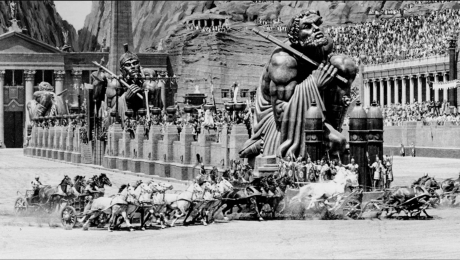
A couple of hours ago I was discussing the Oscar nominations and wins that went to William Wyler‘s Ben-Hur (’59). This led me to a Charlie Rose riff that I posted on 8.17.16:

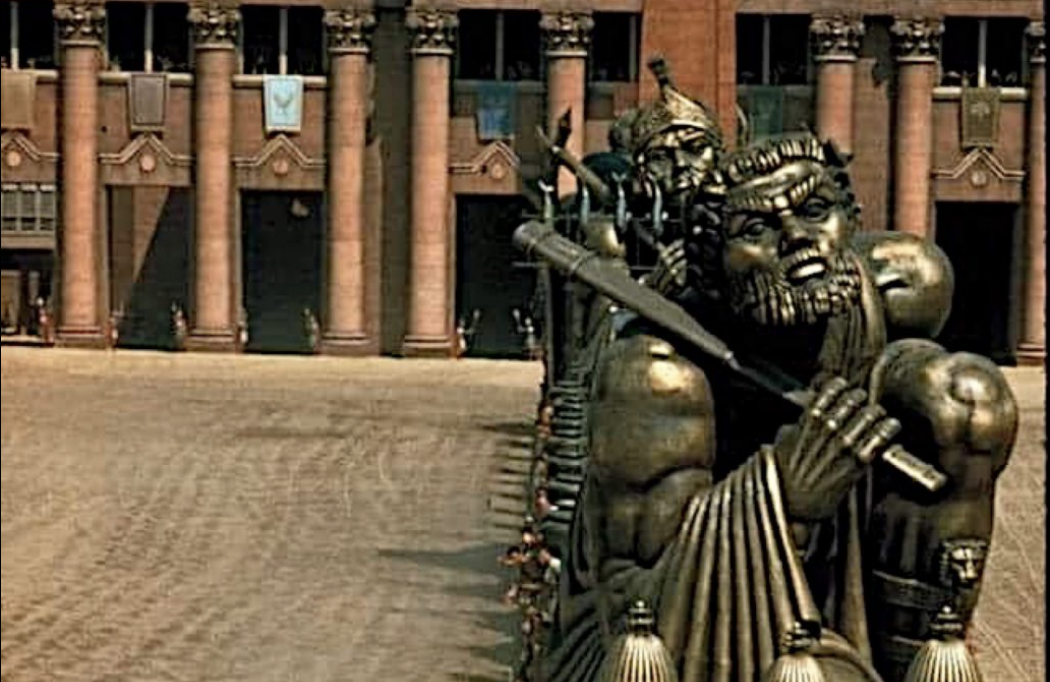
A Charlie Rose Show-type setting. A large, round, polished oak table. Bottles of Fiji water, the usual dark backdrop. The host is myself, and the guests are the late William Wyler, Jack Hawkins and Gore Vidal, all of whom helped create the 1959 version of Ben-Hur, along with original Ben-Hur author General Lew Wallace, still bearded and uniformed.

Jeffrey Wells: First of all, thank you all for coming. None of you are living, of course, but we appreciate your time nonetheless. Today’s topic, somewhat painful or at least uncomfortable to discuss, I realize, is the decision by the remakers of Ben-Hur — director Timur Bekmambetov, screenwriters Keith Clarke and John Ridley — to jettison the character of Quintus Arrius, the Roman general and nobleman who rescues Judah Ben-Hur from living death as an oar slave.

Wyler: For the sake of running time.

Vidal: The Arrius portions added up to roughly 30, 35 minutes. Which is one reason why our version, Willy, ran 212 minutes. The 1925 version ran…what was it, two and a half hours?

Wells: 143 minutes.

Wyler: And the new version, which of course we’ll never be able to see as they still won’t offer spectral streaming in heaven, despite numerous requests…

Vidal: Drop, it Willy. It’ll never happen.

Wells: The new version runs 123 minutes.

Hawkins: Who makes a film with the goal of eliminating characters from an original version to save time? If a character brings something good to a film, you keep him. Arrius is the only steady, fair-minded, comforting figure in Judah Ben-Hur’s life.

Vidal: The only character of consequence offering friendship and security, in the entire play. Or the film. At all.

Wallace: Except the Nazarene, of course.

Wyler: You don’t count him.

Vidal: He’s more of a spiritual presence than a character.

Wyler: Not a character. No dialogue. We don’t even see his face in our version.

Wallace: Of course, he’s human! As human as the next fellow. He was a man who lived and breathed and died and who now reigns in heaven, eternally sitting next to God the Father on a gleaming throne.

Wyler: (Clears throat)

Vidal: That’s fine, General Wallace.

Read more

“EEAAO” Lemmings Over The Cliff

In the opening paragraph of Sasha Stone‘s “Last Day of Oscar Voting as Mass Formation Takes Hold,” the reason for the insane allegiance to Everything Everywhere All At Once is laid flat on the kitchen table:

“Mass formation is the flipside of mass hysteria. Both are ways [in which] whole groups of people are afflicted in one direction or another, both affording greater chances for survival. We’ve seen mass hysteria afflict Hollywood and the awards race for about seven years now. What usually follows from mass hysteria is mass formation. That means everyone falls in line partly out of fear, but also to be part of one movement, one people.”

Paragraphs #2, #3 and #4 are pretty good also.

Engaged Infidels

I certainly didn’t make a habit of this, but during the ’70s I got lucky twice with 20something women who were engaged to be married and were in fact only days away from taking their vows. Experience taught me that such women were more approachable and in fact seducible not in spite of the impending marriage, but because of it.

Reason #1: “This is my last shot before tying the knot. I’m totally serious about marriage and I intend to be 100% faithful to my husband so if I want to bed some guy than I’m attracted to, now’s the time….not later….now or never.”

Reason #2: “If I go to bed with this guy we’ll both know this will be a one-time thing because the marriage ceremony is only a week or a few days away, so unless he’s a total sociopath he won’t be calling or texting after I’m married so this is safe…no concerns about being pestered down the road…I know the guy is cool….he’s not an idiot, knows the rules.”

Virus Was Bloodstreaming Five Years Ago

There’s this idea that the woke virus didn’t really manifest in the liberal bloodstream until the George Floyd riots of late May and early June 2020. No — it was well underway by mid to late ’17. It was significant enough that I wrote an Invasion of the Body Snatchers satire of this poisonous phenomenon on 1.9.18.

Five years of this shit! And probably another two or three years before it starts to flatten out and go away. Maybe.

Posted on 1.9.18: Over the last 60 years we’ve seen four Invasion of the Body Snatchers films — Don Siegel’s 1956 original, Phil Kaufman’s 1978 remake, Abel Ferrara’s 1993 version and Oliver Hirschbiegel‘s decade-old The Invasion.

Now it’s time for a fifth involving the installation of seed-pod mindsets, with the change agents being the Millennial and Generation Z sons and daughters of today.

I’m talking about a scenario in which the Anglo Saxon whitebread gene is regarded as inherently arrogant, criminal and bad for the planet — flawed, cruel, heartless, exploitive. A consensus emerges that the only way to correct this abhorrent culture is to fully indict the historical criminality of whiteness over several decades and in fact back to the beginnings of this nation — what it’s been, what it is now and where it’ll lead if things aren’t turned around.

Alien spores float down from space, affecting only the children and grandchildren of boomers and GenXers. Once turned, the awoken are free to call Anglo-Saxon culture by it’s true name — oppressor, a cancer, a scourge upon humanity. Within days the idea is spread that it’s time for enlightened non-whites to marginalize or dilute or even overthrow white culture so that POC culture can re-shape things and bring in a little fresh air and more fairness, freedom and opportunity.

Gradually seed-pod consciousness spreads to members of the liberal intelligentsia, and more and more of them are suddenly embracing the program. The general idea is “let those shitty old crusty white guys eat some of the shit that POCs have been eating for the last couple of centuries,” etc.

Gradually it becomes accepted that if you’re white and straight you’re kind of a bad person, or at the very least suspect. And that you probably need to re-educate yourself and embrace the new reality…or else.

A clever horror-comedy satire that ten years ago would have come and gone and been forgotten by awards season is transformed by seed-podders into a Best Picture contender, and those who question the validity of this are regarded as cranks or closet racists.

Friends and family members of seed-pod film critics begin to notice a certain robotic manner and a glassy, out-to-lunch look in their eyes. Local constable: “But he looks like his picture, madam. Obviously he’s Guy Lodge, the Variety critic.” Mrs. Lodge: “But it isn’t him, I’m telling you. Something is missing. It’s just not Guy!”

Liberal-minded film critics Anne Thompson and Eric Kohn declare that they’ve been making sure that POCs are ranked prominently in their year-end awards ballot, partly because they admire their films but also because they’re about or were made by POCs.

Seed-pod urban culture begins to adopt other changes. Millenial and GenZ types begin to regard heterosexuality as a problem, and it’s gradually decided that it’s time to let LGBTQ folks run the culture and push heteros off to the side a bit. They’ll be allowed to walk around and buy groceries, but they need to accommodate themselves to the notion that straight whites are an underclass.

And if educated liberal Democrat white guys complain about any of this on social media platforms, the seed-podders tag them as closet Republicans or closet racists or closet homophobes. Would the seed-podders be delighted to bust these white guys on any of these counts and thereby eradicate or at least marginalize their asses and put them out to pasture? You have to ask?

The transforming of society has never been a gentle process, and to make an omelette you have to break a few eggs.

I’ll Never Trust Guy Ritchie Again

I decided a while back that Guy Ritchie‘s Operation Fortune: Ruse de guerre (Lionsgate, 3.3) was almost certainly meh-level or, you know, some kind of problem. Partly because it began filming over two years ago (1.14.21), and then the previously scheduled 1.21.22 release was abandoned by STX Entertainment “without comment.”

Not to mention Ritchie’s rep as a skilled hack who makes Guy Ritchie films….nothing wrong with that, but nothing great about it either. Plus there’s no forgiving Ritchie for making those two repulsively awful Robert Downey Sherlock Holmes films (in ’09 and ’11). Plus the only Jason Statham movie that didn’t blow chunks was Roger Donaldson‘s The Bank Job (’08),

Right now Operation Fortune has a 66% Rotten Tomatoes rating. That means it has problems. That means it’s at least half a wank.

Fortune has less to recommend than even the weakest of the Bond films, according to The Age‘s Jake Wilson. “The banter is witless, the action sequences perfunctory and the take on global affairs is almost too wilfully empty-headed to be labelled as cynicism. If a film such as this can be defended, it’s as an invitation to set adulthood aside. As with much genre storytelling, what we’re dealing with is a child’s game writ large – but with more than the usual indifference to whether anything seems ‘real’.”

But wait…Variety‘s Owen Gleiberman was impressed by the damn thing. The leadline of his 3.1.23 actually calls it a “home run.” HE to Glierbamn: Wait a minute, wait a minute…what? Guy Ritchie doesn’t hit homers, and he hasn’t slammed a triple since Lock, Stock and Two Smoking Barrels in ’98. His brand is about hitting mostly doubles and occasional singles.

Gleiberman: “The script of Operation Fortune is a gem, allowing this to be the rare thriller that’s as driven by words as an old Hollywood movie. Yet it’s Ritchie’s direction that makes every scene vibrate. His talent is on full display, though now it’s held in perfect perspective.

“The Cannes yacht scene is intricate enough to rival what Tarantino brought off in Inglourious Basterds” — I didn;t like Inglourious Basterds all that much! — “and the climax, set in the power tower of those biotech moguls, spins on a reversal of expectation about one of the film’s characters that’s wily enough to be exhilarating. The sparingly used helicopter shots expand the action with an almost musical visual flair.

“All of this makes me want to go back and watch Guy Ritchie’s early movies again. Will I change my mind about them? Probably not. Yet with Operation Fortune, Ritchie rules. In this movie, he’s like Howard Hawks in overdrive. Tom Cruise, Barbara Broccoli and everyone else in Hollywood: take heed.”

Conversation’s Over

You wouldn’t believe how much the know-it-all Telluride wokester journos were shrieking with delight and doing cartwheels over Sarah Polley’s talking-in-a-barn movie last September…Oscar noms, going all the way, wheeee!

Abraham Lincoln wasn’t into combs or brushes or looking tidy — the crazy-morning-hair, just-woke-up look

/