Reversal of Fortune

Oliver Stone‘s Wall Street 2: Money Never Sleeps (20th Century Fox, 9.24) is an intelligent, briskly paced, rat-a-tat financial tale that moves along nicely for the first 75% to 80% of its running time — not brilliantly but sufficiently, offering a more-or-less decent ride. And then it blows itself up during the last 25 minutes or so.
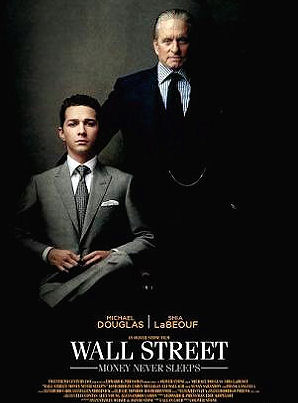
Or so it seemed to me. Some have told me they disagree, but I know (or think I know) when a film is gutting itself emotionally. WS2 does this with a sudden turnabout in the character and actions of Michael Douglas‘s Gordon Gekko character, and I can’t figure any way to explain this without announcing that spoilers are just around the corner.

WS2 screened this morning for Cannes Film Festival press. I saw it a couple of days ago at the Star plex on rue d’Antibes.

The Manhattan-based drama takes place 21 years after the 1987 original, and uses the 2008 stock market meltdown as a major plot point. But it’s primarily a family drama about a son (Shia Lebeouf‘s Jake Moore), two fathers (Gekko and Frank Langella‘s Lewis Zabel, a first-act presence whom Jake regards as a mentor), and a daughter (Carey Mulligan‘s Winnie Gekko).

The Gordon-Winnie relationship is the core of the thing. After serving seven or eight years for insider trading and being released in 2000, Gekko has become an author of a Wall Street tell-all book and, we’re told repeatedly, a genuinely reformed whore — an infamous Wall Street shark who’s not only seen the error of his ways, and who wants to be a good and caring father to Winnie. And yet she despises him for his selfishness and bad parenting that resulted, she believes, in the drug-related death of her brother (and Gekko’s son).

This echoes into Douglas’s own life, of course, as it mirrors to some extent the drug-related troubles of his son Cameron, who was recently sentenced to prison on a drug charge. Douglas has beaten himself up over this in interviews, acknowledging that he’s probably responsible on some level due to having been an indifferent or absentee parent during his 1980s and ’90s heyday.
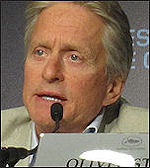

Oliver Stone, Michael Douglas, Carey Mulligan during this morning’s press conference for Wall Street 2: Money Never Sleeps.

The plot is partly about Jake wanting to stick it to Josh Brolin‘s Bretton James, a high-level trader who ruined Zabel and, Jake believes, more or less goaded the old lion into suicide, and his teaming with Gekko in order to manage this. It’s also about Jake acting as a kind of go-between between Gordon and Winnie, whom he loves dearly and intends to marry.

This leads to the most emotionally affecting moment in the film, set on the steps of the Metropolitan Museum during a party. Gordon begs Winnie to forgive him for being a prick, and begins to convince her that he feels genuinely tortured about his son’s passing, and that he really wants to make amends.

And then — here comes the spoiler — Stone and the script turns cynical and throws Gekko’s older but wiser, seen-the-light character under the bus. He reverts to the old Gordon with his using-and-taking side resurfacing. And when this happens the film drops dead. Its heart simply stops beating. You can’t build sympathy for a character by proving in this and that earnest way that he’s become (or is trying to become) a better person, and then say “fake out!” Or at least, you can’t do that with me.

I felt as if the movie was saying, “Look, we know we’ve sold you on the reformed Gordon and have used Douglas’s real-life history to put it across and all, and we’re sorry to do this but…not really! A shark can’t change his spots! Bad-ass Gordon is back!”
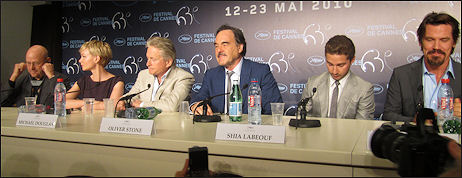

(l. to r.) Wall Street 2c producer Ed Pressman, Carey Mulligan, Michael Douglas, Oliver Stone, Shia Lebelouf, Josh Brolin.

Except he isn’t. The Gordon Gekko of yore was a wolverine, but also a gifted combatant who rationalized his behavior with a harshly realistic view of human nature. “We’re all greedy fucks,” he basically said in Stone’s original 1987 film. “I just happen to be better at grabbing all I can than most.” But Gekko doesn’t “shark” his way into financial triumph in Wall Street 2. He pulls a slimeball move that further ruptures things between himself and Winnie.

Why did Stone and his screenwriters — Allan Loeb and Stephen Schiff share the credit — do this? Because they know Gekko has become a villainous cult hero over the last 23 years, and they wanted to deliver this Prince of Darkness in order to satisfy the fans.

And then comes a finale between Douglas, Lebeouf and Mulligan that tries to sell the notion that Gordon can be forgiven yet again because now he’s really seen the light. This scene is purely and simply a disaster. You don’t buy it, can’t believe it — it doesn’t come close to touching bottom.

The bottom line is that you feel burned and betrayed by the decision to sell out Gekko’s character. You’re with him, you feel for him somewhat, you half-sympathize…and then the filmmakers pull the rug out.

There’s a bit between Douglas and Charlie Sheen at a swanky New York party that gets a rise, but — again –it’s a capitulation to the lore of the ’87 film. The filmmakers didn’t believe or invest in what the new film could have been entirely on its own merits and cultural groundings.

Otherwise WS2 handles itself pretty well. It’s over-emphasizes certain plot points and emotions — it’s overly explicit, playing to the gallery — but the observations about the nature of high finance these days and how it’s all been twisted and corrupted beyond belief or control are spot-on. It’s a reasonably decent film in many respects, but…well, I’ve said it.
Fair Is Fair

Actuals report that the predicted second-place finish by Kick-Ass didn’t quite materialize. Instead of getting slightly beaten by How To Train Your Dragon by a margin of a million or less, Kick-Ass managed to eke out a $200,000 margin of victory over the animated DreamWorks release. In so doing Kick-Ass and the Lionsgate team have just barely saved face — fine. The bottom line is that Matthew Vaughn‘s satiric comic-book actioner did semi-respectably, but did not whoop or kick ass by any stretch of the dictionary.

Walken’s Labyrinth

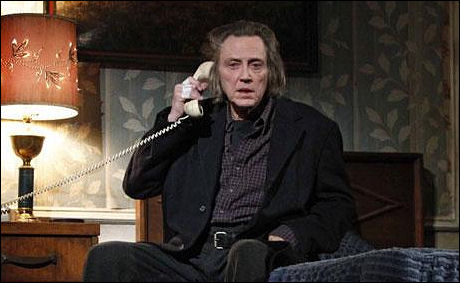
As Carmichael, a man without a left hand in Martin McDonagh‘s Behanding in Spokane, Christopher Walken is “a scrofulous wonder to behold,” says N.Y. Times theatre critic Ben Bantley. He is “an actor’s actor of fabled eccentricity,” and his “signature arsenal of stylistic oddities has seldom been more enthralling.


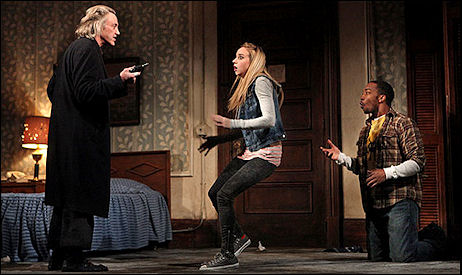
(l. to r.) Christopher Walken Zooey Kazan and Anthony Mackie in Martin McDonagh’s Behanding in Spokane, which opened at B’way’s Schoenfeld theatre on 3.4.

“Some people have become allergic to his familiar panoply of tics and quirks, but seldom does [Walken] only glide on surface mannerisms. There’s highly intelligent method in his madness. Or should we say Method? Mr. Walken is directly descended from Method acting’s most celebrated practitioner, Marlon Brando. And like Brando he has a turn of phrasing that makes even the most generic sentences sound worthy of serious analysis.

“Pauses pop up when you least expect them, entirely shifting the weight of the words around them. Inflections rise upward when normally they would curve down. A single clause can slalom from ennui to anger. These idiosyncrasies of delivery surprise you into close attention and, ultimately, into feeling you can trace the thoughts of the man speaking.

“For Carmichael that train of thought feels singularly lonely, propelled by a logic only he can understand. Variously abstracted and abruptly, frighteningly focused, he is unquestionably a man obsessed. He’s like a small-time, loopier and more selfish variation on the revenge-starved vigilantes played by Charles Bronson and Clint Eastwood.

“But Eastwood and Bronson never let us into their characters’ heads the way Mr. Walken does here. ‘Step into my mind,’ he seems to be saying, as he stammers or curls his lip or blinks catatonically. If Mr. McDonagh hasn’t provided the kind of exhilarating, nasty fun house we have come to expect of him, we are at least allowed to spend shivery time in that shabby, scary labyrinth that exists behind Carmichael’s glassy forehead.”

Anti-Zionist Navi

The Associated Press reported today that in their weekly protest against the barrier near the village of Bilin, Palestinian protesters “have added a colorful twist to demonstrations against Israel’s separation barrier, painting themselves blue and posing as nativist characters from Avatar. In so doing they were obviously equating their struggle to that of James Cameron‘s ten-foot-tall smurfs, and the Israeli position to that of Giovanni Ribisi and Stephen Lang‘s. What say ye to this, Jim?

Scattered

Two Fantastic Mr. Fox themes were expressed at today’s Dorchester hotel press conference. George Clooney said it was more or less about “being true to your animal instincts,” and Wes Anderson called it “a celebration of thievery.”


Walking down London’s Half Moon Street — Tuesday, 10.13, 11:05 pm.

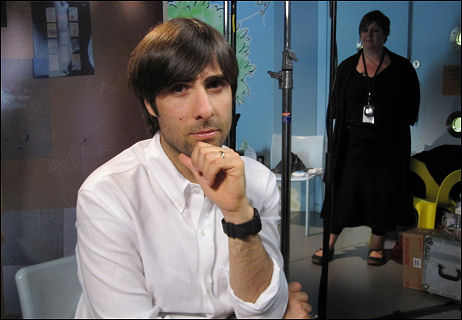
Fantastic Mr. Fox voicer Jason Schwartzman (who told me that Bored To Death, his HBO series, has been picked up for a second season).

Bill Murray behind the bar following yesterday’s pub interview session.

Visited here last night, met up with a couple of HE reader acquaintances.

Gauging Up In The Air

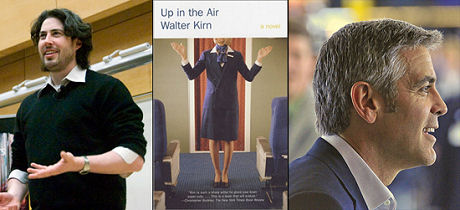
A guy I’ve known for a while and who knows how to write — he calls himself Marlowe — has seen Jason Reitman‘s Up In The Air (Paramount) at a recent test screening. (Two weeks ago in the L.A. suburb of Westlake Village, he says.) I’ve spoken to him and believe he’s real. The George Clooney-Vera Farmiga film will premiere at the Toronto Film Festival and open I-don’t-know-when in the fall. Here’s his review:

“Let me begin by saying that this summer has been a bust. The only highlights being smaller films like Moon and The Hurt Locker. The major tentpoles have all had problems. Even one of the better ones like Star Trek has some glaring plot problems. So when something like Up In The Air comes around it restores my faith in film.

“This is only Reitman’s third film and he’s showing such a level of confidence here that it’s almost scary. Where does he go from here? UITA is going to be on everyone’s Ten-Best list, and Clooney will be nominated for Best Actor. Clooney has never been so good. In fact, I feel he was born to play this character, a charmingly aloof business-track smoothie called Ryan Bingham.

“This is the Clooney who dashes around Italy on a motorbike with an Italian lap-dancer strapped to his back. This is a character Clooney was born to play, always impeccably dressed, meticulous in his words, basically a throwback to the great stars of yesteryear. In the film he plays a professional whacker…yup, the big companies fly Clooney around when they don’t have the balls to fire a long time employee and he’s good at it. He’s got it down to a science.

“And he lives his life up in the air. He has no attachments, he has an empty apartment, he’s a stranger to his family, nothing tethers him to this world… and that’s the way he likes it. His only goal in life is to accumulate enough air miles so he can get the top secret super-platinum card given to you by the pilot himself.

“Of course, a complication arises. Clooney/Bigham’s way of life is threatened when a young female whipper-snapper (Anna Kendrick) strolls into the office and comes up with a way to save the company loads of money by grounding Clooney and the staff of flying assholes whose job it is to fire you. The solution: fire people by web-conference, which is the next level of demeaning. Clooney freaks at the notion of not being able to accumulate his air miles and, in a great scene, he completely schools the young Ivy-league girl on why firing people over a web camera will not work.

“Clooney is masterful in this scene. Cary Grant crossed with Warren Beatty. He’s amazing to watch. At the heart of the film is the notion of what drives us in life and what’s most important to us as human beings. Clooney is a superficial jerk who meets a superficial lady (Vera Farmiga), and they strike up a very modern relationship. They have palpable chemistry in the film. They meet all over America in swanky hotel rooms with no strings attached. I don’t want to spoil the film but by the end Clooney’s character wants more from life and from the girl. Although he may be too late in making these needs known.

“I saw the film two weeks ago, and I still haven’t been able to shake it. It was a test screening but it was a near perfect film, except for one minor dream sequence which was a little on the nose. In the film, Clooney says he’s crisscrossed the world so many times that he could’ve gone to the moon. Well, you can guess what the dream sequence is: Clooney dressed like an old-timey astronaut floating up through buildings in downtown Omaha. It’s trippy but felt out of character for the film.

“The film tackles all the big questions of life, prime among them: What is the meaning of life? It’s relevant because it deals with corporate downsizing. There’s so many levels to the film and I don’t want to spoil to much. Basically, UITA is an absolutely amazing film. Love it and can’t wait to see it again. As a former Montrealer, it’s great to see the Montreal-born Reitman hitting it out of the park or, in hockey parlance, ‘scoring a hat trick.’

“Oh, and there’s a great ass-shot in the film….astounding.”

Update: As I told Drew McWeeny a little while ago, I trust that this review is legit. I know the name of the guy who wrote the review, I have his phone number and I’ve spoken to him. He’s told me he’s a screenwriter and he sounds cool over the phone. I know him for having liked his writing before and especially enjoyed a savage review he sent me last year of Hancock. I don’t think he’s a plant. On top of which I’ve read about half of the Up In The Air screenplay and thought it was quite good.

Bond Backtalk

A week ago Variety‘s Todd McCarthy‘s got into the whole Bourne-y Bond syndrome in his “Deep Focus” column — my apologies for not catching it sooner.

The main point is the little-discussed fact that all along the Bond films have exclusively used British directors, or at least Commonwealth, given that New Zealander Lee Tamahori did one. But never an American or Euro until now with Marc Forster, which McCarthy feels might have been a genetic mistake of one kind or another, the Bond thing being in British blood

McCarthy states at the end that Danny Boyle would have been the most enticing candidate to direct Bond. (Boyle told McCarthy last week he was a huge Bond fan as a teenager, reading every Fleming book at least twice.) Chris Nolan, among other Brits, would obviously be good, but he might be too much of an auteur for the notorious “stopper” producers Michael Wilson and Barbara Broccoli to deal with.

The word around the campfire, I’m told, is that the film was originally longer than the final-cut length but that none of the quieter scenes were working and Olga Kurylenko‘s scenes with Craig didn’t rise to the occasion, so they just decided to cut them all out. Has anyone heard anything more along these lines?

Sad Red Lamp

Six years old, and one of Spike Jonze‘s best spots ever. The lamp’s heart is breaking, the woman doesn’t get it and then she does. But that guy who narrates at the end with the Swedish-Danish accent…vat is it you say? You love red lamp too, yah?

No End for Free

Screw future revenues, No End in Sight director Charles Ferguson is saying. I’m loaded anyway, and what matters to me now is to get some fence-sitters out there to consider the message of my film (i.e., “did the Bushies screw things up in Iraq after the invasion or what?”) as they decide how to vote on November 4th.
Which is why as of Monday, September 1st, No End in Sight will be the first widely released feature film to screen in its entirety for free on YouTube. The highly-praised doc will be featured on its own YouTube channel and available to anyone with a computer and high-speed internet connection, as well as via the YouTube service on broadband-connected TiVo Series3 or TiVo HD DVRs, blah blah. Good thing, this.

Skilled Musician

Bill’s two best lines: (a) “Actually, that makes 18 million of us” and (b) “They actually want us to reward them for the last eight years by giving them four more. Let’s send them a message that will echo from the Rockies all across America: Thanks, but no thanks.”

That’s Entertainment

Paul Schrader‘s Adam Resurrected has been selected to be shown at the Telluride Film Festival, which sorta kicks off tomorrow night but more precisely on Friday morning. I don’t believe that Tom Luddy or Gary Meyer would invite this film to their festival if it (a) didn’t have merit and value, and (b) if it was any kind of relative of Jerry Lewis‘s The Day The Clown Cried (’71), which has been the rap against it in the columns. Better to reserve comment until people see it this weekend.
It’s been explained that Schrader’s film, based on Yoram Kaniuk‘s novel, is about Adam Stein, an inmate and former circus clown living in an asylum in Israel and looking back on his having agreed to entertain Jews during WWII as they were led to their deaths in the camps.
I’m told Jeff Goldlblum is quite good as Stein; William Dafoe plays Commandant Klein.