
The Biblical word "Babel" refers

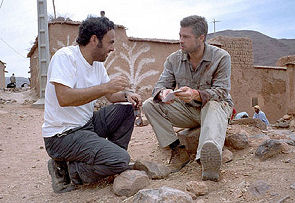
The Biblical word “Babel” refers to “Babylon,” which generally means a place in which the serenity of God’s path is not heeded. In Genesis 11:9, Babel “is etymologized by an association with the Hebrew verb balal, which means ‘to confuse or confound.'” This should give you an oblique idea about where Alejandro Gonzalez Innaritu ‘s Babel (Paramount Classics, 11.17) is coming from. I’ve read Guillermo Arriaga‘s script because the film is most likely going to play at the Cannes Film Festival, and I want to be up to speed. Like Innaritu and Arriaga’s Amores perros and 21 Grams, Babel about how a single violent event — a car accident in the first two films, and a shot fired from a rifle (“a well-conserved .270 calibre Winchester 60”) in the new film — affects the fate of numerous unconnected people in various rippling and/or tangential ways. I won’t discuss the story particulars, but the stars, as mentioned earlier, are Brad Pitt, Cate Blanchett, and Gael Garcia Bernal…although there are vivid, fairly sizable parts that will be played by another four or five actors, at least. It’s set in Tunisia, northern Mexico and Tokyo, and I’ve tried to learn the name of a young Japanese actress who plays a character named “Chieko.” (Does anyone know? I’m interested because there’s a nude scene factor.) I’m not going to get into the script very much either, but it’s one of those pieces in which God is in the details. There’s not a shitload of plot — it’s more sparely written than the other two films — but what happens cetainly sticks to your ribs. I would call Arriaga’s script lean, pungent and haunting. Although the emotional rapids don’t churn quite as heavily or tempestuously as they did in Amores perros and 21 Grams, what settles down at the end is some kind of less-is-more residue. Babel‘s three stories, which unfold at roughly the same time but within slightly staggered time frames (in terms of the back-and-forth of what we see and when), are about confusion and wrong turns and things going badly in the world today…about the unfairness and randomness of life and the off-and-on sensuality of it. Is it about rot? The end of the world? An inter-connected world society collapsing and eating away at itself? Depends on your reading of the script or the film, but one thing’s for sure: two (presumably) pretty actresses have nude scenes. I know, I know…I’m a profoundly deep cat.
It was officially announced yesterday…"officially"

It was officially announced yesterday…”officially” being a euphemism in this instance for “at long last”…that Chicago Tribune editors had finaly gotten their nerve up and permanently replaced big-wheel film critic Michael Wilmington with former hotshot theater critic Michael Phillips, whom I spoke to last September during the Toronto Film Festival. It was obvious back then that Phillips (whom a Chicago Tribune colleague describes as “an elegant writer” and coming from “more or less in the same [aesthetic] place as Wilmington”] was on the upswing and Mike, a flat-out brilliant critic and scholar from way back, was on the downswing. A friend of Wilmington’s told me a good year ago that Tribune management had been “treating him badly,” so the writing had been on the wall. If you’re going to get respectfully demoted or fired or dropped by a girlfriend, you can always feel it a long time before the actual words are spoken (or typed out for a press release). The drip-drip-drip of disapproval …those little disses, dirty looks and innumerable hints that your stock price is dropping…is always detectable well in advance.

MSNBC film critic John Hartl

MSNBC film critic John Hartl has made a good if obvious point, which is that regular audiences tend to embrace mediocre films that don’t tend to stand the test of time, and that the really good films tend to more celebrated by critics and, to a lesser extent, awards-giving orgs like the Academy. I’ve always maintained that the most popular films of any year always amount to a kind of portrait of where the mass audience is at deep down…a reflection of what they’re longing for, or how they would like to see themselves in some way. What does it say about a society that celebrates a film as bad as My Big Fat Greek Wedding? No one ever talks these days about the films directed by Mervyn LeRoy (Quo Vadis, Mr. Roberts, The FBI Story, No Time for Sergeants, Gypsy). They were enormously popular in the 1950s, but who talks about any of these films now with serious affection or respect? I’ve never even heard of 1947’s #1 box-office hit called Welcome Stranger , which costarred Bing Crosby and Barry Fitzgerald. Who’s ever seen The Egyptian, one of the big box-office hits of 1954? (20th Century Fox wanted Marlon Brando to star in it and he refused, resuilting in a big brouhaha.) Samson and Delilah was 1950’s biggest hit, David and Bathsheba was 1951’s top-grosser, and The Ten Commandments ruled in 1957…and none of them play very well by today’s aesthetic standards. And Alfred Hitchcock‘s Vertigo , one of his very best and an undisputed classic, flopped when it opened in 1958.

Regarding the Jared Paul Stern/"Page

Regarding the Jared Paul Stern/”Page Six” shakedown fiasco, Lewis Beale offers the following: “The ‘Page Six’ people play by their own rules, and they ain’t the rules anyone else in the industry abides by. I collaborated with the Daily NewsGeorge Rush on and off when I was a staffer there, and I can tell you that George (a sober, upright, pleasant, Midwestern kind of guy) was not accepting free first-class plane rides to L.A. and comp stays at elite hotels. If he had, he would have been fired, plain and simple. The whole Stern/’Page Six’ flare-up is about two things: the total lack of any sense of journalistic ethics on the part of guys like Stern, and the complete lack of institutional control on the part of the New York Post. I actually don’t think Stern was trying to extort the guy; but at the very least he was trying to get paid for being his damage-control maven, which is a complete and total conflict of interest. This little creep, whose sartorial affectations just make me want to kick his teeth in, represents exactly what’s wrong with the gossip industry. He wouldn’t know an ethical dilemma if it bit him in the face. And he’s arrogant enough to think he’ll emerge from all this with his career intact. If by some chance he does, that says a lot about how far we’ve sunk as a society. The Post should, of course, clean house. But they won’t, because without ‘Page Six’ no one would read the rag. Stern himself will probably keep it going, because unlike any other human who’s being investigated by the FBI, he sees this as a great chance to up his personal profile . He’s been all over the media, e-mailing people (check out his responses to questions Gawker sent him), trying to set up TV appearances, etc. He is absolutely shameless. Of course, if he’s indicted, that will be another story — whether guilty or not, he’ll be ruined. Unlike Jayson Blair, Stern knows how to use the media, which says to me he might have a career of sorts after this blows over (but not at ‘Page Six’…he’s toast there). The more I follow this, the more I see Stern as an interesting case: a completely amoral human. He makes Bonnie Fuller look like Mother Teresa.”

The last line in United

The last line in United 93, seen in white type against black background before the end credits, is “America’s war on terrorism had begun.” My gut tells me this proclamation was muscled into the film. Universal knows the right is going to be suppporting this film big-time, and I think it was thrown in as a sop to the Bill O’Reilly crowd. This is merely a suspicion, and far from a factual assertion. It’s not a huge deal and obviously not central, but it’s stuck between my teeth at the moment. It’s the one and only incongruent note in the film.

Filmmakers tend to be a

Filmmakers tend to be a bit more affectionate and supportive of other filmmakers than, say, critics or the public, but that aside, Kevin Smith has seen Mission: Impossible: 3 (Paramount, 5.5) and passes along the following: “I saw it last month in [director-writer J.J. Abrams’] editing room, and it’s really great: far, far superior to the second one, and as good (if not better) than the first. Philip Seymour Hoffman plays the most believable bad guy since Anthony Hopkins in Silence — he’s just plain frightening. [The film has] great tent-pole scenes and Tom Cruise is in top form. There’s no fat on it at all. All those years working on Alias made for fine training for JJ, as this thing is very well plotted and paced. It’ll do extremely well. I know I’ll see it again in theaters.” Why is Paramount publicity not showing it then? What is the strategy in keeping word-of-mouth spreaders away from it until three days before it opens? I think it’s part of the New Hollywood World Order…the truly big tent-polers are their own engine, about themselves & their own self-perpetuating inevitability, and writers and reporters are but lint on the lapels of the big-studio distribs in this context…at best incidental to the process. And the p.r. people are looking to make a statement to that effect.

"I haven't read the orginal

“I haven’t read the orginal script for The Break-up, but it sounds like the girly-girls in the audience just didn’t want Jennifer Aniston guy-less at the end. If there wasn’t another strong viable male character for her to end up with, then I guess the director and the writers had to figure out how to put her back with Vince Vaughn, even if the rest of the movie is telling us they don’t belong together. That’s an awfully big change. Maybe they should just have a final scene of her sitting alone in a bar…free at last, free at last, thank Dod almighty. And then George Clooney saunters over and they smile and things start to click right away.” — Eric Williams

"I think United 93 is

“I think United 93 is the best film of the year so far. I almost wished I hadn’t seen the A&E telefilm. I thought it was cool that John Rothman (older brother of Fox honcho Tom Rothman) and David Rasche (star of TV’s Sledgehammer series) were in it as two of the passengers. [Director Paul] Greengrass is opposed to the war in Iraq, so the ending card — ‘America’s war on terror had begun’ — that you cited smacks to me of studio meddling.” — Connected industry guy