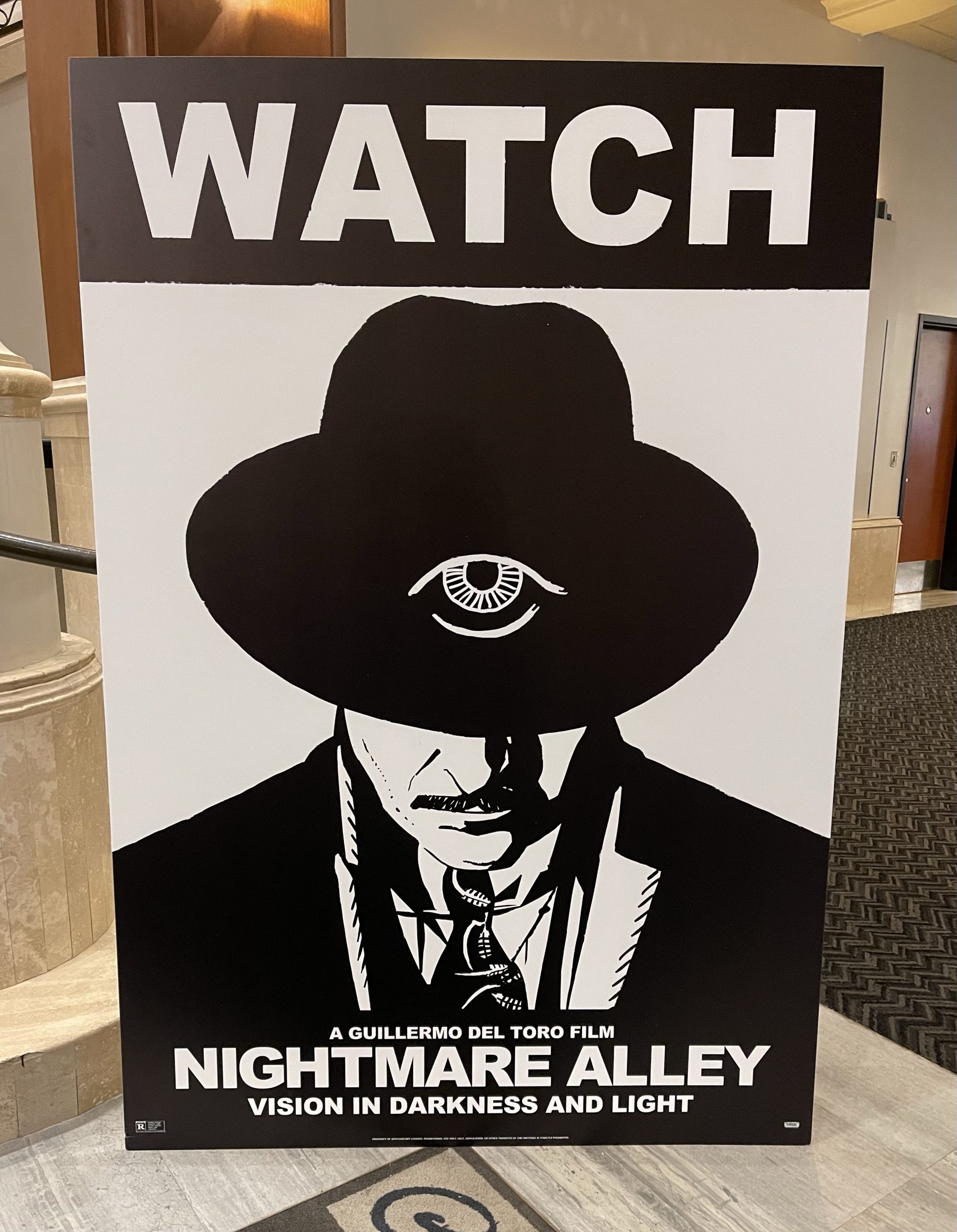
Last night I rumble-hogged over to the Grove and caught Guillermo del Toro‘s black-and-white version of Nightmare Alley (subtitled “Vision in Darkness and Light”). I generally felt that the whole thing looked too dark and muddy. Not each and every shot, mind, but a good portion of it. Especially the travelling circus section, which accounts for the first…what, 35 or 40 minutes?
I’m sorry but my eyes want what they want, and they wanted more light, more contrast and less shadow and murk.
Plus I had an even worse time with Bradley Cooper‘s Stanton Carlisle character. I didn’t care for his slimey company the first time around (I saw it in Manhattan in late December), but “monochrome Stan” was somehow even worse. I was sitting there going “I don’t like you and your fucking moustache and your fucking cigarette habit” — the actual subject of Nightmare Alley is unfiltered cigarette addiction — “and I really wouldn’t mind it if someone killed you with a pick-axe. In fact I’d prefer it. I don’t like hanging out with scumbags.”
Yes, the ending in which Stanton has a good hearty laugh about how he’s screwed his life up and is doomed to misery…this is still the best scene in the whole film.
Two comments from yesterday were spot-on, as it turned out
Michael Gebert: “These straight conversions of a movie shot for color rarely work well. It’s worth looking at Warner Archive’s disc of Doctor X, which was shot in both two-strip Technicolor and black-and-white, but it’s not a conversion– the black and white version is plainly lit differently, to work in black and white with proper highlights and shadows. while the color is shot to deliver the novelty of color. (There were even two cinematographers — Ray Rennahan, who shot Becky Sharp, the first three-strip Technicolor feature, as well as Duel in the Sun, The Court Jester and others, did the color version.)”
Brenkilco: “You’re not going to get anything like the chiaroscuro of a ’40s noir, specifically lit for monochrome and photographed on black-and-white filmstock, by draining the color out of a digital movie originally shot in color.”