I finally got around to watching Rebecca Hall‘s Passing…mild groan. Okay, it’s a tolerable sit. I was mildly bored from the get-go but I got through it, and that’s saying something.
The gobsmacking Ruth Negga miscasting issue aside, it isn’t half bad…just a little boring. The contentious marital discussion scenes between Tessa Thompson and Andre Holland‘s upper-middle-class Harlem couple, Irene and (doctor) Brian Redfield, are sharp and well-modulated, and Ed Grau‘s monochrome cinematography, rendered in HE’s second favorite aspect ratio (1.37:1), is highly agreeable.
But the whole film hangs on a visual whopper that you just can’t roll with.
Based on a same-titled 1929 book by Nella Larsen and mostly set in 1920s Harlem, Passing is about a married woman of color — Ruth Negga‘s Claire Kendry, whose blonde hair and half northern-European features allow her to pass for white, which was deemed desirable 90-odd years ago. The story focuses on the reunion of Kendry and Irene and subsequent complications that lead to tragedy.
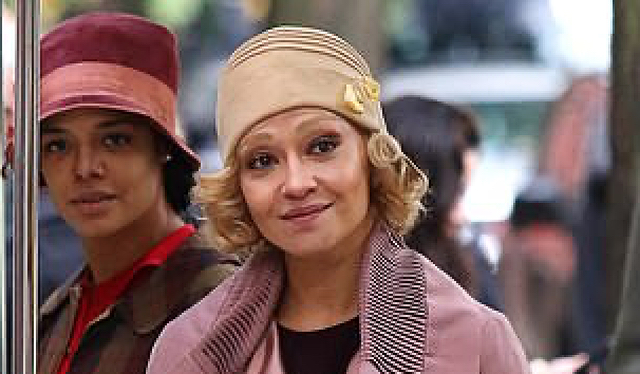
Tessa Thompson (l.), Ruth Negga (r.) during filming of Rebeca Hall’s Passing.
The problem is this: In real life (i.e., outside the forced woke universe in which we’re all presently dwelling) nobody and I mean nobody would glance at Claire and think “meh, ‘nother rich white lady.” The fact is that the dolled-up, blonde-wig-wearing Negga — smothered in paleface makeup, dressed to the nines in foxy flapper fashion — looks like a partially Afro-descended woman trying to look like a daughter of some European tribe with the aid of a veteran make-up person working for Netflix.
It’s one thing for a none-too-observant passerby to fail to notice the obvious. But it’s something else entirely when Claire’s racist husband Jack Belew (Alexander Sarsgard) believes her to be as white as Calvin Coolidge. This is what’s known in the motion picture industry as “a stumbling block.”
And I hate that Hall cast Negga when Gugu Mbatha-Raw (or an actress who resembled the young Marilyn McCoo, Lonette McKee or Lena Horne) would have been perfect. She knew that Negga, born to an Irish mom and an Ethiopian dad, wasn’t quite right for Claire but she did it anyway, and thereby undercut her own film.
I especially hate that Hall did this knowing that most critics would be too intimidated to mention the obvious, and that those who did mention it would have to dodge slings and arrows from hair-trigger wokesters, all of them pointing fingers like Donald Sutherland at the very end of Phil Kaufman‘s Invasion of the Body Snatchers (’78).
I refuse to explain why Negga isn’t in the Gugu or Lonette or Marilyn or Lena universe because doing so would make me sound like Heinrich Himmler, and Hall knows that, and I really hate that kind of oblivious thinking, that “fuck you” calculation.
Friendo: We’re supposed to believe that Skarsgard, Negga’s very racist husband who uses the N-word freely, is completely oblivious to the fact that his wife may have some black ancestry. He believes he married a 100% white woman.
HE: But Negga, though light-skinned and wearing a blonde wig in the film, is obviously mixed race to some degree. Just ask those scurvy racist crackers in Loving — they did everything they could to break up her marriage to Joel Edgerton. I love, however, that Passing was shot in black and white.
Friendo: The film is very well made, but its biggest flaw is the implausibility I mentioned. There is no way a racist husband would not realize that Negga has at least some African-American blood. He even mentions that he hates “them” even if they have a small fraction of non-white DNA.