Define “Sad”

Sad is loss, suffering, cruelty. Sad is “one day the universe rolled out of bed in a bad mood, decided this or that person’s life or career was no longer necessary or compelling, and decided to crush him / her like a cockroach.” It’s also “I had this thing and then lost it, and now it’s gone forever.”

Rand Paul Isn’t Tall

Until I watched this video I’d never had the slightest interest in Rand Paul‘s height. But post-viewing I have to say that my primary observation was “wow, he’s definitely no basketball player.” Google says he’s 5’8″. I can believe it. Right next to Lindsey Graham (5’7″).

Trump Is A Teleprompter Droid

You need to deploy a certain kind of musical rhythm to deliver a good speech. Especially if you’re reading off a prompter. Some have a natural gift (Bill Clinton, Barack Obama) and some need to learn it, and others can’t find the groove even with years of practice. All to say that Donald Trump‘s delivery last night was flat and robotic. No spirit, no energy, no relish. And it went on for what, 70 minutes or so? The speech itself was the usual bullshit, but he would’ve done much better if he’d winged it.

Read more

Don’t Kid Yourself

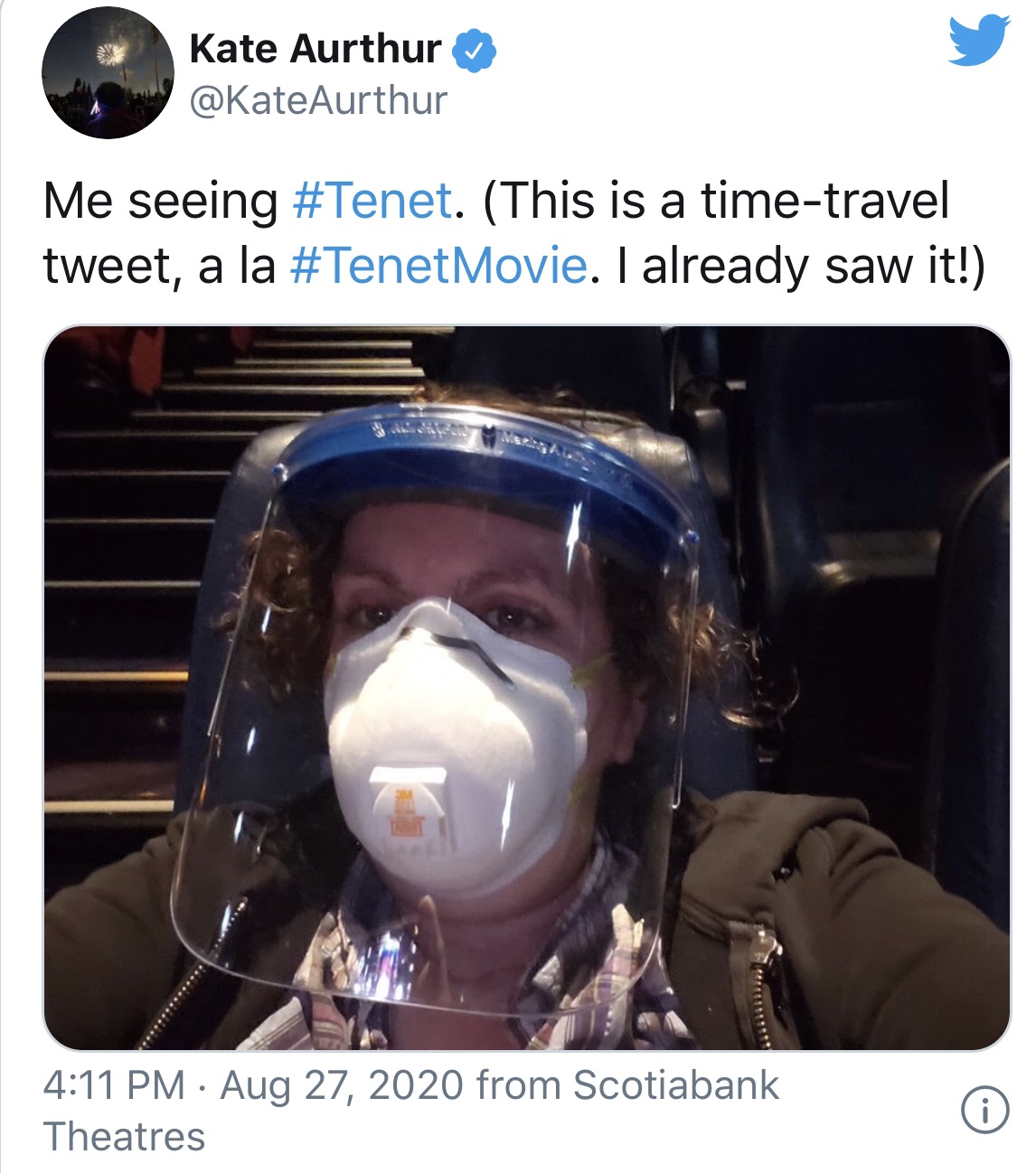
Variety’s Kate Aurthur + virus-blocking plastic face mask (i.e., Question Mark & The Mysterians) on catching Tenet in a Vancouver Scotiaplex: “All the stuff you’re starting to read about not being able to hear the dialogue is true.”

Ankler Flavor

The trades have reported what they know about the Ron Meyer-Charlotte Kirk curiosity in their usual fashion — forthright, discreet, careful. Richard Rushfield’s discussion of same was more candid in a neighborhood tavern sort of way, and therefore more enjoyable. One of the reasons, etc.

Curious Rejections

I have this vague impression that wokesters with the major domestic film festivals have been less than fully receptive cool to the established-older-white-guy contingent in terms of festival passes. (Excepting the trade critics, of course.) They — Sundance for one, Toronto for another — seem to be preferring to accredit women critics, younger regional critics, critics of color, LGBTQ critics.

I was famously stiffed by Sundance in ’19, of course, largely thanks to the delightful Scott Weinberg but also the spirit of Maximilien Robespierre. I also didn’t attend Toronto that year.

This year, needless to point out, has been a wash due to Covid. Virtual viewings + drive-in screenings just ain’t the same.

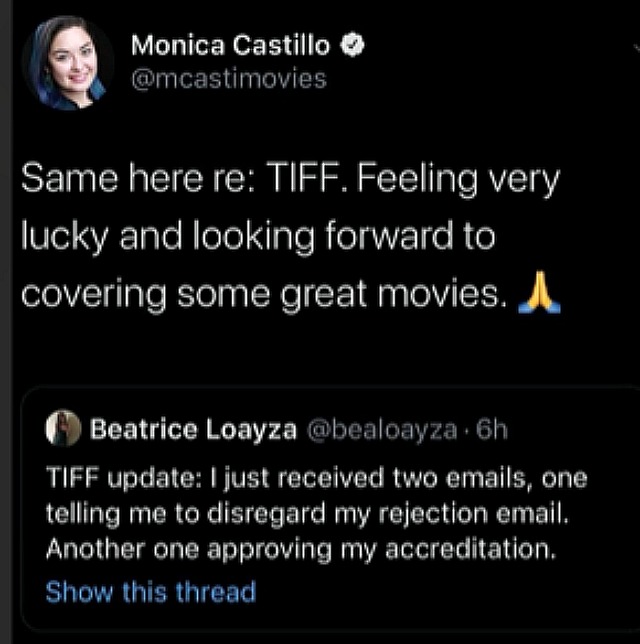
I’m nonetheless surprised to discover that a few younger critics have recently gotten the TIFF brush-off — Jordan Ruimy (World of Reel), Nathaniel Rogers (The Film Experience), @NextBestPicture’s Matt Neglia and Blackfilm‘s Wilson Morales. Bizarre but true. A tweet indicates that even Monica Castillo and Beatrice Loayza were briefly denied a TIFF pass, although these decisions were later reversed.

I’m also hearing that several members of the Toronto Film Critics Association have been denied accreditation.

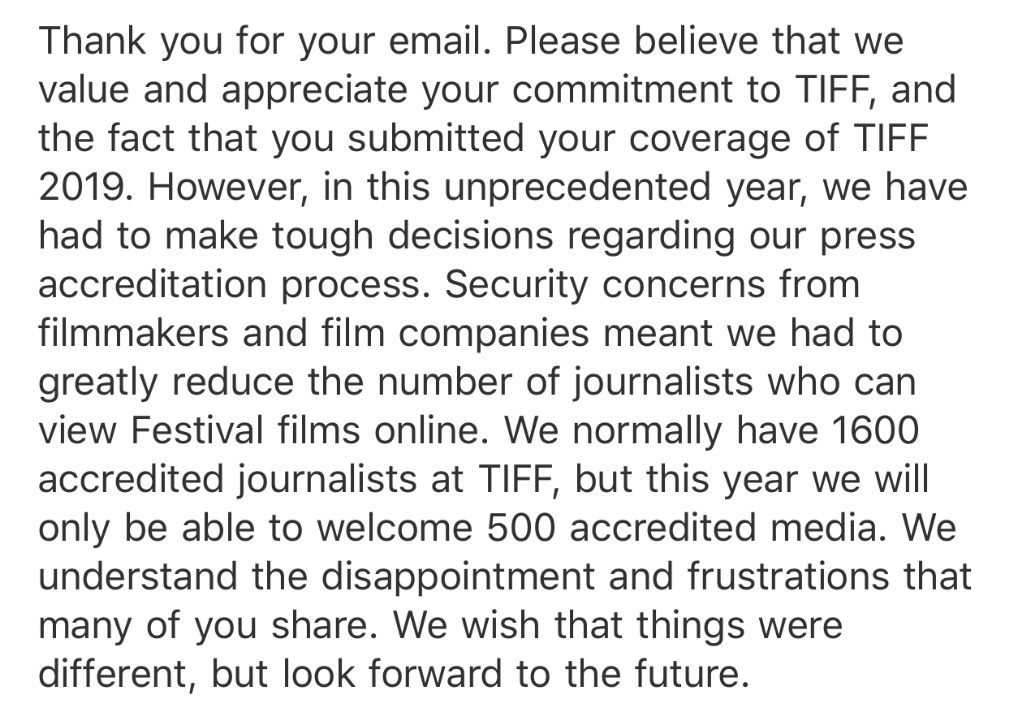
One dismayed suitor explains that “a lot of people got rejected…their reasoning being that they need to limit the amount of people they accept due to the virtual component of the fest this year, which doesn’t make any sense.”

Morales: “Two publicists went to bat for me and still no luck…not sure what they were looking for, given the years of experience and how much I have covered TIFF in the past.”

Has anyone else of note been stiffed by TIFF?

At least I still have Cannes, Telluride, Santa Barbara and Middleburg in my quiver!
Fading Ustinov

“And of course Charles, who spent most of his time loitering and waiting to be offended…he was an extremely vulnerable and sensitive soul…he was therefore of course equally open to flattery, and when he heard [the praise of a passing female tourist] he preened.”

I’ve posted excerpts from this “Peter Ustinov recalls the making of Spartacus” interview once or twice since HE’s launch in August ’04. It’s easily one of the best interview or commentary supplements ever offered on any disc of any film, and of course the Charlies Laughton portion (imitations and stories — 8:20 to 15:00) is the highlight.

The 20-minute supplement initially appeared on the 1992 Criterion laserdisc of Spartacus, and again on the 2001 Criterion DVD.

It’s a shame that Universal Home Video never licensed the Ustinov interview for their various home video versions — the 50th anniversary “shiny” Bluray of 2010 (since discredited), Robert Harris‘s 2015 Bluray restoration and the recently released 4K UHD upgrade.

How much could it have cost to include the Ustinov segment? Given the fact that the 480p Criterion versions look atrocious compared to what followed, the only way to savor the Ustinov these days is via YouTube. Had Universal sprung for the license fee the interview would have been HD-upgraded…a shame.

Memorize This

In view of widespread complaints about viewers being unable to understand (key?) portions of Tenet‘s dialogue, this concisely phrased summary by Vulture‘s Christina Newland (“Tenet Is a Locked Puzzle Box With Nothing Inside”) might be worth storing on your smartphone’s notepad:

John David Washington, known only as The Protagonist, is brought into a top-secret cabal working to stop the literal destruction of the planet through means of an ‘inverted’ bomb. That is to say: In this world, objects and, it turns out, people can actually exist on two planes, moving both forward and backward through time, simultaneously. This dynamic can be manipulated, and some very bad people know how to do so — namely Andrei Sator, played by a silly-accented Kenneth Branagh as a Bond-villain-esque Russian mastermind.

“At least initially, this ‘temporal inversion’ is a generous platform for plot trickery and an even better one for action sequences. Bullets surge backward, like the gun is swallowing them; hand-to-hand combat is on rewind and fast-forward; explosions can be funneled back into their bombs. This means a lot of grinding, inventive sound design, as wind moves in the wrong direction and debris flies in reverse; the soundtrack is accordingly and throbbingly unpleasant. Its efficacy is hard to deny.

“The Protagonist and his British compatriot Neil (a foppish Robert Pattinson) fight their way through London, Mumbai, and numerous other far-flung locales by way of arms dealers and art forgeries in order to find and entrap their man, eventually looping back in on themselves in multiple situations.”

Read more

Another Nolan Sound Mix Flunk?

Six years ago theatrical viewers of Chris Nolan‘s Interstellar were put through a form of aural hell. Nolan, it was later revealed, had deliberately mixed the sound in a muddy, soupy, music-dominating way that made it awfully difficult to hear the dialogue. I watched it twice inside Hollywood’s TCL Chinese and had trouble with the dialogue both times. I also read that it drove many others crazy. **

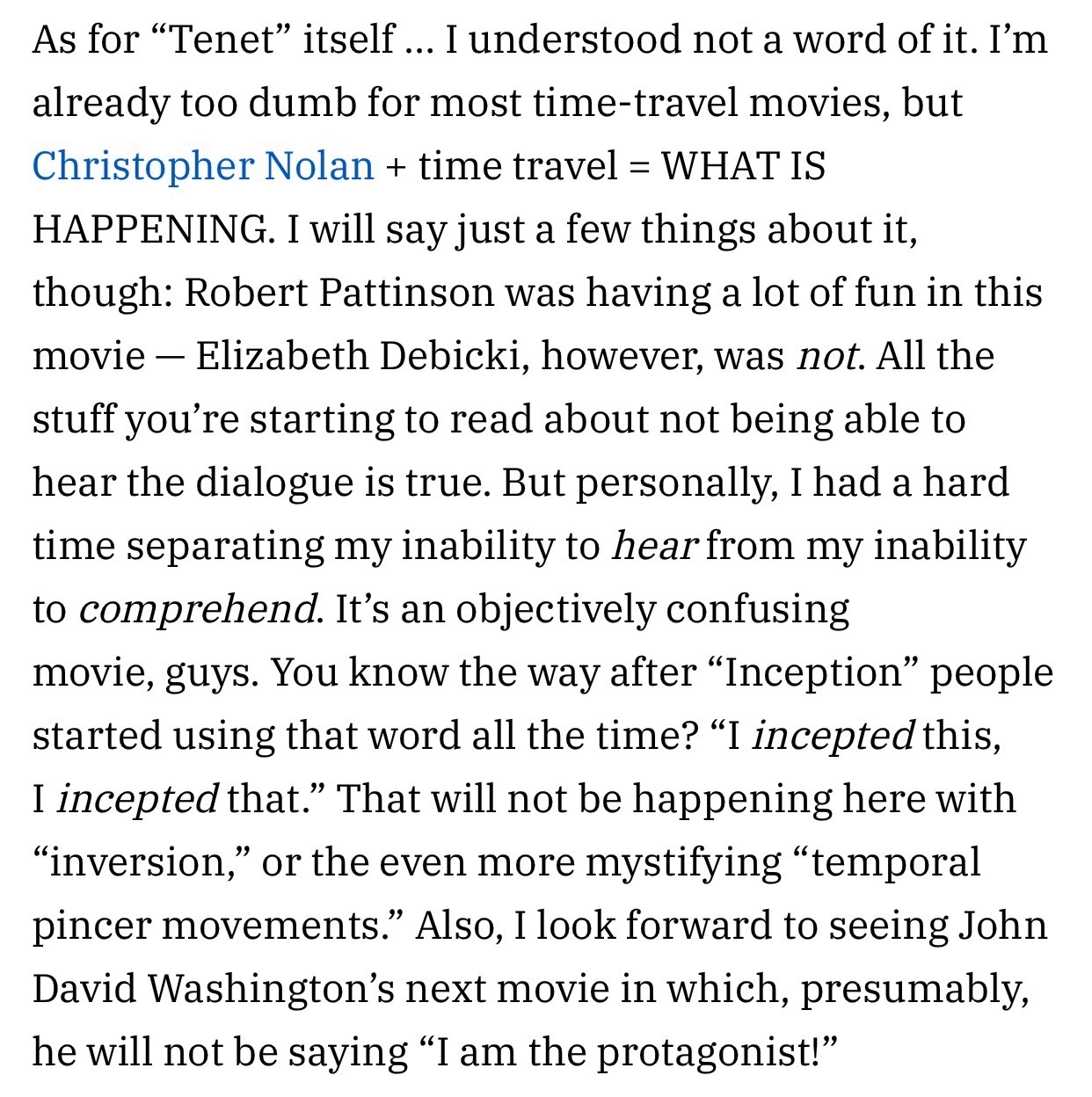
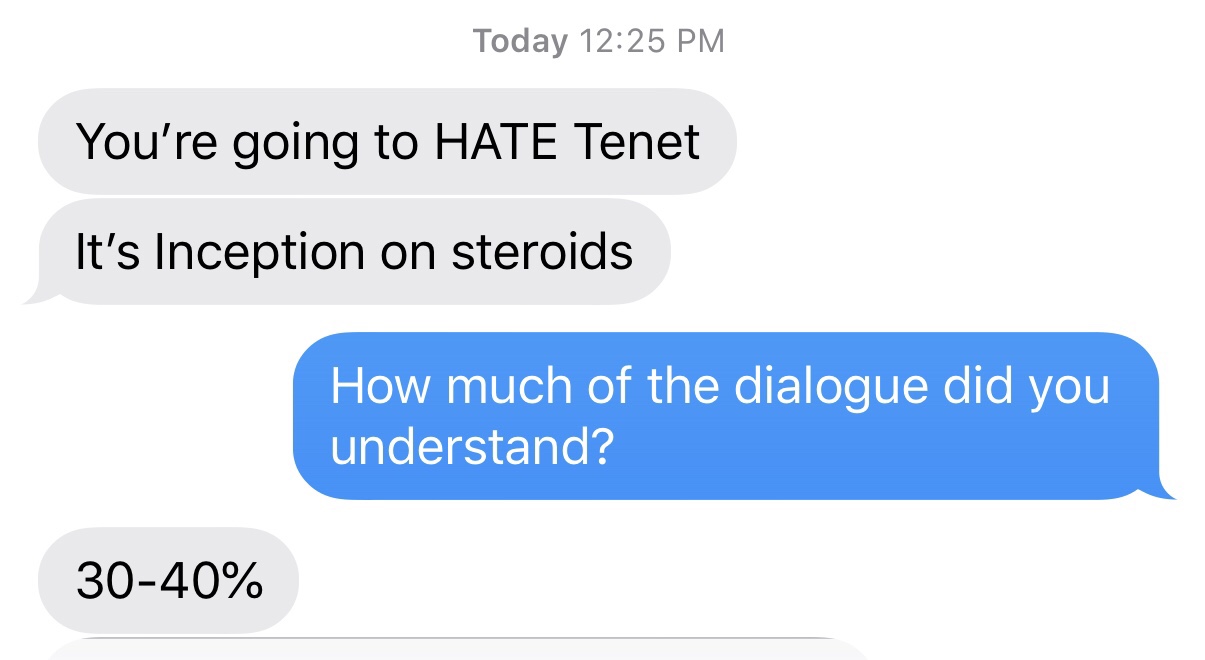
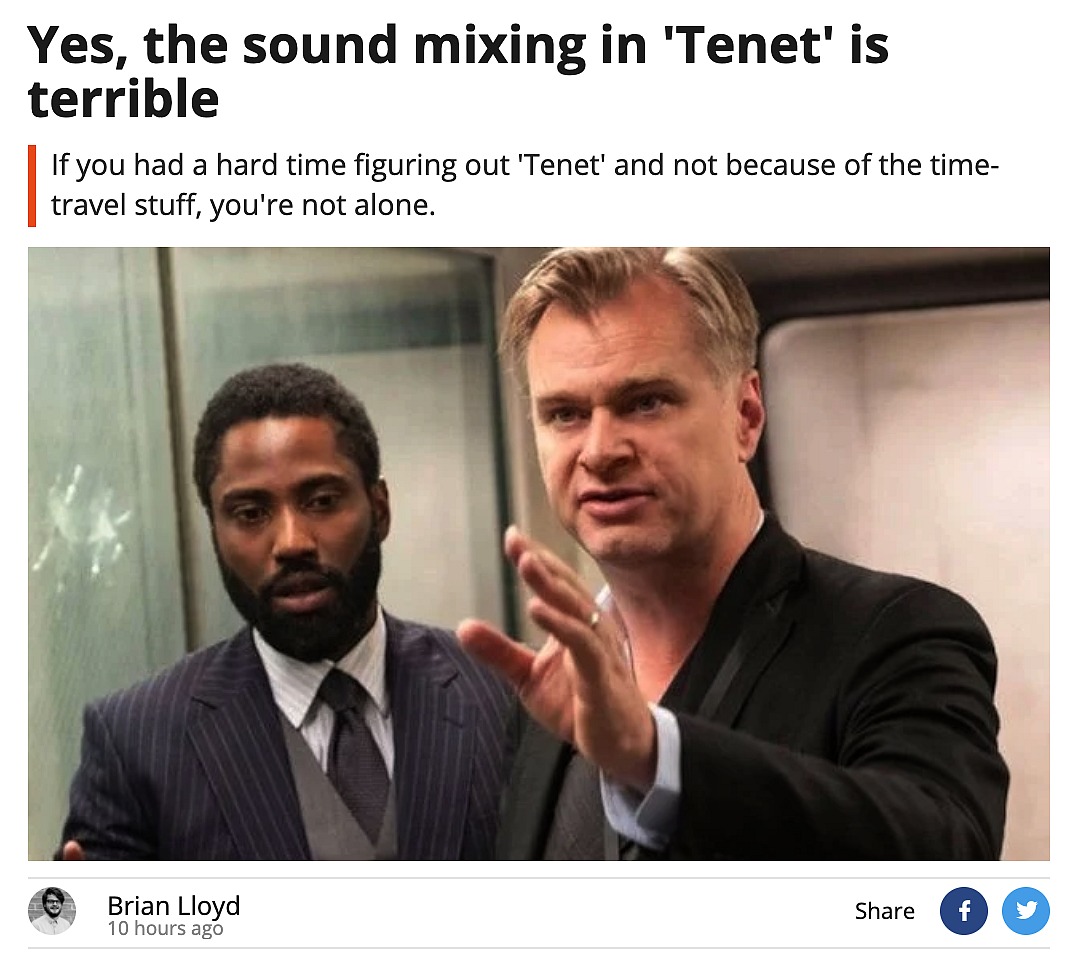
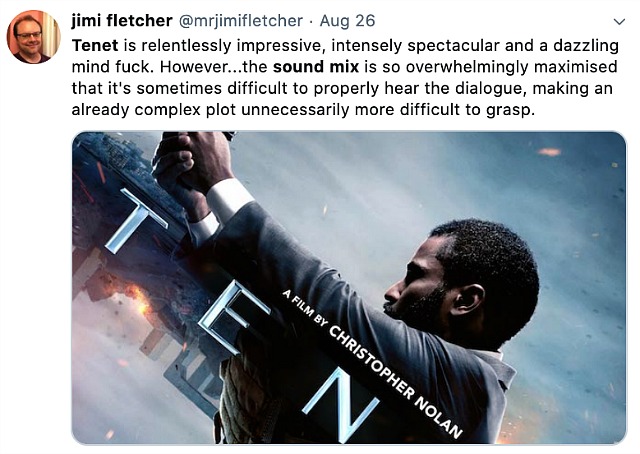
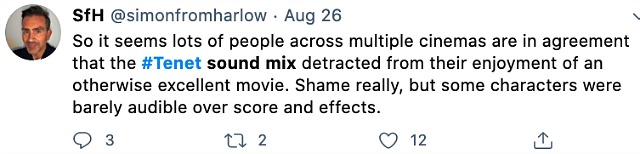
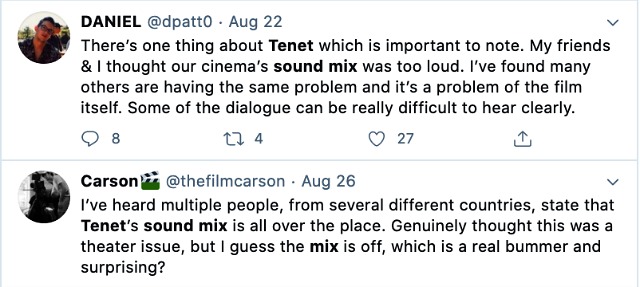
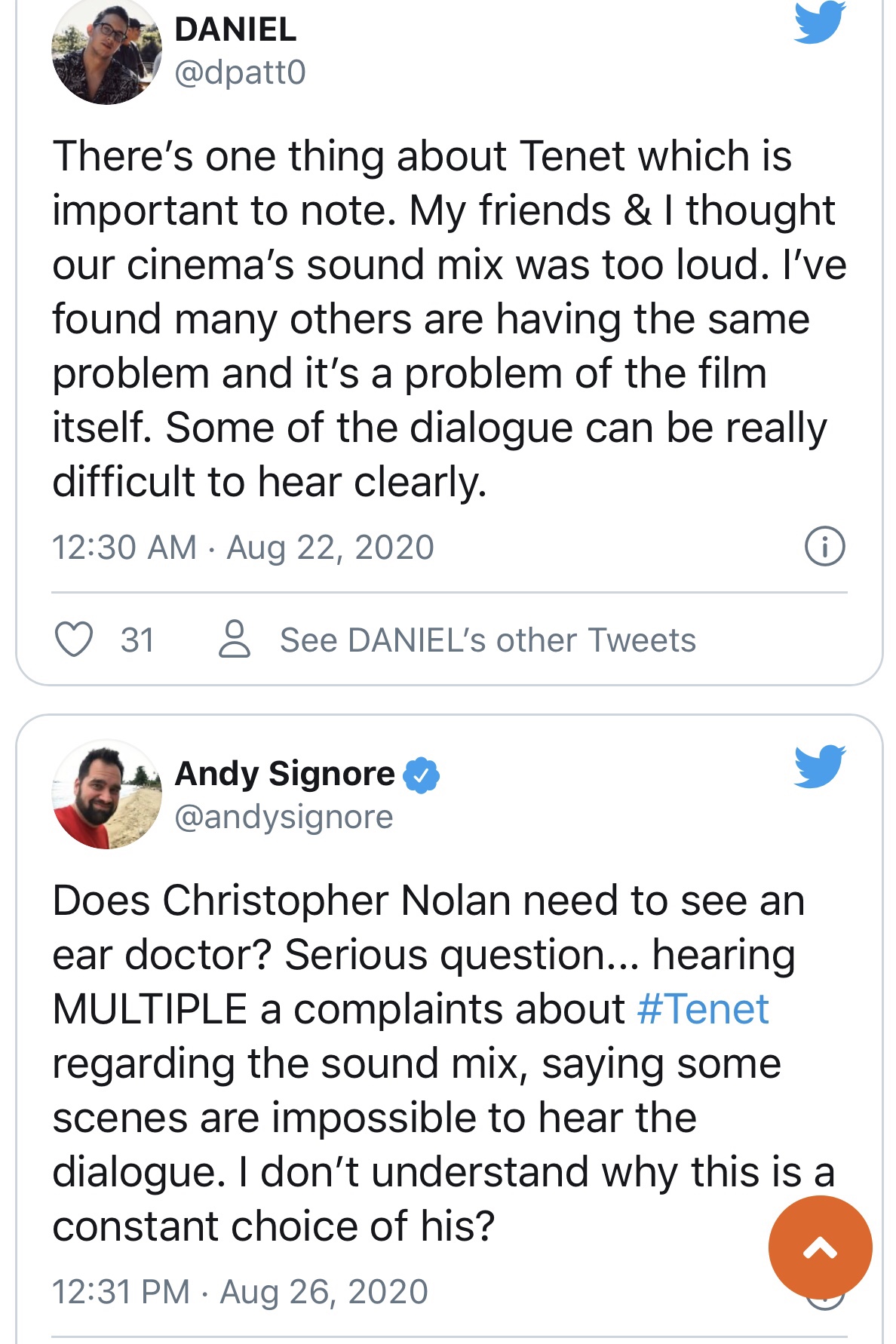
It’s now being alleged on Twitter and by entertainment.ie’s Brian Lloyd that Tenet is another sound headache. The repeated claim is that some passages of expositional dialogue are difficult to decipher.

“The sound mix in Tenet is pretty awful,” Lloyd has written. “Explosions and Ludwig Goransson‘s soundtrack often drown out dialogue to a point of it being unintelligible. At least one key scene involving some pretty key story points is done during wind-sailing over a crackling intercom system.

“It’s so bad, in fact, that we had to view the movie twice. The sound mixing was that terrible the first time around so it required a second viewing. Our first viewing on the movie was done with a 35mm print, while the second viewing was a DCP [presentation].”

In a Reddit q & a, Nolan’s sound designer Richard King, who mixed Tenet as well as Dunkirk and Interstellar, explained Nolan’s concept as follows:

“Chris is trying to create a visceral emotional experience for the audience, beyond merely an intellectual one. Like punk rock music, it’s a full-body experience, and dialogue is only one facet of the sonic palette. He wants to grab the audience by the lapels and pull them toward the screen, and not allow the watching of his films to be a passive experience.

“If you can, my advice would be to let go of any preconceptions of what is appropriate and right and experience the film as it is, because a lot of hard intentional thought and work has gone into the mix.”

Here are some Twitter captures:

Read more