“Outpost” Chickens Are Sorry Now

It would appear that Rod Lurie‘s The Outpost has become, at least to some extent, the new American Sniper — a unanimously well-reviewed war flick that’s connecting with both urban and (perhaps particularly) heartland audiences.

It was reported two days ago that The Outpost is the top renter/seller on iTunes as well as FandangoNow. It still has that standing as of today (7.8). It’s also been reported that the stock price of Chicken Soup for the Soul Entertainment, owner of distributor Screen Media, had surged 26% due to Outpost popularity.

As one of the film’s earliest and most ardent supporters, Hollywood Elsewhere trusts that The Outpost will keep chugging and humming along, and that come award season Caleb Landry Jones‘ performance will continue to generate enthusiasm for a Best Supporting Actor nom.

A fair number of big-time distributors were offered The Outpost earlier this year. Everyone but Screen Media responded with the usual “uhm, we don’t know how to sell it.” Translation: We’ve forgotten how to sell well-crafted war movies on their basic merits, and Scott Eastwood, Orlando Bloom and Caleb Landry Jones aren’t big enough names.” Lurie to prospective distribs: “It’s a straightforward ‘support the troops’ heartland flick with a potential to be the next American Sniper, and it’s relatively inexpensive — how can you not make money with it?”

Screen Media, at least, was willing to take the gamble, and now they’re looking like the smartest kids in the room. All due credit to their foresight, business acumen and marketing (i.e., the little choo-choo engine than showed up the studios).

The original Screen Media plan was to debut The Outpost at South by Southwest and then open it nationwide theatrical run via Fathom, but COVID-19 killed Austin and then the recent surge destroyed the Fathom plan.

In a Deadline guest column, Lurie wrote that his “primary attention and anxieties for this past weekend were directed at how the military community would receive the film, in particular veterans of the Afghanistan War and, even more microscopically, the soldiers and families of the men who served at Combat Outpost Keating where the film is set. That would be the metric of success for this particular film.

“Last October, we showed the movie in rough-cut form to several of the surviving veterans and to family members of the eight men who died in this battle. Jake and I were both nervous wrecks. We had worked so hard on the film and been in constant communication with these people, and yet…well, who knew how they’d react?

“The release of the film prompted an avalanche of support from veterans of the war. Dr. Dan Barkhuff, a Navy SEAL and graduate of the Naval Academy, said it was ‘the best war movie since Black Hawk Down, maybe better.” (Perhaps a bit much, but we’ll take it.)

“A Green Beret with 24 years of service: ‘The authenticity in the film is amazing…it had me reliving the sights and smells of the Nuristan province.’

“On Reddit a veteran observed, ‘The best way to honor these men is to remember them, remember their families when you think of your loved ones, they had wives and children that will never see their husbands/fathers again.’

“A military spouse wrote, ‘If anyone in our country starts to lose respect for what our soldiers go through in a time of divisive politics; they need to see this movie. We owe all of them our deepest gratitude. I can’t thank you enough for putting this together.'”

HE vs. Snooty Morricone Scolds

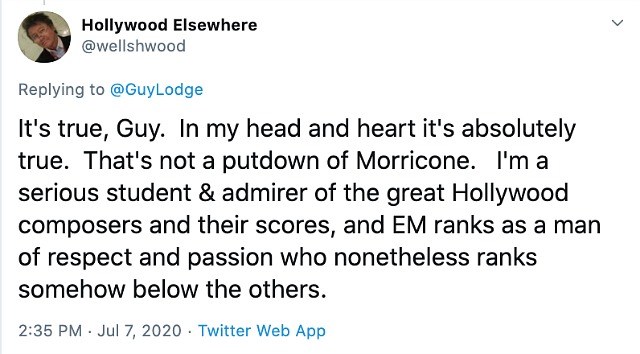
Futile repeating of basics: The late Ennio Morricone was a legendary film-music composer. The common consensus is that he deserves a place in the pantheon, and I’m certainly not arguing with that. But his score for Terrence Malick‘s Days of Heaven (’78) is the only one I truly love, and I just don’t believe that his stuff was otherwise all that elevating or transcendent. Over a half-century-long career he created good, respectable, at times haunting, occasionally hum-worthy music. And that’s as far as I can go.

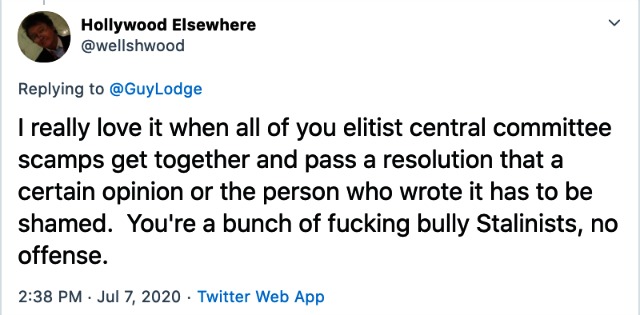
Alas, yesterday the People’s Central Committee for the Assessment and Approval of Critical Opinion decided that yesterday’s “Subdued Respect” post had to be condemned. What’s that old Carly Simon line? “These are the good old days.”

Best Lincoln Project Trump Ad Ever?

Manic but well-disciplined editing plus a fascinating paranoid-whisper soundtrack delivers the effect of being inside Donald Trump‘s mind on a bad day. It reminds me of the brilliant editing in Oliver Stone‘s JFK. HE commenter Jeff Tompkins: “Agreed. A brilliant exercise in Psyops using his phobias against him. Biden’s strategy of letting Trump kill himself while hiding some of his own weaknesses would also be brilliant, if it was actually planned.”

Harper’s to Khmer Rouge: Back Off

In a July 7 manifesto titled “A Letter on Justice and Open Debate” and signed by over 100 journalists, authors and academics, Harper’s is warning the world about the dangers of woke fanaticism and Robespierre cancel culture.

“Whatever the arguments around each particular [twitter-shaming or cancelling], the result has been to steadily narrow the boundaries of what can be said without the threat of reprisal,” the essay notes. “We are already paying the price in greater risk aversion among writers, artists, and journalists who fear for their livelihoods if they depart from the consensus, or even lack sufficient zeal in agreement.

“This stifling atmosphere will ultimately harm the most vital causes of our time. The restriction of debate, whether by a repressive government or an intolerant society, invariably hurts those who lack power and makes everyone less capable of democratic participation. The way to defeat bad ideas is by exposure, argument, and persuasion, not by trying to silence or wish them away.”

Kaufman’s Film-Nerd Satire

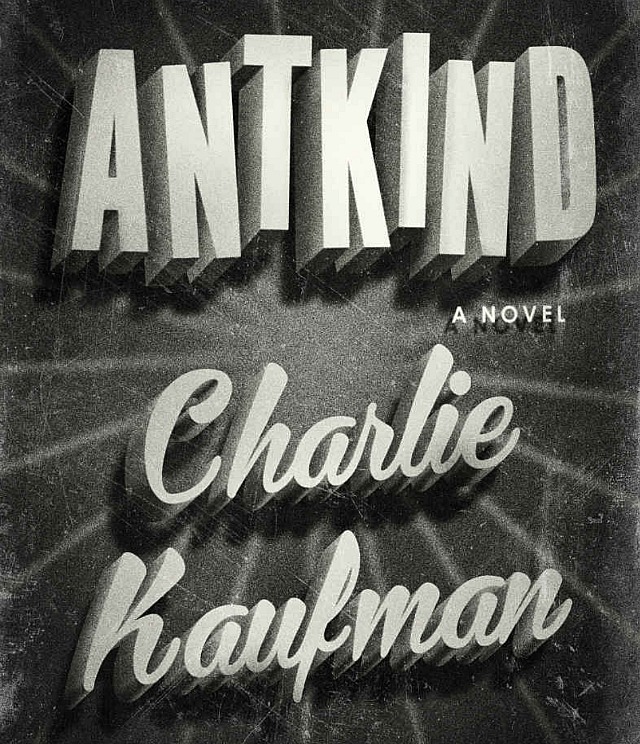
I’m naturally interested in Charlie Kaufman‘s just-published Antkind. What blogaroo wouldn’t be? I’ve only read the opening chapter, but it appears to be a withering satire of a highly self-regarding film devotee slash journalist-author type. The title, which could be interpreted to mean “kind of like an ant”, seems to indicate Kaufman’s attitude about his middle-aged (late 40s?) protagonist.

He sounds like a cross between Humbert Humbert and a Jewish Gerald McBoingBoing. (It’s actually Rosenberg something-or-other.) He’s bald and proudly wears a big, Herman Melville-ish, Brillo-paddy Richard Brody beard as a badge of honor and exceptionalism. He wears “owlish wire-rim glasses” and has a “hawkish nose and sunken blackbird eyes.” And he has a fetching, significantly younger African American girlfriend with whom he has great sex…bullshit.

To go by the Amazon excerpt, the tone of the book is a kind of deep-burrowing insect absurdism. Or, you know, a kind of surrealist extremism that keeps the reader at arm’s length. Nothing is real, and nothing to get weirded out about because it’s Charlie Kaufman wandering through a hermit-termite world…a low-rentish, film-dweeb nether realm, half cave and half steel cage.

Descriptive excerpt: “Trapped in a self-imposed prison of aspirational victimhood and degeneratively inclusive language…while attempting to keep pace with an ever-fracturing culture of ‘likes’ and arbitrary denunciations that are simultaneously his bête noire and his raison d’être.”

HE commenter Jimmy Porter said this morning that Kaufman “gets effete film bloggers down to a tee.” The toenail-fungus kind, he means. We’ve only just met, but Rosenberg McBoingBoing has never owned a pair of suede Bruno Magli lace-ups, trust me. And he’s certainly no urban rumblehogger.

In the opening chapter Humbert Rosenberg McBoingBoing is driving through pitch-black darkness in rural Florida, heading toward St. Augustine. Every so often he notices a roadside fast-food joint with the lights on but zero customers. One of these operations is called Slammy’s. Any rural fast-food joint with an eccentric, clearly non-corporate name like Slammy’s is something to be savored if not cherished. If I saw an open-for-business Slammy’s in some out-of-the-way hamlet I would pull over without hesitation. I would order and sit on one of the outdoor benches and phone-surf. I would breathe it all in and smell the air and gaze at the stars.

Charlie’s protagonist pulls in, but only to get some paper towels and a cup of water to clean his windshield with. That’s a significant difference right there.

“Writing Happens To You”

New Yorker film editor/columnist Richard Brody, speaking in a video dated 2.1.14: “The act of writing, itself, is almost sexual. The act of writing, itself, is almost transcendent. Nobody should ever be proud of their writing. Because no one should ever take credit for writing. It happens to you.”

Correction: Good writing happens to you. You’re sniffing and digging and poking around, and then, if God or fate or luck wills it, you’ll strike oil in the same way that James Dean‘s Jett Rink noticed oil seeping through the mud. If you stay with it (and if you’ve any kind of knack or talent) you’re suddenly in the groove and maybe even riding a perfect wave.

The best way to find oil is to not care if what you’re tapping out is any good. If you’re reviewing yourself as you write, if you’re overly concerned with how people might react as you’re attempting to say or explain something, you’ll never take flight. Otherwise writing…typing, I should say, is drudgery. Typing without hope of oil is worse than digging ditches.

And being stuck on a dry, oil-less plateau with an IBM Selectric while sitting inside a West Fourth Street studio back in the early ’80s…it was so godawful I can’t revisit.

Out Of The Blue

Phillip Noyce‘s Above Suspicion, a brilliant Kentucky redneck crime drama that I first saw and wrote about three years ago, is still unreleased. It was going to open last March but you know what happened. The last I heard the U.S. debut would be in early ’21. The 7.5 appearance of an “international” trailer suggests an Australian opening. The whole COVID thing has thrown everything out of whack.

The Girl From Lonesome Holler,” posted on 7.24.17: “Above Suspicion, which is based on Joe Sharkey’s 1993 true-life novel, is a triple-A, tightly-wound, character-driven genre flick (i.e., rednecks, drug deals, criminals, lawmen, murder, car chases, bank robberies) of the highest and smartest order.

“Most people would define ‘redneck film’ as escapist trash in the Burt Reynolds mode, but there have been a small handful that have portrayed rural boondock types and their tough situations in ways that are top-tier and real-deal. My favorites in this realm are John Boorman‘s Deliverance, Billy Bob Thornton‘s Sling Blade, and Lamont Johnson‘s The Last American Hero. Noyce’s film is the absolute, dollars-to-donuts equal of these films, or at least a close relation with a similar straight-cards, no-bullshit attitude.

“Noyce always delivers with clarity and discipline but this is arguably the most arresting forward-thrust action flick he’s done since Clear and Present Danger. Plus it boasts a smart, fat-free, pared-down script by Mississippi Burning‘s Chris Gerolmo, some haunting blue-tinted cinematography by Eliot Davis (Out of Sight, Twilight) and some wonderfully concise editing by Martin Nicholson.

Above Suspicion damn sure feels like an early ’70s film. I mean that in the most complimentary way you could possibly imagine. It’s about real people, tough decisions, yokel culture, corruption, Percocets, hot car sex and lemme outta here. There’s no sense of 21st Century corporate wankery. Adults who believe in real movies made this thing, and they did so with an eye for tension and inevitable plot turns and fates dictated by character and anxiety and, this being rural Kentucky, bad karma and bad luck.”

Subdued Respect

Ennio Morricone was a talented, gainfully employed composer who knew from catchy hooks and whistling melodies, but to a significant degree he was a a genre guy. Because when you boil it right down his whole career rests upon his scores for Sergio Leone‘s spaghetti westerns (A Fistful of Dollars, For A Few Dollars More, Once Upon A Time in the West) and, more recently, his score for Quentin Tarantino‘s The Hateful Eight. Plus the scores for Gillo Pontecorvo‘s The Battle of Algiers, Bernardo Bertolucci‘s 1900 and Terrence Malick‘s Days of Heaven (along with Leo Kottke).

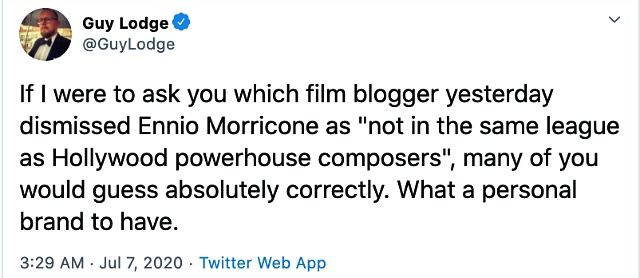
In the Italian realm Morricone’s music wasn’t as deep or ravishing as Nino Rota‘s, and he certainly wasn’t in the same league as Hollywood powerhouse composers like Bernard Herrmann, Max Steiner, Franz Waxman, Elmer Bernstein, John Williams, Jerry Goldsmith, James Horner, David Raksin, Dimitri Tiomkin, Miklos Rozsa, Maurice Jarre, Alex North and Hugo Freidhofer. Not in my book, he wasn’t.

Diminishing Returns?

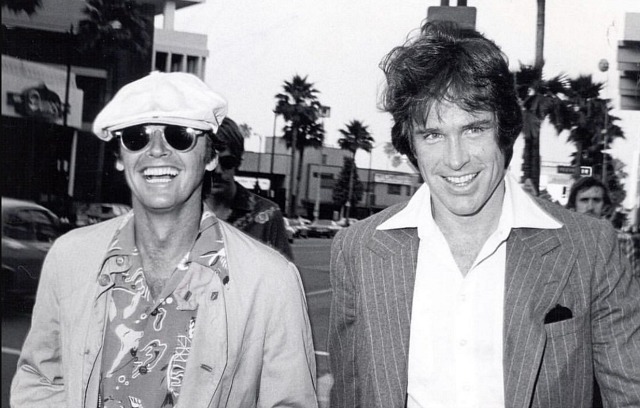
Seven years ago Bruce Dern shared an interesting observation about the difference between his generation of actors (i.e., Clint Eastwood, Warren Beatty, Jack Nicholson, Harrison Ford, Lee Marvin, Al Pacino, Robert DeNiro) and the classic big-studio stars of the ’30s, ’40s and ’50s (Clark Gable, James Stewart, Gary Cooper, Cary Grant, Spencer Tracy, Humphrey Bogart, John Wayne, James Cagney, Frank Sinatra, Burt Lancaster, Alan Ladd, Errol Flynn, Kirk Douglas).

“The difference between my generation of actors and their generation is that they were bigger than life,” Dern said. “My generation got a chance to work with the legends, but we are not bigger than life. Not today. Too many people want to know what you do after work. You can’t be a mystery anymore.”

I came upon this photo early this morning. I’m guessing it was taken sometime in the mid ’70s (maybe ’77 or ’78, judging by Beatty’s elephant collar). My first thought was that in their day, these guys were just as “bigger than life” as the big-studio guys. They certainly seem to have a certain something or other, an extra-dimensional glow or current that out-pulsates Timothee Chalamet, Ansel Elgort, LaKeith Stanfield, Liam Hemsworth, Nicholas Hoult, John David Washington, RBatz, John Boyega, et. al. No?

Oscar-wise, “Hamilton” Is Oh-You-Tee

This morning Variety‘s Marc Malkin reminded the industry that “recorded stage productions are not eligible for consideration.” That’s straight out of the AMPAS rulebook, and so you can forget Hamilton as a Best Picture contender.

The fact that the Disney Plus filmed version was watched by nearly everyone over the Independence Day holiday weekend will have to do. That and the fact that it’s won 11 Tonys, a Pulitzer and a Grammy.

Hollywood Elsewhere watched the Disney Plus Hamilton a couple of nights ago, and my basic reaction was to agree that 18th Century hip-hop is indeed a thing to submit to, revel in and cheer as far as it goes.

Hamilton is five years old now, but it was the first high-impact show to afford POCs strength and dominance in a reimagined historical narrative. Many films, plays and streamers followed in its conceptual wake. A brilliant gimmick slash concept, and certainly vigorously staged, inventive, dynamically conceived, excitingly choreographed. So yes, it’s quite the capturing of the late Obama zeitgeist.

But thank God for the subtitle option. I caught a phrase here and there, but I’m glad I saw it with subtitles because at least I understood every line and phrase. If I’d paid $400 or $500 to see it on stage at Manhattan’s Richard Rodgers theatre, I would have followed the general drift but missed 60% or 70% of the particulars.