Sweltering temps begin today. I love 92 in the shade in the dry lower desert, but not so much in muggy-ass Connecticut or Manhattan.
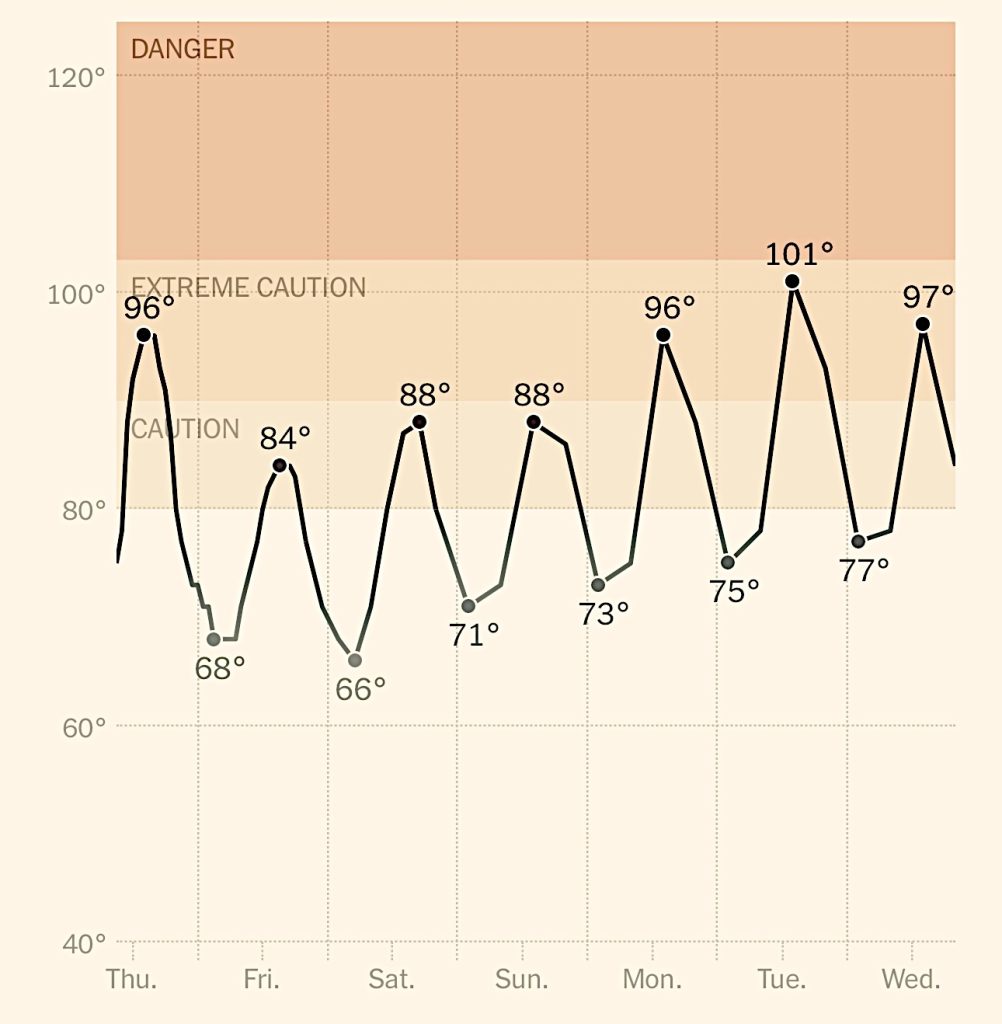

Sweltering temps begin today. I love 92 in the shade in the dry lower desert, but not so much in muggy-ass Connecticut or Manhattan.
As a veteran of countless back-and-forths between Fairfield and Westchester counties and NYC-area airports (JFK, LGA, Newark), I’m acutely aware of how agonizing and soul-draining congested highway travel can be (particularly on the 678 through the Bronx and Queens).
Don’t buy any bureaucratic b.s. about the massive JFK reconstruction project proceeding at a reasonable pace — month after month the seeming absence of churning machinery and busy-bee workers by the roadside has been obvious — it’s mostly a slow-motion exercise in urban hellscape obstruction.
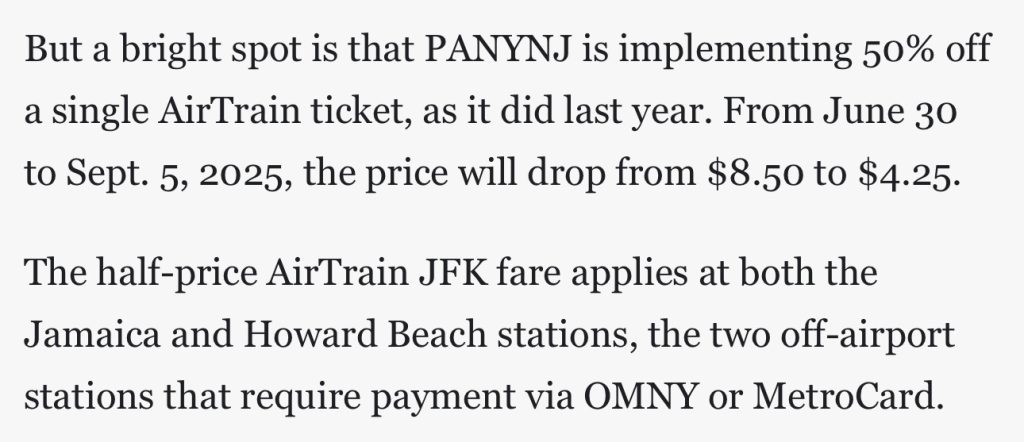
Take a train to Manhattan and then grab a Howard Beach-bound A train plus the JFK Air Train (the fare will be cut this summer by 50%!)…only way to travel.


When it came to brass tacks at the end of The Godfather‘s first act, Michael Corleone didn’t mince words: “We can’t wait. We can’t wait. I don’t care what Sollozzo says about a deal, he’s gonna kill Pop…that’s it. That’s the key for him. Gotta get Sollozzo.”
Similarly, Israel’s Bibi Netanyahu has said in no uncertain terms that Israel (and by extension the U.S,) has to “get” Iran’s Supreme Leader, Ayatollah Ali Khamenei. Netanyahu has stated that he believes Khamenei’s death could potentially “end the conflict” between Israel and Iran.
So that’s it — kill the Ayatollah. A bullet through the forehead inside Louis’s restaurant in the Bronx.

At the end of yesterday’s riff about Team IndieWire’s rundown of the finest films from the first half of the 2020s, I said I’d slap together HE’s own roster from the same period. My tally comes to 38, but maybe I’ve overlooked a few.
HE’s top ten films of the 2020-2025 period thus far: (1) Roman Polanski‘s J’Accuse (which premiered in Europe in late ’19 but wasn’t pirated for U.S. consumption until early ’20), (2) Sean Baker‘s Anora, (3) Joachim Trier‘s Sentimental Value, (4) Steven Zallian‘s Ripley, (5) Edward Berger‘s Conclave, (6) Steve McQueen‘s Mangrove, (7) David Fincher‘s The Killer, (8) Pedro Almodovar‘s Parallel Mothers, (9) Reinaldo Marcus Green‘s King Richard, (10) Tran Anh Hung‘s The Taste of Things (The Pot au Feu).
Second Grouping of Ten: (11) Guy Ritchie‘s The Covenant, (12) Joseph Kosinski‘s Top Gun: Maverick, (13) Hasan Hadi‘s The President’s Cake, (14) Janicza Bravo’s Zola, (15) Joachim Trier’s The Worst Person in the World, (16) Mike Leigh’s Hard Truths, (17) Eva Victor’s Sorry Baby, (18) Yorgos Lanthimos’ Poor Things, (19) Bradley Cooper‘s Maestro, (20) Alexander Payne‘s The Holdovers.
Third Grouping of Ten: (21) Audrey Diwan‘s Happening, (22) Jasmila Žbanić‘s Quo Vadis, Aida?, (23) Errol Morris‘s The Pigeon Tunnel, (24) Ali Abbasi‘s The Apprentice, (25) Alice Rohrwacher‘s La Chimera, (26) Anders Thomas Jensen‘s Riders of Justice, (27) Jon Watts‘ Spider-Man: No Way Home, (28) Peter Jackson‘s The Beatles: Get Back, (29) Cristian Mungiu‘s R.M.N., (30) Todd Field‘s TAR.
Last Licks: (31) Alejandro G. Iñárritu‘s Bardo, False Chronicle of a Handful of Truths; (32) Aaron Sorkin‘s The Trial of the Chicago 7, (33) Judd Apatow‘s The King of Staten Island, (34) Michael Winterbottom‘s The Trip to Greece, (35) Diao Yinan‘s The Wild Goose Lake, (36) Chloe Zhao‘s Nomadland, (37) Jon M. Chu‘s In The Heights, (38) Steven Spielberg‘s West Side Story.
Obviously grade-A direction, writing, acting (not just Jeremy Allen White as Bruce but the great Jeremy Strong as Jon Landau, his manager) and everything else.
Please, please debut this biopic at the 2025 Venice Film Festival.
Why isn’t it just called Deliver Me From Nowhere? Why did they have to fecking call it Springsteen: Deliver Me From Nowhere? You know the answer. You know why they added his last name to the title. Because a significant portion of American moviegoers are too ignorant, and because they’d be alienated by a title that sounds a bi despairing and melancholy.
Deliver Me From Nowhere is the coolest sounding movie title since Zero Dark Thirty. But the 20th Century marketers have killed it…they’ve killed the poetic vibe.
Long is the way and hard that, out of darkness, leads up to Oscar light.
Cary Grant famously labored as a (mostly leading) Hollywood actor for 35 years before retiring. He began at Paramount in 1931 and retired after Walk Don’t Run in 1966. He had been Best Actor-nominated for Penny Serenade (’41) and None But the Lonely Heart (’44), but Grant never had his golden-statue moment until landing a Lifetime Achievement Oscar in 1970. 39 years in the making**.
On 11.16.25, Cruise, one of the most popular, hard-working and quality-aspiring stars in Hollywood history, will receive the same kind of award given to Grant — an Honorary Oscar — at a Governors Awards ceremony inside the Ray Dolby ballroom.
He’s been Best Actor-nominated three times — Born on the Fourth of July, Jerry Maguire and Magnolia — but, like Grant, has never won, and he damn well should have been nominated for playing Vincent-the-hit-man in Collateral. And now after 44 years of acting in major-league films (1981’s Taps was his first standout role) and serving as a major theatrical magnet since Risky Business, Cruise’s moment in the sun as at hand.
Grant was 66 when he finally took the Oscar stage; Cruise will be 63 when his big moment occurs five months hence.
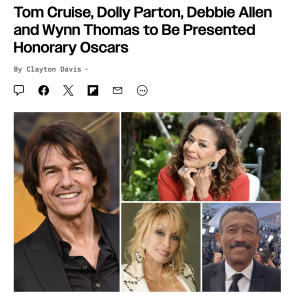
** In my book Grant should have been nominated for his lead performances in Only Angels Have Wings, Mr. Blandings Builds His Dream House, To Catch a Thief and absolutely North by Northwest.
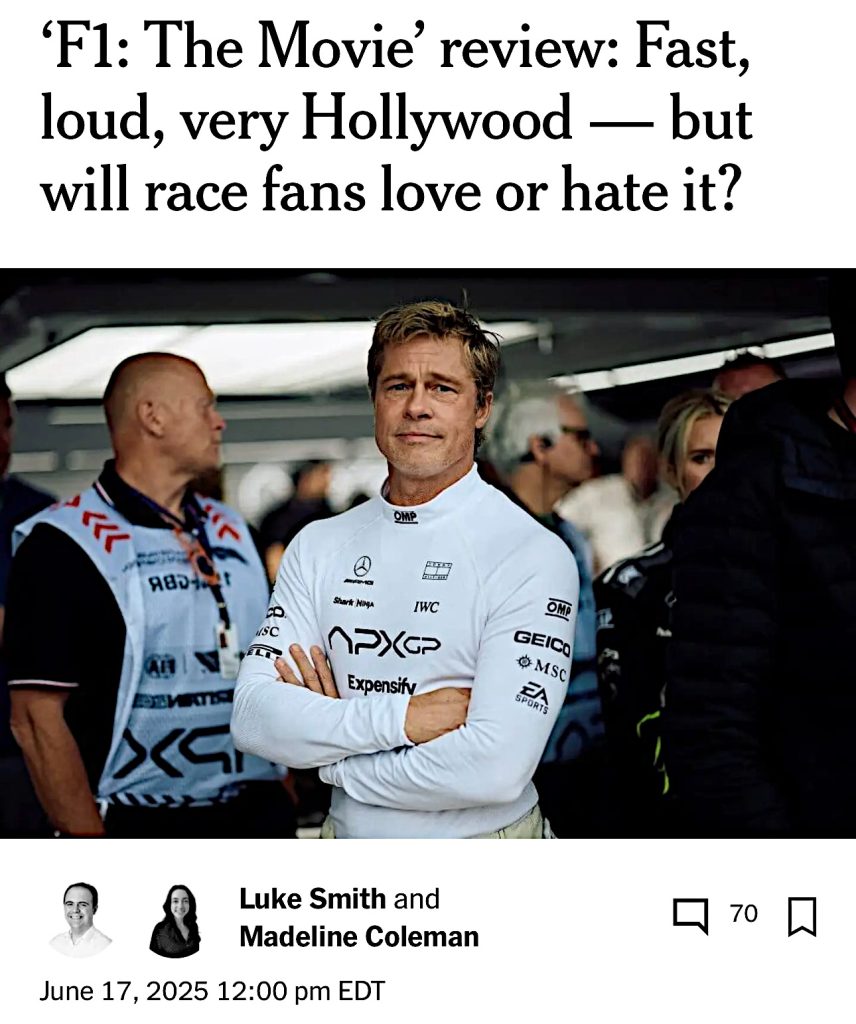
Only in the N.Y. Times could you find a nod to the trans community in a sentence about the growing presence of women within the F1 fanbase.
In an F1: The Movie fan–review piece by Luke Smith and Madeline Coleman (“Fast, Loud, Very Hollywood — But Will Race Fans Love It or Hate It?”), a parenthetical appearing inside the second sentence in paragraph #36 reads as follows: “Around 40 percent of the F1 fanbase identify as women”.
In other words, Smith and Coleman are allowing for the possibility that this particular fanbase is composed of biological women (almost certainly the majority congregation) as well as an unspecified percentage of biomales presenting themselves as women…right?
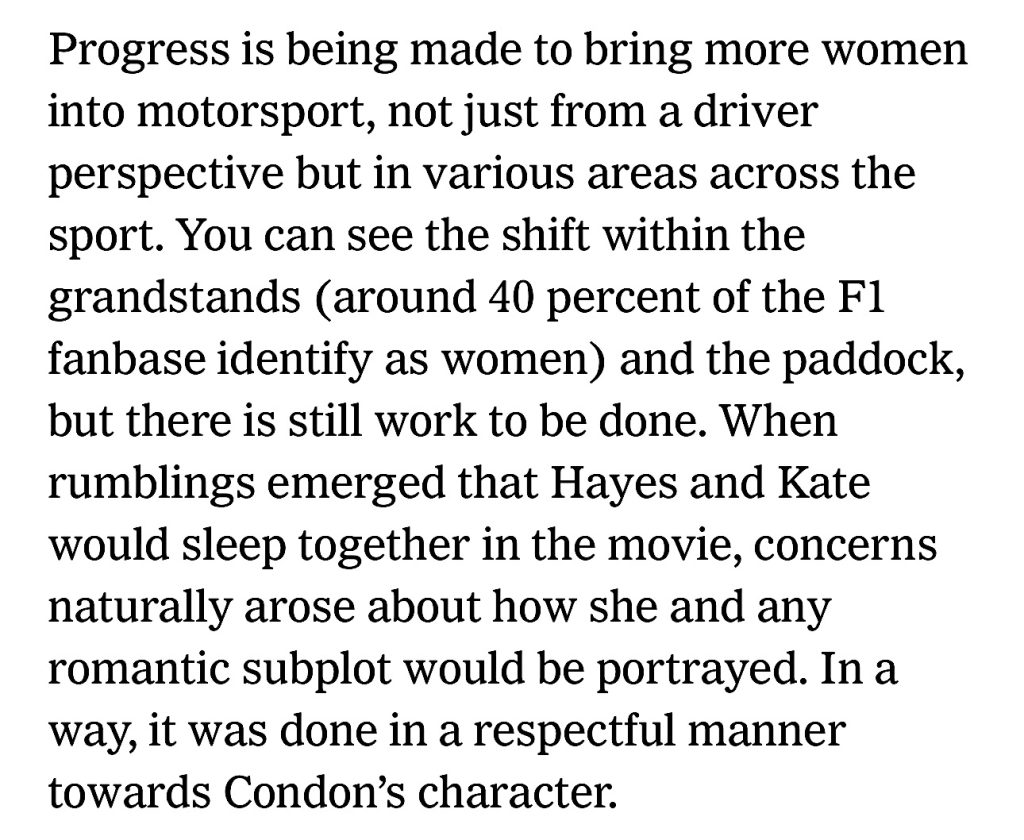
Paragraph #14, by the way, contains a major spoiler about Damson Idris’s Pearce character.
Almost everything was awful in ‘20, ‘21 and early ‘22…peak wokeism + the pandemic…the dreariest and darkest years of our lives.
One of the lowest, most despairing episodes in my industry-covering life was watching the beyond-awful Union Station Soderbergh Oscars — people still shudder at this memory, an epochal event that convinced the moviegoing public that progressive filmmakers were giving the finger to ticket-buyers …that they were committed to the guilt-tripping, misery-spreading business like never before.
But then three months later (July ‘21) along came David Lowery’s The Green Knight…a dank, sodden enterprise that stood up to the Soderbergh lethargy and said “hold my beer….you don’t know what a misery pit is.” And then Leos Carax’s Annette opened a month later, plunging movie culture into an even blacker realm.
Lo, a swirling devil cloud had descended, and only now can we understand that it was this four-month nightmare (April to August ‘21) that more or less slit the throat of the movie industry…that convinced Joe and Jane Popcorn that modern cinema was up to something menacing and awful and deeply insane.
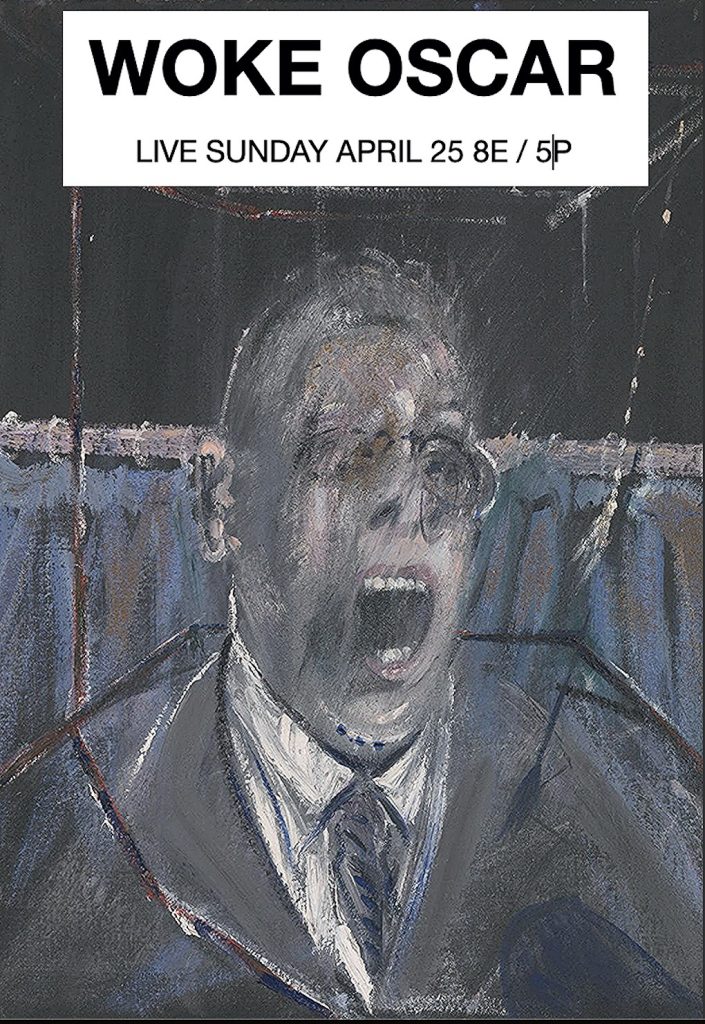
Like a strange virus I had absorbed but hadn’t yet settled into my system, I could feel my latent loathing for David Lowery‘s The Green Knight early on. I didn’t watch it when it first came out because I “knew” (i.e., strongly sensed) I would hate it.
I finally streamed this fucker late last night, and I felt smothered in thick, swamp-like boredom within seconds. Drugged, oxygen-starved, submerged in medieval muck, and facing a terrible two-hour slog.
I will never forget The Green Knight, and I will never, ever watch it again. It’s an exacting, carefully crafted, “first-rate” creation by a director of serious merit, and I was moaning and writhing all through it. I can’t believe I watched the whole thing, but I toughed it out and that — in my eyes, at least — is worth serious man points.
The Green Knight is a sodden medieval dreamscape thing — a trippy, bizarre, hallucinatory quicksand movie that moves like a snail and will make you weep with frustration and perhaps even lead to pondering (not my idea but the film’s) the idea of your own decapitation.
What would I rather do, I was asking myself — watch the rest of The Green Knight or bend over and allow my head to be cut off? Both would be terrible things to endure, I reasoned, but at least decapitation would be quick and then I’d be at peace. Watching The Green Knight for 130 minutes, on the other hand…
It’s a kind of Christmas movie or, if you will, about a game of strange beheadings. Dev Patel‘s Gawain is one of the Knights of King Arthur’s Round Table — a drinking, whoring fellow who sweats a lot and often smiles when spoken to and regards much of what he sees with his mouth half open.
It must be said that Gawain splashes water onto his face and hair a lot…he’s often dripping.
The film more or less begins with the Green Knight, a intimidating ghostly figure, appearing at King Arthur’s court on Christmas Day and declaring — bear with me here because this makes no sense — that anyone can cut his head off as long as the head-chopper will agree to let his own head be sliced off by the Green Knight a year later, at the Green Chapel.
What kind of blithering moron would say “okay!” to a suggestion this ridiculous?
Why is Patel, the son of British-residing Indian Hindus, playing Gawain, a medieval Englishman with the usual Anglo-Saxon characteristics? You could just as well ask why Patel was cast in the lead role in Armando Iannucci’s David Copperfield (’20). Because in today’s realm it’s cooler to embrace “presentism” than to adhere to any sense of general historical reality, or at least the historical reality that filmmakers tended to prefer before anti-white wokester Stalinism became a thing. Call it subversive casting, if you want.
Everything that happens is dream-logical. None of it adds up or leads to anything else. You could claim that Lowery’s film is about character and morality and karma and facing the consequences of one’s own actions, and I would say “okay, sure…if that works for you, fine.”
There’s a talking fox. There are giant bald women seen in the misty distance. Patel’s head explodes in fire at one point…whoa.
Barry Koeghan, an Irish actor with tiny rodent eyes and a deeply annoying swollen nose, plays a scavenging asshole of some kind. Alicia Vikander plays two roles, a commoner with a Jean Seberg-in-Breathless haircut, and a married noblewoman who has sex with Gawain at one point. You’re thinking “gee, she’s bringing Patel to orgasm…am I supposed to give a shit one way or the other?”
DECAPITATION SPOILERS: There are three beheadings in The Green Knight, and a promise of a fourth. The big ugly Green Knight (played by Ralph Ineson) loses his head early on. A ghost character named Winifred (Erin Kellyman) loses hers at the midway point. Patel’s Gawain, the ostensible hero, loses his at the end. And then he wakes up and realizes he’s been dreaming, but then is asked to submit to an actual beheading…this is presented as some sort of satisfying ending.
The finale is a complete failure, a wipe-out. It’s so completely off and miscalculated that it inspires you to mutter “seriously….that‘s the ending?”
Five minutes after The Green Knight began I understood why Average Joes have generally given it poor reviews. It’s obviously a visually inventive, high-style smarthouse thing about ultra-peculiar realms, made by a director who believes in imaginative leaps of fancy and fantasy, but watching it makes you feel fucking awful.
I can’t tell you how depressed I was at the half-hour mark when I realized I had 100 minutes to go.
Film critics generally don’t acknowledge audience miserablism. For most of them visual style is 90% to 95% of the game. If a director shoots a film with a half-mad, child-like sense of indulgence with a persistent visual motif (i.e., everything in The Green Knight is either muted gray or brown or intense green)…bathing the viewer in mood and mystery and moisture (filmmakers like Lowery adore mist, fog, rain, mud, sweat, rivers, streams)…that’s it and all is well.
There are dozens of details I could get into, but I’m not going to because what’s the point?
I had read several reviews, of course, but before watching Lowery’s film I read the Wiki synopsis of the source material, “Sir Gawain and the Green Knight,” a 14th Century epic poem. Right away I was muttering “dear God…no, please.”
I’m completely mystified why British film director Stephen Weeks would make two films based on the Sir Gawain legend — Gawain and the Green Knight (’73) and Sword of the Valiant (’83).
Friendo: “The best reviewed movies of the year so far are The Green Knight, In the Heights and Pig. We are fucked. American cinema is dead.”
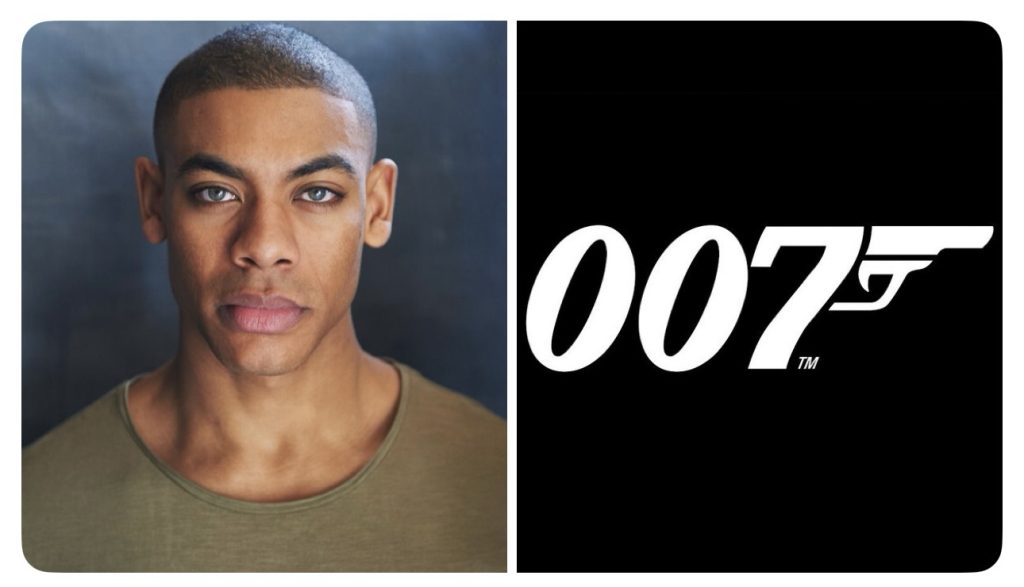
The new Bond just has to be British…that’s the main thing. I’m okay with Aaron Pierre, 31, filling the slot. He’s an above-average actor (admired him in Rebel Ridge) with great eyes and a buff bod.
But nobody cares about the Bond franchise, do they? The concept of a stand-alone Bond film has been all but terminated with Amazon intending to strip-mine 007 for all he’s worth.
I think the current was destroyed when (a) Daniel Craig was killed for absolutely no reason, and then (b) the toxic, deeply loathed Jennifer Salke stalled the development process interminably.

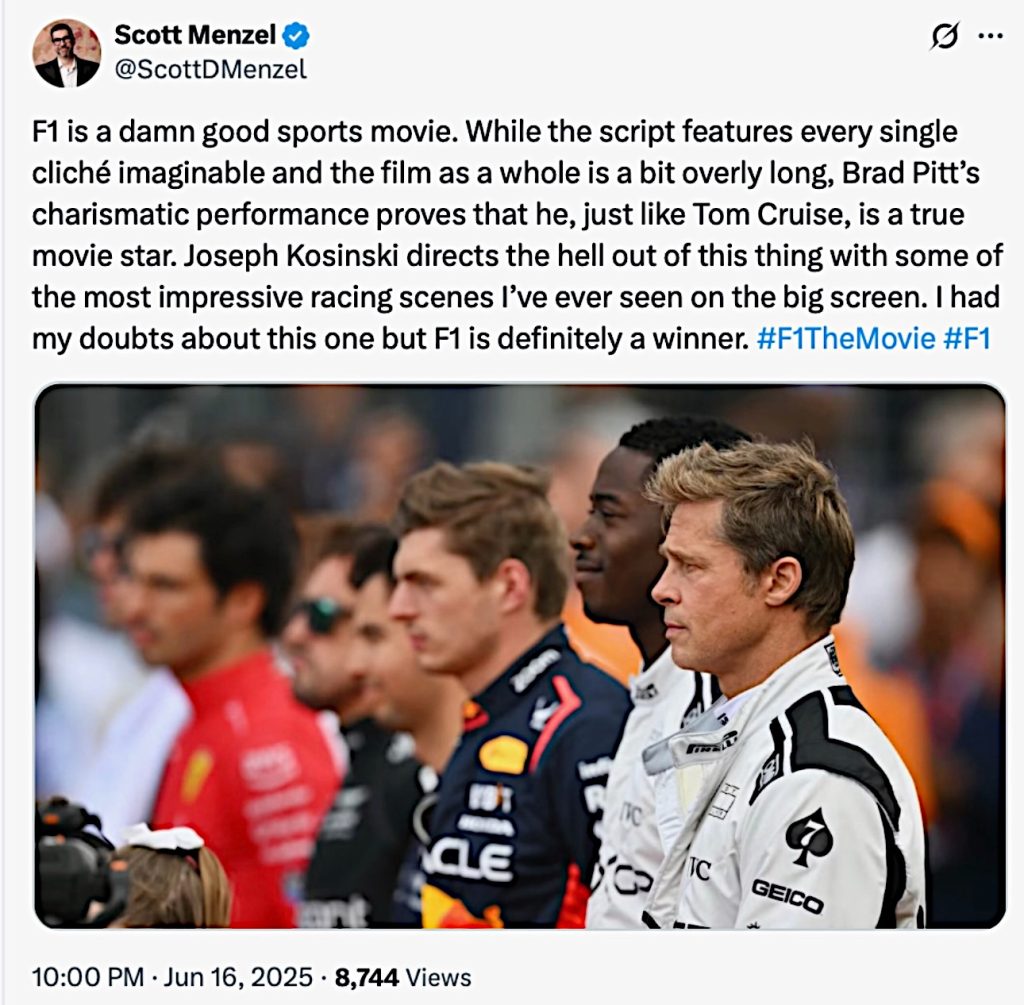
I’ll admit it — I’m emotionally invested in F1 enjoyment, regardless of however good or great or so-so it might turn out to be. I’ve read that it has issues, but I don’t want to play in that playground.

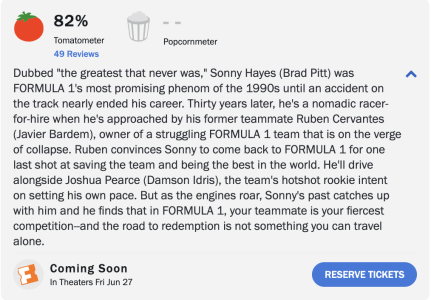
“F1 isn’t deep or layered or complex enough, dammit! Adrenaline highs are well and good, but we’re hoity-toity film critics, and and we want more. We want something that’s friskier and woolly-bullier and deeper and more emotional than a proverbial ‘dad movie’. Something that attempts the unexpected.
“Why wasn’t F1 directed by James Cameron of the ’80s and ’90s? Or by the Michael Mann of the ’90s and aughts? You know what we mean…by a director who’s more inward and contemplative and a bit less formulaic and synthetically-minded than Joseph Kosinski seems to be.
“Why couldn’t it have been directed by the Tony Richardson who made The Loneliness of The Long-Distance Runner, say? Or the Karel Reisz who made Saturday Night and Sunday Morning? Why are we stuck with a hugely exciting but very standard slam-bang vroom-vroom?” — the Rotten Tomato & Metacritic pissheads (Owen Gleiberman, Kevin Maher, Whitney Seibold, Ian Sandwell, Wiulliam Bibbiani)
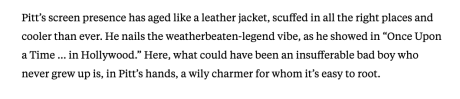
From Gleiberman’s review: “There have been very good auto-race dramas, like Ford v Ferrari, centered around conventional macho-rivalry plots. That F1 flirts with cliché isn’t necessarily a problem; just look at how commandingly Pitt takes a character we’ve seen before and paints him with a fresh coat of rusty glamour.
“But what a movie like this one needs is for the drama to play out within the races themselves. That’s what happened in Ford v Ferrari, and in the aerial dogfights of Top Gun and Top Gun: Maverick (which were shot and edited with bedazzling precision), and in the car-race film that raised this sort of thing to the level of art — the staggeringly underrated Ferrari.
“But as F1 sprawls across the Formula One World Championship, moving through the last nine Grand Prix contests of the season, the races generate a surface buzz, but the stories they’re telling are less than razor-sharp.”
HE to Gleiberman: I wasn’t totally floored by Ford v Ferrari, but I really like Grand Prix, and you’ve just called the non-racing portions of that 1966 John Frankenheimer film “late-studio-level claptrap.” The hell you say! The non-racing portions are assured and acceptable as far as they go, and don’t hinder the basic scheme.
I’m not saying we need incontrovertible proof that IndieWire’s cinematic soothsayers are living on a separate rarified planet…I think most of us have absorbed this repeatedly over the years, particularly since Team IndieWire went wacko wokey starting in the late teens….
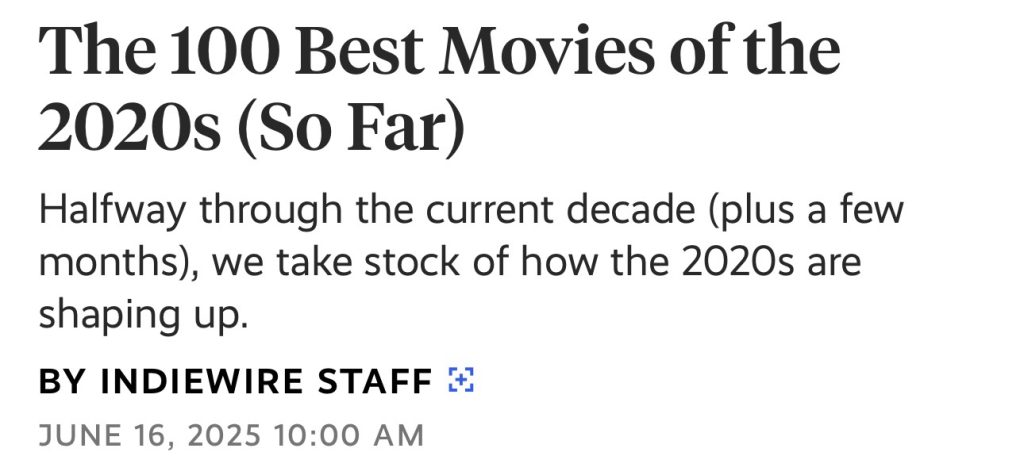
But if you want proof of this, read no further than their “100 Best Movies of the 2020s” rundown, which posted yesterday (6.16).
I’m not going to nitpick the entire list, and yes, I’m either agreeing or am largely comme ci comme ca with a fair amount of their selections. These guys are nutty but not completely untethered
But at the same time they’re saying with a straight face that Charlotte Wells’ Aftersun (which plague-dogged us wih the insufferably sensitive weepy-ass Paul Mescal) and Ryusuke Hamaguchi‘s Drive My Red Saab (primarily an ode to Parliament cigarettes)…they’re saying these films deserve third- and ninth-place rankings. C’mon!
They’re also declaring that Jordan Peele’s Nope (#12), Jane Campion’s stifled, soul-draining (if visually handsome) The Power of the Dog (#14) , Martin Scorsese’s colossally miscalculated Killers of the Flower Moon (#29), The Daniels’ mostly infuriating Everything Everywhere All At Once (#36), David Lowery’s all-but-unwatchable The Green Knight (#45) and the Wachowski’s 100% unbearable The Matrix Resurrections (#49) deserve special consideration among the top 50 films…lunacy!
They’re also saying that these eight migraine-inducers are better than five incontestably superior releases from the same era…Janicza Bravo’s Zola (#59), Joachim Trier’s The Worst Person in the World (#62). Mike Leigh’s Hard Truths, Eva Victor’s Sorry Baby (#77) and Yorgos Lanthimos’ Poor Things (‘88)..
I’m going to slap together HE’s own roster of the best films from the first half of the ‘20s. Give me a couple of hours.