Most Blatant Cinematic Fakeout of 21st Century?

Toronto Star critic Peter Howell is one of the very few who understands the Sharon Stone gambit in Martin Scorsese‘s Rolling Thunder Revue (Netflix, now playing):
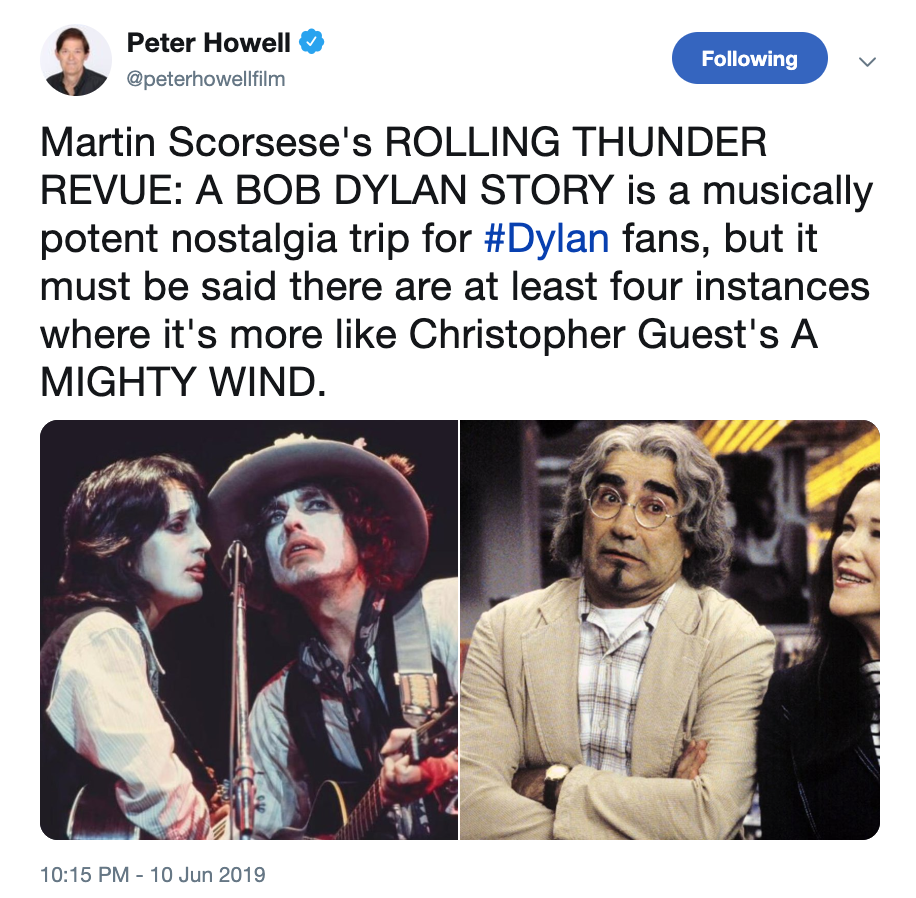
Vanity Fair‘s Mike Hogan and NPR critic Ann Powers understand, but Globe and Mail critic Barry Hertz isn’t quite sure. After mentioning Stone, he writes that she “maybe, or maybe not, was spotted by Dylan early during the tour, and asked to join to do…well, it’s never quite clear.”

After posting an initial review that showed he’d been hoodwinked, Indiewire‘s David Ehrlich (along with Chris O’Falt and Zack Sharf) has co-authored a piece that discusses the Stone con. The article is titled “Debunking the Four Big Lies at the Heart of Martin Scorsese’s ‘Rolling Thunder Revue’.”

In his review, Vulture‘s Craig Jenkins writes that “some of this shit never happened, and it’s tricky to tell what’s what.” He notes that Martin von Haselberg and Michael Murphy are fakers but he doesn’t mention Stone, thereby indicating he probably thought her quotes were legit.

To judge by his review, Empire‘s Ian Freer has also been taken in.

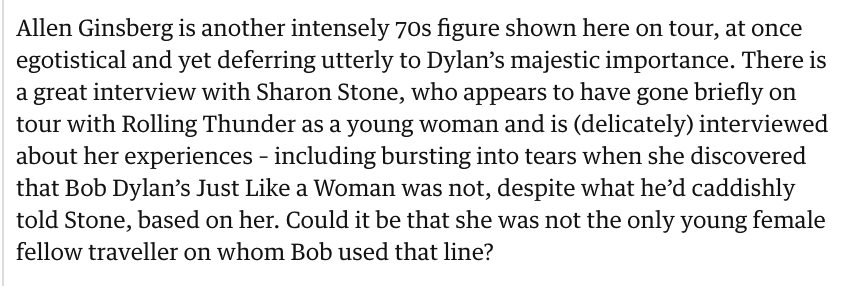
Guardian critic Peter Bradshaw, who rarely misses a trick, doesn’t seem to get it either:
Read more

Michelle Sidesteps It

The gist of Michelle Pfeiffer‘s complaint is that while bathing in a flush hotel suite she accidentally washed her hair with laundry detergent and used a face-cleanser as a cream rinse. It’s ironic that she’s wearing glasses in this video since the absence of same is the nub of it. The problem is that unless over-45 types take a shower with their glasses on or contact lenses inserted, they can’t read the labels on those stupid little plastic bottles in the shower. It’s that simple. Solution: A braille system — shampoo bottles need to be square, conditioners need to be oval and so on.

Old Refrain

[Around 7:10 mark] “Far-left political correctness is a cancer on progressivism. When you talk to Trump supporters, they are not blind to his myriad flaws, but one thing they always say is ‘[at least] he’s not politically correct.’ I don’t think you can overestimate how much people have been choking on political correctness and hating it. There were two recent studies about this recently, in a N.Y. Times front-page story and in The Atlantic about a year ago. The vast majority of liberals in this country hate it…they think political correctness has gone way too far…no one likes to be living on eggshells.”

Chased By Dark Cloud

Sometime in his mid teens Anton Yelchin was told he had cystic fibrosis, a lung disease that ensured he wouldn’t live past his early 40s and perhaps not even his late 30s. Yelchin understandably hid this information from everyone, but what a thing to live with…good God.

“Few of his costars were aware of his struggles, though dozens of them show up here to sing his praises. Kristen Stewart describes how he ‘kinda broke my heart’ when the two were teenagers. Simon Pegg warmly labels him ‘a little dirt bird’ for his nocturnal photo shoots at Van Nuys sex clubs. And Willem Dafoe recalls commiserating with Yelchin over his anxieties about losing his hair, which, in a profession that strives to project eternal youth, was more than a matter of simple vanity.” [HE interjection: Two or three trips to Prague — problem solved.]

“Directed by Garret Price, Love, Antosha [paints] a touching and surprising portrait of an actor who had much more going on in his life than was mentioned in his obituaries. The Yelchin we see here was a devoted son, an almost fanatically committed actor (he amassed a remarkable 69 acting credits), a blues guitarist, a photographer of lurid fetish clubs, and an intellectually adventurous budding artist who could well have added several more entries to that resume.” — from Andrew Barker’s 9.29.19 Variety review.

Read more

Perfect Coordination

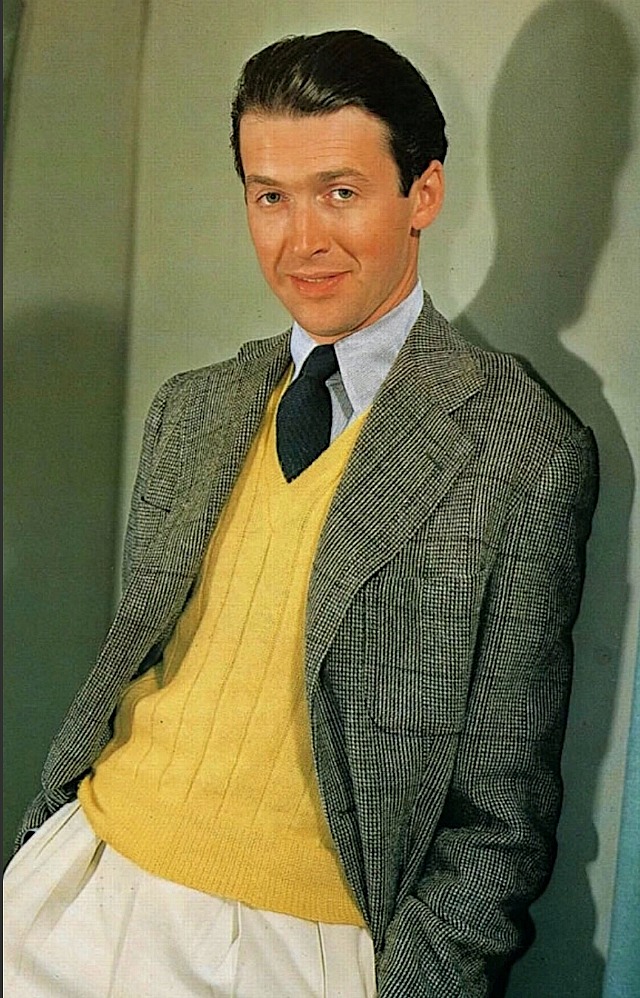
I was instantly impressed when I came upon this photo last night. The canary yellow sweater against the greenish tweed jacket, white pants, light blue shirt and black tie. I’m guessing that the shoes are brown with…what, black socks? Or blue-ish gray? It’s perfect. Was Stewart a beau brummell on his own steam or did he have a fashion consultant? I’m guessing this was taken sometime after Destry Rides Again but before The Philadelphia Story.

“A Descent Into Hell”

Michael Wolff six days ago: “I think it gets crazier and crazier…Donald Trump is more isolated, more alone…as we see this dominant personalty, I think this a story of a meltdown, one of the greatest political meltdowns of all time…it ends in tears, Donald Trump‘s tears. Let’s put it this way. I put it to Steve [Bannon]…I referred to the possibility of Trump getting another term and winning re-election, and Steve said ‘stop’.”

Son of Bring Back The Pup

Every five years or so I remind everyone that idiosyncratic home-grown commercial storefronts from the old days are as much a vital part of Los Angeles culture as any standard tourist attraction (Hollywood Bowl, movie-star homes in Beverly Hills and Bel Air, Santa Monica Pier, Venice Beach). And that it’s important to keep them alive and visible.

I’m speaking of the gone-but-not-forgotten Tail of The Pup, which disappeared from its last location (San Vicente and Beverly Blvd.) in 2005. As well as Tower Records, the shuttered Formosa Cafe, the long-defunct Tiny Naylor’s and the permanently closed Irv’s Burgers of West Hollywood.

Obviously we still have Astro Burger, Mel’s Drive-in on Sunset, Pink’s, the original Farmer’s Market, Genghis Cohen, Cole’s French Dip sandwiches, Kindle’s Big Doughnut, Chez Jay in Santa Monica and so on.

Tail O’ the Pup was an iconic fast-food stand that was actually shaped like a hot dog. Built in 1946, the small, walk-up stand was noted as a prime example of “mimetic”-type novelty architecture. It was one of the very last surviving mid-20th century buildings that were built in the shapes of the products they sold. The kids and I laughingly agreed in the mid ’90s that Tail of the Pup’s representation of a mustard-lathered dog on a bun looked (I’m sorry) like a bowel movement in progress.

Read more

Martin Scorsese’s “The Deceived”

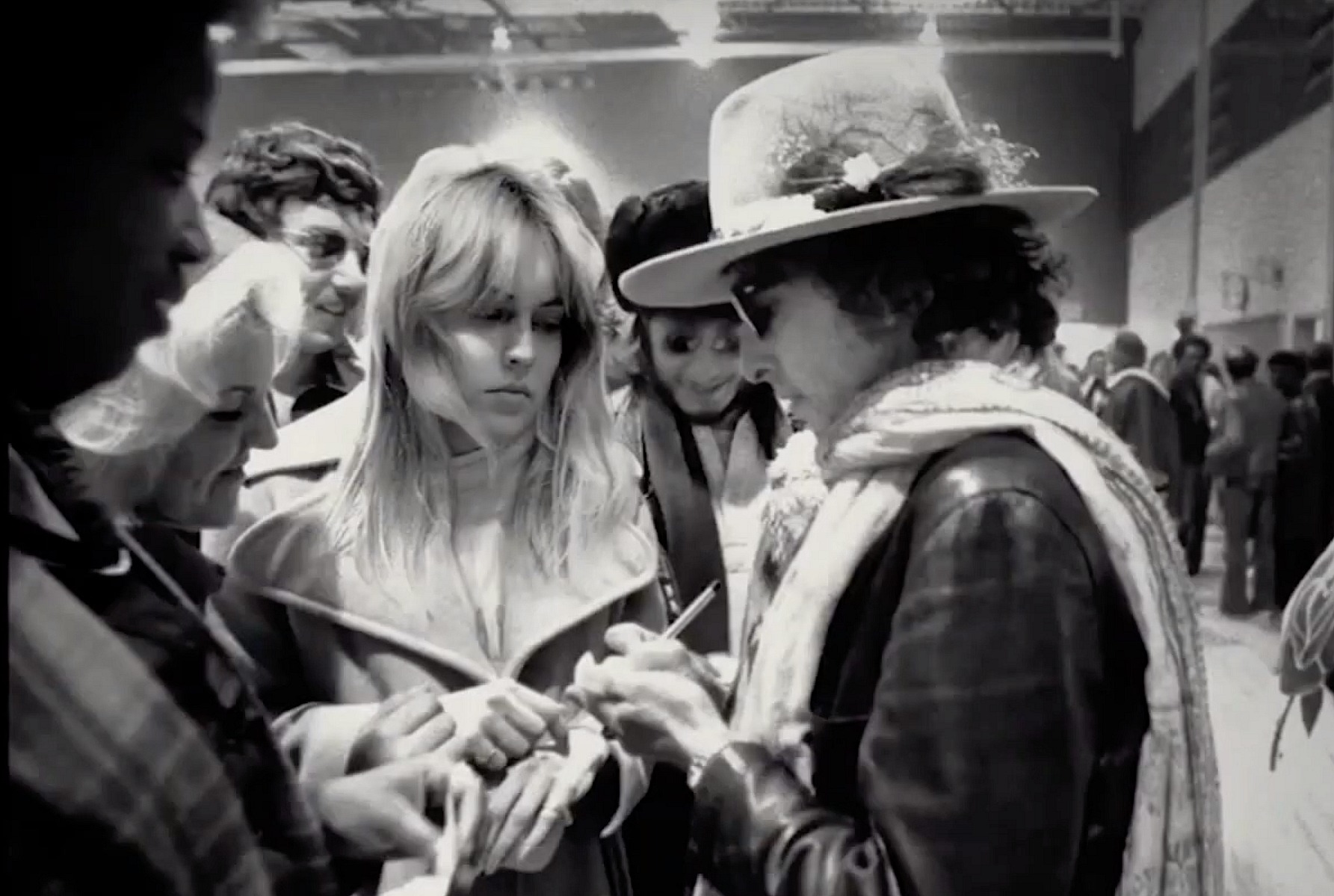
A significant percentage of film critics didn’t realize that Sharon Stone‘s testimony in Martin Scorsese‘s Rolling Thunder Revue is fictional. I’ve personally spoken to a pair of top-tier critics who went “the fuck?” when I told them Stone was one of the four hoodwinkers. Notice the seemingly doctored photo of Stone getting Dylan’s autograph during the Rolling Thunder tour, which is used in the doc.

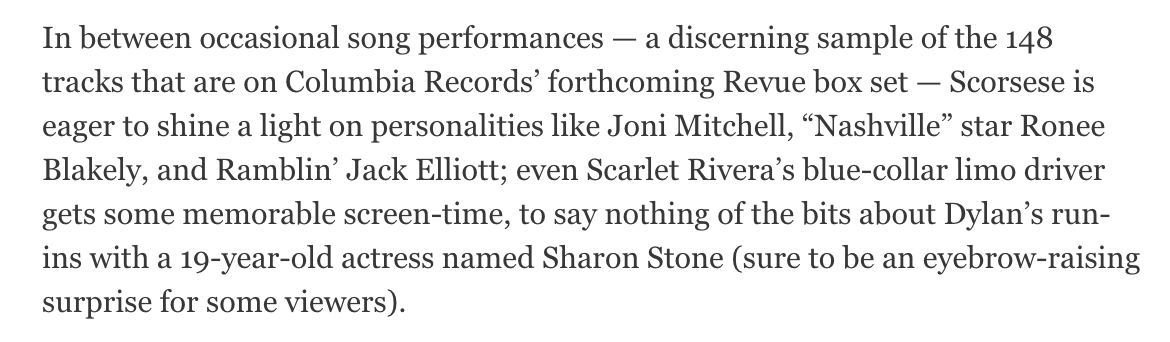
BTW: Indiewire‘s David Ehrlich, with whom I communicated last night, has so far declined to change a line in his review that clearly indicates he thought the Stone story was legit. Toward the end of paragraph #10, Ehrlich mentions “Dylan’s run-ins with a 19-year-old actress named Sharon Stone (sure to be an eyebrow-raising surprise for some viewers).”

Ehrlich didn’t even get the age right. Born on 3.10.58, Stone was 17 when the first leg of the tour was underway. Even if she ran into Dylan during the second leg in the spring of ’76 she would have been 18.

Read more

Stewart vs. “Fiscal Hawks” Over 9/11 Victim Fund

Jon Stewart to Fox News’ Shep Smith: “What we’re saying is, just renew the VCF Fund. There’s no fraud. It runs beautifully. It’s an incredible program. Look, this was war. These are the casualties of war. We can’t stop supporting them because they can no longer serve us. That is not an imaginable outcome for this.”

Have It Both Ways

In King Vidor‘s Man Without A Star, Kirk Douglas‘s “Dempsey Rae” plays a tough, rugged cowboy who doesn’t join, follow or subscribe. Kind of like James Caan‘s character in Thief. Dempsey definitely doesn’t like barbed-wire fences, as scars on his chest suggest. But he’s also a showoff, as this scene with William Campbell confirms.

Dempsey says that fancy gunplay is silly and empty, and yet he’s taken the time to learn how to twirl guns like a Barnum & Bailey performer. That’s because Douglas the movie star didn’t have the character to play a man who truly disdains flashy gunplay and holds back — who values the fundamentals over tricks and technique. He had to dazzle the audience and then say “it’s all bullshit.” That’s how movie stars usually play their cards.

Read more

Canyon Currents

Andrew Slater‘s Echo in the Canyon is a quaalude tablet ** — a mild-mannered, perfectly agreeable tribute to the seminal mid ’60s Laurel Canyon music scene. The focus is mainly upon ’65 (particularly the narrative advanced by Andrew Grant Jackson‘s “1965: The Most Revolutionary Year In Music“) and how The Byrds, Buffalo Springfield, The Mamas and the Papas and The Beach Boys introduced spiritual depth and poetry to pop music playlists, which up until that moment had been mostly on the level of “Hang On, Sloopy.”

The film also follows the musical innovations and advancements of ’66, but stops before the onset of early ’67 flower power. Yes, Joni Mitchell is strongly identified with Laurel Canyon, but she didn’t move into her little house on Lookout Drive until the spring of ’68, and so she doesn’t fit into the timeline. I don’t know why Slater ignores Judy Collins but he does.

Slater doesn’t tell you anything you didn’t know (especially if you’ve read the Jackson book) but the film is fine. With Wallflowers frontman Jakob Dylan as a kind of host-guide, the doc glides and grooves along and gives the legend a nice neck massage. The ’65 and ’66 Laurel Canyon scene was the same kind of creative hotbed that Paris was for writers in the ’20s, New York City of the late ’40s and ’50s was for abstract impressionists and Australia was for native filmmakers in the late ’70s and ’80s. The critical reaction has been positive, and deservedly so.

Bob Strauss said last night that Dylan and his “youngster” bandmates “try” to play classic mid ’60s songs in the doc. To which I replied that “they do a bang-up job with the Mamas and Papas ‘Go Where You Wanna Go.'”

** Specifically a Lemmon 714 purchased at Manhattan’s Edlich Pharmacy.

Read more