

I’m sitting in a peon-class seat (42C, way in the back) on a Delta red-eye. Midnight departure, arriving at JFK a little after 8 am. If you buy a Delta cheap seat you have to be down with being politely humiliated with a smile. It’s like riding on a chicken bus from Belize City to Playa del Carmen. You just have to adopt a Zen attitude and accept the bargain-basement reality of what you’ve paid for and who you are in the eyes of Delta employees. I don’t expect to “enjoy” the flight — I just want to get through it. In the words of Sterling Hayden‘s psychotic Air Force general In Dr. Strangelove, “I think I can.”
Hidden Virtues
Once in a blue moon Hollywood Elsewhere will post a portion of an Armond White review, most often because I agree with the opinion. White is a big fan of Craig Zahler‘s Dragged Across Concrete (Summit, 3.22). Here’s a portion of his National Review assessment:
“At last, we have an American filmmaker who has experienced Tarantino and got past it. Zahler’s surprisingly felt art is not predicated on movie violence, even though genre violence is his métier. Despite Zahler’s heightened form of crime fantasy, Dragged Across Concrete presents a strangely naturalistic worldview. Instead of imagining how heartless — or ‘cool’ — mankind can be, Zahler looks for hidden virtues in each situation, no matter how bizarre.
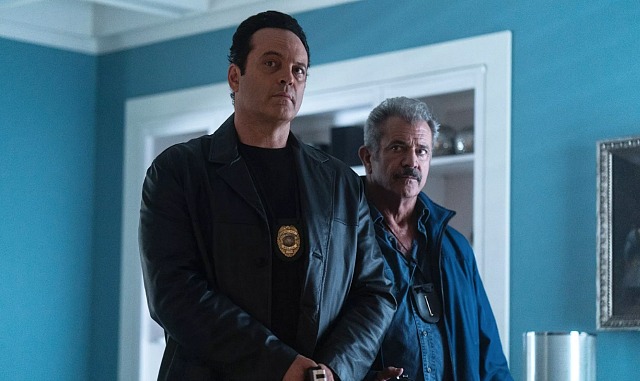
“Most Hollywood movies — post-Tarantino — distract us from viewing American life as a unique experience. Zahler gravitates toward the violent and the outré as comic aspects of American greed and lust.
“But he doesn’t stop there, as Tarantino does. Zahler’s characters are full of yearning (uncorrupted desire and love). That explains the plot digression about an anxious new mother (Jennifer Carpenter) reentering the workforce. Her fate triggers the heroic rescue action that will determine each man’s familial resolve.”
There’s a reason why Dragged Across Concrete has a 76% Rotten Tomatoes rating. The reason is too many p.c. pearl-clutcher critics, all of them complaining that it’s too much of a rightwing fantasy or that it’s too insensitive or too brutal, that it doesn’t move fast enough. Basically reviewing where it seems to be coming from politically above other aspects.
The naysayers include N.Y. Times critic Manohla Dargis, L.A. Times‘ critic Justin Chang, TheWrap‘s Todd Gilchrist, The Daily Beast’s Marlow Stern and The New Yorker‘s Richard Brody.
Seven Days Back In Wintry Connecticut/NYC
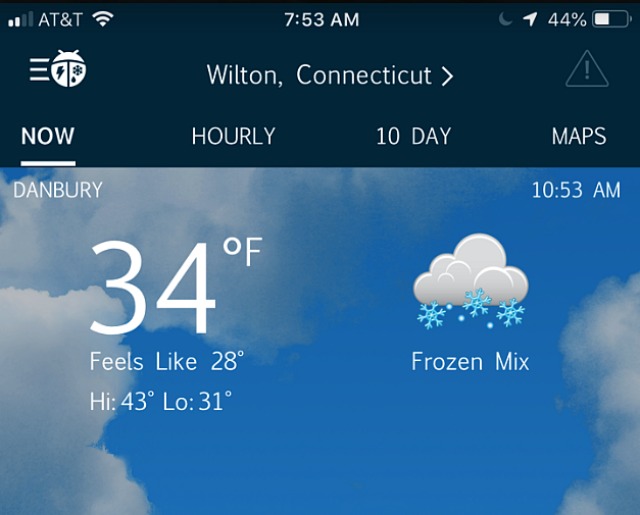
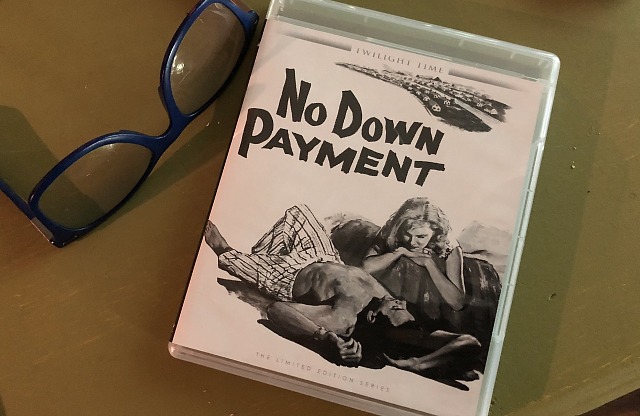
I’m flying to JFK late tonight and Metro Northing up to Wilton tomorrow morning. I have to sell a Nissan Maxima that I bought last fall and send stuff (the beloved Yamaha Majesty, my 65″ 4K HDR TV, Roku player + 4K Bluray player, Blurays, sub-woofer, oriental rug, wooden shoe rack, clothing, framed photos) back to Los Angeles via Arrow Movers, who are picking up on Monday or Tuesday. It’s a pain in the ass but I have to do it. I’ll also be catching a couple of screenings in Manhattan and probably hang with friends a bit. Returning to Los Angeles next Friday, 3.29. I’ve gotten used to the warmish (recently almost summery) Los Angeles weather so I’m not looking forward to those frigid Connecticut climes.

Selling this 19 year-old rig for a cool $1500 sometime this weekend.
How Dare He?
After almost two years of meticulous closed-door inquiries, special counsel Robert S. Mueller has finally delivered a report on Russian interference in the 2016 election to Attorney General William P. Barr.
The jowly, bespectacled AG told congressional leaders late today that “he may brief them within days on the special counsel’s findings,” according to a N.Y. Times report. “I may be in a position to advise you of the special counsel’s principal conclusions as soon as this weekend,” Barr wrote in a letter to the leadership of the House and Senate Judiciary committees.
There is, however, a question of how much of the report Barr will want to share with Congress and the public. In other words he might conceivably censor or suppress portions of Mueller’s findings in order to…what, protect Trump from political difficulty and/or eventual prosecution?
After the Comey firing and the endless indications of Russian meddling, after all the indictments and plea deals and strong whiffs of criminality by various Trump associates and appointees, after all this apparent stink-from-the-head corruption and sociopathic behavior from Cheeto himself, where does Barr find the balls to even flirt with the idea of not releasing portions of the final report?
After all the struggle, bubble, toil and trouble, how can Barr even think along these lines?
Now That “Triple Frontier” Cat Is Out Of The Bag…
Originally posted on 3.6, but more SPOILERY this time: “At the very end a hefty portion of the ill-gotten loot is donated to daughter of Ben Affleck, who doesn’t quite make it to the end. I have a problem with this.
“More than anyone else, Affleck goaded the team to carry off a lot more money than they had originally planned to find, etc. Everyone went along with this, but Affleck was leading the charge, urging them on.
“Taking more money makes no sense as there are clear weight limits on the amount of cash the helicopter can carry over the Andes. The pilot (Pedro Pascal) voices concerns about this, but they’re all so money-crazy they decide to risk it anyway.
“So after Affleck dies and the others make it back safely, they bequeath their shares to Affleck’s chubby daughter, a typically sullen teen who refuses to face life without ear buds.
“I would make sure the daughter gets a full one-fifth share of the loot, naturally, but why does she get all of it? I really don’t get this at all. Affleck inspired the team to think and act in greed mode. He was the father of it. How does that translate into the fat daughter pocketing every last dime?”
Dead-Ass Wrong
Tweeted this morning by Dave the Tentacle: “I recently heard a playwright say that you always want to end your play (or movie) at a point that leaves the audience saying ‘Is THAT the ending?’ so they’ll have something to think about and discuss afterward, and not immediately forget your work.”
HE response: No — the best endings are those that the entire audience (a) can see coming, (b) are fully understanding and conversing with as they unfold and (c) are fully satisfied by as they’re leaving the theatre and heading for the parking lot. Good endings are never about puzzlement or uncertainty — they’re about resolution and finality and passing along fundamental truths. Any ending that throws an audience for a loop is dogshit.
“Show Us Your Bone Spurs”
Methinks President Trump‘s anti-John McCain rants will fester and simmer and come home to roost in the ’20 election. Obviously an idiotic move on his part. Sure to engender a split between pro-Trump bumblefucks and traditional pro-McCain, pro-military service VFW loyalists.

When Criterion Channel Launches on 4.8…
One thing that always bugged me about Filmstruck is that they never seemed to specifically state that their films were streaming at 1080p. I assumed as much, but sometimes films stream at 720p or even (God forbid) 480p, depending on the breaks. There’s also the forthcoming option, obviously, of 4K streaming. Let’s hope that the Criterion Channel guys have learned from Filmstruck’s blithe disregard and will specifically state what file sizes they’ll be offering — no more crapping around.
The Criterion Channel is coming April 8! https://t.co/4YJthFTTyC ✨ pic.twitter.com/lXQxAXlSTS
— Criterion Collection (@Criterion) March 22, 2019

Crocodile Butt Cheeks

If I was in charge of maximizing Rocketman revenues, I would simply split the difference — for the more liberal-minded U.S. and European markets, I would include the 40-second scene in which Elton John (Taran Egerton) and his manager John Reid (Richard Madden) exchange a little erotic current, but for the allegedly homophobic territories in question I would distribute a version of the film without these 40 seconds.
I wouldn’t feel very good about this, but Paramount stockholders would approve, I think. And gay culture would be in fine shape the morning after.
Guy Lodge sez: “Please tell me again how homophobia isn’t the default position for absolutely everything. Egerton and Madden should refuse to do any promo for the film if that scene is cut. Simple as that.”
Ștefan Iaonco sez: “The problem [always] arises if companies want to distribute films in places like China, Africa, the Middle East. They either go ‘true to the gay’ and accept it [as a] North America & Europe-only distribution [situation], or, if they want global sales, they straight-wash. It’s art vs. commerce.”

“I Eat Determination For Breakfast”
Nobody knows who Eddie Albert is these days. People began to forget about him 30 years ago. Mention his name and those with a vague inkling will say Green Acres. I think of his performances in a lot of World War II films (there was one in which he fell out of an airplane at 10,000 feet) as well as roles in Roman Holiday (’53), Teahouse of the August Moon (’56) and Oklahoma! (’55)…what else?
The best thing Albert ever did was play Cybill Shepherd‘s disapproving dad in this scene from Elaine May‘s The Heartbreak Kid (’72). The back-and-forth between Albert and Charles Grodin goes on for four or five minutes. Albert was nominated for Best Supporting Actor because of this one scene.
BTW: Back in the ’70s and ’80s nobody was better at playing smarmy, self-assured, soft-spoken assholes than Grodin.
Wick Me With Your Rhythm Stick
Did director Chad Stahelski and screenwriters Derek Kolstad, Shay Hatten, Chris Collins and Marc Abrams not get the HE memo? Last year I wrote at least twice that any movie dialogue that begins with the words “you have no idea” will be automatically discredited and shitcanned. The movie will, I mean. But they went right ahead and used it anyway.
Will John Wick: Chapter 3 — Parabellum (Lionsgate, 5.17) blow chunks? An unfair question, agreed, but this, after all, is the second sequel. I was down with the novelty of the original but I found Chapter 2 draining, to put it mildly. In my 2.11.17 review, I noted that “a vapor cloud of stupidity hangs over this film at every turn.”
“I’m With The Klaaayuhn”
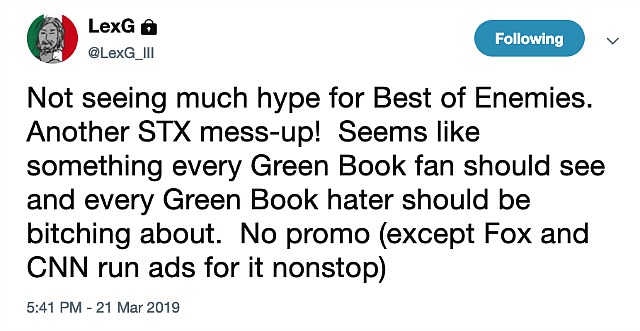
Is there something about The Best of Enemies (STX, 4.5) that doesn’t quite work or…? I’m just not sensing any special current or exceptional energy. No screening invites from Sunshine Sachs, no Sundance Film Festival showings, no advance buzz to speak of. Based on Osha Gray Davidson‘s “The Best of Enemies: Race and Redemption in the New South”, it’s about some kind of mano e mano that led to a rapproachment between civil rights activist Ann Atwater (Taraji P. Henson) and Ku Klux Klan leader C.P. Ellis (Sam Rockwell) in 1971. Sorry but I’m sensing a disturbance in the force. A liberal do-goody vibe.
The Best of Enemies Movie Premiere #WeAreDPS @DurhamPublicSch @TherealTaraji looks Amazing! pic.twitter.com/1oduhQzxMP
— Chanel Sidbury (@DPS_K12C_I) March 19, 2019