Check-Out Conversation
March 15, 2026
Should Have Called Out Teyana Taylor's "Cat-face", But "James From Corporate" Beat Me To It
March 14, 2026
Most Under-45s Have Never Seen This
March 13, 2026
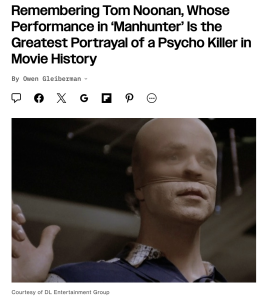
That fascinating scene with the blind Joan Allen and the sedated Bengal tiger…burned into my memory. She’s emotionally open to Noonan’s Dollarhyde (aka “the Tooth Fairy”) and yes, even sexually. Lo and behold they do it. And yet Noonan/Dollarhyde is too fucked up to go with the feeling. Plus he’s killed a guy he sees as a romantic rival. Plus he later decides to kill Allen. A real babe magnet.
Nothing else that Noonan ever did comes close to Manhunter. I don’t even remember What Happened Was. Or, for that matter, his supporting role in Charlie Kaufman‘s Synecdoche, New York.
Brody shares some of the same observations that I mentioned last year, but his review really digs in…it’s more fully considered…plus the construction is smarter, better. Here’s the whole Brody piece, and here’s my favorite portion:
“It’s no surprise that the children’s frantic quest fosters a deep friendship. The pairing is an old one—the principled book-smart girl and the rough-edged streetwise boy—but Hadi revitalizes it with meticulous observation that links their struggles to those of the country at large. The children playing Lamia and Saeed had no training as actors, yet both are fanatically precise, effortlessly expressive, and pensively deep-hearted. The girl achieves perfect comic timing when she holds a recipe in one hand and her pet rooster in the other as it pecks at the paper.
“When things go sour, both kids spew insults and indignation with a matter-of-fact insolence. At moments of exceptional gravity, they play a staring contest that fills the screen with an ingenuous romanticism. The bonds of the children, Bibi, the postman, and a very few others in their circle endow “The President’s Cake” with a grandly humanistic warmth that’s all the stronger for the mighty pressure under which it’s forged.”
5.16.25: “I tend to be impatient with films about young kids but this handmade Iraqi film (apparently the first from that formerly turbulent, war-torn country to be shown in Cannes) is different…it has an impoverished but compassionate Bicycle Thief atmosphere with just a tiny little touch of The Red Balloon and maybe a slight spritzing of Hector Babenco‘s Pixote, and you can tell almost immediately it’s a grade-A, pick-of-the-litter pearl.
“Partially set in the wetland marshes of southern Iraq (which for the 37th time is not pronounced EYE-rack but Uhraq) but mostly in a big city (not precisely identified as Bagdad but shot there) and all of it occuring just before the 2003 U.S. invasion, it’s basically about a nine-year-old girl, Lamia (Banin Ahmad Nayef), who lives in a floating straw hut upon the Mesopotamian marshes with grandmother Bibi (Waheed Thabet Khreibat).
“The plot comes from Hadi’s childhood memory of a school event in which one member of each class is chosen to bake a cake for Saddam Hussein‘s birthday (4.28). Lamia is selected to be her class’s cake-baker. She and Bibi are dirt poor and can barely afford, much less find, the chief ingredients (eggs, flour, sugar) but failing to deliver or, worse, refusing this honor is out of the question.
“And so Lamia, Bibi and Lamia’s pet rooster Hindi head for the big city (Basra, Nasiriyah and Amarah are closest to the marshes). And yet the diabetic, overweight Bibi has a secret agenda in visiting the city, and this freaks Lamia out. So she takes off and hooks up with Saeed (Sajad Mohamad Qasem), a school friend and an Artful Dodger-like thief who’s roughly her age. The heart of Cake is about these two scrounging around Bagdad in a search for the cake ingredients and coping with a few Dickensian twists and turns.
Boiled down, the film is essentially a portrait of Bagdad street life and all kinds of crafty, hustling, struggling denizens (including a devious would-be molester) trying to save or make a buck or otherwise stay afloat.”
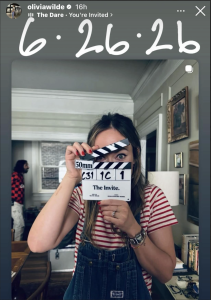
I’ve been assuming all along that Olivia Wilde‘s The Invite (A24, 6.26), which exploded last month during Park City’s final Sundance Film Festival, would play during Cannes ’26. All those European critics champing at the bit…they’d have to show it, right? But Jordan Ruimy informs that A24 is saying “no more festivals.” But there will certainly be Cannes market screenings, I’m figuring. I’ll find my way into one of them.
I knew right away I’d eventually ban this dickhead. He was an irritating ass from the get-go. A psychopath. The air feels slightly cleaner now…more breathable.
Bob Fosse‘s All That Jazz (’79) is a dazzler in several respects, but it keeps pushing the coy cynicism button…over and over and over. It walks and talks big-city sophistication within a very narrow lane, but it’s essentially aimed at the rubes.
Roy Scheider gave a career-peak performance as Broadway musical director Joe Gideon, whose story was modelled on Fosse’s own in the early ’70s. And yes, Jazz impressed me the first time (the Manhattan press screening was at Cinema 1). But it irked me the second time. When I caught it a third time on DVD (I love the early dance-audition sequence) I quit before the halfway mark. It over-emphasizes to a fault. Parts are ham-fisted and painfully un-hip, but it was quite the film of its day.
“Almost every scene is excruciating (and a few are appalling), yet the film stirs an obscene fascination with its rapid, speed-freak cutting and passionate psychological striptease,” wrote critic Dave Kehr. “This is the feverish, painful expression of a man who lives in mortal fear of his own mediocrity.”
Time‘s then-critic Frank Richwrote that “as a showman, [Fosse] has no equal. Music, performers, movement, lighting, costumes and sets all blend together in Fosse productions to create brilliant flashes of exhilarating razzle-dazzle. Yet the man just does not know when to leave well enough alone.”
I interviewed Scheider in late ’81 or ’82 for Us magazine. We met at a coffee shop on Lexington, somewhere in the mid ’70s. He used to go there after his morning run. He was a good egg, an honest cat and a hard worker. Most actors don’t get to flourish with the kind or roles that Scheider was able to land from the early ’70s to the early ’80s.
If a dead celebrity is used for one of those nostalgic AI slop featurettes, he/she enters the frame with a pair of white feathered angel wings attached to his/her back. This one uses amber halos instead. There’s something vaguely creepy or even demonic about those feathers. They’re meant to convey a loving respectful attitude about the deceased, but to me they’re like a glimpse of the reaper. “They’re coming for you, Barbara…”
Even I, a non-sports fan from my mid-teen years onward, know who the great Bill Mazeroski was. The What’s My Line? clip (after the jump) reveals that Bill spoke with a West Virginia barnyard accent. Mazeroski passed yesterday at age 89.
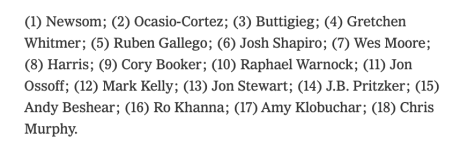
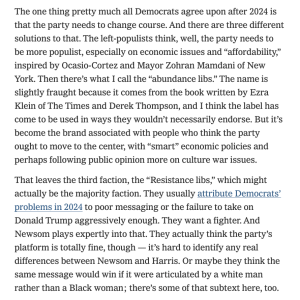
Sen. JonOssoff can’t compete with Gov. GavinNewsom’s rhetorical ease, balls and all-around charisma, but he has a solid honest center. He strikes me as well-grounded.
HE is a sensible centrist, but in the above context my closest allegiance is with the “abundance libs.”
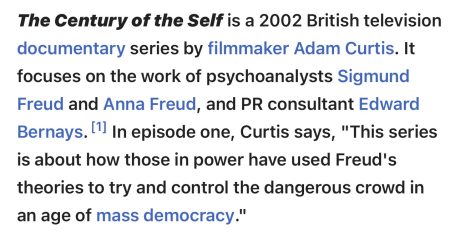
The odious implications of modern advertising were explored in Adam Curtis’s The Century of the Self (‘02), a landmark doc with laser-like insights into a few bizarre corners of the human psyche.
This reminds me of a certain legendary ad copy line for Clairol hair coloring…a line that came from the contours and tendencies of the culture of the mid to late ‘50s but finally broke through in the first year of the Kennedy administration.
In 1961 a copywriter in the employ of Foote, Cone & Belding named Shirley Polykoff came up with the line: “If I’ve only one life, let me live it as a blonde!”
The basic attitude of having “only one life,” said Wolfe, contradicted a general belief among families and nations that had existed for centuries, which you could sum up as a belief in “serial immortality.”
Boiled down, serial immortality means that we’re all part of a familial stream — our lives being a completion or fulfillment of our parents’ lives and our children’s lives completing and fulflling our own, and everyone understanding that we’re part of the same genetic river of existence and spirit.
Polykoff’s copy line basically said “the hell with that — it’s just me, it’s just my life and my goals, and I’m going to satisfy myself!”
By the time the early ’70s rolled around the culture had begun to believe in the “me first” philosophy en masse.
And then, exactly ten years after Polykoff’s brainwave, came ErhardSeminarsTraining (EST).
And then, in ‘77, along came MichaelRitchie‘s SemiTough, a satire of the human potential movement and, really, the whole damn ‘70s decade.
That completely aside, the 1970s were arguably the greatest nookie decade in the history of Western civilization, and they’ll never, ever return. That was then, this is now.
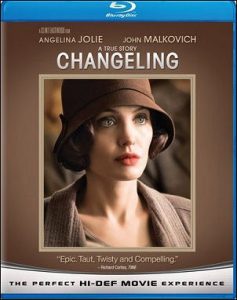
HE-posted on 1.25.09: When the Changeling Bluray pops on 2.17.09, drinking games will commence nationwide. One swig all around whenever Angelina Jolie says “I want my son back!” Double swigs all around when she says “that’s not my son!”
Clint Eastwood‘s drama opened theatrically on 5.20.08.
This hilarious John Carpenter interview happened during the filming of Halloween in May 1978. “Hilarious” because of Carpenter’s reaction to the interviewer mentioning the avant- garde, envelope-pushing nature of Robert Altman‘s Nashville (’75).
Go to the :39 mark — Carpenter’s eyebrows arch dramatically as his eyelids briefly close. In his eyes and eyebrows, Altman is a dead man.
Differing HE opinion: I agree with Carpenter about Nashville, but there’s just no slagging Altman’s M.A.S.H., McCabe and Mrs. Miller, California Split, The Long Goodbye and The Player. You can’t dismiss these five…verboten.