Qualifier #1: Even from the fanboys, the consensus seems to be that Solo‘s first act is clunky and that it takes a while (what, 30 to 40 minutes?) to find its footing but once Donald Glover arrives and “the Kessel Run heist plot kicks in, it’s a whole lot of fun.” There’s also agreement that it takes a while to settle into Alden Ehrenreich‘s Han Solo (i.e., mini-Han) but that you just have to accept that the young-Harrison-Ford template is out the window and that Ehrenreich is playing Jake Gittes. Qualifier #2: All I’ve said from the get-go is that Ehrenreich is a bad fit for the part, but I’ve projected nothing at all about the film itself. Qualifier #3: I’m concerned that Bradford Young, Hollywood Elsewhere’s second-least favorite cinematographer for his tendency to make everything look slightly murky and covered in pea-soup, is Solo‘s dp.
Tonight’s big film is the highly regarded Birds of Passage, a Directors Fortnight entry showing at 10:30 pm. Directed by Ciro Guerra and Cristina Gallego, it’s about “the origins of the illegal drug trade in Colombia in the 1970s” as well as “a family story set within an indigenous community.”
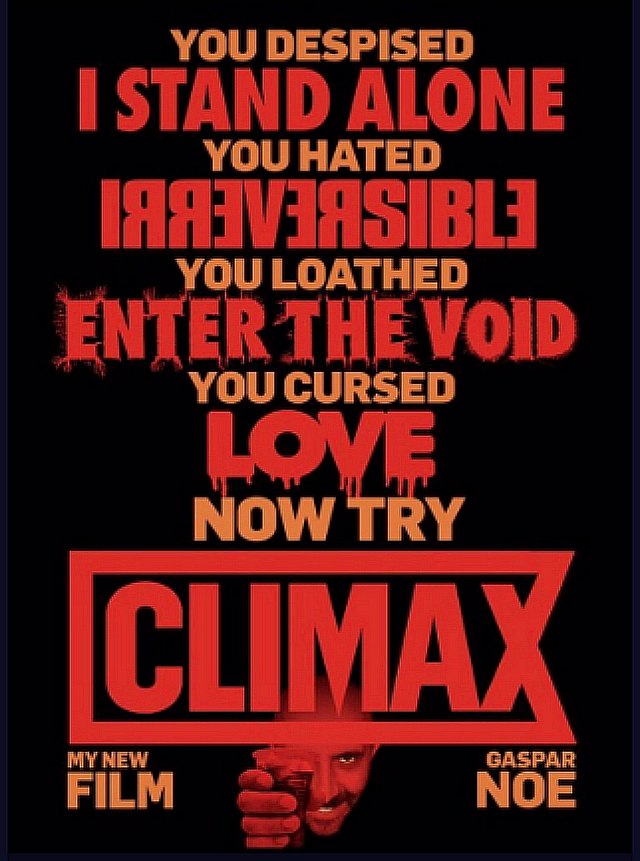
Someone speculated earlier that I might avoid Gaspar Noe‘s Climax. Bullshit — I’ve never sidestepped an opportunity to see a Noe film, ever. Previously titled Psyche, Climax was allegedly “shot in just two weeks, and focuses on an urban dance troupe that embarks on a kind of Dionysian frenzy in an abandoned school.” (Wild Bunch’s Vincent Maraval has said this information is incorrect.) For years Noe has been promoting the idea of his being some kind of sensual Satanic figure. The effort continues.
A few hours ago I was forced to choose between the 11 am press conference for Pawel Pawlikowski‘s Cold War or catch a Salle Bazin screening of Joe Penna‘s Arctic at the same hour. I chose the press conference. It was announced soon after that Bleecker Street has acquired U.S. and select international rights for Arctic.
From Owen Gleiberman’s Variety review: “Five years ago, All Is Lost premiered at Cannes to deserved acclaim. But when it opened later that fall, the film was a noteworthy commercial disappointment (it made just $6 million domestic), and the awards magic never happened for Robert Redford.
“I think I understood why. All Is Lost was ingeniously made, and a true experience, yet the stark fact is that it was slow. Arctic, as effective as it is, may face a similar challenge (at least in the U.S.), precisely because of the rough-hewn, trudging-through-the-tundra, one-step-at-a-time honesty with which Joe Penna works. The movie, in its indie way, is the anti-Cast Away. Yet that’s what’s good and, finally, moving about it. It lets survival look like the raw experience it is.”
It was reported three days ago that the GOP-led House of Representatives had voted to kill guidance from a consumer protection agency aimed at preventing lenders from charging minority consumers more on car loans — obviously a discriminatory practice. Republicans don’t care, of course; they just want to diminish government regulations. All hail Rep. Maxine Waters, D-Calif., for calling out those who would deny that discrimination takes place in this realm. “This resolution is one part of a widespread Republican effort to make it more difficult to hold financial institutions responsible,” said Waters.
Watch Congresswoman Maxine Waters rip a GOP Rep in half who interrupted her and was being racist: “I do not yield. Not one second to you. Not one second,” Waters said. This is how it’s done. We are done with their BS. No more. Not one second more. pic.twitter.com/vzHlTioSyN
“This is really a movie about chain of command, and about people diminished and decimated by authority. In this case you have a colonel who’s middle management, and with middle management you can look up or look down. And when you have a system without oversight, about power fortifying itself at the expense of the non-powerful, this is what you get.” — David Simon, creator, executive producer, head writer and show runner for all five seasons of The Wire (’02 to ’08). (Essay posted on 5.10.18.)
In a word, Pawel Pawlikowski‘s Cold War is brilliant — an impressively grim, beautifully shot, wonderfully concise portrait of a compulsively hot if constantly frustrating love affair. Romantic bindings can be fatiguing, turbulent, infuriating, painful or even destructive, but the fires are not easily quenched.
Right now Cold War is the leading candidate to win the Palme d’Or, hands down.
Set in ’50s-era Poland and France (mostly Warsaw and Paris) and spanning about a decade, it’s about a musician-arranger (Tomasz Kot) and a headstrong femme fatale singer (Joanna Kulig) who are drawn to each other but never quite come together or achieve even a semblance of stability, much less synchronicity.
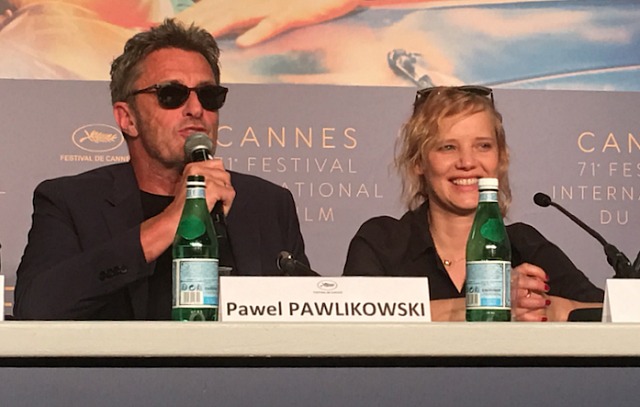
Cold War director Pawel Pawlikowski, actress Joanne Kulig during this morning’s press conference — Friday, 5.11, 11:35 am.
Kot pursues, wins, then loses Kulig, over and over. But she keeps returning, affirming her love then changing her mind and ducking out the side door.
Pawlikowski employs the same glorious black-and-white palette and 1.37:1 aspect ratio that he used for Ida, and it’s just pure dessert, an ice-cream sundae — I was in boxy heaven.
And Cold War is only 84 minutes. I love it when a world-class director reminds us all that narrative discipline and pruning things down to essentials are still active options.
Heralded as a kind of African-cinema breakthrough, banned in Kenya for encouraging homosexuality and finally becoming the first Kenyan film accepted by the Cannes Film Festival, Rafiki is…well, pretty good. Set in low-rent Nairobi, it’s a nicely finessed lesbian love story that plays in familiar ways.
Wanuri Kahiu‘s second film is good and winning but in a mild (but not meh) sort of way. The lovers, Kena and Ziki (Samantha Mugatsia, Sheila Munyiva), are daughters of opposing political candidates, which obviously piles on the pressure. Kahiu’s decision to deal head-on with Kenyan homophobia and intolerance is understandable, but the result is that the first half loses its aura of intimacy and tenderness. The second half is a little too adamant and on-the-nose. There should have been one or two straight characters who don’t give the couple so much grief.
But I loved the two leads (especially Munyiva); ditto Kena’s mom (Muthoni Gathecha). And I loved getting to know native Nairobi culture to some extent.
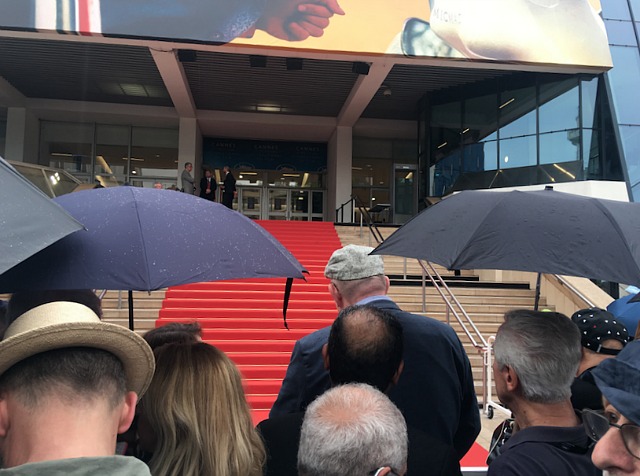
It began to drizzle before Thursday evening’s Salle Debussy screening of Sorry Angel. Most of the press people waiting to get in didn’t have umbrellas. Thankfully the rain didn’t intensify but if it had suddenly begun to rain cats and dogs, the Palais security guys never would’ve taken pity. They would’ve stood there and just watched as everyone got soaked. They stick to their schedules and never alter them, come hell or high water.
Set during the early ’80s Leningrad rock-music scene and focusing on a largely factual, less-than-ardent romantic triangle, Leto (Russian for summer) is a kind of monochrome dream trip — more about feeling the vibe than savoring the story. It’s something you need to sink into rather than judge and evaluate with a fine tooth comb.
The screenplay is reportedly based on a memoir by Natalya Naumenko. (Natasha and Natalya are essentially the same name.)
It’s a trippy, at times rhapsodic recreation of the beginnings of Russia’s rock-music movement, a couple of years after the death of Leonid Breshnev and four or five years before Mikhail Gorbachev, the architect of glasnost and gradual liberal reforms within the Soviet Union, came to power.
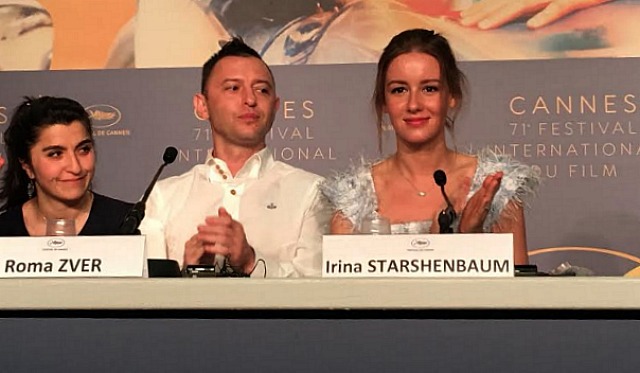
Leto costars Roma Zver, Irina Starshenbaum during today’s 11 am press conference.
Leto kind of runs out of steam over the last 25 or 30 minutes and is therefore something of a mixed bag, but the first half to two-thirds are mesmerizing.
Anyone who expresses a “meh” reaction to Vladislav Opelyant‘s velvety black-and-white cinematography, framed within a lavish aspect ratio of 2.76 to 1 (the same as the nearly 60-year-old Ultra Panavision 70 or Camera 65 process), not to mention the monochrome hand-drawn animation used in the musical sequences…anyone who watches and says “aahh, no big deal, seen stuff like this before” really and truly has something wrong with them.
Call me a music-video rube but the musical sequences are electric and exhilarating and just great fun. Leto is definitely worth seeing for these alone.
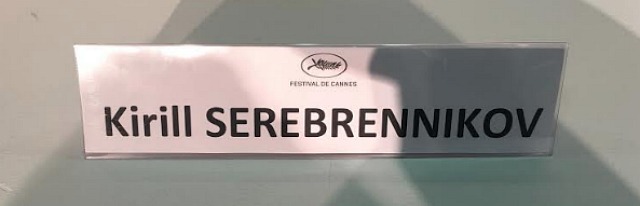
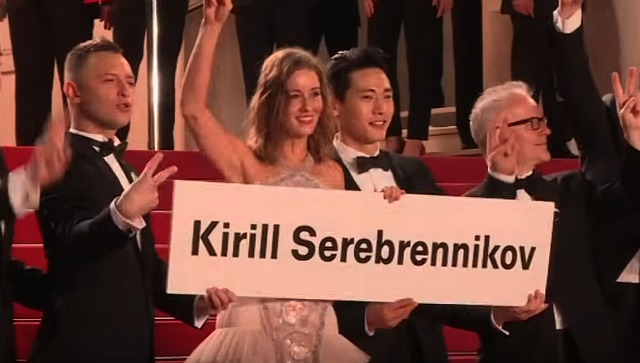
Serebrennikov, an anti-Putinite, was arrested by government forces last August on trumped-up charges. He’ll apparently remain under house arrest until next fall, and was therefore unable to attend last night’s premiere or this morning’s press conference. The Leto costars held up a sign with his name on the red-carpet steps.
As one who’s searched high and low for decent Times Square marquee photos, this full-color shot (from a reel of 8mm film) of the Astor marquee during the 1946 and ’47 run of The Best Years of Our Lives is one of the most striking I’ve ever come across. It’s not as dazzling as that color shot of Spellbound‘s Astor premiere on 10.31.45 [after the jump], but at least it’s in color.
As I didn’t care for Christophe Honore‘s Sorry Angel, I slipped out of the theatre after…oh, 85 minutes or so. Life is short.
Sorry Angel is actually a well-written, better-than-decent period drama (early ’90s) about a couple of gay guys separated by age and education levels, but influencing each other for the better in various open-ended, whatever-the-fuck ways. It’s not a terrible thing to sit through, but it kind of meanders along without a great deal happening. Then I began to realize that nothing actually would happen. I began to exhale audibly and glance at my watch around the 45-minute mark.
The main protagonist is Jacques (Pierre Deladonchamps), an HIV-positive writer in his late 30s, living with a young son. The romantic interest is Arthur (Vincent LaCoste), a 22 year-old bisexual lightweight. They both struck me as relentlessly self-obsessed, thinking about their schtufenhaufers above everything else, and given to blah-blahing about whatever comes into their heads. Plus they’re pathetically addicted to cigarettes. I started out merely disliking these guys, but I soon graduated into despising and then hating the ground they stood on.
A friend who attended my 7 pm screening has just written that “Sorry Angel had no reason whatsoever to be 132 minutes long.”
There’s a stand-out scene in which a dying gay guy with Kaposi’s Sarcoma lesions gets into a bathtub with Jacques. (He resists the idea at first but Jacques pulls him in.) They talk things over in a murmuring, open-hearted fashion, like old marrieds. I respect the inherent sadness and emotional candor and whatnot, and I doubt if I’ll ever forget this scene. But I’d be lying if I said it didn’t make me feel…uhm, uneasy? Does this make me an asshole?
And the cigarettes! There isn’t a single scene in Sorry Angel in which someone doesn’t light up. Jesus H. Christ, can you give those stinkweeds a rest? The smoking in this movie smokes is so relentless I felt I was getting early-stage cancer from just watching this.
On top of which I prefer modestly-behaved, straight-friendly gay films like Call Me By Your Name, Moonlight, Brokeback Mountain and The Times of Harvey Milk. Oh, I’m sorry — does that make me sound like a heterosexual straight-washer? If you want to call me that, fine, but I’m not a big fan of sticky, cummy, in-your-face sexual behavior a la Sorry Angel, 120 Beats per Minute, John Cameron Mitchell‘s Shortbus, Taxi Zum Klo and so on. I prefer films that hold back on that stuff. Sorry, p.c. brownshirts, but I’m allowed to have this opinion.




 Leto costars Roma Zver, Irina Starshenbaum during today’s 11 am press conference.