One of The Few Name-Brand Actors Who’s Openly Admitted

…that the percentage of really good films he’s starred in has been fairly low. Hanks has said this plain and straight.

It’s a basic creative and biological law that only about 10% of your films are going to be regarded as serious creme de la creme…if that. Most big stars (the smart ones) are given a window of a solid dozen years or so in which they have the power, agency and wherewithal to bring their game and show what they’re worth creatively. We all want to be rich, but the real stars care about making their mark.

Most name-brand directors, producers and actors enjoy 12-year streaks when everything is cooking and breaking their way. Some directors and actors are lucky enough to last 15 or 20 years or even longer. Your task, should you choose to accept it (and I know I’ve posted about this before), is to list any number of Hollywood heavyweights and when their 12-year hot streaks (or better) happened.

I’m not talking about the ability to work or get work — I’m talking about the years of serious heat and the best years falling into place.

Cary Grant peaked from the late ‘30s to late ‘50s.

James Cagney between Public Enemy and White Heat — call it 20.

James Stewart between Destry Rides Again and Anatomy of a Murder20.

Clark Gable’s hottest years were between It Happened One Night (‘34) and The Hucksters (‘47).

Humphrey Bogart happened between High Sierra / The Maltese Falcon (‘41) and The Harder They Fall (‘56) — a 15-year run.

Robert Redford peaked between Butch Cassidy (‘69) and Brubaker and Ordinary People (‘80) — 11 to 12 years.

Elizabeth Taylor had 15 years — 1950 (Father of the Bride) to 1966 (Who’s Afraid of Virginia Woolf).

Jean Arthur — mid ’30s to early ’50s (Shane) — call it 15 years.

Katharine Hepburn — early ’30s to early ’80s (On Golden Pond).

Meryl Streep — 1979 (The Seduction of Joe Tynan) to today…40 years and counting.

Martin Scorsese is the king of long-lasting directors — Mean Streets (’73) to Killers of the Flower Moon (’22)…a half-century!

John Huston had about 15 years — 1941 (The Maltese Falcon) to 1956 (Moby Dick).

Alfred Hitchcock had 23 years — ’40 (Rebecca) to ’63 (The Birds).

Steven Soderbergh‘s had 23 years so far — 1989 (sex, lies and videotape) to 2012 (Magic Mike) and he’s obviously still kicking.

John Ford enjoyed 27 good years — ’35 (The Informer) to ’62 (The Man Who Shot Liberty Valance).

John Wayne had an amazing 37 years — 1939 (Stagecoach) to 1976 (The Shootist).

George Clooney‘s peak period lasted almost 20 years.

Tony Curtis‘s hot streak was relatively brief — 1957 (Sweet Smell of Success) to 1968 (The Boston Strangler).

Kirk Douglas had about 15 years — Champion (’49) to Seven Days in May (’64).

Richard Burton — 1953 (The Robe) to 1977 (Equus) — almost 25.

Not My Hearing, But Their Sound Mixing

During my two viewings of A Complete Unknown I’ve understood and enjoyed a fair amount of Timothee Chalamet‘s Dylan dialogue. but only about…oh, 60% or 70% at most. But when I watch the YouTube teaser clips with headphones, I can hear each and every vowel and syllable. The Searchlight trailer makers have simply mixed the sound so you can really hear the words while James Mangold‘s feature mix…not so much.

Don’t tell me it’s my fucking hearing…the dialogue is sharper and cleaner in the trailers, and that’s all there is to it. No arguments and fuck off.

Read more

Why Did “Oz” Producers Cut This Great Physical Effect?

The spectacular Wizard of Oz sequence when the cyclone approaches and then consumes the Gale farmhouse (2:06 to 2:23) wasn’t used for some idiotic reason…talk about exciting, believable, first-rate work. Hats off to A. Arnold Gillespie, Edwin Bloomfield, Marcel Delgado, A.D. Flowers, Corril Harris, Donald Jahraus and J. McMillan Johnson, among several others.

Good Sandler vs. Bad Sandler

Good Adam Sadler: The Wedding Singer, Punch-Drunk Love, Anger Management, 50 First Dates, Spanglish, Reign Over Me, Funny People, Uncut Gems.

Not-so-good or problematic Sandler: Pretty much everything else he’s starred in over the last 30 years.

Here’s Hoping That Other Female Directors Jump Into Halina Reijn’s Hot Box

From Owen Gleiberman‘s “Could Babygirl Have Been Made by a Male Director?’, posted in Variety earlier today:

Babygirl is a film about someone” — Nicole Kidman‘s CEO character — “who feels, and believes, that her deepest desires are wrong.

“It’s important to recognize what a common sensation that is. There’s an old saying that goes, ‘Sex isn’t good unless it’s dirty,” and I think what that expresses is that it’s intrinsic to the nature of human sexuality that people are drawn, in the erotic arena, to acting out things that feel ‘naughty’ or ‘bad’ or whatever. It’s whatever floats your boat. And it’s why we have porn, which Kidman’s character in Babygirl is addicted to. That’s the realm where her libidinous imagination can roam free.”

HE’s answer: No male filmmaker would DARE to try and make such a film, as this would be politically suicidal. And the mob that would lash and eviscerate this guy would, of course, be progressive women.

Woke female mission statement: “We’ve reached a position of power that allows Halina Reijn to make this kind of film, but woebetide any dude who would be stupid enough to try and make such a film himself.”

Gleiberman: “What if a man had made Babygirl You could certainly say it would be more controversial.

“[But] the real answer is: A male director would not and could not have made Babygirl the way that Halina Reijn made it.

“It’s not just about the cultural identity politics. It’s about how the film’s power emerges from a hard-wired female consciousness. Kidman’s performance is extraordinary (the best by a female actor this year, in my opinion), but part of what makes acting like this possible is that the role is conceived with an intimacy that renders Romy’s gaze more potent than ours. She’s gazing into the sadomasochistic abyss of her own longing.”

Nolan Aiming for Definitive “Odyssey”

It goes without saying that Chris Nolan‘s forthcoming The Odyssey will have to surpass (a) Mario Camerini and Kirk Douglas‘s Ulysses (’54), a cheeseball fantasy-adventure based on Homer’s epic poem, and (b) Andrei Konchalovsky‘s 1997 two-part miniseries that starred Armand Assante, Greta Scacchi, Irene Papas, Isabella Rossellini, Bernadette Peters, Eric Roberts, Geraldine Chaplin, Jeroen Krabbe, Christopher Lee and Vanessa Williams.

Making a better adaptation than the Camerini-Douglas version will not be difficult.

Flamed, Melted…Gone Like That

I’m not very knowledgable about the Kazakhstan plane crash, but it may have been caused by a bird strike. I’m reading that one engine was lost, but the landing area was fairly flat and wide open so couldn’t the (now dead) pilot have attempted some kind of half-assed bellyflop landing? Why couldn’t he ease into a landing…why did he have to crash into the ground at a sharp angle and cause a fireball explosion?

15 years ago a bird strike caused the loss of both engines when a commuter flight took off off from LaGuardia, and yet somehow pilot “Sully” Sullenberger (aka Tom Hanks) managed to skillfully land the plane in the Hudson river with no loss of life.

What am I missing?

Women Are Allowed To Walk Around Barefoot

…on talk shows and inside sound stages and even restaurants and department stores as long as they have truly nice, attractive, well-pedicured feet.

Unfortunately that holds true for only a relatively small percentage of specimens. I’m sorry but I’ve been eyeballing women’s feet for decades and that’s just how it is.

Men are not allowed to stroll around barefoot anywhere except for beaches and pool areas, and sometimes even that’s a really bad idea. It goes without saying that mandals and flip-flops are totally verboten.

The Real Thing

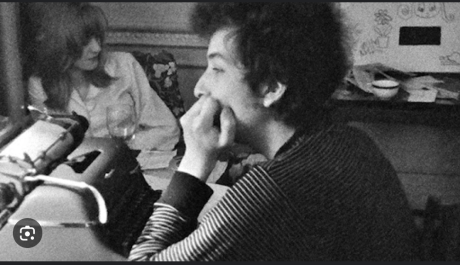
With A Complete Unknown opening tomorrow (Wednesday, 12.25), consider a brief riff on Martin Scorsese‘s No Direction Home, which was first unveiled at the 2005 Toronto Film Festival:

I remember watching this 208-minute doc with 18-year-old Jett in the summer of ’06, and his saying around the 70- or 80-minute mark, or roughly where Dylan’s career was in ’60 or ’61, “I don’t get it” — i.e., what was the big deal about this guy?

That’s because Dylan didn’t really come into full flower until ’63, and because Part One of No Direction Home (roughly the 110-minute mark) ends with Dylan’s triumphant performance at the 1963 Newport Folk Festival. That’s when the heavy journey really began, and when the tectonic plates began to shift.

People forget that Dylan wasn’t fully free of his lefty-social-protest folk troubadour chapter until Another Side of Bob Dylan (8.8.64). And for many (including myself), he didn’t really hit the brass-ring zeitgeist jackpot until Bringin’ It All Back Home” (4.10.65).

Read more

Semblance of Peace, Serenity

I offer no apologies or explanations as to why I’m strictly a once-a-year churchgoer. That said, this evening’s service was soothing, familial, good-vibey in a Brian Wilson way, and not too long.