Son of Great Wounded Fellow

Originally posted in 2008: Frank Pierson‘s King of the Gypsies is a fairly difficult film to sit through. It’s a stab at trying to give a Godfather-like treatment to gypsy culture, and there’s just no believing it.

While it “isn’t the worst film of the year,” said N.Y. Times critic Vincent Canby in his 12.20.78 review, “the gypsies should sue.”

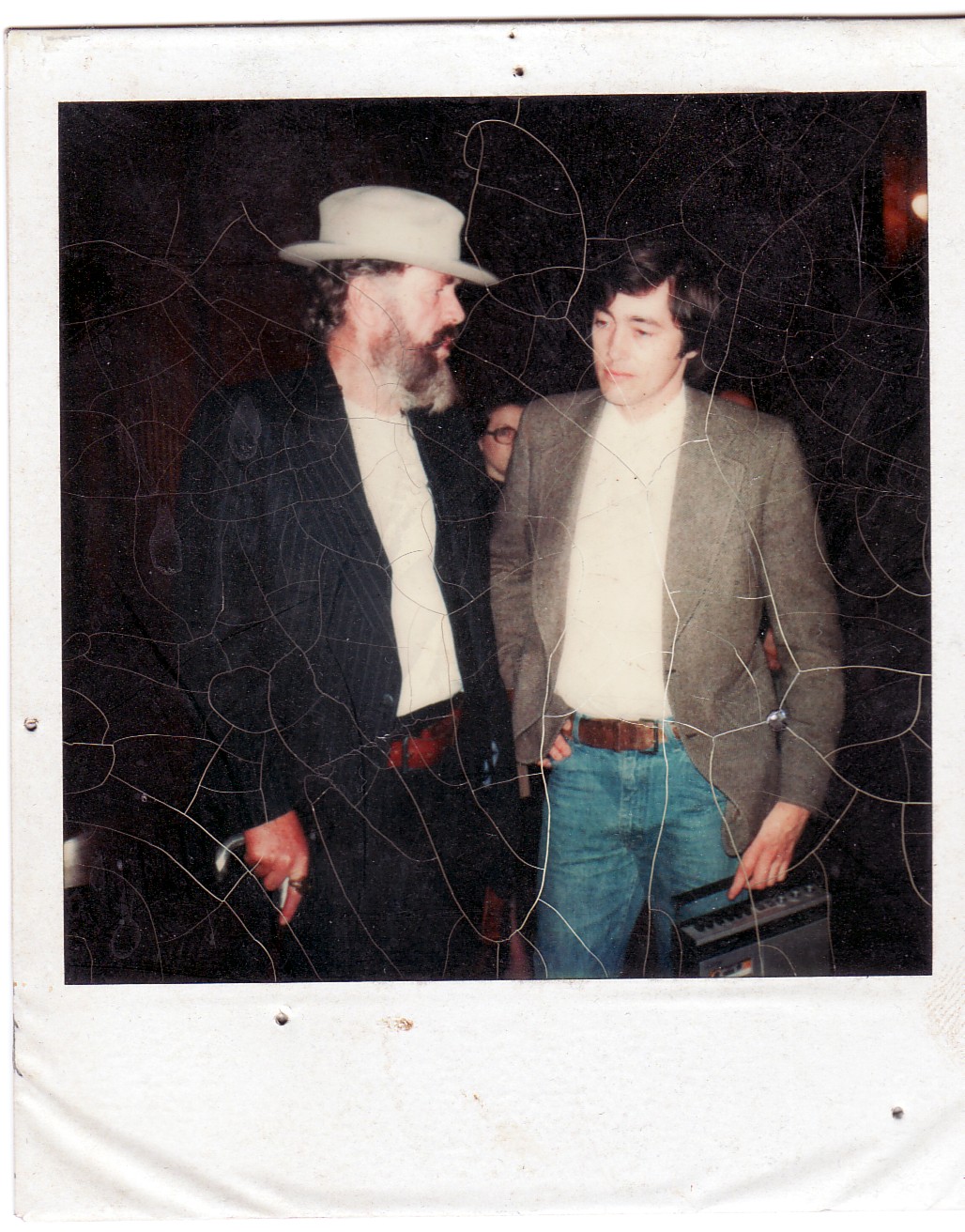
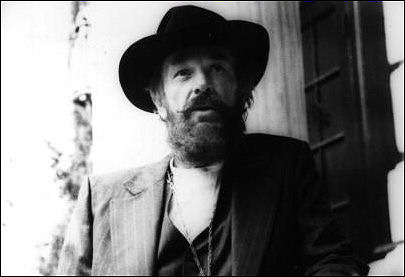
Degraded Polaroid photo of King of the Gypsies star Sterling Hayden and journalist during filming in late ’77 (or was it early ’78?) at Manhattan’s Plaza hotel.

But the film carries a special memory for me, however, as I managed an interview with star Sterling Hayden during filming in Manhattan in late ’77. Hayden, who lived in my home town of Wilton, Connecticut, and whom I knew faintly because of this, was the first “name” guy I ever sat down with for a piece.

A good actor but an even better writer, eloquent and blustery, and a “bothered” malcontent from way back, Hayden — 62 at the time — was a tall, bearded Zeus-like figure, and one of the first bohemian-minded older guys I’d had the pleasure of slightly knowing.

He liked being the ornery old rebel, and was fairly open to hanging with younger fans like myself. I visited his Wilton home two or three times to listen and learn and shoot the shit. (It helped that I knew all of his films, and had strong opinions about his best performances.) I never got high with Hayden, but I knew a couple of Wilton guys who told me they did. Hash, they said.

Hayden had some legendary problems with the bottle. He wasn’t all that different from Roger Wade, the alcoholic writer he portrayed in Robert Altman‘s The Long Goodbye. (Hayden was less bitter.) He would do rehab and fasting from time to time. I remember him saying once that fasting “is the precise opposite of debauch…the hard thing is to hold that middle ground, hold that middle ground.”
My King of the Gypsies interview with Hayden took place in a hotel room at the Plaza hotel, where filming was happening that day. It was sometime in the mid-afternoon, and I recall his downing a couple of large glasses of Johnnie Walker Red over a two-hour period. Hayden wasn’t much of a give-and-taker. He was the Great Man who’d been through it all, knew it all and had a lot to say. It was all about feeding him set-up lines and and letting nature takes its course.

He told me that producer Dino de Laurentiis had given him a copy of Lorenzo Semple, Jr.‘s script of Hurricane, in hopes that Hayden would agree to costar. When De Laurentiis asked what he thought, Hayden said (or so he told me), “I gotta tell ya — I think it’s crap!” Bristling, De Laurentiis replied, “You’re the first person who’s said that!” A day or two later Hayden talked to a De Laurentiis development guy who said, “Naahh…you’re not the first.”

The best moment of our interview happened when Hayden began speaking of his farmer role in Bernardo Bertolucci‘s 1900. He said that Bertolucci had let him write his own dialogue, and was proud of a line he’d written for his death scene. I knew it and said it before he did — “I’ve always loved the wind.” Hayden patted my knee and said “Hod love ya.” NTalk about a bonding moment.

“Queer” Over “Challengers”

Owen Gleiberman‘s “Challengers should be Oscar nominated” essay (posted a few hours ago) ends with this passage: “If a movie like Challengers is nudged aside by the Oscars, that becomes a way of devaluing it.”

Such a dismissive snub, he argues, will amount to “Oh, a dazzlingly fun movie that was popular? That’s not up to our standards.”

Gleiberman: “Over the years, the Oscars have been accused of many things, from vulgarity to irrelevance. The last thing the Oscars should leave themselves open to being accused of is snobbery.”

Due respect, no offense and full affection, but Owen has leapt onto the wrong Guadagnino horse.

Challengers is sporadically intriguing and certainly different in its approach to a well-bonered, relationship-driven sports drama, but it pales alongside Luca’s Queer, which I regard as not just masterful but a breakthrough — “one of the most fascinating, out-there films about vulnerability, transformative intimacy and emotionality that I’ve ever seen.”

To me Challengers was intriguing in a left-field sort of way, but it didn’t fulfill my idea of “crowd pleasing.” Plus Zendaya is too much of a mouseburger, and I didn’t like Mike Faist‘s alabaster skin and champagne-tinted ginger hair.

Posted on 4.16.24: Last night I saw Luca Guadagnino and Justin KuritzkesChallengers (Amazon, 4.26), and as far as “tennis pros engaged in romantic triangle” flicks go it’s fairly out there, man.

Challengers hasn’t been written and shot in my preferred style (like King Richard, my all-time favorite tennis movie) but I respect and admire the fact that Guadagnino, the director, has made a jumpy, flourishy, time-skotching, impressionistic, mostly hetero but also vaguely homoerotic film that…what’s the term, broadens your horizons? Challenges you and wakes you up? Makes a dent in your psyche?

It doesn’t do the usual thing and certainly pushes a few boundaries, but I like that for the most part. I certainly prefer films that try different strategies over ones that adhere to predictable ones.

So, putting this carefully, I didn’t love everything about it (which puts me in a minority) but I loved the verve, the effort, the invention, the ballsiness. I was irked here and there but I certainly wasn’t bored. All in all the audacity and impulsiveness of Challengers makes it Guadagnino’s best film since Call Me By Your Name. Really.

Read more

“Boots Boots Boots Boots”

I, too, am encouraged by the trailer for 28 Years Later (Sony, 6.20.25). especially with Danny Boyle directing and a script by Alex Garland, and a cast toplining Jodie Comer, Aaron Taylor-Johnson, Ralph Fiennes, Jack O’Connell and Cillian Murphy.

True, I’m not a fan of Murphy or more particularly his eyes, but I respect his acting.

I’m less enthused abour 28 Years Later Part II: The Bone Temple, largely due to the threatening notion of Nia DaCosta (The Marvels) having directed.

Both films were reportedly shot with iPhones.

Boots” is Rudyard Kipling poem, initially published in 1903.

Read more

Bad People

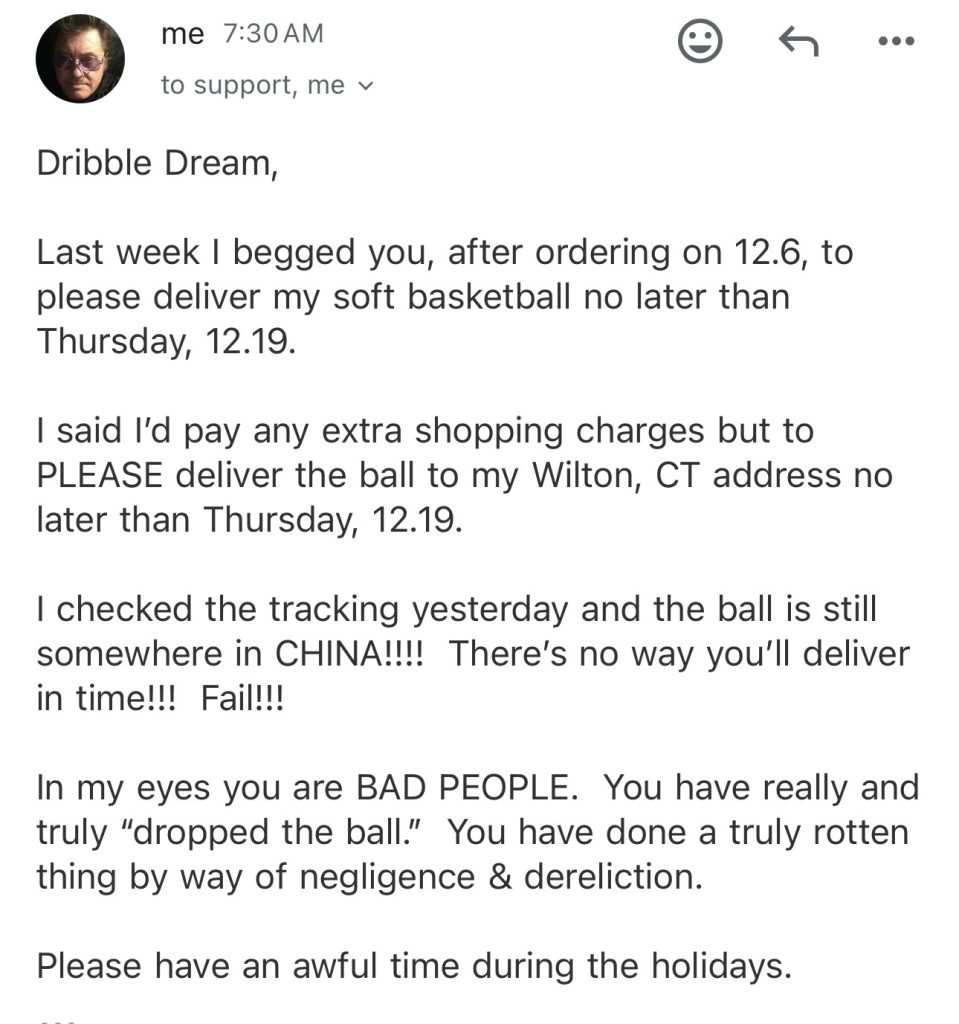
It would’ve been one thing if my Dribble Dream ball (which cost $47 plus shipping and taxes) was in the States and slowly making its way. That’s life — you can’t always get what you want.

But I hit the roof yesterday when a tracking report said my package was still in effing China…CHINA!

“Maria” Is Mysterious

Pablo Larrain’s Maria has no pulse. It’s nicely directed for what it is. Handsome, decorous, more than a bit plodding, etc. Jolie delivers as well as can be expected, given the flatness of the concept.

But it’s slow as effing molasses. No story tension to speak of. It’s a museum piece.

My immediate response was “why did they make this effing thing?“ It’s not a bad film form-wise, but why?

Interior dialogue as I watched: “I have no empathy or sympathy for Angie’s Maria Callas. She’s a solemn, regal, frosty attitude-bitch with all kinds of grief and anger churning inside. She sulks, hides, chills. Later.”

Excellent cinematography, production design, hair, makeup, wardrobe…totally aces from a tech standpoint.

What was I thinking or feeling while watching the last half-hour? “Angie has no blood in her veins. She needs to die like Maria did and get this over with. Release me from this mortal coil.”

Hiding In The Vaults?

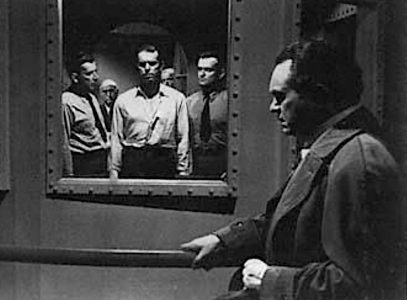
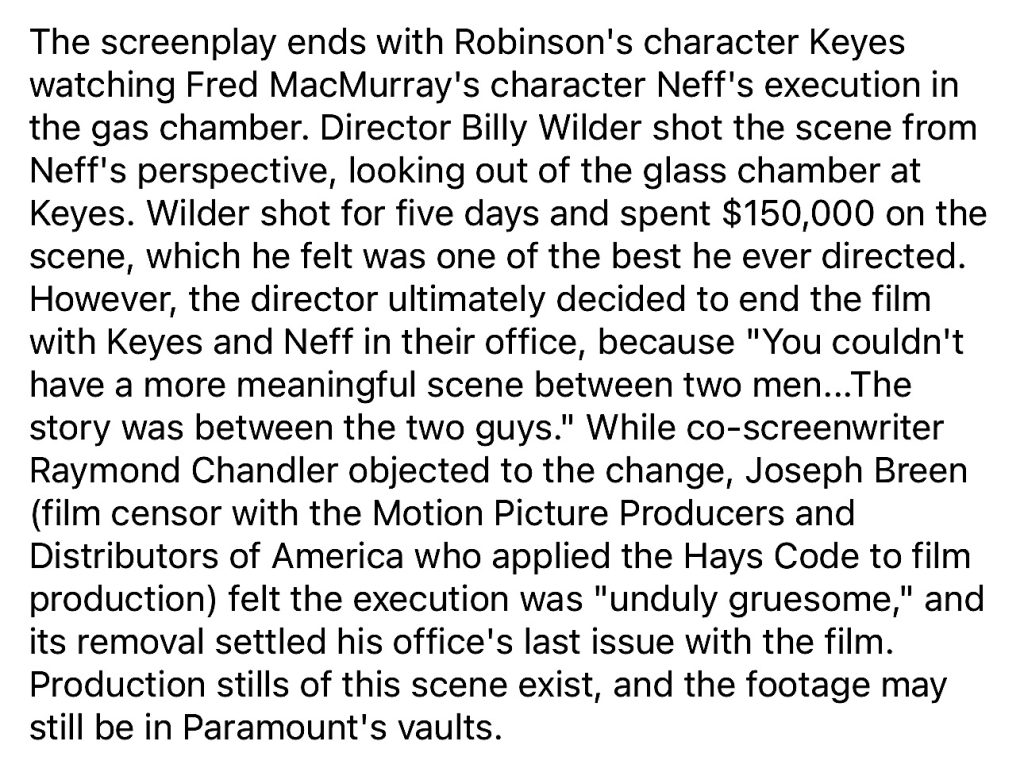
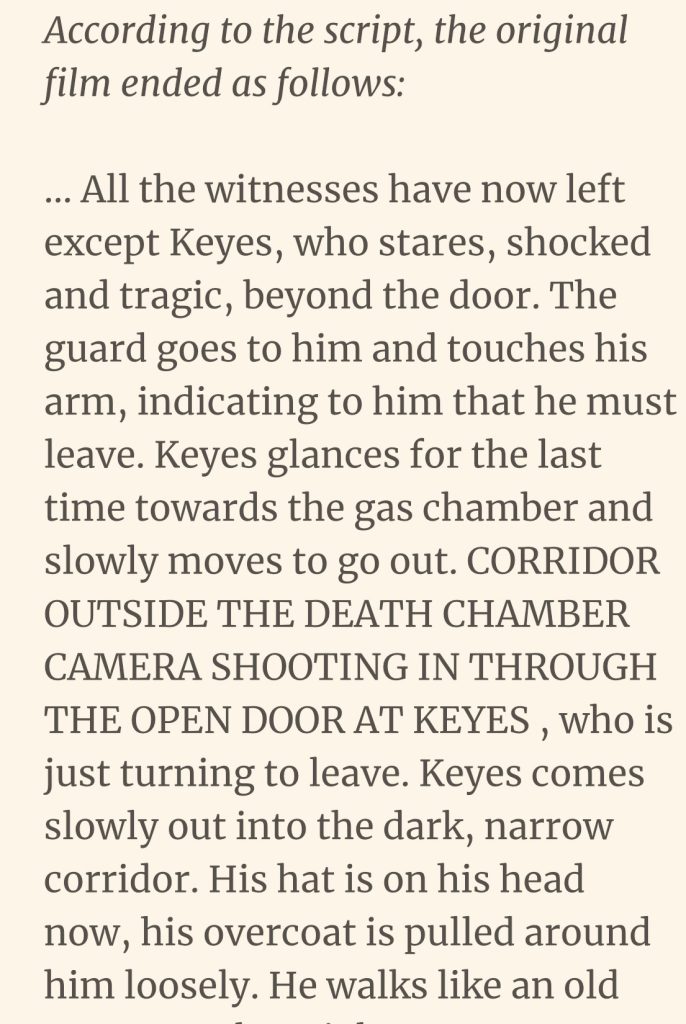
I have no problem with the idea of never, ever seeing the missing gas chamber finale from Billy Wilder’s Double Indemnity (‘44).

Because the finale that Wilder ultimately went with (i.e., Edward G. Robinson lighting Fred MacMurray’s cigarette) pays off so perfectly — why spoil it?

MacMurray’s Walter Neff was an absolute idiot, of course, for killing Barbara Stanwyck’s cranky-ass husband. Risking his life for some great sex on the weekends? Not worth it, bruh. It was obvious she was a wrong one from the get-go.

Would I like to see the missing finale anyway? The scene sounds awfully grim, verging on grotesque. But if it turns up one day, sure. I can take it.

From https://filmnoir.art.blog/2008/04/09/double-indemnity-the-unseen-ending/:https://filmnoir.art.blog/2008/04/09/double-indemnity-the-unseen-ending/:

Cox: Let Spacey Thing Go

“I just think Kevin [Spacey] had certain things which he couldn’t or didn’t admit to, and I think it was a strain on him in many ways. And for me, that was Kevin’s only difficulty.

“But he’s a very fine actor, and I like Kevin a lot. He’s very funny. I met with him recently. I think he’s been through it. He’s had the kicking that some people think he deserved. He’s ready to get back in the saddle again, and some people are trying to stop him from doing that.

“And I really do go back to, ‘Let he who is without sin cast the first stone.’ Maybe he got too out of hand, but I don’t think he should be punished endlessly for it. There should be a case of forgive and forget. Let’s move on. I think he should be given the opportunity to come back to work.” — Brian Cox to THR‘s Andrew Goldman.

Indiana Critics “Substance” Trolling

Last weekend the Indiana Film Journalists Association (IFJA) asked themselves “what we can do, collectively and film-award-wise…what can we do this year to really stand out against the other critics groups, even if it makes us look like behind-the-curve showboats?”

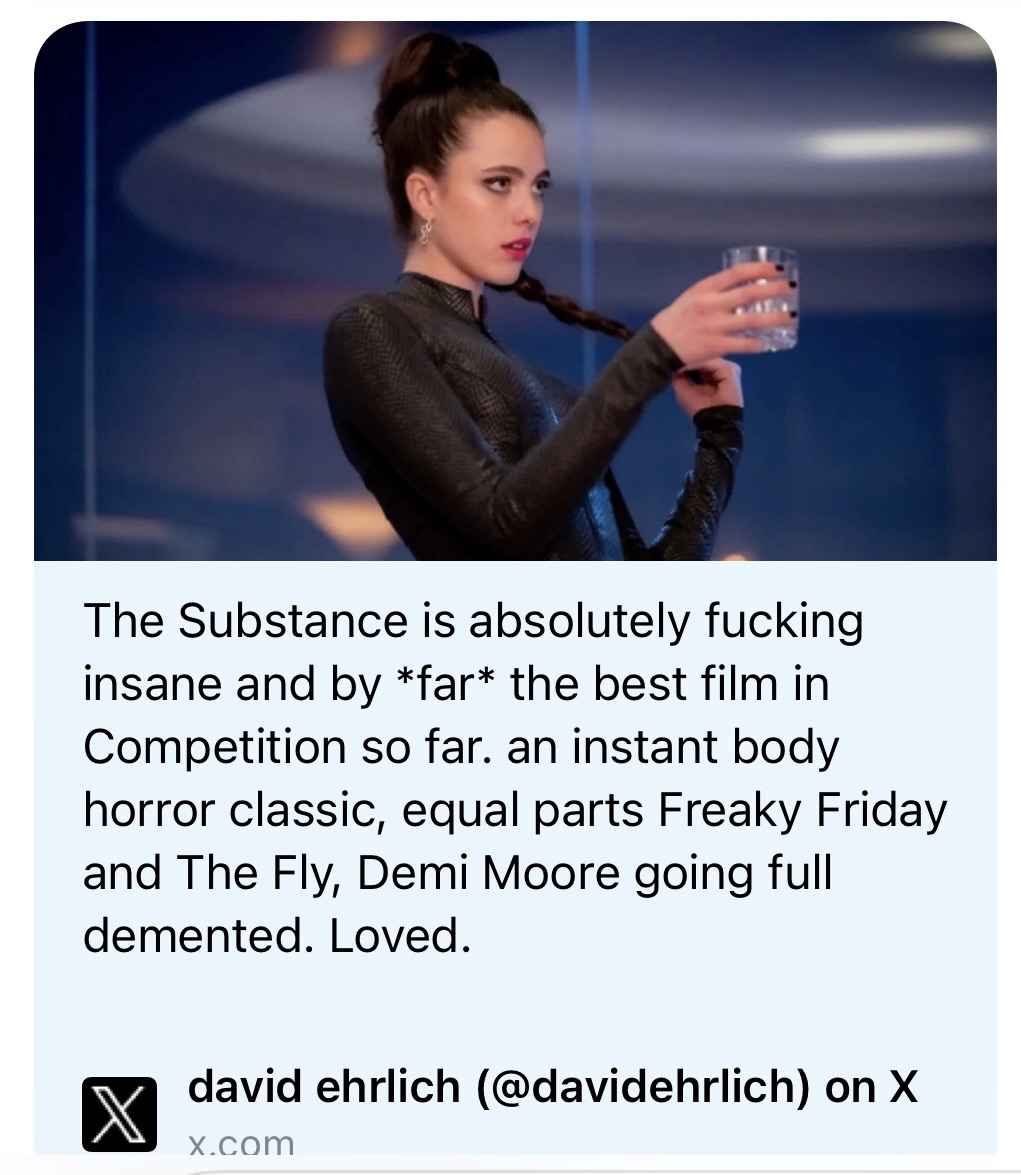
And so they decided to go all-in on Coralie Fargeat‘s The Substance by handing it four big gutso-slammo awards — Best Film, Best Director (Fargeat), Best Performance (Demi Moore) and Best Supporting Performance (Margaret Qualley).

Their second-favorite filmn was HE’s biggest hate-on of 2024 — Brady Corbet‘s The Brutalist.

Compounding their assholery, the IFJA has gone gender-neutral on acting awards. Yo, fellas….you didn’t get the memo? DEI is retreating everywhere…no longer fashionable…ballgame’s over!

IFJA: “Our commitment to diversity, equity and inclusion: The IFJA believes comprehensive diversity of opinion goes hand-in-hand with comprehensive diversity of gender, race, creed, culture and sexual orientation…pathetic assholes! “To encourage such diversity, equity and inclusion within the group’s ranks — and spur innovation and promote growth in the field of film criticism in Indiana — the IFJA encourages critics of all genders, races, creeds, cultures and sexual orientations to apply for organizational membership.”

Bottom line: The Substance is sufficiently Cronenberg-perverse to warrant attention, but it goes on too long and wears out its welcome.

Posted during last May’s Cannes Film Festival:

There’s a degree of irony, methinks, in Demi Moore starring in The Substance, a riveting David Cronenberg-ian body-horror flick about the fear of aging among older women and the application of artificial enhancements, when it’s been apparent for some time that Moore herself has been augmenting nature with the usual costly touch-ups.

Not that I have the slightest problem with this. Born during the Kennedy administration, Moore looks great (and I’m saying this as a veteran of three Prague procedures so don’t tell me) but c’mon…her character, an aging actress and workout-show host named Elizabeth Sparkle who injects herself with a radical youth drug, isn’t that far from self-portraiture.

Sparkle’s radical de-aging situation conveys a certain parallel or reach-back to Oscar Wilde‘s Dorian Gray, of course, but I’m also thinking of poor, anguished Norma Desmond. Imagine her post-Sunset Boulevard, non-mental-asylum life with the benefit of today’s plastic surgery techniques. She might not have wound up shooting William Holden‘s Joe Gillis, and he might have become Betty Schaefer‘s permanent writing partner!

(Who speculated that Gillis might have somehow been the father of American Gigolo‘s Julian Kaye? Was it David Thomson?)

Directed by Coralie Fargeat, The Substance is a whipsmart body-horror flick. Urgency, punch and pizazz feeds into this synthetic-feeling, slickly assembled piece of feminist (i.e., male-asshole-hating) agitprop, and obviously with a bullhorn message, to wit: Women, throw off the yoke of male assholery and their imposition of bullshit beauty standards and live for yourselves.

There are only two problems with The Substance.

One, it’s not just about Moore’s Sparkle de-aging herself after being fired from her TV show (i.e, too old) but about being replaced by Margaret Qualley‘s Sue, a 20something who emerges, Cronenberg-style, from within Elizabeth. Elizabeth and Sue have some kind of alternating arrangement in which they take turns strutting around in the big, bad city. And I couldn’t understand the rules…how and why of it all.

And two, the film goes on too long. It wore me down and I started glancing at my watch repeatedly….c’mon, wrap this up already.

The New Yorker‘s Justin Chang is calling The Substance “a shoo-in for the Palme d’Or.” Sure thing. If they gave to Titane, why not?