If the below films wind up playing at Cannes ’26, I will be happy and jazzed. My blood will be up. Obviously a strong lineup and then some.
1949 (d: Pawel Pawlikowski) Fjord (d: Cristian Mungiu) Jack of Spades (d: Joel Coen) Coward (d: Lukas Dhont) The Entertainment System is Down (d: Ruben Östlund) Bitter Christmas (d: Pedro Almodovar) Minotaur (d: Andrey Zvyagintsev) Parallel Tales (d: Asghar Farhadi) Switzerland (d: Anton Corbijn) The Diary of a Chambermaid (d: Radu Jude) Bucking Fastard (d: Werner Herzog…a kin of Fitzcarraldo?) Sex and Death at Camp Miasma (d: Jane Schoenbrun…slasherschlock?) Paper Tiger (d: James Gray)
I don’t believe that Terrence Malick‘s The Way of the Wind will be submitted. I don’t believe Malick is capable of finishing it. I think he’s flaked and dithered himself into a corner, and can’t figure a way out.
Which is why the truly artful Marty Supreme has been back-handed, mostly, I suspect, by progressive women and mainly because it’s about an overly selfish, callous, non-progressive lead character.
This is also why One Battle After Another and Sinners are such hot Oscar contenders, because they’re about devotional, good-hearted fringe characters doing what they can to help the vulnerable and the oppressed.
First and foremost wokeys want movies that say the right political things…that’s their bottom line. Which was the same bottom line as far as Nikolai Lenin, Mao Zedong, Joseph Goebbels and post-1966 Jean Luc Godard were concerned.
“His words were a caring, gentle, and protective gesture, directed not only at the artistic community but at humanity itself, and despite the predictable pile-on, I suspect that many artists, maybe most, will genuinely appreciate his words.”
“[Wenders might have been] trying to save the Berlinale from succumbing to the fate of those festivals that have become little more than a narrowing of the cultural imagination”, criticising many modern events for having become subject to “a single monolithic ideology — one voice, one cause, one dissent”.
Cave: “I do not imagine for a moment that Wim thinks art should ignore the great and persistent injustices of the world. He seems to believe, as I do, that using art to raise awareness of these injustices can be extremely effective, but perhaps he also believes that art is more than the sum of its utility…it is more than a tool or a weapon.”
“Maybe he believes, as I do, that at its core, great art exists purely for its own sake – and that at its most transformative it reveals itself subtly, ambiguously, and curiously; that it is something we approach with awe and wonder, that humbles us whilst also enlarging our hearts, that works its way into our souls and spirits, guiding us towards what is good, beautiful, and true.
“Art captivates us and imparts a sense of what it means to be human, broadening our understanding of the world and our own place within it — that we have the right to love, laugh, cry, and be thrilled by the world. This is art’s largesse — to remind us that life is worth living.”
When I think of the peak triumphs of the late Robert Carradine, the gifted bipolar actor who’s just taken his life at age 71, I don’t think of his work in Jeff Kanew‘s Revenge of the Nerds (’84) or Lizzie Maguire (Disney Channel series, began in ’01), which were both made for mass-market schmucks.
I think instead of Carradine’s edgy, vulnerable performances in a pair of films about frustrated men living outside the straight-and-narrow — his mentally unstable, guitar-playing veterans hospital patient in Hal Ashby‘s Coming Home (‘78) and his West Village gay guy dying of AIDS in Michael Lindsay-Hogg and William Hoffman‘s As Is (‘86), which aired on Showtime and attracted some award nominations but enjoys little recognition today.
Film critic friendo to HE: “I’ve never even heard of As Is.” HE to friendo: “Hah…I rest my case.”
The Carradine obits I’ve read so far (including those by Deadline‘s Tom Tapp and Mike Fleming) have ignored AsIs.
Showtime’s adaptation of Hoffman’s 1985 off-B’way play is listed on Carradine’s Wikipedia page, but it isn’t mentioned in Wiki’s narrative summary of his TV career. Which seems odd.
Carradine’s As Is performance, arguably his last in the realm of real-deal anguish and complex emotional damage, was nominated for a CableACE award.
I never wanted to see Revenge of the Nerds, and, to my immense satisfaction, I never have. I realize that my instinctual cowardly fear of submitting to Nerds has no value. A friend insists it was actually a witty, widely liked and much appreciated ‘80s comedy…it wasn’t To Be or Not To Be, but it was genuinely well done.”
HE to friendo: “Not a coarse tits & zits comedy?” Friendo to HE: “It emerged from the swamp of that genre, true, but Nerds was genuinely a cut above. If you do a post on Carradine and Nerds. You’ll witness some nostalgia and affection.” HE to friendo: “Okay.”
There are those who swear by Carradine’s cameo in Mean Streets. He played an unnamed gunman who shoots a drunk, played by Robert’s significantly older half-brother David. The grabber is how Robert slowly, almost ritualistically takes his cap off before firing, which allows his extra-long hippie hair to fall to his shoulders.
“Prostitution”? Joe Gillis simply acquiesced to a semblance of a pay-for-play MILF relationship with Norma Desmond, except he never wanted her sexually.
Call it a standard quid pro quo, cash-on-the-barrelhead transactional relationship. What’s the biggie? Is Gillis lying to Desmond by assuring her that he loves her and will always be loyal? No. Plus he admits at the halfway mark that she’s the only person in Los Angeles who has treated him with a semblance of decency or kindness. Okay, so she wants him to fuck her as a side benefit. Is that a crime?
Flipping the coin over, how many tens of thousands of Los Angeles women have been in such relationships in exchange for security and a flush lifestyle, and nobody bats an eye?
William Holden didn’t have to end up dead in Gloria Swanson‘s swimming pool. And he really didn’t have to submit to self-loathing when he began to fall in love with Nancy Olson’s Betty Schaefer, a fellow screenwriter.
Don’t forget that the second half of Billy Wilder’s Sunset Boulevard was largely driven by self-revulsion — a young male screenwriter feeling morally sickened by his willingness to sexually satisfy a 50 year-old former silent-era star in exchange for a swanky lifestyle.
1950 was one sexually uptight year, you bet. It saw both the release of Sunset Boulevard and the widespread condemnation of Ingrid Bergman for having had Roberto Rossellini’s baby outside of wedlock. In the eyes of the general public there was nothing more odious than unsavory sexual behavior, or any kind of hanky panky outside the usual proper, middle-class boundaries.
But Gillis could have have just laid his cards on the table as he explained to Schaefer, “Look, I was broke…the finance company was about to take my car away.…I’m not evil…I’ve simply been using Desmond and living off her largesse while I figure out my next move.
“Plus I did what I could to finesse her awful Salome script. What’s so terrible about that? Okay, so I’ve been to bed with her a few times. I’ve laid there while she rides me like a cowboy on a palamino…big deal!”
Schaefer: “Don’t worry about it, Joe. You did what you had to do in order to survive. Now pack your things. You’re moving in with me.”
Gillis: “But we haven’t even been intimate yet. And what about your devoted fiancé, nice-guy Artie (Jack Webb)?”
Schaefer: “Artie’s a sweetheart but I don’t love him…not really. Largely because he’s too possessive plus he’s not from the creative side, and writing is my lifeblood. We’re not a great match. I’ve submitted to his sexual advances on occasion but he doesn’t turn me on. I’ve never once blown him and I’m sorry but that means something. This may sound cold but all’s fair in love and war.”
HE commenter Dixon Steel (two years ago): “The image of anyone blowing Joe Friday is not a pleasant one.”
HE commenter Naido: “Yeah, my main takeaway is that now I have to think about Webb being blown. Or not blown, which would make me sad.
“I think most guys doing today what Gillis was doing would feel this way about themselves. If it were truly transactional and not a Macron thing. Not all would, but not all would have back then.”
Remember “Mandy” in Stanley Kubrick‘s Eyes Wide Shut? The heroin-addicted hooker who nearly od’ed at Sydney Pollack‘s mansion, and then apparently attended the big orgy only to end up in a Manhattan morgue locker?
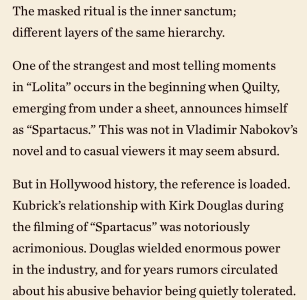
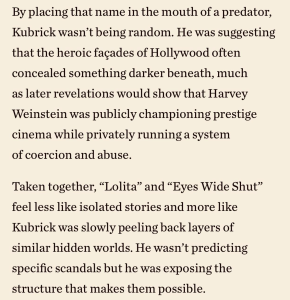
She was played by Julienne Davis, who’s now 62 or thereabouts. Davis has written a smart, well-honed piece (paywalled) about the parallels between EWS and the Jeffrey Epstein history, as well as the Epstein echoes contained in Kubrick’s Lolita (’62).
HE is hereby divested from the Nancy Guthrie disappearance case. The trail has apparently gone cold. The Pima County bozos can’t even find that dumbshit ski-mask-and-backpack video doorbell guy. Benoit Blanc could maybe crack it, but local investigators are obviously in over their heads.
And the reporting-and-speculating YouTube brigade has nothing…nothing at all. I can’t stand watching Ashleigh Banfield now…she has zip on her plate and knows it, but she can’t stop milking this thing. It’s kinda pathetic, really. Poor Brian Entin…a good reporter but he has nothing, nothing, nothing.
It’s all a dead end, a dry gulch. Nobody wants to admit that poor Nancy has almost certainly passed, but she probably has. She may have died the first night.
When will the Banfields and the Entins call it a day, pull up stakes and go home? This case could be the new Picnic at Hanging Rock.
Once he’s found guilty of murdering his parents, Nick Reiner will live out the remainder of his life in an eternity of grim confinement. A more humane resolution would be a death penalty. A firing squad, I’m thinking. Seriously…bullets in the chest would be a more compassionate sentence.
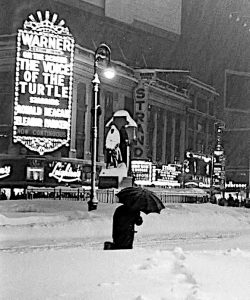
Manhattan is glorious after a big snowfall. I’ve done it a few times. So much energy and camaraderie to be shared. If you’re dressed for it, walking around the West Village is heaven. Wonderland vibes.
Congrats to Sinners costar Wunmi Mosaku after taking the Best Supporting Actress trophy during yesterday’s BAFTA awards. She plays Annie, the estranged, Hoodoo-practicing wife of Michael B. Jordan‘s Smoke Moore. I was looking at one of her Sinners clips this morning and saying to myself, “Yup, she brings it.”
But I have to be honest — when Mosaku was Oscar-nominated a while back I could barely remember a single stand-out scene that she was in. Ditto when she won yesterday. For the first time in the history of the BAFTAs I had to pull clips to jog the memory. Face it — Mosaku’s big one-on-one scene with Jordan is on the flat side.
Maybe she won because she’s a Brit — born in Nigeria, raised in Manchester. Or because the voters were attracted to the idea of making history, Mosaku being the first black British winner of this particular BAFTA award.
When I think of Sinners the principals appear in a recollection cavalcade — Jordan, Hailee Steinfeld, Jack O’Connell, Miles Caton, Buddy Guy, Delroy Lindo, the KKK guys. Mosaku? Not so much.
The Tourette’s-afflicted John Davidson, whose personal saga is dramatized in Kirk Jones‘ I Swear, made a mess out of yesterday’s BAFTA awards. To no one’s condemnation, Davidson blurted out the N-word while Sinners‘ Michael B. Jordan and Delroy Lindo were on stage. The BB1 footage has since been deleted, of course.
BAFTA host Alan Cumming: “You may have heard some strong and offensive language tonight. If you have seen the film I Swear, you will know that film is about the experience of a person with Tourette’s syndrome. Tourette’s syndrome is a disability and the tics you have heard tonight are involuntary, which means the person who has Tourette syndrome has no control over their language. We apologize if you were offended.”
HE disagrees with the “no control over language” part. Cumming meant to say that that Tourette’s sufferers have no ability to control their tics, spasms and vocalizings, but it’s hard to believe that Davidson’s terminology had nothing to do with Jordan and Lindo being front-and-center. (Davidson is more specifically grappling with coprolalia, or “the utterance of obscene words or socially inappropriate and derogatory remarks.”)
Did Davidson shout out “peacock!” or “muff diver!” or “Lamborghini!” or “Cheerio’s!”? No, he shouted out a racial slur. How can anyone argue that this wasn’t a form of id commentary?
Consider the famous Tourette’s scene from Ruben Ostlund‘s The Square (’17).
During a one-on-one between Dominic West‘s Julian, a famous artist, and Annica Liljeblad‘s Sonja, a Tourette’s sufferer starts interrupting with sexually provocative taunts like “show us your boobs!,” “whore!” and “camel-toe!” These remarks were responses to Liljeblad, an attractive Nordic blonde with great gams. The Square guy didn’t blurt out anything racial or scatalogical — he went sexual for an obvious reason.
If I was producing a live awards show or on-stage interview and some Tourette’s guy started ruining the moment, I would tell the security goons to politely and gently escort the offender out of the room. I wouldn’t stand for it. I don’t care how insensitive this would make me seem.
Note the feeling of frustration in The Square when the wife of the Tourette’s shouter doesn’t lead him out of the room, and the feeling of immense audience satisfaction when the black-tie invitees abandon their composure and beat the crap out of Terry Notary for behaving like an overly aggressive gorilla.
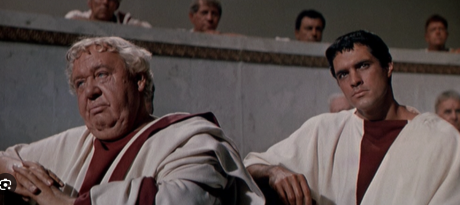
65 years ago Dalton Trumbo wrote the following Spartacus dialogue between Charles Laughton‘s Gracchus and John Gavin‘s Julius Caesar. The subject was Gracchus having arranged with Cilician pirates to provide ships to help Spartacus’s slave army escape from Italy:
Julius Caesar: “So now we deal with pirates. We bargain with criminals.”
Gracchus: “Now, don’t be so stiff-necked about it! Politics is a practical profession. If a criminal has what you want, you do business with him.”
Not so much any more.
The release of the Epstein files has adversely affected POI (people of influence) who had any kind of friendly relationship with the late Jeffrey Epstein during the ’90s, aughts and teens. We’re talking about a “social crime” or “stain” upon reputations, and the ones who’ve suffered the most in this regard are Andrew Mountbatten-Windsor (recently arrested), Kathryn Ruemmler (Goldman Sachs GC…resigned earlier this month after reports she was a friend of Epstein’s), Brad Karp (Paul Weiss chairman), Larry Summers, Casey Wasserman (LA 2028 chair…tarnished by friendly emails with Ghislaine Maxwell).
I’m not aware that these people are guilty of any kind of hard criminal activity with Epstein, according to the files. Maybe I’m overlooking stuff, but as far as I know they were just chatty with the guy. I’m presuming they saw a financial upside in keeping Epstein in their corner. Nothing more than that.
Somebody needs to find Trumbo in heaven and tell him that the rules have changed. If a criminal has what you want, you avoid him like the plague lest you be condemned for merely being loose and friendly with the guy.