

Slow-Moving Filmstruck
HE to Criterion’s Peter Becker (who’s on vacation): “Peter — Could you please tell me what Criterion’s plans are for offering 4K versions of its library, if not via physical media (4K UHD Blurays) then at least via 4K streaming files on Filmstruck? I’ve been floored by Amazon’s 4K streaming versions of Lawrence of Arabia and The Bridge on the River Kwai, and I would love, naturally, to see L’Avventura, Blow-Up, One-Eyed Jacks, The Spy Who Came In From The Cold and all my other favorite Criterion Bluray titles on 4K. A Filmstruck app, by the way, still isn’t available on the Roku box. A tech support person recently wrote that the Filmstruck app will arrive on Roku sometime in May. Is that true? I realize that you’re not exactly a vigorous communicator when it comes to direct questions from persons like myself, but is there any chance you could reply this time? Or at least ask someone to provide answers on your behalf? Many thanks — Jeffrey Wells, Hollywood Elsewhere”

Posted by TCM chatroom guy named “TopBilled” in thread about when Roku will finally carry the Filmstruck/Criterion app. A Filmstruck rep told him sometime in May, but you never know.
But Not For Me
I was discussing with a friend the differences between real and fake 4K, and just how many 4K Blurays out there are generating the maximum true blue, and how many are flim-flamming with HDR-enhanced 2K uprez product, which seems to be good enough for most customers. There’s a half-decent site (Real or Fake 4K) that examines the particulars. Everyone says how great the Revenant 4K Bluray looks, but even this visually dazzling tour de force isn’t a pure experience. Real or Fake 4K says that while “films shot with 2.8K camera have more than twice the pixels as an ordinary 1080p Bluray”, The Revenant was “shot in 3.4K (some scenes 6.5K), VFX-rendered in 2K with the digital intermediate done in 4K” — obviously close but not quite an absolutely pure 4K cigar. The friend recommended that I buy Panasonic’s 4K UHD Bluray player — DMP-UB900 — for $600 and change, and right away I thought “no way.” Not until an abundant library of pure 4K Blurays of quality-level films are available, preferably with a good percentage of the classic stuff shot in large-format celluloid (70mm, VistaVision, et. al.). And that price has to come down.


A Bluray Too Far
Queer as I am for black-and-white Scope (2.39:1), I can’t see paying $30 for Twilight Time’s Our Man in Havana Bluray. I saw this agreeably droll Carol Reed film at the Aero two and half years ago, and as pleasant as it was it failed to lift me out of my seat. It was obviously made without any such notion in mind. Yes, I know the Bluray will almost certainly look sharper and richer than it did at the Aero. I would probably cough up $20 but no — Twilight Time insists otherwise.

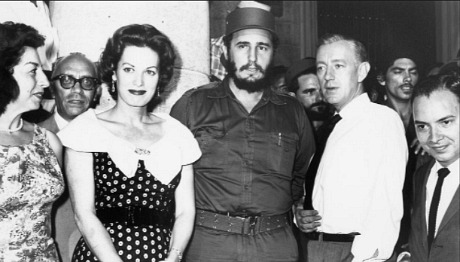
Maureen O’Hara and Alec Guinness flanking Fidel Castro during making of Carol Reed’s Our Man in Havana.
“Vacuum Cleaner Intrigue,” posted on 8.22.14: Last night I went to see Carol Reed and Graham Greene‘s Our Man in Havana (’59) at the Aero. A dryly amusing, mild-mannered timepiece. Intelligently written by Greene, pleasantly assembled. Handsomely shot in widescreen black-and-white (those old cobblestoned streets of Havana look wonderful under streetlights), although everyone is unfortunately affected with the CinemaScope mumps. Alec Guinness in his prime, Ernie Kovacs, Noel Coward, Maureen O’Hara, Ralph Richardson, Burl Ives, etc. The sort of light-hearted, old-school, mid 20th Century film that was all but eradicated by the cultural upheavals and radical passions of the ’60s and all that followed.
“Havana was filmed in Havana two months after Fulgencio Batista was overthrown by Fidel Castro and the Cuban revolution.
In Like Flynn
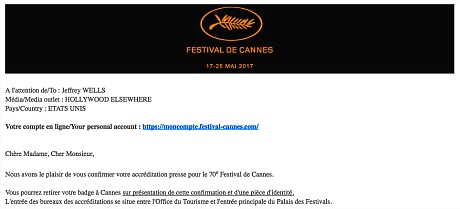
I was told this morning that my Cannes ’17 press credentials have been approved, and that I’m good for the usual pink-with-yellow-pastille badge. Unlike Team Sundance, the Cannes people know how to treat a hard-filing veteran. I wrestled briefly with using the above headline, but it’s the first thing that came to mind and that’s usually the way to go. (Yes, every so often it’s not.) “In Like Flynn” means you’ve got it, no sweat, walk right in, etc. We’re all aware of Errol Flynn‘s errant reputation, but I decided long ago that he’s more of a metaphor for self-destruction than anything else. Flynn totally cancelled his cool ticket by destroying himself with drink. The man looked like a 73 year-old when he died at age 50 from a heart attack. He may have been “in like Flynn” in the late ’30s and ’40s, but he was “wrecked like Flynn” by the mid 1950s, when he was only 45 or thereabouts. Heed this warning, party animals: think seriously about making lifestyle adjustments when you hit your late 30s or else.

Errol Flynn at age 35 or thereabouts.
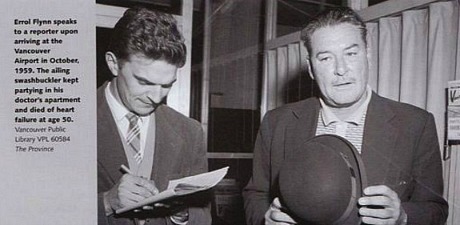
Destroyed, diseased, dessicated at age 50.
Mungiu the Masterful Heading Student, Short Film Cannes Juries
HE’s own Cristian Mungiu — Palme d’Or winner for 4 Months, 3 Weeks and 2 Days and co-recipient of last year’s Best Director prize for Graduation — will serve as the honcho for the 2017 Cannes Film Festival’s student and short film juries. What does this have to do with the price of rice in Pomona? Nothing, but at least it’s another opportunity to remind engaged, upmarket viewers to catch Graduation when it opens on April 7th…please.
It’s also an opportunity to re-post my 5.19.16 Graduation review, titled “Graduation Is A Grabber, But Cutting A Slight Ethical Corner In a Tight Spot Isn’t Necessarily An Evil Thing”:

Graduation is a fascinating slow-build drama about ethics, parental love, compromised values and what most of us would call soft corruption. It basically says that ethical lapses are deceptive in that they don’t seem too problematic at first, but they have a way of metastasizing into something worse, and that once this happens the smell starts to spread and the perpetrators feel increasingly sick in their souls.
I don’t necessarily look at things this way, and yet Mungiu’s film puts the hook in. I felt the full weight of his viewpoint, which tends to happen, of course, when you’re watching a film by a masterful director, which Mungui (Four Months, Three Weeks, Two Days, Beyond The Hills) most certainly is.
And yet I tend to shy away from judging people too harshly when they bend the rules once or twice. Not as a constant approach but once in a blue moon. I’m not calling myself a moral relativist, but I do believe there’s a dividing line between hard corruption and the softer, looser variety, and I know that many of us have crossed paths with the latter. Let he who is without sin cast the first stone.
Inspired By Love & Mercy?
Showtime’s page for The Beach Boys: Making ‘Pet Sounds’ (4.7, on demand 4.8) says that the doc is “celebrating the 50th anniversary” of Brian Wilson’s landmark album. But of course it isn’t. Pet Sounds was recorded between 7.12.65 and 4.13.66, and was released on 5.16.66, so the doc might as well celebrate the 51st anniversary. I’m presuming that it happened because of Bill Pohlad‘s impressive recreations of the making of this album in Love & Mercy. It would be more interesting, I feel, to see a doc about the making of Smile — the saga of how it was recorded and then abandoned and then reborn in the 21st Century.
Just Wanna Keep My Distance, Due Respect
Filed from Park City on 1.22.17: “Craig Johnson‘s Wilson (Fox Searchlight, 3.24) is basically about a middle-aged, passive-aggressive malcontent (Woody Harrelson) who’s way too friendly, way too open, doesn’t edit himself, has no social skills. He smiles sweetly and blathers on about anything that comes into his head. Free and unrestricted commentary about this, that and the other thing, and without a point or a strategy of any kind. Except to convey that he’s a passive-aggressive malcontent.
“Wilson is a sweet, kind-hearted guy who will never ‘fit in’ to any semi-conventional social congregation because he really has no idea what the word ‘dignity’ means. One of my definitions of that term is being able to sense when it’s cool to say something in mixed company and when it’s best to shut the fuck up. This instinct is not in Wilson’s tool kit.
“He also seems incapable of understanding a concept that I’ve always respected, which is that sometimes you shouldn’t say anything unless you can improve upon the silence. There’s a lot of joy and peace in silence, but lovable social calamities like Wilson will never, ever be able to get that.
“Which is one reason why I would carefully limit my time with a guy like Woody’s Wilson if life had managed to install him in my orbit in some capacity. I wouldn’t necessarily cross the street or bolt in the opposite direction if I saw him coming, and I would never say anything cruel to the guy, but I would politely avoid him whenever and however possible.
“This is basically why I didn’t much care for Johnson’s film, which is based on an original script by Daniel Clowes. I didn’t hate it, but I wasn’t the least bit disappointed when it ended.”
Inspired By Love & Mercy?
Showtime’s page for The Beach Boys: Making ‘Pet Sounds’ (4.7, on demand 4.8) says that the doc is “celebrating the 50th anniversary” of Brian Wilson’s landmark album. But of course it isn’t. Pet Sounds was recorded between 7.12.65 and 4.13.66, and was released on 5.16.66, so it might as well be celebrating the 51st anniversary. I’m presuming that this doc happened because of Bill Pohlad‘s impressive recreations of the making of this album in Love & Mercy. It would be more interesting, I feel, to see a doc about the making of Smile — the saga of how it was recorded and then abandoned and then reborn in the 21st Century.
“Show Me The Mummy!”
The only reason I’m writing about Alex Kurtzman‘s The Mummy (Universal, 6.9) is because I want credit for the “show me the mummy!” line. A screenwriter friend passed it along, and right away I said “that’s funny.” I’m not saying it hasn’t appeared somewhere else before (on some chat board or whatever), but I’m claiming it as an HE thing all the same, just like I put dibs on “Apocalypse Kong” for Kong: Skull Island.
In fact, I’m openly advising Universal marketing to use this line on the Mummy one-sheet…seriously. In the same way that Paramount wound up selling Mommie Dearest with Faye Dunaway‘s “no wire hangers!” line. A slogan that everyone will get right away, and which will take the heat off Universal — “Of course it’s a silly tentpole thing…what do you think those Brendan Frasier mummy movies were?…dope-crazy is what we wanted going in, it’s what we’ve got now and it’s what the popcorn crowd wants to see…relax! A stupid-ass Tom Cruise mummy flick that’ll be fun to see with your rowdy friends.”
Get real — The Mummy has seemed like a fairly silly film from the get-go, and now those chickens are coming home to roost with talk swirling around that “people are laughing at it” and that a recent test screening (which may or may not have happened in Glendale on March 8th) drew lousy numbers and that it may not be quite good enough to launch a Universal monsters franchise a la Marvel universe.
That’s what the basic game plan is — to use the success of The Mummy to generate excitement in a reboot of several classic Universal monster films — “a whole new world of gods and monsters” or words to that effect. That said, has anyone ever expected The Mummy to be anything more than a super-expensive piece of CG goofery? No. Was anyone taking it seriously when they made it? How could they? That Mummy trailer that popped last December makes it look like a satire of an absurdly expensive meta monster flick.
This is all loose talk, of course. Nobody knows anything, least of all myself. And you always need to take a few steps back when it comes to second-hand sources.
TCM Classic Film Festival Standouts
Beat The Devil aside, the attractions at the TCM Classic Film Festival (4.6 thru 4.9) that have my interest are as follows: (a) the nitrate films, all being shown at the American Cinematheque’s Egyptian theatre — Black Narcissus (’47), The Man Who Knew Too Much (’34), Laura (’44) and Lady in the Dark (’44); (b) a screening of Larry Peerce‘s The Incident (’67) which hasn’t been seen in any kind of shape for decades; (c) A Cinerama Dome screening of This is Cinerama (’52) in its original three-projector format; (d) a 3D showing of the recently restored Those Redheads from Seattle (’53), featuring commentary from 3D Film Archive restorationist and major HE aspect-ratio nemesis Bob Furmanek; and (e) a screening of a presumably restored Hell Is For Heroes (’62).

Restored Devil Details Elude TCM Classic Film Festival Webmasters
The 2017 TCM Classic Film Festival (Thursday, 4.6 thru Sunday, 4.9) announced its schedule today, but somebody on the staff screwed up as far as their 4.7 showing of John Huston‘s Beat The Devil is concerned.
The 1953 black-and-white release is showing on Friday, April 7, at 11:15 am. A restored 94-minute version of this initially misunderstood camp classic, recovered and refined by Sony’s Grover Crisp, was screened at the annual Reel Thing symposium on 8.19.16. In keeping with the TCM festival’s longstanding tradition of showing recent restorations, Crisp told me this morning that the 94-minute version will indeed screen on 4.7. And yet the TCM Classic Film Festival website not only says the running time will be 89 minutes (the length of the somewhat faded and bleachy public-domain version that’s been playing on TV for decades) but fails to mention Crisp’s restoration. Brilliant!
6:10 pm update: The Beat The Devil running time has been corrected to say 94 minutes, but still no mention of the fact that the film has been restored.
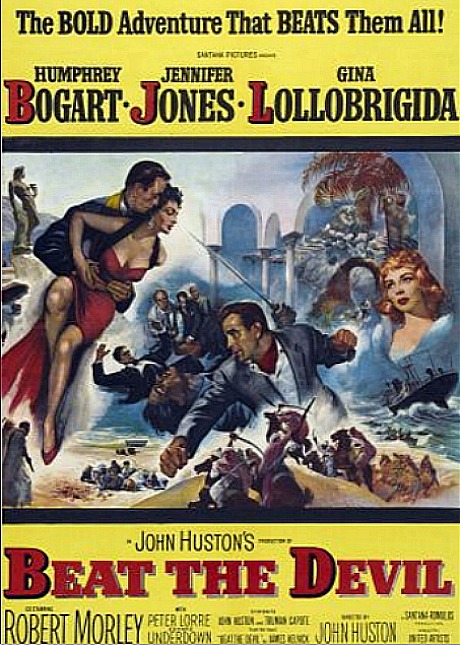
The restored version played at Manhattan’s Film Forum last February.
Crisp said he hasn’t been told when his 94-minute version will be made available via HD streaming or Bluray.
Sony has a history of disregarding Crisp’s classic film restorations. They waited until October 2013 to release HD streaming and Bluray versions of Crisp’s restored From Here To Eternity, even though the first screening of Crisp’s version happened at the Academy in the fall of ’09.