

I’m talking about a remake of The King and I, costarring a bald Cynthia Erivo in the Yul Brynner role (King Mongkut of Siam) and Ariana Grande in the Deborah Kerr role (Anna Leonowens). I’m not suggesting that Erivo’s king should be transformed into a bald lesbian, mind — she could portray the actual Mongkut but in the same way that Cate Blanchett played Bob Dylan in I’m Not There. And they (Erivo + Grande) could fall in love in a straight hetero sense, except the audience would process their affair as a whole ‘nother thing.
Finally Diving into “Juror No. 2,” “Blitz”
The first 12 hours of Tuesday, 11.5, will be such a nail-biter, I won’t know what to think or do. No encouraging or discouraging numbers will appear until 8 pm eastern, right? To alleviate my anxiety I might burrow into all kinds of non-political topics…I’ll be going quietly nuts.
But I’ll definitely be tapping out an HE live blog starting sometime in the early evening.
Today I’ll be catching a 4 pm screening or Clint Eastwood‘s Juror No. 2, which I’m excited about due to a reportedly unconventional ending, and an early evening showing of Steve McQueen‘s Blitz.
All Quincy Jones Wrote
We all have to go sometime, and yesterday the bell tolled for the great Quincy Jones.
I don’t know how awake or aware he was at the end or how politically minded he may have been, but I feel a little bit sad that he didn’t get to witness the election of Kamala Harris as the nation’s 47th president.
Posted on 9.23.18: “I admire and respect Quincy Jones as much as the next guy. He hasn’t done much since the ’80s, but he’ll always be cool.
“Jones’ musical score for Richard Brooks‘ In Cold Blood (’67) is a standout…in my mind, at least.
“I was intrigued when I read that Jones’ ancestors include Betty Washington Lewis, a sister of president George Washington, Edward I of England, and Jane Fonda even. And I loved that Vulture interview he gave earlier this year, and particularly an implication that Jones had enjoyed some kind of intimate contact with Ivanka Trump.
“But I had no interest in seeing Alan Hicks and Rashida Jones‘ Quincy, as I don’t enjoy kiss-ass portraiture as a rule. The first 44 seconds of the trailer are suffocating in this regard.
“I would love to sit down with the 85-year-old Jones for hours and hours and listen to his stories, but his friends need to give that ‘oh my God, what an awesome, genius-level talent!’ shit a rest…no offense.”
Beware of Pennsylvania Bumblefucks
I’m feeling fairly confident about Harris’s chances tomorrow, especially after that shocking Selzer poll out of Iowa, but I’m also continuing to feel quite antsy about Pennsylvania, where, outside of Philly, Scranton and Pittsburgh, the breathtaking, mule-stubborn, Alabama-mindset legions reside…truly dumber than a box of rocks.



Son of Opposite Peas in Polish Travel Pod

With Jesse Eisenberg‘s A Real Pain finally playing commercially or at least about to open in suburban locations, here’s a refresher of my 9.25.24 Telluride review:
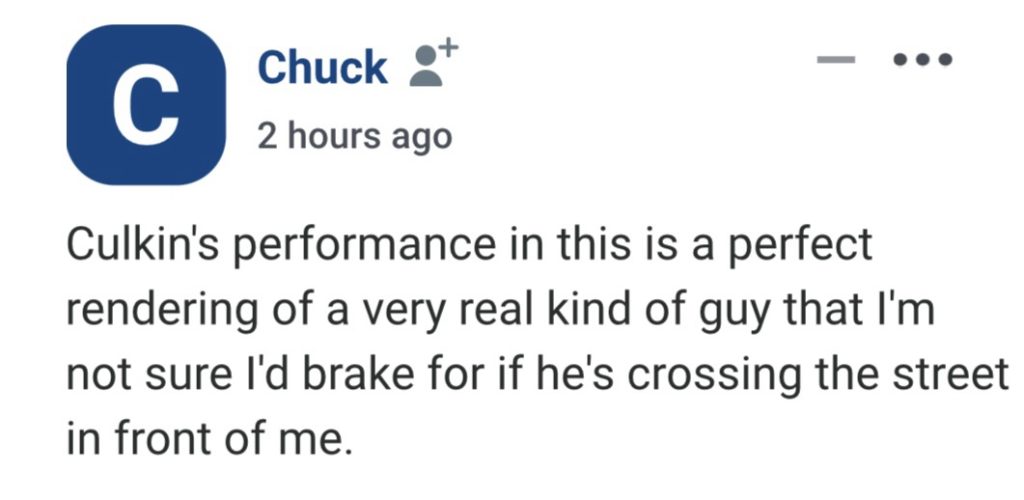
Jesse Eisenberg‘s A Real Pain (Searchlight, 11.1), a quirky, shifty dudes-travelling-through-Poland thing, is going to connect because of Kieran Culkin‘s richly eccentric and occasionally unhinged character, Benji Kaplan…one of those hyper, live-wire guys whose irreverent, unfiltered energy most of us can’t help but enjoy or even get off on in short bursts.
But Culkin’s stoned-jumping-bean manner is also a bit much after repeated exposures. And knowing that Benji is doomed to some kind of arduous instability later in life…a poet who’s fated to “die in the gutter,” as Bob Dylan might put it…Benji is, of course, quite sad.
Everyone has encountered a Benji or two in their life, and this is the film’s big irresistable draw. A Real Pain has to be seen for the Culkin effect. I had heard quite a lot about his firecracker turn, and yet Culkin didn’t disappoint in the least. God, what an amazing, infectious asshole…love his shpiel! And I adore the fact that he loves to sit in airline terminals and study the travellers.
Pic is basically about a pair of tristate-area Jewish cousins, crazy Benji and anxious, straightlaced, somewhat dull David (Eisenberg, who is strangely being campaigned for Best Actor with Culkin going for a Best Supporting nom) embarked on a group holocaust tour in Poland. The usual intrigues and complications ensue.
On top of which Dirty Dancing‘s Jennifer Grey, 63 years young when the film was shot in mid ’23, is also a participant. (The others are like lumps of mashed potatoes.)
This, trust me, is an excellent trailer:
Costas Knows All, Sees All
Bob Costas on LeBatardShow three days ago: “Kamala Harris is not an ideal [presidential] candidate, and [she] may have to grow into the job if she wins it. But this is not a political question — it’a a moral question, and it would be [this] no matter who opposes Donald Trump.
“There is nothing wrong with being a Republican or a conservative. Nothing wrong with that. I read George Will on a regular basis, and Peggy Noonan in The Wall Street Journal. I’m like Bill Maher. I’m a center-left guy, a classic liberal, who is troubled by the distortions of [woke] leftism, which is different than liberalism, and some of that is an anchor around Kamala Harris’s neck now. Because she can’t distance herself from the worst of it, even if she doesn’t fully embrace it. Over the years excessive [voices] on the left have handed Fox News their talking points on a silver platter. Or, in this case, the Trump candidacy points.
“So I can understand people having serious misgivings about Biden’s record, and about how the Dems kinda gaslit the public about Biden’s fitness, both as a candidate and [his ability to handle] a second term as president. There are some policies that can’t be defended. You cannot defend what has gone on for a long time at the [Mexican] border. You can certainly defend attempts to reform the police and the justice system, which has historically been tilted against African Americans and other people of color.
“[But] the Trump candidacy is about a man who is a liar, a lunatic and an ignoramus. So it’s a moral question such as we have never seen, not in my lifetime and maybe ever…a presidential candidate with so many of those who are rock-solid Republicans and conservatives, and who worked closely with him and whose credibilty and credentials cannot be questioned…all of these [veterans of the 2017 to 2021 Trump administration] saying the same word — unfit. He is unfit to hold any position of public trust, let alone the presidency.
“So there are millions of people who may have misgivings about aspects of Kamala Harris’s candidacy, but at the same time cannot stomach the idea that somebody whose entire being is antithetical to actual patriotism, to American principles, to common sense and common decency…that, to me, is the deciding factor.”
Lame Flatliner, Total Bust

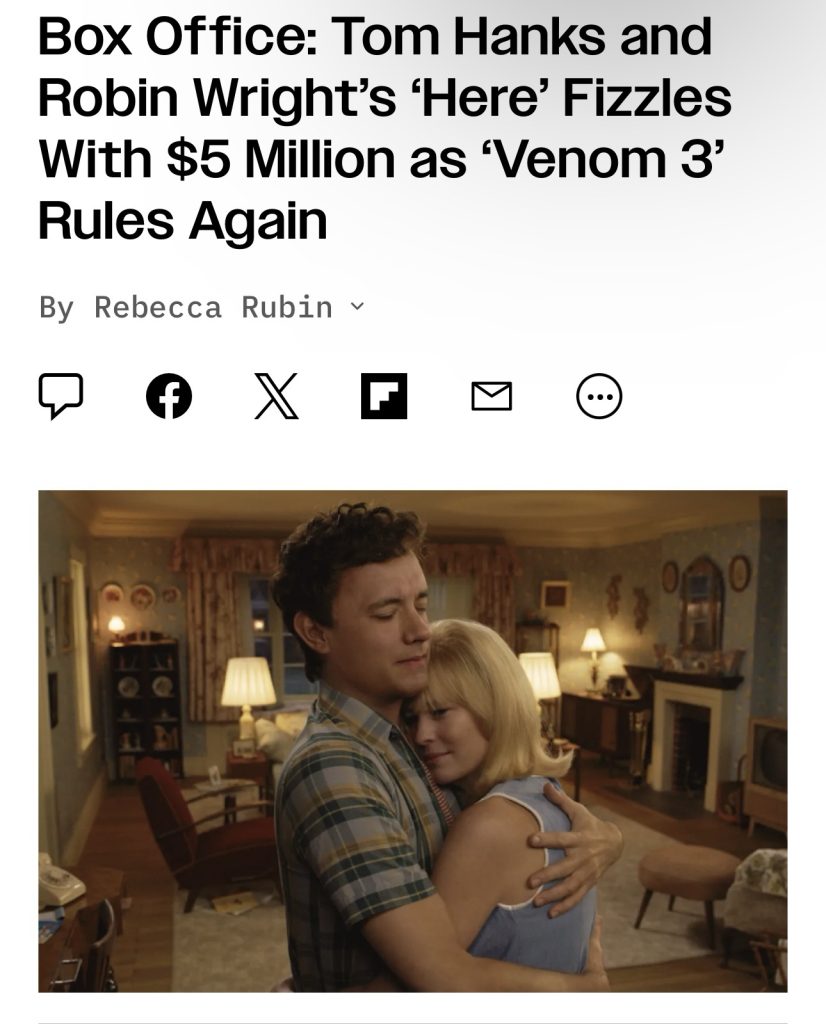
I’d like to say something positive about Robert Zemeckis’ Here (Sony, 11.1), a bizarrely stilted adaptation of Richard McGuire’s 1989 graphic novel, and it’s this: the de-aging of Tom Hanks and Robin Wright, accomplished through Metaphysic Live, is much, much better than the de-aging of Robert DeNiro and Joe Pesci in The Irishman. Serious points for this.
But if you’re going to focus primarily on a location — a living room in a suburban New Jersey home — and secondarily its various residents over the span of roughly 100 years (early 1900s to early 21st Century), which is basically an Our Town-ish concept (people come and go but the relentless, ever-expanding scheme of life pushes on), I think it’s a really, really bad idea to lock your camera into a single, static unmovable shot. I know…that’s the bravery aspect but it’s tedious all the same.
The nicest thing you can say about Here is that it’s an ambitious concept, although it would’ve worked better on-stage.
Who cares about dinosaurs stomping around millions of years earlier? Nobody. And William Franklin, the illegitimate son of Benjamin Franklin, radiates the same indifference.
Zemeckis shows a young, attractive Native American couple making out in the 1700s and a black family moving into the home in the 1980s or ‘90s because woke Hollywood rules demand diversity.
Would a typical American family on February 9th 1964…would they have had their black-and-white TV tuned to The Ed Sullivan Show and the debut performance of The Beatles in particular but ignore this because of some domestic issue they happened to be focusing on?
The Dean Martin Show (‘65 to ‘74) was broadcast in color so you can’t show it playing in the same family’s living room in black-and-white. It just wasn’t a black-and-white show…c’mon.
Due respect to the Forrest Gump gang (Zemeckis, Hanks, Wright, screenwriter Eric Roth, dp Don Burgess) for having given Here the old college try, but it’s one of the most shoulder-shrugging, close-to- embarrassing “who cares?” flicks I’ve ever seen.
It should’ve been a play.

Special, Only-in-Wilton Fall Leaves
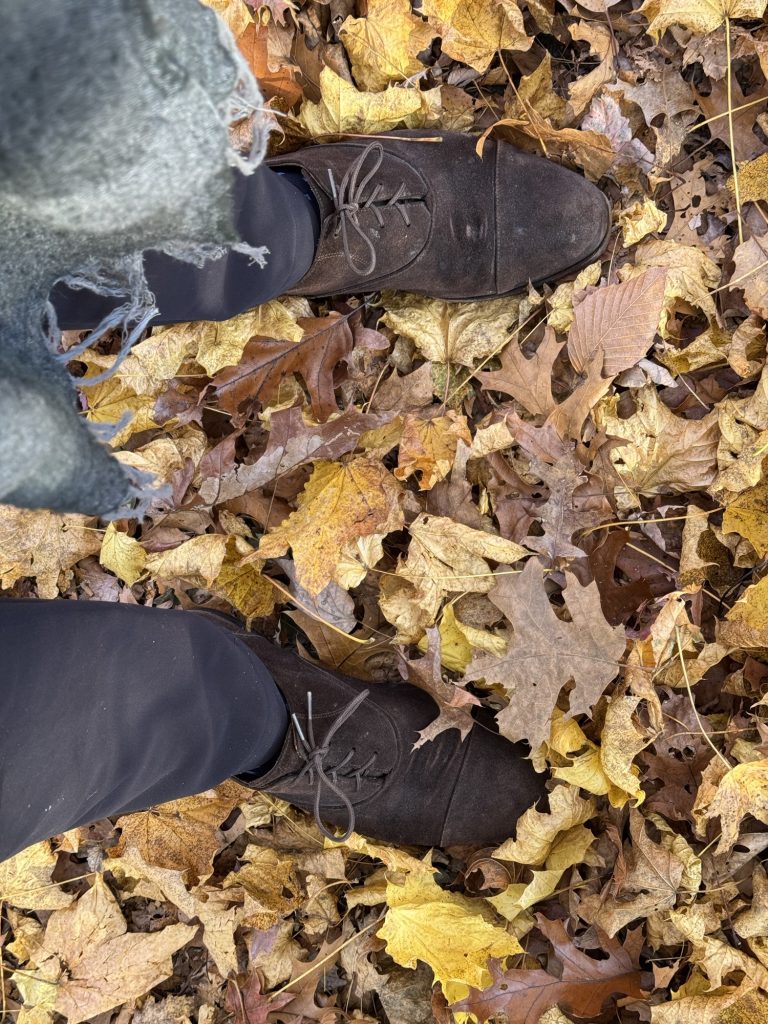
Snapped at 8:16 am, 11.3.24.


Last Significant Boomer Nostalgia Flick?
In a fair and just world James Mangold’s A Complete Unknown (Searchlight, 12.25) would just be a film and that’s all…an experience to be judged and savored and possibly enjoyed according to how good it is, period..,how straight and true and honest it feels on a no-bullshit, deep-down, character-driven basis.
But of course it won’t be processed that way.
For Mangold and Jay Cocks’ Bob Dylan biopic is arriving at the tail end of the boomer nostalgia era, which arguably began 41 years ago with Lawrence Kasdan’s The Big Chill (‘83) and peaked with Robert Zemeckis ‘ Forrest Gump (‘94).
HE commenter Eddie Ginley posted this yesterday:
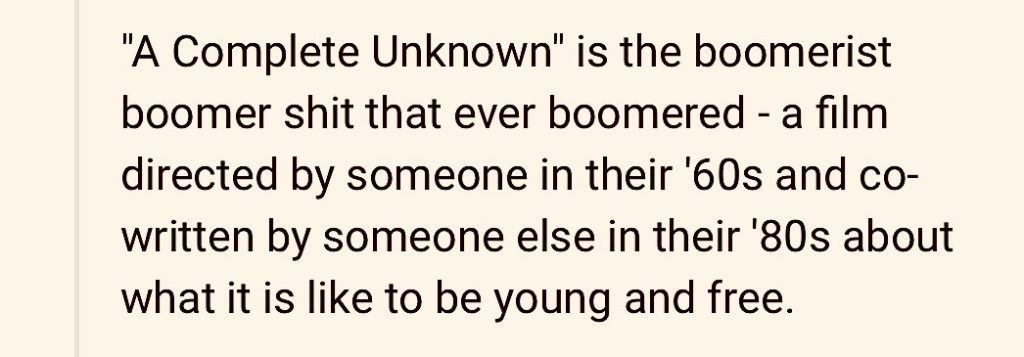
Throw in Zemeckis’ Here (Sony, 11.1) and the forthcoming Jeremy Allen White-Bruce Springsteen biopic and you have to admit that the hour has probably come for boomer sagas and sentimentalists to give it a rest and sorta kinda go away…to hand the mythological movie torch to GenXers and even, God forbid, Millennials, some of whom who are now in their early 40s and are probably nurturing sentimental looking-back notions of their own (i.e., Eminem, Korn, Limp Bizkit).
A friend insisted this morning that no matter how crafty or admirably well-written or emotionally affecting or compellingly performed A Complete Unknown turns out to be, the younger Academy members and particularly the mutants who adored Parasite and Everything Everywhere All At Once are too dug into their boomer hatred, which is why Steven Spielberg’s The Post was blown off.
If a generational yardstick has to be used, a fair way to frame A Complete Unknown would be as the last noteworthy boomer flick…the last ambitious ‘60s atmosphere film….an auld lang syne to the pot and protest and sexual revolution generation (nookie from the late ‘60s to early ‘80s was really and truly astounding) in the same way that Saving Private Ryan, Flags of Our Fathers and The Fog of War were seen as farewell-to-the-greatest-generation movies.