Cronenberg’s Map To The Stars Is Daring, Highly Acidic, Major-League

David Cronenberg‘s Map To The Stars (Weinstein Co., 9.26) is not just a brilliant, black-as-night satire of soul-less, impossibly fucked-up Hollywood players, although it’s certainly that in part. And it’s not just a film that will send Justin Beiber and his representatives into saliva-sputtering fits due to the fact that Beiber is clearly the model for a 13 year-old TV superstar named Benjie Weiss (Evan Bird) — an ice-cold, soul-dead monster who has the makings of a junior-league Hannibal Lecter. What Map to The Stars does altogether — and this is what makes it an historic film within the Cronenberg canon, and which may result in winning the Palme d’Or or some special distinction prize of some kind — is jump off a kind of grand guignol cliff. I went in expecting a stiff swig of vinegar and a smart-ass spoof, but Map, which was written by Bruce Wagner (Force Majeure), is much darker and more visionary and at the same time much more sincere in an unforced, even-handed way.
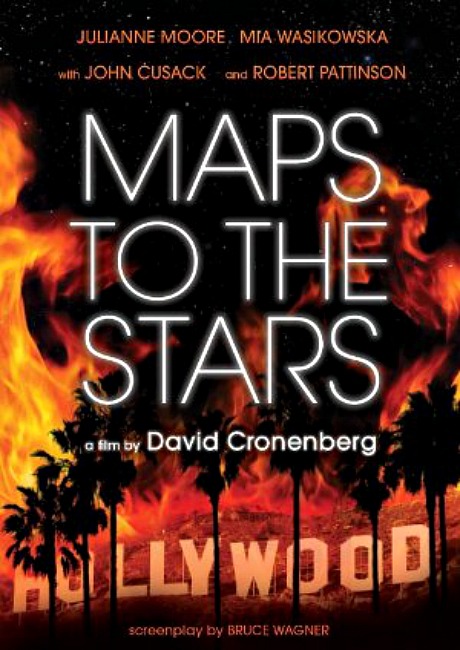
This is how you do a lethal comic satire, by having the cast perform and behave like they’re not kidding or winking in the slightest, like they really mean it…seriously. Map really cuts to the rancid bone of Hollywood fuckwad culture in a mad-brushstroke way. I think…no, I know it’s Cronenberg’s best since A History of Violence or Spider, and before that Crash, Dead Ringers and The Dead Zone. Julianne Moore owns it pretty much as a nearly over-the-hill actress who’s desperate to stay in the game, but everyone else is on the same page here — John Cusack, Mia Wasikowska, Olivia Williams, Robert Pattinson (yes, he’s on the stick), Sarah Gadon and the afore-mentioned Bird. They all get what’s going on, and it’s all quite perfect and complete.


What’s In A Legendary, Beatles-Created Name?

There are two…well, technically three versions of The Disappearance of Eleanor Rigby (Weinstein Co., 9.26) — a Him/Her version (which constitutes two films) and a Them/mashup version. I didn’t see The Disappearance of Eleanor Rigby: Him and Her at last September’s Toronto Film Festival, but it took 191 minutes to tell the same breakup story from the differing perspectives of James McAvoy and Jessica Chastain‘s characters. Word around the campfire is that Him/Her is a more interesting film than the 123-minute Them, which tells the same tale but in a neutral-ish way. In any event I saw Them yesterday in Cannes, and I can tell you three…no, four things:

(1) Them is an intimately rendered, believably performed adult relationship piece that “does it right,” for the most part. It’s about character and trust and need and longing and trauma, and it deserves all the nice things that have been said about it. As such it casts…how to say it?…a certain favor upon director-writer Ned Benson, at least in terms of how it feels as it moves along during the first hour;

(2) I lost patience at the one-hour mark because I suddenly realized nothing was really happening — the story is about a breakup (due to an initially unexplained tragedy) and a possible rapproachment, but it boils down to being about a series of sometimes intriguing, sometimes meandering conversations between family members and friends with little hints of character thrown in from time to time…but nothing really happens in a semi-decisive, plot-propelling sense…nothing that makes you say “oh, that was interesting, what just occured”;

(3) The conversations between Chastain and Viola Davis‘s sardonic, world-weary NYU professor character started to bother me after a while. I started to ask myself, “Why am I supposed to give a shit about what Davis thinks about anything? What is she, Moses down from the mountain? Why doesn’t she just zip it?”;

(4) In the middle of an intimate moment that may signal a new beginning for their relationship, McAvoy tells Chastain that he had it off with another woman (a restaurant co-worker played by Nina Arianda) but not in a way that meant anything. Good God, man…never tell someone you love about any intimate contact (recent or otherwise) with another woman EVER. Respond to questions but never, ever offer that. Any guy who’s dumb enough to do what McAvoy does in this scene doesn’t have my allegiance or rooting interest. When this happened I said to myself, “All right, that’s it…this guy is an emotional idiot…he doesn’t deserve to get back together with Jessica Chastain.”

Homesman Whatta-Whatta

Tommy Lee JonesThe Homesman screened early Sunday morning at the Cannes Film Festival, and it deserves no more than a modest salute. Just because it’s a feminist western with an oddly unusual story that regards the plight of Old West women in a compassionate light…that doesn’t mean it gets a pass. It basically says that life on the prairie could be so brutal and unforgiving that some women went plumb out of their heads; it also says some were so gripped with despair that they offed themselves. That’s a new kind of sadness to bring into a western, and that’s what The Homesman is selling. But that doesn’t mean I have to jump up and click my politically-correct heels and go “whoo-hoo, a great western because it looks at the female side of things!”

Based on a 1988 novel by Glendon Swarthout (The Shootist, Where The Boys Are), it’s a well-made, handsomely-shot drama (set in Nebraska territory) with a few plot turns that are just too what-the-fucky to add up or calculate in a way that feels right. It’s an odd, minor-key effort at best.

Read more

Les Expendables Trois

During this afternoon’s Expendables 3 press conference at the Carlton, which I was totally down with not attending, Sylvester Stallone was asked “how do know when you are too old to be an action star?” His response: “You wake up in the morning and your ass falls off. Then you know.” He added, “Let me tell you — we are children with arthritis.” Does that mean they have arthritis but are buoyed by the spirit of children? Or that they have super-early-stage arthritis, or the kind that children might have? Harrison “Paycheck” Ford was there — he’s in this video briefly.

Day of the Locust

Cannes Film Festival tourists always congregate around the entrances to the big hotels on the Croisette on weekends, obviously hoping to catch sight of a celebrity. The Martinez and the J.W. Marriott allow closest access to the unwashed masses. (The Carlton and the Majestic have security guys keeping onlookers from getting any closer than the street.) Is there any activity on the planet that more loudly screams “we have no shame, we are the world champions of lame”? Three or four giggly girls were squealing with delight over something (i.e., probably nothing) just before I took this in front of the Marriott. Regular guests had to be escorted inside by security.


Totally taken by Indiewire‘s Anne Thompson — a more beautiful Cannes snap than any I’ve ever taken here.

Regrets, Respect

Longtime Boston Globe and New England Cable News cricket Jay Carr has left the earth. He was chief Globe critic from ’83 to ’02, and hosted NACN’s “Jay Carr’s Screening Room” from ’98 to ’10. Carr won the George Jean Nathan Award for Dramatic Criticism, and in ’89 was named “Chevalier, Ordre des Arts et Lettres” for his writings on French film.

Engulfed By CG Vistas, Subtlety By Wayside

“Peter was always a geek in terms of technology but, once he had the means to do it, and the evolution of the technology really took off, he never looked back. In the first [Lord of the Rings] movie, yes, there’s Rivendell and Mordor, but there’s sort of an organic quality to it, actors acting with each other, and real landscapes — it’s grittier. The second movie already started ballooning, for my taste, and then by the third one, there were a lot of special effects. It was grandiose and all that, but whatever was subtle, in the first movie, gradually got lost in the second and third. Now with The Hobbit, one and two, it’s like [all] that to the power of 10.” — Viggo Mortensen on Rings/Hobbit maestro Peter Jackson in recently-published Telegraph interview.

“Do You Know Who I Am?”

I was too freaked about my destroyed iPhone to concentrate on Abel Ferrara‘s Welcome to New York, which screened last night at 9 pm, but Variety‘s Scott Foundas had this reaction: “The career-imploding misadventures of former IMF chief (and presumptive French presidential candidate) Dominique Strauss-Kahn get filtered through the uniquely lurid prism of director Abel Ferrara in Welcome to New York, a bluntly powerful provocation that begins as a kind of tabloid melodrama and gradually evolves into a fraught study of addiction, narcissism and the lava flow of capitalist privilege.

Gerard Depardieu‘s audacious performance is undeniably the pic’s chief selling point….he seems more present, more committed to the role than any of the several dozen he has played since Claude Chabrol’s Bellamy in 2009, and he charges brazenly into whatever breach Ferrara demands of him — especially in several scenes that require the once-strapping, feral actor to expose his now-bloated, porcine body for the camera’s unforgiving scrutiny. When Devereaux is forced to strip nude by prison officers and must agonizingly contort his body to complete the task, it’s the actor and not the character who conjures our sympathies. Elsewhere, though, it is Depardieu the canny, empathic performer who finds a tragic dimension in the heretofore monstrous Devereaux — a man of large, insatiable appetites he is at a loss to control.”

Unanimous

Every critic I’ve read so far loves Damian Szifron‘s Wild Tales — easily the biggest breakout hit thus far of the 2014 Cannes Film Festival. I knew it was a home run less than five minutes after it began. It’s safe to say that if you don’t love this film there’s almost certainly something wrong with you. Raves have been posted by Indiewire‘s Eric Kohn, Hitfix.com‘s Drew McWeeny, The Hollywood Reporter‘s David Rooney, Variety‘s Jay Weissberg, etc.

Cracked, Crushed To Death

I was waiting in my Salle Debussy seat for the 7 pm screening of Alice Rohrbacker‘s Le Meravaglie when my iPhone slipped off my lap and through the crack at the the rear of the seat. I realized it was missing a minute or two later and started searching around. I got down and reached around on the floor…nothing. Then I sat down again. I noticed my seat wasn’t collapsing all the way to a sitting position, and — genius engineer that I am — it didn’t occur to me that the missing phone, which was lying inside the seat-hinge mechanism, might be the cause. So like an idiot I flopped down on the seat and in so doing crushed my iPhone to death. I reached into the seat crack and pulled out the damaged remains. Lights off, inoperable, glass cracked, ruined Mophie charger — totally destroyed.

Now the same process that I went through in Germany last year begins again — buy a new iPhone for the maximum price in New York, have my son send it over via Fed Ex for God knows how much money…an instant death-hit of $1200 or more.

Until the new phone arrives I’ll just have to make calls on Skype. A pain but not that much of a problem — just expensive. It would be a howling nightmare if all this had happened, say, five or ten years ago. Synching issues are not the problem they used to be. It’s not that bad. Tonight so far this problem has eaten Le Meravaglie and the 9 pm screening of Abel Ferrara‘s Welcome to New York.

Love Is Not Enough

As I hear it, Hilla Medalia’s The Go-Go Boys — a largely sympathetic, warm-hearted documentary about former Cannon honchos Menahem Golan and Yoram Globus — was made to counterbalance the impact of a forthcoming, less-compassionate doc about the Israeli-born moguls from Mark Hartley called Electric Boogaloo: The Wild, Untold Story of Cannon Films. I was therefore expecting an overly fawning portrait from Medalia’s doc, which I saw last night, and it does constitute a charitable view. It looks the other way at loads of lively material that could have been used. (Having worked for Cannon as a press kit writer during ’86 and ’87, I know whereof I speak.) But as obliging portrayals go, The Go-Go Boys is a reasonably accurate and fair-minded one. It feels as if it was made by an intelligent member of Golan or Globus’s inner family — intimate, admiring and even faintly critical from time to time.

The problem is that The Go-Go Boys won’t acknowledge the elephant in the Cannon room. The reason Menahem and Yoram made almost nothing but crap is that they loved the action and the chutzpah in their veins (winning awards, making money, signing big names, the crackling excitement of “being there”), but they never really got it. Their affection for movies was enthusiastic but primitive. An under-educated rug-merchant mentality could never really fit into a business that is also, at heart, a kind of religion. The best filmmakers have always operated on a devotional Catholic principle. I believe that Menahem and Yoram were never devoted enough to the faith and traditions of great, soul-stirring cinema. They never really respected the idea of wearing cinematic monk robes.

Read more